Zechariah 3:5
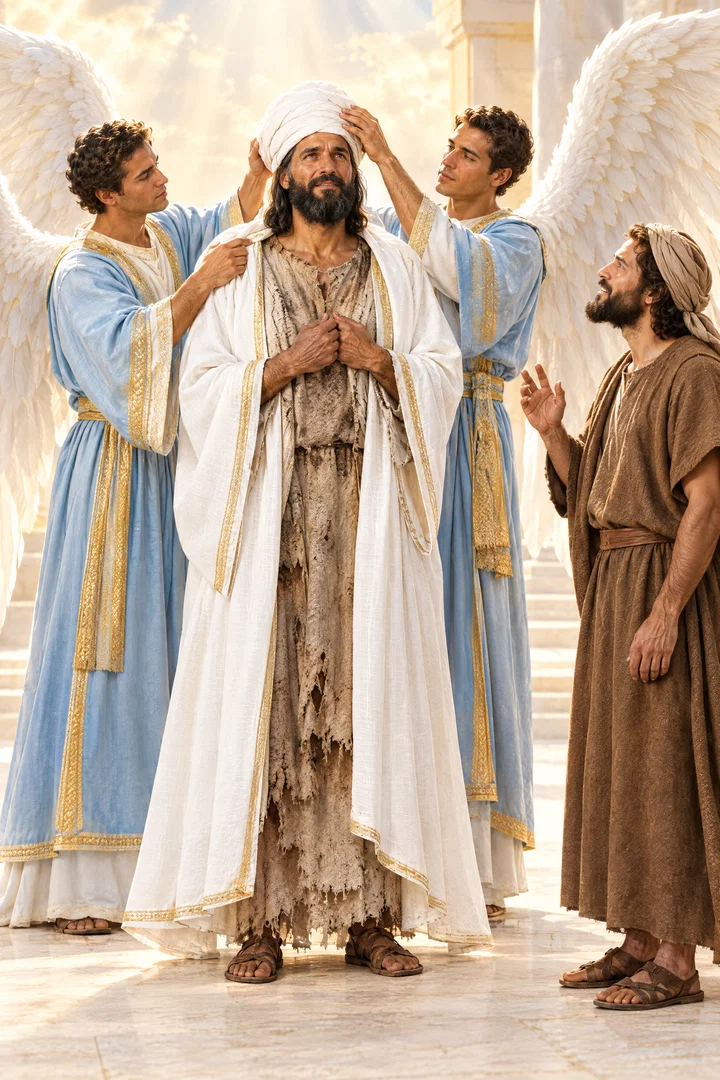
And I said, Let them set a fair mitre upon his head. So they set a fair mitre upon his head, and clothed him with garments. And the angel of the LORD stood by.
Translations
And I said, Let them set a fair turban on his head. So they set a fair turban on his head, and clothed him with garments. And the angel of the LORD stood by.
And I said, Let them set a fair mitre upon his head. So they set a fair mitre upon his head, and clothed him with garments. And the angel of the LORD stood by.
And I said, Let them set a fair mitre upon his head. So they set a fair mitre upon his head, and clothed him with garments. And the angel of the Lord stood by.
And I said, Let them set a fair miter upon his head. So they set a fair miter upon his head, and clothed him with garments. And the angel of the LORD stood by.
And I said, Let them set a fair mitre upon his head. So they set a fair mitre upon his head, and clothed him with garments; and the angel of the LORD stood by.
And I said, Let them set a clean mitre upon his head. So they set a clean mitre upon his head, and clothed him with garments; and the angel of Jehovah was standing by.
He also said, 'Let them set a pure diadem on his head. And they set the pure diadem on his head, and clothe him with garments. And the messenger of Jehovah is standing,
And I said, Let them set a pure turban upon his head. And they set the pure turban upon his head, and clothed him with garments; and the Angel of Jehovah stood by.
Then said I, Let them put a clean turban upon his head,—So they put the clean turban upon his head, and clothed him with garments, and, the messenger of Yahweh, was standing up.
Berean Standard Bible, Majority Standard Bible
Then I said, “ Let them put a clean turban on his head.” So a clean turban was placed on his head, and they clothed him, as the angel of the LORD stood by.
I said, “ Let them set a clean turban on his head.”So they set a clean turban on his head, and clothed him; and the LORD’s angel was standing by.
And let them put a clean head-dress on his head. So they put a clean head-dress on his head, clothing him with clean robes: and to him he said, See, I have taken your sin away from you.
And I saide, Let them set a faire diademe vpon his head. So they set a faire diademe vpon his head, and clothed him with garments, and the Angel of the Lord stoode by.
Douay-Rheims (Challoner revision)
And he said: Put a clean mitre upon his head: and they put a clean mitre upon his head, and clothed him with garments, and the angel of the Lord stood.
Pictures

Cross-references 20 of 26
- Isaiah 61:10
I will greatly rejoice in the LORD, my soul shall be joyful in my God; for he hath clothed me with the garments of salvation, he hath covered me with the robe of righteousness, as a bridegroom decketh himself with ornaments, and as a bride adorneth herself with her jewels.
Both depict God clothing his people with salvation and righteousness.
- Exodus 28:36-38
And thou shalt make a plate of pure gold, and grave upon it, like the engravings of a signet, HOLINESS TO THE LORD.
Both texts describe a priestly mitre bearing the inscription “Holiness to the Lord.”
- Revelation 3:4-5
Thou hast a few names even in Sardis which have not defiled their garments; and they shall walk with me in white: for they are worthy.
Clean garments signify acceptance and honor before God.
- Exodus 29:6
And thou shalt put the mitre upon his head, and put the holy crown upon the mitre.
The mitre marks Joshua as God’s anointed high priest.
- Zechariah 3:1
And he shewed me Joshua the high priest standing before the angel of the LORD, and Satan standing at his right hand to resist him.
Satan resists Joshua in the restoration scene, where Joshua represents the people.
- Hebrews 4:15
For we have not an high priest which can not be touched with the feeling of our infirmities; but was in all points tempted like as we are, yet without sin.
Joshua points to Jesus, the High Priest who understands human weakness and temptation.
- Revelation 7:14
And I said unto him, Sir, thou knowest. And he said to me, These are they which came out of great tribulation, and have washed their robes, and made them white in the blood of the Lamb.
Both describe God’s people in robes made white through cleansing.
- Matthew 22:11-12
And when the king came in to see the guests, he saw there a man which had not on a wedding garment:
Both require wearing the provided garment to be fit for the feast.
- Hebrews 4:14
Seeing then that we have a great high priest, that is passed into the heavens, Jesus the Son of God, let us hold fast our profession.
Joshua’s priesthood points to Jesus, the great High Priest.
- Zechariah 6:11-12
Then take silver and gold, and make crowns, and set them upon the head of Joshua the son of Josedech, the high priest;
Joshua’s priestly clothing anticipates the Branch, who unites priestly and kingly offices.
- Revelation 1:6
And hath made us kings and priests unto God and his Father; to him be glory and dominion for ever and ever. Amen.
The redeemed are honored as priests to God.
- Hebrews 7:1-2
For this Melchisedec, king of Salem, priest of the most high God, who met Abraham returning from the slaughter of the kings, and blessed him;
Christ is described as king and priest after the order of Melchizedek.
- Revelation 19:8
And to her was granted that she should be arrayed in fine linen, clean and white: for the fine linen is the righteousness of saints.
same white robes as righteousness
- Leviticus 16:23-24
And Aaron shall come into the tabernacle of the congregation, and shall put off the linen garments, which he put on when he went into the holy place, and shall leave them there:
The high priest changes garments after interceding for Israel.
- Exodus 29:29
And the holy garments of Aaron shall be his sons’ after him, to be anointed therein, and to be consecrated in them.
Both texts describe priestly garments used in preparing priests.
- Philippians 3:9
And be found in him, not having mine own righteousness, which is of the law, but that which is through the faith of Christ, the righteousness which is of God by faith:
Both describe restored standing before God through righteousness received by faith.
- Hebrews 9:7
But into the second went the high priest alone once every year, not without blood, which he offered for himself, and for the errors of the people:
The high priest enters the most holy place alone for the people’s sins.
- Jeremiah 33:15-16
In those days, and at that time, will I cause the Branch of righteousness to grow up unto David; and he shall execute judgment and righteousness in the land.
Also promises the Branch whom Joshua represents.
- Galatians 3:27
For as many of you as have been baptized into Christ have put on Christ.
Believers are described as putting on Christ.
- Hebrews 2:17-18
Wherefore in all things it behoved him to be made like unto his brethren, that he might be a merciful and faithful high priest in things pertaining to God, to make reconciliation for the sins of the people.
Christ is the merciful High Priest who helps those being tempted.
Commentary
Each commentary is drawn from primary sources: the writings of Ellen G. White and Adventist pioneers and periodicals. Each commentary is separate. Its own words are not a quotation; follow the references to read the source passages.
Ellen G. White
87 sources
Zechariah sees Joshua the high priest standing in a heavenly court with Satan resisting him, and after his filthy garments are taken away and his iniquity is caused to pass, the fair mitre is set on his head and he is clothed with garments while the Angel of the Lord stands by.Ms 29, 1900, par. 21–23Ms 95, 1903, par. 6–717MR 240.2–241.1Lt 136, 1910, par. 5–8Lt 138, 1897, par. 20–23 The mitre is the clean priestly headdress of consecration to the Lord, showing the cleansed one accepted and fitted to minister despite former transgression.PK 584.2Ms 70, 1902, par. 19–22Lt 68, 1900, par. 14–16 The taking away of filthy garments and giving of clean garments and mitre means full pardon of sin and the imputing of Christ's righteousness to the repentant sinner, to Israel and to the church.ST Sep 16, 1889STMW6 13.2Ms 96, 1902, par. 38–41Ms 24, 1891, par. 33–3619MR 244.4–245.2 Christ as compassionate High Priest rebukes the accuser who points to past sins and claims God's people as his prey, delivers Joshua as a brand plucked from the fire, and clothes him in change of raiment.Ms 65, 1909, par. 2–617MR 240.2–241.1Lt 136, 1910, par. 5–8Ms 34, 1893, par. 58–60CE 160.3–161.1 That clothing is God's gift received by coming as one is and trusting Christ alone, not a robe prepared by striving to cover deformity, and it requires sincere repentance, confession and forsaking of sin and leads to a pure holy life and appointment to sacred service as kings and priests.7MR 202.2–203.3Lt 65, 1894, par. 14–15Lt 34, 1899, par. 275T 471.1–472.1Ms 33, 1894, par. 17–18 The vision applies with peculiar force to the faithful remnant at the close of probation and in the time of trouble, when conscious of unworthiness they plead through Jesus as Advocate, are pardoned, clothed nevermore to be defiled, and secured from the tempter.RH Nov 19, 1908RH Jan 9, 1908RH Nov 19, 19085T 472.2–473.1PK 591.1
Vision Setting and Symbols
The verse belongs to a heavenly-court controversy over Joshua the high priest standing before the Angel of the Lord with Satan standing at his right hand to resist him.Ms 95, 1903, par. 6–717MR 240.2–241.1Lt 68, 1900, par. 4–7Ms 74, 1903, par. 1620MR 188.5–189.1 In that standing Satan accuses backsliding Israel and opposes God's work through the church and its ministers, resisting every effort to save those bought with blood, persecuting those he caused to sin and accusing them day and night.17MR 240.2–241.1Lt 68, 1900, par. 4–720MR 188.5–189.1 After the Lord rebukes Satan and claims Joshua as a brand plucked from the fire, the filthy garments and iniquity are taken away and clean raiment is given, marking cleansing and restoration before the conditional promise of judging God's house and walking among the heavenly attendants.Ms 95, 1903, par. 6–717MR 240.2–241.1Ms 74, 1903, par. 16
The vision was given when the Jews feared that permission to rebuild Jerusalem and the temple might be withdrawn, to assure them of compassion and love and to sustain those advancing the work.RH Dec 26, 1907 It was personal encouragement to Joshua and to God's people.RH Jan 16, 1908 It comes immediately before the message regarding the work of Zerubbabel about the golden candlestick and the two olive trees.PK 593.1–594.1
The scene pictures heavenly realities and glory beyond the darkness that clouds spiritual sight.Lt 138, 1897, par. 20–23 Joshua stood clothed with filthy garments, and they were taken away with the word that his iniquity was caused to pass from him and he would be clothed with a change of raiment.Ms 29, 1900, par. 21–23Lt 136, 1910, par. 5–84MR 249.3–250.1 Then at the prophet's word a fair mitre was set upon his head and he was clothed with garments while the Angel of the Lord stood by.Ms 29, 1900, par. 21–23Lt 136, 1910, par. 5–8Ms 95, 1906, par. 65–77 The restored clothing marks cleansing and renewed standing, presenting the forgiven sinner as clothed and prepared with the Lord's angelic presence beside him, after which Joshua is charged to walk in God's ways and keep His charge.Ms 29, 1900, par. 21–23Ms 95, 1906, par. 65–77
The fair mitre is a clean priestly turban or headdress, the priestly mitre inscribed Holiness to the Lord or Holiness unto the Lord.PK 584.2Ms 70, 1902, par. 19–22Lt 68, 1900, par. 14–165T 469.2–4RH Jan 2, 1908 Its placing together with the garments solemnly invests the cleansed person with the dignity of the priesthood and marks consecration and restored standing before God.Ms 70, 1902, par. 19–22Lt 68, 1900, par. 14–165T 469.2–4 It signifies that, despite former transgressions, he is now accepted and qualified to minister before God in His sanctuary.PK 584.2Ms 70, 1902, par. 19–225T 469.2–4RH Jan 2, 190820MR 190.3–191.1 His unworthiness is not denied; he is restored because God has bought him with a price.20MR 190.3–191.1
The Angel standing by is the heavenly presence that watches over and strengthens tempted people.ST Aug 28, 1901 He stands by to witness their justification and their victory over Satan and sin.Ms 98, 1893, par. 3–6 Under that presence the forgiven person, after guilt is removed and clean garments are given, is clothed with honor and appointed to sacred service, with restored standing connected to walking in God's ways and keeping His charge.FE 274.2–275.1Ms 125, 1901, par. 37–43
Cleansing Clothed in Righteousness
The taking away of soiled clothing and the putting on of clean clothing with a fair head covering means the passing away of iniquity and the pardoning of guilt with the imputing of Christ's righteousness to the repentant sinner, to Israel, and to the church.ST Sep 16, 1889STMW6 13.2Ms 96, 1902, par. 38–41Ms 27, 1894, par. 33–36Ms 39, 1891, par. 24–25 The cleansed one is restored before God while the Angel stands by, and Satan's accusations cannot undo that pardon for those who trust in Jesus' righteousness.STMW6 13.2Lt 17, 1897, par. 10–14 The honor and salvation pictured belong to all who come to God for forgiveness and truly repent and believe.ST Sep 16, 1889Lt 17, 1897, par. 10–14
The clothing is God's gift and not a robe of righteousness that people prepare by striving to cover deformity and sin.7MR 202.2–203.3Lt 65, 1894, par. 14–15 The sinner is to come just as he is and believe in Christ as a personal sin-pardoning Saviour, and the forgiving Father brings forth His best robe to array the returning child.7MR 202.2–203.3Lt 65, 1894, par. 14–15 The taking away of the filthy garments is the destruction of self, for Christ alone can cover human sinfulness and imperfection with His spotless perfection and robe of righteousness.Ms 33, 1894, par. 17–18Ms 18, 1898, par. 8
Christ Himself changes the raiment, writes pardon against the name, records it in heaven, and confesses the person as His before the heavenly universe.COL 169.2–34MR 249.3–250.1 Those thus represented have used the hours of probation to confess sins with contrition of soul and put them away, to vex their souls over abounding corruption and iniquity, to sigh and cry because of abominations without mixing in them or corrupting their ways, and to wash their robes of character white in the blood of the Lamb, so that their appearance is changed from sin-clad to clean.4MR 249.3–250.1 Those who have not ceased to sin and have not repented and sought pardon for transgressions are not in that company.4MR 249.3–250.1
The garments are Christ's garments of righteousness bought with a price, and they are not placed over disobedience and transgression while sin remains unremoved, for the filthy garments are first taken away.RH Aug 20, 190120MR 190.3–191.1 The unworthiness of the one restored is not denied, yet the change is made because God has bought the unworthy person with a price.20MR 190.3–191.1 In holy innocence Christ as substitute bore the curse and condemnation due to humanity though undeserving of punishment, resisted Satan, and lets His light and righteousness shine into the heart against Satan's hellish shadow.7MR 202.2–203.3RH Aug 20, 1901ST Dec 8, 1898
Accepted intercession brings full pardon for Joshua's own sins and those of his people, with Israel clothed in change of raiment which is the righteousness of Christ imputed to them.Ms 24, 1891, par. 33–365T 469.2–4RH Nov 19, 1908 Christ removes the sin-soiled garments of the church and clothes His faithful obedient children in change of raiment and coronation robes.Ms 24, 1891, par. 33–3619MR 244.4–245.2 The fair head covering set upon him is the priestly mitre inscribed Holiness to the Lord, and its placing with the garments solemnly invests him with the dignity of the priesthood, so that notwithstanding former transgressions he is now qualified to minister before God in His sanctuary.5T 469.2–4
The imagery teaches sinners to cast away sin-stained character and put on Christ's righteousness, to trust Christ and receive cleansing from sin, and to be led from pollution into a pure and holy life through faith.SW 24.1Ms 21a, 1895, par. 9–10 The scene shows Christ mediating for the repentant sinner, defending the person against Satan's accusation and restoring them.Ms 34, 1893, par. 58–604MR 302.4–304.1 As compassionate and faithful High Priest He understands human weakness, intercedes according to the will of God, helps those tempted by Satan, and does not permit the destroyer to destroy those He has prevented from destruction, which gives courage and hope and light and increased faith with evidence of acceptance instead of laboring in human strength clothed with the filthy garments of selfishness.Ms 34, 1893, par. 58–60CE 160.3–161.14MR 302.4–304.1
Christ Defeats the Accuser
Satan resists by reviving the past sins of Joshua and of God's people to destroy confidence in God and hold upon heaven and to place them in a false light by apparent defects and failures.Ms 65, 1909, par. 2–6 He points to their filthy garments, which are their defective characters, weakness and folly, sins of ingratitude, and unlikeness to Christ dishonoring their Redeemer.RH Jan 9, 1908 He declares that by those sins they have forfeited divine protection, claims the right to destroy them as transgressors, pronounces them as deserving as himself of exclusion from God's favor, and claims them as his property and prey.RH Jan 9, 1908PK 588.3GC88 618.2–3 He urges whether people who profess to obey the law yet have not kept its precepts, who have been lovers of self more than lovers of God, who have placed their own interests above His service and loved the things of the world, whose lives are marked by selfishness, malice, and hatred of one another, are to take his place in heaven and the place of the angels who united with him, and demands that justice requires sentence to be pronounced against them rather than God banishing him and his angels while rewarding those guilty of the same sins.PK 588.3 He declares the Lord cannot in justice forgive their sins and yet destroy him and his angels, and demands they be given into his hands to destroy.GC88 618.2–3
After Satan leads men into wrong positions he stands as adversary to resist every effort made to save the purchase of the blood of the Lamb, persecutes those he has caused to sin, and accuses them before God day and night.17MR 240.2–241.1 He has accurate knowledge of the sins he tempted them to commit and presents them in exaggerated light, and as he moved Esau to march against Jacob he stirs up the wicked to destroy God's people, numbering the world as his subjects while seeking to blot out the little company who keep the commandments and resist his supremacy.GC88 618.2–3 He seeks to frighten them with hopeless defilement and to terrify them with the thought that their cases are hopeless and the stain will never be washed away, so they will yield to temptation, turn from allegiance to God, and receive the mark of the beast.RH Jan 9, 19084SP 436.1 The Lord permits him to try them to the uttermost, so their confidence in God, faith, and firmness are severely tested, and as they review the past their hopes sink for in their whole lives they can see little good and are fully conscious of weakness and unworthiness.GC88 618.2–34SP 436.1
Christ rebukes Satan as the Lord who has chosen Jerusalem and claims Joshua as a brand plucked out of the fire.17MR 240.2–241.1Lt 136, 1910, par. 5–8 With the voice and attitude of a king He does not permit Satan to destroy them though Satan complains and is determined to do so, but prevents their destruction, commands the filthy garments to be taken away, causes iniquity to pass away, pardons repented sin, and clothes with change of raiment and sets a fair mitre upon the head.Ms 65, 1909, par. 2–6Lt 136, 1910, par. 5–84MR 302.4–304.1 That clothing declares what Christ will do for Joshua and for all who like Joshua seek to stand justified before Him, even the righteousness of Christ, while the time for glorification has not yet come.Ms 65, 1909, par. 2–621MR 449.4–450.3 This gives courage and hope and light and increased faith, brings evidence of acceptance with God, and answers the desire to be clothed with the garments of Christ's righteousness instead of laboring in human strength clothed with the filthy garments of selfishness.4MR 302.4–304.1
The vision illustrates Satan's opposition and Christ's work and the Mediator's power to defeat the accuser of God's people, giving them comfort.RH Jan 2, 1908 It pictures the position Satan now occupies toward every church and toward ministers of the gospel, standing before the angel of God to resist them in their official work of the ministry of the Word and to resist the Lord's working in behalf of His people.20MR 188.5–189.1 It shows that God restrains the powers of darkness and preserves from Satan's destructive power, leaving opportunity for forgiveness and acceptance despite disloyalty, and shows God's love for fallen people and His care against Satan's power to afflict and destroy them.Lt 76, 1898, par. 6–8Ms 23, 1888, par. 10 The Lord comes to the relief of His afflicted people in answer to intercession and in pity toward them, working for them through Messiah, the coming Branch, who when those warned decidedly change wrong principles and make thorough work pardons transgression, causes iniquity to pass away, discerns true repentance, says it is enough, and grants prosperity.Lt 68, 1900, par. 4–720MR 188.5–189.120MR 189.2–3
Nothing in this world is so dear to God as His church, which He guards with jealous care and has not forsaken, and it offends Him for Satan's servants to rob His people of their rights.Lt 136, 1910, par. 5–8Ms 23, 1911, par. 2 Satan points to mistakes and tries to make them believe they have separated themselves from God, and evil angels seek to discourage those striving for victory over sin by holding up past unworthiness and representing the case as hopeless.Lt 136, 1910, par. 5–8 Those who denounce, accuse and condemn the church militant help Satan cast reproach upon Christ's kingdom and clothe His church with filthy garments instead of working as laborers together with God to seek and restore the erring, urging the church into false positions by taking the reproofs and corrections God gave to show sin and turning them into accusations, for God's work is to restore, not to tear down, discourage and destroy.1MR 356.2–357.3 Accusers who misinterpret and misrepresent with blinded eyes set forth figures and interpretations that Satan has worked out for them, while claiming to be Christ's children as Judas did, yet standing on the accusing side with Satan and educated in Satan's school of misstating, and Satan will continue to work upon human minds to betray sacred trust in a spurious way.Ms 23, 1911, par. 2
Honor and Priestly Service
After guilt is removed and Christ's righteousness is imputed, the setting of the fair mitre and the clothing with garments clothes the forgiven person with honor and appoints to sacred service.Ms 125, 1901, par. 37–43RH Jan 9, 1908STB 61.3–4 The fair mitre marks the faithful as honored as kings and priests of God after pardon and clothing in Christ's righteousness, accepted, kept from defilement, eternally secure, retained among the faithful and secured from the tempter.Ms 125, 1901, par. 37–43RH Jan 9, 19085T 475.2–476.1 The restored priestly clothing invests those who receive Christ's Spirit with Christ's righteousness and commissions them to minister to others, giving them means to plead with God with promise of answered prayer while the Angel stands by as witness.Ms 125, 1901, par. 37–43STB 61.3–4
In this application Joshua stands for ministers and also for congregations and church members, whose filthy garments are removed, iniquity taken away, and change of raiment and righteousness of Jesus Christ given as they humble themselves, repent and seek pardon.Lt 208, 1906, par. 34–36Ms 52, 1901, par. 15–17ST Nov 13, 1901 They are those needing revival, reformation and sanctification by the Holy Spirit.Ms 52, 1901, par. 15–17ST Nov 13, 1901 That restoration comes through wholehearted obedience and dependence on Christ's merits and atonement, so that being forgiven and pardoned they follow righteousness because Christ formed within is righteousness and truth.Lt 208, 1906, par. 34–36Ms 52, 1901, par. 15–17
After the cleansing comes the charge that if they walk in God's ways and keep His charge, which is the Ten Commandments, they will judge His house, keep His courts, and be given places to walk among those standing by.21MR 384.1–385.1Lt 51, 1886, par. 19–21Lt 136, 1910, par. 5–8 The change of appearance of the pardoned people thus points to a future promise of judging His house and having places among the angels.21MR 384.1–385.1Lt 51, 1886, par. 19–21Lt 136, 1910, par. 5–8 The same promise is extended to all who keep His charge, that they will be accompanied by angels in this life and at last stand among the angels around His throne.Lt 136, 1910, par. 5–85T 470.1–2
End-Time Vindication Promise
The vision bears with peculiar force upon the remnant church at the closing of the great day of atonement and in the final time of trouble.RH Nov 19, 1908RH Jan 9, 19085T 472.2–473.1 It portrays the faithful who keep the commandments of God and the faith of Jesus facing severe trial as Satan and earthly powers oppose them.RH Jan 9, 19085T 472.2–473.1 They are threatened and persecuted for refusing human commands that violate God's law, and their enemies seek to destroy them.RH Jan 9, 1908 Their hope and defense rest in God's mercy and in Jesus as Advocate, through whom they plead for pardon and deliverance while Satan points to their sins and defective characters.RH Nov 19, 19085T 472.2–473.1
In that trial their confidence, faith and firmness are tested to the uttermost, for the Lord permits the accuser to try them fully.4SP 436.1PK 588.1 Reviewing the past, their hopes sink, for they see little good in their whole lives and are fully conscious of their weakness, sinfulness and unworthiness until ready to despair.4SP 436.1PK 588.1 Satan endeavors to terrify them with the thought that their cases are hopeless and their defilement can never be washed away, hoping to destroy faith so they yield to temptation and turn from allegiance.4SP 436.1 Menaced, denounced, proscribed, and betrayed by parents and brethren and kinsfolks and friends even unto death, with mercy their only hope and prayer their only defense, the true plead with broken heart and unfaltering faith through Jesus their Advocate for pardon and deliverance.5T 472.2–473.1PK 588.1
Those whose names are in the book of life are then pardoned, clothed with Christ's righteousness, and marked as His own.RH Nov 19, 1908RH Nov 19, 1908 All who come to Jesus in penitence and faith receive the robe of His righteousness, and in that final trouble His pardoned people are so clothed.RH Nov 19, 1908RH Nov 19, 1908 After iniquity is caused to pass away and the spotless robe is placed upon the tried, tempted, faithful children, the despised remnant who afflict their souls pleading for purity of heart, a fair headpiece is set upon them.PK 591.1 It means they are arrayed in glorious apparel nevermore to be defiled by the corruptions of the world, their names retained in the Lamb's book of life enrolled among the faithful of all ages.PK 591.1 Having resisted the wiles of the deceiver and refused to be turned from loyalty by the dragon's roar, they are now eternally secure from the tempter's devices, and their sins are transferred to the originator of sin.PK 591.1
The removal of the soiled attire ends the reproach and contempt with which wicked men delighted to clothe them, making them the sport and ridicule of the wicked and mean and sorrowful in the eyes of despisers.2MR 210.1–2 They come from mountains, rocks, dens, caves, dungeons, prisons, torture chambers, hovels and garrets after sore affliction, deep self-denial and deep disappointment over enforced worship of the beast and his image.2MR 210.1–2 Taken away never again to despise, ridicule, sadden or debase, the filthy covering gives place to white robes of righteousness, richer than earthly beings ever wore, and the fair headpiece becomes diadems of glory such as human eyes never saw.2MR 210.1–2 Then days of suffering, reproach, want and hunger are ended and weeping is past, issuing in loud, clear, musical song with palm branches of victory, salvation to God and the Lamb.2MR 210.1–2
The headpiece and clothing picture restoration and preparation of a pure, holy character fit to stand in the judgment when every case is decided.Lt 225, 1906, par. 15Lt 225b, 1906, par. 13–15Lt 225a, 1906, par. 15Lt 225c, 1906, par. 10 When sinners confess, repent and forsake wrongdoing, defilement is removed, clean garments are given, and the fair covering is placed upon the head as forgiveness and cleansing by the sin-pardoning Redeemer.Lt 225, 1906, par. 15Lt 225b, 1906, par. 13–15Lt 225a, 1906, par. 15Lt 225c, 1906, par. 10 Refusing to turn from sin and iniquity prevents that transformation and leaves no character that will stand in that day.Lt 225, 1906, par. 15Lt 225b, 1906, par. 13–15Lt 225a, 1906, par. 15Lt 225c, 1906, par. 10 The chapter will become living reality in the time when evil springs forth at the end, when Satan drills his army to develop strong parties ready for the great battle of the last conflict, when men in high places supposing themselves wise block the way and the call is to clear the King's highway.Ms 134, 1908, par. 9–10
Conditions for Receiving Restoration
The one whom God honors and makes resplendent and glorified is the one who does justice and judgment and obeys God.Lt 34, 1899, par. 27 Restoration comes through repentance and faith, with confession of sin, forsaking of sin, pleading for pardon through Jesus, obedience to His commandments, and receiving Christ's robe of righteousness.5T 471.1–472.1RH Jan 2, 1908 To appear before God clothed in the garments of Christ's righteousness is to walk humbly before God and to depend wholly on the merits of a crucified and risen Saviour, for God's rebuke rests upon all self-sufficiency.12MR 75.2 That clothing is to be sought with earnest hearts now, because the work is great, the time is short, and the end is near.12MR 75.2
Joshua after repentance, with filthy garments replaced by clean garments and a fair mitre set upon his head while angels stand by, represents people who have sinned but have sincerely repented and received the Lord's forgiveness and pardon.Lt 360, 1906, par. 2–7Lt 360, 1906, par. 8–11 Such pardoned ones are no longer to bear the reproach and shame of their forgiven sins, even though Satan seeks to shame and humiliate them and others may repeat their former wrongs to accuse them.Lt 360, 1906, par. 2–7Lt 360, 1906, par. 8–11 The same image of removing filthy garments applies to clearing a guiltless servant of God from the reproach and false accusations placed upon him.Lt 98a, 1897, par. 26–31
The restoration is not a covering for continued wrongdoing, for sins are forgiven through faithful repentance and God honors faithful service.Ms 52, 1901, par. 18 Filthy garments picture sin that must be put away, and clinging to those garments as if they were precious leaves a person unfit to enter heaven and causes loss of eternal bliss.SLP 26.2
The restored Joshua, clothed with clean garments and crowned with a fair mitre after filthy garments are removed and iniquity is taken away, represents people whose religious lives have been faulty and who have been overcome by temptation, and the punished repentant people accepted through Christ's righteousness while the Angel stands by.Lt 173, 1903, par. 8–14Lt 68, 1900, par. 11–12 He also represents the church, Jerusalem standing in repentance unto obedience after dishonoring God by yielding to temptation and disobeying His commandments.20MR 189.2–3 Satan resists Jesus and claims the suffering people because of transgression of the law, seeking to hold them in depression, sorrow, weakness and suffering and to block the work God is about to do for them through Messiah the coming Branch.20MR 189.2–3 When those who have known the way of the Lord take warning and decidedly change wrong principles of action and make thorough work, their transgressions are pardoned and their iniquity is caused to pass away, and God discerns true repentance, says it is enough, and grants prosperity, receiving the penitent not because they deserve favor but because they trust in Christ.Lt 173, 1903, par. 8–1420MR 189.2–3
When clothed anew and given the mitre, the cleansed and restored give Christ all the glory for salvation and approval.5T 471.1–472.1RH Jan 2, 1908
Sources
Pioneers and periodicals
65 sources
The verse belongs to the vision of Joshua the high priest standing in filthy garments before the Angel of Jehovah for judgment, with Satan at his right hand to accuse and resist him.ST May 13, 1903ST Oct 7, 1930ST Oct 22, 1896 His iniquity is first caused to pass away and his filthy garments are removed, then he is clothed with a change of raiment, and the setting of the fair mitre on his head completes the clothing at the angel's command and the prophet's request.ST Jan 9, 1893ST Oct 8, 1902ST Apr 26, 1883 The fair mitre restores him to the dignity of the high-priestly office and marks him as accepted, pardoned, and qualified to minister, bearing Holiness to the Lord.RH Aug 20, 1901RH Jan 2, 1908ST Aug 16, 1910ST Jan 9, 1893ST Aug 16, 1910 The change of raiment is Christ's spotless righteousness imputed to the believer, a free gift for the remission of sins and not secured by good works nor placed over unremoved sin.RH Aug 20, 1901RH Jan 2, 1908ST Mar 8, 1899ST Sep 2, 1889RH Nov 14, 1865 Jesus the righteous Advocate defends the repentant sinner, rebukes the accuser and plucks Joshua as a brand from the fire, and this applies with peculiar force to the remnant pleading for pardon in the closing of the great day of atonement.RH Jan 9, 1908RH Jan 9, 1908ST Mar 8, 1899ST May 13, 1903ST Oct 22, 1896
Vision Setting and History
The verse belongs to the vision of Joshua the high priest standing in filthy garments before the Angel of Jehovah at the judgment seat, with Satan standing at his right hand to accuse, resist and denounce the filthiness of his raiment.ST May 13, 1903ST Oct 7, 1930ST Oct 22, 1896ST May 30, 1911 The filthy garments symbolize sin, and Satan denies that forgiveness is possible, while the Lord rebukes Satan and affirms His choice of Jerusalem as a brand plucked from the burning.ST May 13, 1903ST Oct 7, 1930ST Oct 22, 1896 The Angel of Jehovah is Michael, who with Christ and the good angels pleads for sinners and instructs them in righteousness amid the accusations.ST May 13, 1903ST May 30, 1911
The order is that Joshua's iniquity is first caused to pass away and his filthy garments are removed, then he is clothed with a change of raiment.ST Jan 9, 1893ST Oct 8, 1902ST Apr 26, 1883 The setting of the fair mitre upon his head completes the clothing and restores him to the dignity of the high-priestly office, while the angel of the Lord stands by.ST Jan 9, 1893ST Oct 8, 1902ST Apr 26, 1883 This was done partly at the angel's command and partly at the prophet's request.ST Apr 26, 1883
The iniquity thus removed was that borne by Joshua as high priest for Israel, not his own sin alone.ST Apr 26, 1883 The people's sins rested upon him as their representative, and for that reason Satan accused God's high priest.ST Apr 26, 1883ST May 30, 1911
Joshua in this typical scene represents Israel burdened by sin, seeking acceptance and relief.ST May 13, 1903ST Oct 22, 1896 He represents God's people with their imperfections, restored and instructed as the angel stands by.ST Aug 28, 1901RH Apr 30, 1901ST Aug 16, 1910ST Aug 16, 1910 In its wider sense he represents the remnant church brought before the judgment-seat.ST Aug 16, 1910
The visions were given when the Jews feared that permission to rebuild Jerusalem and the temple might be withdrawn.RH Dec 26, 1907 They were given to assure God's people of His compassion and love and to sustain those advancing His work.RH Dec 26, 1907RH Feb 21, 1907 They were given as personal encouragement to Joshua, showing God's purpose to rebuke Satan and remove the iniquities that hindered Israel's restoration, showing that God could overcome Satan's resistance and lead His people to victory in their work.RH Jan 16, 1908RH Feb 21, 1907
The book whose visions chiefly give reasons for confidence and earnest effort looks forward to the final glorious restoration at Christ's coming.ST Sep 16, 1913
Mitre and Garments Explained
The setting of the fair, clean mitre upon the head comes after iniquity is caused to pass away and the filthy garments are taken off and replaced with clean garments and a change of raiment.ST Aug 16, 1910ST Jan 9, 1893ST Aug 16, 1910ST Apr 9, 1902ST Aug 16, 1910 It completes the clothing and the restoration, and it restores to the dignity of the high-priestly office.ST Aug 16, 1910ST Jan 9, 1893ST Apr 9, 1902 It marks as God's anointed high priest, while the new garments stand for the righteousness of Christ, and the whole takes place with the angel of the Lord standing by as restoration and instruction are given to one who represents God's people.ST Aug 16, 1910ST Aug 16, 1910ST Aug 16, 1910
The mitre bears the inscription Holiness to the Lord.RH Aug 20, 1901RH Jan 2, 1908 That crowning act follows repentance, when garments of disobedience and transgression are first removed and not covered over, and the change of raiment is Christ's righteousness imputed, bought with a price.RH Aug 20, 1901RH Jan 2, 1908 Though formerly defiled and justly charged, the one so clothed is now accepted, pardoned, and qualified to minister in God's sanctuary, on condition of walking in God's ways and keeping His charge.RH Aug 20, 1901RH Jan 2, 1908
The mitre with the change of raiment signifies God's approval and salvation, with honor, acceptance, and liberty for those freed from sin.RH Jan 9, 1908RH Jan 2, 1908ST Oct 8, 1902RH Sep 4, 1900ST Jan 21, 1903 It is appointment as kings and priests, kept from defilement and eternally secure, a promised blessing to those who love the Lord, who repent, confess, plead for pardon through Jesus, and then give Him all the glory.RH Jan 9, 1908RH Jan 2, 1908RH Aug 3, 1905ST Jan 21, 1903 Guilt and shame are replaced by a new standing and hope of serving in His presence, and holy angels accompany the delivered while the accuser is put to shame.ST Oct 8, 1902RH Sep 4, 1900 In its application to the remnant, and to the 144,000 sealed while Satan accuses, the honored ones stand with the Lamb on Mount Zion bearing the Father's name, singing the new song, following the Lamb, redeemed, truthful, and without fault.RH Jan 9, 1908RH Aug 3, 1905
The mitre also represents God writing Holiness to the Lord upon the minds of His people.ST Oct 8, 1902ST Oct 8, 1902 Clothed in His righteousness and forgiven, they reflect His character and become a revelation of Him, and through cleansed Israel He brings forth the Branch, Jesus, manifested to the world.ST Oct 8, 1902ST Oct 8, 1902 The standing by of the angel is the heavenly presence watching over, strengthening, keeping, and accompanying tempted people by angelic power.ST Aug 28, 1901ST Oct 8, 1902ST Mar 13, 1893 That guarding holds even when protection cannot be seen and no audible assurance is heard, so confidence rests on God's written Word grasped by faith, with the Great High Priest giving assurance of the same divine power to keep, and with God's care shown also in rebuking the enemy, blotting out sin, and clothing with clean garments and fair mitre.ST Aug 28, 1901ST Mar 13, 1893ST Oct 8, 1902
The cleansing and clothing prepare for priestly service.RH Jul 30, 1901ST Jan 9, 1893 After the adversary is rebuked, the change makes ready for instruction and promises and points to Jesus as the great High Priest to whom approach may be made boldly for mercy and grace to help in time of need.ST Jan 9, 1893 The anointing connected with the change of garments signifies the baptism of the Spirit.RH Jul 30, 1901
Cleansing Clothed in Righteousness
The filthy garments are disobedience and transgression, sin itself and defective character, weakness and folly, sins of ingratitude and unlikeness to Christ, and their taking away means iniquity is caused to pass from the sinner and sins are washed away and blotted out.RH Aug 20, 1901RH Jan 9, 1908ST Oct 22, 1896RH Oct 22, 1857 Joshua pleading for acceptance and relief stands in those garments while Satan insists forgiveness is impossible, yet the Lord rebukes him and delivers Joshua as a brand plucked from the burning.ST Oct 22, 1896 The clean clothing and the fair mitre crown that cleansing after repentance, and they are never placed over sin.RH Aug 20, 1901 That righteousness is not man's own achievement and cannot be made fit by repairing its faults; what comes from human nature must first be undone, and the sinner is indebted to God for the cleansing and for providing the clothing.RH Aug 20, 1901RH Jul 2, 1901RH Nov 14, 1865RH Sep 29, 1859
The change of raiment is Christ's righteousness imputed to the believer, His spotless purity and beautiful garments of salvation, the robe of His love put on in place of filthy rags.RH Jan 2, 1908ST Sep 2, 1889RH Nov 14, 1865RH Oct 22, 1857RH Nov 21, 1865 In that exchange past sins, failures and weaknesses are no longer seen, but the Redeemer's righteous life is seen instead. This righteousness is bestowed for the remission of sins, taking the place of the sinner's sin, and it is not secured by the sinner's good works.ST Mar 8, 1899ST Sep 22, 1890 It was bought with a price, yet it is given freely out of love without price.RH Aug 20, 1901ST Mar 8, 1899
The robe is righteousness rather than literal clothing; sin stains character and Christ's blood alone removes the stains.ST Sep 2, 1875 Disobedience soils the garments again and makes cleansing necessary, and the filthy garments of sin and rags of self-righteousness must be exchanged even now for the beautiful robe to be worn in this life.ST Sep 2, 1875ST Keeping one's garments means living in that righteousness through right doing and obedience to God.RH Jul 8, 1902 The change is made on condition of repentance, penitence and faith in Christ, of walking in God's ways and keeping His charge, and it applies to everyone who truly repents and believes, who confesses sin and pleads for pardon through Jesus.ST Sep 16, 1889RH Aug 20, 1901RH Nov 19, 1908RH Jan 2, 1908
God so makes guilty sinners innocent, clothes them with holiness, and makes them like Christ.ST Aug 16, 1910 This is possible because Christ is the stone set before Joshua, bearing the complete ministration of the Spirit and the full wisdom and power of God, and because the Servant, the Branch, removes the iniquity of the land.ST Aug 16, 1910 The perfectly holy One took humanity's defilement as substitute, bearing the curse and condemnation due to sinners though innocent and undeserving of punishment, so that they may be clothed in His glorious righteousness.ST Dec 8, 1898
Advocate Rebukes the Accuser
Jesus Christ the righteous stands as Advocate for the repentant sinner who is sorry for sin and tired of it, defending him against Satan the accuser at his right hand.ST Mar 8, 1899ST May 13, 1903ST Oct 22, 1896 Joshua the high priest in filthy garments is that burdened sinner seeking acceptance and relief, and the Advocate rebukes Satan, delivers Joshua as a brand plucked out of the fire, causes his iniquity to pass away, and affirms God's choice of Jerusalem.ST Mar 8, 1899ST May 13, 1903ST Oct 22, 1896 The clothing with change of raiment and the setting of the fair mitre upon his head are done freely out of love without price.ST Mar 8, 1899
The vision illustrates Satan's opposition set against Christ's work as Mediator and His power to defeat the accuser of God's people, and so gives them comfort.RH Jan 2, 1908 It is connected with the acknowledgment that the atonement made for Israel was complete and undeniable.RH Feb 19, 1867
The Angel of Jehovah who stands with Joshua is Michael, and with Christ and the good angels He pleads for sinners and instructs them in righteousness amid Satan's accusations.ST May 13, 1903 He rebukes the adversary in the Father's name, and that rebuke alone is sufficient to overcome Satan, as in the dispute over the body of Moses.ST May 30, 1911ST Jan 11, 1905 The people's sins rest upon the high priest as their representative, which is why Satan accuses him.ST May 30, 1911
Satan denies that forgiveness is possible and insists the sinner cannot be accepted.ST May 13, 1903ST Oct 22, 1896 He points to the filth with censure and fault-finding, to defective character, weakness and folly, sins of ingratitude, and unlikeness to Christ that dishonors the Redeemer.RH Jan 9, 1908ST Mar 8, 1899 He declares that by sin they have forfeited divine protection, claims the right to destroy them as transgressors, and pronounces them as deserving as himself of exclusion from God's favor.RH Jan 9, 1908 He seeks to frighten them with hopeless defilement so that they yield to temptation, turn from allegiance to God, and receive the mark of the beast.RH Jan 9, 1908
Satan acts as accuser even in the presence of the Lord.ST Nov 5, 1896 Those who accuse and condemn fellow sinners act as his mouthpiece.ST Nov 5, 1896
Though Joshua is clothed in filthy garments and compassed with the infirmities of mortal nature while standing before the judgment seat, God Himself rebukes the adversary and spares him.ST Oct 7, 1930 He does not break the bruised reed nor quench the smoking flax.ST Oct 7, 1930 After guilt is removed He restores His people promptly and graciously to honor and acceptance with change of raiment and fair mitre.ST May 4, 1904ST Oct 7, 1930
Christ the Priest Foreshadowed
Joshua standing with the linen mitre upon his head is a sign of his priestly office, representing Christ in His priestly office and work as high priest.ST Jun 7, 1883ST Jun 7, 1883 He is not the Branch Himself but a representative of the Branch, and the mitre of this vision is to be distinguished from the crowns afterward placed upon him, which represent Christ's kingly office.ST Jun 7, 1883 The change made in him after his adversary is rebuked prepares him for instruction and promises, and points to Jesus as the great High Priest to whom believers may come boldly for mercy and grace to help in time of need.ST Jan 9, 1893 He serves as the merciful Divine-human Priest whose clothing is Christ's righteousness as the character and covering needed to face the heavenly judgment, pleading for people, while those who reject Him are left to the choice they have made.ST Jan 9, 1893
God clothes Israel with His righteousness so that, with Holiness to the Lord written on the mind, His people reflect His character and become a revelation of Him, and through the cleansed and clothed people He brings forth the Branch, Jesus, manifested to the world.ST Oct 8, 1902 The removal of the filthy garments and the giving of clean garments with the fair mitre pictures the repentant person clothed with Christ's righteousness, so that past sins, failures, and weaknesses are no longer seen but the Redeemer's righteous life is seen instead. God's unchangeable law bears witness to that righteousness displayed in the one thus clothed.
Final Atonement and Remnant
The vision belongs with peculiar force to the closing work of the great day of atonement, portraying the remnant church that keeps the commandments of God and the faith of Jesus under severe trial.RH Jan 9, 1908 Satan with earthly powers opposes them, and because they refuse human commands that violate God's law they are threatened and persecuted, and their enemies seek to destroy them.RH Jan 9, 1908
As Joshua pleaded before the Angel while Satan stood to resist and accuse, so the remnant with broken heart and earnest faith will plead for pardon and deliverance through Jesus their Advocate.RH Jan 9, 1908 They are conscious of sinfulness and weakness and unworthiness, and ready to despair.RH Jan 9, 1908 The tempter accuses them before God as he accused Joshua, pointing to their filthy garments of defective character, weakness and folly, sins of ingratitude, and unlikeness to Christ that dishonors their Redeemer.RH Jan 9, 1908 He declares that by sin they have forfeited divine protection, claims the right to destroy them as transgressors, pronounces them as deserving as himself of exclusion from God's favor, and seeks to frighten them with hopeless defilement until they yield to temptation, turn from allegiance to God, and receive the mark of the beast.RH Jan 9, 1908
The scene is given to encourage God's faithful people who will pass through the final time of trouble.RH Nov 19, 1908ST Nov 5, 1885 Those whose names are in the book of life are pardoned, and Christ clothes them with His righteousness and marks them as His own.RH Nov 19, 1908RH Nov 19, 1908 The clothing with garments is the white robe of Christ enfolding the sinner's record in the heavenly book, so that all whose sins are forgiven are accepted through His merits and taken to heaven at the last day, while those left unforgiven and uncovered are rejected to dark and hopeless night.ST Nov 8, 1905
The fair mitre is the honor of the pardoned remnant after their sins are pardoned and they are clothed in Christ's righteousness, accepted, kept from defilement, and eternally secure as kings and priests.RH Jan 9, 1908 It marks the 144,000 sealed by God while Satan accuses them, honored as kings and priests standing with the Lamb on Mount Zion, bearing the Father's name, singing the new song, following the Lamb, redeemed, truthful, and without fault before God.RH Aug 3, 1905 The forgiven sinner receives that mitre by faith as assurance of deliverance from sin, portraying gracious restoration and acceptance by God.ST Oct 8, 1902 In the closing hours of the day of atonement, facing the coming judgment and Satan's accusations, confidence rests on God's written promise and written Word grasped by faith, with assurance of being clothed in Christ's righteousness and guarded by heaven even when that protection cannot be seen and no audible assurance is heard.ST Oct 8, 1902ST Oct 8, 1902
Readiness and Daily Living
The change of filthy garments for clean garments and a fair mitre, with the angel of the Lord standing by, is the restoration God works in those whose iniquity is taken away, and it is the revival, reformation, and sanctification by the Holy Spirit that ministers and church members need.ST Nov 13, 1901 It pictures Christ's willingness to cleanse sinners and clothe them in His own righteousness so they may be ready to face divine judgment.ST May 13, 1908 That clothing is not mere covering but the character needed for heaven, provided through the merciful Divine-human Priest who pleads for men, while those who reject Him are left to the choice they have made.
The forgiven person is robed in spotless purity and formed into perfect character, so that at the final judgment the Judge sees in him a likeness to His Son and he can enter God's presence.ST Nov 29, 1899 Every person fitted for God's kingdom must experience Joshua's helplessness before God and receive this deliverance by faith.ST Oct 8, 1902 Sinners may come even now and wear the robe in this life, exchanging filthy garments of sin and rags of self-righteousness for the beautiful robe of Christ's righteousness.ST That robe is the wedding garment furnished by the Master of the marriage feast, the white robes washed and made white in the blood of the Lamb for going to heaven in, and those robes of righteousness in which the saints are arrayed will even add to the brilliancy and glory of the city of God.ST The fair mitre received with the new garments is the honor and liberty given to those freed from sin, holy angels accompany them, and the accuser is put to shame.ST Oct 8, 1902
Receiving the Savior's spotless white robe in place of one's own robe of night brings peace and joy.RH Nov 14, 1865ST Jan 23, 1893 It is the exchange of sin's filthy rags for the beautiful garments of salvation, for men cannot make their own righteousness fit for God by repairing its faults.ST Sep 28, 1915RH Nov 14, 1865 God's love in this restores honor and acceptance, replacing guilt and shame with a new standing and the hope of serving in His presence.RH Sep 4, 1900 The conditions of salvation ask men to give up only what is harmful and sinful, not what is good.ST Sep 28, 1915
Being much alone with Jesus is a sweet and holy refuge from the charges of Satan, the accusations of the world, and the sorrows of life, where the soul unfolds itself and tells its hidden tale in the ear of infinite love, tenderness, and compassion. Being much there makes Christians humble, gentle, and loving, stamps holiness on the brow, stops judgment of others and turns judgment upon self, and gives calmness, resignation, and joyful submission, so that the passage to glory is sunshine whether through the grave or through the clouds of heaven. Prayer is not to be entered in soiled garments, for worldly distractions and unguarded thoughts obstruct communion with God.RH Jun 26, 1855
God's care for His people in the face of the accusing enemy is shown in rebuking the enemy, in forgiving and blotting out sin and clothing with clean garments and a fair mitre, in keeping His forgiven people by angelic power as the angel of the Lord stands by, and in the Great High Priest who gives assurance of the same divine power to keep.ST Mar 13, 1893 This cleansing and clothing belong to everyone who truly repents and believes in Christ, the repentant sinner cleansed from guilt and clothed in Christ's righteousness receiving fair mitre and garments as signs of restoration.ST Sep 16, 1889 Those who repent, confess their sins, and plead for pardon through Jesus receive God's approval and salvation in the removal of sin-defiling garments and the gift of clean clothing that is Christ's righteousness, and are thus prepared to give Him all the glory.ST Sep 16, 1889RH Jan 2, 1908
Sources