Zechariah 5:11
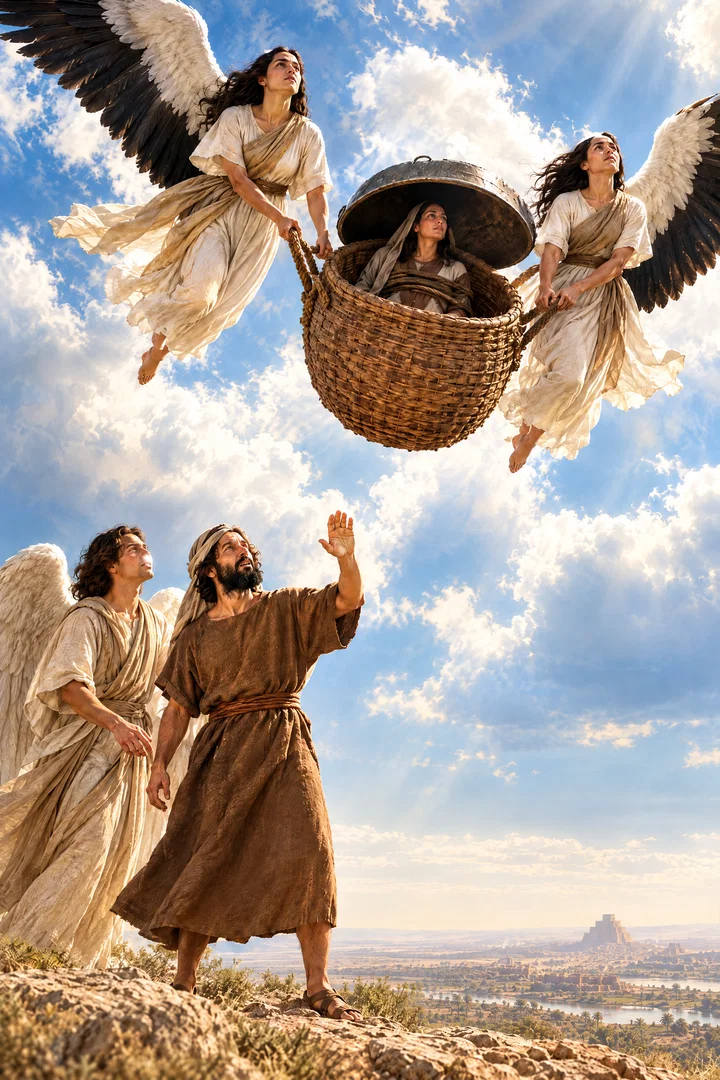
And he said unto me, To build it an house in the land of Shinar: and it shall be established, and set there upon her own base.
Translations
And he said to me, To build it an house in the land of Shinar: and it shall be established, and set there on her own base.
And he said unto me, To build it an house in the land of Shinar: and it shall be established, and set there upon her own base.
And he said unto me, To build it a house in the land of Shinar: and it shall be established, and set there upon her own base.
And he said to me, To build for it a house in the land of Shinar: and it shall be established, and set there upon her own base.
And he said unto me, To build her an house in the land of Shinar: and when it is prepared, she shall be set there in her own place.
And he said unto me, To build her a house in the land of Shinar: and when it is prepared, she shall be set there in her own place.
And he saith unto me, 'To build to it a house in the land of Shinar.' And it hath been prepared and hath been placed there on its base.
And he said unto me, To build it a house in the land of Shinar; and it shall be established, and set there upon its own base.
And he said unto me, To build for it a house in the land of Shinar,—so shall it be ready, and they shall settle it there, upon its own base?
Berean Standard Bible, Majority Standard Bible
“ To build a house for it in the land of Shinar,” he told me. “ And when it is ready, the basket will be set there on its pedestal.”
He said to me, “ To build her a house in the land of Shinar. When it is prepared, she will be set there in her own place.”
And he said to me, To make a house for her in the land of Shinar: and they will make a place ready, and put her there in the place which is hers.
And hee saide vnto mee, To builde it an house in the lande of Shinar, and it shall be established and set there vpon her owne place.
Douay-Rheims (Challoner revision)
And he said to me: That a house may be built for it in the land of Sennaar, and that it may be established, and set there upon its own basis.
Pictures
Cross-references
- 2 Chronicles 36:20-23
And them that had escaped from the sword carried he away to Babylon; where they were servants to him and his sons until the reign of the kingdom of Persia:
It recounts the captivity and the decree allowing the Jews to return.
- Genesis 11:1-9
And the whole earth was of one language, and of one speech.
Connects Shinar with the city and tower of Babel.
- Genesis 10:10
And the beginning of his kingdom was Babel, and Erech, and Accad, and Calneh, in the land of Shinar.
Places the kingdom of Babel in Shinar.
- Daniel 1:1-2
In the third year of the reign of Jehoiakim king of Judah came Nebuchadnezzar king of Babylon unto Jerusalem, and besieged it.
Describes the Jewish captives being taken to Babylon.
- Psalms 137:1-4
By the rivers of Babylon, there we sat down, yea, we wept, when we remembered Zion.
Describes the Jews carried captive to Babylon.
- Ezra 1:2-3
Thus saith Cyrus king of Persia, The LORD God of heaven hath given me all the kingdoms of the earth; and he hath charged me to build him an house at Jerusalem, which is in Judah.
Cyrus decrees the building of God’s house in Jerusalem.
- Jeremiah 29:5
Build ye houses, and dwell in them; and plant gardens, and eat the fruit of them;
The exiles were instructed to build houses in Babylon.
- Zechariah 2:7
Deliver thyself, O Zion, that dwellest with the daughter of Babylon.
Addresses the Jews dwelling in Babylon.
- Revelation 18
And after these things I saw another angel come down from heaven, having great power; and the earth was lightened with his glory.
It presents Babylon and its corruptions more fully.
- Psalms 137:8
O daughter of Babylon, who art to be destroyed; happy shall he be, that rewardeth thee as thou hast served us.
Both texts name Babylon as the place associated with the exiles’ captivity.
- 2 Kings 24:10-16
At that time the servants of Nebuchadnezzar king of Babylon came up against Jerusalem, and the city was besieged.
Records the deportation of people from Jerusalem.
- Ezra 5:12-13
But after that our fathers had provoked the God of heaven unto wrath, he gave them into the hand of Nebuchadnezzar the king of Babylon, the Chaldean, who destroyed this house, and carried the people away into Babylon.
The Persian ruler is identified as king of Babylon and connected with the return.
- Jeremiah 52:10-30
And the king of Babylon slew the sons of Zedekiah before his eyes: he slew also all the princes of Judah in Riblah.
Records the destruction of Jerusalem and the deportations to Babylon.
- Micah 4:10
Be in pain, and labour to bring forth, O daughter of Zion, like a woman in travail: for now shalt thou go forth out of the city, and thou shalt dwell in the field, and thou shalt go even to Babylon; there shalt thou be delivered; there the LORD shall redeem thee from the hand of thine enemies.
Foretells Zion going to Babylon and being delivered.
- Jeremiah 29:10
For thus saith the LORD, That after seventy years be accomplished at Babylon I will visit you, and perform my good word toward you, in causing you to return to this place.
The Babylonian captivity would end after seventy years.
- 2 Kings 25:7
And they slew the sons of Zedekiah before his eyes, and put out the eyes of Zedekiah, and bound him with fetters of brass, and carried him to Babylon.
Describes Jerusalem’s fall and the fate of its survivors.
- Jeremiah 25:11
And this whole land shall be a desolation, and an astonishment; and these nations shall serve the king of Babylon seventy years.
Both texts place Babylonian rule within the period of captivity.
Commentary
Each commentary is drawn from primary sources: the writings of Ellen G. White and Adventist pioneers and periodicals. Each commentary is separate. Its own words are not a quotation; follow the references to read the source passages.
Pioneers and periodicals
16 sources
The woman who is wickedness shut up in the ephah is carried away to the land of Shinar where Babylon stood, and there a house is built for her where she is set firmly established on her own base.ST May 24, 1883ST Apr 9, 1902 This signifies the Jewish nation being taken into Babylonian captivity, with the greatly diminished remnant settled there as though in a permanent home, yet with hope of return to their own land after seventy years.ST May 24, 1883ST May 24, 1883ST May 24, 1883 Wickedness will not end with judgment but will be perpetuated and established as a permanent institution in Shinar, identified with the later spiritual or mystic Babylon as a new form of rebellion against God.ST Jul 15, 1913 That house is a lasting religious system built on Babylonian rebellion and idolatry, in which iniquity as a false religious standard in the measure is given a permanent home and foundation and is enforced, depicting the Roman Catholic Church sending its altered standard of God's law throughout the earth.ST Oct 29, 1902ST Oct 29, 1902ST Oct 29, 1902 Catholics and Protestant bodies unite to give that false standard lasting legal authority, especially through laws enforcing Sunday observance, while Babylon advances through war, commotion and strife and uses force to suppress those whose truth threatens it.ST Oct 29, 1902ST Oct 29, 1902
Symbols and Captivity History
This prophecy belongs to the part concerning the reformation under Zerubbabel and later reformations of which it was a type, whose figures and symbols point to nations and to God's power to save.ST Nov 25, 1908 Its visions give motives for confidence and earnest effort, looking beyond the restoration from Babylon to the final glorious restoration when Christ comes.ST Sep 16, 1913 The ephah is a just measure and standard under God's watch, and its vision condemns fraud in weights and measures.ST May 24, 1883 It reaches the same people condemned by the flying roll for stealing and swearing falsely, since such wrongdoers also cheat in their dealings.ST May 24, 1883
The ephah with the woman, representing wickedness, is carried away to the land of Shinar where Babylon was situated.ST May 24, 1883ST Apr 9, 1902 There a house will be built for it and it will be set firmly established on its own base.ST May 24, 1883ST Apr 9, 1902 The carrying of the woman in the ephah to Shinar where Babylon stood signifies the Jewish nation being taken into Babylonian captivity.ST May 24, 1883 The woman represents the greatly diminished Jewish remnant carried into Babylonian captivity after Jerusalem's destruction.ST May 24, 1883 Only a few thousand people, including surviving members of the royal family and priesthood, remained to be taken captive, while many others were killed and the sanctuary's surviving vessels were carried away.ST May 24, 1883
The woman is established as a helpless captive beneath the lead.ST May 24, 1883 The two winged women who carry her away in triumph represent her captors, the Babylonians and Assyrians, united under Nebuchadnezzar to conquer and carry the Jews away after he destroyed Jerusalem.ST May 24, 1883ST May 24, 1883 The captive woman is settled in Babylon in Shinar as though it were her permanent home, with the house firmly established there.ST May 24, 1883 The captivity would last a long time, but the stork's return points to hope that the Jews would return to their own land after seventy years.ST May 24, 1883 The vision recalls Jerusalem's first destruction and the Jews' captivity in Shinar or Babylon as a warning against sin, so that a second destruction and final dispersion might be avoided.ST May 24, 1883 That warning was not permanently heeded, and Jerusalem was later destroyed and the Jews dispersed by the Romans under Titus in A.D. 70.ST May 24, 1883
Wickedness Established as Babylon
The wickedness shut up in the measuring vessel does not come to an end in judgment but is carried away to be perpetuated and set up as a lasting institution in Shinar on its own base, which is the later spiritual or mystic Babylon, a new form of rebellion against God. The corrupt woman taken to Shinar and set in her own place is Babylon and its corruptions, for Shinar is Chaldea whose center was Babylon.ST Jul 15, 1913 The ephah is corrupt religious commercialism borne to Shinar, the land of rebellion, where a system of Babylonian idolatry is founded on its own foundation, formed before the Christian age in rebellion against God and made to endure under various outward forms.
The house built for the woman in Shinar is a lasting religious system grounded in Babylonian rebellion and idolatry, arising after men refused the light of truth that had shone at Babylon for seventy years and turning their guilt into a religion that allowed them to continue in evil without conscience. It was to endure through changing outward forms while keeping the same spirit, but not forever, for it was finally to be destroyed. That house is a corruption of the light and truth given through God's servants, blended with Babylonian idolatry, and the two women carrying it portray that corruption joined to other powers to give it strength and authority, as in Christ's time apostate Christianity blended with paganism, and in the present application Spiritualism unites with apostate Protestantism. The two women with stork-like wings lift the ephah to the land of rebellion, supplying the power that upholds the apostate woman and makes her continued existence possible. The wind in their wings is war, commotion, and strife, for Babylon advances by earthly conflict and uses force to put down those whose truth threatens it, yet it keeps throughout the earth and across the ages the name God gave it and the same character.
The ephah is a standard of measure and the woman is a church, together picturing the Roman Catholic Church sending its altered standard of God's law throughout the earth.ST Oct 29, 1902 Iniquity as a false religious standard in the measure is carried to the land of Shinar, which is Babel or Babylon, a place of confusion, where a place is prepared for it and it is given a permanent home and foundation on its own base, and its removal there pictures a false standard becoming established and enforced.ST Oct 29, 1902ST Oct 29, 1902 That giving of the ephah a permanent place in Shinar pictures Catholics and Protestant bodies uniting to give that false standard lasting legal authority, especially through laws enforcing Sunday observance.ST Oct 29, 1902ST Oct 29, 1902
Sources