As performed in the Jewish economy, the cleansing of the sanctuary must have been a matter with which Daniel was familiar. It occurred in their service once a year, on the tenth day of the seventh month of each year. He must also have had some definite idea of the significance of that atonement, as it prefigured the final work to be accomplished by the promised Messiah.
The Jewish people of this day who carefully study their service understand the type, at least. That this35is so is seen both in their sayings and writings. As proof, your attention is called to the following circumstance: In September, 1869, during a series of meetings held in Healdsburg, Cal., a well-educated Jew, who resided in that place, became much interested in the meetings. Being a man who was very diligent in his mercantile business, it was a matter of great surprise that he should leave his store to attend a meeting in mid-week, and in the daytime. At the close of the meeting, one of the ministers questioned him regarding the matter. He replied, with seriousness: “Why, elder, a Jew who broke every Sabbath in the year would not dare to work to-day. This is the Day of Atonement; the tenth day of the Jewish seventh month.” The minister then asked, “What is the most solemn name your people have for this day?” With a most devout and reverential look, and in a tremulous tone of voice, he replied, “To-day is the Day of Judgment.”
The following quotation from the Scriptures represents the day of atonement as a decisive day with that people. “On the tenth day of this seventh month there shall be a day of atonement; it shall be a holy convocation unto you; and ye shall afflict your souls, and offer an offering made by fire unto the Lord. And ye shall do no work in that same day; for it is a day of atonement, to make an atonement for you before the Lord your God. For whatsoever soul it be that shall not be afflicted in that same day, he shall be cut off from among his people.”
In further proof that the Jewish people regard the36tenth day of the seventh month as a day of judgment, the following is quoted from one of their journals published in San Francisco. It is called the Jewish Exponent, and is an organ of the orthodox Jews, west of the Rocky Mountains. In the issue for September, 1892, was the announcement that before the next number would be published, the seventh month and day of atonement would come. Their name for the seventh month is Tisri, and that of the sixth month is Elul; so the paper stated: “The month of Elul is here, and the monitory sounds of the shofar [the trumpet that was to be blown from the first to the tenth day of the seventh month] are to be heard every morning in the orthodox synagogues, advising preparation for the day of memorial, and the final judgment of yom kippur.” Hence, as they were in the close of Elul, the sixth month, and Tishree, the seventh month, was about to open, they would every morning, for ten days, hear the trumpet announcing the final day of judgment of that typical system.
Here is the testimony of another, the Rev. Isidore Myer, rabbi of a large congregation in San Francisco. In announcing the day of atonement in the autumn of 1902, he explained the significance of the feast thus:—
“While crossing the threshold of time from one year to another, the Israelite is forcibly reminded of the creation and of the universal sovereignty of the Creator, and is called upon to celebrate, with the blast of trumpet, the anniversary, so to speak, of the birth of time and of the coronation of the great37King. He is also summoned by the voice of the same trumpet, or ‘shofar,’ to scrutinize retrospectively his actions of the past year, while he stands trembling before the all-seeing eye of Eternal Justice sitting on the throne of judgment.”
STANDING IN THE LOT.
From the time that Daniel heard the saint say, “Unto two thousand and three hundred days; then shall the sanctuary be cleansed,” his mind was filled with anxiety as to what should be “the end of these things,” and as to how long it should be. Finally, he is given to understand that a knowledge of the time is not for his day. It is said to him, “Go thou thy way till the end be; for thou shalt rest, and stand in thy lot at the end of the days.”
Some have supposed this language to refer to the final end of the world, and that at that time Daniel, with the rest of the Lord’s people, would receive their reward, and stand in their lot of inheritance. The Hebrew word for lot of inheritance, region of country, etc., we are told is geh vehl. That is not the word translated “lot” in this scripture. The word is goh rahl. Hebrew scholars tell us that this word occurs seventy-six times in the Old Testament. It is the same word that is used in speaking of the typical cleansing of the sanctuary, where “lots” were cast to determine which of the two goats was to be slain. As the high priest took the blood of the Lord’s goat and went into the sanctuary to perform the work of cleansing, all Israel stood without, afflicting their souls, and confessing their sins, that they might stand clear, and38receive the blessing of the high priest as he would come out of the sanctuary, instead of being classed with the rejected ones, who would be cut off from among the people. Thus, on that day, Israel stood in their lot.
When the final cleansing of the sanctuary should come, at the close of the twenty-three hundred days (which comes down a little further than any other prophetic period, at the end of which it could be said, “The *end of the days”), Daniel’s case, with the cases of all the righteous dead, came in review before God. So Daniel stands in his lot.
Thus it is seen that the great period of twenty-three hundred days brings us to the investigative judgment. As in the Jewish temple service, the sanctuary was cleansed once every year, it must have been apparent to Daniel that this cleansing at the end of the twenty-three hundred days must relate to something besides yearly typical service. The Lord had instructed His people that when using symbols in prophecy, the time given was counted “each day for a year,” so this period of twenty-three hundred years would reach far into the future from Daniel’s time.
In the twelfth chapter, this anxious inquiry is found: “How long shall it be to the end of these wonders?” and, “O my Lord, what shall be the end of these things?”
TIME SEALED UP.
In response to Daniel’s inquiry, the angel replied, “O Daniel, shut up the words, and seal the book,39even to the time of the end: many shall run to and fro, and knowledge shall be increased.” Again: “Go thy way, Daniel: for the words are closed up and sealed till the time of the end.”
What so exercised the mind of Daniel was the “when?” the “how long?” and “what shall be the end?” These were the points that perplexed and troubled the prophet, and these things only were to be sealed up till the time of the end, and not the whole book of Daniel, as some have supposed. These words were not then written in vain, never to be understood, for the time was to come when the wise should understand. When the appointed time should come for this sealed matter to be opened—for the “when?” the “what?” and the “end” of these periods to be unsealed and made plain—when the time of the end should come, many would “run to and fro” through the Scriptures, searching into these things, and knowledge on the close of these prophetic times would be increased.
That this is the idea conveyed in the foregoing language will be made more clear by the following translations of the text:—
Dr. Adam Clarke says: “Many shall endeavor to search out the sense; and knowledge shall be increased—by this means.”
In the German Bible of Luther, Revised, we read: “So shall many come over it, and find great understanding.”
The German Parallel Bible reads: “Many shall run it through, and so the knowledge will be increased.”
The German Bible of L. Van Ess, admitted also by the pope to Catholic readers, translates it: “Many will search it through, and the knowledge will be great.”
The Swedish Bible reads: “Many shall search in it, and knowledge shall become great.”
The Danish-Norwegian, Revised, reads: “Many shall eagerly search, and knowledge shall become much.”
In the prediction concerning the sealing up and the opening of these words, the accuracy of prophetic fulfilment is again seen; namely, that the event, the time, the knowledge of the period of time, shall be sealed up, and when it shall be opened and understood by “many.” This event is called
“THE TIME OF THE END.”
Till the time of the end, this matter should be sealed up. What is the time of the end? It can not be the actual end of the world, for then this part of Daniel’s prophecy would be of no use to mortals; it must therefore refer to a period just before the end. But, “things which are revealed belong to us,” says the prophet.
To ascertain what is meant by the expression “time of the end,” we will notice where the same terms are used in another prophetic scene. In the eleventh chapter of Daniel, a persecuting power is introduced which was to hold its dominion until the time of the end. The Lord says of the work of this persecutor, “And some of them of understanding shall fall, to41try them, and to purge, and to make them white, even to the time of the end; because it [the time of the end] is yet for a time appointed.” Protestant commentators are generally agreed in applying the prophecy of this persecuting power to the papal church, which had the civil power in its hands for the appointed time—“time, times, and an half,” the 1260 years from A. D. 538 to 1798. Its civil power was taken away at the end of the “time appointed”—1798. So, at that time, the people had ceased to “fall” by the hand of that persecuting power, as they had previously been falling. This marks 1798 as the period of time in prophecy called the time of the end.
Then, in the light of this prediction, the knowledge of when the twenty-three hundred days (the close of all prophetic days) were to close, was sealed up; but when that point of time passed, “many” were to search out, and obtain the light upon the subject. Now, these are the facts in the case; for until the year 1798, the exponents of prophecy had no light as to where the twenty-three hundred days would end. They could understand the symbols, the image, and the beasts of the book of Daniel. They also understood and correctly applied the seventy weeks of the ninth chapter, but could not tell where the twenty-three hundred days ended; for, as yet, they had no understanding as to where the days commenced.
KNOWLEDGE INCREASED.
In the paper called the Midnight Cry, of June 15, 1842, we read: “It is truly interesting to find the42various independent writers, who, since 1798, have seen what was entirely unperceived before,—that the seventy weeks was a key to the twenty-three hundred days.”
The discovery that the seventy weeks was the first part of the twenty-three hundred days unlocked the whole subject. Whereas, before they failed to find where the twenty-three hundred days commenced, now, as the seventy weeks were the first part of the twenty-three hundred days, of course the two periods must begin at the same date.
Previous to 1798, students of prophecy had light concerning the commencement of the seventy weeks—B. C. 457. Christ’s public ministry, death, etc., occurred in exact harmony with that date. This exact fulfilment of the Saviour’s mission in harmony with this reckoning had given them a mighty proof that He was indeed the true Messiah, and that the date of the seventy weeks was unalterably fixed. Failing to discover that the seventy weeks was the first part of the twenty-three hundred days, left the matter sealed up until 1798, as predicted.
Coming down this side of 1798, the other part of the prediction is as accurately fulfilled. Again we quote from the same number of the Midnight Cry: “Is it not a wonderful coincidence that so many writers, without any knowledge of one another, came to the same conclusion about the same time?” And why should it not be so? The Lord’s time had come when He said “many” would receive the light, and His Spirit would lead minds to the truth regardless43of distance or countries, and without knowledge one of another.
Before me is a list of twenty different localities where the light was discovered, not by communication one with another, but as the result of diligent searching of the Scriptures, led by the influence of the Spirit of God. Heading the list is William Miller, of the state of New York. Then follow A. J. Krupp, of Philadelphia; David McGregor, of Falmouth, Me.; Edward Irving, of England; Archibald Mason, of Scotland; W. E. Davis, of South Carolina; Joseph Wolff, who labored in various parts of Asia; Alexander Campbell, in his debate with R. Dale Owen, 1829; Capt. A. Landers, of Liverpool, England; Leonard Henrich Kelber, of Stuttgart, Germany; Laucunza, of Spain, in his book, “Ben Ezra;” Hentzepeter, of The Hague, Holland; Dr. Capadose, of Amsterdam, Holland; Rau, of Bavaria; priests of Tartary, in 1821; Bible students of Yemen, in the book called “Seera;” Hengstenberg, in another part of Germany; Russians on the Caspian Sea; Molokaners, on the shores of the Baltic, etc.
Such a general discovery of light on the close of the twenty-three hundred days, and at the time when God predicted that the matter, so long sealed up, would be opened, is not so surprising. It is, however, interesting, after the lapse of years, to bring together the conclusions of the various students who, from the opening of the nineteenth century to 1840, reckoned out the period of twenty-three hundred days, and located the seventy weeks as the first part of that44period, and then to find the whole period terminating in 1844.
The question arises, Can we rest with certainty that 1844 is the true date for the close of the twenty-three hundred days?—Yes; for as surely as a false fulfilment of prophecy can not come in the right time for the true fulfilment, the conclusion must be correct that 1844 is the true date for the close of that period.
God, who sealed up the knowledge of the time till 1798, and promised that then the true light would shine, by His unerring Spirit, guided those who earnestly sought Him to a correct understanding of this time. His time had come for the “knowledge” on that subject to “be increased,” and He guided to the true light.
We have now discovered the period of time, developed in the Lord’s order, when the judgment of the saints would come. With this time as a basis, the message could finally be given, “The hour of His judgment is come.” Mark, it does not say that immediately on the discovery of that period the message would be proclaimed, but that this light previously sealed would be made plain. In succeeding chapters it will be seen that the Lord just as definitely marks the time when the advent message would be proclaimed to the whole world.
CHAPTER IV.
THE LAST GENERATION.
A SHORT time before our Saviour’s death, His disciples asked Him the following very important question relative to the close of earth’s history: “What shall be the sign of Thy coming, and of the end of the world?”
Not repudiating their question, Christ proceeded to give them a definite answer, rehearsing the predictions concerning events that would transpire, and finally giving signs by which, when fulfilled, it might be known that His coming is near; even saying that the very generation witnessing the signs—the last generation—is not to pass until He shall come.
The Saviour goes over this prophetic ground three times, first giving what may be called a summary of events reaching down to the end. None of these, however, does He call definite signs of His near coming until the last one mentioned,—“This gospel of the kingdom [“glad tidings of the reign,” some translate] shall be preached in all the world for a witness unto all nations; and then shall the end come.” In passing over the ground the first time, Christ told His disciples there would be wars, famines, pestilences, and earthquakes in divers places, and, though these things were to come, they were not the signs of His near coming; for, said He, “The end is not yet.”46That famines, pestilences, etc., have been abundant, history fully shows. While these were not the tokens of His immediate coming, they were things which would transpire. However, He does proceed to give what will be the state of things when the end is near. He says: “Because iniquity shall abound, the love of many shall wax cold.” This prediction is in exact accord with that given by the apostle Paul respecting the last times: “In the last days perilous times shall come.” Paul enumerates some eighteen sins that will exist among that class who have a “form of godliness” and who are “lovers of pleasure more than lovers of God.”
From verses fifteen to twenty-eight, our Saviour goes over the ground the second time, down to His second coming, this time going back only to the destruction of Jerusalem. Having given the tokens of its overthrow, and instructions to His people regarding the course they should pursue when the ruin of the city should be threatened, He calls attention to the great tribulation which was to come upon God’s people. The tribulation came in the persecutions of the “Dark Ages,” but was to be, and was, shortened, else none of the elect would have been left. This period of tribulation was from A. D. 538 to 1798. Although the persecutors retained the civil power, by virtue of which they had heretofore persecuted, until the year 1798, the rage of persecution was restrained by the government’s granting toleration to all religions47about 1773 and onward. Thus the days of persecution were shortened even before they expired, and while yet the persecutors retained the civil power.
Before closing this second line of prophecy, our Lord presented the fact that near the end “Lo heres!” and “Lo theres!” would arise, teaching of secret comings of Christ. That His followers be not deceived by that deception, He guards them with the great fact that His coming is an event that will be as visible to all as the lightning’s flash which shines in mid-heaven.
The third time our Saviour reviews this line of prophetic events down to His coming, He goes back to the close of the tribulation and gives the definite signs by which it may be known when He is “near, even at the doors.” In verse twenty-nine is found this record: “Immediately after the tribulation of those days shall the sun be darkened, and the moon shall not give her light, and the stars shall fall from heaven.” Here are distinct signs. Of these He says: “When ye shall see all these things, know that it [margin, “He”] is near, even at the doors.”
Respecting the time when these definite signs should begin to be fulfilled, we read in Mark’s record of the same discourse, “Except the Lord had shortened those days, no flesh should be saved,” and, “In those days, after that tribulation, the sun shall be darkened,” etc. Comparing these two records of the discourse, it is seen that these definite signs would begin to receive their fulfilment “in those days,” and “immediately after the tribulation.” The days ended in 1798.48The persecutions began to be checked from about 1773, as previously stated, and the last act of public burning was in 1779. The first of these signs, then, would naturally be expected between the years 1779 and 1798. Now what are the facts?—The signs here mentioned in the sun and moon were both fulfilled in that memorable “dark day” of May 19, 1780. It was a darkness that continued for twelve hours—from 11 A. M. to 11 P. M. Although the moon had fulled the day before, it was said by those describing the scene of that night that “if every luminous body had been struck out of existence, the darkness could not have been more complete.”
It is not to be understood from the words of our Saviour, as recorded in Luke, that those who should observe the first of these signs would be of the generation that should witness His coming; but said He, “When these things begin to come to pass, then look up, and lift up your heads; for your redemption draweth nigh.”
The third of these signs, the falling of the stars, was fulfilled on Nov. 13, 1833. On that night—or rather for five hours previous to day dawn—there was a meteoric shower, compared by some to streams of fire coming down from heaven; by others said to resemble sparks of fire flying from some great piece of fireworks. This phenomenon covered all North America, from the Gulf of Mexico on the south to Hudson’s Bay on the north, and from the Sandwich Islands on the west to within two hundred miles of Liverpool on the east. Where observed, it was49the same continuous shower of stars, falling as thickly as snowflakes in a snow-storm. Testimonials concerning this wonderful display of “celestial fireworks” may be found in the publications already referred to.
In a book published by Leonard Heinrich Kelber, in Stuttgart, Germany, in 1835, it is stated that, on Nov. 25, 1833, there was a fine display of falling stars on the continent of Europe. Mr. Kelber says that “in Minsterburg, Silesia, stars fell like a rain of fire. With them fell balls of fire, making the night so light that the people thought that the houses near them must be on fire.”
“At the same time, in Prin, Austria, there was a falling of stars that covered a space of over five hundred square miles. It was described by some as like streams of fire coming down from heaven. Some called it a rain of fire. Horses were frightened by it, and fell to the ground. Many people were made sick through fear.”
PARABLE OF THE FIG TREE.
Coming down in this line of prophecy past the fulfilment of the third sign, our Saviour says: “Now learn a parable of the fig tree; when his branch is yet tender, and putteth forth leaves, ye know that summer is nigh; so likewise ye, when ye shall see all these things, know that it [margin, “He”] is near, even at the doors. Verily I say unto you, This generation shall not pass, till all these things be fulfilled.50Heaven and earth shall pass away, but My words shall not pass away.”
This language does not apply to the generation that was living when Christ gave this discourse, but to the generation who see these things fulfilled—not who see them fulfilling, but fulfilled. The things they see fulfilled as tokens that Christ is at the door does not include the shaking of the heavens when He will be seen actually coming. These signs of His near coming include this third sign, the one in the stars. As surely as we know that summer is coming when the leaves are putting forth, so surely we may know by the signs that are past that Christ’s coming is near, even at the door, and may know also that the generation witnessing the falling stars will not pass away until His actual coming shall take place. This statement Christ declares to be more certain than the continuance of the heavens and the earth. They will pass away, but His words respecting His coming in this generation shall not fail.
With these points clearly established, do not the events, with their fulfilments, designate the last generation? The last of these events—the falling of the stars—was fulfilled in 1833. Since this date we have entered upon the last generation, the generation that shall not pass away until Christ shall come.
LEARNING THE PARABLE.
The Lord’s appointed time for the people to learn the parable of the fig tree dates this side of 1833. Here also is seen the accuracy of prophetic fulfilment51in the great Advent Movement. The Lord, by this prophecy, marked the time when the proclamation of His second coming should be sounded to the world, and the parable was to be learned. Having reached this date, it is evident, too, that the time for the Lord to raise up teachers to teach the parable has come; for, “How shall they hear without a preacher? and how can they preach, except they be sent?” When the Lord has something for His people to learn, He will see that teachers are provided to teach that very thing. As His time had come for the parable to be learned, it was equally true that His time had come to raise up teachers.
Then this side of 1833 is the Lord’s time for the people to be taught that His coming is at the doors, and that His coming is before that generation shall pass away. Thus the time is marked out in this prophecy when the great advent proclamation should be given to the world.
In fulfilment of this prediction we find that right there the Lord raised up His ministers in various parts of the world, who, from 1834 to 1844, sounded the cry of Christ’s coming near, “even at the doors;” and these taught the parable of the fig tree, pointing to these signs of His coming, even as He had instructed. This message, either by the living teacher, or through the agency of the printed page, went to every missionary station in the world, and to every seaport on the earth.
The extent of the message has been plainly set forth by the editor of the Voice of Truth, of52Rochester, N. Y., January, 1845: “The everlasting gospel, as described in Rev. 14:6, 7, has been preached to every nation, kindred, tongue, and people; saying with a loud voice, ‘Fear God, and give glory to Him; for the hour of His judgment is come; and worship Him that made heaven, and earth, and the sea, and the fountains of waters.’ No case can be more clearly substantiated with facts than that this message has been borne to every nation and tongue under heaven, within a few years past, in the preaching of the coming of Christ in 1843 [1843, Jewish time—our time, 1844], or near at hand. Through the medium of lectures and publications, the sound has gone into all the earth, and the words to the end of the world.”
Some people, unacquainted with the facts, have looked upon the Second Advent Movement as limited to a certain locality, supposing it a work connected with William Miller and a few hundred ministers associated with him in the northern portion of the United States. To such it may be a surprise to learn that the movement in America, in which Elders Miller and Himes were prominent leaders, was but a small part of a great message that, as stated above, went “to the ends of the earth.”
The Lord’s time came for this proclamation to go forth to the world, and in a score or more different parts of the earth, at about the same time, men were raised up, who, without a knowledge of one another’s work, went forth to sound this message to all parts of the earth. Many of those mentioned in chapter53three, who received the light on the close of the twenty-three hundred days, were afterward moved upon to engage in the proclamation of the first angel’s message of Revelation 14.
Such men as W. E. Davis, of South Carolina; Archibald Mason, of Scotland; Edward Irving, of England; Hentzepeter, of Holland; Lacunza, of Spain; Rau, of Bavaria; Kelber, of Germany; and Joseph Wolff, of Asia, did not receive their message from William Miller. In fact, but few of them had heard of William Miller until his work, like that in their own countries, had so spread as to rouse the public interest. Hentzepeter, of Holland, in a letter of 1843, said he never heard of William Miller until 1842. He had then been publishing books and preaching the doctrine of Christ’s second coming in Holland for about ten years.
There are individuals who have regarded this doctrine of the near advent of Christ as an American movement only, and under the leadership of William Miller. From some English writings it appears there were people in Great Britain who thought the movement was confined alone to Britain. An English writer said of the extent of this work: “It is not merely in Great Britain that the expectation of the near return of the Redeemer is entertained, and the voice of warning raised, but also in America, India, and on the continent of Europe. In America, about three hundred ministers of the Word are thus preaching this ‘gospel of the kingdom,’ while in this country about seven hundred of the Church of England are54raising the same cry.” Besides these of the Church of England, many of the Non-Conformist ministers were engaged in giving the same message.
At Newark, Ohio, Aug. 8, 1894, Elder G. W. Mitchel stated to the writer that Elder Miller told him, at McConnelsville, Ohio, in September, 1844, that he had the names and addresses of three thousand ministers in various parts of the globe, who were proclaiming, “Fear God, and give glory to Him; for the hour of His judgment is come.”
Of the extent of the proclamation, William Miller himself said that “one or two in every quarter of the globe have proclaimed the news; and all agree in the time. Wolff, of Asia; Irving, late of England; Mason, of Scotland; Davis, of South Carolina; and quite a number in this region, are, or have been, giving the cry.”
In 1837, Elder Hutchinson was sent from England as a Wesleyan missionary to Canada. He finally settled in Montreal, where he embraced the advent doctrine. In the years 1843 and 1844, he published a paper called the Voice of Elijah, in which he earnestly promulgated the message of Christ’s advent near. He had a very extensive acquaintance in foreign countries. Having ready access to vessels sailing to those countries, and being privileged to send large parcels of his papers free, he sent large quantities55of them to all parts of the earth. The Adventists in the United States, Canada, and other parts furnished him means with which to print, and he sent hundreds of thousands of his papers all over the sea, and to the ends of the earth. He said of his own work, that he had sent the papers freely to Nova Scotia, New Brunswick, Newfoundland, England, Ireland, Scotland, Wales, France, Germany, Constantinople, Rome, and all over the British Dominions.
Thus is seen, in the light of facts presented, how accurately prophecy concerning the Advent Message was fulfilled. God’s time came for the parable of the fig tree to be taught,—for the first announcement of the first angel’s message to be given,—and He raised up His messengers to herald the cry to all nations, peoples, and tongues.
The history of the rise of this work has now been given; but as other messages “followed” (“went with,” as some translate) the first message, in following the movement to its present threefold cry, which is widely spreading, there are other features of the work to be examined.
CHAPTER V.
LAST-DAY TOKENS.
In answer to the question, “What shall be the sign of Thy coming?” our Saviour replies by saying, “Fearful sights and great signs shall there be from heaven.” From this reply the conclusion would naturally be drawn that as the proclamation of the Lord’s near coming was being given, signs and wonders in the heavens would be multiplied. That such has been the case will be clearly shown in the many wonderful and unexplainable sights that have appeared in the heavens from time to time, as related by the individuals themselves who observed them.
From a work entitled “The End Comes,” written by Leonard Heinrich Kelber, and published in Stuttgart, Germany, in the year 1835, we quote as follows:—
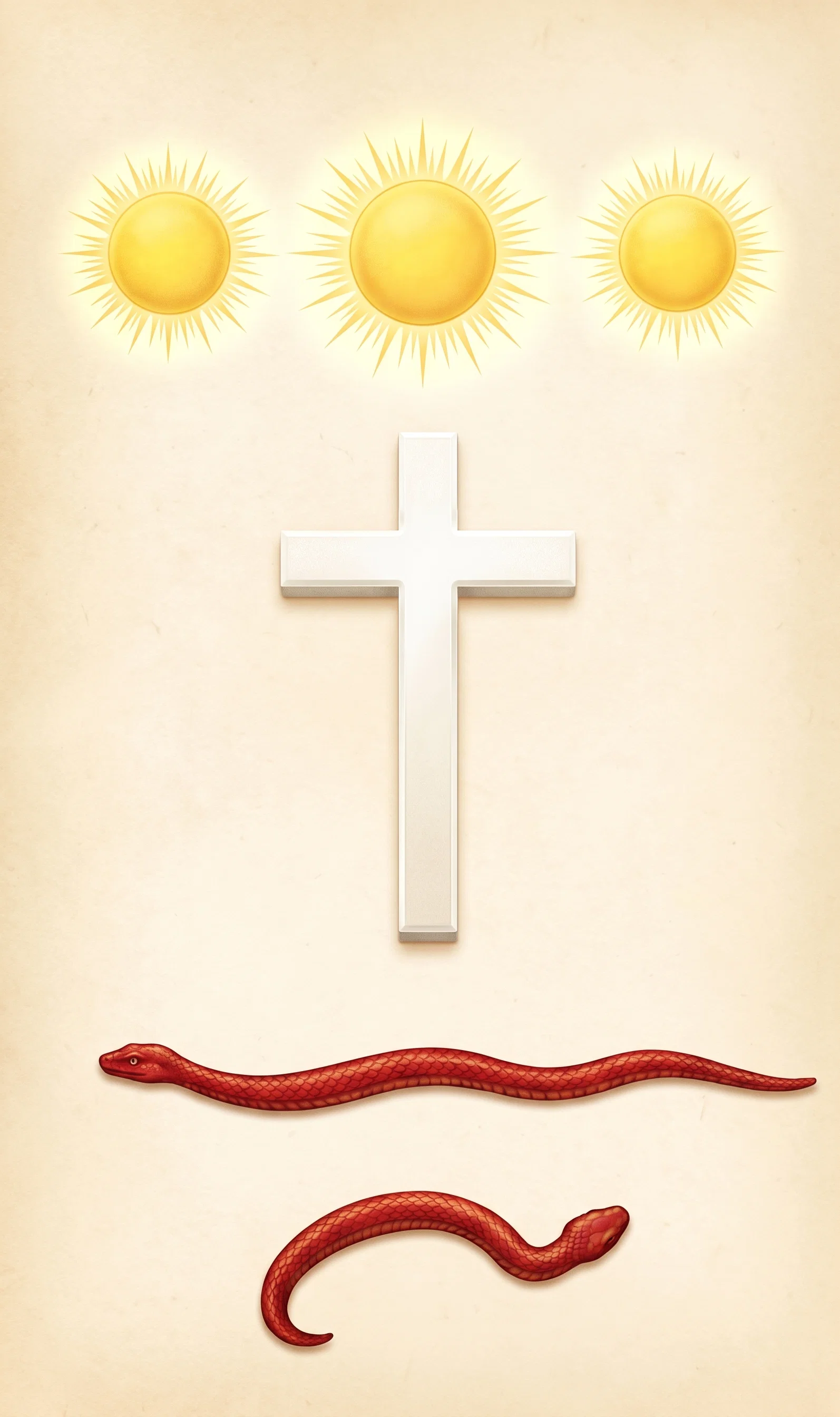
“In 1811, on March 20, in some parts of Silesia, there were three suns visible at the same time.
“In 1814, April 14, in several parts of Russia, for a whole day, the real sun was covered with a cloud. On either side of the cloud appeared a clear sun. Under the clouded sun was a clear white cross, under the cross a serpent, under the serpent a sickle. On the opposite side of the heavens was the moon.
“At the same date, in Bavaria, there appeared a clear white cross in the sky, which was visible for three days.
“In 1826, December 14, in Stuttgart, Germany, from 9:30 A. M. till noon, two extra suns were visible, one on either side of the real sun. These extra suns had tails shooting out from them opposite the true sun, like comets’ tails.
BERLIN WONDER OF 1829.
“In 1829, December 26, the Berlin journals state that, on the morning of December 23, about forty-five minutes before sunrise, there appeared in the east three tall, perpendicular, purple columns. The sun arose under the middle column, when it glowed like burning coals of fire. Then the other two columns displayed, brightly, for some time, all the colors of the rainbow.”
The following is copied from a work called “Bible Reader,” published about 1844:—
A BAND OF LIGHT.
“Mr. Asahel Towner and family, of Oxford, Conn., now solemnly affirm that in the summer of 1828 they saw a very white breadth of light, which lighted the earth so that they could see to pick up a pin on the ground in the middle of the night. The light, they say, rose gradually in the east of northeast and came overhead, even to the horizon of the west of southwest, which seemed to them of the equal width of four or five yards, and it so remained for several hours. And62while the latter end of it sank below the horizon, the first end appeared to rise to the height of an hour. Waves of darker light arose in the same belt of light, from both ends of it, and met overhead, and succeeded one another as often as every minute or two. It disappeared about midnight. Many others, they say, witnessed the same sight, and that they saw an account of it published in the papers afterward, as having appeared in other places.”
Coming down to the years 1843 and 1844, when the doctrine of the Lord’s near coming was being proclaimed with great power to the world, signs in the heavens seemed very abundant.