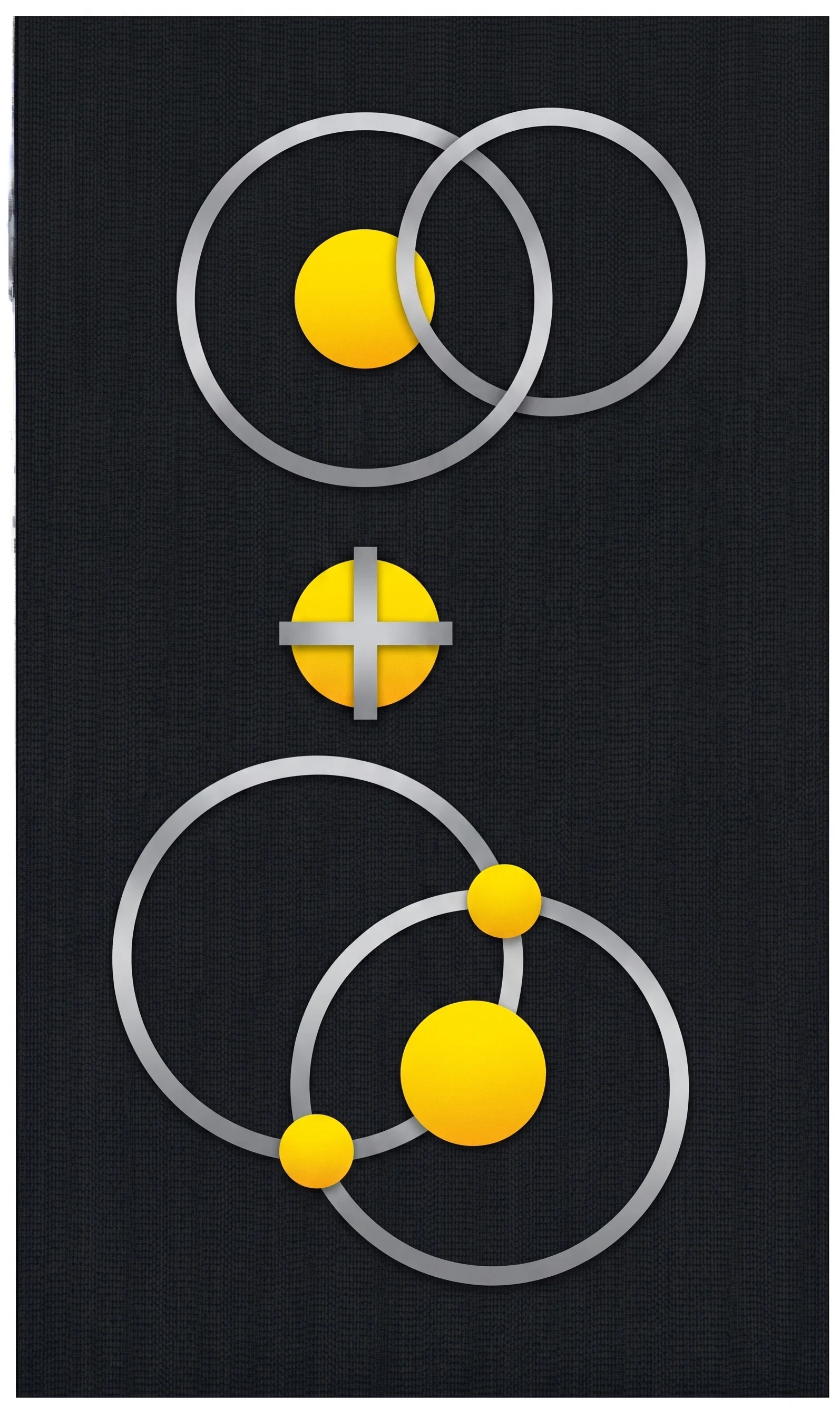
That wonderful sights in the heavens have not131yet ceased the following from the Louisville (Ky.) Evening Post, of Feb. 28, 1898, will show:—
“There were strange happenings in the heavens last night.” . . . The appearance of two large circles of light, followed by a large Grecian cross, with the moon in the center, is not an every-night occurrence.
“The first circle appeared at about eight o’clock, when the moon could be seen about seventy degrees above the horizon. It stretched from the southwest corner of the heavens over the center to the north. . . . In about half an hour, as the clouds became heavier in the east, the other circle appeared. For a while the circles remained apart, but toward the end they arranged themselves at right angles, with the moon in the center, thus forming the cross. While the display was remarkable, it is thought, as was stated, that it was due to the refraction of the moon’s light on the thin layers of cloud and mist that covered the heavens last night, but which were so light that even the starlight penetrated them.”
The Louisville Courier-Journal, of February 28, said of the moon’s appearance: “No similar phenomenon was ever before witnessed in this vicinity. Its appearance was enough to cause more than a passing notice. It [the moon] was first surrounded by a small circle, and then there was the segment of a second circle that made a magnificent sweep around the zenith. The large circle cut the little circle in two, and when they finally faded away, a little before midnight, they were followed by a well-developed136Grecian cross, with the moon in the center. This was the phenomenon every one who looked at the moon saw.
“It was an extraordinary phenomenon, which, for all that is known, may have transcended the domain of meteorology. The general impression is that it was a ‘lunar rainbow.’ In its earlier stages of development, a greenish tinge was quite perceptible; but there were numerous other phases about it that were difficult to reconcile with the theory of rainbow. It was, in all probability, due to the reflection and refraction of the rays of moonlight upon the thin stratum of cirro-stratus clouds at the particular altitude at which they were flying during those hours.”
If, according with this theory, this phenomenon was such an ordinary affair—simply the rays of the moon shining upon clouds so thin that stars shone through them—why so rare that no such sight had ever been seen there before? Why not acknowledge the power of God so combining the rays of light at that time as to produce this “wonder” in the heavens?
CIRCLES AROUND THE MOON.
The New York and Jersey City papers of April 5, 1898, contained full accounts of a sight seen in connection with the full moon of the night before. It was a clear night, and the moon was near the zenith, when there appeared a large circle, with the moon in its circumference. This circle was to the137north of the moon, and displayed, distinctly, all the colors of the rainbow. At the same time there was a smaller circle of white light, with the moon in the center of the circle, which intersected the other circle on the east and west of the moon. At each of the two points of the intersection there was an extra moon, three moons being visible in the heavens for more than an hour, when all passed away. Many thousands of people in New York, Brooklyn, and Jersey City witnessed this phenomenon.
A FLAMING SWORD.
In the Chicago Inter-Ocean of Sunday, March 20, 1898, is an account of a “flaming sword” seen in the sky by the people of New York City on the evening of Monday, March 14. It reads:—
“Thousands upon thousands of people in New York, Brooklyn, Jersey City, and neighboring places saw a wonderful sight in the heavens Monday night of last week. It was a sword of flaming fire, sharp, and well defined. None of those who saw it had doubt concerning its nature; what they asked themselves was, ‘What does it portend?’
“The sword was first seen in the western skies, well above the horizon, at 8:10 P. M. Mercury was then descending, and as this was then the ruling planet, but on the wane, astrologers will have it that the flaming sword means war, and quick war at that.”
So we see, as expressed by the apostle Peter, men seek to explain away—“all produced by natural causes”—those tokens and wonders the Lord has138promised as reminders of His power, and evidences that the end approaches. The apostle affirms that in the last days the people would say: “Since the fathers fell asleep, all things continue as they were from the beginning of the creation.”
FOUR EXTRA SUNS AND AN INVERTED RAINBOW.
The above illustration was witnessed for two hours in southeastern England on the afternoon of Oct. 11, 1899. I give the account as described in several English papers.
In the London Daily Mail, of Oct. 16, 1899, we read: “A correspondent, M. D., sends us the following description of an interesting celestial phenomenon which he and others witnessed at Tonbridge on the afternoon of Wednesday last:—
“Soon after two o’clock, a halo round the sun was observed, with brilliant mock suns, east, west, and north. The southern one was below the point of our vision, hidden by the trees, while over the upper mock sun was an inverted rainbow, in strong prismatic colors. At four o’clock only one sun remained visible, of an intense white.”
From the Kettering Daily Telegraph, of Oct. 23, 1899, we quote: “A correspondent writes from Bushy, Herts, to the Spectator: ‘On the afternoon of Wednesday, October 11, at three o’clock . . . I observed what few of your readers, I believe, will have ever seen. Almost directly over the sun, and high up in the zenith, in a clear blue sky, was the portion of the arc of a rainbow. Its colors were139vivid. . . . Several others, countrymen of Hertfordshire, were looking up at the same time, and I heard the words, “Never saw such a thing as that in my life.”’”
In the London Echo of Oct. 23, 1899, is the following: “The singular rainbow phenomenon of October 11 seems to have been visible over a very wide area. Correspondents writing from Ipswich, Ventnor, and Bournemouth all bear testimony in the Spectator to having seen it. The Bournemouth gentleman saw ‘a highly respectable tradesman in a rather excited state, as he said he had just seen a thing he had never seen before in his life. A neighbour had called him into the open to see a rainbow which was upside down, reversed.’ I said, “What, concave instead of convex?” He said, “Yes, reversed like a cup.” It must have been about three o’clock when these men saw it.”
Having called attention to a few of the many “wonders” that have been observed in the heavens during the present century, perhaps it may be well to quote the testimony of an able writer respecting the future:—
“Greater wonders than have yet been seen will be witnessed by those upon the earth a short time previous to the coming of Christ.
“In the day of the Lord, just before the coming of Christ, God will send lightning from heaven in His wrath, which will unite with fires in the earth. The mountains will burn like a furnace, and will pour forth terrible streams of lava, destroying gardens142and fields, villages and cities; and as they pour their melted ore, rocks, and heated mud into the rivers, it will cause them to boil like a pot, and send forth massive rocks, and scatter their broken fragments upon the land with indescribable violence. Whole rivers will be dried up. The earth will be convulsed, and there will be dreadful eruptions and earthquakes everywhere.”
A REMARKABLE PHENOMENON.
BY M. C. WILCOX.
One of the precursors of the great day of God, as given by the prophet Joel, is “wonders in the heavens.” The passage in which it is found reads as follows:—
“And I will show wonders in the heavens and in the earth: blood, and fire, and pillars of smoke. The sun shall be turned into darkness, and the moon into blood, before the great and the terrible day of the Lord cometh.”
The darkening of the sun and moon occurred May 19, 1780. The “blood, and fire, and pillars of smoke” are common, graphic appearances of various electric and light phenomena, manifest especially in the aurora borealis, the marvelous forms of which have excited alarm, wonder, admiration, and curiosity in earth’s children during the last century or so, for it is only in later times that these wonders have become so manifest. They are evidences of decay, disintegration, and disturbance in the earth and its atmosphere. The Bible, more than twenty-five143centuries ago, foretold their appearance. God is now confirming that word by hanging these predicted signs in the heavens.
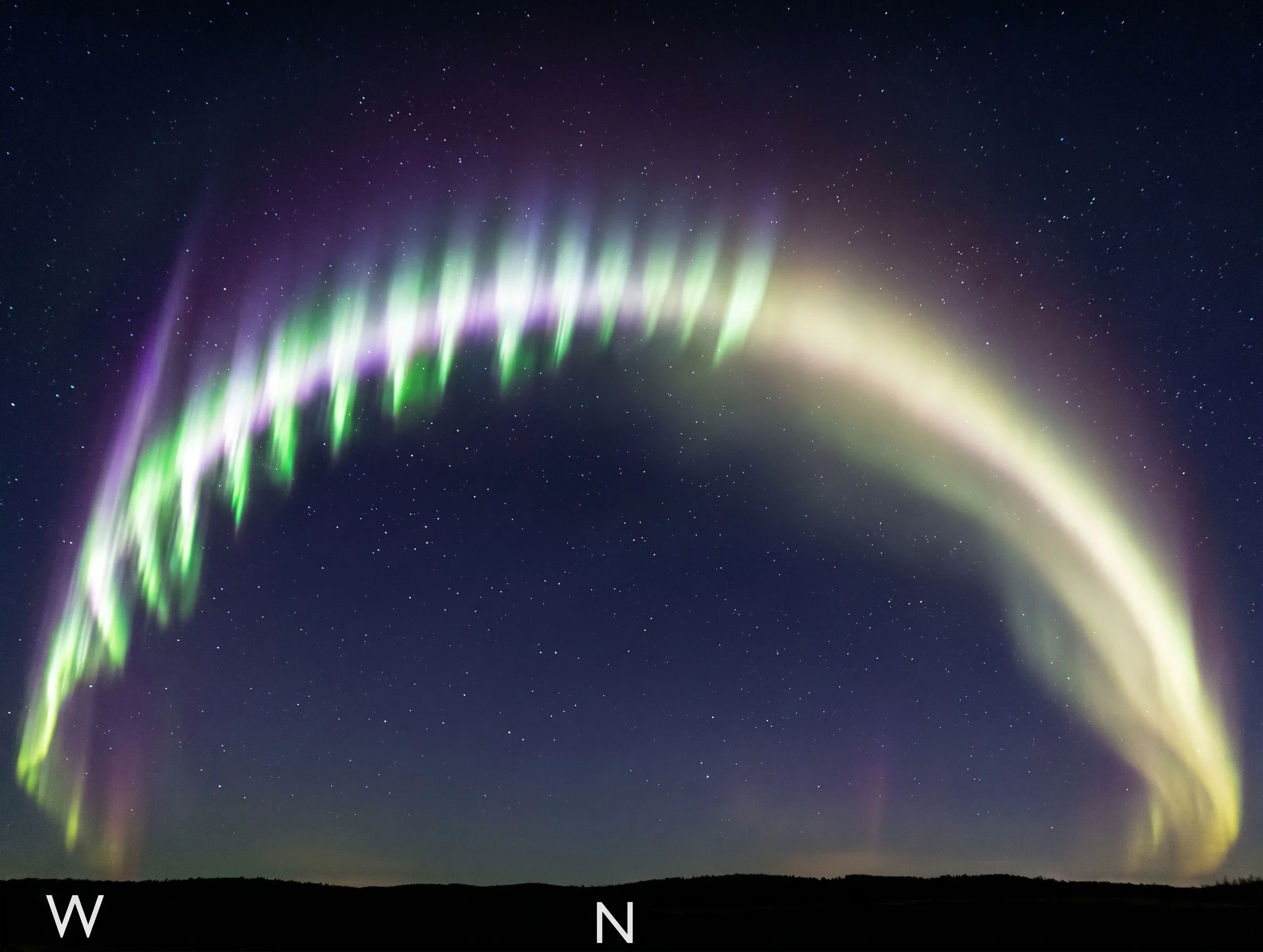
A remarkable wonder, worthy of note, occurred last August. A correspondent, Mr. W. H. Holden, at Choteau, Mont., under date of Aug. 24, 1903, writes us that this remarkable phenomenon was seen by him August 21, 10:15 P. M. It consisted in a clearly-defined band or belt of light, extending athwart the heavens, from the northwestern to the southwestern horizon, “passing directly overhead, and cutting the heavens into two equal parts. At the zenith it seemed a little wider than the disc of a full moon when half an hour high, and tapered toward either end.” The edges were clear-cut and regular. There was no moon at the time. As the144time passed (illustration No. 1 is from a rough drawing furnished by Mr. Holden), the north end swung slowly to the west, as if moved by a gentle breeze, but did not break. “After maintaining its appearance for nearly an hour, it suddenly began to fade equally throughout its length, and in about ten minutes it had entirely disappeared.”
No. 1. As Seen in Choteau, Mont.
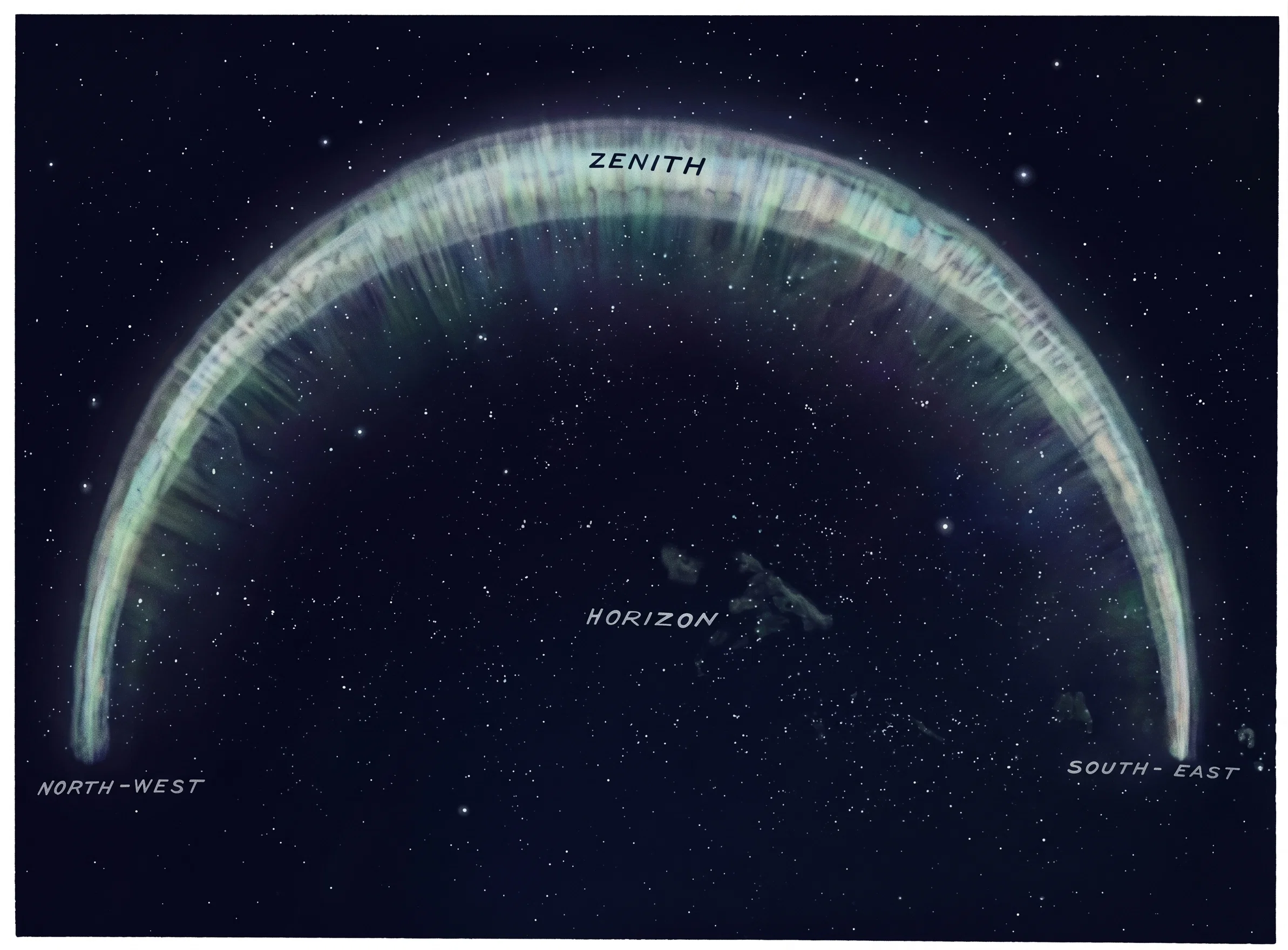
A similar phenomenon was witnessed at York Harbor, Me., on the same night, at 9:30 P. M., preceded by an ordinary display of aurora borealis, which gradually faded. The one who records this is Dr. A. F. A. King, a scientific observer, in the Popular Science Monthly for October. He thus describes it:— “At 9:30 P. M. there appeared a magnificent arch spanning the heavens from east to west, the top of145the arch being a little north of the zenith, and almost overhead. As shown in the diagram, at least three-fourths of the eastern half of the arch consisted of a pale, only half-luminous column of visible streaks, the band being perhaps as wide as the diameter of a full moon appears to be. The western segment of the arch presented a most extraordinarily magnificent spectacle. [See cut No. 2.]”
No. 2. As Seen in York Harbor, Me.
“Beginning a little east of the zenith and continuing almost to the western horizon, there appeared what might easily be likened to a string of tremendous comets. These pendants of light, however, unlike comets, were more brilliant at their bases, less so at their apices. Their bases were directed upwards, their points down. They were constantly changing, appearing and disappearing, but not very rapidly. . . . At the western end of the arch, one long, half-luminous streak shot up obliquely (as shown in the figure), and remained some minutes after the arch had disappeared. The arch lasted from 9:30 to nearly 10 P. M. . . .
“No visible connection existed between the arch and the nebulous masses and streaks of light near the northern horizon.
“In looking at the diagram, the reader may well conceive it to be too toy-like and artificial to come within the range of truth or possibility, but so was the arch itself. No one could have conceived such a display to be either natural or possible. To some it suggested a festive arch, adorned with luminous cornucopias, like a Christmas decoration. Those of146us who, for a few weeks before, had obtained telescopic views of Breli’s comet with some difficulty, seemed now to be rewarded by nature exhibiting a whole string of far more brilliant comets for our special delectation. The kind and degree of luminosity appeared to be almost exactly like that of the comet when seen through a good glass.
“The splendor and magnificence of the display were beyond description, startlingly beautiful. The spectacle seemed almost to overstep the modesty of nature, but its coming unheralded during the majestic silence of night served to banish so unjust a thought. Surprise, delight, admiration, and awe,—these were the feelings which thrilled with pleasure those of us who witnessed the sublime, mysterious scene.
“The writer remembers witnessing a similar phenomenon just before the Civil War, probably in 1861. This was in Theresa, N. Y. Many looked upon it and the remarkable display of aurora borealis that winter as precursors of coming war. The belt of light was uniform throughout, in width about the face of the full moon, extending from the eastern to the western horizon, athwart the heaven. It must have lasted over an hour.”
These are among the many tokens of the soon-coming day of God, when before His face the very heavens shall seem to be rolled up as a scroll, and all nature marred by sin shall crumble in His presence. M. C. WILCOX. Oakland, Cal.
CHAPTER VII.
LOUD VOICE OF THE TIME MESSAGE.
In previous chapters it has been proved that the Lord marked the time when the light should be given relative to the close of the great prophetic period leading to the investigative judgment, and that He accurately fulfilled the prediction at that time, that “knowledge shall be increased,” by raising up many who discovered that light, and that He also marked the time when the “parable of the fig tree” should be learned, by raising up His teachers then and there to go forth and herald that parable to the world. Just so accurately has He marked the point when the time message should swell to its loud cry, and just so accurately was that fulfilled.
In Revelation, chapter 10, is a prophecy relating to this very subject: “And I saw another mighty angel come down from heaven, clothed with a cloud; and a rainbow was upon his head, and his face was as it were the sun, and his feet as pillars of fire; and he had in his hand a little book open; and he set his right foot upon the sea, and his left foot on the earth, and cried with a loud voice, as when a lion roareth; and when he had cried, seven thunders uttered their voices. . . . And the angel which148I saw stand upon the sea and upon the earth lifted up his hand to heaven, and sware by Him that liveth forever and ever, who created heaven, and the things that therein are, and the earth, and the things that therein are, and the sea, and the things which are therein, that there should be time no longer; but in the days of the voice of the seventh angel, when he shall begin to sound, the mystery of God should be finished, as He hath declared to His servants the prophets.”
THE ANGEL A SYMBOL.
As already shown, the work of preaching the Lord’s truth to the inhabitants of earth has been committed to mankind, and the Lord has promised His blessing on that instrumentality till the “end of the world.” So this angel, bearing this message, must be a symbol of a work of preaching time to earth’s inhabitants. The message is proclaimed from a book that is “open,” clearly implying that it had once been closed. These messengers are esteemed of God; for the “bow,” a token of God’s covenant, is over them, and they stand clothed with the light of God’s glory, and declare the message on the authority of the Creator of all things. That which is here declared is a time message, once “sealed,” but now proclaimed from an “open” book.
The point of time when the loud cry of this proclamation was to be made is a question of interest. It is here placed between the sounding of the sixth and seventh trumpets, which may be seen not only by its position in the Scripture record, but by the message,149itself, which says: “In the days of the voice of the seventh angel, when he shall begin to sound, the mystery of God should be finished, as He hath declared to His servants the prophets.” This is conclusive evidence that the time proclaimed in this message is the time extending to the
SOUNDING OF THE SEVENTH TRUMPET.
When the seventh angel sounds, we read that “the temple of God was opened in heaven, and there was seen in His temple the ark of His testament.” In the service of the earthly sanctuary, the apartment containing the ark—the most holy place—was only opened once a year; that was on the day of atonement, and for the blotting out of sins—the cleansing of the sanctuary. The time spoken of by the prophets, when this cleansing work, as accomplished by Christ, should take place, is at the close of the twenty-three hundred days. It is also stated that when the seventh angel sounds, voices in heaven say that the time is come for the dead to be judged.
In the days of the Jewish sanctuary, the yearly service was an “example” of the work of Christ in the heavenly sanctuary,—first, a service for those confessing their sins, and finally a work to blot out the sins which had been confessed, which is really the investigative judgment. So it is seen that this time message of Revelation 10 is but another symbol of the message in Revelation 14,—“The hour of His judgment is come.”
This prophetic symbol of Revelation 10 presents150the time when this message is to go forth “with a loud voice,” and finally, “as when a lion roareth.” The time when, according to this prophecy, the message was to increase to its “loud cry” is from the close of the sixth trumpet to the end of that prophetic period leading to the cleansing of the sanctuary,—in other words, to the end of the twenty-three hundred days. The first four trumpets met their fulfilment in the wars of the Goths, Vandals, Huns, etc., which divided Western Rome into ten parts or kingdoms.
THE FIFTH TRUMPET
presents the rise of Mohammedanism with its cloud of errors, but especially the period of “five months,” one hundred and fifty prophetic days (one hundred and fifty years) from the time they “had a king over them.” July 27, 1299, Othman, the founder of the Ottoman Empire, invaded the territory of Nicomedia. From that time the Ottomans harassed and “tormented” the Eastern Empire of Rome till July 27, 1449, the one hundred and fifty years of the sounding of the fifth trumpet. At that time the Turks came with their forces against the city of Constantinople itself, using gunpowder in their warfare; and from a ponderous cannon, which the historian Gibbon says required sixty oxen to draw, they fired great rocks against the walls of Constantinople. About this time John Paleologus—who is set down by historians as the last Greek emperor—died. Constantine Decozes was the rightful heir to the throne, but151it is said that his fears of Amurath, the Turkish sultan, who was waging this warfare against him, led him to ask permission of Amurath to ascend the throne. Such an act would almost seem a resignation of the throne to the Turks. In fact, very shortly the Ottomans had possession of the city of Constantinople, and the Eastern Empire of Rome. Thus they (politically) “killed” that empire which they had before “tormented.” They were to “slay” it for “an hour, and a day, and a month, and a year.” Taking this as prophetic time, a day for a year, how long a time would it be? The problem is a simple one: A year, 360 days, or years; a month, 30 days, or years; and one day, one year,—in all, 391 days, or, literally, 391 years. An hour being the twenty-fourth part of a day, as a symbol it would be half a month, or fifteen days. The whole time of Mohammedan independent rule of Eastern Roman territory would therefore be 391 years and 15 days. This added to July 27, 1449, brings us to Aug. 11, 1840. On that very day, the affairs of the Turkish Government passed into the hands of the “allied powers” of Europe, and there they have remained until the present time. The four governments which at that time took in hand to manage for the Turk were England, Russia, Austria, and Prussia.
CLOSE OF THE SIXTH TRUMPET.
The sounding of the sixth trumpet, as it closes with the independent rule of the Turk, brings us down to Aug. 11, 1840. From that time until the close152of the twenty-three hundred days in 1844, the time message was to increase to a mighty cry. The question as to the termination of the twenty-three hundred days in 1844 rested on the ground that a day in symbolic prophecy meant a year of literal time. N. Colver, a theologian of Boston, Mass., said: “If these days are years, the world will end in [with] 1843; any schoolboy can see it; for if the four hundred and ninety days terminated at the death of Christ, the twenty-three hundred days would terminate in [with] 1843; and the world must end, unless it can be shown that some other event is to take place, and I do not see how that can be done.”
CLOSE OF TURKISH INDEPENDENCE.
In 1838, Dr. Josiah Litch, of Philadelphia, Pa., published to the world an exposition of the seven trumpets of the Revelation, claiming, on the ground that a day in symbolic prophecy means a year of our time, that the Ottoman power would lose its independence on the 11th of August, 1840. The fulfilment of the prophecy at that exact date demonstrated to the satisfaction of thousands that a day in symbolic prophecy was a symbol of a year. Brother Litch said that after the fall of the Ottoman Empire in 1840, he had letters from over one thousand prominent infidels (some of them had been leaders in infidel clubs) who, on the fulfilment of the predicted fall of the Ottoman independence, renounced their infidelity, and accepted the Christian religion, and declared their faith in the Word of God.
Now, as it has been shown that 1840 is the date in the prophecy when the time message is to begin its “loud voice,” let us carefully review the facts. We have already seen that when we came to the sign in the stars—1833—we had reached the time when the Lord would raise up His teachers to teach the parable of the fig tree; and to the time when He did raise up teachers in various parts of the world. By the publication of books, and in lecturing, they began to teach the people the parable, and that the coming of Christ was at the doors, but it was this side of Aug. 11, 1840, that the public mind was so fully aroused, and the message increased to its “loud cry,” as may be shown by
WILLIAM MILLER’S WORK PRIOR TO 1840.
Elder Himes, in a letter dated at McConnelsville, Ohio, speaks of his first joining Elder Miller in his work in the year 1840, and says that up to that time “Brother Miller stood almost alone, but his labors had been incessant and effectual in awakening professors of religion to the true hope of God’s people, and the necessary preparation for the advent of the Lord; as also the awakening of all classes of the unconverted to a sense of their lost condition, and the duty of immediate repentance and conversion to God, as a preparation to meet the Bridegroom in peace at His coming.”
To show the increasing interest in the work from that time to the close of the prophetic period in 1844, more than three hundred ministers joined Brother154Miller in his work in the northern portion of the United States. In like proportion did the interest increase in other countries. In Great Britain, seven hundred ministers of the Church of England enlisted in giving the message for that time.
The fall of the Ottoman Empire on the very day predicted, demonstrating so clearly that the “year-day” theory was true, aroused intense interest everywhere to hear the advent message. To meet the growing interest to hear on this subject, some of the largest church buildings were occupied; but these being too small in the summer season to accommodate the vast crowds that assembled, tents were employed, capable of seating thousands. E. C. Williams, a tent and sail-maker, of Rochester, N. Y., embraced the doctrine, and furnished, gratis, a large tent, which was used in such cities as Rochester, Buffalo, Cleveland, Cincinnati, etc. Thus the message was brought to the attention of many thousands.
When, in the year 1855, Mr. Williams was making a tent for the Seventh-day Adventists of the state of New York, he said to the writer: “This reminds me of the work of Brethren Miller and Himes. I had a circular tent one hundred and twenty feet in diameter, and I said to them, ‘I will erect this tent, and seat it, and care for it; now come on, and preach the message.’ And so they came. The tent being too small to seat the people who came to hear, we put in a forty-foot splice, using two center poles. I made a nice bunting banner for them, with a motto,155reading, ‘Thy kingdom come,’ which was placed above the tent between the two center poles.”
With this mammoth tent, the message was proclaimed in many of the large cities in the United States until the fall of 1844.
CALL TO THE CHURCHES.
Having shown that the prophecy relating to the time when the “loud voice” of the message should go forth was fulfilled, we will examine predictions relating to other features of the work, noticing how they met their accomplishment. The first prediction relates to the class of people to whom the call should first be made, found in Luke’s record of Christ’s teachings, and reads: “A certain man made a great supper, and bade many; and sent his servants at supper time to say to them that were bidden, Come; for all things are now ready.” The supper is the last meal of the day, and at the close of the day. This call, undoubtedly, has reference to the marriage supper of the156Lamb, of which the apostle John speaks: “Blessed are they which are called unto the MARRIAGE SUPPER OF THE LAMB.”
It is customary to serve the marriage supper after the marriage ceremony has been performed. This marriage supper must be after Christ’s coming, because Luke’s testimony in regard to Christ’s coming reads: “Let your loins be girded about, and your lights burning; and ye yourselves like unto men that wait for their lord, when he will return from the wedding; that when he cometh and knocketh, they may open unto him immediately.”
This call to the marriage supper must be the same as the first message of Revelation 14, and the time proclamation of the tenth chapter already noticed. As recorded in Luke, this first call goes to those persons who had “been bidden.” It must, therefore, have gone direct to the churches, and there is just where the first call of the second advent message went. Protestant churches were open in all directions for the preaching of the message. Elder Himes thus spoke of the labors of Brother Miller, down to the spring of 1844:—
LABOR AMONG THE CHURCHES.
“He labored among all parties and sects without interfering with their organization or discipline, believing that the members of the different communions could retain their standing, and at the same time prepare for the advent of their King.”
He speaks of his own and Brother Miller’s united labor thus: “Most of the ministers and churches that opened their doors to us and our brethren who were proclaiming the Advent doctrine, co-operated with us until the last year.”
The calls for the labors of Adventist ministers among the churches were so numerous up to April, 1844—the close of the Jewish year, 1843—that neither Brother Miller nor his numerous associates could possibly answer them.
The first call went in and to the churches; but, according to Luke’s statement, we now reach a time when excuses abound, and a second call of short duration—being “made quickly”—goes out to gather those together who, by some means, have become “maimed,” “halt,” and “blind.” The cause of such a deplorable state of things the writer will endeavor to show.
SECOND CALL TO THE SUPPER.
In the first announcement of the time message the Adventists supposed the twenty-three hundred days began with the natural Jewish year 457 B. C., and the period would end with the natural Jewish year 1843, which would really be in our April, 1844. When that period of time passed, and the Lord did not come, those in the churches who had not sincerely embraced the Advent doctrine turned to persecute those who still held fast their faith in Christ’s immediate coming. This brings us to notice another point predicted by the Saviour, which began its fulfilment immediately after April, 1844.
TWO CLASSES OF SERVANTS.
Referring again to the twenty-fourth chapter of Matthew, you will notice that after the proclamation of the parable of the fig tree, two classes of servants are presented, in the following language: “Who then is a faithful and wise servant, whom his lord hath made ruler over his household, to give them meat in due season? Blessed is that servant, whom his lord when he cometh shall find so doing. Verily I say unto you, that he shall make him ruler over all his goods. But and if that evil servant shall say in his heart, My lord delayeth his coming; and shall begin to smite his fellow servants, and to eat and drink with the drunken; the lord of that servant shall come in a day when he looketh not for him, and in an hour that he is not aware of, and shall cut him asunder, and appoint him his portion with the hypocrites; there shall be weeping and gnashing of teeth.”
These two classes of servants have been “fellow servants.” They must then have been engaged in the same work. This was true of those ministers in the churches who said, “Amen,” to the advent doctrine up to April, 1844, but who, after that time, turned to oppose the doctrine. They had been “fellow servants” with those who still continue to give “meat in due season,” and had joined them in saying, “The Lord is coming,” and in teaching the needed preparation to meet Him. Now they begin to smite their fellow servants, and at the same time “to eat and drink with the drunken.”