The Youth’s Instructor, Vol. 31, No. 7.

THE SNOW-BIRD’S LESSON
Earlier text: THE SNOW-BIRD’S LESSON

NEW-TESTAMENT HISTORY SERIES.

LESSON 122.—FROM MALACHI TO JOHN THE BAPTIST.

1. Who wrote the last book of the Old Testament?
2. When did he prophesy?—About B. C. 416.
3. Whose coming did he foretell?—The coming of John the Baptist, the forerunner of Christ.
4. When were the Jews released from Persian rule?—B. C. 333.
5. Under whose control were they brought at this time?—Under the control of Alexander the Great.
6. When were the Persians completely overthrown?—B. C. 331.
7. How long were the Jews subject to Alexander?—Ten years.
8. How long had they been subject to the Persians?—From B. C. 538 to B. C. 333.
9. How long since the time of Malachi?—From B. C. 416 to B. C. 333.
10. How did Alexander treat them?—With marked kindness.
11. How did he honor them?—By inviting them to settle in Alexandria and other newly-founded cities of his empire.
12. How was the empire of the world divided after the death of Alexander?—Among four of Alexander's leading generals,—Lysimachus, Cassander, Seleucus, and Ptolemy.
13. Which of these held dominion over the Jews?—Ptolemy.
14. Where was the seat of Ptolemy's empire?—In Egypt.
15. How many kings by the name of Ptolemy reigned successively over Egypt?—Eleven.
16. How long did the Jews remain under the Ptolemies?—One hundred and nineteen years.
17. Who were among the most noted of these kings?—Ptolemy Soter and Ptolemy Philadelphus.
18. What great works rendered the latter famous?—He built the light-house of Pharos, one of the wonders of the world; he founded the Alexandrian library, which contained seven hundred thousand volumes; and it was under his patronage that the Hebrew Scriptures were translated into Greek.
19. How did these kings treat the Jews?—They were generally favorable to the Jews.
20. Which one treated them cruelly?—Ptolemy Philopater.
21. What caused him to do so?—Because the priests opposed his entering the holy places in the temple at Jerusalem.
22. Under whose dominion did the Jews next fall?—The Macedonian kings of Syria.
23. How many of these kings were there?—Twenty-two.
24. What were they called?—The Seleucidae.
25. What names did they bear?—Several of them bore the name of Seleucus, and thirteen, the name of Antiochus.
26. How long were the Jews under this empire?—Forty-one years.
27. Which of these kings treated the Jews with unparalleled cruelty?—Antiochus Epiphanes.
28. Enumerate some of his wicked deeds.—He slew, at one time, forty thousand Jews, and took as many women and children prisoners; he slaughtered great numbers on the Sabbath-day, when they would not defend themselves; he defiled the temple, forbade the worship of the true God, and set up in the temple-court a statue of Jupiter Olympus.
29. Who finally rallied the people against this oppressor?—A brave family called the Maccabees.
30. What was the result of their effort?—After a long and severe struggle, they gained their independence.
31. How long did they maintain their independence?—About one hundred years.
32. Into whose hands did they then fall?—The Romans.
33. When was this?—B. C. 63.
34. Who was ruling over Judea when Jesus was born?—Herod the Great.
35. From whom did he derive his authority?—From the Romans.

DON'T PLANT TOO DEEP.

In the teacher's chair, in the Bible-class room, in the superintendent's desk, and in the pulpit, there is always danger of over-heaping soil on the seed of truth. Too much comment may kill out the life of the text. To begin with, he who sows must have clearly in mind the distinction between the seed and the soil. “The seed is the word”—God's word, not man's thought about that word. That word needs to be handled as seed. It should be planted with judicious care, and not over-heaped with soil of any sort. Soil is necessary. Planting below the surface, by a stimulating question, or a suggestive remark, or a helpful illustration, is better than broadcast sowing on the bare and hard earth. But, after all, the seed is the chief thing—not the soil. Yet there are teachers and superintendents and preachers who take one or two grains of good truth-seed, and then devote themselves to shoveling earth upon it until the seed is buried out of sight and hope forever. The seed was good enough, but it was killed in the planting. In all attempts at planting the seed of God's word, in class, or school, or congregation, “there is good reason for the old rule, not to plant seeds more than five times their diameter in depth.” Not the covering soil, but the lightly covered seed, gives the hope of a harvest, in any planting. If we are to reap where we have sown, we must choose well our seed, must plant it wisely, and must resolutely refrain from crushing out its life by what we heap above it—merely because soil is abundant, and we enjoy shoveling.—H. Clay Trumbull.

Judging the True Value of a Sabbath School

In estimating the value and success of a Sabbath-school in its field of work, the true test is not in the numbers gathered in, but in the gain secured to those who are gathered in. It is far better to have a small school well managed and well instructed, than to have a large school loosely managed and poorly instructed. The growing roll of scholars may be a sign of inefficiency—especially if the roll grows in holiday season under the temptation of proffered gifts and rewards to the scholars. And again, a diminishing roll may be a proof of larger efficiency, through the raising of the school standard, and the consequent dropping off of teachers and scholars who are unwilling to conform to that standard. How much gain is made by the teachers and scholars who remain in our Sabbath-school? is a far more important question than, How many teachers and scholars can be induced to remain in our Sabbath-school?—S. S. Times.

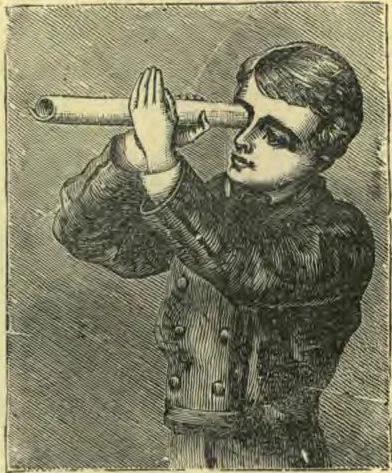
THE TELESCOPE

Written for the INSTRUCTOR.

THE TELESCOPE.

“Father,” said Frank one evening, “this afternoon as I was coming home after school, I stopped at the bookstore and bought a large sheet of drawing-paper for my lesson to-morrow.”
“It was tied up in a roll, and when I had come home and taken off the string, it still stayed rolled up. So I began to play with the tube,—to look through it and talk through it, and then Effie talked to me through it. We were very sure that a whisper through it sounded as plain as words spoken aloud at the same distance without it. And we found, too, that by looking through it, we could seem to see plainer. Now we did not know what to think of this, and so thought we would ask you to tell us about it when you came home.”
“Well, my children,” said Mr. Bruce, “you have found out some very interesting things. You are still too young to fully understand the principle of them, but I will tell you that the tube is said to gather the waves of sound and the rays of light, and keep them from scattering, so they are brought to your ear and eye more directly than they would be if you heard and looked without the tube. When you are older, you will be able to read and study into these things, and understand all about them.”
“And now I will tell you a little story which your discovery this afternoon brings to my mind. Nearly three hundred years ago, in a country far over the seas from here, lived a poor man who made spectacles, or eyeglasses, for a living. One day he was working in his shop, and his children were there with him, playing about and amusing themselves with his tools, though I hope they were not meddling with things their father did not want them to have. All at once the little girl said,—
“‘O papa! see how near the church steeple comes.’”
“The child had two of the lenses, or little round pieces of glass which go in the spectacles, one in each hand; and her father found by holding them, one behind the other as she did, and looking through them both, that the church steeple did seem to be brought into their very faces. He then made a tube of pasteboard, and set these lenses in it in such a way as to give this effect every time. Soon after, he made a better one, and took it to the ruler of the country, who thought it was a very nice thing. So this poor spectacle-maker came to be the inventor of the telescope, which he called ‘an instrument by means of which to see at a distance.’ The telescope has since been improved until it is a wonderful instrument; and without it men could not see the sun, moon, and stars, and tell us so many interesting things about them, as they do. Some clear evening I will take you to the observatory of the high-school building, and let you look through a telescope, and then you will better understand what it is.”
“Well,” said Effie, when her father was done, “it was the little girl who first found out about it anyway; and maybe, Frank, you and I will some day find out something new that nobody knows.”
“You may not be likely to do that,” said their father, “but if you keep your eyes open, you may learn some very useful things in a pleasant way, which will be a help to you when you are older and come to study about all these things.”
E. B. G.

Publishers' Column.

WORKERS WANTED!

The Instructor should have a great many more readers than it has at the present time. Filled as it is every week with a great variety of excellent reading matter suited to the wants of children and youth, and being free from the sensational trash in which so many so-called youth's papers abound, our paper should go to ten subscribers where it now visits one. And this might be accomplished, if the proper efforts were put forth. To help in attaining this end, we make the following—

Special Premium Offer.

For every new subscription, accompanied with 85 cents, we will give—

THE SUNSHINE SERIES,

consisting of a package of ten beautiful pamphlets of 32 pages each. These comprise a choice collection of sketches, stories, poems, etc., adapted to the wants of children, and contain more reading matter than can be found in many dollar books.
Our young friends will certainly be able to obtain many new subscriptions by calling the attention of their schoolmates and friends to this liberal offer. For only 10 cents in addition to the regular subscription price, each new subscriber obtains the paper one year and the above mentioned valuable premium. Will not each one of our readers determine to obtain at least one new subscriber to the Instructor the present season? Many can accomplish more than this. Let all do something.
As an inducement to our readers to begin this work of gathering in subscribers, we publish the following—

LIST OF PRIZES,

To agents and canvassers who obtain new subscribers to the Instructor either at full subscription price, 75 cts. without the premium, or 85 cts. with the premium.
For THREE NEW SUBSCRIBERS, your choice of either of the following books:—
Rules for Daily Life, Scripture text for every day in the year, with a verse of poetry, 25
Daily Bread, 25
Revised New Testament, flexible, 25
Advent Keepsake, 25
Child's Poems, 25
For SIX NEW SUBSCRIBERS, your choice of either of the following books:—
Sabbath Readings, Vol. 1, 60
Smith's Diagram of Parliamentary Rules, 50
Blanche Gamond, a Heroine of Faith, 45
Charlotte Elizabeth, 45
May Coverly, 60
For TEN NEW SUBSCRIBERS, your choice of either of the following books:—
Revised New Testament, both versions on opposite pages, 75
Life of St. Paul, by Conybeare and Howson, 1 00
For FIFTEEN NEW SUBSCRIBERS, your choice of either of the following books:—
Giant Cities of Bashan, $1 25
Bunyan's Pilgrim's Progress, illustrated, and elegantly bound, Porter and Coates' edition, $1 50
For TWENTY NEW SUBSCRIBERS:—
Cruden's Complete Concordance, $1 75
For TWENTY-FIVE NEW SUBSCRIBERS:—
Oxford Teacher's Bible, No. 502, pearl type, round corners, gilt edges, $2 25
The prizes and premium will be furnished by us if the money and subscriptions are sent directly to this Office; but if the business is done through the Tract Society, the State secretary of said society will furnish them.
Any person working for a prize must state his intention when the first subscriptions are sent, that an account may be kept of the names.
A canvasser's outfit, consisting of sample copies of the Instructor, circulars describing the paper, and a set of the Sunshine Series, will be mailed for 35 cents to those who wish to work for the paper.
We trust that many will begin this work at once. Who will be the first?
PUBLISHERS.

Letter Budget.

EDITH STONE writes from Clyde, Ohio: “I have been thinking all winter that I would write a letter for the INSTRUCTOR. I love the Sabbath-school very much. There are eight scholars in my class, and I think we have a very nice teacher. I am nine years old. I had a brother named Rolla, but he died when he was nine years old, and has been dead two years. I have a brother Walter five years old and a sister Verna two years old. I think everything of the INSTRUCTOR. I do want to be a real good girl so that when Jesus comes, I can go to heaven and see my brother.”
RALPH BRIGGS says: “I am eleven years old. The INSTRUCTOR has been a welcome visitor in our family for nine years, but I have never written for it before. I have commenced to keep the Sabbath with my mother, and am trying to be a good boy. I am reading my Testament through. I got my leg hurt while coasting on the ice, and have had to stay in the house, under the doctor's care, for a month. I have four brothers and one little sister three years old. We have had the paper come in all our names.”
MARY and JOSE LEWIS write from Farnham, Richmond Co., Va.: “We have taken the INSTRUCTOR four years, and think it a very instructive paper. We thought we would like to see our names in it too. We have a little Sabbath-school of thirteen members. We send our love to the INSTRUCTOR family, and hope we may all be ready to meet the Lord when he comes.”
CARRIE HILL writes from Grenola, Kansas: “Our superintendent wanted to know how many of the children of our Sabbath-school would write for the ‘Budget,’ and I promised him I would write. I am nine years old. I have two sisters, Lulu and Emma. I was baptized at camp-meeting this fall, and am trying to be a good girl.”

A SHORT SERMON.

Children who read my lay, Thus much I have to say: Each day, and every day, Do what is right! Right things, in great and small; Then, though the sky should fall, Sun, moon, and stars, and all, You shall have light!
This further I would say: Be you tempted as you may, Each day, and every day, Speak what is true! True things in great and small; Then, though the sky should fall, Sun, moon, and stars, and all, Heaven would show through.
Figs, as you see and know, Do not of thistles grow; And though the blossoms blow White on the tree, Grapes never, never yet On the limbs of thorns were set; So, if you a good would get, Good you must be!
Life’s journey, through and through, Speaking what is just and true; Doing what is right to do Unto one and all, When you work and when you play, Each day, and every day; Then peace shall gild your way, Though the sky should fall.
—Alice Cary.

You have reached the end of this edition.

The Youth’s Instructor · Feb 14, 1883