The Youth’s Instructor, Vol. 31, No. 7.

THE SNOW-BIRD’S LESSON

The Youth’s Instructor

Feb 14, 1883

S. D. A. Publishing Association · Battle Creek, Mich. · Feb 14, 1883

THE SNOW-BIRD’S LESSON.
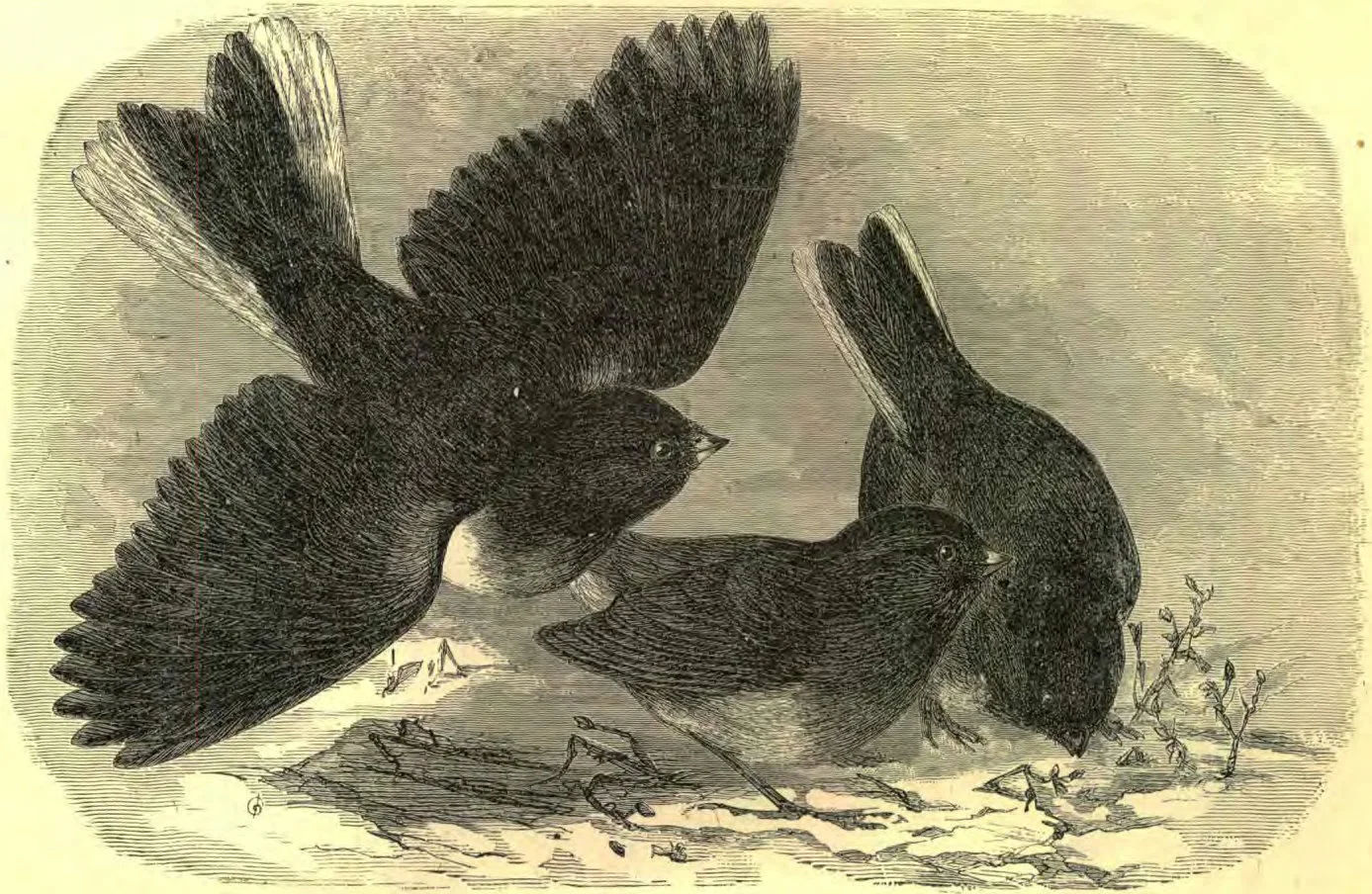
OH! what will become of thee, poor little bird? The muttering storm in the distance is heard; The rough winds are waking, the clouds growing black— They’ll soon scatter snow-flakes all over thy back! From what sunny clime hast thou wandered away? And what art thou doing this cold winter day?
“I’m picking the gum from the old peach-tree; The storm doesn’t trouble me. Chee, dee, dee.”
But what makes thee seem so unconscious of care? The brown earth is frozen, the branches are bare; And how canst thou be so light-hearted and free, As if danger and suffering thou never should’st see, When no place is near for thy evening nest, No leaf for thy screen, for thy bosom no rest?
“Because the same hand is a shelter to me, That took off the summer leaves. Chee, dee, dee.”
But man feels a burden of care and of grief, While plucking the cluster and binding the sheaf. In the summer we faint, in the winter we’re chilled, With ever a void that is yet to be filled. We take from the ocean, the earth, and the air, Yet all their rich gifts do not silence our care.
“A very small portion sufficient will be, If sweetened with gratitude. Chee, dee, dee.”
I thank thee, bright monitor; what thou hast taught Will oft be the theme of the happiest thought; *We look at the clouds; while the birds have an eye To Him who reigns over them, changeless and high.* And now, little hero, just tell me thy name, That I may be sure whence my oracle came.
“Because, in all weather, I’m merry and free, They call me the Winter King. Chee, dee, dee.” —Miss Gould.

SNOW-BIRDS

When the wintry winds have driven away all the summer songsters, how our hearts are cheered by the coming of the snow-birds! And well do they merit their name; for they come with the snow and leave when it goes. Sometimes the snow has all melted, and we think our winter friends have taken their journey north; when lo! out of their hiding-places in the woods will come a whole family of them, fluttering about the hedge, and hopping about the barn-yard, and up to the doors and windows of the house, with their “cheep, cheep.” Then we know that a snowstorm is on the way, for the little fellows are reliable weather prophets, in this respect at least.
Snow-birds are found in the United States from New England on the east to the Missouri River on the west, and as far south as Louisiana. Although so small, they endure very severe cold. Indeed, they seem to prefer it; for they remain all summer in the frozen regions of the north, and while there, raise their young. But in early winter they come south, probably as much to obtain food as to escape the cold. They journey in small families, and but one family will inhabit the same neighborhood at once. At first they are somewhat shy, staying in the edge of the woods; but as the cold increases, they approach the farmhouses and villages in diligent search of food. They are very fond of grass seeds and berries. When the cold is very severe, they often stay hidden in hay-stacks. The picture gives a better opportunity of studying their form and appearance than one easily gets by watching them as they hop and flutter about the yard.

THIRTY SECONDS TOO LATE.

REV. MR. BELL was always punctual. Whoever might be late at meeting, at the funeral, or anywhere else, they all knew that Mr. Bell would not. If called to attend a wedding, his foot was on the door-step and his hand on the bell-handle when the clock was striking the hour. It was, at first, quite annoying to his flock to go, according to their old habits, to a funeral, and meet it on its way to the grave, or to go to a wedding, and find it all over before they thought of getting there. So old Mr. Slow waited on the minister to ask him why he “was always in such a hurry, and so afraid of being too late.”
“Well, my good friend, I will tell you; and if, after hearing me, you do not think I am right in this thing, I will try to alter.”
“That’s surely fair,” slowly said Mr. Slow, as if afraid to commit himself.
“When I was a young man, and had been preaching only a few months, I was invited to go to a distant mountain town and preach to a destitute people. I was there for some weeks, and then returned home for a few days, promising to be back, without fail, the next Sabbath. Well, I had a pleasant week among my kind relatives, and was so engaged that I hardly thought of my solemn duties till the day before the Sabbath came, and then my sister and a beautiful friend of hers persuaded me to go out a little while in a small boat, Cinderella, on our beautiful lake. The day was fine, and the Cinderella spun and darted under my oars as if a thing of life. When we got ashore, I found it two o’clock, and I knew the cars would start in fifteen minutes.
“I left the ladies, and ran home and caught up my carpet-bag, and ran for the depot. I saw the cars had arrived. I heard the bell ring. With all my strength I ran. I saw them start. I redoubled my efforts, and got within fifteen feet of the cars! Oh, for thirty seconds more! Thirty seconds too late! No more! The next day was a fair, still, sweet Sabbath. My mountain people gathered, coming down from the glens and following the rills, and filled the house of worship. But there was no minister, and the hungry sheep had no shepherd to feed them. He was thirty seconds too late!
“There was a poor old blind man, who lived four miles from the church, and seldom could get to meeting. That day he ate his breakfast early, and his little granddaughter led him all the way down the mountain to the church. How weary, sad, and disappointed he was! There was no minister to speak to him. He was thirty seconds too late!
“There was a sick child up one of the glens of the mountain, and she had been inquiring all the week for her minister. She was so anxious to see him and have him pray with her. How she hailed the day when he would be there! He was thirty seconds too late!
“That poor old blind man never came to the church again. He was too feeble, and never heard another sermon or prayer. The minister was thirty seconds too late!
“That little girl was dead before I got back, and I could only shed tears over her corpse. I had been thirty seconds too late!
“On my bended knees I asked God’s forgiveness, and promised him that, if possible, I would never again be thirty seconds too late.
“And now, Mr. Slow, am I right in my punctuality?”
“Well, I guess it don’t look quite so unreasonable as it might!”
And if it is not well to put off the things of life, is it safe to put off the preparation for eternity? Death will be a punctual visitor, reader.—Selected.

Heaven's Mercy in Hiding the Future

ONE of the kindest things Heaven has done for man is denying him the power of looking into the future.

THE ENERGY THAT SUCCEEDS.

The energy that wins success begins to develop very early in life. The characteristics of the boy will commonly prove those of the man, and the best characteristics of young life should be encouraged and educated in the wisest possible manner. The following story strongly illustrates this truth.
About thirty years ago, said Judge P——, I stepped into a bookstore in Cincinnati in search of some books that I wanted. While there, a little ragged boy of twelve years of age came in and inquired for a geography.
“Plenty of them,” was the salesman’s reply.
“How much do they cost?”
“One dollar, my lad.”
“I did not know they were so much.”
He turned to go out, and even opened the door, but closed it again, and came back.
“I’ve got sixty-one cents,” said he; “could you let me have a geography, and wait a little while for the rest of the money?”
How eagerly his little bright eyes looked for an answer, and how he seemed to shrink within his ragged clothes, when the man, not very kindly, told him he could not. The disappointed little fellow looked up at me with a very poor attempt to smile, and left the store. I followed and overtook him.
“And what now?” I asked.
“Try another place, sir.”
“Shall I go, too, and see how you succeed?”
“O yes, if you like,” he said in surprise.
Four different stores I entered with him, and each time he was refused.
“Will you try again?” I asked.
“Yes, sir; I shall try them all, or I should not know whether I could get one.”
We entered the fifth store, and the little fellow walked up manfully and told the gentleman just what he wanted and how much he had.
“You want the book very much?” asked the proprietor.
“Yes, very much.”
“Why do you want it so very much?”
“To study, sir. I can’t go to school, but I study when I can at home. All the boys have got one, and they will get ahead of me. Besides, my father was a sailor, and I want to learn of the places where he used to go.”
“Well, my lad, I will tell you what I will do; I will let you have a new geography, and you may pay me the remainder of the money when you can, or I will let you have one that is not quite new for fifty cents.”
“Are the leaves all in it, and just like the other, only not new?”
“Yes, just like the new one.”
“It will do just as well, then, and I will have eleven cents left towards buying some other books. I am glad they did not let me have one at the other places.”
Last year I went to Europe on one of the finest vessels that ever plowed the waters of the Atlantic. We had beautiful weather until very near the end of the voyage; then came a terrible storm that would have sunk all on board had it not been for the captain. Every spar was laid low, the rudder was almost useless, and a great leak had shown itself, threatening to fill the ship. The crew were all strong, willing men, and the mates were all practical seamen of the first class; but after pumping for one whole night, and the water still gaining upon them, they gave up in despair, and prepared to take to the boats, though they might have known no small boat could live in such a sea.
The captain, who had been below with his chart, now came up. He saw how matters stood, and with a voice that I distinctly heard above the roar of the tempest, ordered every man to his post.
“I will land you safe at the dock in Liverpool,” said he, “if you will be men.”
He did land us safely; but the vessel sank moored to the dock. The captain stood on the deck of the sinking vessel, receiving the thanks and blessings of the passengers as they passed down the gang plank. As I passed, he grasped my hand and said,—
“Judge P——, do you recognize me?”
I told him I was not aware that I ever saw him until I stepped aboard of his vessel.
“Do you not remember that boy in Cincinnati?”
“Very well, sir; William Haverly.”
“I am he,” he said. “God bless you!”
And God bless noble Captain Haverly.—Selected.

Rules of Good Manners and Courtesy

NEVER give promises that you cannot fulfill. Never laugh at the misfortunes of others. Never send a present, hoping for one in return. Never fail to be punctual at the time appointed. Never make yourself the hero of your own story. Never make much of your own doings. Never fail to give a polite answer to a civil question. Never read letters which you may find addressed to others. Never question a servant or child about family matters.

TOO BUSY TO FREEZE.

How swiftly the glittering brook runs by, Pursuing its busy career, Reflecting the beams of the cheerful sun, In waters transparent and clear; Kissing the reeds and the lowly flowers; Refreshing the roots of the trees; Happy all summer to ripple a song, In winter too busy to freeze.
Onward it glides, whether sunshine or storm Await on its vigorous way, And prattles of hope and sustaining love, Whether bright or cloudy the day. Chill Winter around may his torpor fling, And on lazier waters seize; But the nimble brook is too much for him, Being far too busy to freeze.
May we, like the brook, in our path through life, As active and steady pursue The course in which real utility lies— Which is lovely and useful, too; Still nourish the needy, refresh the sad, And, despising indulgent ease, Adorn life's current with generous work, With love that's too busy to freeze!
—Selected.

GOOD WORK OR NONE.

It is a rule that a workman must follow his employer’s orders, but no one has a right to make him do work discreditable to himself. Judge M——, a well-known jurist, living near Cincinnati, loved to tell the anecdote of a young man who understood the risk of doing a shabby job, even when directed to. The Judge had on one occasion to send to the village after a carpenter, and a sturdy young fellow appeared with his tools.
“I want this fence mended to keep out the cattle. There are some unplaned boards—use them. It is out of sight from the house, so you need not take time to make it a neat job. I will only pay you a dollar and a half.”
The Judge then went to dinner, and coming out, found the man carefully planing each board. Supposing that he was trying to make a costly job of it, he ordered him to nail them on at once just as they were, and went to his business. When he returned, the boards were all planed and numbered, ready for nailing.
“I told you this fence was to be covered with vines,” he said angrily. “I do not care how it looks.”
“I do,” said the carpenter, gruffly, carefully measuring his work. When it was finished, there was no part of the fence so thoroughly done.
“How much do you charge?” asked the Judge.
“A dollar and a half,” said the man, shouldering his tools.
The Judge started. “Why do you spend all that labor on the job, if not for money?”
“For the job, sir.”
“Nobody would have seen the poor work on it.”
“But I should have known it was there. No, I’ll take only a dollar and a half.” And he took it and went away.
Ten years afterward the Judge had the contract to give for the building of several magnificent public buildings. There were many applicants among master builders, but the face of one caught his eye. “It was my man of the fence,” he said. “I knew we should have only good, genuine work from him. I gave him the contract, and it made a rich man of him.”
It is a pity that boys are not taught in their earliest years that the highest success belongs only to the man, be he carpenter, farmer, author, or artist, whose work is most sincerely and thoroughly done.—Living Age.

Cicero on Persisting in Mistakes

ANY man may commit a mistake, but none but a fool will continue in it.—Cicero.

SCENES IN THE LIFE OF CHRIST.

LESSON 108.—JESUS ON THE CROSS.

“And when the sixth hour was come, there was darkness over the whole land until the ninth hour. And at the ninth hour Jesus cried with a loud voice, saying, Eloi, Eloi, lama sabachthani? which is, being interpreted, My God, my God, why hast thou forsaken me? And some of them that stood by, when they heard it, said, Behold, he calleth Elias.”
“After this, Jesus knowing that all things were now accomplished, that the scripture might be fulfilled, saith, I thirst.” “And one ran and filled a sponge full of vinegar, and put it on a reed, and gave him to drink, saying, Let alone; let us see whether Elias will come to take him down.” “And when Jesus had cried with a loud voice, he said, Father, into thy hands I commend my spirit; and having said thus, he gave up the ghost.”
“And, behold, the veil of the temple was rent in twain from the top to the bottom; and the earth did quake, and the rocks rent; and the graves were opened; and many bodies of the saints which slept arose, and came out of the graves after his resurrection, and went into the holy city, and appeared unto many. Now when the centurion, and they that were with him, watching Jesus, saw the earthquake, and those things that were done, they feared greatly, saying, Truly this was the Son of God.”
“The Jews therefore, because it was the preparation, that the bodies should not remain upon the cross on the Sabbath-day, (for that Sabbath-day was an high day,) besought Pilate that their legs might be broken, and that they might be taken away. Then came the soldiers, and break the legs of the first and of the other which was crucified with him. But when they came to Jesus, and saw that he was dead already, they break not his legs; but one of the soldiers with a spear pierced his side, and forthwith came there out blood and water. And he that saw it bare record, and his record is true; and he knoweth that he saith true, that ye might believe. For these things were done, that the scripture should be fulfilled, A bone of him shall not be broken. And again another scripture saith, They shall look on him whom they pierced.”
“And now when the even was come, because it was the preparation, that is, the day before the Sabbath, Joseph of Arimathæa, an honorable counsellor, which also waited for the kingdom of God, came, and went in boldly unto Pilate, and craved the body of Jesus. And Pilate marveled if he were already dead; and calling unto him the centurion, he asked him whether he had been any while dead. And when he knew it of the centurion, he gave the body to Joseph. And he bought fine linen, and took him down, and wrapped him in the linen, and laid him in a sepulchre which was hewn out of a rock, and rolled a stone unto the door of the sepulchre.”
“And the women also, which came with him from Galilee, followed after, and beheld the sepulchre, and how his body was laid. And they returned, and prepared spices and ointments; and rested the Sabbath-day according to the commandment.”
“Now the next day, that followed the day of the preparation, the chief priests and Pharisees came together unto Pilate, saying, Sir, we remember that that deceiver said, while he was yet alive, After three days I will rise again. Command therefore that the sepulchre be made sure until the third day, lest his disciples come by night, and steal him away, and say unto the people, He is risen from the dead; so the last error shall be worse than the first. Pilate said unto them, Ye have a watch; go your way, make it as sure as ye can. So they went, and made the sepulchre sure, sealing the stone, and setting a watch.”

QUESTIONS.

1. Describe the noonday darkness that came upon the earth while Jesus was upon the cross. Mark 15 : 33.
2. How long did this darkness continue?
3. What happened about three o’clock in the afternoon? Verse 34.
4. What is the meaning of these words?
5. Did those who stood by understand their meaning?
6. What did some of them think he meant?
7. How did Jesus afterward speak of his suffering? John 19 : 28.
8. What was then done by one who stood by? Mark 15 : 36.
9. What was said as the drink was given to him?
10. What did Jesus then utter with a loud voice? John 19 : 30; Luke 23 : 46.
11. What were his last words? Luke 23 : 46.
12. Tell how he expired. John 19 : 30.
13. What remarkable things happened at the time when Jesus died? Matt. 27 : 51-53.
14. How were the centurion and soldiers affected by these things?
15. What did they say?
16. As the Sabbath drew on, what favor did the Jews ask of Pilate? John 19 : 31.
17. How was their wish carried out?
18. What did they do to Jesus?
19. What scripture was thus fulfilled?
20. On what day of the week was Jesus crucified? Mark 15 : 42.
21. Who came to Pilate just at evening, and asked for the body of Jesus?
22. What made Pilate marvel?
23. How did he satisfy himself that Jesus was really dead?
24. What did Joseph do when Pilate had given him the body of Jesus?
25. Who followed and watched Joseph? Luke 23 : 55.
26. What did they afterward do?
27. Who made Pilate a visit on the Sabbath-day? Matt. 27 : 62.
28. What did they say they remembered?
29. What request did they make?
30. What did Pilate say?
31. How did they then secure the body of Jesus so that it could not be stolen?
Continue reading: NEW-TESTAMENT HISTORY SERIES