"Let the Revelation speak and tell what is truth. . . . Uplift Jesus as the center of all hope"
GOD'S LIVING HEAVENLY AGENCIES
Four Seals Broken
THE sealed book of Revelation 5 contained that which could only be opened by the sacrifice and victory of the Son of God. But as Christ won the victory in human flesh that we might win it by His dwelling in us (Heb. 5:7-9; 1 John 4:2, 4), as He died that we might be saved from sin and live in Him (2 Cor. 5:21; Gal. 2:20), so that book must contain the Good Tidings of God, the message of life to a dying world. It was that mystery which was "kept in silence through times eternal" till disclosed by the sacrifice and victory of Christ Jesus our Lord. Rom. 16:25; Col. 1:26, 27. It existed in prophecy and promise from the time that God brought hope to our first parents till Jesus our Saviour "abolished death, and brought life and immortality to light through the Gospel." 2 Tim. 1:10.
Just as long as that mystery existed in promises there was room at least for trembling, halting faith. Man sinned and died. Man by God's grace overcame sin and died. Generation after generation passed away, century after century was tolled off by the great bell of time, and still wickedness and corruption continued and extended their dominion as humanity increased. The graves did not open, the enemy and usurper loosed not his prisoners, bound in the narrow cells of the cold tombs. Would evil eternally triumph? Had "God clean forgotten?" True, the power of sin and death had been broken by the ascension of Enoch in the patriarchal age and Elijah in the Levitical; and now and then one had been brought back from the cold embrace of death to temporal life. But in present distresses, calamities, sore trials, persecutions, these incidents were forgotten; and devout men asked God, "How long shall the wicked triumph?" And when they looked at their own pitiful case they cried in despairing agony, "For Thy sake we are killed all the day long; we are accounted as sheep for the slaughter." And as they saw the oppression and cruelty around them, the suffering of the righteous, the innocent, from agonized heart arose the pitiful question, "How long, O Lord, how long?"
Even the devil must have counted on victory when the Seed became flesh, the Son of the woman. Through all the ages had Satan been practising on the deception and overthrow of souls, that he might deceive, ensnare, entrap, drive to despair the Second Adam, who was to come in all the weakness of humanity.
That very spirit the demons spread abroad in humankind; and when the Son of God came in voluntary abasement in the stead and for the sake of man, His own
rejected Him, and at last put Him to death who voluntarily "poured out His soul" to save them and all sinners. Satan and his legions held high carnival when the Man of Sorrows was locked in the Roman sealed sepulcher; and yet the devil must have doubted his own triumph as he remembered that never once had the Man yielded to temptation, never once had He sinned.
John's weeping in vision was a figure of the disappointed ones as Jesus died. But the peoples of earth had meditated a vain thing; and all counsel "against Jehovah, and against His Anointed," was a thing of naught. "He that sitteth in the heavens shall laugh: the Lord shall have them in derision." And the Father declares, "Yet [despite their counsel] have I set My King upon My holy hill of Zion;" and that King responds: "I will declare the decree: the Lord hath said unto Me, Thou art My Son; this day have I begotten Thee. Ask of Me, and I shall give Thee the heathen for Thine inheritance, and the uttermost parts of the earth for Thy possession." (Read the whole of Psalm 2.)
All this the Lamb won by sacrifice, and became "worthy to open the book." The long doubts of the ages were solved to every loyal heart. Christ had conquered; Christ
"is risen." Let the doubters doubt, let the professed teachers criticize and throw doubt upon the Record they profess to regard; God and man and Book are triumphant. "Worthy is the Lamb."
But He has not yet come into the inheritance given Him. It is still held by rebellious and sinful and unsubmissive rulers. He is, however, regenerating souls and fitting them for that kingdom. He pleads with all to come, and the kingdom pleads for Him. Of this will we learn more as the seals are opened.
The Answer of the Text
[The answers to the questions are from the American Revised Version. Omitting questions, and disregarding sometimes the capital at the beginning and the period at the close of an answer, the text may be read continuously. In notes and comments both versions are used without designation.]
1. What occurred when the first seal was opened?
And I saw when the Lamb opened one of the seven seals, and I heard one of the four living creatures saying as with a voice of thunder, Come.
2. What response was there to the appeal?
And I saw, and behold, a white horse, and he that sat thereon had a bow.
3. What was given him?
And there was given unto him a crown.
4. What did he do?
And he came forth conquering, and to conquer.
5. What occurred when He opened the second seal?
And when He opened the second seal, I heard the second living creature saying, Come.
6. What was the response to the call?
And another horse came forth, a red horse.
7. What was the work of the rider, and what was given to him?
And to him that sat thereon it was given to take peace from the earth, and that they should slay one another: and there was given unto him a great sword.
8. What occurred when the third seal was opened?
And when He opened the third seal, I heard the third living creature saying, Come. And I saw, and behold, a black horse; and he that sat thereon had a balance in his hand.
9. What did a voice say?
And I heard as it were a voice in the midst of the four living creatures saying, A measure of wheat for a shilling, and three measures of barley for a shilling; and the oil and the wine hurt thou not.
10. What occurred when the Lamb opened the fourth seal?
And when He opened the fourth seal, I heard the voice of the fourth living creature saying, Come.
11. What followed in response?
And I saw, and behold, a pale horse: and he that sat upon him, his name was Death; and Hades followed with him. And there was given unto them authority over the fourth part of the earth, to kill with sword, and with famine, and with death, and by the wild beasts of the earth.
7
Note and Comment
1. One of the four living creatures, the first, the lion, indicated also by the voice of thunder, emblem of power and majesty. Come.—Not "Come and see." The best Greek texts have "Come." John was already seeing. It was not a curiosity exhibition; it was an invitation. To whom? Is not the answer furnished by numerous passages in the book? "Him who is and who was and who is to come." 1:4, 8; 4:8. "Behold, He cometh." 1:7. "I come quickly." 3:11; 22:20. "Come, Lord Jesus." 22:20. It is creation's groaning, agonizing appeal echoed by this divine agency, the living creature, for the coming of the Just One, for the close of sin's reign, for "the manifestation of the sons of God." See Rom. 8:19, 22, 23.
2. A white horse.—Horse is a symbol of war in the Scriptures. White signifies purity and righteousness. The Roman commanders rode white horses in their triumphs. A bow.—An instrument of war, a direct reference perhaps to Hab. 3:8, 9, where God is represented as riding forth for the salvation of His people.
3. A crown.—The rider was a conqueror, one who had won the right to reign; a crown was placed upon his head. His career was a conquering one.
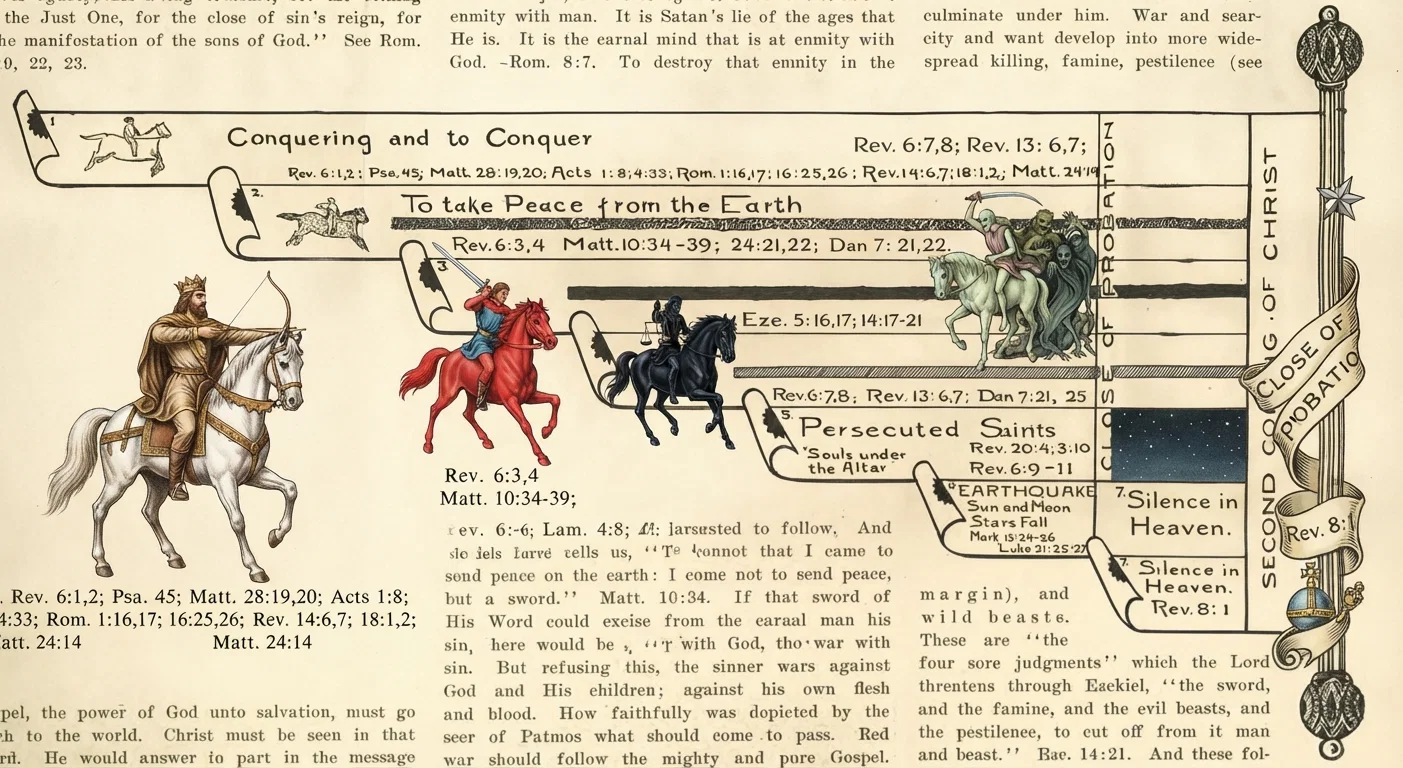
4. Conquering, and to conquer.—The Bible student has already concluded that this rider is a symbol of Jesus Christ in His Gospel. He can not yet answer the invitation, "Come." A work must be done yet among the sons of men. The Gospel, the power of God unto salvation, must go forth to the world. Christ must be seen in that Word. He would answer in part in the message of a risen victorious Christ for the salvation of men. The imagery is not akin to that of the conquering horses of Zechariah, but has direct reference to that prophecy of Christ in Psalm 45:
"My heart overfloweth with a goodly matter;
I speak the things which I have made touching the King:
Thou art fairer than the children of men;
Grace is poured into Thy lips;
Therefore God hath blessed Thee forever.
Gird Thy sword upon Thy thigh, O Mighty One,
Thy glory and Thy majesty.
And in Thy majesty ride on prosperously,
Because of truth and meekness and righteousness:
And Thy right hand shall teach Thee terrible things.
Thine arrows are sharp;
The peoples fall under Thee;
They are in the heart of the King's enemies.
Thy throne, O God, is forever and ever:
A scepter of equity is the scepter of Thy kingdom.
Thou hast loved righteousness, and hated wickedness:
Therefore God, Thy God, hath anointed Thee
With the oil of gladness above Thy fellows."
To all earth goes the mighty healing message of His Gospel, not for a little time, but till He shall respond in full to the invitation, "Come." His arrows in the heart of the sinner arouse conviction; and surrender to Him means salvation. Men may turn from and pervert that Gospel in their own heart, but it has gone and will again go in the closing days of earth's struggles in all its early power and purity. Rev. 14:6, 7. And the Master echoes the invitation to all earth's needy, burdened ones, "Come unto Me."
5. The second seal.—As each of these seals is opened, enough of the scroll of the vision is unrolled that we may discern its character. The second living creature, the calf, or ox. It speaks of sacrifice, of patience, of service. The invitation is still, "Come."
6. A red horse, the symbolic color of war, strife; the color of blood. See Zech. 6:1-8. Note the horses and the four winds, symbolic of strife. Yet God overruled all for good. Verse 8.
7. To take peace.—If the mission and message of the first rider had been received, the second rider would not have gone forth. There is no war message in the Gospel, save that against sin. God is not at enmity with man. It is Satan's lie of the ages that He is. It is the carnal mind that is at enmity with God. Rom. 8:7. To destroy that enmity in the flesh and bring man to peace with God, the Gospel is given, Jesus Christ came. Eph. 2:14, 15. But if the rebellious heart will not give up the sin, will retain its enmity against God, fierce carnal strife is bound to follow. And so the Lord tells us, "Think not that I came to send peace on the earth: I came not to send peace, but a sword." Matt. 10:34. If that sword of His Word could excise from the carnal man his sin, there would be peace with God, the war with sin. But refusing this, the sinner wars against God and His children; against his own flesh and blood. How faithfully was depicted by the seer of Patmos what should come to pass. Red war should follow the mighty and pure Gospel. Men should "slay one another." The great sword of bloodshed would eclipse the sword of the Spirit of the white-horse rider. How faithfully the centuries have fulfilled the prediction, in strife and war between nations, within nations; strife and war for religion's sake! Think of the myriads that have fallen in the name of Christ Jesus the Prince of Peace! God has permitted it that man might see how evil is his own way. No wonder the living creature of sacrifice calls to the glorious King of righteousness and peace, "Come."
8. Third living creature, with the face of the man, the calculating, planning creature; referring to God's work, indicating wisdom, and suggesting the Man Christ Jesus. And the appeal is again, Come. A black horse.—Black is a symbol of want, famine, mourning. "Judah mourneth, and the gates thereof languish, they sit in black upon the ground." See Jer. 14:2-6. Balance.—Weighing; justice, scarcity, both are implied.
9. As it were a voice.—Not perhaps an actual voice, but the demand of actual conditions, demanding the instruction which followed, God speaking in His providence. So He spoke to Moses of old from between the cherubim. A measure of wheat.—A choenix, about a quart of wheat for seventeen cents; in our time a bushel for $5.40, indicating great scarcity. Usually from 15 to 20 measures were given for a "penny," or shilling, the price of a day's work. Oil and wine, the luxuries specially needed by the sick to be spared. In wrath God remembers mercy. By the scarcity of food and the necessities of life, always consequent on transgression, God would call His children back to Him; and these very conditions in the earth call for the coming of Him whose reign is peace and plenty.
10. The fourth living creature.—The flying eagle, indicating here perhaps swiftness of judgment.
11. A pale horse.—"That greenish pallor which we know as livid; the color of the corpse in incipient decay, or the complexion extremely pale through disease."—Alford. The rider is Death personified. Hades, the grave, with its ever-hungry maw for the victims of death, is represented as a monster following the work of death. The fourth part.—Four is the earth number. Death is one of the four riders. The ills of the second and third riders culminate under him. War and scarcity and want develop into more widespread killing, famine, pestilence (see margin), and wild beasts. These are "the four sore judgments" which the Lord threatens through Ezekiel, "the sword, and the famine, and the evil beasts, and the pestilence, to cut off from it man and beast." Eze. 14:21. And these followed transgression as of old. Apostasy brought union of Church and State, and Christendom was cursed by persecution and war. "Heretics" were slain by the myriads. Mohammedans scourged without pity the apostate church; pestilence followed war, and millions so died. Even now scores of thousands die in India every year from wild beasts. How much greater must have been the number of victims before firearms were invented in all parts of the world. And the "wild beasts" (therion) may be symbolical of Church and State persecuting governments, the wild beasts (the same Greek word) of Rev. 13:1, 11; 17:3. Fearful was the slaughter, the crimes against God and humanity, the results of sin during the long Dark Ages. No wonder there came the cry to the Master and Victor of all, Come. The groaning, suffering creation, wounded to its very heart by sin, cries to the Deliverer in a fourfold voice of power, suffering, agony, and terror, Come, COME, COME, COME. Surely, He will come sometime in His glory, and end the sad living picture forever; but not yet. In the meantime the horses and their riders drive on. But over all and through all and in all earth's strife and suffering, may be heard by the intent longing soul the voice of the compassionate Christ, who waits in patience the wisest time, "the fulness of time," to come unto His own, pleading with the burdened, weary ones of earth, "Come unto Me, . . . and I will give you rest."
1. And I saw when the Lamb opened one of the seals, and I heard, as it were the noise of thunder, one of the four beasts saying, Come and see.
2. And I saw, and behold a white horse: and he that sat on him had a bow; and a crown was given unto him: and he went forth conquering, and to conquer.
3. And when He had opened the second seal, I heard the second beast say, Come and see.
4. And there went out another horse that was red: and power was given to him that sat thereon to take peace from the earth, and that they should kill one another: and there was given unto him a great sword.
5. And when He had opened the third seal, I heard the third beast say, Come and see. And I beheld, and lo a black horse; and he that sat on him had a pair of balances in his hand.
6. And I heard a voice in the midst of the four beasts say, A measure of wheat for a penny, and three measures of barley for a penny; and see thou hurt not the oil and the wine.
7. And when He had opened the fourth seal, I heard the voice of the fourth beast say, Come and see.
8. And I looked, and behold a pale horse: and his name that sat on him was Death, and Hell followed with him. And power was given unto them over the fourth part of the earth, to kill with sword, and with hunger, and with death, and with the beasts of the earth.
Disagreement Is Not Enmity
A MAN is not necessarily my enemy because he disagrees with me; his disagreement may be the evidence of his friendship.
Lessons in Liberty
By W. M. Healey
By W. M. Healey
VII. Personal Responsibility
HUMAN responsibility toward God centers in the individual. Obtaining or losing eternal life is a matter of personal choice and effort. It is true that sin and death have come upon the human family, and the individual has no choosing in the nature that he is to inherit; but Jesus Christ came that each individual might have liberty.
“For if by one man’s offense death reigned by one; much more they which receive abundance of grace and of the gift of righteousness shall reign in life by one, Jesus Christ.” Rom. 5:17.
There is no offer of this liberty to any special class or nationality. “There is neither Jew nor Greek, there is neither bond nor free, there is neither male nor female: for ye are all one in Christ Jesus.” Gal. 3:28. God taught this truth to Peter to fit him for his mission to Cornelius and his people: “Then Peter opened his mouth, and said, Of a truth I perceive that God is no respecter of persons; but in every nation he that feareth Him, and worketh righteousness, is accepted with Him.” Acts 10:34, 35.
“And whosoever will, let him take the water of life freely.” Rev. 22:17.
“Behold, I stand at the door, and knock; if any man hear My voice, and open the door, I will come in to him, and will sup with him, and he with Me.” Rev. 3:20.
From the creation of man God has been teaching him this lesson of personal trust, personal responsibility, personal choice, and a personal reward or punishment. “So then every one of us shall give account of himself to God.” Rom. 14:12.
“National Reformers,” as the name implies, propose to reform the nation. This might be well in matters of civil law, in temperance, in social relations, in fact in all matters of the relation of one to another. But the work of these so-called “Reformers” is not confined to these issues, but they propose to reform the nation religiously. This, also, is no doubt a good work; but the method which they propose to use is not God’s way. God would have the truth taught to every “creature,” and then leave each to choose, or refuse, to worship Him. The “Reformers” propose to define what shall be done in worshiping God, and then leave no choice in the matter. A sample of their present work is found in their demand for Sunday laws to compel the nation to regard this institution of worship.
Have these “Reformers” never learned, or have they ignored the fact, that God does not accept of compulsory worship?
God does not compel any one to worship Him. Has He given into the hands of some men a power over other men which He Himself will not exercise?
These “Reformers” not only go beyond what the Lord has done in efforts to force worship, but they propose, by their laws, to take from man that which God has given to him,—the privilege of choice, by the individual, independent of what others may or may not do.
Thus spoke our Lord to His ministers: “Ye know that the princes of the Gentiles exercise dominion over them, and they that are great exercise authority upon them. But it shall not be so among you: but whosoever will be great among you, let him be your minister; and whosoever will be chief among you, let him be your servant: even as the Son of Man came not to be ministered unto, but to minister, and to give His life a ransom for many.” Matt. 20:25-28.
Liberty
By Golden-West Scot
By Golden-West Scot
To my native Scotland my fostering America, and all liberty lovers
WHEN first went forth Jehovah's word,
Creative power to employ,
And angels sang with one accord,
While all God's sons cried out for joy;
To wield His scepter, Righteousness,
Insure for ay each high decree
E'er made by Him — and that to bless —
God gave His offspring liberty.
Tho God's own law was writ on stone,
'Mid clouds through which man does not see,
'Tis godly fear and love, alone,
That makes for truth and loyalty.
And He who came since Sinai,
To live, then die on Calvary,
Our Father's law to magnify,
Still left us all our liberty.
Since Babel reared her daring pile,
Where human empires have held sway,
Strong minds have tried, by force and guile,
To take our liberty away.
And men have suffered — bled and died,
Or lonely exile braved — that we
Might yet in happiness abide,
Enjoying life and liberty.
Let all electors, everywhere,
Be vigilant continually,
Lest tyrants, tho they seem so rare,
Deprive us, now, of liberty.
Lend not your efforts to enact
Religious laws, whate'er they be;
Vote out such foes, preserve intact
Our country's ark — fair liberty!
"The powers that be" were not ordained
To teach us faith and piety;
But that oppression be restrained,
And justice meted equally.
We'll worship, therefore, whom we choose,
And when, and where, and how-so-free;
Give Cæsar, too, his proper dues;
But live, or die, with liberty!
No dragon laws our souls affright;
For He who is our hope and trust,
Shall bring to naught all beastly might,
For He is strong and pure and just.
And we are nearing that glad day
When earth's dark shadows all shall flee
Before each healing, bursting ray
Of life and love and liberty.
So, ye who think by human law
To bring Christ's kingdom speedily,
Know, God foretold, as He foresaw,
And brands each work "iniquity."
The task you take is worse than vain;
And in confusion you shall be,
When He shall come — Himself to reign —
The Author of our liberty.
Refrain
O liberty! Dear liberty!
Our precious God-gift, liberty!
O Lord, we lift our hearts to Thee,
And thank Thee, now, for liberty!
Long live liberty!
The Peace of God
By C. H. Bliss
By C. H. Bliss
“GREAT peace have they which love Thy law.” This peace is not an outward peace, such as the world gives. Says Jesus, “Peace I leave with you; My peace I give unto you: not as the world giveth, give I unto you.”
The world can not ease the guilty conscience. It can not quiet the troubled waters. It has nothing to offer. “The wicked are like the troubled sea, when it can not rest, whose waters cast up mire and dirt. There is no peace, saith my God, to the wicked.” But of the righteous it is said, “Thou wilt keep him in perfect peace, whose mind is stayed on Thee.” There are reasons why the Christian may enjoy such peace.
FIRST, God is our Father, and He is not only able but willing to supply all our needs. This was demonstrated by Christ, who represented the Father when He was on earth. He could feed a multitude in the wilderness with the five loaves and a few fishes. If necessary He could turn the stones into bread, or He could sustain life without natural food. He could gather money from the fish’s mouth. He could heal the sick and raise the dead. All nature was subject to His command.
SECOND, God rules and controls all things. “He doeth according to His will in the army of heaven, and among the inhabitants of the earth: and none can stay His hand.” “Declaring the end from the beginning, and from ancient times the things that are not yet done, saying, My counsel shall stand, and I will do all My pleasure.”
If these words of inspiration are true, then may we know of a surety “that all things work together for good to them that love God.” And the natural fruit of such faith is “quietness and assurance forever.” Isa. 32: 17.
THIRD, God knows His people. He knows their weakness. He knows every thought, and every desire of the heart. And tho they sin, He does not forsake them, for He loves them “with an everlasting love.” He says, “I will never leave thee, nor forsake thee;” and, “Tho he fall, he shall not be utterly cast down.”
In all this there is much peace and comfort. But if we would enjoy this peace in all its fulness, we must recognize God, not only as a loving Father, but as our rightful Sovereign, whose commands we are to obey. “This is the love of God, that we keep His commandments.” “O that thou hadst harkened to My commandments! then had thy peace been as a river, and thy righteousness as the waves of the sea.”
Full and complete submission to God, recognizing His guiding hand in all the affairs of life, believing that all things are working out for His glory and our eternal good, will bring such peace and calmness to the soul, that our cup of joy will be continually full and overflowing. Truly “Great peace have they which love Thy law: and nothing shall offend them.”
Is Faith Unreasonable?
By George A. Snyder
By George A. Snyder
SOME assert, with a sneer, that “religion is founded on faith, not on reason.” Paul, in speaking of the Christian religion, calls it a “reasonable service;” and Peter admonishes us to be able to give a reason for our hope. A great many Christian people have the idea that faith stands out in strong contrast to reason, and makes credulity a virtue. In taking this view of faith Christians seem to confirm the assertion of the philosopher, and discredit the Bible. The reason why so many people believe that faith is contrary to reason, is because they have an unreasonable conception of the nature of true faith. Those who imagine that their faith is opposed to reason, would do well to ask themselves how long their faith would last if they should suddenly lose their reason.
There are several places in the New Testament where the word “confidence” is translated from the same primitive verb that is the root of the word “faith.” See 2 Cor. 2:3; Gal. 5:10; Phil. 1:25; 3:3; 2 Thess. 3:4; Philemon 21. In the above scriptures the original verb peithō means “to convince by argument, or to assent to evidence.” See Strong’s Greek dictionary. In Heb. 11:1, margin, we read that “faith is the ground or confidence of things . . . not seen.”
“Faith” and “confidence” being so nearly alike in meaning that they have both been translated from the same original verb, it would seem that if faith is opposed to reason, then confidence must also be opposed to reason. But we all know enough about the nature of confidence to perceive without argument that it is not opposed to reason. On the contrary, it is one of the most reasonable and essential virtues in all the range of human affairs. There may be plenty of money in the country, and every prospect of continued prosperity; but if confidence begins to waver, we are liable soon to find ourselves in a serious crisis. Without confidence between husband and wife, no amount of money, or the luxuries which it can purchase, can bring happiness into the home. Seeing that confidence is so important a factor in our relations to our fellow creatures, why should it seem unreasonable that faith, the twin virtue of confidence, should be set forth as the essential element in our relations to our Creator?
When we say that without confidence it is impossible for a child to please the parent, we state a fact that is very clear to all; but when God says that “without faith it is impossible to please Him,” we are likely to permit ourselves to imagine that such a statement is contrary to reason. Yet we have greater reason to confide in our heavenly Father than a child has in earthly parents. The orderly march of the planets, and the wonderful adaptation and design throughout the range of the diversified phenomena of nature on which we depend for our very existence, surely ought to furnish sufficient reason for us to confide in the “God that made the world and all things therein, seeing that He is Lord of heaven and earth, . . . for in Him we live, and move, and have our being.” Acts 17:23-28.
One reason why faith is supposed to be contrary to reason, is because imagination is mistaken for faith. We can imagine all sorts of unreasonable things. We might imagine that a toothache is a delightful sensation, but it is not reasonable that its effect on the nervous system can thus be avoided. The ancients imagined that the earth was flat; but they did not have faith that it was flat, because they had no evidence. Christopher Columbus had faith in the sphericity of the earth, because he had at least some evidence. With faith based on the little evidence at hand, he pushed the prow of his craft into hitherto unknown waters, and opened up the New World. In like manner we base our faith on the evidence at hand in the great books of nature and revelation, and brave the angry dash of the waters of earthly strife and commotion on our voyage toward the peaceful shores of the new earth.
Our Bible Reading
Special Warning of Christ’s Second Coming
1. What warning message does Joel predict eight hundred years before Christ, of the Master’s second coming?
Blow ye the trumpet in Zion, and sound an alarm in My holy mountain: let all the inhabitants of the land tremble: for the day of the Lord cometh, for it is nigh at hand. Joel 2: 1.
2. Who gave a message to the antediluvian world before the coming of the Deluge?
3. What solemn warnings were given to Israel of old before their captivity as a nation?
Moreover all the chief of the priests, and the people, transgressed very much after all the abominations of the heathen; and polluted the house of the Lord which He had hallowed in Jerusalem. And the Lord God of their fathers sent to them by His messengers, rising up betimes, and sending; because He had compassion on His people, and on His dwelling-place: but they mocked the messengers of God, and despised His words, and misused His prophets, until the wrath of the Lord arose against His people, till there was no remedy. 2 Chron. 36: 14-16.
4. How does Jesus warn those who live in the last days?
And take heed to yourselves, lest at any time your hearts be overcharged with surfeiting, and drunkenness, and cares of this life, and so that day come upon you unawares. Luke 21: 34.
5. Of what class of teachers does He warn us?
For there shall arise false christs, and false prophets, and shall show great signs and wonders; insomuch that, if it were possible, they shall deceive the very elect. Matt. 24: 24.
6. What does He say we may look for when professed teachers of Christianity are crying peace?
For when they shall say, Peace and safety; then sudden destruction cometh upon them, as travail upon a woman with child; and they shall not escape. 1 Thess. 5: 3.
7. What will the true watchman be giving at that time?
Therefore be ye also ready: for in such an hour as ye think not the Son of Man cometh. Who then is a faithful and wise servant, whom his lord hath made ruler over his household, to give them meat in due season? Blessed is that servant, whom his lord when he cometh shall find so doing. Verily I say unto you, That he shall make him ruler over all his goods. Matt. 24: 44-47.
See also following verses for what the unfaithful servant will be doing.
The Coming King
By Verna Cowan
By Verna Cowan
WE are waiting for the coming
Of our Saviour, Lord, and King;
For the host of shining angels
That we know He'll surely bring;
For the gathering of the faithful
By the bright celestial band,
And the welcome home to heaven
By our Saviour's loving hand.
He has left us signs and watchwords,
And we know His coming's near.
With God's seal upon our foreheads,
We have nothing then to fear.
When you see these signs and tokens,
Know His coming's at the door;
Be ye ready then, and watching,
Lest His coming pass you o'er.
O, the joy it then will give us,
At the gathering of the blest,
To be welcomed home to glory
In that heavenly land of rest.
We will lay our crowns before Him,
The new song to Him we'll sing,
And will evermore adore Him,
Our blest Saviour, Lord, and King.
What Service Does
A boy has come to his pastor to tell him of his doubts. The pastor listens to them, and his own heart beats with the tenderest pity for the lad.
“It is a most serious hour for you, my lad,” the pastor says; “will you do me a favor this afternoon?”
“I will with pleasure; tell me at once what you would have me do.”
“Go for a visit this afternoon to the old blind man,” whose name he gives, “and read to him several chapters from the Word of God.”
The lad turns pale. How can he do it? What will he read? The pastor tells him what to read, and asks that again at seven that day he join him in the study, and tell how his visit went. The day goes by. At seven the pastor is eagerly waiting in his study for the lad. The lad is at the door. There are tears upon his face. He is alternately sobbing and laughing like a little child. What does it mean? His words explain:
“Say not a word about my giving up the church — about my doubts and fears. When I read to the old blind man, he became so happy that he shouted for joy, and I think I shouted, too. O pastor, I have learned my lesson! Henceforth I will be busy for my Lord.”—The Brooklyn Eagle.