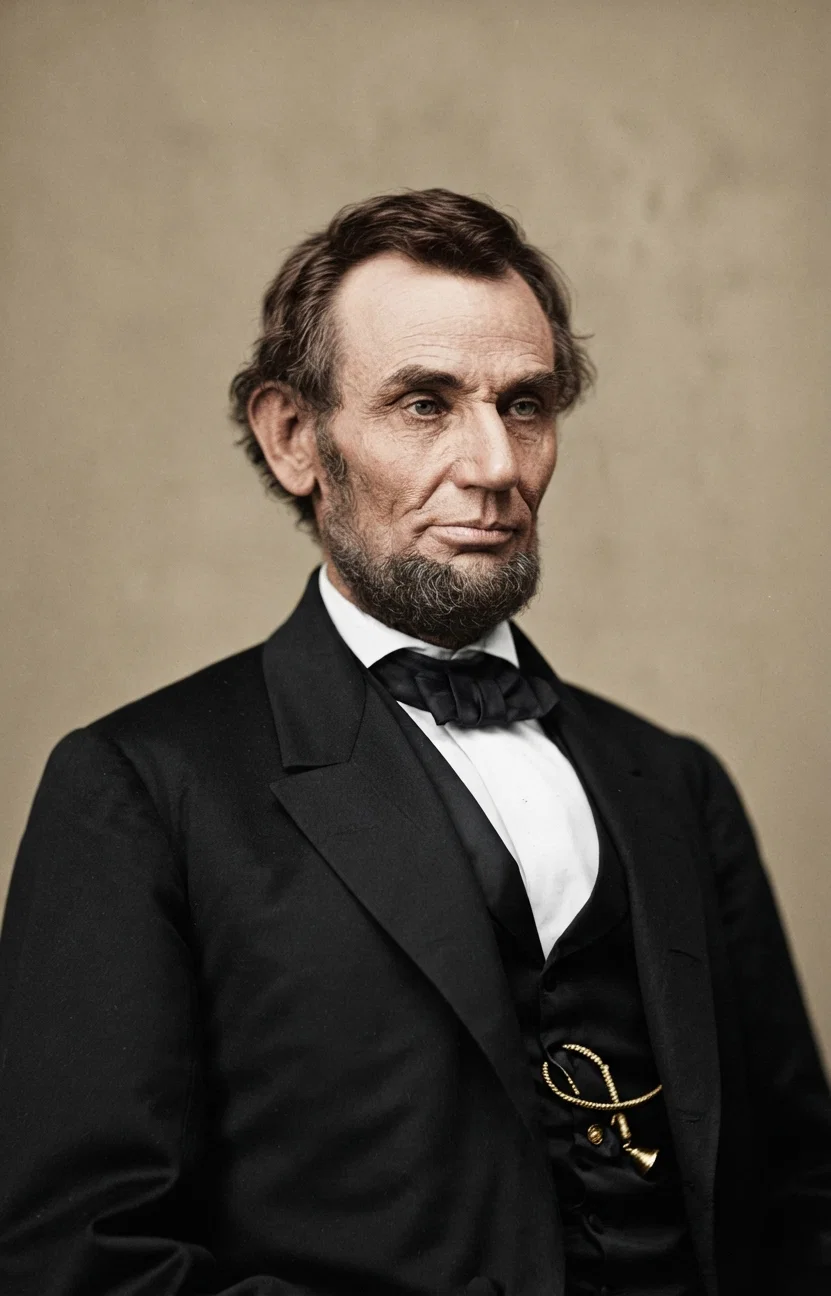
ON February 12, 1809, one hundred and two years ago, was born in Hardin County, Kentucky, one of the most illustrious men of his generation—Abraham Lincoln. It is not the purpose of this sketch to relate his biography, which is probably more familiar to the readers of this paper than that of any other American. Suffice to say that there was nothing in his ancestry, birth, early life, or education, that indicated his later career, or that would have led his most ardent, intelligent admirers to predict for him a great future. Tall—six feet, four inches—awkward, ungainly, uneducated, lacking culture, wealth, prominent relatives and friends, or business capacity—lacking everything outwardly, it would seem—yet he became the sixteenth president of the United States, and honored by the entire world.
His success must have been due to his character, to the principles and motives which actuated him. His reading was not extensive. If he had had access to some of our great public libraries and the mass of newspapers and magazines now poured out upon a satiated people, it is doubtful whether he would have gleaned and gathered the wonderful principles that molded his life and shaped his political career. Among the books that helped to mold his character was Weems's "Life of Washington," "Pilgrim's Progress," and the Bible.
His retentive memory, his natural oratory, his exceedingly good humor at all times, made him many friends; and this, with his later reading of political books that he could borrow, had much to do in shaping his future career.
In his disposition there existed strong affection and sympathy. This was shown in his securing, when but a boy of ten, a minister to preach his mother's funeral sermon two or three years after her death. Thank God, after the death of his own devoted, suffering mother, he found a true second mother in his father's second wife; and she said of her stepson, "Abe was the BEST boy I ever saw or ever expect to see." She was indeed a godsend to the neglected family, and especially to the growing, awkward, homely, longing, sympathetic boy.
Then, too, he was honest and just. He believed in rendering to every one his due, at whatever cost. In his love of justice were born his principles of liberty. He believed in liberty not for himself alone, but for the other man, whoever he might be. It has been said that the Catholics of the Middle Ages believed in religious liberty for—themselves; that the Puritans of New England believed in religious liberty for—the Puritans. Many races and nations believe in liberty for their respective race or people. But Lincoln believed in liberty for all; and the logic of events, to his mind, forced him to the Emancipation Proclamation, which went into effect Jan. 1, 1863. The freedom of the Negroes was not his original purpose, but the preservation of the Union was. Emancipation became to him the only logical step, a forward move in the divine program. His preference, when he felt the logic of the situation, was the purchase of the slaves; but this plan he was forced to abandon. Had he lived, we may well believe that the unfortunate "reconstruction" period following the Civil War would have been far more worthy of the name, and that the enmity existing between the two great parts of a great country would have more quickly healed. He truly was a man "with malice toward none and charity for all;" and his warm human sympathies, his large generosity and sterling common sense, would have adjusted amicably many difficulties that became festering thorns in the body politic.
This is written with no desire to call up one unpleasant reminder on either side of that great contest. It is written in the spirit expressed in the sentiment quoted above. It is written to emphasize that to which all history bears witness,—that while a mere personality is remembered and honored, the principles which made him great are forgotten.
We need to remember the broad human sympathies, the love of justice, honesty, and liberty, which made Lincoln the man possible to become Lincoln the President.
Such as he are needed in the conflict which, since the Civil War, has been growing and deepening—a conflict caused by a sordid, grasping, greedy, growing commercialism, which has been tremendously successful in crushing individuality, in creating class distinctions, in squeezing out of human hearts the old-time sympathies and fellow feelings for the individual man. The conflict has not yet taken form in armed hosts and division of territory; but it is already reaping a harvest which will be more fruitful of evil than that of the Civil War. The harvest of greed, if the sowing be wide and deep, is a fearful one.
ABRAHAM LINCOLN
But there is another field where there is a demand for principles as great as ever moved the heart of a Lincoln or a Washington. There is a far more precious jewel to be guarded than the right of franchise, a greater boon than mere civil liberty. Better the shackles of a galley-slave with the freedom to worship God as he will, than what is called civil liberty with religion prescribed by law. Of course such things are not usually seen. The deprivation of religious liberty is the curtailment of civil liberty. The two go together. Never on this earth did a government grant the former without the latter. This Government has granted both civil and religious liberty. For both of these the fathers fought and died. The latter is menaced now as never before for a century. Large religious bodies are forming to effect a political purpose; and in it, as intimated by the Hon. R. M. Johnson, there is always danger. These religio-political activities are centering around the Sunday-sabbath, which, whether the Sabbath of the Lord or not, has no place under the aegis of civil law. If true, it does not need it; God its Author does not ask it. If false, it should be utterly repudiated, and no government on earth can afford to legislate against God. Lincolns and Jeffersons and Washingtons are needed to-day to lift voice against the mistaken efforts of these religious politicians, to plead for the right of every man to choose not to worship, or to choose to worship God according to the dictates of conscience.
—★—
College Men and Russian Exiles
Elbert Hubbard concludes, from a college alumni society bulletin, that that society is "intent on smokers, basket-ball, football, and the silly trifles of life, all in the holy name of education, but as far as the microscope can detect, absolutely without education; and, moreover, with no interest in it even as a theory or hypothesis." He says further: "The average college man is a victim of arrested development. He is not a thinker—not a student. Something has ironed the zeal out of mind and sterilized his soul. And I think it was college that helped. . . . The business college that has to struggle for an existence and make good or die is far in the lead of any classic concern when it comes to effectiveness and manhood."
The awful tortures of Russian exiles in Siberian prisons have driven many to commit suicide. The prisoners are crowded together in cold, filthy cells, are insufficiently clothed, and are almost starved. The hardest labor is imposed upon them, and being unable to perform it, they are knouted almost to death, and the women subjected to gross insults. A letter of one of these unhappy creatures which reached the outside world reads: "And yet our tormentors will not let us die. They always stop short of killing us outright, for they know we pray for death as the greatest boon that could come to us."
By the simple method of putting edibles in cold storage instead of delivering them to the market, the so-called "food trust" is caught in its own trap. People have curtailed their purchases in cold-storage foods, and as a result these wholesalers in a year or two found their warehouses full and no demand. As a consequence it is reported that millions of pounds of cold-storage butter, eggs, cheese, and poultry will be thrown on the market and sold for whatever they will bring.
Mexicali, in Lower California, Mexico, has suddenly been captured by a band of 100 armed revolutionists led by an American. The custom-house officers were compelled to surrender, and $200 was taken. Imprisoned revolutionists were liberated from the jail, and joined the Insurrectos. Many people, anticipating trouble, have carried their valuables across the border line into the United States. Government troops have been despatched to quell the insurrection.
Several members of the California Legislature are in receipt of a letter from Dr. David Starr Jordan, president of Stanford University, in which he urges an anti-liquor bill to curb the drink evil. In it he presents the following: (1) Exclusion of women from saloons and drinking places; (2) Prohibition of all public drinking places outside of incorporated towns; (3) Local option, to have the question of license decided by popular vote. And why not?
The California Senate Committee on Judiciary reported favorably a constitutional amendment providing equal suffrage for women.11
Coal-Mine Fatalities.—Four hundred miners have been entombed and forty instantly killed in a coal-mine explosion at Sosnowice, Russia. Failure of the mine owners to install safety devices was responsible for the disaster, and their arrest has been ordered by government officials. January 20, the same date, six men were reported killed and many injured in a colliery explosion near Richmond, Virginia. To eliminate frequent disasters of this nature in the United States, which country has the largest death-rate from such causes, the Government proposes to acquire a coal-mine, and stage actual convulsions, for the benefit of operators and lawmakers, and to prove that the dust of bituminous coal will explode.
One of the largest seizures ever made in the history of opium smuggling was at San Francisco, when custom officers boarded a vessel and brought from clever concealment 733 five-tael tins of opium, worth $29,320. This capture has given conclusive evidence that much opium smuggling is backed by wealthy white men. This raises the value of one year's seizure of the drug to more than $60,000.
The casket containing the body of Mrs. Mary Baker G. Eddy, founder of the Christian Science Church, has been removed from the tomb where it has rested since the funeral, and lowered into a grave in Mount Auburn Cemetery. A complete set of the founder's works rests on the coffin, and both are enclosed in a vault of concrete and steel.
An Ugly Record.—According to the reports of R. G. Dun & Co., defaulted liabilities of the first nine months of 1910 were greatly in excess of the same time in previous year. The defaulted liabilities of the first three quarters of 1909 were $116,135,871; for the same period in 1910 they were $154,417,304. It is a bad showing.
That bread tickets instead of money were used to bribe voters at the "wet and dry" election in Danville, Illinois, is an allegation now brought before the county court. Bread tickets were afterward redeemed, it is said, for $1.00, $2.00, and $5.00 each. Investigation is pending.
Simultaneously with two prolonged earthquakes, the volcano Taal in the Philippines belched forth lava and stones to a height of 3000 feet. Many were prostrated by the awful explosion, and the island upon which the volcano is located sank two feet.
A Presbyterian Church in Fort Wayne, Indiana, is to have a church nursery, in charge of experienced kindergarten teachers, where babies may be left while their mothers attend the morning services.
Japanese dentists pull teeth with their fingers. It is said that an apprentice in Japanese dentistry is not considered proficient until he can draw nails from the hardest wood without moving it.
The last contract has been signed between the Marconi Telegraph Company and the government of India for the construction of a number of wireless telegraph stations in that vast empire.
A statue of Jefferson Davis is to be erected in New Orleans. The dedication will take place February 22, the anniversary of his inauguration as President of the Confederate States.
A bill has been introduced into the Nevada Legislature providing penalty for the selling or giving of cigarets or materials for making them to any person in the State.
Three hundred sailors who participated in the recent mutiny at Rio Janeiro, Brazil, are reported to have been executed and their bodies consigned to the sea.
Upon the discovery of black smallpox in Philadelphia, 2600 persons have been quarantined in that city.
Eleven were killed and forty-two hurt in a railroad collision in Wales.
A curious accident occurred in San Francisco when a Chinese boy's curiosity to know what made the cable-cars go, led him to kneel down and peep through the slot between the rails. As he did so his cue dropped into the opening, and the next minute he was taking a cable ride that attracted much attention. A near-by policeman prevented what might have been serious injury to the lad by severing Ow Ling's cue.
Abounding in wealth, New York City abounds in poverty. An average of one person in nine receives charitable assistance. Relief societies number 571; institutions and homes, 147; hospitals, 389; for preventive social work and delinquent adults, 393; for the defective, 69. The cost of the city's charity a year is estimated at $35,000,000. What a stigma on modern civilization!
A unique thing occurred in New Jersey the other day. A woman, the retiring governor's private secretary, filled the governor's chair of New Jersey from 12 midnight till the next day noon, the constitution of that State making no provision for the period of time when an outgoing governor retires and his successor takes oath. She is not a suffragist, nor was she in politics.
BOOK NOTICES
"Scripture and Song in Worship." A service book for the Sunday-school. Arranged by Francis Wayland Shepardson and Lester Bartlett Jones. The University of Chicago Press, Chicago.
This song and service book is the outcome of experience in Sunday-school work, we are told, under the leadership of the late William Rainey Harper, to whose memory the book is dedicated. There are eighteen divisions in the book, such as the Majesty and Power of God, Prayer, Jesus the Saviour, Christian Missions, etc. The Scripture readings are generally appropriate, the responsive readings excellent, and the hymns are generally good, and often old standard favorites. The prayers are often from the Scriptures, and when otherwise are well expressed petitions. One hymn in the "Sabbath" division was written for Sunday, but all the Scriptures are for the Bible Sabbath, of course. Those who want a service definitely marked out, would seek long and far to find a better guide; while to those who do not, the book will be helpfully suggestive.
"The Girl in Her Teens." By Margaret Slattery. Cloth. Price 50 cents net. Sunday School Times Company, Philadelphia.
This is a helpful little book to those interested in girls; and who is not? It is written by one who has a large, strong sympathy with the girl in her teens, in all her multi changeful moods and tenses, and who longs to save them. And she has discussed in a sympathetic and intelligent way in the ten chapters of this little book most of the important phases of this question, such as the "teen period," the physical, mental, spiritual, social sides, her relations to the church, the Bible, to every day, and her teacher.
"The Fundamentals. A Testimony." Volume III. Price 15 cents, post-paid; eight copies $1.00; 100 copies $10.00. Testimony Publishing Company, 808 La Salle Avenue, Chicago, Illinois.
"Two Christian Laymen" furnished the funds for publishing these witnesses to the truth of the Christian religion, and to meet the wave of infidelity sweeping over the church through Higher Criticism. The aim of the books is to emphasize the "Fundamentals" of Christianity. Encouraging letters to the number of more than 10,000 have reached the publishers from all parts of the world, with more or less of adverse criticisms. The present volume deals with Inspiration; The Moral Glory of Jesus a Proof of Inspiration; God in Christ the Only Revelation of the Fatherhood of God; The Testimony of Christian Experience; Christianity, No Fable; My Personal Experience with the Higher Criticism; The Personal Testimony of Charles T. Studd. The writers of these papers are respectively, James M. Gray, Wm. G. Moorehead, Robert E. Speer, E. Y. Mullins, Thomas Whitelaw, J. J. Reeve — all men well known in the religious and theological world. Thank God for the voices raised for Christ and the Book.
"A Dictionary of Terms Used in Architecture and Building." Price 50 cents. Compiled from the best authorities, and published by the Industrial Publication Company.
The little book is profusely illustrated, one of the best means sometimes of defining, and is indeed an intensely practical glossary and more of architectural terms that every mechanic, and especially every architect, builder, and carpenter ought to know. There are probably 2000 terms defined, and 100 illustrations.
"World Corporation." By King Camp Gillette. The New England News Company, Boston, Massachusetts.
This book is an effort to help to settle the industrial and social questions of the world. Mr. Gillette is set forth as the "Discoverer of the Principles and Inventor of the System of World Corporation." The book itself presents the articles of "World Corporation," organized under the laws of Arizona, the capital stock unlimited, the par value of each share of which shall be one dollar; but he who owns twenty shares or less has no share in the dividends. The design is to control the labor and industries of the world on a more economical plan. It is against individualism and for the corporation, but it would make the world the corporation. We presume that if it were successful the next thing would be a corporate religion. A very beautiful, enticing picture Mr. Gillette gives us of the world under this corporation, with one great central city, little work, and much leisure. But world corporation will not change the human heart. Christ's way is best, the conversion of the individual soul.
"Catacombs of Worldly Success; or History of Coarsellor Dell." By F. M. Messenger. Metropolitan Church Association, Waukesha, Wisconsin.
The story we are told is not invented, tho the names and places are fictitious. The book is written to show the tremendous influence of commercialism, worldly ambition, and worldliness in general upon a church, a pastor, a community. The author believes that if hidden things were brought to light a condition of things would be revealed akin to those existing in the antediluvian age, and that these show that "the second coming of Jesus is at hand."
"On Christmas Day in the Evening." By Grace S. Raymond. Illustrations, done in color, by Charles M. Relyea. Doubleday, Page & Company, New York.
This is not a Santa Claus or Christmas tree story. It is a peace-bringing tale of how a few strong, earnest young people and an aged minister healed some neighborhood and church-member quarrels on a Christmas evening in an old church which had been closed for a year on account of the quarrels. Tho Jesus was not born on December 25, He is as willing to come into hearts on that day as on any other.
"The Boy Aviators on Secret Service; or Working with Wireless." By Captain Wilbur Lawton. Price 50 cents. Hurst & Company, New York.
It is strange, when there is such a general desire for peace and so much talk about it, that every possible invention of man that can be turned to his destruction in war is so used. Wireless telegraphy, at first, and still, but it has its other uses in life saving. Aviation is barely accomplished before elaborate experiments are attempted to learn what profit the bird-man may be in war. The little volume before us, the second in Captain Lawton's series, is to stir the ambition and daring of youth along the war line in the building and use of the aeroplane. We wonder if the machine will ever be used as the messenger of peace.
"The Problems of Your Generation." By Daisy Dewey. Price $1.00. The Arden Press, 122 East 25th Street, New York.
The chief beauty of this book is in its binding and printing. Claiming wonderful depth, in the light of the Bible it is very shallow, a mixture of truth and error, and this "the author claims but to have been privileged to transmit." It is a herald of another phase of self-salvation which never saves. It applies not to the times, but to the man.
Sherman, French & Company, Boston, have just issued a new work of historic value on the late Hon. "John Sherman, His Life and Public Services," by Winfield S. Kerr, in two volumes.
Shiloh: the Man of Sorrows
By Mrs. L. D. Avery-Stuttle
Chapter LIV. The Walk to Emmaus
WE must now go back to the evening of the first day of the week,—the resurrection day.
It will be remembered that at this time there was yet great uncertainty in the minds of many of His disciples as to the real fate of their Master—or rather, what had become of His body.
The great red face of the sinking sun looked down upon crowded Jerusalem, and the evening breezes whispered sadly among the dark green branches of the juniper and the olive. Like white dots upon the green hillsides and valleys round about the city, were grouped the tiny tents of the visitors assembled to celebrate the solemn rites of the Passover,—thousands of whom had heard for the first time of the life, miracles, death, and rumored resurrection of the Man of Nazareth.
Out of the eastern gate of the city, which was never closed during public festivals, passed two men on their way to Emmaus, a small city about eight miles to the northwest of Jerusalem. Cleopas, of Emmaus, the merchant whose withered hand was restored at Capernaum by the Master, was about leaving Jerusalem, where he had been to attend the Passover, for his home in Emmaus.
In company with him was our old friend Matthias. As they journeyed northward, toward the dark mountains of Ephraim, their conversation was concerning the strange events of the past three days:
"Hast thou heard, Cleopas, the wonderful story of Mary Magdalene, sister of Lazarus? for behold, she came to the sepulcher of the Master, in the early morning, and certain other women came also, because they would anoint Him after the passing of the Sabbath, and then—"
"Did not Joseph of Arimathæa also bring spices and costly ointments in which he wrapped the body?" interrupted Cleopas, "and did not Nicodemus also bring an hundred pounds weight of sweet spices?"
"It is even so," replied the other.
"But verily, I have wondered concerning Machbor of Jericho, the rich young ruler,—why came he not also, with spices? for of a truth he hath great possessions, and he loveth the Master."
"But he hath forsaken Him—hast thou not heard?"
"Forsaken Him—Machbor of Jericho forsaken the Master!"
"It is even so; altho he followed not after Him, yet hath he ever favored Him, and believed Him to be the Messiah of the prophets. But Machbor came one day unto the Master, saying, 'Good Master, what shall I do to inherit eternal life?' and the reply of the Nazarene was not to his liking—for Machbor hath great possessions." And Matthias sighed.
"But what saidst thou of Mary Magdalene?" questioned Cleopas.
"She came even to the tomb, and because it was empty, she wept, thinking that mayhap He had been taken away because they would not allow Him so costly burial. And as she looked, a Man stood before her; and Him she supposed to be the gardener. But when He said unto her, 'Mary!' behold, then she knew Him—knew that it was truly the Master. Dost thou believe this, Cleopas?" questioned Matthias, grasping his companion's arm as he spoke, and looking into his face earnestly.
"I know not. My heart faileth me; for many of the teachers of Israel are Sadducees, as thou knowest, and I—I know not. I only know that I had trusted that this had been He who should have redeemed Israel. Ah, Matthias! when He raised Lazarus of Bethany from the grave, I saw and believed. And when He healed my withered arm, long time ago, then, verily I loved Him. But I have seen Him upon the cross, and I have seen Him in the sepulcher; and I know not where they have taken His body. I dare not hope, Matthias; my hope is dead. But what saith Bar-jona? for tho he denied the Master, yet he loveth Him."
"Bar-jona believeth," replied Matthias,—"he believeth the story of the women,—and yet he understandeth it not, and his heart still faileth him; but one of the twelve, named Thomas Didymus, believeth not; and I—I know not. My father Sylvanus refuseth to give up his hope, altho he is sorely perplexed. But my sister, the wife of Bar-jona, hath wept until the fountain of her tears is dried; and she said unto me, 'My brother, the Hope of Israel hath perished.'" And the speaker's voice was full of tears.
"Where is thy brother Heber, who, I have heard, was a maniac among the tombs of Gadara, and who hath also been healed by the Master?"
"Verily, I have a brother, and he, Heber, was present at the Passover, and was among the multitude at Golgotha, when the Master bowed His head and died; and now he refuseth to eat his food, since the night of the burial, saying, 'Let me also die with Him; for why should I live any longer?'"
Cleopas was about to reply, when suddenly they were overtaken by a stranger.
"Let him pass on," whispered Matthias, "for why should we ask a stranger to share the grief of our own hearts?"
But the stranger spoke; and the tones of his voice were filled with such sympathy that almost unconsciously the two travelers opened their hearts to him.
"Why are your faces sad?" he inquired; "and what manner of communications are these that ye have, one with another?"
"Knowest thou not the strange things which have come to pass in Jerusalem in these days? then surely thou art a stranger," replied Cleopas.
"What hath happened in Jerusalem?"
"Jesus of Nazareth hath been delivered to death by the chief priests and rulers of our people; and verily He was a mighty prophet in word and deed, but they have crucified Him."
"They have crucified Him," repeated Matthias; "and behold, we believed that this was the Messiah of the prophets—He who should have redeemed Israel."
Lovingly and sadly the stranger looked into the face of the speaker, and Matthias bent his head eagerly to listen to the soft, earnest voice:
"Why are ye so slow of heart to believe the words written by the prophets? Have they not declared that the Messiah must suffer these things before He entered into His glory? Was not this He who should 'bruise the head of the serpent'? and behold, the days are fulfilled, the 'midst of the week' spoken of by Daniel the prophet, when the Messiah must be cut off. Know ye not also that the scepter hath departed from Judah, and the lawgiver from between his feet?"
"Israel hath no more any power—it is true!" exclaimed Matthias.
"Heard ye not the voice crying in the wilderness?" questioned the stranger. "Spake not the Baptizer concerning the Jesus of Nazareth, saying, 'Behold the Lamb of God, who taketh away the sin of the world'?"
"Of a truth," assented Cleopas, gazing with wondering eyes at the stranger, "and it was upon the head of Jesus of Nazareth that the dove-like form descended, and of whom the voice spake from heaven, 'Behold, this is My beloved Son, in whom I am well pleased;' and I saw this with mine own eyes, and heard the voice!" exclaimed the merchant.
"I also saw and heard," assented Matthias, a strange light shining in his eyes.
"Was not this Jesus of Nazareth a Man despised and rejected,—a Man of sorrows and acquainted with grief? and hid ye not your faces from Him?"
"But, O stranger," sighed Cleopas, "spake not David the prophet, of the Messiah and His enemies, when he said, 'Thou shalt break them with a rod of iron, and dash them in pieces like a potter's vessel'?"
But of a truth, this Jesus of Nazareth was an humble man, tho He did many mighty miracles.
"Of a truth," rejoined the stranger; "but when the Son of Man shall come in His glory, and all the holy angels with Him,—when He shall come again the second time, then shall He sit upon the throne of His glory, and then shall He judge the nations and scatter His enemies—then shall He 'dash them in pieces like a potter's vessel.' But said not the prophet also, concerning the Messiah, 'He was led as a lamb to the slaughter; and as a sheep before her shearers is dumb, so He opened not His mouth'? Did not the Man of Nazareth even so? Remember ye not how He said unto you, The Son of Man goeth up to Jerusalem, and He will be delivered into the hands of sinful men, and they will kill Him, and He shall rise from the dead the third day?"
"Surely, O stranger!" exclaimed Matthias, astonished and trembling. "Of a truth these things have been hidden from our eyes!"
"Verily; and saw ye the soldier when he pierced the side of the Man of Nazareth? Remember ye not the scripture which saith, 'They shall look upon Him whom they have pierced?'"
"It is true; I saw the man Rufus, a soldier of Herod, when he pierced the side of the Man—our Master."
"Brake they any of His bones?" questioned the stranger.
"No; because that He was already dead; albeit the soldier brake the bones of the others who were crucified with Him."
"Verily," continued the stranger, "because thus saith the Scripture, 'A bone of Him shall not be broken.' Remember ye also that the prophet saith of Him, 'They parted My garments among them, and upon My vesture did they cast lots'? Saw ye the soldiers at the foot of the cross of the Nazarene? and did they not even thus?"
"Of a truth!" exclaimed both Cleopas and Matthias in one breath, "we saw them—Rufus and the soldiers of Pontius Pilate; they did cast lots for the vesture, because it had no seam, and they said, 'Why should we divide it?'"
"Remember ye the scripture which saith, 'I hid not My face from shame and spitting'?"
"Ah," exclaimed Matthias, while a sob shook his body, "when the Man was before Herod Antipas, I saw the scribe Jazer spit upon His pallid face and upon His bloody thorn-crowned head!" And the speaker groaned aloud.
"Know ye also by whom the Nazarene was betrayed?" insisted the stranger.
"He was betrayed by one of our number, one of the Master's followers and friends—one in whom we all trusted, even Judas of Kerioth!"
"Yea; Mine own familiar friend, in whom I trusted, which did eat of My bread, hath lifted up his heel against Me," softly quoted the stranger.
The sun had already gone down, and the stars were twinkling in the purple sky. Light in the east indicated that the royal queen of night was about to rise, as the travelers entered the little city of Emmaus.
"Behold, now, here is mine house," declared Cleopas, as he and Matthias paused before a large house of white limestone, while the stranger passed on. But Cleopas could not endure to part from the wonderful man—their strange companion; and besides, Eastern hospitality prompted him, and he cried out:
"Abide with us, O stranger; for the day is far spent—see, the stars are in the sky, and the moon ariseth."
"Wherefore dost thou constrain me to abide with thee?"
"Because thy words are words of wisdom, and we would learn the truth at thy mouth," replied Cleopas, as they all entered the house.13"Come, Levi," called the host to a servant who met them at the door; "come, prepare thou bread, that we may eat."
A half hour passed. The stranger sat at the table with Cleopas the host and Matthias.
Already their hearts had burned within them, as the Scriptures of truth regarding the Shiloh of Jacob were unfolded in all their beauty, until they acknowledged joyfully that a single specification of the prophets there was not, but had been met in the Man of Nazareth—the Crucified of Calvary. But who was this stranger—this wonderful expositor of the prophets?
Finally Levi, the servant, placed the bread upon the table before the man.
"And he took the bread, and blessed it, and brake, and gave to them; and their eyes were opened, and they knew him; and he vanished out of their sight."