Your ShelfYour Projects

Review and Herald, Vol. 92, No. 32.

Prayer
Earlier text: Sunday Crusade in Bristol, Tenn., and Bristol, Va

Publications Wanted

THE following-named persons desire late, clean copies of our publications, sent postpaid, for use in missionary work:—
Mrs. A. Carey, Nortons, Oregon.
Mrs. Fred Canning, 4601 A St. Ferdinand Ave., St. Louis, Mo.
Mrs. C. O. Jones, 720 Cherry St., Chattanooga, Tenn. Continuous supply.
Mrs. Dilla Power, Charleston, Okla. Little Friend, Instructor, Signs, and tracts.
Mrs. Henry Malone, 1211 East Richards St., Sherman, Tex. Continuous supply. Could use 100 each week.
Mrs. Jennie B. Foye, Box 123, Kittery Point, Maine. Continuous supply of papers, magazines, and tracts.
Edward Quinn, Jr., 6 Hickory Ave., Takoma Park, D. C. A continuous supply of Signs, weekly and monthly, and Watchman.
Miss Amy Rawlinson, Roswell, N. Mex. A continuous supply of Signs, Health and Temperance, Bible Training School, Watchman and tracts.

The War Losses

ONE of our exchanges sums up the fearful fruitage of the present war as follows:—
“The appalling losses of the nations at war, from an economic point of view, it is impossible to calculate with anything approximating accuracy. There are periodical announcements of losses in armies and navies; and these are mounting into figures which would suggest that if the same rate of loss continues, the numbers in graves, in hospitals for wounded, and in prison camps will exceed the numbers on the field. The New York Evening Post has gathered up a concise statement of the losses up to June 1, based largely upon the official bulletins. In all these reports of losses, of course it is understood that wounded and prisoners as well as killed are included. The statement made in the House of Commons last week gave the British losses since the beginning of the war as 258,069, an average of 6,500 a week. The later losses appear to have been more than twice the average per week of the whole period. The British have borne the heaviest part of the fighting in Flanders and at the Dardanelles. The German losses have been enormous. The Russian official reports up to about June 1 ran close to 1,400,000. To this must be added the loss of the south German states, which it is estimated would amount to above 400,000, bringing the German total up to 1,800,000. These figures would not include the casualties in the recent desperate fighting in Galicia. The ratio of killed to total casualties on all sides is stated at about one fifth. German dead, therefore, amount to nearly half a million. Definite figures as to Russian losses are not available. They must have been enormous, approximating if not exceeding those of Germany. They may reach two millions, a very large proportion—larger than in other nations—of which is prisoners. The figures of Austro-Hungarian losses are not available. The maintenance of prisons must be a matter of serious concern, especially with Germany and her allies, so large is the number in their camps. The number of Russian prisoners in Germany at the beginning of May was 513,000. In Austria-Hungary there were 302,000 Russian prisoners. Since the beginning of the battles in Galicia the Teuton allies claim to have taken nearly 300,000 prisoners. This would bring the total number of Russians in captivity to 1,115,000. Of other nationalities there were in Germany and Austria on May 20, according to the same authority, French prisoners, 254,000; Belgian, 40,000; Serbian, 50,000; English, 24,000; or, altogether, 1,483,000 Allies. A fair approximation to these figures is supplied by the number of Teuton prisoners in Allied countries. In April, Russia officially claimed 616,000 Austrian prisoners. By this time the number must be close to 700,000. Of Austrian prisoners in Serbia there must be about 50,000, so that the total Austrian losses may be placed at three quarters of a million. For German prisoners we have no figures.”
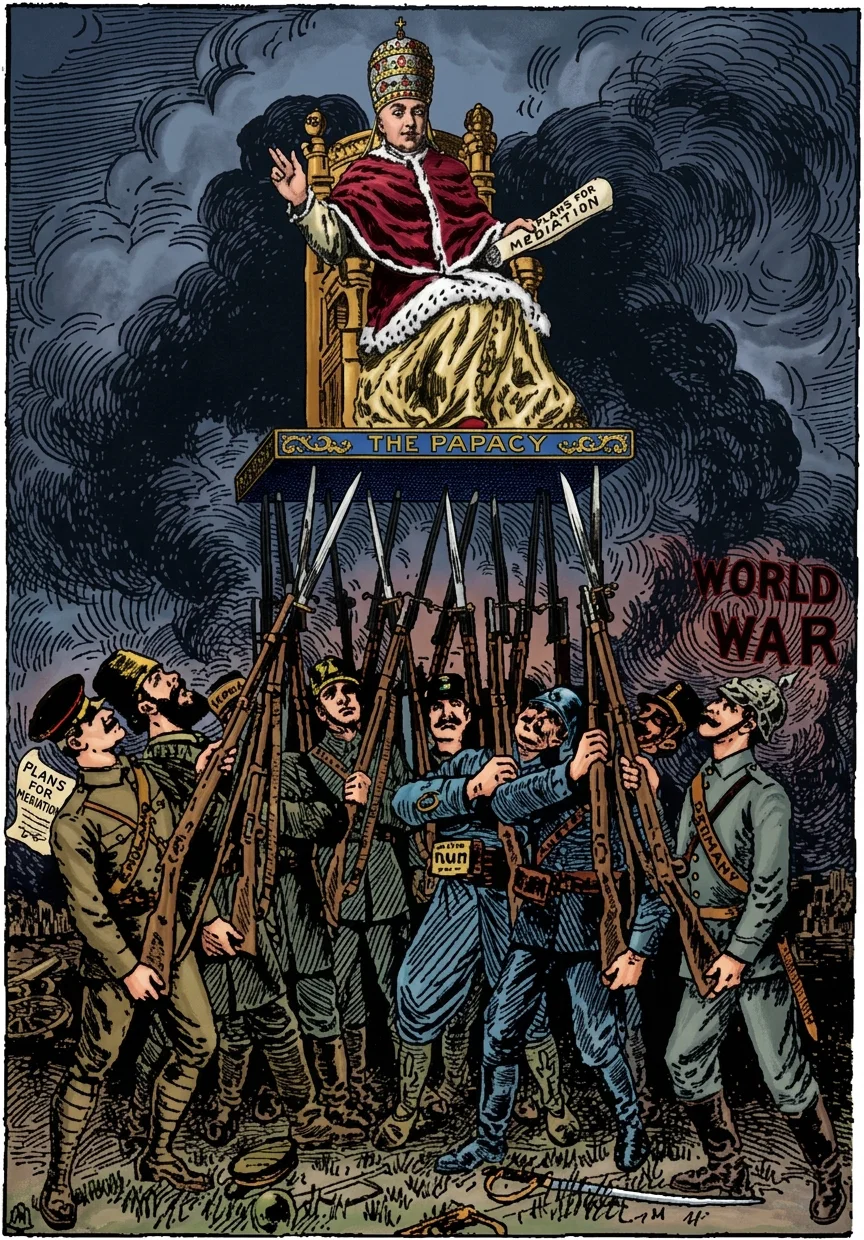
This gives but a slight conception of the terrible fruitage of the present war. There are sufferings and experiences of which figures can convey no conception. If the war were finished and these figures were the total of its results, the world could in some way bind up its wounds, and turn again to the work of building up what war had thrown down and devastated. But this is not the total, and the great men of the state and of the church are stating that the time to offer mediation has not yet come. Not one of the nations is willing to stop where it is and say, “What we have achieved is all we desire, and we will make peace here.” The desperate intensity of the situation is shown by the employment of thousands of women in the factories where guns and ammunition are made. Skilled workmen cannot be spared from the trenches, and so women are now running the most ponderous and intricate machinery to build the weapons of war and furnish the ammunition requisite to make them effective against the enemy. The present war has furnished many new developments, of which this would seem to be one of the most unnatural.

Developing the Colporteur Work in China

CHINA is fast developing the colporteur work. Requisition upon Australia is being made for workers to lead out in and develop this branch of the work in the Far East. Of the possibilities in the circulation of our literature there, Brother Porter writes: “West China has a population of 88,000,000; Central China, 112,000,000; East China, 97,000,000. Central China has seventy canvassers and paper sellers in the field, and a large number of young people who would soon enter if properly developed. East China is an organized field, with four churches, seven companies, a number of canvassers already at work, and a number of advanced students ready to enter the field as soon as they are properly trained. West China has a most promising field, which is just opening, but a man is needed to develop and train canvassers.” When we consider that it will be largely through the circulation of our literature that the message must go in these populous countries, we get a glimpse of the magnitude of the work of establishing upon a good foundation the colporteur work in the East.

Camp Meeting Reports

THE editor of the REVIEW, writing from Stevens Point, Wis., reports most excellent services in the camp meeting just closed at that place. He says: “About fifty will be baptized here today. There has been no excitement, but the steady, deepening movings of the Holy Spirit.” Elder Wilcox is now in attendance at the camp meeting at Holly, Mich.

Tent Meetings in Kingston

BROTHER E. C. BOGER, president of the Jamaica Conference, informs us that tent meetings have been opened in Kingston under the direction of Brother Aalborg, himself assisting, and says: “We have a good interest in our tent meetings. So far three or four hundred people are coming out each night.”

China Inland Mission Anniversary

THE fiftieth anniversary of the establishment of the China Inland Mission was celebrated at Niagara, Ontario, June 15-20. This historic mission has accomplished much in bringing the light of the gospel to China’s millions.

Religious Instruction Barred in Korean Schools

The Japanese government has recently published a regulation to the effect that after a period of ten years all religious instruction is to be barred from the schools of Korea which give a general education. This order applies to the national religion of Japan—Shintoism—as well as to other religions. It is explained that if the missionaries in Korea desire to continue their religious teaching separate from the general schools, they may do so in theological schools, English language schools, book-keeping schools, or other institutions of a like character. The ten-year period is allowed to enable the Korean teachers to acquire the Japanese language and to enable the existing private schools to adjust themselves to the new requirements.

Prisoner’s Message from Malta Camp

A CARD from the prisoners’ camp of war at Malta, Egypt, was received at the Mission Board office last week. Brother Ising writes: “Your letters bring me all I know regarding the work of God going on in the earth. I have been here now six months. Some of our books have been circulating here in the camp, also other literature, and some interest has been created, which I hope will ripen in time. Am well. With kind regards and Christian love.” Let us pray as “being bound” with him.

The Sixty-Third Student

Brother Sam Konigmacher, of the Barotseland Mission, South Africa, sends in this word, dated May 11: “Yesterday the sixty-third student came, and we were glad to see some of the local boys as well. I am sure that it would be encouraging to you if you could step into our evening school and see how busily the boys are reading to prepare their lessons for the next day. One boy who works by the month for us attends night school.” All the books these African boys are studying contain the message for this time; so they soon develop a love for the truth, and also the desire to pass on the good word to their kindred who know it not.
OUR HOME'S
OUR HOME'S
CO YE INTO ALL THE WORLD

You have reached the end of this edition.

Review and Herald · Jul 1, 1915