Pacific Press Publishing Company · New York · Sep 3, 1896
THE “CHRISTIAN CITIZEN.”
The term “Christian citizen” is one frequently used nowadays, but is, we fear, only imperfectly understood. This is not saying, however, that the designation is an improper one, or that it describes something that cannot exist. That a man can be at once a Christian and a citizen is evident from the fact that the Apostle Paul was such; he was both a citizen and a Christian. We name these things in their order; for the apostle was first a citizen in point of time, and subsequently became a Christian; but did not thereby either forfeit or renounce his citizenship, for we find him twenty-five years after his conversion declaring himself “a citizen of no mean city” (Acts 21:39), and claiming his legal rights as a Roman (Acts 22:25); and still later, by several days at least, we find him exercising the Roman citizen’s right of appeal to the emperor himself. Acts 25:10, 11. The Apostle Paul was, then, a Christian citizen of the Roman empire, and that at a time when Rome itself was wholly pagan.
Silas also a Roman Citizen.
Nor was this the first time that the apostle availed himself of the privileges of Roman citizenship; neither was he alone in it. From Acts 16 we learn that when arrested, whipped and imprisoned at Philippi, Paul and his companion, Silas, refused to be secretly released, but sent word to the magistrates, saying, “They have beaten us openly uncondemned, being Romans, and have cast us into prison; and now do they thrust us out privily? nay verily; but let them come themselves and fetch us out.”
Referring to this circumstance another has well said:—
Paul and Silas felt that to maintain the dignity of Christ’s Church they must not submit to the illegal course proposed by the Roman magistrates. The apostles were Roman citizens, and it was unlawful to scourge a Roman save for the most flagrant crime, or to deprive him of his liberty without fair trial and condemnation. They had been publicly thrust into prison, and now refused to be privately released without proper acknowledgments on the part of the magistrates.
It may be that when Paul described himself as “a citizen of no mean city,” he meant no more than that he was a native of Tarsus, and regarded that as his home; but no such explanation can avail to weaken the force of the apostle’s assertion that he was a Roman. In this he as clearly claimed citizenship in an earthly government as does the American, who, going abroad, carries with him a passport from the Secretary of State at Washington; and who, upon occasion, claims his rights as an American citizen. All of which, in the absence of evidence to the contrary, shows that citizenship in a civil government, and a legitimate exercise of the rights thereof, are not inconsistent with Christianity, nor with the fact that the Christian’s citizenship is in heaven (Phil. 3:20, R. V.), and that he is a stranger and pilgrim upon the earth seeking a city whose builder and maker is God.
The Sphere of Civil Authority.
Civil authority is ordained of God for the preservation of human rights. “We hold these truths to be self-evident,” declared our forefathers, “that all men are created equal; that they are endowed by their Creator with certain unalienable rights; that among these are life, liberty, and the pursuit of happiness; that to secure these rights governments are instituted among men.” The same sublime truths are taught in the sacred Scriptures. Civil government has, then, to do only with the relations of men as social beings, and in the very nature of the case can have nothing whatever to do with any man’s relations toward God. Nor does the individual, the citizen, the subject, or whatever else he may be called, owe to civil government any duty, or service, or obligation of any kind that does not pertain to the equal rights of his fellow-men.
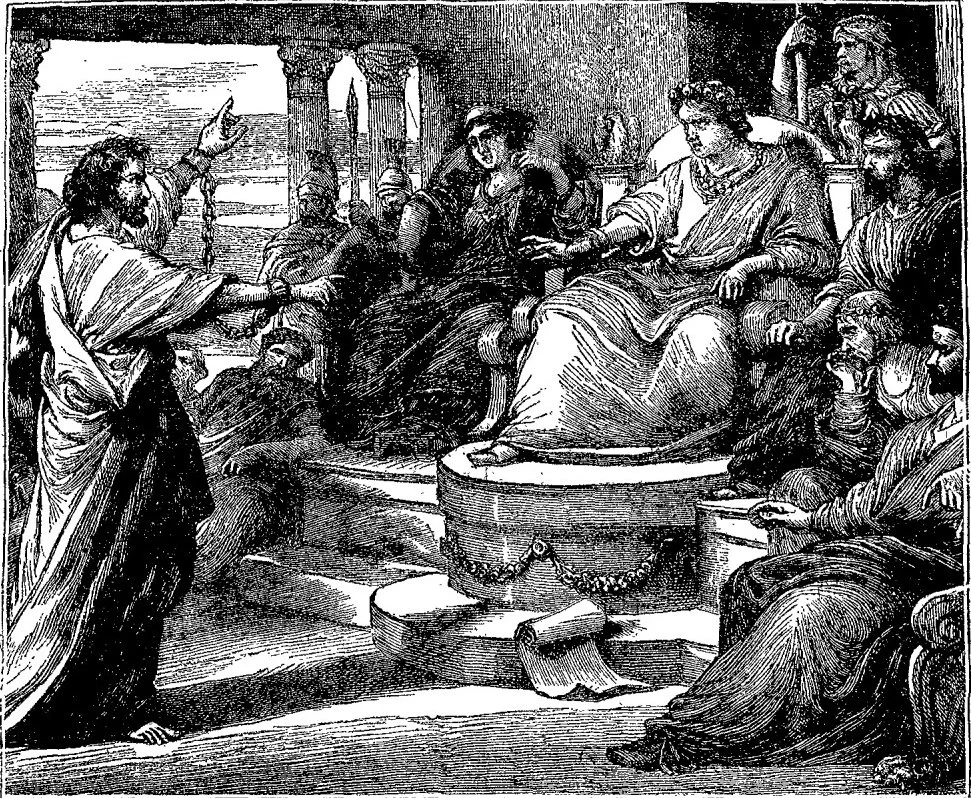
Paul Before Festus: He Appeals Unto Cæsar.
As an intelligent, civil, social being he is amenable to the God-ordained authority which men have to safeguard their own rights; but as a moral being, endowed with a religious nature, capable of knowing good and evil as revealed in the word of God, the individual is responsible only to God. In these things civil government can have no legitimate jurisdiction over him.
A Dual Citizenship.
Such being the relations of men to each274other and to their Creator, it follows that he who properly understands the obligations resting upon him may at the same time be loyal and obedient to a just, civil government, and to the moral government of God; he may thus have a dual citizenship being at the same time an American or other citizen and a citizen of the heavenly kingdom. To deny this is to assert that there is a necessary conflict between just civil government and the moral government of God, which is certainly not the case since both are ordained of God for the good of man, including Christians. 1 Tim. 1:1–4.
The Christian citizen, then, of an earthly government, is simply one, who, being a citizen, is also a Christian, and who having learned to do unto others as he would that they should do to him, having learned to love his neighbor as himself, is subject to just civil law “not only for wrath but also for conscience sake.”
But the fact that the man is a Christian entitles him to no special favors from the government. Every man who conducts himself as a good citizen, who discharges his obligations to his fellowmen and respects their equal rights, whatever may be his motive, is entitled to all the benefits of civil society. Government cannot know the heart and cannot inquire into the motive which impels the subject to obedience; it can take cognizance alone of his conduct in its relation to the government and to his fellow-citizens.
Just Government and the Conscience.
Just government will not trench upon the moral domain, it will not invade the sacred precincts of the conscience. Nor will the Christian citizen (the citizen who is truly a Christian) invoke the civil power in behalf of the supposed interests of his religion. To do so would be to violate the all-comprehensive rule of Christian life, namely, “Whether ye eat or drink, or whatsoever ye do, do all to the glory of God.” It is to the glory of God that his gifts and the things which he has ordained are used for the purposes for which he gave them; while to wrest his word, to change his ordinances and usurp power which he has reserved to himself is God-dishonoring, as it is also to despise his gifts by refusing to use for our preservation, improvement and comfort, the means which he has graciously given. The Christian will then, while thankfully availing himself of the benefits of civil society, while willingly contributing his quota of money and influence for its maintenance, for the benefit not only of himself but of his fellowmen, insist that the State confine itself to its God-ordained sphere, that it respect the right of conscience, which is indeed only the right of God to the untrammeled heart-service of every man. In short, the Christian citizen will exemplify in his own life and in every sphere of action and influence which he enters, the Golden Rule: “All things whatsoever ye would that men should do to you, do ye even so to them.”
The Ten Commandments and the Golden Rule.
As before remarked, the one all-comprehensive rule of the Christian’s life is, “Whether ye eat or drink, or whatsoever ye do, do all to the glory of God.” The servant of God never gets beyond this rule; he cannot without forsaking Christ enter any sphere where this law of action is not of binding obligation. Whether in the home, in the church, or in the State, the claims of the divine law are equally upon him.
When a prominent senator declared several years since that the ten commandments and the Golden Rule had no place in politics, he doubtless spoke the truth so far as the practice of many politicians is concerned, but he did not announce a great principle nor a necessary rule of action. Politics primarily means, “The science or practice of government; the regulation and government of a nation or State for the preservation of its safety, peace and prosperity,” “The protection of citizens in their rights,” etc. To say that in these things men might not or ought not to be governed by the ten commandments and the Golden Rule is to declare that God has ordained something from which sin is inseparable, and that for the good of mankind; for that even a very poor government is better than none, all must admit.
Individual Accountability.
The trouble in regard to this question is that too many agree with the honorable senator, to whom reference has been made, so fully that in the political sphere they consider themselves outside the jurisdiction of the law of God, and act accordingly. They are governed by policy and that only; they know no other law. Theirs is a terrible mistake. Caucus, party, and State action is, in its last analysis, individual action, and for it individuals are accountable and must one day answer at the bar of the God whose law they have despised and ignored.
Man Cannot Enforce the Law of God.
This is not saying, however, that caucuses, parties, or States, have any warrant to enforce either the ten commandments or the Golden Rule. The Decalogue reaches to the thoughts and intents of the heart; the Golden Rule requires not only that a man shall be just, but that he shall be generous. Civil rulers have no jurisdiction over the mind; they have no authority to enforce more than equal and exact justice between man and man; and even this they are to do from the standpoint of natural right, not from that of the divine law.
In moral duty, in all things relating to the relations of the creature to the Creator, God has left men free to choose or to refuse His service. Touching all these things he has appointed a day in which he himself shall judge the world; and to all who would usurp his prerogative as Judge, he says: “Who art thou that judgest another man’s servant? to his own master he standeth or falleth. Yea, he shall be holden up; for God is able to make him stand.” Let the Christian, therefore, while he refuses to enter any sphere in which he cannot be loyal to God, or to engage in anything in which he cannot be governed by the ten commandments and the Golden Rule, beware on the one hand of despising an ordinance of God, and on the other hand of usurping the authority and functions of the Judge of all the earth.
The evils of civil government are not in its legitimate use but in its abuse. The man who attends a district school meeting and assists in determining the amount of school tax that shall be levied and the number of months that school shall be taught thereby exercises a right of civil citizenship, and engages to just that extent in politics and government; and it would be absurd to say that in so doing he could not act in harmony with the will of God as expressed in the ten commandments and the Golden Rule.
A Serious Question Considered.
But while it is not in itself contrary to the principles of Christianity for the Christian under certain circumstances to exercise the rights of civil citizenship, yet there are circumstances of time and place which, to say the least, render participation in civil affairs by the Christian very questionable. Politics, in the common acceptation of the term, are both corrupt and corrupting. The chances are a thousand to one that the Christian entering the political sphere, under prevailing conditions, would not only fail in doing any good but would be himself contaminated by the abounding corruption. Surely the servant of God can find a more fruitful field and promising sphere of usefulness than the role of political partizan.
The ever, overshadowing, all-absorbing theme of the truly Christian minister or layman is the salvation of sinners. It is to rescue those who are conformed to this world, that being transformed by divine grace, they may “prove what is that good and acceptable, and perfect will of God.”
In the pursuit of such work, Christians accomplish vastly more for the betterment of civil society by the reflex influence on the non-Christian world of their Christian words and deeds than they could possibly accomplish by attempting to reform civil government by devoting their time to the never-yet achieved and indeed impossible task of purifying politics, when any betterment of politics can come only as the result of the reformation of the individuals who compose the body politic.
Civil Government Only Temporary.
According to the Word of God, civil governments are only temporary. They are ordained among men for the purpose of preserving order among the selfish, oppressive masses of men, while the ambassadors of Christ plead with these masses to be translated not from civil society but from the kingdom of Satan into that of God’s dear Son.
By the same Word we learn that these same governments are to be destroyed by the hand of God. “The God of heaven shall set up a kingdom. . . . It shall break in pieces and consume all these kingdoms.” The same Word declares that “in the last days” “wicked men and seducers shall wax worse” up to the coming of our Lord Jesus Christ the second time; when every government of earth represented by the kings of the earth and their armies will be arrayed in open hostility to him and perish as a result. It must follow from this that the nearer we approach this destruction the greater the separation between these God-defying governments and the citizens of the kingdom of God.
The people who publish the AMERICAN SENTINEL believe that the world is fast nearing that solemn hour to which we have referred. They believe that now as never before it is the duty of the Christian minister and layman to labor to rescue men from the impending doom of all things earthly. They do not believe that the ship of State can be saved from the wreck which He who sees the end from the beginning has decreed to be the fate of worldly governments; and just as it would be a crime for the captain of a hopeless wreck to urge his crew and passengers to man the pumps when they should take to the life-boats, so to-day it is a sin against heaven and against perishing men for the followers of Christ to devote their energies, as so many are doing, to the attempted salvation of political government, to the regeneration of civil society, instead of the salvation of perishing men. The church is honeycombed with infidelity, her life is well-nigh crushed out by an insupportable load of worldliness, while her ministers who should be weeping between the porch and the altar crying, “Spare thy people, O Lord, and give not thine heritage to reproach”210are dabbling in the cesspool of politics in the vain effort to renovate civil society! But to all who will heed the call the Creator says, “Come out from among them, and be ye separate, saith the Lord, and touch not the unclean thing, and I will receive you.”
THE KINGDOM OF GOD.
By S.
IN these days when it is prophesied that “the kingdom of God is to enter the realm of law through the gateway of politics,” and so many influential men and women are earnestly working to fulfill the prophecy, it is more than ever important that we understand the nature of that kingdom, as set forth by Him from whom all knowledge upon the subject must be derived.
The Scriptures clearly teach that under the regime of sin and evil which has prevailed in the earth since man’s fall, and will prevail while this world remains, the kingdom of God cannot be a visible kingdom. This is contrary to the idea which has in all ages been cherished by many professed followers of Christ; but it is the truth, notwithstanding. The idea that the kingdom of God was to be forcibly set up as a visible, glorious kingdom among the other kingdoms of earth, was cherished by the apostles themselves, and was the very last of their false notions to be given up. It was only after a most bitter and trying experience that they did so.
At one time, we read, as Christ was on his way to Jerusalem, accompanied by his disciples, “he added and spake a parable, . . . because they thought that the kingdom of God should immediately appear.” Luke 19: 11. The parable was that of the nobleman who went into a far country to receive a kingdom, and to return; and by it he taught that the kingdom is not to appear until the return of the nobleman; that is, until the return of Christ, which will be at his second coming in the clouds of heaven.
At another time the Pharisees came to him and asked him when the kingdom of God should come? The Pharisees and all the Jews were looking eagerly for the restoration of the kingdom of David and deliverance from the yoke of Rome. In reply the Saviour said, “The kingdom of God cometh not with observation; neither shall they say, Lo, here! or, lo there! for behold, the kingdom of God is within you.” Luke 17: 20, 21. It is directly against this plain declaration that men and women are zealously working to-day in Christ’s name. They are striving to make the kingdom of God come with observation. They are trying to give it a triumphal entry “through the gateway of politics.” There is nothing more conspicuous to-day than events which come as the result of political agitation. The political arena is the cynosure of all eyes. Nothing can issue out of that place without attracting world-wide notice.
Such efforts must result in utter failure; for the word of God cannot fail. “The kingdom of heaven cometh not with observation.” The nature of that kingdom has not changed since the days of the apostles. The kingdom of God is within the hearts of those who, in spirit and in truth, worship God. The kingdom is now the kingdom of grace, and men enter into it through faith. When faith comes into the heart, the kingdom of God comes with it. The individual’s allegiance is transferred from the author of sin to the Author of righteousness. The heart becomes the temple of God, the habitation of his throne.
When the grace of God has done its work, —when all have received it who will, and the “mystery of God” is finished—Jesus Christ will leave the Sanctuary in heaven, where he is now High Priest before the heavenly mercy seat (Heb. 8: 1, 2), and will “appear the second time,” in the clouds of heaven, unto the salvation of those that look for him. Heb. 9: 28. And when he shall appear in his glory then will his saints also appear in glory, both those who have died in faith and also “we which are alive and remain unto the coming of the Lord.” 1 Thess. 4: 15. Then will the kingdom of God become a visible kingdom of glory.
But how insignificant will then appear the schemes of misguided men to usher in that awful and sublime condition, through politics. Let Christians and all men turn from earthly vanities unto the living God, and by the power of God unto salvation, manifested in their lives, hasten the answer to the prayer, “Thy kingdom come.” S.
THE SOURCE OF CIVIL POWER.
THAT civil government is ordained of God is plainly taught in the Scriptures of truth; but that this is so in the sense contended for by some, namely, that governments are endowed with extraordinary rights and powers, rights and powers which do not grow out of the very conditions under which governments exist, which do not primarily belong to the people, but which come directly and specially to the government from God, is sustained neither by the testimony of Inspiration, nor by the nature of man and the conditions under which he exists.
John Locke, one of the most profound moral philosophers of any age, shows plainly and incontrovertibly in his treatise on “Civil Government,” that every power which justly belongs to the State belongs first of all to the individual, and comes to the State from the individual. “God,” he says, “having made man such a creature, that, in his own judgment, it was not good for him to be alone, put him under strong obligations of necessity, convenience, and inclination to drive him into society.” And it may properly be observed that in doing this God ordained civil government as well as every other relation that grows out of the conditions under which man exists.
“The first society,” says Mr. Locke, “was between man and wife, which gave beginning to that between parents and children; to which, in time, that between master and servant came to be added; and although all these might, and commonly did meet together, and make up but one family, wherein the master or mistress of it had some sort of rule proper to a family; each of these, or all together, came short of political society. . . . Conjugal society is made by voluntary compact between man and woman. . . . It draws with it mutual support and assistance, and a communion of interests too. . . . But the husband and wife, though they have but one concern, yet having different understandings, will unavoidably sometimes have different wills too; it therefore being necessary that the last determination, i. e., the rule, should be placed somewhere; it naturally falls to the man's share, as the abler and stronger. But this reaching but to the things of their common interest and property, leaves the wife in full and free possession of what by contract [or by nature] is her peculiar right, and gives the husband no more power over her life than she has over his.” Again, on this very point Mr. Locke remarks, that the power of the husband over the wife is so far from being absolute that she “has in many cases a liberty to separate from him, where natural right or their contract allows it.”
We do not understand by this that Mr. Locke denies that marriage is a divine institution, but that he asserts that it is entered into by agreement, and that the just powers of the husband are derived from the consent of the wife, which consent, together with compliance with whatever forms may be required by civil society, constitutes her his wife; and that the wife is under obligation to the husband only in that which natural right or their contract allows. The same he shows is true in civil society. He says: “Men being by nature all free, equal, and independent, no one can be put out of this estate and subjected to the political power of another without his own consent. The only way whereby any one divests himself of his natural liberty, and puts on the bonds of civil society, is by agreeing with other men to join and unite into a community for their comfortable, safe, and peaceable living one with another, in a secure enjoyment of their properties.” But that men will and must do this is made certain by the very fact that they are created social beings with equal rights; it follows, therefore, that in creating them thus and associating them together, God ordained that they should thus organize, therefore “the powers that be”—the civil powers—“are ordained of God.”
This view of the matter preserves the perfect harmony which exists between the teaching of the Scriptures on one hand, and the nature of man and the facts of history on the other; while any other theory arrays the Bible against facts as we know them to exist, and makes the Creator responsible for a great deal of very bad and tyrannical government.
CHRISTIANS AND CIVIL GOVERNMENT.
By S.
We have been asked the question, Does not the fact that the Christian is an ambassador for Christ debar him from any rightful participation in civil affairs?
An affirmative view of this question is held by some individuals, and sought to be supported by a parallel drawn with respect to the position of an ambassador from one earthly government to another. At first glance the position seems to be well taken; but a moment’s276candid reflection shows that the parallel does not hold good.
In the first place, the Christian is not an ambassador for Christ to any government on earth, but only to individuals. He is sent to beseech individuals, not governments, to become reconciled to God. 2 Cor. 5:20. His mission is not to induce men to transfer their allegiance from civil government to God, who has himself ordained it, but to renounce the service of Satan, the god of this world, and to give their allegiance to the God of heaven.
Secondly, the parallel destroys itself. For it is the whole business of the Christian as such to persuade those whom he meets to become subjects of another government, that is, the kingdom of Christ. What would be thought of the conduct of an ambassador to this country who would devote his time to the work of persuading Americans to become subjects of the government which he represented? It would certainly be deemed a most outrageous interference in our civil affairs. The Christian, from the standpoint of those who make use of this parallel, is required to violate in the most flagrant manner the principle which debars the ambassador of one government from meddling in the internal affairs of another.
All Christians know that Christianity is not against the interests of any good government, but for those interests. The conversion of an individual to Christianity does not in the least interfere with his performance of those duties which spring from the relationships of civil society. The more real Christians any country has in it the better for that country. The stigma of working against the interests of civil government does not rest upon the Christian ambassador. The sphere of civil government is entirely distinct from that of Christianity; action in one of these does not in the least interfere with action in the other. Hence renunciation of the duties and principles which relate to one is not demanded by participation in the affairs of the other.
S.
BEARING DEADLY FRUIT.
By S.
That “religion in politics,” as illustrated in the present campaign, leads directly to the position of the party who are clamoring for religious legislation by State and nation, is evident to a prominent representative of that party, the pastor of St. Paul’s M. E. Church, Philadelphia. In the Christian Statesman of Aug. 22, he says:—
Especially will the prominence the money discussions on both sides give to moral considerations open the way for Christian ethics. If only in private conversation with friends be sure to follow up a moral appeal with the value of the Christian amendment. No circumstances can be more favorable than the present conflict. Already the rhetorical figures are of sacred subjects and the fiery appeals to God’s higher laws of Christian equity and brotherhood. If all who believe in the Christian amendment will earnestly agitate, the convictions on the subject will most rapidly grow and bear fruit.
It is “National Reform” fruit that will surely be borne upon the Upas tree of religion in politics.
S.
THE EASTERN FERMENT.
[New York Journal, August 28, 1896.]
ZANZIBAR and Constantinople are some distance apart, but fighting in both places on the same day helps to show how comprehensive the Eastern question is, and how full of sinister possibilities. Indeed, it is no longer the Eastern question, but the world question—at least the question of the Old World. It cannot be localized now at one end of the Mediterranean, as it could forty years ago. While there are riots in Constantinople, revolutions in Macedonia, Crete, and the Lebanon, and massacres in Armenia, there is a war of diplomacy in Egypt which shades into a war of troops in the Soudan. This carries us to the regions of the Abyssinian armed truce and the rival expeditions of the French and the Congo State. Then we find ourselves at the scene of the Uganda dispute, which is closely connected with the disturbed politics of Zanzibar. This takes us by insensible degrees to the theater of the Matabele war and the Transvaal crisis.
Again, starting eastward from the storm center on the Bosphorus, through Persia, Afghanistan, Turkestan, and China, we find one diplomatic entanglement linked with another until the rising power of Japan comes into view, and the Eastern question is merged into the question of the Far East.
Yesterday’s affair in Constantinople was like some of the “race wars” that used to flourish in the South. “July 1. A horde of infuriated negroes is advancing upon the town, with the supposed intention of massacring all the white inhabitants. The whites are arming in self-defense.” “July 2. The riotous negroes were attacked in their cabins yesterday and routed. Fifteen of them were killed. No white men were injured.” The Armenian riots were supposed to have been begun by Armenian revolutionists. The result was that several hundred of these dangerous Armenians were killed. Later accounts may make the number some thousands.
It is a pity that it took some bloodshed to convince the natives of Zanzibar that they were really British subjects. Ever since the partition of 1890, by which England and Germany agreed to help each other to the territories of the Sultan of Zanzibar, it has been generally understood that England would take the island whenever she got ready. Its government has been administered by British officials for the past five years. There is a little coy hesitation in London about proclaiming a formal annexation, but this modesty will doubtless be overcome, and it is well that it should be. The Sultanate of Zanzibar has been a nest of slave trading whose suppression would end more human misery than anything else except the destruction of the Turkish Empire. And that may not be long delayed either.