It is admitted by all Christians that civil government is ordained of God, for this is plainly stated by the Scriptures. Rom. 13: 1. But for what purpose? To rule in religious matters? If so, then what need of the Church? Why not let the State be the Church, and have all the gospel ordinances administered by government officers? In that case, each government officer would, of course, be inducted into office by prayer and imposition of hands, in the same way as officers of the church. It may be objected that such an extreme would not be admissible, because it would necessarily degrade Christian ordinances to the level of secular matters. True enough; but if civil government is ordained of God, to regulate, in any degree, matters of religion, who shall say where its powers must end?
Did not the Apostle Paul exhort the Roman Christians to be subject to the “powers that be,” for conscience’ sake? Yet the very work of preaching the gospel, in which that apostle was engaged, was opposed to the religion and laws of the Roman Government. The religion of Rome, at that time, was pagan, and was controlled by the State. The religion Paul preached was Christianity, to which Rome was uncompromisingly opposed. Neander, in his Church History, quotes the following from Cicero, as one of Rome’s fundamental maxims of legislation:—
No man shall have, for himself particularly, gods of his own: No man shall worship, by himself, any new or foreign gods, unless they are recognized by the public laws.—Vol. I, pp. 86, 87, Torrey’s Translation, 1852.
And yet in the face of law so stringently opposed to Christianity, the apostle exhorted the subjects of Rome, who professed Christianity, to be subject to the “powers that be,” calling them the “higher powers,” and declaring that they were “ordained of God.” Now, if that government was ordained of God, to enforce such laws as it did against Christianity, then how manifestly wrong was it for the Apostle Paul to preach a religion in Rome, which was diametrically opposed to the laws of Rome! Looking at the matter in this light, Nero did the work of a minister of God in executing wrath upon the Christians for not conforming to the laws of the country, which commanded all to “worship the gods in all respects, according to the laws of your country, and compel all others to do the same; but hate and punish those who would introduce anything whatever, alien to our customs in this particular.”
This was Roman law. Yet Paul himself, as well as the other apostles, practiced that which was plainly in violation of that statute, and suffered death in consequence. They justified themselves, too, in the course they pursued, by asserting that the law of God had higher claims on them than the laws of earthly governments.
At one time, when Peter and John had been preaching the gospel contrary to the law under which they lived, they were threatened by the authorities for so doing, and were commanded to desist from such a course. They simply replied, “Whether it be right in the sight of God to hearken unto you more than unto God, judge ye.” Acts 4:19. That all might know how they regarded the authority of the civil power in religious matters, they still kept on preaching Christ; but were again apprehended and brought before the council. They were then reminded of the caution given them a short time before, but the apostles quietly said, “We ought to obey God rather than man.” Acts 5:29. These answers of the apostles plainly show the position they occupied, relative to this matter. They did not have the faintest idea that the State had the least authority in matters of religion. More than that; their words plainly teach that human laws are utterly incapable of meeting the requirements of the individual conscience, and are therefore inadequate to regulate matters of personal faith toward God.
Why, then, were those injunctions regarding the “powers that be,” given by the Apostle Paul to the Roman Christians? Manifestly to teach them that their relation to Christianity in no way absolved them from their duty as citizens, to the government under which they lived. Although they had come to recognize the King of heaven as their spiritual Ruler, they were not to forget that civil governments have a part to act, in procuring peace and protection to the honest and industrious, and, for that purpose, were ordained of God.
And, although the king of the country in which they lived, was a wicked heathen, they would not be justified in refusing to obey his laws, which imposed taxes to maintain peace and public order. So long as those laws did not contravene that law which is above all—the law of God—they were enjoined to observe them, as duties toward their fellowmen, which were covered by the law of their heavenly King.
Civil government, then, is ordained of God, for the sole purpose of regulating affairs between man and his fellowman. This is as true of a heathen as of a Christian power, as seen from the fact that Paul made such a statement and applied it to the Roman government, when it was intensely pagan, and even when it was ruled by Nero. But, admitting this, it does not follow that God ordains each statute enacted by civil governments, or any of the statutes thus enacted. To say that every civil magistrate holds office by divine authority, and has, therefore, a5right to rule in religious things, is stating that which every one knows is not, and cannot be, true. For, in that case, no man, whoever he may be, would have any alternative but to obey the mandates of the civil authority in divine as well as earthly things, without a question as to whether it was just or not. This would destroy all necessity for any one but the magistrate to read the Bible, in which is found recorded the will of God. Moreover, such a rule would make the magistrate’s conscience the rule for all under his jurisdiction, and would, therefore, destroy the relation man is supposed to sustain toward God by making him, in religious matters, wholly responsible to the magistrate rather than to God.
This principle is well illustrated by the statement of Louis XIV., when, on his death-bed, he was approached in relation to his spiritual condition. His answer was, “I have left all these matters with the church, and I expect they have attended faithfully to them.” Here was a man who had been taught to depend wholly on the church, as an institution divinely guided, and the consequence was that, in all his wicked career, he never acknowledged any responsibility except to that institution upon which he had been prone to lean. The same condition of things would surely follow with those who were led to believe in the divine appointment of all the magistrates of the land.
It is well known, however, that the powers of civil authority are always obtained and regulated according to the peculiar notions of those who happen to be in authority; and the way governmental authority has usually been obtained, is well stated by Macaulay, in his essay on “Gladstone on Church and State”:—
A nation of barbarians pours down on a rich and unwarlike empire, enslaves the people, portions out the land, and blends the institutions which it finds in the cities with those which it has brought from the woods. A handful of daring adventurers from a civilized nation wander to some savage country, and reduce the aboriginal race to bondage. A successful general turns his arms against the State which he serves. A society, made brutal by oppression, rises madly on its masters, sweeps away all old laws and usages, and when its first paroxysm of rage is over, sinks down passively under any form of polity which may spring out of the chaos. A chief of a party, as at Florence, becomes imperceptibly a sovereign, and the founder of a dynasty. A captain of mercenaries, as at Milan, seizes on a city, and by the sword makes himself its ruler. An elective senate, as at Venice, usurps permanent and hereditary power. It is in events such as these, that governments have generally originated; and we can see nothing in such events to warrant us in believing that the governments thus called into existence will be peculiarly well fitted to distinguish between religious truth and heresy. Par. 33.
Yet such as these are among the “powers that be,” and exist in the providence of God; not, however, to regulate religion among men, but to maintain order and the proper relations between man and man. To say more than this, would be to assert that God ordained the powers of the East to maintain Mohammedanism and Buddhism. This could not be true, otherwise the gospel commission conferring authority to carry the gospel into all the world, was a mistake, and the labors of foreign missionaries in heathen countries, are all out of order.
The truth is, that the language of Paul to the Roman Christians, was designed to state only a general truth, which was applicable to every form of government in order to ensure peace and prosperity to God’s creatures everywhere. Order in government may be seen even in the lower grades of creation. We have only to watch a colony of honey-bees for a short time, when it will be seen that they have governmental order, and are controlled in all their movements, by some acknowledged head. And those proverbially enterprising insects known as ants, are said, by naturalists, also to be governed by specific laws which are rigidly carried out in each community of these little creatures. The governmental powers of these and other orders of the animal creation, were just as much ordained of God as were human governments; yet it does not follow that their powers of government were designed to extend to religious things.
SATOLLI'S SUCCESSOR APPOINTED.
A DISPATCH from Rome, under date of August 22, says:—
The diplomatic career of Father Sebastiano Martinelli, second Delegate Apostolic in the United States, will begin here to-morrow under unusually brilliant auspices. In the Sistine Chapel of the Vatican, the scene of so many famous and historic ceremonies, the erstwhile humble prior of the Augustinians will be raised to the archiepiscopal dignity. At the conclusion of this impressive rite Cardinal Rampolla, the Papal Secretary of State, will bestow on the newly consecrated prince of the church his commission as Leo’s representative in America.
The text of this commission cannot fail to be interesting to all your American readers, particularly since it departs from the usual formula to bestow warm praise on the retiring delegate, Cardinal Satolli. It reads as follows:—
“Venerable Brother: The post of Delegate Apostolic in the United States of North America having become vacant by the promotion to the sacred purple of His Eminence Cardinal Satolli, who, by his great work has merited this mark of our esteem, we, holding you in our very especial affection and seeing in you the qualities to carry on and perfect the work begun by our beloved son, His Eminence Cardinal Satolli, do benignly nominate you to that vacant post.
“By virtue of our apostolic authority and by virtue of these present letters, we do further elect, make and declare you to be the second Delegate Apostolic to the United States of America at the good will of ourself and this Holy See. We grant you all and singular the powers necessary for the carrying on of such delegation.
“We command all whom it concerns to recognize in you as Apostolic Delegate the supreme power of the delegating pontiff.
“We command that they give you aid, concurrence and obedience in all things, that they receive with reverence your salutary admonitions and orders. Whatsoever sentence or penalty you shall declare or inflict against those who oppose your authority we will ratify, and with the authority invested in us by the Lord, will cause the same to be observed inviolably until condign satisfaction be made, notwithstanding constitutions and apostolic ordinances or any other thing to the contrary.
“Leo XIII.
“Given at Rome, on the twenty-third day of August, eighteen hundred and nine six, in the nineteenth year of our pontificate.”
It does not appear upon the face of this commission that the appointment of Martinelli has any reference to the desire of Rome to establish diplomatic relations with this Government, but doubtless that long-cherished scheme is still dear to the heart of Leo XIII. and will be cherished in the Vatican until such time as public sentiment shall make it possible of accomplishment. Let not Americans relax their vigilance.
LOYAL TO LIBERTY.
By A. F. Ballenger
A TOUCHING story is told of General Marion, “the Swamp Fox,” of revolutionary fame. As the story runs, a British officer was sent to the rude camp of General Marion, located in the swamps of North Carolina, for the purpose of negotiating an exchange of prisoners. When the officer came to dine with General Marion and his staff, all they sat down to was a peck of sweet potatoes, baked in the ashes and served on a log. The English officer commented on the poverty of the fare, but was told that it was better than usual.
“But your pay is good?” inquired the English officer.
“I have never received a dollar for my services, nor my people,” replied the General.
“What motive, what stimulus, have you for fighting then?” inquired the astonished Englishman.
“We fight for love of liberty,” responded Marion.
The story adds that the officer was so impressed by this devotion to the cause of American liberty that he returned to Charleston and resigned his commission.
Such examples of devotion to the cause of political liberty have been numerous and have not been confined to one nation nor to one age. But in the cause of religious freedom there have appeared the most striking examples of devotion to truth. Neither privation, fiendish torture, nor death have been able to quench the spirit of loyalty to divine truth in the breasts of men. The early Christians were true to their convictions in the presence of the flame, and the fury of the hungry beasts. Albigenses, Waldenses, Lollards, Hussites, Huguenots, German Princes, Baptists and Quakers, each in turn suffered and fought the battle for liberty of conscience. To-day the Stundists of Russia and the anti-revolutionary portion of the Armenians, are choosing exile and death rather than surrender their religious convictions.
There is another class of patient, loyal278sufferers whom the world does not generally recognize as yet, who are making a heroic struggle for religious liberty. These are the Seventh-day Adventists who have been called to suffer in prison and chain-gangs for their faith. First they sacrifice the most valuable business day of the week to their convictions, and then for a failure to sacrifice another day to the opinions of their neighbors, they are fined, their property sold by the sheriff to pay costs, and imprisoned or worked with criminals in the chain-gang. Their fortitude, the joyfulness with which they take the spoiling of their goods, separation from family and friends, the disgrace of the cell or the chain-gang and the associations with the vile, is a spectacle to inspire one amidst this compromising, trimming, time-serving age of ours.
For the purpose of aiding these oppressed people, and promulgating the Christian principles of liberty of conscience, the International Religious Liberty Association was organized. It is supported by members who pay one dollar a year as a membership fee; and by donations from sympathizing friends of religious liberty, some of whom, while they do not endorse the religious practices of these persecuted people, yet desire to aid them in the struggle for freedom, realizing that if religious liberty may be abridged in the case of this humble minority, it may be in any case.
Many of the members of the organization are poor, and the self-denial manifested in many cases to secure funds to donate to its work, is hardly second to the devotion of those called upon to suffer for their faith in prisons and chain-gangs. One in the position of secretary of the Association can but be impressed, much as was General Marion’s English visitor, with this self sacrificing devotion to the cause of liberty, and with the fruitlessness of any attempt to quench it by persecution.
A man of sixty cuts cord-wood in the summer’s sun to obtain money to send to the Association; a man of seventy in his poverty cultivates a row of tomatoes and realizes three dollars and a half which he donates; a widow sends a dollar earned by washing for her neighbors; one sends two dollars, and writes: “I am sixty-six years old and very feeble and have only thirty-one cents. left. . . . But I know He will put more means in my hands if I use what I have to his glory.”
How utterly useless it is for mortal men to attempt to stamp from the breasts of their fellow-men this immortal God-breathed principle,—love of liberty.
A. F. BALLENGER,
Sec. I. R. L. Ass’n.
39 Bond St., New York.
HOW THE STATE BENEFITS(?) THE CHURCH IN HOLLAND.
“It is a sad picture,” says the New York Observer, of the 20th ult., “which the Rev. Herman Vanderwart gives in the Christian Intelligencer, of the State Church of Holland. He says:—
The State Church of Holland is just about the same as of old. There is very little life to it. The majority of her pulpits still preach a sort of refined rationalism, placing great stress on ethics and forms. The real religious life finds stronger expression in the Christian Reformed Church of the kingdom, which grows year by year in strength and composes the backbone of the people. It grew out of a reaction against the rationalistic teachings of the State Church, and is to-day the church of Holland’s future. It has just completed, some three years ago, a union with another small body which revolted against the teachings of the old church, and presents a united front against the inroads of dead orthodoxy and pernicious rationalism. Its synod meets triennially at different places. This year it convenes, August 11, at Middelburgh, in Zeeland, where I hope to go and convey the fraternal greetings of our church, in company with Dr. Bishop, of Orange, and the Rev. B. Van Ess, of Roseland. The masses which have been baptized and trained in the old State Church are more and more drifting away from all church influences. They care very little for religion, the Bible is no longer of any authority, and God’s Sabbath is turned into a full holiday. That’s the plain truth. It only shows the old saying that when once you begin to unravel the smallest stitches, you won’t have any seams left at all.
“A solemn warning, surely,” says the Observer, “is to be found in the story here told. Alas that it is all true as others besides Mr. Vanderwart can and do testify.” But will the Observer heed the warning? If we mistake not our contemporary is among those who insist upon State support of the Church in the matter of Sunday laws, State-paid chaplains, exemption of church property from taxation, etc. They simply carry the matter a little farther in Holland.
DEVELOPMENT OF RELIGIOUS LAW.
[Present Truth (London, Eng.), Aug. 20, 1896.]
WHAT is the origin of the present development of human law for the enforcement of religion? Paul asked the Thessalonians if they did not remember that when he was with them he had told them of these things; and that they should let no man deceive them, for there should be a falling away and the man of sin be revealed, by whom the mystery of iniquity was already, even at that time, working.
The Thessalonians were to remember—and are we to forget that this was said to them?—that God was to be opposed, and there should be one who would exalt himself above God, and should, from the very temple of God itself, attempt to show that he was himself God. They were told not to forget—and are we to fail to remember?—that the iniquitous workings, then begun in secret, should at length be revealed, and that which was planned in secrecy should finally be proclaimed on the housetops.
Here was the origin of human laws for the enforcement of religion, and this subtle deceivableness of unrighteousness, which is now working with power and signs and lying wonders, is the mystery of the deeds of sin of that wicked one who will be consumed and destroyed by fire out of heaven in that last great and terrible day of the Lord.
This wicked one still works in secret and his deeds are yet a mystery to most—but not to all. That mysterious antichristian influence which has permeated the world—has invaded and corrupted churches—has, with consummate tact and diplomacy, insinuated itself into civil councils and dominated governments—is not now utterly unknown and unrecognized.
Prophecy has pointed out the progress of the mystery of iniquity, and history has recorded the fulfillment and realization of prophecy step by step, and emphasized each prophetic milestone by such unmistakable inscriptions that the most ignorant may read and comprehend. The line of march of the mysterious commander of the forces of anti-christ is marked by ever increasing inroads into the confines of true religion and civil justice; while pagan observances are added to, or mingled with, methods of worship, and practiced, until they become accepted forms. Those who have resisted the encroachments of evil, and remained true to the teachings of Christ and the apostles, acknowledging no rival authority, and submitting their lives to no rule but that of God and his word, have, at the behest of this commander, filled the cells of the Inquisition, suffered under its instruments of torture, fed the flames with their flesh, and soaked the earth with their blood.
The same spirit of fraud, and violence, and force, and cruelty, and injustice, is still at work. Its field of operations is not circumscribed. It is not confined to the battlegrounds of former campaigns. Fresh fields of conquest have been opened in new worlds. The same tactics which have been so successful in former ages are still in vogue, in forms modified to suit changed social and political conditions. Religious observances, pagan and idolatrous in character, have been ingrafted into the accepted religious formality. These observances have grown and developed until they overshadow the real purpose of religion, and take the place, in the minds of their devotees, of true religion itself. The test of a profession of religion has, oftentimes, become the acceptance of the popular and accepted forms of superficial and fashionable devotion.
Not infrequently they who occupy the highest seat in the synagogue ignore Christ and his teachings, and, although they profess to accept the Word of God, deny the authority of its precepts, and affirm the authority of the traditions of men.
The pulpit has been set in the open doorway of the temple of Janus. While it remains there those doors can never be shut. From such a pulpit the gospel of force must be preached. From such a pulpit the soldier and the police constable will be accredited emissaries. Such a gospel does not persuade or convert, it subjugates; it does not convict of sin, it establishes the sinner in an hypocrisy which covers evil with an affectation of good, and imputes evil where good is.
NEWS AND NOTES.
THE question of Sunday street-car service is still agitating the people of Toronto, Ont. The mayor has promised his hearty support to the opponents of Sunday cars.
THE National Christian Citizenship League has issued an appeal to the friends of temperance to aid in the fight for the preservation of prohibition in South Dakota, which has now reached a critical stage.
NEW ORLEANS, La., Ravenswood and Astoria, N. Y., Waterbury, Conn., Atlantic City, N. J., Oshkosh, Wis., and Brazil, Ind., are a few of the places where the gospel of force is being invoked by clergymen and others in the interests of Sunday observance.
IN New Orleans, La., the Sunday-law forces, beginning with the closing of the saloons, have now proceeded to close all groceries and other stores on Sunday, except the markets and fruit stands. Their goal seems to be the closing of everything on Sunday except the church.
AN Anti-Masonic International Congress is soon to be held in Europe, under the special auspices of the Vatican, none being allowed to participate in it except those who “profess the most absolute obedience to the Roman Catholic Church and to the pope.” The papacy will in this try to impress the people with a sense of the sinfulness of allegiance to anything except itself.
REPRESENTATIVES of the Greek, Anglican, Old Catholic, and Protestant churches recently held a meeting in Vienna, at which a resolution was passed unanimously protesting against the claim of the Pope to be the source of healing for Christendom, and against other assumptions of the papal church. The convention was designed as an offset to the Pope’s late encyclical to Hungary.
THE Armenian Revolutionary Society are to the front again with serious disturbances in Constantinople and Galata. On August 26, an armed body of these revolutionists entered and took possession of the Ottoman Bank, where they remained during the day, shooting at the police and firing bombs into the streets, killing and wounding passers by. The next morning they surrendered, and stated that the purpose of the riot was to secure reforms. The immediate result, as reported, was extensive damage to property and the loss of several hundred lives, mostly those of Armenians.
“RELIGION in politics” is intensifying the desperate conflict between “Christian” and Turk in Crete. The evidence of this is the following statement made recently in Parliament by the English Under-Secretary for Foreign Affairs:—
“The second difficulty with which we are confronted is one which it is almost impossible to escape, and that is the outbreak of religious and political animosity which unhappily prevails in the island. One day one party is the aggressor, and the next day the other party is the aggressor. It is not fair to say that in every case the Christians have been the victims. If the House could at all realize the intensity of the religious feeling which prevails, it would try and avoid taking sides.”
A FIRST-CLASS HIGH-GRADE BIBLE
$7.00 WORTH FOR $3.50.
We propose to make it possible for each and everyone to be the possessor of
A FIRST-CLASS HIGH-GRADE BIBLE.
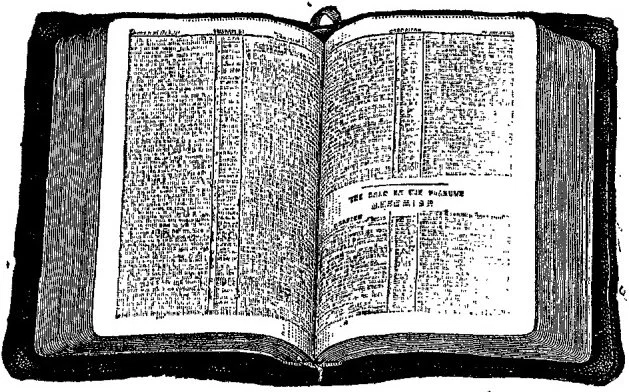
The book we offer has large clear type (see specimen page) and is what is known as the
AMERICAN OXFORD SELF-PRONOUNCING REFERENCE TEACHERS’ BIBLE,
Bourgeois Type, Bound in Imperial Seal Leather, Divinity Circuit, Extra Linen Lined to Edge, Round Corners, Red Under Gold Edges, Silk Headband, Silk Marker, Binding of the Best Quality,
REGULAR PRICE, $6.00
OUR PREMIUM BIBLE OPEN.
WITH SENTINEL, ONE YEAR $3.50
With this book reading is made easy. No more stumbling over the hard words. All proper names are divided into syllables, and the accent and diacritical marks render their accurate pronunciation a simple matter. With a little study of the Key to Pronunciation to be found in every copy of this Bible, the reader loses all fear of the long, hard names of Scripture, and pronounces them with ease.
OUR PREMIUM BIBLE
CLOSED.
As is indicated by the name, this is a teachers’ Bible. It contains fifteen maps and 64 pages of illustrations and diagrams, copious helps of the latest revision, Bible index, concordance, dictionary of Scripture proper names with their pronunciation and meaning, and many other excellent features.
They that sealed the covenant. NEHEMIAH, X. The points of the covenant.
gavest before them, neither turned they from their wicked works.
36 Behold, we are servants this day, and for the land that thou gavest unto our fathers to eat the fruit thereof and the good thereof, behold, we are servants in it:
37 And it yieldeth much increase unto the kings whom thou hast set over us because of our sins: also they have dominion over our bodies, and over our cattle, at their pleasure, and we are in great distress.
38 And because of all this we make a sure covenant, and write it; and our princes, Levites, and priests seal unto it.
CHAPTER X.
1 The names of them that sealed the covenant. 29 The points of the covenant.
NOW those that sealed were, Nehemiah, the Tirshatha, the son of Hachaliah, and Zedekiah,
2 Seraiah, Azariah, Jeremiah,
3 Pashur, Amariah, Malchijah,
4 Hattush, Shebaniah, Malluch,
5 Harim, Meremoth, Obadiah,
6 Daniel, Ginnethon, Baruch,
7 Meshullam, Abijah, Mijamin,
8 Maaziah, Bilgai, Shemaiah: these were the priests.
9 And the Levites: both Jeshua the son of Azaniah, Binnui of the sons of Henadad, Kadmiel;
10 And their brethren, Shebaniah, Hodijah, Kelita, Pelaiah, Hanan,
11 Micha, Rehob, Hashabiah,
12 Zaccur, Sherebiah, Shebaniah,
13 Hodijah, Bani, Beninu.
14 The chief of the people; Parosh, Pahath-moab, Elam, Zatthu, Bani,
15 Bunni, Azgad, Bebai,
16 Adonijah, Bigvai, Adin,
17 Ater, Hizkijah, Azzur,
18 Hodijah, Hashum, Bezai,
19 Hariph, Anathoth, Nebai,
20 Magpiash, Meshullam, Hezir,
21 Meshezabeel, Zadok, Jaddua,
22 Pelaiah, Hanan, Anah,
23 Hoshea, Hananiah, Hashub,
24 Hallohesh, Pileha, Shobek,
25 Rehum, Hashabnah, Maaseiah,
26 And Ahijah, Hanan, Anan,
27 Malluch, Harim, Baanah.
28 And the rest of the people, the priests, the Levites, the porters, the singers, the Nethinims, and all they that had separated themselves from the people of the lands unto the law of God, their wives, their sons, and their daughters, every one having knowledge, and having understanding;
29 They clave to their brethren, their nobles, and entered into a curse, and into an oath, to walk in God’s law, which was given by Moses the servant of God, and to observe and do all the commandments of the LORD our Lord, and his judgments and his statutes;
30 And that we would not give our daughters unto the people of the land, nor take their daughters for our sons:
31 And if the people of the land bring ware or any victuals on the sabbath day to sell, that we would not buy it of them on the sabbath, or on the holy day: and that we would leave the seventh year, and the exaction of every debt.
32 Also we made ordinances for us, to charge ourselves yearly with the third part of a shekel for the service of the house of our God;
33 For the shewbread, and for the continual meat offering, and for the continual burnt offering, of the sabbaths, of the new moons, for the set feasts, and for the holy things, and for the sin offerings to make an atonement for Israel, and for all the work of the house of our God.
34 And we cast the lots among the priests, the Levites, and the people, for the wood offering, to bring it into the house of our God, after the houses of our fathers, at times appointed year by year, to burn upon the altar of the LORD our God, as it is written in the law:
35 And to bring the firstfruits of our ground, and the firstfruits of all fruit of all trees, year by year, unto the house of the LORD:
36 Also the firstborn of our sons,
It is only by special arrangement with the publishers of this Bible that we are able to make this
UNPRECEDENTED OFFER.
REMEMBER, the price of this Bible is $6.00. ANYONE, OLD OR NEW SUBSCRIBER, SENDING US $3.50 WILL RECEIVE THIS BIBLE POSTPAID, AND THE SENTINEL ONE YEAR.
Or WE WILL GIVE ONE OF THESE SUPERB BIBLES for seven new names at the regular subscription price, $7.00.
For 25 cents extra, we will mark on the Bible in gold letters any name desired.
Address all orders to AMERICAN SENTINEL, 39 Bond Street, New York City.
Political Parties and Great Moral Questions
“WHAT a pity it is,” exclaims the Christian Statesman, of August 15, “that neither of the great political parties is willing to take a high position on great moral questions.” In view of the very limited acquaintance of the great political parties with “great moral questions,” we think they can hardly be blamed for not taking a high position on the same, in view of their liability to a fall.
Since both political parties cannot succeed, one or the other must fall, and in such a case it would seem a sad misfortune if it had taken a lofty position on some great moral question, since the fall would certainly reflect on the latter. Does not the reader see that great moral battles cannot be fought by any party which is liable to defeat? The battles of the Lord are not fought by the losing side; for God cannot be defeated. Such battles must be fought by faith; and faith can never know defeat.
Utah Statehood and the Threat to Church-State Separation
A CINCINNATI daily expresses the opinion that the country will soon become aware that a serious mistake was made in the admission of Utah to Statehood. The same belief is expressed by other journals. That the Mormon Church is the predominating power in Utah, and that neither constitutionally nor historically is it opposed to the union of Church and State, are facts of sinister import in the present situation of things, beyond a doubt. But the great and overshadowing menace to American interests is that the orthodox churches of the land have a scheme under full headway to combine and do on a national scale what it is feared the Mormon Church will try to do in Utah on a small scale.
A Call for Careful and Candid Reading
WE ask for our leader this week a careful and candid reading.
Catholic Mirror Article on The Inquisition
THE Catholic Mirror, of the 29th ult., contains a very remarkable article on “The Inquisition,” which we will review next week.
Catholic Press Favors Free Silver
It is regarded by some as a significant fact that the Roman Catholic press of the country is, almost without exemption, on the side of “free silver.”
The Golden Rule as the Christian Standard
AN exchange has pertinently remarked, with reference to the religious aspect of the political campaign, that the proper “gold standard” for Christians is the Golden Rule.
Christian Citizenship and the Rights of Conscience
IN the light of our first-page article of this week much that is called “Christian citizenship” appears to be only usurpation of a prerogative of the Creator. God has given no man authority over the consciences of his fellowmen.
Manitoba School Question Nears Compromise Settlement
The Manitoba school question is about to be settled by a compromise, and that of a sort which shows that the only matter ever at issue was who should control the schools in the interests of their religion, Protestants or Papists. The spoils are soon to be divided.
Church Attendance in British Industrial Centers
It is said that in the great industrial centers of England and Scotland, less than one-tenth of the people go to church on Sunday. The English papers have been collecting statistics and this is the result. And in some places one-half of this ten per cent. is made up of Catholics.
Adventist Arrested at Wartrace for Sunday Labor
INFORMATION reached us just before closing up this paper, of the arrest at Wartrace, Bedford County, Tenn., of a Seventh-day Adventist named Philpot for working on Sunday. We have not learned the particulars further than that his trial was set for the 8th of October, and he was released on his recognizance.
Free Speech and Conscience: The American Sentinel's Role
THE greatest issue before the American people to-day is not that of free silver, but that of free speech and free action in fulfilling the dictates of conscience. The foremost champion of liberty in this contest with religious despotism is the AMERICAN SENTINEL. What are you doing, reader, to enlarge its field of usefulness?
Go Thou and Do Likewise.
What could not be done by the lovers of religious freedom if only a little effort were put forth by each one with the means which this paper affords them? As a pertinent suggestion upon this point, we print the following letter received last week from a subscriber whose attention was attracted by our special offer of Bibles as given on our advertising page:—
Battle Creek, Mich., Aug. 23, 1896.
PUBLISHERS OF SENTINEL:—Seeing in the SENTINEL your offer of a Bible as a premium “for seven new names,” etc., and being in want of a Bible, I concluded to make an effort. I succeeded pretty well; when, learning of a worthy unfortunate who had no Bible, I concluded to make a still further attempt, and the result was the enclosed list of (with very few exceptions) new names.
Following was a list of twenty-one names for one year, four more for six months, and one for three months. Is there not in this a suggestion worth heeding by many of our readers? Could not many of them do as much with a little effort? Is not the reason so little is being done in presenting the great issues of the day before the people, the widespread individual neglect of the little that each one might do as well as not? Why not put forth a little effort in the line of that so successfully made by our correspondent? Think of it, readers. TRY IT.