LAST week I showed how the Turkish empire has dwindled from its once magnificent proportions to a mere fragment of its former self. I also brought forward authority from the Scriptures to prove that when the Turk does ultimately “come to his end,” it will be because “none shall help him,” and that the only reason why the Ottoman has not suffered extinction long since is because some one has helped him.
The object of this paper is to institute an inquiry in order to learn whether history records that a nation or nations have helped the Turk.
In the year 1762, Empress Catherine II came to the Russian throne. In the rank of queens this woman has never had a peer. In genius and audacity, she stands the Semiramis of the North. By the time her reign was over, Russia ranked as one of the great powers of Europe, “entitled to enter into negotiations on a footing of equality with the proudest states of the Continent.”
The determination to make the Black Sea a Russian lake was born in the brain of this great woman. “She resolved that the possessions of the sultans should become the heritage of the tsars.” As a manifestation of her faith in this idea, she christened a grandson “Constantine,” and she erected arches in Moscow, inscribed with the famous Greek inscription,—“The Way to Constantinople.” Twice she was at war with Turkey. She conquered Moldavia and Wallachia. She invaded the Crimea and the Greek Archipelago. She prevailed on the Egyptian bey to rebel against the Sublime Porte. Later she entered into a conspiracy with the emperor of Austria for the immediate partition of large portions of European Turkey. They actually joined forces with that end in view. They crossed the Danube together, and invaded the Ottoman dominions. The sultan Mustafa, however, proved himself too much of a general for them; and the great empress was ignominiously defeated, and forced to beat a disgraceful retreat into Hungary.
Nothing daunted by this, Catherine determined to change defeat into victory, and to transfer the seat of her government from St. Petersburg to Constantinople. She died before she could carry out her project.
It was during the reign of Catherine that friendship between England and Russia virtually came to an end, and that the Eastern question in somewhat of its present form was born.
For some time before the days of the great empress, and during the early years of her reign, there existed a grouping of some of the powers of Europe, known to history as the System of the North. This was a close alliance of Russia with Prussia, England, and Denmark against the two great powers of the South, France and Austria.
But when the determination of Catherine7to plant her capital in Constantinople became so manifest, an estrangement sprang up between Russia and England; and the System of the North, as far as these two were concerned, came to an end.
Concerning the state of affairs engendered by the events of this period, a great statesman has written:—
“It seemed to be the natural business of other European powers to see that the defects of the Ottoman government, such as they were, should not be made an excuse for helping Russia to secure the objects of her special ambition. One great power, above all the rest, had an interest in watching over every movement that threatened in any way to interfere with the highway to India, still more with her peaceful and secure possession of India itself. That power, of course, was England. Russia, England, and Turkey were alike in one respect: they were all Asiatic as well as European powers. But Turkey could never come into any manner of collision with the interests of England in the East. The days of Turkey's interference with the affairs of any great state were long over. Neither Russia nor England nor any other power in Europe or Asia feared her any more. On the contrary, there seemed something like a natural antagonism between England and Russia in the East. The Russians were extending their frontier toward that of our Indian empire. They were showing in that quarter the same mixture of craft and audacity which had stood them in good stead in various parts of Europe. . . . It was in great measure out of these alarms that there grew up among certain statesmen and classes in this country [England] the conviction that the maintenance of the integrity of the Turkish empire was part of the national duty of England.”
“It is not too much, therefore, to say that the states of Europe generally desired the maintenance of the Ottoman empire, simply because it was believed that while Turkey held her place, she was a barrier against grave dangers, which it was not worth while encountering as long as they could be possibly averted. Sharply defined, the condition of things was this: Russia, by reason of her sympathy of religion or race with Turkey's Christian populations, was brought into chronic antagonism with Turkey; England, by reason of her Asiatic possessions, was kept in just the same state of antagonism to Russia.” — McCarthy, “History of Our Own Times,” Vol. I, chap. 25, par. 5.
Among many the notion is quite prevalent that the British policy of maintaining the Turk in Constantinople was never heard of until the Crimean war. This view is altogether erroneous. It began during the period of which I am writing, and it began with no less a statesman than the great commoner, William Pitt, at least as far as politicians were concerned.
And then it was that William Pitt brought down to the House of Commons a message from the crown, and asked that body to vote the sinews of war to compel Catherine to submit to his demands. The great minister was at the very zenith of his career. But it was over this measure that he received his first rebuke from the people of England. He carried his motion in the House, but in the debate his policy was attacked with great vigor by Charles James Fox and Edmund Burke.
Fox succeeded in establishing the fact that Pitt's proposal was “AN ABSOLUTELY NEW DEPARTURE.” “It was new,” he said, “to hear the greatness of Russia represented as an object of dread.”
Burke with his great oratory “denounced the squandering of British blood and treasure in bringing or keeping Christian nations under the yoke of a savage and inhuman government.” The debate did its work: though triumphant in the House, Pitt was beaten in the country. See Stanhope, “Life of Pitt,” Vol. II, chap. 15; Fox's Speeches, IV, 179; Argyll, “Our Responsibilities for Turkey,” par. 3.
This action upon the part of Pitt marks the advent of England as a live factor in the Eastern question. Henceforth for many years the Court of St. James will be found helping the Turk to maintain his place on the Bosporus. From now on England will be found spending blood and treasure in untold amounts for the salvation of a non-Christian power, which she always hated and despised in her innermost heart. But the reason for it all, as stated above, lay in the fact that she feared the growing power of Russia, which power, in her judgment, would have been so greatly enhanced by the possession of Constantinople and free access to the sea. On this point the duke of Argyll says:—
“As a popular feeling, the dread and dislike of Russia seem to date from the overweening power which she acquired by her great share in the overthrow of Napoleon, and from one of the earliest results of that predominance in the politics of Europe. For then came the new spirit breathed into our foreign policy by George Canning, and especially our national and popular antipathy to the Holy Alliance. Russia was the head and front of that offending. That she should be allowed to seat herself on the throne of Constantinople,—to make the whole Black Sea a Russian lake, to command the Bosporus and the Dardanelles, and to issue from them into the Mediterranean with fleets powerful in action and inaccessible in retreat,—this would indeed be a menace and a danger to the Western world. To avert this danger, or at least to postpone it, the easiest plan was to keep up the Turkish empire as long as possible.” — Argyll, Id., page 6, par. 4.
British feeling was further stirred during this period by a step which Napoleon Bonaparte took in the Eastern question. He caused to be published in the newspapers a series of articles wherein it was shown that “Europe was sure to become the prey of Russia,” and declared that “the invasion must be checked, the universal domination must be extinguished.” It was during this period also that Lesur published his famous book, entitled “Of the Progress of the Russian Power.” In this for the first time, but by no means for the last, appeared that extraordinary apocryphal document,—the will of Peter the Great.
This alleged document was not genuine. It was spurious from end to end; but it made, nevertheless, a very deep impression upon the British people. It enjoined upon all succeeding Russian sovereigns never to relax in the extension of their territory northward on the Baltic and southward on the Black Sea shores, and to encroach as far as possible in the direction of Constantinople and the Indies, or that part of the world which we now term the far East. “To work out this,” said the supposed testament, “raise wars continually—at one time against Turkey, at another against Persia; make dock-yards on the Black Sea; by degrees make yourselves masters of that sea as well as of the Baltic; hasten the decay of Persia, and penetrate to the Persian Gulf; establish, if possible, the ancient commerce of the East via Syria, and push on to the Indies, which are the entrepôt of the world. Once there, you need not fear the gold of England.” Cited by McCarthy, “History of Our Own Times,” Vol. I, chap. 25, par. 5.
The will was a humbug, but there can be no doubt that, though spurious, it did voice the sentiments of both Peter and Catherine. Moreover, it did its part in settling England into the policy of keeping Turkey in Europe.
Madison, Tenn.
The Heart That Carries Others’ Burdens
By Charles Miel
The heart which can carry the burdens and sorrows of even the most forsaken, which can make room for the griefs and toils and cares of the hapless multitude, is filled without measure with the life and love of God.—Charles Miel.
The Bible in Literature
The fountainhead of the power of the Bible in literature lies in its nearness to the very springs and sources of human life,—life taken seriously, earnestly, intensely; life in its broadest meaning, including the inward as well as the outward; life interpreted in its relation to universal laws and eternal values. It is this vital quality in the narratives, the poems, the discourses, the letters, gathered in this Book, that give it first place among the books of the world, not only for currency, but also for greatness.—Selected.
Christian Missions in Western Asia
WITHIN the boundaries of five Moslem lands,—Turkey, Palestine, Syria, Persia, Arabia,—there are over six hundred Protestant missionaries engaged in educational, medical, and evangelistic work. The Bible has been translated into all the languages of Western Asia, and a large Christian literature prepared for its polyglot people. At the Beirut Press alone sixty million pages of Christian books were printed in a single year; and in one month orders were on file for one hundred thousand copies of the Arabic Scriptures, including eighteen cases of Bibles sent to Shanghai for the Moslems of China.—Selected.
A Hint to Boys
I stood in the store of a merchant, the other day, when a boy came in and applied for a situation.
“Can you write a good hand?” he was asked.
“Yaas.”
“Good at figures?”
“Yaas.”
“That will do; I do not want you,” said the merchant.
“But,” said I, when the boy had gone, “I know that lad to be an honest, industrious boy. Why don’t you give him a chance?”
“Because he hasn’t learned to say, ‘Yes, sir,’ and, ‘No, sir.’ If he answers me as he did when applying for a situation, how will he answer customers when he has been here a month?”—Selected.
Where Sympathy Counts
As the observant woman awaited her turn one “bargain day” afternoon, she forgot her eagerness to be served in watching the girl behind the counter as she carefully fitted the hands of one who preceded her; for it was plain to be seen that will power alone kept the pale-faced clerk at her task. Still, in reply to such impatient exclamations as: “Do be more expeditious, or I shall lose my car!” she replied, sweetly: “I am doing my very best. If I hurry, I am liable to tear them.”
“And now it is your turn,” said the clerk as the impatient woman walked away, and she smilingly turned to the woman who endeavors to live up to the golden rule under all conditions. “I am sorry to have kept you waiting so long.”
“And I am sorry to add to your burdens by having you wait upon me,” was the rejoinder in so sincere a tone that the clerk, with a puzzled look, said:—“O, I might as well wait upon you as any one; for my services are always in demand. What number, please?”
“I have noticed that you are always busy,” remarked the customer, after giving her glove number, “but I never saw you look as you do to-day. But it has been an enervating day, and I am glad for your sake that closing time is near.”
The clerk then hurriedly faced about, ostensibly to take down more gloves, which gave her a chance to brush aside her tears; then, winking back others, she said, “I thought I was ready to drop when I turned to you, but I am all courage again, for — you —”
“What, child?”
The question was not answered at once; but when the second glove was nearly adjusted, she said: “You gave me just the tonic I needed—sympathy. I had a nervous headache when I came to the store this morning, and it has been a hard fight for me to stand here all day; but you are the only one who seemed to look upon me as anything but a machine.”
“Why, you poor child!” was the motherly reply; “how hard it must be to stand here and wait upon thoughtless people when you are ill and tired.”
Just then the fitting process was over, and as the clerk folded up the gloves, she said, with a smile: “I thought I was both a few moments ago, but, thanks to you, I have had such a tonic that I feel equal to anything now.”—New York Observer.
Fragments on Health
By H. E. Sawyer-Hopkins
H. E. SAWYER-HOPKINS
“One of the greatest temptations we have to meet is upon the appetite.”
“Appetite and passion are overcoming thousands of Christ’s professed followers.”
“Those who are slaves to appetite will fail of perfecting Christian characters.”
“Alexander fell through the indulgence of appetite. Daniel and his companions formed temperate habits, which enabled them in the fear of God to make wise decisions.”
“Continual transgression for over six thousand years has brought sickness, pain, and death as its fruit; and as we draw near the close of time, Satan’s temptations to indulge appetite will be more powerful and more difficult to resist.”
“God has bountifully provided for the sustenance and happiness of all his creatures; but in order for us to enjoy the natural appetite, which will preserve health and prolong life, he restricts the appetite. He says, Beware, restrain, deny, unnatural appetite.”
If we saw a valuable treasure within our reach, would we not deem it of the utmost importance to do all within our power to secure it? Health is a treasure more precious than jewels. It is the first thing to be considered in our search for happiness in this life; without it we can not even render acceptable service to our Creator.
“Had the Israelites obeyed the instruction they received, and profited by their advantages, they would have been the world’s object-lesson of health and prosperity. Above any other people, they would have possessed physical strength and vigor of intellect. They would have been the mightiest nation on the earth.”
It is very easy to see that when the Lord’s plan is followed, great blessings are in store for his people.
Aids to Perpetuate Youth
ONE way to arrest old age, or prolong youth, is to avoid those things which lower the tone of the general health. Besides giving way to hurry and worry, discontent, envy, anger, jealousy, hatred, and other emotions, we also break almost every law of health and hygiene. We take too little muscular exercise, and consequently deteriorate in bodily stamina. We frequent lecture-halls and other public places, and sit for hours in a poisonous bath of carbon dioxide. We eat almost twice as much as is necessary for the proper sustenance of the body; we crowd down vegetable, pastry, candy, nuts, fruits, spices, condiments, ice-cream, etc., into a stomach which is probably overworked, and expect it to take care of this incongruous burden without a protest. In an hour or so a glass of ice-water is tumbled on top of this trying load, and then another, until the poor stomach is “stalled,” and labors under extreme difficulty.
We do not keep the million or more drain-pipes of the body (the pores of the skin) open by frequent bathing, and our lungs do not properly perform their function, due to shallow breathing. We burn the “midnight oil,” while these weary bodies should be resting and recuperating. We do not live slowly enough; we are zealous for wealth, position, and power, to the exclusion of recreation and vacation, and are therefore becoming neurasthenic and are shortening life.
We should realize that too much food and drink, especially if impure, together with vitiated air, make impoverished blood; that poor blood creates diseased tissue; that unhealthy flesh begets evil morals; and that evil morals and emotions have their offspring.
One who banishes evil thoughts and emotions; who exercises the mind and body daily with health-giving thought and rational exercise and proper diversion; who indulges in a daily bath; who secures sufficient rest; who breathes pure air deeply, and basks in the sunshine occasionally; who strives to live an industrious, careful, cheerful Christian life, will grow old gracefully, and be an inspiration and a help to those with whom he comes in daily contact.—Health.
A Cigarette’s Effects
“I AM not much of a mathematician,” said a cigarette, “but I can add to a man's nervous troubles; I can subtract from his physical energy; I can multiply his aches and pains; and I can divide his mental powers. I can take interest from his work, and discount his chances of success.”
I Must Live Pure
“I MUST live pure, speak true, right wrong, follow the King — else wherefore born?”
Child Marriage in India
By Edith E. Bruce
EDITH E. BRUCE
“The condition of its women is the truest test of a people’s civilization. Her status is her country’s barometer,” says Dr. J. P. Jones, in “India’s Problem: Krishna or Christ?” If this is true, certainly India falls to a very low mark; for the condition of Indian women is deplorable.
I believe I voice the sentiment of every one who has investigated the conditions of India, with its millions of adherents to the Hindu religion, when I say that the greatest curse that this system of religion has brought upon the homes (?) of the people is child marriage. At the time of the last census, there were 2,273,245 wives under the age of ten; 243,503 under the age of five; and actually 10,507 baby-wives under one year.
Consider this, fathers and mothers! Could you think of giving your own little girl of twelve years, even, to a man thirty or forty? or your eight-year-old darling to a thoughtless, selfish man of twenty-five? The code of Manu says: “A man aged thirty shall marry a maiden of twelve who pleases him, or a man of twenty-four a girl eight years of age.”
But although the code of Manu gives the minimum age of eight years, the orthodox Hindu is taught that the earlier the marriage, the more creditable to the parents and the greater their reward in heaven. It is the popular belief that no woman can have salvation unless she is married; hence the anxiety on the part of the parents to marry their daughters as early as possible. Custom has also made it popular for boys of ten and twelve to marry girls of seven or eight, but it is not such a disgrace for them not to marry young as it is for girls.
There is one class that must betroth their daughters soon after birth. A young Brahman sixteen years of age was reported by a missionary to be in great perplexity and distress. Upon inquiry he said he feared he could not find any one to marry his little baby girl, as he did not have very much money. Often little girls and boys cry at their own wedding, because they have lost sight of their mothers, and are frightened in the din and confusion of the wedding festivities, or perhaps are sleepy and tired.
The giving of little girls in marriage is not because of a lack of love on the part of the parents; for, though unwelcome at birth, they often win the heart of the father, and are petted and adored by him in early childhood. It is said that no mother loves her child more than does a Bengali. It is the cruel caste system, stronger than parental love, that snatches these little ones at such tender age, and carries them into the homes of strangers, there to become the marital property of men perhaps old enough to be their fathers.
I was very much touched by an incident related by Mrs. Ada Lee, a missionary of Calcutta, who has done much commendable work among the Bengalese.
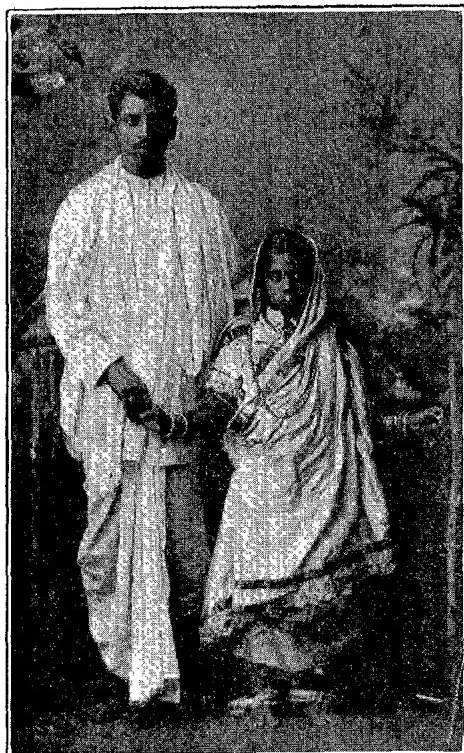
A YOUNG BENGALI MAN WITH HIS LITTLE GIRL-WIFE
While these marriages are the custom in India, yet the picture is a rare one. A missionary had tried for years to get one like the above, without success. The young man is about twenty-five, the girl eight or nine years of age.
It illustrates the condition of many, and shows how the people are held in an iron grasp by a superstitious caste system. She said that one day a middle-aged high-caste Brahman gentleman, of fine, noble appearance, and speaking English fluently, came to her for help. He told her that three of his little daughters had attended one of her day-schools in another part of the city. Now one of these little girls was in serious trouble, and in his extremity he came to her, hoping that in some way she might be able to help him.
At the age of eight he had given this little daughter in marriage to a man who he hoped would make a good husband. After a few months the husband came, and begged to take his child-wife to his own home. The child hated him, and pleaded to be left with her parents—as what child would not? Finally the father succeeded in persuading his son-in-law to leave her with her mother until she was a little older. As the husband returned from time to time, the father pleaded for his child, and so for a while he was able to keep her. But one day the husband came when the father was away, and by force took his poor little frightened bride.
For months the parents knew not where she was. But having learned to read and write, one day she wrote a note to her father, and dropped it from an upper window, whispering to a little girl below to take it to the Bible woman who visited in that neighborhood. In this note she begged her father to come and release her from this awful man. The tortures she had suffered are too terrible to be related. The father sued the man for cruelty, and the child, not being twelve years of age, was given into his hands once more; but now the time had expired, and the husband had brought suit against the man for detaining his lawful wife. In two or three days would be the trial, and the law declared that the child must appear, dead or alive. What could the missionary do? What could the father do? One thing he might do,—break his caste and keep his daughter, but of this he said to Mrs. Lee: “O, yes, I know its evils, and how much we suffer from it, but I am a Brahman, and would be put out of caste if I did not keep our rules, and marry my girls while young; and, you know, we fear each other until we are not able to do that which is right.” And because he feared to do that which he knew to be right, his little innocent, sensitive, delicate child was placed on the altar of Hinduism, there to suffer the rest of her natural life.
The case was tried, and the law gave that brutal man whom they called her husband, this little girl, as they would have given him a horse or a cow. In charge of a police officer she departed for her husband’s home, not in anticipation of being the tenderly cared-for, honored bride, the mistress of the household, but beating her head and shrieking, begging to be shot rather than to be returned to this house, where nothing but cruelty and the worst drudgery awaited her.
This is no sensational story, but an actual fact, and only a sample of what frequently occurs. If we could but look behind the purdah, and behold the more than nine million child-wives,—little girls with all the joy and light of freedom crushed out of their lives,—I am sure that our hearts would be filled with righteous indignation, and in loving sympathy we would cry out, together, “How long, O Lord, holy and true, dost thou not judge?”
Again, from this code which sways so mighty an influence over this people, we quote the following: “Neither by sale nor by repudiation is a wife released from her husband; such we know10to be the law which the Lord of creatures made of old. The ancient sages declare: A bride is given to the family of her husband, and not to the husband alone.”
Ramabai, in her book entitled “The High-Caste Hindu Woman,” says: “The girl now belongs to the husband’s clan; she is not only known by her husband’s name, but in some parts of India the husband’s relatives will not allow her to be called by the name given her by her parents; henceforth she is a kind of impersonal being. She can have no merit or quality of her own.”
The code says: “Whatever be the qualities of the man with whom a woman is united in lawful marriage, such qualities even she assumes, like a river united with the ocean.”
It is not always easy for parents without means to find husbands for their daughters; and rather than suffer the disgrace of having them remain unmarried, they often give a girl of eleven or twelve in marriage to an old man of sixty years. Frequently, fathers give a daughter in marriage to an entire stranger, without knowing or making inquiry concerning the suitor’s character. They take a man’s word for his caste and clan, and submit to him forever the life of their little daughter. After the marriage ceremony, the man takes his bride home, and places her under the care of his mother, where she often takes up the work of the family. If this mother-in-law is a kind-hearted woman, the child fares quite well; but woe to the little one with a hard-hearted mother-in-law to rule over her! She may be subject to the most dreadful tortures; but to whom can she go, or where find refuge? Is she not the lawful property of her husband and his family? and may they not do as they please with her? Law is against her; public opinion is against her; so there is nothing for her to do but to submit. Sometimes she seeks relief in the nearest tank or well, and so ends a life born to misery and woe.
In presenting this subject to an intelligent people, who know anything of the anatomy of the human body, it is needless to dwell upon the physical effects of child-marriage. It is not an uncommon thing to see little girl mothers of eleven or twelve years, or a woman of twenty with a large family of children. It is said that there is one tribe in North India whose women are never able to stand erect. And I have noticed, as I have walked in the streets, that at least three fourths of the women are undersized. Among the wealthy, high-caste women, who are not obliged to work, and are not allowed the freedom of the open-air walks, etc., the opportunity for exercise is very limited. The greatest distance that many of them know is an occasional trip from the father-in-law’s house to the parental home. All this is dwarfing alike to the physical and the moral nature. One of these “shut-ins” said to a missionary, “You are like the birds flying in the air; we, like the ones in a cage.”
Of course it must be understood that I am speaking of the masses—the vast majority—of the Indian people. India has noble people, who have broken the bonds of caste at a mighty sacrifice, and have educated their daughters. One of the brightest and truest women I have ever met, and to whom I am much indebted for information on this subject, is an Indian woman who has creditably qualified herself as a lawyer, and is giving her life to the women and children of Bengal. But such as she are few and far between. Only one per cent of the one hundred forty-four million women of India can either read or write. The East moves slowly; and so the years come and go, and thousands upon thousands of these girls and women, who know not a burden-bearing Saviour, are born, married, and rear children, with no hope of happiness or heaven, save as they worship their good husband. This is their life; they know no other.
O for the time when we shall have consecrated Bible workers to go to these blighted homes, and teach the women of India the story of Jesus and his love! Mothers, as the twilight fades away, and you kiss your darling little girls good-night, and see them tucked away in bed, safe in your loving care and protection, think of these little ones in far-away India, with their hands outstretched for mercy and help. Breathe a prayer that we may know just how to reach them, and that you may know the best way to help us.
Calcutta.
Out-Station of the Malamulo Mission
By S. M. KONIGMACHER
S. M. KONIGMACHER
The work in this part of the Master's vineyard is going steadily forward, and we thank God for what success we have had. There are few natives living near the mission; so when seventy-five come to Sabbath service, we feel especially grateful, as they come from quite a distance. All the services are carried on in the native language.
On Friday our teachers go to the far-away villages, and on Sabbath to the nearest ones, to hold services. Last week there were five hundred seventy-five who attended village meetings. This does not include the work of five teachers in out-schools some distance away.
A few weeks ago one of our teachers went to his school, and finding but a few children, searched for the others. He found them in another village at a big dance and beer-drink. Two hundred twenty-five men, women, and children were congregated there; but they stopped the dance, and listened respectfully as the teacher talked to them about Jesus. Our teacher appealed to the chief, and was granted permission to conduct a school. This is especially gratifying, as but a few months ago this same chief forbade his children to attend our school.
We have also been granted permission to open a school in a village which has been twice refused on account of the Catholics. Altogether we have eight out-schools, and a three-session school at the mission.
We have one case in our native hospital. The other evening a child was brought to us, supposed to be dying, but one simple treatment was sufficient to relieve the little one, and it was soon restored to health. Last week the drums were sounding the death of the chief's child, but a simple remedy was very effective, and the little one recovered.
This evening three boys came from a distance to go to school, sleeping two nights on the road. They seem willing to hoe, although one is just back from the Johannesburg mines, and the other is a teacher from another school.
So, although opposition is great, God is greater. Pray for the work.
British Central Africa.
Outlook for Missions in Spain
THE revolution in Portugal and the success of the liberal ministry in Spain promise better things for religious liberty in the most bigoted, unprogressive Roman Catholic countries in Europe. For many years Protestants have suffered from the papal dominion, and government restrictions have forbidden even the simplest signs on the places of Protestant worship. These restrictions are now being removed, in spite of the protests of the Roman clergy. The Spanish Cortes has declared that no person shall be molested or interfered with in the exercise of his form of worship, so long as he respects Christian morality in a becoming manner. At the same time no other public ceremonies are permitted to any except Roman Catholics. Church doors may now open on the public streets, and notices may be posted outside the building, inviting strangers to enter. Strenuous efforts are being made by the clerical party to prevent further concessions in favor of religious liberty. It seems evident, however, that a refusal to grant these reforms would endanger the existence of the monarchy.
There are still other laws that interfere unwarrantably with the Protestants. Persons may still be punished for not uncovering their heads when the host is carried in a procession through the street. Magistrates still advise people to be married by a priest, and sometimes put off for months the ceremony when parties do not wish to employ a priest. Priests, monks, and nuns who have left the Roman Catholic Church can not contract a legitimate marriage in Spain. Their children are regarded as illegitimate. The Cadenas bill for the regulation of religious orders in Spain has passed the Chamber of Deputies, and shows that the country is alive to the menace of papal control. The number of priests paid by the state is still some forty thousand, and the number of monks and nuns is much larger. The people, however, are becoming more liberal in their ideas, and many of them are seeking for truth.—Missionary Review of the World.