Your ShelfYour Projects

Review and Herald, Vol. 88, No. 8.

The Heritage of the Saints
Earlier text: The Weekly Sabbath Instituted at Creation, and Not at Sinai

Our Medical College and Its Needs

The reasons for establishing a medical college at Loma Linda are understood by a large proportion of Seventh-day Adventists throughout the world. The lack of a college where our young people could study the healing art under God-fearing instructors, and where they might be taught to treat the sick without poisonous drugs, together with the pointed, definite instruction of the spirit of prophecy regarding the establishment of our own medical school, made it imperative that a medical school be chartered at Loma Linda.
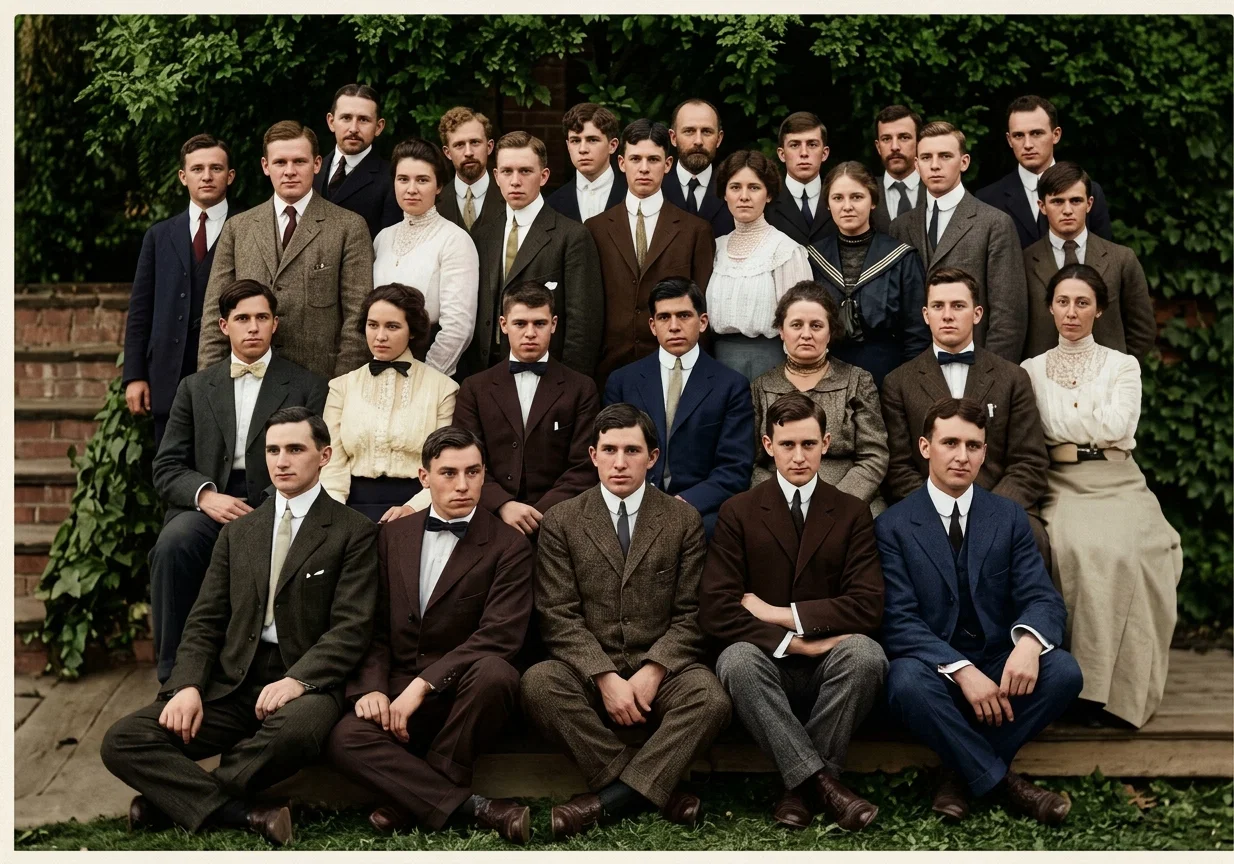
FIRST-YEAR MEDICAL CLASS
In accordance with the instruction received, and the action of the executive board, consisting of twenty-one members, comprising the presidents of the General Conference, of most of the union conferences in the United States, and of the Southern California Conference, the second annual session of the college opened Sept. 29, 1910. The college had been chartered in November, 1909, and one class had completed the first year’s work.

Requisites for a Medical School

Four things are necessary to any educational institution: (1) Students desiring such education as is offered by it; (2) a constituency which will maintain the school, and from which it may draw students; (3) instructors who are in harmony with the principles of the institution; and (4) facilities for giving the instruction required, and, in case a home is maintained, accommodations for caring for those connected therewith.

Our Students

From the response of our young people from all parts of the world to the proposition to have a medical college of our own, it is evident that the time is certainly ripe for establishing such a school. When the college was organized last May, the board planned for not more than twenty students in each class. To our surprise, twenty-nine entered to take the first year’s work. These, with the eleven who were in attendance the previous year, made forty students in the medical department at the beginning of the present year.
A standard of preliminary education for entrance has been held, equivalent to that required for any first-class medical school; namely, the matriculation standard of the American Medical Association and the Association of American Medical Colleges. Were it not for this high standard, a much larger number would necessarily have been admitted. The prospect is that next year will see an even larger class entering the college.
These students comprise members of the three-year medical evangelists’ course and those taking the complete medical course, covering five years. It is expected that a large number of those pursuing medical studies at Loma Linda will secure the needed training in the evangelistic course, and will go out into the great harvest-field as medical missionaries.
One year in addition to the regular four years ordinarily devoted to medical studies is made necessary in our school, in order to give instruction in Bible, and special studies, such as hydrotherapy and allied subjects employed in our system of therapeutics.
That the school is of general importance to the entire field, is shown by the fact that our students represent more than a dozen States and countries.

Constituency

The second requisite of the school is a constituency, those who will sustain the enterprise. The board, acting in accord with the direction of the Lord’s Spirit, have moved out by faith in establishing the school,—faith in God’s leading and faith that our brethren will as willingly accept the responsibility of this movement as their leaders have done. Will we do it? The responsibility rests upon the denomination as a whole and upon each one of us individually.
An important part of a college of this kind is a faculty that can give the necessary training in scientific lines. Thus far a faculty of nine physicians, three ministers, and a number of assistants has been chosen. We need the support and prayers of our people everywhere, that we may meet the mind of the Lord in this great undertaking. If we do that, we have no fears but we shall meet all the requirements of the State.
In regard to this latter point, I might say that it is imperative that we meet the standard of the State in our curriculum, faculty, and equipment. No other class of our workers is under such strict legal surveillance as our physicians. The requirements by the State cover the life of a physician from the time he begins his medical studies until he gives up the practise of medicine. Not one of our other schools is required to meet State requirements in every way as is our medical college; hence the necessity of thorough work, backed up by the faithful support of a loyal constituency.
And now to the important point of this question. We have our students—a goodly number of the flower of the denomination. In coming to Loma Linda, they feel that they are turning their backs upon the great and popular colleges of the world, in response to the call of God. They give themselves heartily to the work of building up a medical school after the plan and pattern that has been shown us, fully expecting and believing that the rank and file of the denomination will faithfully do their part.

Standing of the College

The standing of the school before the State boards is not established yet, nor can it be until our first class has completed its course, and has passed the examination before the State. This will be one of the determining factors in securing recognition for our college. To be sure we are chartered as a medical college, but our standing as such will depend upon three things: (1) The efficiency of our students, as determined by State board examinations after they have completed their course; (2) the number and standing of the physicians composing the faculty; (3) the buildings, appliances, and apparatus for giving instruction in medical subjects.
A great responsibility rests upon these young people, as their efficiency will be so large a factor in determining the standing of the school; but they have accepted the situation, and the earnest, faithful work they are doing leaves no doubt that they will succeed. As to the faculty, it will be strengthened from year to year as the students increase in numbers, and classes multiply.

Shall We Have the Buildings and Necessary Facilities?

At the organization of the college, the board of managers saw the necessity for several buildings,—a laboratory, a hospital, dormitories for the students, and, later on, a main college building, with appropriate equipment for the school proper.
At a later meeting the board authorized the expenditure of twenty-five thousand dollars this year for a dormitory for the young women, and a laboratory in which to do our scientific work, provided the money could be raised. The building of a ladies’ dormitory has been pushed forward as rapidly as the gathering of means would permit, and we hope it will be ready for occupancy in a few weeks.
At a meeting of the board held July 24, it was planned to erect a laboratory building, to be ready, if possible, in December. But because of the lack of funds, the work on this building has not yet begun. The twenty-nine students in the first-year class are carrying on laboratory work in chemistry in a room fifteen feet wide and forty feet long—like bees in a hive. Another laboratory class is endeavoring to do its work in a little room fifteen feet square. These are the only laboratories we have.

Urgency of the Situation

Now the situation is this: Under direct instruction from the spirit of prophecy, the College of Medical Evangelists has been established. The board, the faculty, and a large class of students have accepted the situation, and are doing their part, fully believing that the denomination will do its part in the matter. The requirements for the school are as enumerated above. There are but three years in which to accomplish the work of erecting all these buildings, and getting the school into first-class running order as a whole. Of course, our classes are running, with full work in the two years; but each year will add a class, and the prospect from the correspondence is that the number in the school next year will be doubled.
From all this, it is evident that in order for us to have our laboratory, our hospital, and our school building finished, and in running order in time for the inspection which we must undergo by the State boards during 1913, we must get busy at our buildings.

Students Willingly Co-operate

Elder J. A. Burden will tell the story of the excellent missionary work our students are doing,—how they went out in the missionary campaign and gathered over three hundred dollars; how they are going to neighboring towns, and holding Bible readings, selling our books and other literature, and doing medical missionary work in many places.
Elder G. A. Irwin will testify that the students and helpers at Loma Linda are willing to bear their share of the expense in constructing these buildings, and he will appeal to you for donations to this work. It is our conviction that our people have thousands of dollars in banks and other worldly enterprises, that ought to be in the work of the Lord. We shall be glad to correspond with any who wish further information regarding the medical school. Funds must be provided. The Lord has spoken regarding this work at Loma Linda. Who is ready to assist in the enterprise?
W. A. RUBLE, M. D., President.

Dangers of City Life

Of the dangers which threaten spiritual life in connection with the great centers of population, the Christian Work and Evangelist in a recent issue has this to say:—
On coming to the city it is natural that one reared in a small community should want to see the sights. Among the sights which appeal to a religious man or woman are churches and choirs and preachers. There is a great abundance of all these in a great city, and several months are consumed in sampling them. By this time the fever of city life has got into the blood, and the pressure of city engagements has obtained its grip on the mind; and as one has no obligation to any particular church, it is not hard on sabbath morning, if one is tired, or if one has a little back work to make up, to drop church attendance for that day, intending to do better a week later. But, alas! as soon as church attendance ceases to become regular, it is in danger of going to pieces altogether. For when one has missed public worship one sabbath, it does not cause a great shock to the conscience to stay at home the next; and as soon as the habit of church attendance is broken, and becomes occasional or accidental, the church ceases to exert a controlling influence over the life.

Greater New York Conference

The annual meeting of the Greater New York Conference was held in New York City, January 24-29. A large delegation was present from the home field, and a good representation from the union conference and the General Conference. The meeting was a profitable occasion, and gave all a more comprehensive idea of the magnitude of the work to be done in this great center.
About eighty per cent of the population of Greater New York is of foreign birth. There are in New York 1,300,000 Germans, 600,000 Italians, 110,000 Russians, 100,000 Scandinavians, 100,000 French, 100,000 Bohemians, and twenty times as many Jews as there are in all Palestine, besides thousands of representatives of many other nationalities. To reach all these with the message for this time is a stupendous task, but God has opened the way, and sent us men from some of these languages who are laboring for their own people.
We are now carrying on aggressive work among the English, Germans, Danish-Norwegians, Swedish, Italians, Hungarians, Slavish-Bohemians, and Russians, besides a strong and vigorous work for the Afro-Americans. Within the past year two city training-schools have been opened in the conference, and these are in successful operation. The International Bible Training School is located in Brooklyn, and is under the supervision of Elder H. R. Johnson. The attendance is excellent, and eight nationalities are represented. This school has been very successful from the start, and is filling a long-felt want in the training of workers for the vast foreign population in this country.
The English Bible Training School has been reopened, with Elder L. T. Nicola in charge. The prospects before this school are good, and we believe it will become a strong factor in training and educating for active service many of our people in this great city.
Our present force of laborers is thirty-two; nine of these are ordained ministers, ten licentiates, and thirteen hold missionary license. During the past year we have received appropriations from the General Conference which have made it possible to carry on a vigorous campaign during the past season. Last summer eight tent companies were in the field, and the coming summer we expect to add one more. As a result of the efforts made during 1910, two hundred persons have been reported as observing the Sabbath, over one hundred of whom have already been baptized.
The revival of the canvassing work during the past six months is a very encouraging feature. Since July, 5,612 books have been sold, besides a large number of smaller publications, magazines, and tracts having been distributed.
The increase of tithes and offerings for the year 1910 over the previous year is an indication of the spirit of courage and aggressiveness that is characterizing the work in this city. The total amount of tithes and offerings for the conference for 1909 was $25,273.06; for 1910 it was $33,216.82, an increase for 1910 of $7,943.76.
For a number of years the Greater New York Conference has been without a conference office, and we have done our business through the branch office of the Review and Herald, located at 32 Union Square. It was felt at the recent conference that the time had come to establish a separate tract society, and open in connection with it a conference office, to become the headquarters of our work in this field. Brother F. M. Dana has been released by the Atlantic Union Conference to act as secretary and treasurer of the conference for the present, and Brother R. J. Bryant has been invited to this field to act as home missionary secretary. Thus we hope to greatly revive and encourage all our people to carry some responsibility in connection with the proclamation of the message.
On Sabbath, January 28, a joint meeting of all our people was held in the Y. M. C. A. Hall in Brooklyn. Elder W. T. Knox spoke in the morning, and Elder O. A. Olsen in the afternoon. These services will long be remembered as seasons of great refreshing. An offering was taken for the foreign missionary work, and about twenty-five hundred dollars was raised in cash and pledges for the needy fields beyond.
The work in this conference is onward, and we are looking forward to great things the coming year in the proclamation of the message to the neglected cities of the East.
R. D. QUINN.

Maranatha Mission

THE work at this mission station is moving steadily forward. Since we held the meetings for the natives in Grahamstown, two families have moved out to Brother Sparrow’s farm. These have a good influence upon the natives living near us, and several are deeply interested. A few of these have become regular attendants at our Sabbath meetings, and thirteen persons have entered the day-school. For this we are thankful, as it has seemed well-nigh impossible to reach these people. God has heard our prayers for our students; and as a result, we see their interest deepening in the truth.
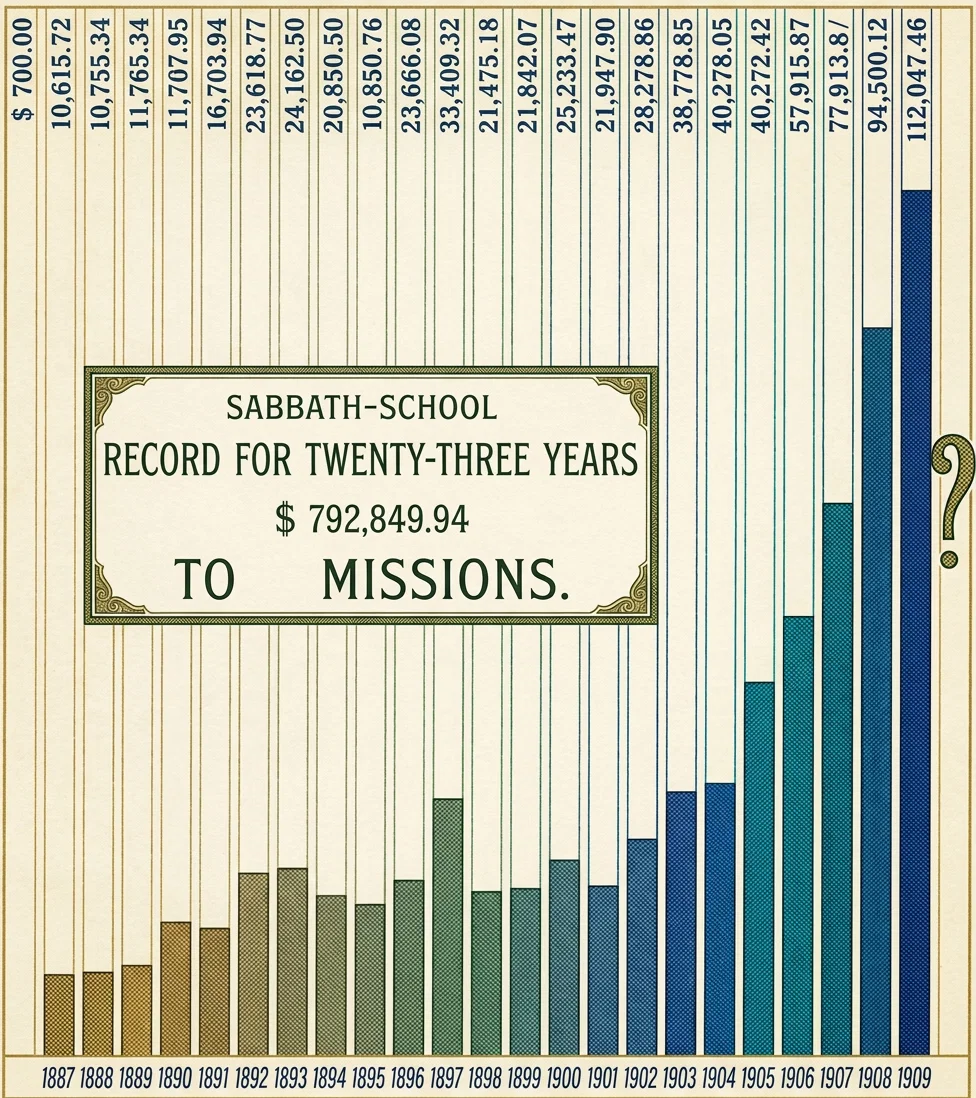
This diagram is reprinted from the Sabbath School Worker. It is encouraging, when unanswered calls are ringing in our ears from every mission field, to see the Sabbath-school gifts for missions so vigorously growing. We understand that the full reports for last year are very sure to show the column for 1910 the tallest of all. Let us thank God for all that this means in hastening the work onward, and keep the columns growing.
A few days ago, while working in the field, one of our sixth-standard girls said taken to me, “Teacher, I am greatly troubled; for I know that the seventh day is the Sabbath, and my people do not keep it. I do not know what to do.” We often hear similar expressions from our children, and many are greatly perplexed, because it seems impossible for them to keep the Sabbath at their homes.
One of our boys who is at home helping his father, who is not well, writes: “I am not pleased to be here, because I may break the Sabbath. I do not like to break the Sabbath. I now still keep it.” We are glad to know that our labor is beginning to bear some fruit.
The mission wagon has brought the truth to many, and a few are rejoicing in the light that has come to them. Several are asking for baptism; and if they continue faithful a little longer, we shall gladly administer this ordinance. We are more and more convinced that we should put forth strong efforts in the evangelistic work. This field is ripe for the harvesters, and there should be delay no longer.
The enrolment of our school for this term is fifty-four, but there are a few less just at present. We have a small carpenter-shop, and our older boys take great interest in working with the tools. They are making tables, benches, etc.
Our daily prayer is that God will give us much of his Holy Spirit, that we may be better fitted to win souls for him. W. S. HYATT.

Field Notes

THREE more persons have accepted the truth at Miles City, Mont.
ELDER D. N. WALL reports that two families have accepted the faith near Tolstoy, S. D.
ON Sabbath, January 14, from two of the Washington, D. C., churches, there were eleven baptized.
NINE persons were baptized at Worcester, Mass., January 22, and the following Sabbath fifteen were received into the church.
As the result of meetings at Dothan, Ala., twelve earnest persons have signed the covenant to keep all the commandments of God.
At Lents, Ore., Sabbath, January 7, Brother G. W. Pettit organized a church of thirty-one members. Eight united with the church by profession of faith.

Among the Sanitariums

My recent trip through the South in the interest of our sanitariums and the health work has been a revelation and an inspiration to me, and I am able to understand more fully why so repeatedly in the past we have been urged to give this field the attention it demands.
A great work is being carried forward by various denominations in the education and uplift of the Negro race. There are a number of universities, especially in Nashville, Tenn., and in Atlanta, Ga., where excellent opportunities are afforded in educational lines. In these universities the number of students in attendance ranges anywhere from four hundred to seven hundred; and at the school in Tuskegee, Ala., there are about seventeen hundred young people. In some of these universities the students appear to be exceptionally bright. They seem to be there for a purpose.
It is evident that from among this race, so recently come out of slavery, there are many who will very soon take an active part in carrying the gospel not only to the millions of their own people in this land, but to the countless millions of Africa and other lands.
I was especially impressed with the spirit and motives which seem to actuate those who stand at the head of these institutional centers. They are there, in nearly every instance, because of an irresistible conviction that God has called them.
I had the privilege of addressing the student body at Mahery Medical College, Fisk University, Atlanta University, Baptist University, Spellman Seminary, and Clarke University. I also had a separate meeting with the theological students of Clarke University. In each of these institutions the students number from five hundred to six hundred fifty. I was conscious of special help as I tried to impart instruction to these young men and women, who will soon take up work as educators and evangelists.
I am glad that we, too, are represented in the South as laborers among the colored race. At Huntsville an excellent work is being carried on, with about seventy students. God is greatly blessing the efforts of the workers. The buildings and grounds are well planned and nicely arranged. Various industries are connected with the school. The purpose is to train the hand as well as the mind and conscience. At present a new dining hall, which is very much needed, is building. The work is done entirely by student help, under the direction of Dr. M. M. Martinson. The new sanitarium building, although small, is admirably adapted to the needs of the school. For a small institution, it is well planned, and will be a helpful addition to the work. The Drs. Martinson have their hearts in the work, and both being practical, are a great help to the school.
About six miles from the Oakwood school, is located the Normal School for Negroes. Between three hundred and four hundred are in attendance at this place. Various industries are carried on, and at present a hospital is under process of construction.
At Hillcrest, near Nashville, a good work is being done by Brother G. R. Staines and his associates. They have a splendid farm, and at present nearly twenty students are in attendance. The students here are more mature, and expect to go from this place directly into the work as missionaries, canvassers, or evangelists. A small building on the land recently purchased, they purpose to convert into a sanitarium for the colored people, especially of Nashville. This is very much needed. A good physician connected with this place could carry forward dispensary work in the most needy parts of Nashville. In this way both the very poor and those in better circumstances could be reached and helped.
Owing to the unsanitary conditions under which many of the colored people are compelled to live, and their ignorance of the value of pure air, also their lack of knowledge pertaining to communicable diseases, the mortality among them is double that of the white race.
It seems very important that those who receive their education in these institutions should be thoroughly trained in sanitary methods. When the Lord anciently led a people out of slavery, he found it necessary to correct their physical habits. Not only did they receive instruction in regard to the prevention and spread of germ diseases, but they were urged to make reforms in eating and drinking. This same knowledge is needed among the colored people in the South. Not very much has as yet been done by these educational institutions in imparting this instruction. From my conversation with representatives of these universities, I am convinced that they see this need, and would welcome such help.
D. H. K.

A United Conference Effort

The Wisconsin Conference has a large sanitarium indebtedness to deal with, in connection with which are some unfavorable features. The people throughout the conference are quite conversant with the situation. A very favorable disposition is shown on the part of all toward the efforts that have been and are being made to adjust the work of the sanitarium satisfactorily, and to relieve it of its heavy burden.
A definite plan of relief has been adopted by the conference, and is being actively advanced. The sanitarium relief campaign, in its regular provisions, has been adopted; and at the last camp-meeting, action was taken to sell, in addition, ten thousand copies of “Ministry of Healing.”
Later it was decided to present the matter to the various churches of the conference. In this work I have recently had the privilege of assisting, visiting a number of the larger churches. I was accompanied at Milwaukee by Elder B. L. Post and P. C. Hansen, and at La Grange by Elder P. M. Hansen. The president of the conference, Elder W. H. Thurston, joined me in visiting most of the other churches. Decided help was rendered in the attitude of the conference president.
The churches took heart and courage from his presentation of the work, and responded well to the call for co-operation. Where time permitted, various interests of the work were presented; but the general relation of the medical missionary and health work to other branches, and its pressing local needs, were made the principal subjects.
It has been very gratifying to see how eager the people are to know about the sanitarium work, and their earnest desire to relate themselves properly to it. Judging from the attitude of the general membership, as seen in these visits, the outlook for Wisconsin is decidedly hopeful. A continuance of the present activity in the relief campaign will bring relief to the sanitarium. While the debt is a large one, it will give way to the constant efforts that may be put forth by the good-sized membership of the conference.
The nurses of the Madison Sanitarium are aiding in this effort. Several are using such time as can be spared from house duties to visit the people and sell “Ministry of Healing.” Books are also sold to patients and visitors in the institution. One nurse has sold twenty books in a short time. The little company in the Madison church has already reached the one-hundred mark in sales, and is still working, proposing to continue as long as the work needs to be done.
The report for last year shows that 1,986 books were sold in Wisconsin as a beginning. The movement is developing in strength and activity. The first two weeks of February were devoted to this work by all the laborers. A workers’ and elders’ meeting then gave the matter further study. The results will be just as definite and telling as are the plans of work and the efforts put forth. What is done in one conference may be done in others. Definite action and co-operation on the part of leaders, workers, and people will bring definite results.
L. A. HANSEN.

Missionary Volunteer Institutes

WE have reached that point in the development of our young people’s work where all can see that the results obtained far more than justify the efforts put forth. The reports for the past few months have been most encouraging. It is evident that where there is proper leadership, our youth in the little churches and companies, as well as in the larger centers, are taking up the threefold plan of devotion, study, and work very earnestly. It is another evidence of the gathering forces to quickly complete the work which means the realization of our hope.
Geikie wrote: “Early vigor and warmth, consecrated to God, work miracles. Older men have their honored work, and are no less needed than younger; but the living force that conquers the world for God is the fresh enthusiasm of opening life. Years may counsel, and stimulate, and provide the means; but the hard work must fall mainly on young strength and zeal. Once won to God, there is no hesitation nor half-hearted service. Youth feels itself only a steward, and gives itself up with unshrinking devotion.” When fully aroused and properly encouraged and directed, what a power our young people can be!
One of the greatest needs in our Missionary Volunteer work is that the young people shall be instructed in how to go to work. “That which is needed now for the upbuilding of our churches is the nice work of wise laborers to discern and develop talent in the church, — talent that can be educated for the Master’s service. . . . Young men and women should be educated to become workers at home, in their own neighborhoods, and in the church.”—“Appeal to Ministers and Church Officers.”
It is for the purpose of increasing the efficiency of our Missionary Volunteer secretaries, and of helping our young people and their leaders to do a greater work, that the union conference Missionary Volunteer institutes outlined in a recent number of the REVIEW are to be held. The places and times of these meetings have been arranged for the various union conferences as follows:—
Southwestern: Keene, Tex., February 22-28.
Central: College View, Neb., March 3-12.
Northern: March 17-26.
Lake: Berrien Springs, Mich., March 31 to April 9.
In the Northern Union Conference it has been arranged to hold three short institutes instead of one long one. These are to be at Minneapolis or St. Paul, Maple Plain, and Hutchinson, Minn. Probably another will be held at Elk Point, S. D.
The General Conference has appointed Prof. H. R. Salisbury, Elder Meade MacGuire, and Miss Matilda Erickson to assist in the work of conducting these important institutes. Pray for the success of these meetings.
It is planned that the conference Missionary Volunteer secretaries, as many of the other workers as possible, and leaders and young people from all the churches, shall attend these meetings. Let each church endeavor to send at least one representative young person. The institute will be more than a series of meetings; it will be a school of missionary methods. Those who attend from first to last, take notes on the lectures, and do the class work assigned, will be given an institute certificate.
M. E. K.

Medical Missionary Department

Conducted by the Medical Department of the General Conference
D. H. KRESS, M. D.   -   -   -   -   Secretary L. A. HANSEN           -   -   -   -   Assistant Secretary

Young People's Work

Conducted by the Young People's Missionary Volunteer Department of the General Conference
M. E. KERN - Secretary
MATILDA ERICKSON - Corresponding Secretary

Notes

THE secretary of the general Religious Liberty Association spoke in Baltimore, Sabbath, February 4, on the subject of religious liberty.
THE Atlantic Religious Liberty Association is preparing a campaign of education in religious liberty matters in the Atlantic Union Conference, and will be assisted by the General Conference Religious Liberty Department. The campaign will begin about March 10.
THE Columbus (Ohio) Union, bearing date of Jan. 27, 1911, contains an interesting report of a meeting of the State board of health, at which a lively discussion was engaged in on the question of Sunday baseball. Some of the speakers maintained that Sunday baseball games were in the interests of health, and ought not, therefore, to be prohibited.
ASSEMBLYMAN LEVY, of New York City, has introduced in the New York Legislature a measure amending the Sunday legislation of New York State so as to exempt from the provisions of the law any who observe as a rest day another day of the week than Sunday, provided that affidavit to this effect is filed with the proper officer of the government. Bills designed to foster Sunday observance by civil law have also been submitted to the legislature of New York.
DURING the recent executive meeting of the Federal Council of the Churches of Christ in America, held in this city, the committee called upon, and presented a written address to, President W. H. Taft. Reporting this incident, the Washington Herald, of Jan. 26, 1911, said: “He explained that the phrase in the Constitution that prohibited an established religion had in reality given to the churches in this country ‘an independence, a strength, and a power and force, that are exceeded in no country in which there is an established church.’”
THE following editorial appeared in the Independent of Feb. 2, 1911: “Among the things not easy to understand is this, why some of our religious teachers who are so much pleased that in this country church and state are separated, should grieve when separation is decreed on the Continent of Europe. Thus the Catholic World, in its December issue, describing very fairly the changes in Portugal, says: ‘Other measures are proposed which in no way deserve the name of reforms: Church and state are to be separated,’ etc. We would like to be told why what is so much valued here would not be a reform there.”
THE New England Lord’s Day League held its annual meeting in Providence, R. I., January 22, and resolved to carry on an active campaign in behalf of better Sunday observance through the machinery of civil law. Bishop Mallelieu, of Boston, bishop of the Methodist Episcopal Church, was the principal speaker, and advised the people to be “a little Puritanical” in their Sunday observance. Another speaker said, “We have a strict sabbath law, which has come down from Puritanical times, which can be enforced by the weight of public opinion.” The “Puritanical times” provoked a “public opinion” which resulted in laying the foundation of this mighty nation of freemen. Will American citizenship permit a return to the days of Puritanism by an indifferent attitude to such demands for enforced Sunday observance?

A Temperance Rally in Every Church

Let every Seventh-day Adventist who believes that “our work for temperance should be more spirited, more decided,” arouse to action, and make this a “living issue” now. Let every church take this matter up, whether or not it has a Missionary Volunteer society. Young and old should be planning and praying to the end that they may do their part in the temperance campaign. Some of the greatest temperance workers in America are seeking to speak to two million people through the Temperance Instructor, which is now on the press. Will you help them?
One conference president is working to double the order from his conference this year. Another writes of a plan to have persons of tact and Christian courtesy go to cities and towns where our work is not represented, and interest the leaders of churches, Sunday-schools, and other organizations in taking large quantities of this fine temperance paper. This plan was carried out very successfully last year, especially with Sunday-schools.
One of the best ways to interest the people in temperance, and to launch your campaign, is to have a temperance rally. The following suggestions may be helpful in carrying out this plan:—
1. Thoroughly prepare. Let your committee study carefully the section in “Temperance Torchlights” on “Temperance Meetings,” and from the materials in that book, the Temperance Instructor, or any other sources, prepare the strongest program possible. Much will depend on the thoroughness of the committee’s work in studying the materials, and adapting the program to the persons available to take part. Give young people on the program plenty of time in which to prepare, and have some teacher or older person help by hearing rehearsals and giving helpful criticisms. Above all, pray much for the success of the undertaking.
2. It is well to arrange for one or two leading parts that will stand out prominently, and give character to the service. If you are fortunate enough to get a good temperance lecturer, he might take most of the time.
3. It is well to give the children a part. A small chorus might sing; or four boys might step to the front and give the “Rights of a Boy,” based on an article in the Temperance Instructor.
4. If readings are given, the selections should be reasonably short, and read very distinctly. The most impressive selection will lose its power in the hands of one who can not interpret its thought to the audience. There are several temperance stories in the Instructor, from which selections might be made; such as, “A Bottle of Tears,” “An Incident in Real Life,” “Whisky and the Baby,” etc. In presenting the first-mentioned, the story might be told briefly, and only the mother’s letter read.
5. Gather from the sources mentioned a series of pointed temperance facts, and let different ones in the audience rise, and give them distinctly.
6. Recognize the power of music in this work by having a few of the best temperance selections given by the best talent available. “Temperance Torchlights” contains a few selections and a list of others.
7. If any scientific experiments are performed, practise till you know how to do them well.
8. Advertise the rally well by announcements at public gatherings, on bulletin-boards, and in the press. Local papers will often print an extended announcement and other temperance matter if requested.
9. Have the rally in a commodious place of meeting, easy of access to the people. Many will come to temperance meetings who will not attend a church service.
10. Have plenty of copies of the Temperance Instructor and other literature on hand at the rally to sell or give away. Be sure to present the pledge.
Whatever plan may seem best for your community, “plan your work, and work your plan,” with definite ends in view.                                                         M. E. K.

Christian Liberty

Reports, Notes, and Comments Pertaining to the Current History of the Rights of Conscience
Conducted by the Religious Liberty Bureau
K. C. RUSSELL . . . . Secretary C. M. SNOW . . . . Corresponding Secretary
Continue reading: Sunday Recreation