The Youth’s Instructor, Vol. XLIX, No. 49

DO YOU? WILL YOU?

The Youth’s Instructor

December 12, 1901

Review and Herald Publishing Company · Battle Creek, Mich. · December 12, 1901

DO YOU? WILL YOU?

WILL the young men and young women who really love Jesus organize themselves as workers, not only for those who profess to be Sabbath-keepers, but for those who are not of our faith?”
Young man, young woman, do you really love Jesus? Many profess to love him. You profess to love him. But do you love him? Do you really love him? Most young people love something else better than Jesus. They love pleasure; they love this world; they love self; they even love folly and sin. Not only is this true of the young people of the world, but it is lamentably true of professed Christians. Even the young people who profess to be Sabbath-keepers, who claim to be looking for the soon coming of Jesus to destroy all pleasure-lovers,—many of these very young people love something else better than Jesus. So I ask again, Do you really love Jesus? DO YOU?
You say: “Yes, I do love him. How could I help it? He left his throne in heaven for me. He lived a life of poverty and toil and self-denial on earth for me. He suffered shame and mockery for me. He died on the cross for me. He is even now pleading the merits of his shed blood for me. He is coming soon to take me home to live with him. He loves me,—me, a poor, lost sinner. Why should I not love him?”
All right. Your argument is sound. My heart thrills to hear you tell it. But will you work for those who do not really love Jesus,—first, for those who profess to love him, but, alas, only profess; then for those who do not know him? Jesus is saying to you, “He that gathereth not with me scattereth.” Will you find some other young person who really loves Jesus, and unite with him in some plan to save others? Will you? Jesus is asking you, pleading with you, to do this work. How will you answer him?
“No one has come to our church to organize us.” “Will the young men and young women . . . organize themselves?”
“We tried to have a Young People’s Society, but some of the young people brought such reproach on the work that the church thought best to stop it. So many are careless and indifferent; there is so much lightness, trifling, and foolish and unseemly talking.” Yes; and all that shows the need of the very work Jesus asks you to do. Now, will the young people who “really love Jesus” do this work for these professed Sabbath-keepers? Will you who “really love Jesus,” whether you are all alone, or whether there are two or three or more of you, organize to work for others, till they also “really love Jesus,” and unite with you to gather with Christ?
Souls are perishing. Our young people are going to ruin. Workers are needed in all the world. Satan is using our youth. His forces are organized: shall our Leader be disappointed any longer? The work of our Master is worthy our highest energy, our liveliest enthusiasm, our most loyal effort. Shall we allow Satan and his agents to work harder to ruin souls than we work to save them? Come, young people, let us make a rush for King Immanuel. Let us rally to the help of our King.
Do you really love Jesus? Will you organize yourself for work? Now? TO-DAY? LUTHER WARREN.

“BEAR YE ONE ANOTHER’S BURDENS”

(December 15-21)
The Divine Commission.— It is not the burdens that the Lord has placed upon us, but those we have taken upon ourselves, or allowed some one else to put upon us, that are heavy; for he expressly declares that his burden is both “easy” and “light.” Matt. 11:30. We should not object either to wearing yokes or to carrying burdens; we should only refuse the yokes that do not fit us, and the burdens that the Lord has not placed upon us. The man who dodges burden-bearing and yoke-wearing actually deprives himself of a wonderful blessing; for, “It is good for a man that he bear the yoke in his youth.” Lam. 3:27. Are you trying to shirk God-given responsibilities? If so, you are depriving yourself of some of the sweetest experiences that can come to you in this life.
The Divine Plan.— “Every man shall bear his own burden.” Gal. 6:5. In addition to this he must put forth all his efforts to “undo the heavy burdens” (Isa. 58:6) which sin has laid upon others, and to “break every yoke” that men have made for themselves. In heeding this admonition our yokes become easier, and our burdens still lighter.
The Worldly Plan.— The worldly plan is to try to make our yoke fit some one else, and to lay our burden on some one else’s shoulder, thus developing selfishness, and thereby missing the blessing that comes to him who carries out God’s plan.
The best way to bear the burdens of others is to teach them to follow the injunction of Ps. 55:22: “Cast thy burden upon the Lord, and he shall sustain thee.” Everywhere about us are human souls that are so loaded down with oppressive burdens that they are instinctively repeating those anxious words, “Who shall roll us away the stone?” (Mark 16:3) and all the while Christ is bidding us, “Take ye away the stone.” When God has commanded us to bear our brother’s burden, he will not relieve us of that responsibility any more than he would remove the stone from Lazarus’ grave. What God has asked us to do it is to our best interest to perform. Frequently after a man has received the new life by conversion, he is still struggling under the bondage of many wrong habits; and this is a divine opportunity for Christian workers to come to his side to aid him. Christ’s management of Lazarus’ case clearly indicates this. He infused into that dead body a new life, but Lazarus came forth bound hand and foot with grave-clothes. It would have been an easy matter for Christ to remove them by a miraculous act; but instead of that he said, “Loose him, and let him go.” How many of your associates, classmates, or perhaps even your own brothers or sisters, are going about bound by some of their grave-clothes—emblems of the old and dead life—because you have failed to fulfill the command of Christ, “Bear ye one another’s burdens”?
Inspiration has said, “Be not deceived; God is not mocked;” so do not go through the solemn mockery of continuing to pray for your friends when there is a human obligation laid upon you to do something for them. Fasting and praying in behalf of our friends, if we have not loosed them from their bands of wickedness, if we have not undone the heavy burdens under which they are struggling, if we have not done all in our power to let the oppressed by the wrong habits of life go free, if we have not labored by wholesome instruction to lead our friends away from such habits as are pulling them down to the earth, can not and will not be accepted by God.

SUGGESTIVE

Almost every human life has a plague-spot somewhere that is eating away its vitals. Have you tried to discover it in some of your associates, and then carefully, under divine guidance, sought to touch it with the healing balm of the gospel? If so, you have been bearing somebody’s burden. Have you endeavored to put into the background as much as possible the defects and shortcomings of others, who, like yourself, are struggling for perfection? If so, you have been helping them bear their burdens.
Have you spent the time that others have wasted, in acquiring a knowledge of how to do simple and useful things for the sick and distressed, and then improved your opportunities in this direction to relieve human suffering, or make the pathway of those who can not be relieved, a little brighter? If so, you have fulfilled the law of Christ.
Have you allowed God to work such a miracle of grace in your life that others who had begun to doubt whether God was still accomplishing such things in this day and age of the world, have had their doubts removed, and have taken fresh courage because a train of providences brought them within the sphere of your influence? If so, in a most blessed way you have been bearing somebody’s burdens.
After reading and rereading Isaiah 35, try to decide how much of it God intends to fulfill in this life, and then try to determine how much of this blessing depends upon how faithfully God enables you to carry out the commission that is outlined in the third and fourth verses.
DAVID PAULSON, M. D.

Young People's Work Progress Reported from the Field

FROM THE FIELD AT LARGE

Not very much has been said through the columns of the INSTRUCTOR about the progress of the Young People’s work. We all seem to be waiting until something great is accomplished, before reporting it. I have just finished reading my mail, and it has occurred to me that other hearts might be made to rejoice, as does mine, if just the information now before me on my desk were published. Some of the writers doubtless would be surprised to see their letters in print, but I think I must send in a few extracts:—
Miss Lottie Farrell, the Wisconsin Sabbath-school secretary, writes: “Young People’s societies are being organized, and the young people are entering heartily into the study of the lessons in the INSTRUCTOR. It was my privilege to attend the meeting of the society at Clear Lake, and listen to the three-minute talks of several of the members on mission fields, also to unite with them in prayer for these needy fields. I am sure we felt nearer to our brethren and sisters in these far-off lands than ever before. I believe these meetings, if rightly conducted, will prove a great blessing to our young people.”
Another letter from the same State says: “We are organizing a Young People’s society in the church at Bethel.”
The Colorado field secretary writes: “We have Young People’s societies organized under the new recommendations at Denver, Colorado Springs, and Cañon City, and our purpose is to move forward as rapidly as possible.”
From Iowa comes the word: “We have three new Young People’s organizations, the result of personal correspondence.” Iowa has quite a number of Young People’s societies.
The leader of the Young People’s movement in one of our large churches writes: “We made a call for members recently, and over one hundred membership cards have been signed. There is considerable enthusiasm on the part of the young people, and we are very anxious to take only such steps as shall be for the best interests of the church in general.”
The next letter is from a young man connected with a little company in a thinly settled mountain county in Oregon. He says: “The young people of our church are endeavoring to heed the Lord’s instruction in regard to organizing into a working band. There are only seven of us who are active members, but the outside attendance at our meetings is large. We have elected a president and a secretary, and are having our meetings Sunday evening. Our little church is quite well filled at times. We feel encouraged to go ahead.”
A president of one of the conferences writes: “I have just secured a list of names of young people, and we are entering upon the line of work of which you write.”
A sister from Portland, Me., writes of the work there. In their company are children as well as young people, and those of the different ages are each given a part to act suitable to them.
Not very long ago I had the privilege of attending a very interesting little meeting in Los Angeles, Cal. About twenty young people were present. Some excellent talks were given by the young people, missionary work was reported, and plans were laid for more effective work.
Gradually the work is growing, and increasing in power and influence. May it be conducted in every place in such a way that it will be an honor to the cause of God and a factor for good in every community.
MRS. L. FLORA PLUMMER.

AN ENCOURAGING EXPERIENCE

Last winter a prominent business man spent several months at the Chicago Branch Sanitarium. On account of his determination to carry on his business interests, he apparently received little physical benefit. While he manifested sufficient respect for the religious spirit of the institution to attend, with reasonable regularity, morning worship and other devotional meetings held in the house, he did not seem to have any special relish for spiritual things, and it was difficult for us to secure an opportunity to have a definite religious conversation with him. For these reasons, I feared, when he left us, that his coming had been more or less a failure from every point of view.
But a few days ago, having occasion to call at his office on a matter of business, he asked me aside into a quiet corner; and after we were both seated, said: “I want to have a talk with you. I came to your institution, an avowed skeptic. Somehow I had always succeeded in reading the Bible in such a way as to twist me all up. My childhood and youth were spent among associates and in an environment that were unfavorable to the development of Christian character. After I attained maturity, for business reasons and for the sake of common decency, I have lived what might be termed a moral life; but I have never been satisfied nor contented. As I mingled with your workers at the sanitarium, I observed that they were human like myself, but that they possessed a power to which I was a stranger, which enabled them to subdue and hold in check evil tendencies. At morning worship and prayer-meetings, the Bible was unfolded to me from a standpoint that was helpful and fascinating. The earnest efforts that your boys put forth to help me touched my heart; and by and by I began to pray that the Lord would forgive my sins at some future time. I did not dare ask for immediate forgiveness; it seemed to me that it would be too much; but after a while the conviction stole over me that my sins had actually been forgiven, and a sense of peace took possession of me which I had never experienced before. I may not recover my health entirely, and so may not secure much more of this life; but that is only a small matter to me now, as I contemplate having a part in the life to come, which is, after all, the real life.”
This, in substance, was what this man told me, and the animated look in his eye testified to the sincerity of his words.
This experience impressed me deeply that if we only faithfully maintain in daily life the principles of the Master, and hold ourselves always in readiness to speak a word in season to those who are weary, we shall be among the happy number who, in the day of God, shall come with rejoicing bringing precious sheaves to the Master.
D. P.

SPEAK UP, BOYS!

Next to standing erect, and having a manly bearing, I like to have a boy speak up when he is spoken to. He can never make a good impression if he mumbles or “mouths” his words when he is talking to others. Clear and distinct enunciation is a valuable trait for a boy to possess. I was in the office of the president of a great corporation, one day not long ago, when he rang his bell for his office boy. The boy came in a moment, and the gentleman said:—
“Did you take that package over to Brown and Smith’s for me?”
“Mum-mum.”
“Did Mr. Brown send any message to me?”
“Mum-mum-mum.”
“What did he say?”
“Mum-mum-mum-mum —”
“Oh, speak up so that I can understand you!” said the gentleman, a little sharply. “I do not know what ‘mum-mum-mum-mum’ means.”
It sounded exactly as if the boy were saying “mum-mum-mum-mum” every time he opened his mouth. When he had finally held up his head, and spoken more intelligibly, and had then gone from the room, his employer said: “I really think that I shall have to let that boy go. He mumbles everything he says so that I can hardly understand what he means. I do not like to send such a boy with messages to our customers. I like a boy who can speak up like a man. He can do that, and, at the same time, be a perfectly modest and respectful boy. Somehow, I feel rather suspicious of a boy who hangs his head and mumbles everything.”
I think that a good many people have that feeling, although a boy may be excessively shy and mumble all that he says, and at the same time be a perfectly honest boy. But he makes a very poor impression, and will not advance so rapidly as the boy who looks one squarely in the face, and speaks up like a man when he has anything to say.
The voice has much to do with a boy’s success in life, and it should be well cultivated. There are boys who speak up so that they can be heard a long distance every time they open their mouths, who are even more objectionable than a boy who mumbles. An over-loud, brassy voice, with a kind of defiant ring in it, is extremely unpleasant, and it is sure to make a bad impression. A voice with a whine in it is always irritating, and an insolent tone of voice has told against more than one boy when he has been in search of a position. The voice that is clear and distinct, and, at the same time, deferential, is the voice that makes the best impression. Don’t mumble, don’t “meech,” don’t whine, and don’t use an insolent tone when you speak.
You may think that it is of no consequence how a boy speaks, if he does his work properly and faithfully, but I am sure that you are mistaken. There are other things to be taken into account besides doing one’s work as it ought to be done, if a boy hopes to get on in the world. I know a young man nearly thirty years of age who is very thorough in his work, and would long ago have been advanced to the position of foreman of the establishment in which he works, but for the fact that he is bearish in his manners. The manner of one’s speech, as well as one’s general bearing, are all considered at certain times, apart from his work. So speak up, and acquit yourselves like men, boys!—J. L. Harbour, in Success for November.

DIVISION I—GEOLOGY

Chapter XIII—Rock-formations; Their Strata and Age
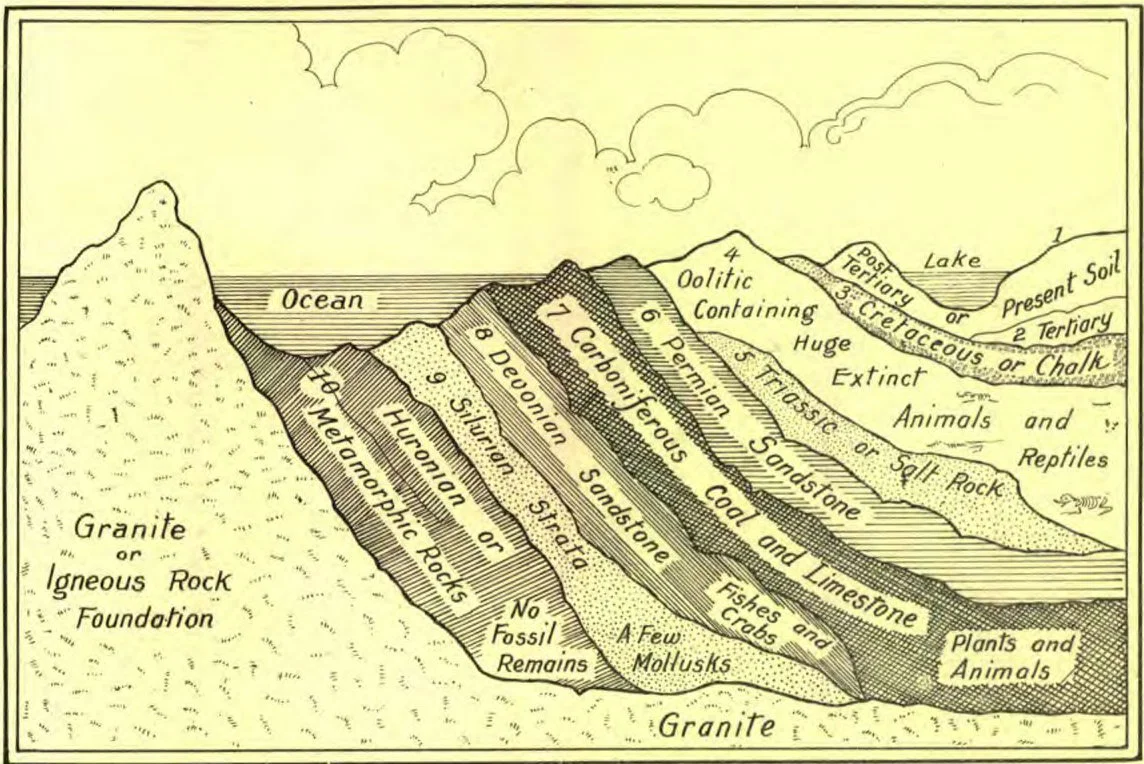
§124. The formations of rocks, their strata and supposed age, form the foundation of infidel geological science, so universally taught and urged against the truths of God’s word. The light of many a youthful soul has gone forever out amid the darkness of infidelity, which so bewilders the inquiring minds of many who, in their thirst for knowledge, become entangled within the meshes of its so-called science. It is that we may understand the real truths of geology, that the preceding chapters have been written; and now let us ask the special blessing of the Lord of all science upon us as we enter more fully into this interesting field of knowledge, prepared for its study by the lessons already learned.
§125. As to the time required for the formation of rock, why should any geologist claim that it required the Creator of all things millions of years to bring into existence a mere mass of stone, when man, with his limited knowledge of the elements of earth, can form rocks capable of immense resisting power in from twenty-four to forty-eight hours? Is not God greater than man? Then how absurd to claim that he required millions of years to perform what we ourselves can do in a few hours.
§126. It is true that there are found, in different parts of the earth’s surface, different kinds of rock-formation; also that in many places those rocks lie in separate, distinct layers, or strata, exactly as the waters of the flood washed the soil together at the time when the Lord caused it to be converted into rock, for a special, definite purpose, as we shall learn farther on.
Geologists classify these rock-formations into from twelve to twenty or more divisions and subdivisions. In the accompanying illustration we present ten of the principal strata, agreed upon by geologists generally, these ten being all that are necessary to a proper understanding of the subject. The illustration gives the theoretical arrangement of the rock. Each stratum, it is claimed, represents a supposed period, or age, in which it was formed. We say “theoretical arrangement;” for the whole geological classification is only theoretical.
§127. It is commonly claimed that the Granite, or Igneous rock, is the oldest of all rock-formations, because it contains the remains of neither animal nor vegetable life. This we believe to be correct. Every piece of granite we see was evidently made at creation, and is as old as this world itself. All other rocks, such as sandstone, limestone, triassic, chalk, etc., we believe to be of later formation. But, it may be asked, when were these later rocks formed? and for what purpose? Does each one represent a long, indefinite period of time, during which certain classes of animals and reptiles evolved from the next lower order?—We will see. With the illustration before us, let us study the subject of geological periods, first, from the commonly accepted point of view.
§128. To begin with, away back in the dim, distant ages, estimated by the best and latest worldly authority as being about one hundred and sixty-four million years ago, this world was just passing out of the heated, granite-rock period into the Huronian, or Metamorphic, period, known also as the Laurentian, or Cambrian epoch. At the close of this period there began, according to the theory, to appear a few cells of the lowest orders of animal and vegetable life. Following this came the Silurian period, with its flat- and cord-worms, trilobites, shell-fish, and animals with primary stomachs and alimentary canals. This epoch—from the Granite to the close of the Silurian—covered, it is claimed, a period of one hundred million years. Now, we ask, could the whole earth have been in so heated a state as is claimed, and this condition not been universal? Would not, then, the resultant formation have also been likewise universal?—We think it would.
§129. The next epochs in the order claimed are the Devonian, the Carbon, and the Permian, which lasted, we are told, forty-six million four hundred thousand years, during which time skull-less and round-mouthed vertebrates came into existence. During the Carboniferous epoch of this immense period the earth became overgrown with the most profuse vegetation. Again we ask, If this be true, must not these conditions have also been universal, and would not, therefore, the coal we now burn, which has come as the result of the burying of those immense forests, be evenly spread over the earth, as was the growth from which it has come? But this is not the case.
IDEAL ARRANGEMENT OF ROCK FORMATIONS
§130. The next in order are the Triassic, or salt rock, the Oolitic, and the Chalk epochs, which, combined, are said to have occupied about fourteen million three hundred thousand years, during which time the great pine forests grew, and were infested with fearful reptiles, tailed and gilled salamanders.
§131. After this came the period of leafy forests, with their narrow-nosed and tailed apes. This Tertiary and Post-Tertiary period is said to have been two million eight hundred thousand years long.
§132. Lastly we come to the period covering the epochs of the Glacial, Post-Glacial, and Recent period, represented in the illustration as Present Soil. This, we are told, occupied five hundred thousand years, during which time the narrow-nosed apes evolved themselves into the woolly-haired, and finally into the straight-haired, man.
§133. Now let us see what we have. All these epochs must have been universal if they existed at all, and consequently have left their remains universally scattered over the earth, in the order in which they occurred. This we know is not at all the case. Nowhere are all these strata to be found in the order given, to any considerable extent. All through Europe the tops of the mountains are covered with granite rock, while in America this rock is found at their bases. In many places where the strata occur in any given order, the different kinds of rock are exactly reversed or entirely confused.
§134. Regarding the Glacial period, of which we hear so much in America, we ask, How could this earth, having been once as hot as is claimed, have cooled down to such a frigid point as to permit the present ice blanket of the poles to approach well toward the equator; then by some mysterious process, invented to suit the occasion, warm up again so as to be habitable for man; and now again, as is claimed, be rapidly cooling off?
As we said before, these epochs must of necessity have been universal. But the cold facts are, as proved by the very latest European surveys, that every one of these supposed evidences of a Glacial period is entirely wanting in Asia and Europe. If we had a Glacial period here in America, then they also had one in Europe; but the topographical evidences are all in favor of a universal flood, just as the Bible gives it. Why not believe the record of the flood, and so be in harmony with the Bible, and also consistent with the facts in the case? Why believe a theory that is self-contradictory, wholly opposed to the facts, and out of harmony with all reason and sound judgment, as well as opposed to the living word of God? “In six days the Lord made heaven and earth, the sea, and all that in them is.” Why not believe it?

QUESTIONS

Why does the study of geology, as popularly taught, lead to infidelity? Into how many divisions is rock usually classified? What can you say of the Granite age? Also of the other rock-formations? Name the strata of rock in their order. Is this order real, or only theoretical? If such ages ever existed, could they have been merely local affairs? Are their supposed remains local or universal? Describe the Glacial period. According to the theory, must it have been universal or local? According to the facts, could it have possibly been universal? What great event was universal? How long a period was occupied in the creation of this earth?
DR. O. C. GODSMARK.

Lives Are Not Wasted in a Lump

LIVES are not wasted in a lump. Scarcely any one is foolish enough to throw away his life as a whole. But the wasting of moments and days—ah! that seems a different matter, though really it is the same thing.—Forward.

FIRMNESS OF CHARACTER

In Christ’s wonderful prayer for his disciples he asked, “I pray not that thou shouldest take them out of the world, but that thou shouldest keep them from the evil.” God has a purpose in associating his people with the world, and we, as young people, need to realize our influence upon all with whom we come in contact.
The work of God needs young men and women who will be firm and steadfast for the right at all times and under all circumstances. If there is one thing that we need more than another in these perilous times, it is firmness. We need to develop characters approved of God, strong to withstand any temptation or persecution.
The Bible gives many beautiful illustrations of such characters. The record of the three Hebrew children shows firmness born of a consciousness of right-doing. When brought before the king, they said, “O Nebuchadnezzar, we are not careful to answer thee in this matter. If it be so, our God whom we serve is able to deliver us from the burning fiery furnace, and he will deliver us out of thine hand, O king. But if not, be it known unto thee, O king, that we will not serve thy gods, nor worship the golden image which thou hast set up.”
Then there is the example of Daniel, which is admired by every Christian. He was true and noble. While he was always anxious to be at peace with all men, yet he would not let any power turn him from the path of right. His life was written for an example to us, “upon whom the ends of the world are come.” If he had yielded one point, he would have placed himself in a position where Satan could easily have overcome him in the future.
We have also the record of our Saviour’s temptation in the wilderness. How much depended upon his firmness then! The salvation of the whole world was to be decided by the course he pursued at that time. The universe was watching to see whether he would yield principle or resist the evil one. By the power of God he withstood the temptations of Satan, and thus made it possible for every one who is tempted, to gain the victory. Tempted in all points as we are, yet without sin, he is abundantly “able to succor them that are tempted.”
If we only realized how much good we might do by being true to principle, we would no longer be swayed by the influence of those who are unconsecrated. The Lord has told us that the young people can do a work that older people and ministers can not do. Let us, therefore, have an aim, a purpose, in life, knowing that he who has saved us is able also to keep us from falling, and to present us faultless before his throne.
C. C. T.

AT THE AGE OF TWENTY

“JUST think! I am twenty years old,” the girl wrote—“twenty! I used to think twenty was so grown-up, but now that I have got there, I can’t feel grown-up, even though I know that the little-girlhood is gone forever. But it is so different from what I expected. I thought things would be easy when you grew up,—easy to decide and to choose and to hold to, I mean. They’re not—they’re harder than ever. I don’t mean good times, you understand. People are lovely to me, and there are beautiful things going on all the time; I mean in myself; I mean that it is so hard to hold one’s ideals steadily, and to grow toward the true woman that I want to be. Isn’t it ever going to be easy?”
It is a question of girls everywhere; one does not have to be twenty to ask it. And the answer is Yes and No. No one can hold her ideal steadily year after year, and not be lifted by it. Unconsciously, but no less surely, one temptation after another will fall away till the day comes when she smiles to think that such small things ever could have cost her the tears they did. But, like everything else in life, ideals, too, must obey the law of growth, else they will wither away, and fail of their high purpose; and so it comes about that always there will be new problems and new battles. What else could we expect? Shall a tiny plant win its way to the victory of bloom by constant effort, and a human soul expect to grow by sunny hours alone?
And after all, would she care to if she could—this girl whose beautiful ideal is a true and high and gracious womanhood? She may think that she does, but the brave heart within cries for something better. It is not easy times she wants—it is Victory!—Well Spring.

HONEY IN THE HOME

Did you see in the newspapers the account of the peculiar experience of Senator Thomas H. Carter, of Montana, in Washington? A swarm of bees took possession of the space beneath one of the floors of his house. They worked away for three years, until the household suddenly awoke to the fact that the floor was a mine of honey. The space was packed full of it. Mr. Carter has taken out hundreds of pounds of the delicious substance. The bees fought bravely for the results of their toil, and had to be driven out by sulphur. All the family became honey-miners, and won sweet and golden rewards.
Well, I do not vouch for the truth of that yarn—I only saw it in a newspaper; but it will serve, at any rate, to make a point that is decidedly worth making.
Every home ought to be a magazine of honey. Especially should the sitting-room and the dining-room be charged with it. Wherever you tap a rightly constituted home, you should find honey. The breakfast table should be loaded down with it. The parlor should be full of it. It should overflow into the kitchen. The sleeping apartments should have their share. Honey Castle the home should be, from top to bottom.
You do not like honey? But you do like the kind I mean; for the bees are Benefits, and Benevolence, and Beneficence, and Beauty, and Benefactions, and Burden-bearing, and the honey is Happiness! That is a swarm worth living, and a product worth gathering.—Caleb Cobweb, in Christian Endeavor World.

Poem: I Opened the Old, Old Bible

I OPENED the old, old Bible, And looked at the page of Psalms, Till the wintry sea of my trouble Was soothed by its summer calms; For the words that have helped so many, And that ages have made more dear, Seemed new in their power to comfort As they brought me my word of cheer. — Marianne Farmingham.

SELF-GOVERNMENT VERSUS ANARCHY

Just at this time, because of its effect on one man, and the direful results that it accomplished in the assassination of our president, the subject of anarchy is being widely discussed.
Anarchy is rebellion against government. In every person there exist traits of character which, if not suppressed, may ultimately lead to outward rebellion. The seeds are there, and only need favorable conditions to germinate.
We find mentioned in the word of God a kind of government far superior to any of earthly origin,—a government that may be known as self-government. If this form of government existed universally, men would not need human government to restrain them. The wise man declares that “he that is slow to anger is better than the mighty; and he that ruleth his spirit than he that taketh a city;” and, also that “he that hath no rule over his own spirit is like a city that is broken down, and without walls.” These two striking texts are in direct contrast the one with the other, each speaking of the same thing,—the ruling of the spirit. For a city to be without walls means that it is open to the enemy from every side. So the heart of one who has no rule over his spirit is open to the adversary from every point, and he may easily take possession, and work destruction and ruin. But, on the other hand, he that ruleth his spirit is better than he that taketh a city.
Every careful observer will have noticed that a lack of self-control is one of the prevailing sins of the present age. There is no one who has ever tried to rule his own spirit, to govern himself in his own strength, who has succeeded; for it is impossible for man in his degenerate state, with the curse of sin resting so heavily upon him, to put under subjection the fast rising tide of turbulence, impetuosity, and rebellion within his own heart. He is too weak, too deficient in will power. But there is a way whereby this can be accomplished. “For the weapons of our warfare are not carnal, but mighty through God to the pulling down of strongholds; casting down imaginations, and every high thing that exalteth itself against the knowledge of God, and bringing into captivity every thought to the obedience of Christ.”
It is not an easy matter to bring our thoughts into subjection; but when an individual has achieved this, he is on the sure road to success in the matter of self-government. It is, however, a work in which all professed Christians must engage if they expect to succeed in the moral warfare.
By repeated failures young Christians often become discouraged in the battle with self. But although we find ourselves deficient in power, we know that there is One who has promised grace sufficient for every need. When Jesus arose from the grave, he declared, “All power is given unto me in heaven and in earth;” and when we stop to realize that he is interested in all that concerns his children, even to the minutest detail, shall we not take courage? When we remember that he who is the author of all life and all wisdom, who, by his power, sets the heavenly bodies in their courses; who holds the waters in the hollow of his hand; who commands the winds and the waves, and they obey him; who says to the waters of the seas, “Hitherto shalt thou come, but no further: and here shall thy proud waves be stayed,” is always ready and willing to help us, how can we give up the struggle?
By trusting in his omnipotent power, we shall be able to repress the elements of anarchy within us, and form a government more stable than any other—self-government.
KATHRINA BLOSSOM WILCOX.

BE GENTLE

Stop now, and let the unkind word Be left unheard. The one you thought had injured you Has feelings, too.
Full half — yea, more — of all the blame And scorn and shame We cast on others, is our own, And ours alone.
How thoughtless are we! so we bring Heart suffering On those whose love, forbearing, sweet, Lies at our feet.
Beyond recall the unkind word Already heard; 'Twill do its work of sin and shame,— And in whose name?
O guard your lips! Words shorten lives; No loved one thrives On unkind words; be gentle, true, As skies of blue.
B. F. M. SOURS.
Continue reading: JUST FOR THE CHILDREN