The Youth’s Instructor, Vol. 49, No. 33.

The Old Missions of California

The Youth’s Instructor

Aug 22, 1901

Review and Herald Publishing Company · Battle Creek, Mich. · Aug 22, 1901

The Old Missions of California
Very soon after the discovery of America, active missionary work was begun among the Indians by different Catholic orders, and priests who had no backing but unbounded zeal and faith. So far as history reveals, the latter seemed to accomplish no permanent good, though the number of their baptisms was usually large. But where the work was carried on by some order, and the missionaries acted under instructions from their superiors, who secured for them financial assistance and military protection, the results were generally of a more stable character.
In most cases the “father’s” authority over his converts was entirely of a spiritual nature. The Indian was given religious instruction, and taught some of the ways of civilization, while he still remained subject to the laws of his tribe. In California and New Mexico, however, a considerable number of missions were established upon different principles, and conducted in an entirely different manner.
In California the work was begun by the Jesuits, and the principle upon which they acted was that the children of the forest were not competent to decide what was best for them; in fact, were not entitled to exercise the power of choice. Therefore, they reasoned, it was perfectly justifiable to put them under restraint as far as that course was practical. A great deal of tact was necessary in beginning the work in a new place; but once firmly established, it grew and prospered in a way that seemed, for a time, to indicate that this principle was the correct one. Whether or not it was, however, can best be judged by the final outcome of the work.
In beginning the work in a new place, the usual plan was for two priests, accompanied by several families of converted Indians, to establish a colony. A church was erected, cottages were built for the Indian families, land was plowed, and farming and stock-raising on a large scale were begun. Then, chiefly through the Indian colonists, others were induced to sever their relations with surrounding tribes, and join themselves to the mission.
Once baptized, the convert was no longer free. He was assigned to some band, whose chief led all his men to prayers and to work, gave to each his task, and sternly enforced the severe discipline of the colony, punishing the offenders with prompt rebuke and often with blows. Against this, the proud spirit of the Indian usually rebelled, and many of the converts promptly deserted the colony, and returned to their tribes. Others, however, soon became accustomed to their new life. Their work was never severe; neither were their hours of labor long. They received religious instruction; they were taught to farm, to make adobe bricks and build them into substantial houses, to spin and weave both cotton and wool, and to practice many other simple trades and handicrafts. They never lacked food. The flocks and herds supplied them with mutton and beef; the mission granaries were always filled with wheat and corn; and an abundance of fruit and vegetables were obtained from the orchards and gardens. Grain, wine, wool, and other produce were exported, often in ship-loads; and in return the colony received tools, farming implements, and such articles of food and clothing as they were unable to raise or to manufacture.
A band of soldiers was stationed in a fort near each mission to protect the colonists and priests from the attacks of hostile tribes, but often they served rather to excite the attacks. The priests were nearly always honest, faithful men, who had the interests of their protégés at heart; but the soldiers were usually the riffraff of Spain, and by their overt acts of treachery and rapine provoked the Indians to retaliation, and brought about the death of the very men whom they had been sent to protect.
The work was only thoroughly established in California when the Jesuit order became so odious to the government of Spain that its priests were all expelled, and their places filled with Franciscan Fathers. They, however, continued the policy of their predecessors; and the colonies continued to grow until 1824, when the first Mexican governor was sent to California.
At that time the Mission Indians numbered over thirty thousand. They owned nearly half a million head of cattle, over three hundred thousand head of sheep, and about sixty thousand horses. Their yearly wheat and corn crop averaged a hundred and twenty-five thousand bushels. These figures, of course, do not represent the entire wealth of the colonies, but they will give an approximate idea of what it was. By assigning to each member of the colonies his proportionate number of live-stock, you will see that there were then no poor Mission Indians.
The Mexican government was unfriendly to the church; and when its first governor took charge of affairs in California, he began at once to curtail the power of the priests. Some of the latter resented this intrusion upon what they considered their rightful authority, but the most determined of them were promptly expelled from the country. Personally, the Fathers had nothing to lose, as they were bound by vows of perpetual poverty. But they were well aware of the inability of their charges to cope with the more shrewd Spaniards, and resisted every advance of the latter as long as there was any hope of success.
It was not till 1834 that the power of the priests was entirely broken. Three years later, Congress decreed a change of the policy upon which the missions were conducted. All the personal property held by the missionaries was then turned over to the civil authorities, who assigned to each family in the colonies its proportionate allotment. A few of the missionaries were able to cope with the intriguing whites, and, for a time at least, save much of the property given to the families in their charge; but the greater portion of it quickly went to enrich the Spaniard, while the poor Mission Indian was left in abject poverty.
In 1842 several of the missions were entirely abandoned, and their once substantial buildings fell rapidly into ruin. The stock that were wont to graze upon the surrounding hills had all disappeared; the farming implements and craftsman’s tools were idle, broken, and rusting; the farms and gardens were overgrown with weeds; the orchards and vineyards were running wild, and rapidly dying for want of care. At other stations there was still a handful of Indians surrounding some faithful priest, who was doing his best to keep them together under the new order of things. In very few of the missions was even a small measure of their former prosperity retained.
At that time the Mission Indians had decreased to four thousand five hundred. Their cattle numbered fewer than thirty thousand, and the other live-stock had decreased in proportion. The remainder of the Indians were scattered, and living in abject poverty. Unused to the ways of the world, and untrained in self-reliance, they could not live as the white men did; and equally unaccustomed to the woods and the mountains, and strangers to the arts of the chase, they could not subsist as their ancestors had. No alternative was left them but beggary and petty thievery. They were a source of constant trouble to the authorities. True, they never rose in open rebellion; for their lives of semi-slavery had tamed the fierce spirit that reddened the tomahawks of their ancestors with the white man’s blood, and left the Mission Indian but a cringing dolt. Had the change of policy been more gradual, history might have written a different record, but of that we can never be sure.
Most of the Indians themselves were strongly opposed to giving up the socialistic plan. That the Fathers were almost universally loved and respected, is proved by the following statement of a writer whose personal observation qualifies him to speak intelligently: “The best proof of the good conduct of the Franciscan Fathers is to be found in the unbounded affection and devotion invariably shown them by their Indian subjects. They venerate them, not only as friends and fathers, but with a degree of devotion approaching adoration. When their pastors have been removed for political reasons, the distress of the Indians knows no bounds. They entreat to be allowed to follow them in their exile, with tears and lamentations, and with all the demonstrations of true sorrow and unbounded affection.”
When I read this, I was reminded of a story told of the late Mr. Moody. He was walking down the street one day, when he was accosted by a man who was partially intoxicated.
“How do you do, Mr. Moody?” said the man, extending his hand.
Mr. Moody took the proffered hand, and asked the man’s name.
“Why, don’t you know me?” was the reply; “I’m one of your converts.”
“I thought as much,” said the great evangelist. “If you had been one of the Lord’s converts, you would not now be in this condition.”
So it was with the Mission Indians. Had they been converted to God, they would undoubtedly have been sorry to lose their pastors, but they would have bidden them Godspeed, and claimed the promise: “I will never leave thee, nor forsake thee.” But when the Indians lost their priests, they lost the head to whom they had been taught to look, and were left as sheep without a shepherd.
J. Edgar Ross.

THE HARVEST

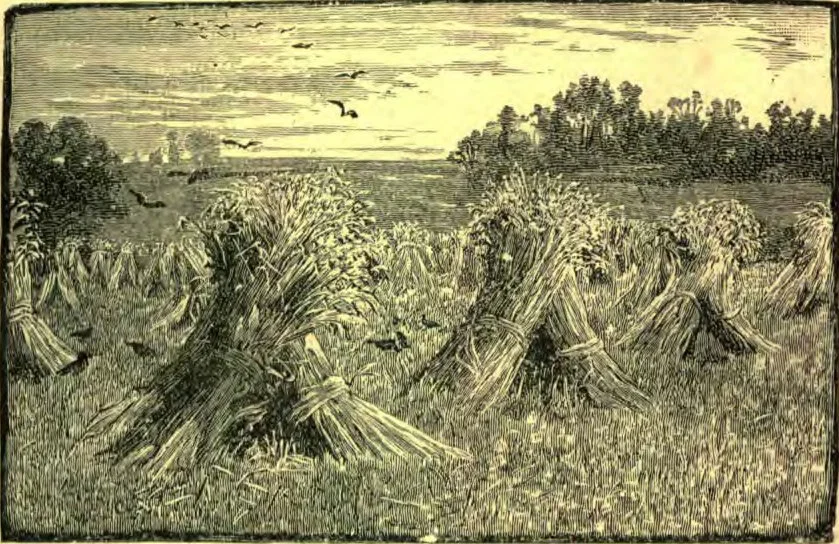
ALL day have the fields been ringing With the sound of reapers singing Many a harvest strain; And the wheat-sheaves hourly growing Told the work their hands were doing, With the golden grain.
Now the shades of evening, creeping, Find a quiet landscape sleeping In the waning light. Shadows lengthen; day is dying; Soon the wheat-fields will be lying ’Neath the solemn night.
Life’s great harvest-time is nearing, And at our dear Lord’s appearing, On that wondrous day, May I come with joy and singing, In my hands a few sheaves bringing, At his feet to lay.
VIOLA E. SMITH.

THE JOYOUS CICADA AND ITS ENEMY

EVERY one knows the cicada (or harvest-fly), often improperly called “locust,” that continues its shrill music from the middle of June till autumn. This music, or “noise,” as some would call it, is somewhat similar to the sound produced by whirling a cardboard attached to a string. The best-known members of the Cicada family are the periodical cicada, or seventeen-year locust, as it is called, and the dog-day harvest-fly, or “lyreman.” The first spends many years in the ground, and the other only about two years. Both suck the juices from roots while they live in the ground.
The music is so monotonous, and so associated with the heat of summer, that it even makes one drowsy. It is produced by a curious apparatus in a form that we may well call a pair of drums. This may be seen just back of the hind leg, on the under side of the body. By the aid of a lens, you can see the folds in the parchment-like heads of these drums. Strong muscles are attached to these heads, and throw them into vibration, which, with a complex arrangement of cavities and sounding-boards, produces a noise that is surprisingly large when we consider the size of the insect, and especially the small size of the musical drums.
It will be of interest to every young observer to examine this apparatus.
Perhaps the greatest enemy of the cicada is the large sand-wasp known as the “cicada-killer.” Many a cicada song is suddenly silenced because the singer is pounced upon by this fierce, large, and handsome wasp, and carried away to be buried in a den in the ground. Sometimes the wasp is not able to carry the cicada, and during the struggle in mid-air both tumble to the ground, and may be caught in a net.
The wasp stings the cicada so as to paralyze it, and then drags it down a hole in dry soil into a cell, and deposits on it a long, white egg. The little wasp that hatches from the egg feeds on the cicada in the same manner that the young of the burying-beetle feed on a buried snake or bird.—St. Nicholas.

DIVISION I — CHAPTER I

Geology

§ 1. WHEN we consider that this earth has been, for six thousand years, the battle-field between Christ and Satan, and that during that period the eyes of the universe have been constantly turned hither, watching not only the working out of Satan’s scheme, but also the developing of the plan of human salvation, we realize something of the importance of the study before us, and of the truths we hope to have unfolded to our view. During all this time the earth has been, in one sense, the lesson-book of the universe.
§ 2. To the geologist this world is merely a globe composed of a given amount of earth and water, containing certain evidences of prehistoric conditions; but to the child of God, it reveals his wonderful creative power, and his dealings with this race.
§ 3. To the astronomer the stars are only suns and worlds, each of a given distance, size, weight, and density, performing certain revolutions that excite his wonder and speculation; but to us they become the places of principalities and powers, thrones and dominions (Col. 1:16), each one of whose subjects is personally interested in, and carefully watching, the events that occur on the earth.
§ 4. To the philosopher, light and electricity are merely manifestations of vibratory force; but to the student of the plan of salvation, these manifestations become the medium through which he learns of the conditions surrounding these beings, who were “subjected in hope;” who are, with us, suffering some, at least, of the results of our transgression; and who also—
§ 5. Look forward to the time of deliverance from bondage; for “whether one member suffer, all the members suffer with it; or one member be honored, all the members rejoice with it.” 1 Cor. 12:26. “For I reckon that the sufferings of this present time are not worthy to be compared with the glory which shall be revealed in us. For the earnest expectation of the creature waiteth for the manifestation of the sons of God. For the creature was made subject to vanity, not willingly, but by reason of him who hath subjected the same in hope, because the creature itself also shall be delivered from the bondage of corruption into the glorious liberty of the children of God. For we know that the whole creation groaneth and travaileth in pain together until now. And not only they, but ourselves also, which have the first-fruits of the Spirit, even we ourselves groan within ourselves, waiting for the adoption, to-wit, the redemption of our body.” Rom. 8:18-23. That this applies not only to our own earth, but in a certain degree to the other planets of our system, will be fully brought out in the proper place.
§ 6. When Lucifer, that mighty angel who sealed “up the sum, full of wisdom, and perfect in beauty,” said in his heart that he would exalt his throne above the stars of God,” and “sit also upon the mount of the congregation, in the sides of the north,” and “be like the Most High” (Isa. 14:13, 14), he—
§ 7. Chose this world as the seat of his rebellious government. Having accomplished the downfall of Adam and Eve, and so gained possession of the earth (Luke 4:5, 6), he hoped to make easy his conquest of the entire universe. His statement that if Adam and Eve would but obey him, and disregard the law and government of God, their eyes should be opened, and that they should “be as gods, knowing good and evil,” set forth the principles upon which he hoped to win to his side every intelligent being in God’s creation. He advocated a government in which every being is his own god and master,—a government without law and without restraint.
§ 8. This was an entirely new principle. The inhabitants of other worlds looked on in wonder and amazement. This earth became the great center of serious consideration. Here was destined to be worked out a great, untested problem. Jesus laid aside his heavenly glory, and undertook the vindication of his Father’s government against the attacks of the mighty rebel, Satan. As the plan of salvation began to be worked out, it was watched by the inhabitants of every unfallen world. This earth became the great theater of the conflict; and we were made, indeed, “a spectacle unto the world, and to angels, and to men.” 1 Cor. 4:9.

QUESTIONS

In what respect has this earth’s experience differed from that of other worlds? Who are interested in this great conflict? Why is the study of geology of greater interest to the child of God than to the unbeliever? In what respects is the study of astronomy of more importance to the Christian than it possibly can be to the infidel? Of what use to us will the study of philosophy be? Is the study of the conditions of our sister planets of importance to us? Why does the whole creation look forward to the time of our deliverance? Who was Lucifer? What is said of his wisdom and beauty? Did he at first openly state his purpose to have a throne of his own? Whom did he propose to be like? Could there be two supreme rulers of the universe at the same time? How did the conflict in heaven result? 2 Peter 2:4. Where did Satan then go with his followers to establish his kingdom? Rev. 12:7-9. How did he obtain possession of this earth? How far did he propose to extend his domain? Did he ever expect to regain heaven? Isa. 14:13. Then where did he propose to place his throne? Verse 14; also Ps. 97:2. What would then have become of God? What were to be the principles of his proposed government? Did God leave this world to Satan’s entire control? Who undertook to vindicate the established principles of God’s government? Why were the angels of heaven especially interested in this matter? They having already taken their stand against Satan, and having assisted in casting him and his followers from heaven, what would have been their fate had the Saviour failed? Were the inhabitants of other worlds concerned in this conflict? Judging from our sad experience, what would have been their fate had Satan triumphed? How far-reaching, then, is the plan of salvation? Why is our world called the “lesson-book of the universe”? What great problem is here being worked out? Who are the participants? Could the inhabitants of other worlds study the unfolding plan of salvation if we were cut off from their view?
DR. O. C. GODSMARK.
Louisville, Ky.

A PERFECT IDEAL

CHRIST is the ideal for all humanity. He has left a perfect example for childhood, youth, and manhood. He came to this earth, and passed through the different phases of human life. He talked and acted like other children and youth, except that he did no wrong. Sin found no place in his life. Ever he lived in an atmosphere of heavenly purity. From childhood to manhood he preserved unsullied his trust in God. The word says of him, “The child grew, and waxed strong in spirit, filled with wisdom.” He “increased in wisdom and stature, and in favor with God and man.”
In the sanctuary of the home, Jesus received his education, not merely from his parents, but from his Heavenly Father. As he grew older, God opened to him more and more of the great work before him. But notwithstanding his knowledge of this, he assumed no airs of superiority. Never did he by disrespect cause his parents pain or anxiety. He delighted to honor and obey them. Although he was not ignorant of his great mission, he consulted their wishes, and submitted to their authority.
Christ had been Commander of the heavenly host; but he did not because of this excuse himself from labor, allowing his parents to support him. While still quite young, he learned a trade, and faithfully discharged his daily duties, contributing to the support of the family.
Christ was the light and joy of the family circle. How many children and youth are seeking to be like him,—kind, thoughtful, and obedient? How many, by following his example, are making their characters attractive? Those who seek to do this will enjoy the favor of God and man.
There is a great difference between Christ and the youth of to-day. Many youth are restless and selfish, content to spend their days in idleness while their parents toil for them. They are disobedient, unthankful, and unholy. Whatever natural ability such youth may have, they are not increasing in wisdom and in favor with God and man.
The youth may think to find happiness by seeking their own pleasure; but true happiness will never be theirs while they pursue this course. The Saviour lived not to please himself. We read of him that he went about “doing good.” He spent his life in loving service, comforting the sorrowing, ministering to the needy, lifting up the bowed down. He had no home in this world, only as the kindness of his friends provided one for him as a wayfarer. Yet it was heaven to be in his presence. Day by day he met trials and temptations, yet he did not fall nor become discouraged. He was surrounded with transgressors, yet he kept his Father’s commandments. He was always patient and cheerful, and the afflicted hailed him as a messenger of life and peace and health. He saw the needs of men and women, children and youth, and to all he gave the invitation, “Come unto me, all ye that labor and are heavy laden, and I will give you rest. Take my yoke upon you, and learn of me; for I am meek and lowly in heart: and ye shall find rest unto your souls. For my yoke is easy, and my burden is light.”
What a wonderful example Christ has left for us in his life-work. Who of his children are living, as he did, for the glory of God? He is the Light of the world; and the one who works successfully for the Master must kindle his taper from that divine life.
To his disciples Christ said: “Ye are the salt of the earth: but if the salt have lost his savor, wherewith shall it be salted? it is thenceforth good for nothing, but to be cast out, and to be trodden under foot of men.” How careful, then, we should be to follow the example of Christ. Unless we do this, we are worthless—salt which has lost its savor.
Only by following Christ’s example can we find true happiness. When he is accepted, the heart is subdued, and its purposes are changed.
Young friends, remember that in order to grow in favor with God and man, you must follow the example Christ has left you. He loves you. It was because of this that he came from heaven to show you how to live a pure, true life. He knows every trial and sorrow of childhood and youth. He was once just your age. The temptations and trials which come to you came also to him. The sorrows which come to you came to him. But he was never overcome by temptation. His life held nothing that was not pure and noble. He is your helper, your Redeemer.
MRS. E. G. WHITE.

SOMETIME

“Some day! Some day!” And over again The promise rings itself in the brain, Soothing the heart so tired to-day, Smoothing with music the weary way, Till life's hard reading is set to rhyme With the fond refrain: “Sometime! sometime.”
A new day comes. Is the heart at peace? Nay, nay! it murmurs, and will not cease; It listens and longs for the soothing chime That lulls its longing: “Sometime! sometime!” And over, and over, and over again, It makes of possession a subtle pain.
The day that we look for still recedes, Leaving the soul alone with its needs; And none shall have it to clasp and to hold But he whose spirit is strong and bold; Who sets his life to a wiser rhyme: “To-day, to-day, is the glad sometime.”
— Selected.

The Power of "They Say"

THERE are two words so short that they are uttered before reflection has time to repress them; so light that they flutter from mouth to mouth, without our even knowing from whose lips they came; so powerful that they justify slander, authorize calumny, reassure the most timorous consciences, and circulate without contradiction the gossip which destroys reputations, and prepares the ruin and despair of families. They are called, “They say.”—Golden Sands.

A SABBATH BY SINAI

I spent a beautiful Sabbath day not long ago, within full view of Sinai. Coming up from Bombay through the Red Sea, our ship passed closely along the Arabian coast. The first sight that caught my eye as I looked out of the cabin window that Sabbath morning, was the mount of God. Far ahead of us, it rose above the morning mists of the foothills, a sublimely grand monument.
Until the early evening I watched the changing colors and shadows move across its face. How real the story seemed to me that day, as I read again and again the narrative of Israel at Horeb. In fancy I could almost see the tents of the camp through the mists, and hear the sound of the trumpet calling to solemn assembly. Up which of these rocky defiles did Moses press, as he “drew near unto the thick darkness where God was”?
Here and there on its lower slopes, the glass showed grassy plots, with trees and shrubs. Above, all was apparently rocky and barren. The summit is cleft in twain, as if by the power that one day, so long ago, shook not this mountain only, but all the earth, as God’s law was spoken from this majestic pulpit.
Most of my fellow passengers were French soldiers. They were interested in the sight for but a moment. Some who knew explained the history to their comrades. But without doubt the general impression was that Sinai represented an extinct power.
There is a common tradition in the Orient that there are no ten commandments east of Suez. A passing glance, a wondering interest, and the soldiers were again at their games, or handling and trading the loot which they had taken in the China war. Does not this fitly represent the attitude of the world? Under the very shadow of the mount that burned with fire at the presence of the living God, our little world on shipboard devoted the holy hours of the Sabbath to pleasure and gaiety. They cared as little for its sacred associations as the Bedouin Arabs who still watch their flocks, as Moses did those of Jethro, at the base of Sinai.
As for myself, all day long I thanked God for the peace of the Sabbath, with its associations of Eden and of heaven, spent within the range of the holy mount. I thanked him, too, for the hope of the promise that the voice that once shook the world from Sinai’s summit will soon speak again, shaking not the earth only but the heavens. The Near East is full of the sacred associations of the past. We must hasten into it with the living message of God for the present.
W. A. SPICER.
THE MOUNT OF GOD
THE MOUNT OF GOD

ORGANIZING YOUNG PEOPLE VERSUS ORGANIZING YOUNG PEOPLE'S SOCIETIES

Very often the machinery connected with a soul-saving enterprise becomes so cumbersome and elaborate that it seriously interferes with the object of its existence. The organization of a society for doing missionary work will in no way help those who are not already missionaries to do missionary work. If those who compose the society are individually missionaries, it may be possible that an organization of their efforts will result in so harmonizing and uniting their plans as to effect a saving of both time and means.
I would not be understood as depreciating the value and helpfulness of organization in connection with young people's work. On the other hand, I desire rather to emphasize the importance of the young people's being individually organized. In other words, we should advocate the organization of the YOUNG PEOPLE, rather than the organization of young people's societies.
An instance which came under my notice to-day will serve to emphasize this thought. A certain young people's band, with a membership of from thirty-five to forty, in handing in its weekly statement, reported the sale of forty-seven copies of the Signs of the Times and five tracts. At the same time a report was read from a little boy ten years of age, who was absent from the meeting. This little fellow had sold two hundred and seventeen Signs of the Times and fifty-eight tracts. What a contrast—one little boy, organized within himself (he is also a member of the young people's organization), seeking God for wisdom and courage each morning, going out, as he was heard to say, “To get the truth before the people, and not to sell the papers or make the money;” and being able to dispose of four or five times as many papers as the entire organization of which he was a member! This is nothing against the organization; for the other members would probably have done no more had there been no organization, but it is everything in favor of individual organization of the young people themselves, and an illustration of what even the youngest can do when filled with the true missionary spirit, and endued with power from on high.
Oh, let us lay hold of heaven with the hand of living faith, and with the arm of loving service reach forth and touch those who sit in darkness and the shadow of death! W. S. SADLER.

TO-DAY

Gift of Thy love, untried, a golden day. Here in the dawn it lies. What treasure hides within it, who shall say, Of joy or sacrifice?
Perhaps to-day thy voice will call on me To suffer grief or loss. This opening path may end on Calvary Beneath the cross.
I know not; yet I say, “Thy will be done,” And lift my thanks to thee, Since all this day, from dawn till set of sun, Thy love will walk with me. — Mabel Earle.

WHAT CAN YOUNG PEOPLE DO?

THERE is a helpful ministry within reach of every one, that is seldom entered into fully, and that is a sympathetic association with those who are in need of encouragement. Very often a group of young people will band together in our churches, and form a friendship so exclusive that all who are not of this favored class are shut out as completely as if separated by bars of iron. I remember particularly one instance that came to my notice. A class of girls in the Sabbath-school were great personal friends. They studied together, worked together, and took their recreation together. They finally became so extremely selfish in their friendship that an attempt to place another girl of their own age and attainments in their class, was resented as an intrusion. They were happy and satisfied in their companionship, and all others were made to feel that they had no part with them. To a greater or less degree this spirit is manifested among us in many places. It is the spirit of the world. It can only harm those who cherish it, and discourage those who are wounded by it.
What can our young people do?—They can break down the barriers that confine their sympathetic helpfulness to a favored few, and extend it outside their circle of intimate friends, even to those who are less fortunate and more needy. You who are leaders among the young people should eliminate every form of favoritism that would set aside in any degree the youth who are dull, or awkward, or disagreeable, or poor, or friendless. Let your first work be an effort in behalf of the youth of your own company. Not one should be allowed to feel that he is “not wanted.” Seek the Lord earnestly for the Spirit of Christ, whose tenderest sympathy and kindest ministrations were extended to the poor, the downtrodden, the unfortunate, the oppressed, the friendless.
Recently I was told of a company of young people who would like to organize for work if they could do so without taking in certain ones of their number whom they did not like, but who would be sure to want a part in the work. Is it possible that this company could expect the blessing of the Lord in a movement founded in such selfishness? Certainly the true spirit of the work was entirely lost sight of. Let it be understood that this is a call to the highest and noblest work, — a work in which childish favoritism and silly sentimentalism have no place. It is a call to our young people everywhere to consecrate themselves wholly to God, and to engage heart and soul in his service. And they who answer the call shall be led of the Spirit, and do a work which no other can do in carrying the Advent message to the world in this generation.
MRS. L. FLORA PLUMMER.

THE WORK AND THE LIFE

Read “Steps to Christ,” Pages 96-105
(August 25-31)
Heavenly beings work—
  1. God the Father. John 5:17.
  2. Christ the Son. John 10:32; Matt. 20:28; Luke 4:18.
  3. The angels. Heb. 1:14.
Christ’s love in the heart will lead its possessor to do such works as he did. John 14:12; Gal. 6:1, 2, 10; Rom. 15:1.
The Christian will always work—
  1. Willingly. 1 Peter 5:2.
  2. Faithfully. Matt. 23:21; Col. 3:23.
  3. Zealously. Titus 2:14.
  4. Constantly. Eccl. 11:6.
  5. Prayerfully. Eph. 6:18.
Will not labor alone. John 14:23; Matt. 28:20; 1 Cor. 3:9.
Will not overlook the “little things,” or the work near at hand. Eccl. 9:10; 1 Cor. 7:24; 2 John 5.
Examples of personal labor for souls. John 3:1-21; 4:7-26; Acts 8:27-39.

SUGGESTIONS

In reading the chapter, notice—
  1. What will constitute the real Christian’s joy.
  2. Reasons why God has chosen us to be laborers together with him.
  3. The sure effect of unselfishly working for others.
Find answers to such statements as the following, often heard from the backslidden:—
“There is nothing I can do.”
“I can not talk to people about their souls.”
“I am not good enough to help others.”
“There is so much to be done I do not see how the little I can do will amount to anything.”
“I can not leave home to engage in missionary work.”
“I have no ability.”
If one should ask you the meaning of Paul’s words, “Work out your own salvation,” how could you explain them?

SPIRITUAL RHEUMATISM

Often when a person eats unsuitable food, or even overeats of good food, he becomes afflicted with rheumatism. This is especially likely to be the case if he neglects active physical exercise. There is a similar spiritual disorder, produced by violating the corresponding spiritual principle.
The more severely a patient is afflicted with rheumatism, the more pain there is produced by the least exertion; likewise, one who is suffering with an attack of spiritual rheumatism finds it extremely painful to exert himself even sufficiently to pray with an associate who needs just that help. One who has had rheumatism in his joints for some time, eventually becomes accustomed to an inactive condition, and ceases to attempt any physical exertion. So the longer the young Christian remains in a spiritually rheumatic condition, the more he loses the inspiration to work for God and humanity.
Sometimes it is possible for a surgeon to loosen a stiffened joint. This is a painful operation, and for the time being leaves the joint in a condition of greater suffering than it was before, but frequently it is the only thing that will secure its old-time mobility. So the Lord sometimes allows the spiritual rheumatic to pass through experiences which “break him all up,” and often cause for a season great anguish of soul. And as when a stiffened joint has been broken loose, it is necessary for the patient himself to move daily, or to have some one else assist him in so doing, in order to prevent its becoming stiff again, so when the backslidden worker has, through some trying experience, been brought back to God, and his spiritual activity has been restored, he must persist in daily spiritual activity, no matter how painful the process, or it will be only a short time before he will relapse into his old condition.
When others observe that it is difficult for a reclaimed worker to accomplish what he is trying to do, they should carry out the spiritual admonition, “We then that are strong ought to bear the infirmities of the weak,” and, “Strengthen ye the weak hands, and stumbling knees make ye firm.” DAVID PAULSON, M. D.

THE SABBATH MEETINGS

Of the Young People's Company at Battle Creek continue with excellent attendance and increasing interest. Sabbath, August 10, the meeting was opened with a song service, followed by the reading of two of the articles written by Mrs. Plummer for this department, entitled “What Can Young People Do?” Attention was called to the fact that the object of these meetings is twofold,—to renew the spiritual strength of those who attend, and to reach out a hand of love and help and courage to all who are disheartened, afflicted, or in any need. The regular study was then given, and the sweet Spirit of the Master accompanied the word spoken. By the most touching, simple illustration those present were made to see how desirous the Lord is that all shall accept his priceless gift of pardon and sonship, and have the deformity of sin replaced with the perfection of Jesus.

MOTHER'S HELPER

SINGING above the washtub, Wielding duster and broom, Cheerily “doing” the dishes, Tidying up the room,— This is the way she labors, All for the good of others: What could we do without her,— This right-hand woman of mother's?
Reading aloud to grandpa News from the Golden Street; Giving a cup of cold water, Easing the weary feet; Lovingly, joyfully caring For younger sisters and brothers: What could we do without her,— This right-hand woman of mother's?
ELIZABETH ROSSER.
Continue reading: CALEB'S ACRE