Two things bothered Caleb Miller not a little. These were: What sort of trade should he choose, and make himself proficient in? and how could he pay the mortgage on his mother's cottage?
Most boys work hard, in school or out, to perfect themselves in their chosen profession or trade. Caleb Miller worked hard, if any boy ever did, to locate himself; but up to the present he had found himself a jack of many trades. This bothered him not a little. Going over the list of the capacities in which he had shown himself willing if not permanent, he had found that he had been an errand boy, a grocer's boy, a plumber's boy, and a farm boy. He congratulated himself that his employers had not found fault with him because he had not worked hard or faithfully enough for them. The new employer had always offered higher wages or an easier grade of work than the preceding. Finally, the farmer had moved away, and Caleb was a farm boy without a job. What next?
He pondered the matter seriously for a day or two, and all of a sudden a bright plan came to him. It did not take him long to make up his mind that he would put it into practice, if he found himself able to overcome some of the difficulties that lay in the way. He also arrived at the sensible conclusion that he had not been a farm boy for nothing.
Caleb's Uncle Job owned plenty of land, and carried on a prosperous farming business; but he had never thought enough of his sister or his nephew to give them any assistance, even to offer Caleb work. The latter determined that the first step toward the fulfillment of his plan would be to break through this unnatural reserve, if possible, and the inspiration that had come to him was the direct means of his making an attempt toward friendliness, which he might never have undertaken otherwise.
So Uncle Job Waite was surprised out in his potato field one day in the very earliest part of the spring by that nephew of his, who, up to that time, had known pretty well how to keep his distance.
“Uncle Job, will you let a piece of land to me?”
“I dunno, young man. I'm goin' to use most o' my land this year,” was the not encouraging reply.
“Are you going to plant that corner acre next to our house, sir?”
“Wall, I dunno. Hadn't thought much on't. What ye comin' at?”
“I thought you might be willing to let me hire it, so that I could plant it, and help mother out a bit this season.”
“You plant? I don't b'lieve you know how. But there, I hain't nothin' to say, ef ye think ye kin manage it, an' ef ye're willin' to pay what I ask fer it;” and he named a good, round sum.
Under ordinary circumstances, Caleb would have gone away from his uncle disheartened; but, to the surprise of the latter, he eagerly accepted the terms, and made a stipulation that the rent be paid the following October.
Caleb's mother was surprised at the burden he had taken upon his shoulders; but she thoroughly believed in her boy, and knew he must have some sort of substantial secret that was bound to secure his transaction against failure.
As for Caleb, he believed that he had discovered the right road to a vocation. He had a few dollars laid by. With some of his little store, he hired a needy young farmer to turn his acre over with his plow, and to harrow it thoroughly. He also bought a large quantity of seed. Then the boy took off his coat, and carefully planted the acre with the seed he had purchased.
Uncle Job looked over toward the corner acre occasionally, but he did not come very near. He was once overheard to say: “I dunno how that fellow expects to raise vegetables, or anything else, the way he's goin' to work, an' I dunno how I'm goin' to git my rent, come October. But I sha'n't say nothin', on'y I won't stan' no nonsense.”
Caleb kept on, working steadily and perseveringly from morning till night, giving constant and anxious care to the young shoots that began to come up as the season advanced, and June appeared.
Uncle Job did not take the trouble to look over in the direction of the corner acre for several long, busy weeks. When he did, he could not at first believe his eyes, and rubbed them in amazement. What had happened? The place was covered with pansy blossoms of all shades and colors, from deepest purple to purest white, a dazzling array of beauty; and they nodded their thousands of strange little faces at the old farmer, as if to say: “We're going to see Caleb through this. You needn't give yourself any uneasiness.”
And the pansies did save the day. Caleb got the idea while at the city market one day, and determined to try an experiment on his own account; and the results solved many a problem for him thereafter. There was not the slightest trouble about selling all the blossoms he could raise. The marketmen and fruit dealers of the neighboring city had already made an agreement to buy him out, and they kept their word. All summer long Caleb was a busy boy,— so busy that the young farmer who helped him plow had his services called into requisition several times.
In October, Caleb met his uncle with a happy face; for, after paying his rent, he had an encouraging sum left over.
Uncle Job relented when he saw that his nephew had both brains and push.
“Say, Caleb,” he said, “I guess ye're goin' to make suthin' out'n yerself. I'll take half off'n the rent of this acre, an' ye kin hev it next year at that rate.”
Caleb owns that acre now, and more besides. He has gained his uncle's respect, paid the mortgage,— and found his vocation.
Frank Walcott Hutt.
THE JANET-LOUISE LETTERS
By Louise
II
DEAR COUSIN JANET: How did you happen to know just what to write to me? Did some little bird whisper in your ear that I was found asleep in my chair one morning, with my lamp burning brightly, my schoolbooks before me, and one in my lap? Mama had called and called, but no answer came; and by and by papa rapped, and then opened the door. He looked very sober, gave me some good advice, and went away. Now they have arranged for me to have as many hours as I wish to take before breakfast, undisturbed, for my study. I am trying to get into the habit of rising early. It’s a little hard now, but mama helps me, and I think I shall succeed.
I must tell you what I am doing. I have a little book that gives directions very clearly how to raise flowers. We have many different kinds of seeds, and I have been much interested in preparing soil suitable for each kind, and then watching them grow. It is a delightful pastime, yet it takes hard work, too. After studying to see in what way our soil was deficient, we set about to remedy it, and the result is charming. Some of the seeds were sown where the plants262are to remain; but I had a number of boxes and old basins prepared in which to raise some kinds in the house. I learned how to transplant them, and mama and I were very careful in changing them to their permanent places. I will tell you more another time.
Your loving cousin,
LOUISE.
INSIDE OUT
“I HAVEN’T said good-by to Miss Mary yet. I’ll run over now, if you don’t need me, mother,” said Alice Ray, hurrying on her hat as she spoke.
“Yes, go now, daughter. I stopped on my way from down town. I am so glad Miss Mary is to have this little trip. It fairly rests me to think of the rest she is to have. Give her my love and congratulations again. The whole neighborhood rejoices with her, I am sure.”
SPRING SONG
Miss Mary Campbell was the neighbor of her neighborhood, and every one loved and leaned on her; for, with a “heart at leisure from itself,” she was always ready to help other people. Now, a long-wished-for journey to her old home was to be taken, her younger sisters—for there were three Miss Campbells—undertaking to do without her for a season. It was beautiful to see how all who knew her rejoiced in the prospective outing for the good neighbor.
When Alice went in, however, instead of finding the stir of preparation she unconsciously expected, she felt the usual quiet of the cheery home.
“I’ve come to say good-by, dear Miss Mary,” she said. “I know that you will be too busy in the morning to see anybody. Are you all packed up and ready?”
“Well, dear, I’m not going, after all,” was the cheerful reply, as if it were nothing worth mentioning, except as an incidental.
Alice fairly gasped, and Miss Mary went on to enlighten her: “You see, some one is coming, instead. I had a letter a little while ago that made me want to stay. My niece and namesake, Mary Campbell, from B——, writes to say she has been ill, and asks if she may come for a while and be coddled up. It won’t do for me to go now, and I don’t wish to.”
“But the disappointment! O Miss Mary! it does seem too bad,” cried impetuous Alice, who knew how tired the good friend was. And the loving, sympathetic girl lifted eyes that would fill with tears to Miss Mary’s face.
“Why, child!” exclaimed Miss Campbell, “don’t let the clouds and rain come like that. It is all right and best, I am sure.”
“But it seems to me that everything is clouded over,” said Alice, in a troubled tone; for all the neighbors had been afraid their good friend would break down if she had not a speedy rest.
“How can you be cheerful about it?” the young girl asked in the next breath. It seemed impossible to her to bear disappointment so brightly.
“Well, I have a secret worth much, if you want to hear it. We can’t help the clouds, that is true; but I learned this by heart long ago, and have made it true, every word:—
‘The inner half of every cloud
Is bright and shining;
I therefore turn my clouds about,
And always wear them inside out,
To show the lining.’”
“I am so sure that everything God orders is best that I take it for best; and by making the best of it, I turn my clouds all inside out, to show the lining.”
Alice went home soon, but she carried a lesson for life with her,—a sermon lived, not preached.
The coming of niece Mary, and the detention resulting, proved in the end to be the best thing that could have happened; for aunt and niece went together, and because of the delay met friends whom otherwise they would have missed. But before she knew this, Miss Mary made brightness about her by wearing her cloud inside out, to the lasting good of one at least. Will you thus “turn your clouds about, to show the lining”?—Selected.
HEALING THE MAN WITH AN UNCLEAN SPIRIT, IN THE SYNAGOGUE
By W. S. Sadler
INTRODUCTORY
Preceding Events.—The healing of the demoniac in the synagogue seems to be the next step in the Saviour’s work, immediately following the miraculous draft of fishes and the final calling of the four.
Bible Story of the Miracle.—“And they go into Capernaum; and straightway on the Sabbath day he entered into the synagogue, and taught: and they were astonished at his teaching; for he taught them as having authority, and not as the scribes; for his word was with authority. And straightway there was in their synagogue a man that had a spirit of an unclean demon; and he cried out with a loud voice, saying, Ah, what have we to do with thee, thou Jesus of Nazareth? Art thou come to destroy us? I know thee who thou art, the Holy One of God. And Jesus rebuked him, saying, Hold thy peace, and come out of him. And when the demon had thrown him down in the midst, tearing him, and crying with a loud voice, he came out of him, having done him no hurt. And they were all amazed, insomuch that they questioned among themselves, saying, What is this? a new teaching? What is this word? for with authority and power he commandeth even the unclean spirits, and they obey him, and come out. And the report of him went out straightway everywhere into all the region of Galilee round about.” (The foregoing is an interwoven story of the miracle, gathered from Mark 1: 23–26 and Luke 4: 33–36, but told in the exact language of the Bible.)
Place.—Capernaum.
Circumstances.—This miracle was performed in the synagogue during the Sabbath service of teaching. The people were greatly astonished at Jesus’ doctrine, and even as he was speaking, the man possessed with an unclean spirit “cried out.” This miracle was worked without the request of the one who was benefited by it. On the other hand, he, or rather the spirit that possessed him, besought Christ, saying, “Let us alone.” It would seem that the miracle was performed without even the requisite of faith on the part of the unfortunate man. It made a profound impression on all who witnessed it; for the fame of Jesus “spread abroad throughout all the region round about Galilee.”
Great Lesson.—God sometimes works great miracles for no other reason than that his heart of infinite pity and love is touched with the sorry plight of intelligent beings, wholly possessed with the evil spirits of impurity, jealousy, and bitterness. This miracle shows God’s willingness and power to deliver men from the grasp and bondage of the evil one.
STUDY OF THE MIRACLE
Was in Their Synagogue.—This man, although possessed with an unclean devil, was permitted to attend public worship. Evidently he did not belong to the class that would be regarded as violently insane, whose behavior would disqualify them for admission into the public congregation. To-day, many who intrude their presence into the house of God are perhaps just as much under the influence of an evil spirit as was this poor creature. This man is a type of one of the most hopeless class of sinners the Christian worker ever meets,—those who have seen the light, who know the character of Christ, who are often263found at religious gatherings, yet whose lives are still controlled by sin. Though these are apparently the most hopeless cases, this miracle teaches that the power of God’s word and the light of his grace can reach even such. This poor man is a type of the sinner whom no amount of preaching, praying, and singing is likely to affect. He must have a word spoken direct from the Master’s lips to the evil one within, before he will be able to decide whether or not he will serve God.
W. S. SADLER.
(To be continued)
THE TEENTY-WEENTIES
Across the fields I see her go;
My hat she's heaped with flowers,
The sweetest, wildest flowers that grow
In rainbowed April showers.
“Now, auntie,” soon her clear voice rings,
“That’s all the flowers you get!
The rest’s such teenty-weenty things
Their eyes aren’t open yet!”
— Little Folks.
A CHILD'S PRAYER
Lord, make my life a little light
Within the world to glow,—
A little flame that burneth bright
Wherever I may go.
Lord, make my life a little hymn
Of tenderness and praise,
Of faith that never waxes dim
In all thy wondrous ways.
11. What will be blotted out in the cases of those who overcome? Isa. 43: 25; 44: 22.
12. When does the blotting out of sin take place? Acts 3: 19, 20;
13. How fully will the sins of God's people be blotted out and destroyed? Jer. 50: 20.
14. What must we now do, if we would have our sins thus destroyed? 1 Tim. 5: 24.
Pine Scent
By Minnie Rosilla Stevens
I WALKED in the elm trees' pleasant shade One summer morning in warm July, When the fiery sun was scorching down On the dusty wayside, parched and dry.
And soon I came where the lane spread out In a wider space; and the elm boughs blent With maple, alder, and oaken branch, That the greensward arched like a leafy tent.
And then an odor, so faint and sweet That it seemed a part of the still, hot air, To me was wafted; and all about I looked for the flowers that shed it there.
But never a blossom met my eye,— They had died long since in the drought and sun; But above I saw where the cool, green arms Of a pine tree moved, and their shadows flung.
And knowing then whence the fragrance came, I passed on, thinking of spring scents sweet; But best, thought I, is the faithful pine, That fragrance sheds 'mid the dust and heat.
And brave is the heart that doeth good, When weather is fair, and clouds float high; But the bravest heart sheds grace abroad Through drought and tempest and burning sky.
MINNIE ROSILLA STEVENS.
A Book for the Children and a Book that Children Love.
By Adelaide Bee Cooper
Easy Steps in the Bible Story
By ADELAIDE BEE COOPER.
The minds of children turn as naturally to the stories of the Bible as a lily to the sun. They never tire of hearing of the wonders of Creation Week, of the incidents of the Flood, and the building of the Tower of Babel, and of the lives of Abraham, Isaac, and Jacob. And Joseph—what mother does not hear again and again from childish lips the request, “Tell me ’bout Joseph?”
“Easy Steps in the Bible Story” gives all these and other narratives reaching from Creation down to the time when the Law was spoken on Mount Sinai. The stories are told in simple words that the children can understand, and the pictures help make the meaning still more plain.
Do your children have this book? If not, make them happy by giving them a copy. If they do, encourage them to present it to some little friend. In these days when the market is flooded with children’s Bible stories that are filled with teaching that strikes at the very foundations of Christian belief, the placing of this book in the hands of the little ones may be the means of forming in some childish mind an idea of the events of Creation Week that neither time nor later teaching can wholly efface.
“The best of all Bible books for children,”
—ALONZO T. JONES.
AGENTS WANTED EVERYWHERE.
Price: Bound in cloth, 50 cents; in paper, 25 cents.
Order of your State Tract Society; Review and Herald Pub. Co., Battle Creek, Mich.; or Pacific Press Pub. Co., Oakland, Cal.
GRAND TRUNK R'Y. SYSTEM.
Taking Effect June 2, 1901.
Trains leave Battle Creek.
WEST-BOUND.
No. 9, Mail and Express, to Chicago ........................ 12.15 P. M.
No. 7, Limited Express, to Chicago ........................ 7.00 A. M.
No. 1, Chicago Express, to Chicago ........................ 9.23 A. M.
No. 3, Lehigh Valley Express, to Chicago .................. 3.50 P. M.
No. 5, International Express ............................. 2.17 A. M.
No. 75, Mixed, to South Bend .............................. 7.30 A. M.
Nos. 9 and 75, daily, except Sunday.
Nos. 1, 3, 5, and 7, daily.
EAST-BOUND.
No. 10, Mail and Express, East and Detroit ................. 3.45 P. M.
No. 8, Limited Express, East and Detroit ................... 4.50 P. M.
No. 4, Lehigh Express, East and Canada ..................... 8.22 P. M.
No. 6, Atlantic Express, East and Detroit .................. 2.10 A. M.
No. 2, Express, East and Detroit ........................... 7.00 A. M.
No. 74, Mixed (starts from Nichols yard) ................... 7.15 A. M.
Nos. 10 and 74, daily, except Sunday.
Nos. 4, 6, 8, and 2, daily.
W. C. CUNLIFFE, Agent, BATTLE CREEK.
RURAL DELIVERY AND THE PARCELS POST
One of the most potent arguments in favor of the parcels post is the order, recently issued by the Post-office Department, forbidding the delivery of express and other packages by the mail carriers on the respective rural delivery routes.
The circumstances which brought about this ruling are, briefly, as follows: As soon as the rural delivery system was fairly started, a large number of farmers saw the possibility of saving both time and money by getting the carriers, for a small fee, to deliver at their doors any packages that might be waiting for them at the express office. This was readily agreed to, and the business soon assumed such proportions that there was scarcely room for the mail matter in the wagons prepared for its transfer.
Of course it is understood that the rural delivery should not take upon itself the delivery of parcels as a private enterprise; still, the residents along the routes where this has been done have had a practical illustration of the saving and convenience that a parcels post would be to them.
England, Germany, and other European countries already enjoy the benefits of a liberal parcels post; but in this country, if a farmer needs a package of any kind of merchandise, or if a part of a machine is broken or lost, he has to purchase it at his village, or send to some distant city for it. The merchant from whom he purchases has to send the articles by private express companies, at an average cost varying from sixty-one cents, if the farmer lives near a railroad line, to $3.89 or more if he lives at a distance, for an eleven-pound package; yet if he had the privileges of the parcels post arrangement that exists to-day in Germany, the same package could be delivered at his post-office, no matter where he resided, at a cost of twelve cents, or at his door, if he had both rural free delivery and parcels post.
As an idea of the extensive benefits that will be conferred by a parcels post, it is only necessary to call attention to the manifest disadvantage to which the people of Pennsylvania are subjected by being obliged to get their packages at an express office rather than at their post-offices. The millions of packages delivered to residents of that State can be delivered only through nine hundred and nineteen express offices; yet if a domestic parcels post were in force, there are over five thousand two hundred post-offices at which the same packages could be received and dispatched. This is true in a greater or lesser degree of every State in the country.
God Requires Nothing That Separates Us From Him
God never requires of his children anything that will separate them in any degree from him.
The Small Coin of Love
The small, everyday courtesies of life have been well called “the small coin of love.” That is coin in which the poorest may be rich.
Dr. Godsmark's First Lesson in Bible Astronomy
THE first article in Dr. Godsmark's new series on Bible Astronomy is given this week. Those who expect to use these lessons for future study would do well to preserve their papers.
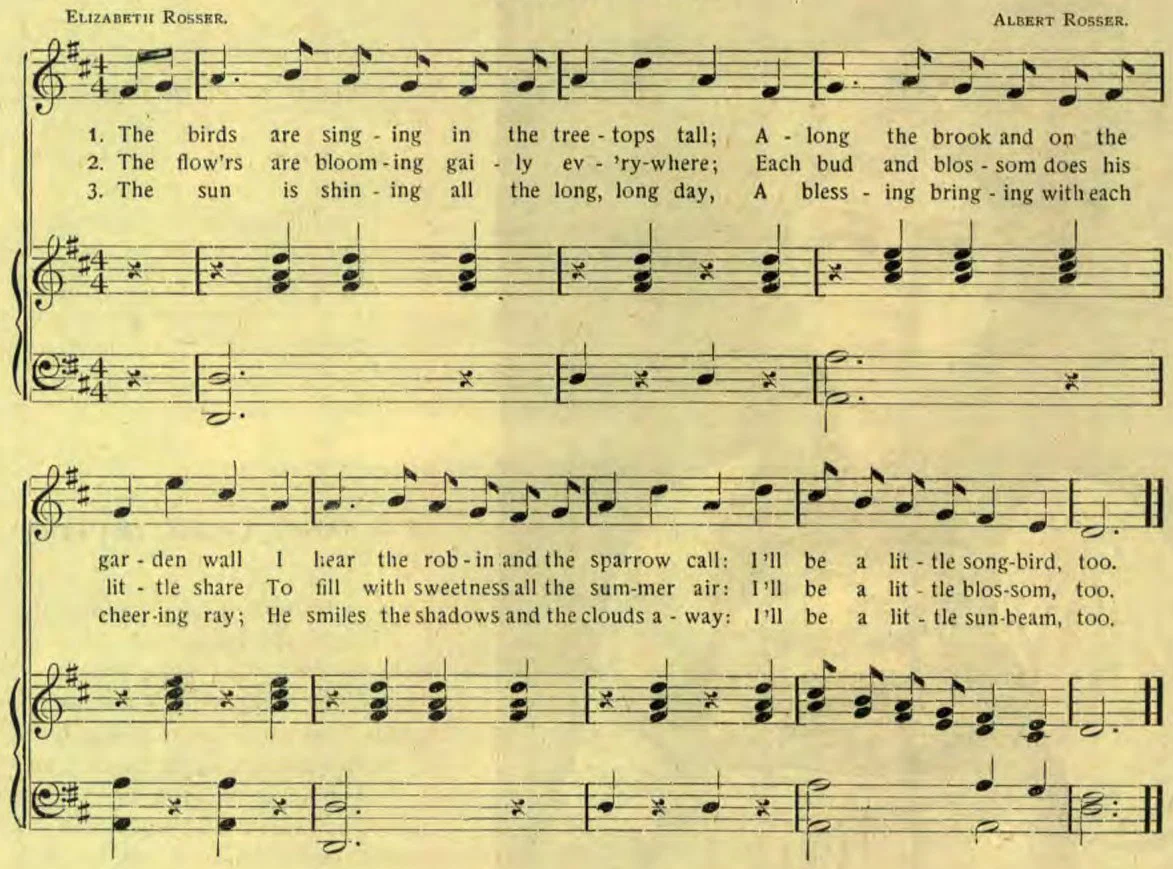
Spring Song Reprinted for Church-School Teachers
By Editor
By request we reprint this week, for the benefit of church-school teachers, the little Spring Song which appeared in the INSTRUCTOR something over a year ago. It is the intention to have a number of songs suitable for the children to learn in school printed in the INSTRUCTOR from time to time. Copies of this and other numbers will be sent to church-school teachers at the following rates: One to five copies, two cents each; ten or more copies to one address, one cent each.
THE PEACE HE-GIVES
PEACE was the Saviour's parting legacy to his disciples, and to all who should, through their word, believe on him. Is it not a most precious inheritance? How the heart reaches out after peace! how nations strive for it! at what unreckoned cost it has often been purchased! One does not have to live very long in this world before he begins to realize something of the value of peace.
But notice for a moment the words of Jesus as he spoke to his disciples on that sad evening so long ago: “Peace I leave with you, my peace I give unto you: not as the world giveth, give I unto you.”
You see, there are two kinds of peace,—his peace, the peace that he gives, and the peace promised by the world. Many make the mistake of thinking that the two are the same,—that what the world looks upon as peace is the gift promised in these words of the Saviour.
But what is the peace of the world? Do we not all know it well,—the pleasing of self,—the permission to acquire and to enjoy, unhindered, the things that minister to one’s sense of ease or pleasure or enjoyment? Beautiful homes, friends, gratified ambition,—how these allure him who seeks the peace of the world!
But the peace of Jesus—outwardly how different it is. Think of his life,—how poor he was—no place to lay his head; how his lowly birth was scorned—“Is not this the carpenter’s son?” how his efforts in behalf of sinners were misunderstood and held up to ridicule—“This man receiveth sinners, and eateth with them;” how his deeds of love were rewarded with ingratitude—only one of the ten lepers returned to offer thanks for his healing; how his chosen and sworn friends forsook and denied him; of that dark hour in the garden when even his Father’s face seemed hidden from him. A very different picture, is it not? from that of the peace promised by the world.
But look at the other side. Is it not true that those who enjoy to the full all that the world can give, find that, at the first hint of disaster, or loss, or failure to work out their own purposes, the peace of the world spreads her bright wings and departs, leaving them uncomforted in the darkest hours?
But the peace that Christ gives is a peace that abides with its possessor at all times; in fact, no hour can be wholly hopeless to him who has this peace in his heart. It makes the weakest strong in endurance and faith, takes away every selfish motive, and gives to the life a serenity and poise and happiness that can be enjoyed or attained by no other means.
And this peace, which passes all understanding, which is able to keep the heart and mind from the snares of the evil one, like all life’s most precious things, is a gift. It is left with us. We have only to reach out our hand, take it, and it is ours.
GLEANINGS FROM THE HARVEST FIELD
Is the name of a new paper for youth that has recently come to our table. It is edited by Miss Waggoner, daughter of the editor of Present Truth, and published monthly. It contains short, live contributions, on questions of interest to the Christian, and a number of reports of missionary work done. No doubt there are many who would appreciate the privilege of welcoming this little periodical into their homes once a month. Size, eight by four and one-half inches; sixteen pages. The price to subscribers in the United States is forty cents a year. Address Gleanings, 53 Mercers Road, Holloway, N., London, England.
INK POWDER PACKAGES
Mrs. M. I. Adams, of Ord, Neb., has prepared an Ink Powder, which she puts up in envelopes containing sufficient of the preparation to make three bottles of black ink, one of red, and one of blue. The packages sell for ten cents apiece, her profits to be divided between the fund for the relief of the schools and the work in the South. She wishes the names of those who would like to sell this preparation, and offers several inducements to agents. Those who have sold the powder have had excellent success. For further particulars write to the address given above.
REMEMBERED AGAIN
“Our India Mission Fund is remembered this week, with three contributions—two of one dollar each, and one of fifty cents. They come from Mary C. Hurlock, of Church Hill, Md.; Brice Morrow, of Lead Hill, Neb.; and Esther Culver, of Dunlap, Iowa. May the blessing of Heaven rest upon these gifts, to the enlightenment and salvation of souls.
THE INSTRUCTOR BIBLE
By Editor
Is still sent out to our readers, and continues to give good satisfaction. A sister in Brainerd, Minn., has ordered three of these Bibles for different members of her family, and is well pleased with them. She says: “It is a splendid Bible. I am thankful for the privilege of getting a good Bible so reasonably.”