Our echoes roll from soul to soul,
And grow forever and forever.
— Tennyson.
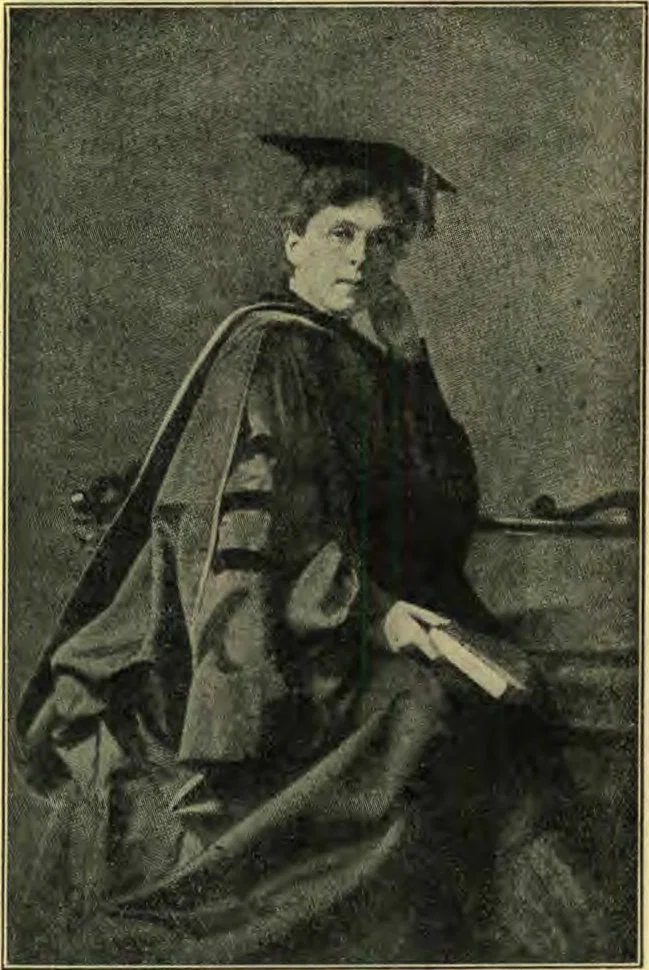
THIS is the story of a princess of our own time and our own America — a princess who, while little more than a girl herself, was chosen to rule a kingdom of girls. It is a little like the story of Tennyson’s “Princess,” with her woman’s kingdom, and very much like the happy, old-fashioned fairy tale.
ALICE FREEMAN PALMER
We have come to think it is only in fairy tales that a golden destiny finds out the true, golden heart, and, even though she masquerades as a goose girl, discovers the “kingly child,” and brings her to a waiting throne. We are tempted to believe that the chance of birth and the gifts of wealth are the things that spell opportunity and success. But this princess was born in a little farmhouse, at Colesville, New York, and to a daily round of hard work and plain living. But it was also a life of high thinking and rich enjoyment of what each day brought.
“Give me health and a day, and I will make the pomp of emperors ridiculous!” said the sage of Concord. So it was with little Alice Freeman. As she picked wild strawberries on the hills, and climbed the apple tree to lie for a blissful minute in a nest of swaying blossoms under the blue sky, she was, as she said, “happy all over.” The trappings of royalty can add nothing to one who knows how to be royally happy in gingham. But Alice was not always following the pasture path to her friendly brook, or running across the fields with the calling wind, or dancing with her shadow in the barn yard, when even the prosy hens stopped pecking corn for a minute to watch. She had work to do for mother. When she was only four, she could dry the dishes without dropping one; and when she was six, she could be trusted to keep the three toddlers younger than herself out of mischief.
“My little daughter is learning to be a real little mother,” said Mrs. Freeman, as she went about her work of churning and baking without an anxious thought.
It was Sister Alice who pointed out the robin’s nest, and found funny turtles and baby toads to play with. She took the little brood with her to hunt eggs in the barn and to see the ducks sail around like a fleet of boats on the pond. When Ella and Fred were awakened by a fearsome noise at night, they crept up close to their little mother, who told them a story about the funny screech owl in its hollow-tree home.
“It is the ogre of mice and bats, but not of little boys and girls,” she said.
“It sounds funny now, Alice,” they whispered. “It’s all right since you told the story.”
When Alice was seven a change came in the home. The father and mother had some serious talks, and then it was decided that father should go away for a time, for two years, to study to be a doctor.
“It is hard to be chained to one kind of life when all the time you are sure that you have powers and possibilities that have never had a chance to come out on the open,” she heard her father say one evening. “I have always wanted to be a doctor; I can never be more than a half-hearted farmer.”
“You must go to Albany now, James,” said the dauntless wife. “I can manage the farm until you get through your course at the medical college; and then, when you are doing work into which you can put your whole heart, a better time must come for all of us.”
“How can you possibly get along?” he asked in amazement. “How can I leave you for two years to be farmer, and father and mother, too?”
“There is a little bank here,” she said, taking down a jar from a high shelf in the cupboard and jingling its contents merrily. “I have been saving bit by bit for just this sort of thing. And Alice will help me,” she added, smiling at the child who had been standing near looking from father to mother in wide-eyed wonder. “You will be the little mother while I take father’s place for a time, won’t you, Alice?”
“It will be cruelly hard on you all,” said the father, soberly. “I cannot make it seem right.”
“Think how much good you can do afterward,” urged his wife. “The time will go very quickly when we are all thinking of that. It is not hard to endure for a little for the sake of ‘a gude time coming’—a better time not only for us, but for many besides. For I know you will be the true sort of doctor, James.”
Alice never quite knew how they did manage during those two years, but she was quite sure that work done for the sake of a good to come is all joy.
“I owe much of what I am to my milkmaid days,” she said.
She was always sorry for children who do not grow up with the sights and sounds of the country. “One is very near to all the simple, real things of life on a farm,” she used to say. “There is a dewy freshness about the early out-of-door experiences, and a warm wholesomeness about tasks that are a part of the common10lot. A country child develops, too, a responsibility—a power to do and to contrive—that the city child, who sees everything come ready to hand from a near-by store, cannot possibly gain. However much some of my friends may deplore my own early struggle with poverty and hard work, I can heartily echo George Eliot’s boast:
“But were another childhood-world my share,
I would be born a little sister there.”
When Alice was ten years old, the family moved from the farm to the village of Windsor, where Dr. Freeman entered upon his life as a doctor, and where Alice’s real education began. From the time she was four she had, for varying periods, sat on a bench in the district school, but for the most part she had taught herself. At Windsor Academy she had the advantage of a school of more than average efficiency.
“Words do not tell what this old school and place meant to me as a girl,” she said years afterward. “Here we gathered abundant Greek, Latin, French, and mathematics; here we were taught truthfulness, to be upright and honorable; here we had our first loves, our first ambitions, our first dreams, and some of our first disappointments. We owe a large debt to Windsor Academy for the solid groundwork of education that it laid.”
More important than the excellent curriculum and wholesome associations, however, was the influence of a friendship with one of the teachers, a young Harvard graduate who was supporting himself while preparing for the ministry. He recognized the rare nature and latent powers of the girl of fourteen, and taught her the delights of friendship with nature and with books, and the joy of a mind trained to see and appreciate. He gave her an understanding of herself, and aroused the ambition, which grew into a fixed resolve, to go to college. But more than all, he taught her the value of personal influence.
“It is people that count,” she used to say. “The truth and beauty that are locked up in books and in nature, to which only a few have the key, begin really to live when they are made over into human character. Disembodied ideas may mean little or nothing; it is when they are ‘made flesh’ that they can speak to our hearts and minds.”
As Alice drove about with her father when he went to see his patients and saw how this true “doctor of the old school” was a physician to the mind as well as the body of those who turned to him for help, she came to a further realization of the truth: It is people that count.
“It must be very depressing to have to associate with bodies and their ills all the time,” she ventured one day when her father seemed more than usually preoccupied. She never forgot the light that shone in his eyes as he turned and looked at her.
“We can’t begin to minister to the body until we understand that spirit is all,” he said. “What we are pleased to call body is but one expression—and a most marvelous expression—of the hidden life—
‘that impels
All thinking things, all objects of all thought,
And rolls through all things.’”
It seemed to Alice that this might be a favorable time to broach the subject of college. He looked at her in utter amazement; few girls thought of wanting more than a secondary education in those days, and there were still fewer opportunities for them.
“Why, daughter,” he exclaimed, “a little more Latin and mathematics won’t make you a better homemaker! Why should you set your heart on this thing?”
“I must go, father,” she answered steadily. “It is not a sudden notion; I have realized for a long time that I cannot live my life—the life that I feel I have it within me to live—without this training. I want to be a teacher—the best kind of a teacher—just as you wanted to be a doctor.”
“But, my dear child,” he protested, much troubled, “it will be as much as we can manage to see one of you through college, and that one should be Fred, who will have a family to look out for one of these days.”
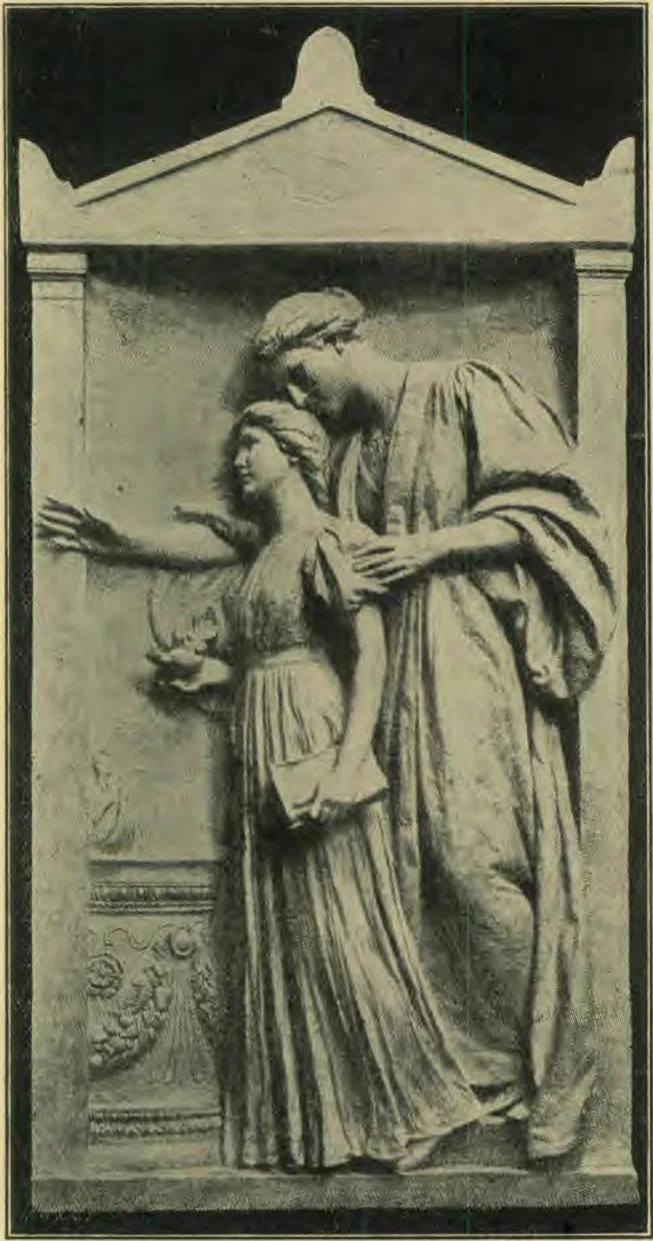
MEMORIAL TABLET IN CHAPEL AT WELLESLEY
“If you will let me have this chance, father,” said Alice, earnestly, “I’ll promise that you will never regret it. I’ll help to give Fred his chance, and see that the girls have the thing they want as well.”
In the end Alice had her way. It seemed as if the strength of her single-hearted longing had power to compel a reluctant fate. In June, 1872, when but a little over seventeen, she went to Ann Arbor to take the entrance examinations for the University of Michigan, a careful study of catalogues having convinced her that the standard of work was higher there than in any college then open to women.
A disappointment met her at the outset. Her training at Windsor, good as it was, did not prepare her for the university requirements. “Conditions” loomed mountain high, and the examiners recommended that11she spend another year in preparation. Her intelligence and character had won the interest of President Angell, however, and he asked that she be granted a trial of six weeks. His confidence in her was justified; for she not only proved her ability to keep up with her class, but steadily persevered in her double task until all conditions were removed.
The college years were “a glory instead of a grind,” in spite of the ever-pressing necessity for strict economy in the use of time and money. Her sense of values—“the ability to see large things large and small things small,” which has been called the best measure of education—showed a wonderful harmony of powers. While the mind was being stored with knowledge and the intellect trained to clear, orderly thinking, there was never a “too-muchness” in this direction that meant a “not-enoughness” in the realm of human relationships. Always she realized that it is people that count, and her supreme test of education, as of life, was its “consecrated serviceableness.” President Angell in writing of her said:
“One of her most striking characteristics in college was her warm and demonstrative sympathy with her circle of friends. Her soul seemed bubbling over with joy, which she wished to share with the other girls. While she was, therefore, in the most friendly relations with all the girls then in college, she was the radiant center of a considerable group whose tastes were congenial with her own. Without assuming or striving for leadership, she could not but be to a certain degree a leader among these, some of whom have attained positions only less conspicuous for usefulness than her own. Wherever she went, her genial, outgoing spirit seemed to carry with her an atmosphere of cheerfulness and joy.”
In the middle of her junior year, news came from her father of a more than usual financial stress, owing to a flood along the Susquehanna, which had swept away his hope of present gain from a promising stretch of woodland. It seemed clear to Alice that the time had come when she must make her way alone. Through the recommendation of President Angell she secured a position as teacher of Latin and Greek in the high school at Ottawa, Illinois, where she taught for five months, receiving enough money to carry her through the remainder of her college course. The junior work omitted was made up partly during the summer vacation and partly in connection with the studies of the senior year. An extract from a letter home will tell how the busy days went:
“This is the first day of vacation. I have been so busy this year that it seems good to get a change, even though I do keep right on here at work. For some time I have been giving a young man lessons in Greek every Saturday. I have had two junior speeches already, and there are still more. Several girls from Flint tried to have me go home with them for the vacation, but I made up my mind to stay and do what I could for myself and the other people here. A young Mr. M. is going to recite to me every day in Virgil; so with teaching and all the rest I shan’t have time to be homesick, though it will seem rather lonely when the other girls are gone and I don’t hear the college bell for two weeks.”
Miss Freeman’s early teaching showed the vitalizing spirit that marked all her relations with people.
“She had a way of making you feel ‘all dipped in sunshine,’” one of her girls said.
“Everything she taught seemed a part of herself,” another explained. “It wasn’t just something in a book that she had to teach and you had to learn. She made every page of our history seem a part of present life and interests. We saw and felt the things we talked about.”
The fame of this young teacher’s influence traveled all the way from Michigan, where she was principal of the Saginaw High School, to Massachusetts. Mr. Henry Durant, the founder of Wellesley, asked her to come to the new college as teacher of mathematics. She declined the call, however, and, a year later, a second and more urgent invitation. Her family had removed to Saginaw, where Dr. Freeman was slowly building up a practice, and it would mean leaving a home that needed her. The one brother was now in the university; Ella was soon to be married; and Stella, the youngest, who was most like Alice in temperament and tastes, was looking forward hopefully to college.
But at the time when Dr. Freeman was becoming established and the financial outlook began to brighten, the darkest days that the family had ever known were upon them. Stella, the chief joy and hope of them all, fell seriously ill. The “little mother” loved this “starlike girl” as her own child, and looked up to her as one who would reach heights her feet could never climb. When she died, it seemed to Alice that she had lost the one chance for a perfectly understanding and inspiring comradeship that life offered. At this time a third call came to Wellesley,—as head of the department of history,—and hoping that a new place with new problems would give her a fresh hold on joy, she accepted.
Into her college work the young woman of twenty-four put all the power and richness of her radiant personality. She found peace and happiness in untiring effort, and her girls found in her the most inspiring teacher they had ever known. She went to the heart of the history she taught, and she went to the hearts of her pupils.
“She seemed to care for each of us—to find each as interesting and worth while as if there were no other person in the world,” one of her students said.
Mr. Durant had longed to find just such a person to build on the foundation he had laid. It was in her first year that he pointed her out to one of the trustees.
“Do you see that little dark-eyed girl? She will be the next president of Wellesley,” he said.
“Surely she is much too young and inexperienced for such a responsibility,” protested the other, looking at him in amazement.
“As for the first, it is a fault we easily outgrow,” said Mr. Durant, dryly, “and as for her inexperience—well, I invite you to visit one of her classes.”
The next year, on the death of Mr. Durant, she was made acting president of the college, and the year following she inherited the title and honors, as well as the responsibilities and opportunities, of the office. The princess had come into her kingdom.
The election caused a great stir among the students, particularly the irrepressible seniors. It was wonderful and most inspiring that their splendid Miss Freeman, who was the youngest member of the faculty, should have won this honor. Why, she was only a girl like themselves! The time of strict observances and tiresome regulations of every sort was at an end. Miss Freeman seemed to sense the prevailing mood, and without waiting for a formal assembly, asked the seniors to meet her in her rooms.
They came pouring in, overflowing chairs and tables, and ranging themselves about on the floor in animated, expectant groups. The new head of the college looked at them quietly for a minute before she began to speak.
“I have sent for you seniors,” she said at last seriously, “to ask your advice. You may have heard that I have been called to the position of acting president of your college. I am, of course, too young; and the duties are, as you know, too heavy for the strongest to carry alone. If I must manage alone, there is12only one course — to decline. It has, however, occurred to me that my seniors might be willing to help by looking after the order of the college and leaving me free for administration. Shall I accept? Shall we work things out together?”
The hearty response made it clear that the princess was to rule not only by “divine right,” but also by the glad “consent of the governed.” Perhaps it was her youth and charm and the romance of her brilliant success that won for her the affectionate title of “The Princess;” perhaps it was her undisputed sway in her kingdom of girls. It was said that her radiant, “outgoing spirit” was felt in the atmosphere of the place and in all the graduates. Her spirit became the Wellesley spirit.
“What did she do besides turning all of you into an adoring band of Freeman followers?” a Wellesley woman was asked.
The reply came without a moment’s hesitation: “She had the life-giving power of a true creator, one who can entertain a vision of the ideal, and then work patiently bit by bit to ‘carve it in the marble real.’ She built the Wellesley we all know and love, making it practical, constructive, fine, generous, human, spiritual.”
For six years the Princess of Wellesley ruled her kingdom wisely. She raised the standard of work, enlisted the interest and support of those in a position to help, added to the buildings and equipment, and won the enthusiastic coöperation of students, faculty, and public. Then, one day, she voluntarily stepped down from her throne, leaving others to go on with the work she had begun. She married Prof. George Herbert Palmer, of Harvard, and (quite in the manner of the fairy tale) “lived happily ever after.”
“What a disappointment!” some of her friends said. “That a woman of such unusual powers and gifts should deliberately leave a place of large usefulness and influence to shut herself up in the concerns of a single home!”
“There is nothing better than the making of a true home,” said Alice Freeman Palmer. “I shall not be shut away from the concerns of others, but more truly a part of them. ‘For love is fellow service, I believe.’”
The home near Harvard Yard was soon felt to be the most free and perfect expression of her generous nature. Its happiness made all life seem happier. Shy undergraduates and absorbed students who had withdrawn overmuch within themselves and their pet problems found there a thaw after their “winter of discontent.” Wellesley girls—even in those days before automobiles—did not feel fifteen miles too great a distance to go for a cup of tea and a half-hour by the fire.
Many were surprised that Mrs. Palmer never seemed worn by the unstinted giving of herself to the demands of others on her time and sympathy. The reason was that their interests were her interests. Her spirit was indeed “outgoing;” there was no Chinese wall hedging in a certain number of things and people as hers, with the rest of the world outside. As we have seen, people counted with her supremely; and the ideas which moved her were those which she found living in the joys and sorrows of human hearts.
Mrs. Palmer wrote of her days at this time:
“I don’t know what will happen if life keeps on growing so much better and brighter each year. How does your cup manage to hold so much? Mine is running over, and I keep getting larger cups; but I can’t contain all my blessings and gladness. We are both so well and busy that the days are never half long enough.”
Life held, indeed, a full measure of opportunities for service. Wellesley claimed her as a member of its executive committee, and other colleges sought her counsel. When Chicago University was founded, she was induced to serve as its Dean of Women until the opportunities for girls there were wisely established. She worked energetically raising funds for Radcliffe and her own Wellesley. Throughout the country her wisdom as an educational expert was recognized, and her advice sought in matters of organization and administration. For several years, as a member of the Massachusetts State Board of Education, she worked early and late to improve the efficiency and influence of the normal schools. She was a public servant who brought into all her contact with groups and masses of people the simple directness and intimate charm that marked her touch with individuals.
Mrs. Palmer never worried. She had early learned to live one day at a time, without “looking before and after.” And nobody knew better than she the renewing power of joy. She could romp with some of her very small friends in the half hour before an important meeting; go for a long walk or ride along country lanes when a vexing problem confronted her; or spend a quiet evening by the fire reading aloud from one of her favorite poets at the end of a busy day.
For fifteen years Mrs. Palmer lived this life of joyful, untiring service. Then, at the time of her greatest power and usefulness, she died. The news came as a personal loss to thousands. Just as Wellesley had mourned her removal to Cambridge, so a larger world mourned her earthly passing. But her friends soon found that it was impossible to grieve or to feel for a moment that she was dead. The echoes of her life were living echoes in the world of those who knew her.
There are many memorials speaking in different places of her work. In the chapel at Wellesley, where it seems to gather at every hour a golden glory of light, is the lovely transparent marble of Daniel Chester French, eternally bearing witness to the meaning of her influence with her girls. In the tower at Chicago the chimes “make music, joyfully to recall” her labors there. But more lasting than marble or bronze is the living memorial in the hearts and minds “made better by her presence.” For it is, indeed, people that count, and in the richer lives of many the enkindling spirit of Alice Freeman Palmer still lives.—Mary R. Parkman, in St. Nicholas.
Why She Waited
The home training which a child receives is often evidenced in some public place, and recently the fact was forcefully brought to a reporter’s attention in a downtown restaurant. A girl, probably eight or nine years of age, was seated at one of the tables with her mother, quietly waiting for their order to be served. When it was brought, she hesitated about beginning to eat.
“Why are you waiting, Elizabeth?” questioned her mother.
“For the blessing to be asked,” she replied.
The incident was watched with interest, and made a great impression on a number of people who sat with heads bowed while the mother asked the grace of God on the repast.—New Bedford Times.
Jehovah's Pledge
By M. E.
(Texts for August 5-11)
IT was only an hour till train time. How quickly the time was slipping by! Only an hour! and the two friends who were watching the hurrying hands of the clock must say good-by, to part for months, perhaps for years, perhaps for—. “Come, let us read the ninety-first psalm,” said the older friend. “Its promises are so good; they are all for you; and I want you to take them with you as you leave.”
Young friend, the promises of this beautiful psalm are also for you. It is a part of God's message to you. Learn it. Let it sink into your memory, sift down through your meditations into the depths of your heart. There keep it until you really know for yourself that God loves you and cares for you. Study it until you can sing, in the midst of danger, this beautiful happy song of perfect trust in God's protection.
Verse 1 of this psalm is a wide declaration of a great truth; and is a fitting prelude to all that follows. God will take care of his children if they will let him. “Loving faith on man's part,” says Kay, “shall be met by faithful love on God's part.”
Verse 2 is a personal testimony of God's love and care. It does not say much, but it gives evidence of deep personal experience. When you see above the waves the small peak of an iceberg, you know that a very much larger volume of ice is below the surface of the water. So in one's Christian experience: before a man can make a clear-cut statement like this, great changes have taken place in the inner life. He has tested God in many ways and on many occasions; he has lived very close to his heavenly Father.
One commentator calls verses 3 to 8 the “choral answer” to what has gone before. In beautiful poetic thoughts these verses portray the blessings that come as a result of perfect trust.
Verse 3 shows that the trustful soul is immune to danger. Ps. 18:5 speaks of “the snares of death;” and it is possible that the psalmist here refers to death as a fowler. How unwittingly men step into the snares of death unless God protects and delivers. But if the psalmist had in mind the devices wicked men laid as snares for his feet, or pestilences abroad in the land, it is still God who “hath delivered, doth deliver, and will deliver.”
Verse 4: “The beautiful description of God sheltering the trustful man beneath his pinions recalls Deut. 32:11, 12; Ps. 17:8; 63:7. The mother eagle, spreading her dread wings over eaglets, is a wonderful symbol of the union of power and gentleness. It would be a bold hand which would drag the fledglings from that warm hiding place and dare the terrors of the beak and claws.”
Verse 5: It is in the night that evil is especially bold. Night is its most opportune time for making raids, robbing houses, and shedding innocent blood. Doors are locked securely; still, hearts tremble with fear of what may come, and sigh for the break of day.
But there are also dangers that stalk about through the day. I wonder how many of the poor war sufferers in Europe are hiding in the last part of this verse? Only those who know their God, can sleep peacefully and safely amid the dangers of night, and awake with courage to face those that abound in the day.
Verse 6: The other day one of the Denver papers printed a letter from a missionary in India. The letter spoke of the plague that is taking a toll of three thousand lives a day; but not one word hinted a desire to leave. There seemed to be an entire absence of fear. Plagues, famines, pestilences, and dangers of other kinds are ever creeping around, and no one knows whom these foes will strike next; but we need not fear them if God is our Refuge, and we are doing what we can to protect ourselves against them.
Verse 7: “The trustful man, sheltered in God, looks on while thousands fall around him, as Israel looked on from their homes on the Passover night, and sees that there is a God that recompenses evil-doers by evil suffered.”—Maclaren.
Verse 8: There is safety for those who abide with God; they only shall see the reward of the wicked. “You will see the just punishment of the ungodly, the vicious, the profane, the sensual. You will see what is the proper fruit of their conduct; what is the just expression of the views which God takes of their character.”—Barnes.
MEDITATION.—It hardly seems possible that in times as full of dangers as the present, there could be a place of safety; but there is, and I am so thankful. Daniel found it in the lions' den, and I may find it today wherever I am.
SPECIAL PRAYER.—Father, I thank thee that thou art willing to be my Refuge. Help me day by day to be so fully consecrated to thee that I may abide under the shadow of the Almighty.
M. E.
A Kindness That Bore Fruit
THE group of schoolgirls had stopped on the corner to wait while a load of lumber passed. It was a heavy load, and the two big horses moved slowly, their muscles straining under their glossy skins. The driver, an elderly man, with bowed shoulders, kept his eyes upon his team, and paid as little attention to the group on the street corner as they to him.
But as he passed, something happened. A coat flung back on the pile of lumber slipped and fell to the street. It was a rather shabby old coat, and sprawled in the dust with a queer air of helplessness, the empty sleeves flung out. One of the high school girls uttered an exclamation.
“Look! that poor man has dropped his coat.”
“Not much of a loss, I should judge,” said another, glancing at the shabby garment with contempt.
The first speaker did not answer. She left her companions abruptly, pounced upon the coat, and started in pursuit of the slow-moving team. She raced along the sidewalk till she was abreast of the driver, called loudly to attract his attention, and held the coat aloft. Her waiting schoolmates saw the lumber wagon halt, while their friend ran into the road and restored to the driver his missing property.
She came back much more slowly than she had gone, flushed from her exertions, and breathing rather fast. But she was smiling happily as she rejoined her mates.
“Well, Doris Day,” one girl cried, half angrily, “if that isn’t the silliest thing I ever heard of in my life. The idea of your bothering with an old rag like that.”
“But it is the only coat the man has except his Sunday one,” Doris answered. “He said so. And he looked so pleased, poor fellow.”
“But the idea of your running after a wagon,” another girl cried. “Nobody but you would think of such a thing.”
“If I can run in a basket-ball game,” Doris returned, “or in tennis; I don’t know why it’s such a dreadful thing to run a little way on the street to do somebody a kindness.” And though she spoke pleasantly, there was a decision in her manner which indicated that it was time to change the topic of conversation.
But as the pair of draft horses toiled up the hill leading to the new development, where cottages were rising as if by magic, their driver turned frequently to look at a coat which lay beside him, a shabby coat with a fresh powdering of dust, and each time he looked, something warmed the heart under the flannel shirt. People were not likely to go out of their way to do favors to Mike Donovan, and perhaps that was why this little kindness meant so much to him.
A boy carrying a bundle came along, a dusty, tired lad, trudging ahead with his eyes upon the ground. Mike gave him a sharp glance, then lifted up his voice. “Want a lift, me b’y?”
The lad stopped, staring. “Talking to me?”
“There’s not so many of yez about that ye need be in doubt.”
“Guess I do want a lift.” The boy’s face was eager. “I lost my car fare. I’ve been walking ever since breakfast.”
“Thin up wid ye. I’ll put yez a little ahead on your way, if I can’t do more.”
The boy climbed up to the driver’s seat. The horses which had halted, strained ahead. Doris’s kindness had already borne fruit.—Young People’s Weekly.
August 8. Zephaniah 2: An exhortation to repentance.
August 9. Haggai 2: A message to the governor of Judah.
August 10. Zechariah 4: Vision of the golden candlestick.
August 11. Malachi 3, 4: Tithing; the day of the Lord.
Micah
Peter said that all the prophets had spoken about Christ. Some said one thing and some another, but all encouraged the people to believe in and look for the Saviour of the world—the Messiah. It is surprising to find how many details of Jesus’ life were foretold by the prophets. Chapters 4 to 6 of Micah seem to be a prophecy of the Messiah, and among other things he told where Jesus would be born. Do you remember about some wise men asking some other wise men where Jesus would be born? What was their answer, and how did they know?
Nahum
This is a prophecy against Nineveh, the capital of Assyria. God is great and all-powerful, and has his eyes upon the nations. All the great nations of the past that were cruel and worked wickedness have been destroyed. Soon all the nations will be destroyed and the kingdom of God set up.
Habakkuk
Habakkuk foretold the conquest of the Chaldeans and their overthrow. It is a great time of distress, but he closes with a beautiful psalm.
Zephaniah
Zephaniah prophesied during the reign of Josiah, the last good king of Judah. He foretold the destruction of Jerusalem.
Haggai and Zechariah
These were the prophets sent to encourage the people in rebuilding Jerusalem and the temple. It is very interesting to read Ezra, Nehemiah, Haggai, and Zechariah at the same time. The people who had seen Solomon’s temple wept when they saw the foundations of Zerubbabel’s temple, it was so much smaller. But Haggai told them this house was more glorious. Do you know why? (Chap. 2: 7, 9.) This house, although it had been rebuilt and added to, was glorified by the presence of Jesus.
Malachi
Malachi was the last prophet who wrote. He reproved the people for neglecting the service of God. He foretold the coming of the Messiah, and especially John the Baptist, also the last great message before the second coming of Jesus. M. E. K.
Missionary Volunteer Society Programs for Week Ending August 11
THE program for this date, with notes, illustrations, and other helpful material, will be found in the Church Officers' Gazette for August.