In harmony with plans laid at our council in Calcutta in November, the writer left the Mountain Mission Home on March 4, to visit Burma. This journey covered nearly five thousand miles, and occupied about six weeks. Unfortunately it was postponed until the heated season began. As we descended from our cool and pleasant mission in the mountains, the hot air of the plains soon made us feel that India's long summer had begun. The intensity of the heat during this part of the year none know but those who have experienced it. Dr. H. C. Menkel accompanied me as far as Calcutta.
For more than a month we had been in Mussoorie, looking for a location for a sanitarium in the mountains. It had been a trying yet blessed experience. So little did we know of conditions, and what might be a suitable location for a sanitarium, and so continuously were we baffled in our efforts to find the right place, that we were brought several times daily to our knees to ask God for wisdom lest a mistake be made. No sooner would what seemed to be a favorable property be found, than something intervened, and it could not be leased. Days and weeks passed, and nothing seemed to be accomplished, save the trying of our faith. In the end, however, prayer was answered. A suitable place was found, and our souls were greatly encouraged in God.
One Sabbath was spent in Calcutta with the church and workers at the sanitarium bath and treatment rooms. We found all of good courage. The fervent testimony of a blind brother who had recently accepted the truth greatly rejoiced our hearts; the glorious advent hope had taken hold of his soul. We were glad to find the sanitarium treatment rooms doing better than in previous years. About eight years ago the sanitarium work was started in Calcutta, and carried forward under exceedingly trying circumstances. The hot, damp climate made the work difficult for workers of northern birth, and a number lost their health, and some their lives, in the heroic effort to found a sanitarium in India. The excessive rent and the keen competition of government hospitals, have also hindered the work. Because of these conditions it was finally decided to move the sanitarium to the mountains of Mussoorie, and to continue only the treatment rooms in Calcutta, both of which plans at this writing seemed well advised. The Mussoorie Sanitarium, which has just been started, though small, has about all it can accommodate, and more than its corps of workers is able to care for; and the bath and treatment rooms of Calcutta have been doing unusually well, being able to clear off some of the indebtedness.
From Calcutta Dr. Menkel returned to Mussoorie to join his band of workers, and to make ready to open the Mussoorie Sanitarium. The writer proceeded on his way across the Bay of Bengal to Rangoon, which is seven hundred fifty miles distant, a journey of three days by mail steamer. At this season of the year the bay is smooth. The new turbine boats, lately introduced, make the journey in a shorter time than formerly.
It was a pleasure to be once again in Rangoon after an absence of nearly four years. I like the city. It has an air of thrift and energy about it not often seen in the Orient. The city has grown immensely the last few years. Again we found ourselves mingling with the Burmese people. As a race they are good-natured and happy, love to dress when they can afford it, and spend money freely. A writer on Burma says, “To the eye of one who has just landed in Rangoon, each individual seems to have arrayed himself as fantastically as possible, or to have gone to the other extreme, and failed to array himself at all.”
We were glad to see Elder H. H. Votaw and wife and Brother and Sister Cook. These gave us a very cordial welcome to Burma. The work was started in Rangoon about six years ago. For more than three years Brother and Sister Votaw have labored in the trying heat of this city, yet with very definite results. A thriving little company of Sabbath-keepers has been raised up, and one year ago they were organized into our first church in Burma,—an evidence that the work of reform begun by Judson nearly a century ago is still moving onward.
Two days after arriving in Rangoon, it seemed best to go to Moulmein, where Dr. Ollie Oberholtzer has been working alone for more than a year. The journey by water is one hundred thirty-five miles, and is usually made in nine hours. Brother Votaw and I left early Friday morning, expecting to get to Moulmein some time before Sabbath; but a fog prevented us, and we were left asleep on deck, and did not arrive in Moulmein until Sabbath, too late for Sabbath-school. We were thankful, however, to arrive safely, to find Dr. Oberholtzer of good courage, and people interested in the truth. Announcement of meetings had been made, and a few were held with good attendance. A church ought soon to be raised up in Moulmein. While there, Brother Hpo Hla's daughter was baptized.
From Moulmein we returned to Rangoon, where a short series of meetings was held. We were glad to get better acquainted with the Rangoon church. Their zeal was inspiring. God blessed us while together. We were sorry, however, to leave several dear souls still in the balance. How to keep the Sabbath and gain a livelihood is a larger problem in Burma than in more prosperous America.
In company with Brother and Sister Votaw, I then went to Meiktilla, some three hundred miles north of Rangoon, where some meetings had been held a few weeks before, and a little company of five had begun the observance of the Sabbath. One family came fifteen miles by train to meet us, bringing a good supply of bale (sherbet) to quench our thirst, a cooling drink not to be despised when the thermometer keeps continuously above the one-hundred-degree mark and many times reaches 120° or 130°. Even more than the refreshing drink we enjoyed their lively interest in the message. The truth has taken root in northern Burma, and there is a brave little band at Meiktilla, two of whom are lawyers. We enjoyed studying the subject of spiritual gifts and the spirit of prophecy with them. They accepted all that was presented.
Sabbath, March 28, two brethren and three sisters were baptized in a beautiful lake near by. Brother Votaw performed the ceremony. Those who were baptized had made a great sacrifice. The scene was touching, and friends and relatives who beheld the ceremony were impressed. In the evening the ordinances were celebrated. The next day, though they clung to us and would study the truth further, it seemed best to return to Rangoon, where a two days' council with workers in Burma had been arranged.
Some plans were laid at this council, looking forward to the time when Burma will be organized as a separate part of the India Mission field. A committee of four persons, in conjunction with Brother Votaw, was appointed to take the needed oversight of the work in Burma, subject to the advisory board. It seemed advisable that a small branch of the International Tract Society should be opened up in Rangoon, in order that time may be saved in filling orders in that field, and that those who are working in Burma may get in closer touch with the work in the field where they are working. A recommendation was therefore made, subject to the sanction of the advisory board, that a branch depository be opened in Rangoon. Sister Lucy Cook was appointed secretary and treasurer of the same.
Some little time was given to the consideration of our literature. It was felt by all that immediate steps should be taken toward the getting out of literature specially for the Buddhist people. It was arranged to get out a small pamphlet on the second coming of Christ for use among both Christians and Buddhists. Brother Votaw was also13requested to get matter together for a booklet on the subject of health to be sold among the Buddhist people. It seems difficult for the Buddhist to understand that there is a God who has created the heavens and the earth. Small leaflets pointing to God as the creator are therefore to be published, making clear to the Buddhist mind that this earth is not a matter of chance, but was created by an all-wise God.
We were very thankful to find the work in Burma in so prosperous a condition, and to mingle with workers so united in their efforts to advance the cause. We feel certain that the work will continue to develop in this encouraging part of the India Mission field. Though there are many perplexities, we are glad to say that the workers in Burma love the people and the work they have in hand. May God greatly bless them.
Brother and Sister Votaw returned with us to the Mountain Mission Home to secure a much-needed change. While here, Brother Votaw is getting out literature. Meanwhile Brother Cook has the oversight of the work in Rangoon and is enjoying it.
The day we left Rangoon, a few hours before our boat sailed, Miss Orr and Miss Haegert arrived from Madras. It was a pleasure to see these workers again. For more than a year they have been going from one place to another in south India, selling our books and papers. Their presence and help in Burma will give confidence and strength to the work. They are now in Moulmein with Dr. Oberholtzer.
Mussoorie, India.
Hunan, China
By J. N. ANDERSON
J. N. ANDERSON
ONE year ago last October, 1906, Brother P. J. Laird and wife, Dr. Emma Perrine-Laird, entered Chang-sha, the provincial capital of Hunan, the last province to open its doors to missionary effort, now a little more than ten years ago. The place is strategically important, and it means much that our work has made an entrance there. As Brother Laird had already learned the Mandarin language, having been a missionary in the Church Missionary Society for several years, he was prepared to begin work at once. Up to the present time he has carried forward a good work as a medical missionary with her meager but effective dispensary facilities.
Two or three men of ability and of substantial character have identified themselves with the work. One of these acts as an evangelist, and another sells literature.
Altogether there is much of encouragement and promise in the work at Chang-sha, and this is particularly true in view of the fact that Hunan as a province is characterized by an anti-foreign spirit and scholastic pride. While the wall of political exclusion has been broken down, there still remains the formidable barrier of prejudice and distrust.
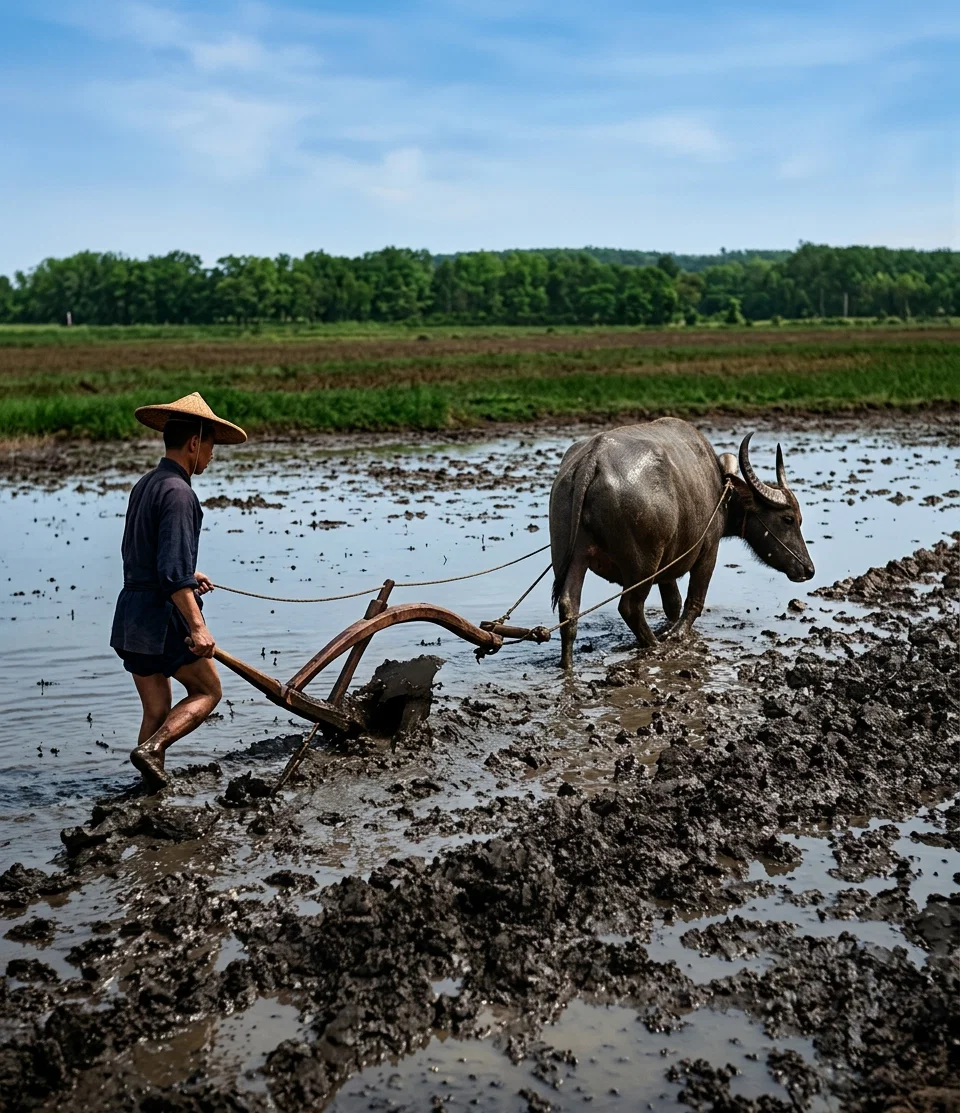
A CHINESE FARMER PLOWING FOR RICE
The coming of Elder R. F. Cottrell and wife and Miss Pauline Schilberg to connect with this work is most opportune. This answers our first and most urgent call for workers made at our annual meeting in Shanghai one year ago last February. It puts five capable workers in the heart of that province. But when it is remembered that within its borders are not less than twenty-two million souls, it is readily seen that we have made only a mere beginning. These workers have bravely entered upon their task in the strength of God. They are holding the fort, and the light of the truth shines invincibly by the very fact of their being located within the walls of that capital city. The Lord, whom they serve, will in his own good time add recruits, both native and foreign, until the message of his coming shall be heard in all Hunan. We ask all our people to pray definitely for the workers and the work in this province of Hunan, that the truth may be successfully established there.
Canton.
In the Capital of Hunan
By R. F. COTTRELL
R. F. COTTRELL
To an American, a casual survey of the landscape about Chang-sha presents nothing particularly strange. The Siang River, nearly a mile in width during high-water, sweeps along the broad valley. On either side the land gradually rises toward the hills and mountains. The lowland is quite largely utilized in the cultivation of rice.
On the hills, vegetation is scanty, the red soil, resembling clay, being seen in many places. Aside from a meager carpet of grass, there is little to relieve the monotony; yet one hill near by is partly covered by a forest. Here one beautiful day we had the privilege of spending several hours. Almost everything, even to the bird songs, seemed so American that it was difficult to believe we were in China.
Nevertheless, even here was to be seen a specimen of Satan's handiwork. Throughout China it seems that almost every unique, favored, or beautiful site has been preoccupied by some heathen edifice or shrine. So this quiet, attractive retreat had centuries ago been dedicated to Buddha; and on the hillside, in the midst of the forest, surrounded by a high enclosure of brick, is a large Buddhist temple.
Hither come devotees of this heathen deity to worship and to pay tribute. This sacred mount would be an ideal place, for this locality, on which to spend some time during the hot season; but when one asks the privilege, he is refused in polite Chinese manner by being told that the governor is afraid he could not extend adequate protection so far from the city.
However homelike a Chinese forest may be, a native walled city is decidedly foreign. Approaching the city as one first does by river-boat, he sees a metropolis that has outgrown its artificial boundaries to quite an extent on either side. Towers of temples and shrines may be seen at a distance; while in the stream are many house-boats, and on the low, muddy shore are numerous small dwellings. Nothing appears particularly imposing except the vast number of people,—some clad, some half-clad,—the most of whom are shouting and clamoring as they surge to and fro.
In the city the streets, averaging about ten feet in width, are thronged by what appears to be an endless procession of humanity. The sedan-chair is largely used as a conveyance, while a few jinrikishas are also seen. A goodly number of wheelbarrows pass along, groaning under their loads with a squeak that may be heard for several blocks. The few drops of oil that might stop the distressing noise apparently are never applied. On hearing one of these musical vehicles from a distance of about one-half mile, and in the direction of some soldiers who were drilling, one of our number thought it was a Chinese martial band.
About ninety per cent of all the water,14fuel, freight, produce, garbage, etc., is carried by suspending it from bamboo poles, which rest upon the shoulders of the Chinese coolies. The load may require one or more according to its weight, a little over one hundred pounds being considered the amount each should carry. As all who are heavily laden invariably travel at a pace that can best be described as a slow run, it is perhaps unnecessary to state that constant vigilance is the price of safety.
A GENERAL VIEW OF CHANG-SHA
A bird's-eye view of Chang-sha may be obtained from several points along the city wall. Tile roofs here and there, temple towers or spires, and occasional clumps of trees greet the eye. Notwithstanding this a person may travel through the city from east to west or north or south, with hardly a glimpse of either house or tree. Open shop fronts, exhibiting a great variety of articles, and a wide range of occupations, line many of the streets; but these various thoroughfares, together with the high, prison-like walls which surround all dwellings, except those of the very poor, almost entirely hide the houses from sight. In the enclosed courts of the rich, and in the precincts of Confucian and ancestral temples, trees, shrubbery, and flowers are cultivated with a skill which rivals that of the American florist. As the houses, or compounds, are separated from one another by these same high walls, every household is isolated from the rest of the world, and, in consequence, with but little chance in the cities for neighborhood broils.
In the country, however, the reverse of this is said to be true, as almost every village has a feud, oft-times of many years' standing.
Korea, is called the “Hermit Kingdom;” but China, shut in by the lofty Himalayas, the Great Wall, the ocean, and her hoary traditional policy of seclusion, stands without a peer as the Greater Hermit Kingdom. Her cities, enclosed also within massive ramparts, are in many ways separate, miniature nations.
Likewise the Chinese family, as has been shown, is in itself a little kingdom, self-imprisoned not only behind barriers of brick, stone, and cement, but fettered by ignorance, superstition, and an idolatrous ceremonialism that is deified and venerable with age.
Our Saviour came to earth to “preach good tidings unto the meek; . . . to bind up the broken-hearted, to proclaim liberty to the captives, and the opening of the prison to them that are bound; to proclaim the acceptable year of the Lord.” Christ commissioned his disciples, and likewise sends us forth into all the world for the completion of this same great gospel enterprise. “And who then is willing to consecrate his service this day unto the Lord?” And who, for China's spiritual emancipation will say, “Lord, I lay my all upon the missionary altar”?
Chang-sha, China.
The Need for a Quick Work Abroad
By H. J. JEWELL
H. J. JEWELL
As we read the reports of the General Conference Committee Council, and of the union conferences in America in regard to increasing contributions to foreign missions, the hearts of the workers in distant fields are made to rejoice, for it is a step in the right direction, and means, if thoroughly carried out, a reviving of the spirit of God's people, and a shortening of the time before the setting up of the everlasting kingdom. Assuredly there has never been a time in the history of the world when the cause of God needed funds and consecrated workers as now. The outpouring of the Holy Spirit will not be much longer delayed.
India is fast falling in line with other large and more civilized countries of the world. Corruption has largely to do with much of the business of the country; abuse of justice, Sunday-law agitation, strikes, riots, and labor troubles are coming to the front, and a serious revolutionary spirit is taking hold of the natives, which prophesies anything but peace.
India is not the only country with these threatening clouds hanging over it, and God's people are not in darkness as to their meaning. Angels are now holding the winds of strife and bloodshed, that the message may be more easily carried. India, as well as every other country, is now open to the truth.
There are many laborers in America who would come over and help us, but they have not the means, and our conference treasury can not supply their needs. Consequently the cause of God is crippled. Many of our faithful laborers in distant fields are being laid away before their time on account of the heavy burdens and lack of help. Had relief come, their lives might have been lengthened, and many precious souls have been saved as a result.
At our general meeting held in Calcutta a year ago last January, the call was sent out to the home land for laborers, but these calls can not be supplied readily. Yet we work, and patiently watch for good reports, and when word comes of “the plan to double the number of our workers in the mission fields,” we take courage, and say, with the brethren, “Surely this is not an unreasonable undertaking.”
As it was in the days of Noah, so it is now. God's Spirit will not always strive with man, but he is now going to make a quick work and end all this delay. Piteous calls have for several years come from Burma, from the Karens, a nation of several millions of people who want to learn of this great truth. Their traditions tell them of a Saviour who is coming to them, and this message is what they are longing to hear. Some have come many miles to hear our workers when there was opportunity.
Dear friends, these people are looking for the Saviour. Who will come and teach them? Calls are coming from the Madras Presidency for some one to come and instruct them, but there is no one to go. We need a worker in Ceylon. Several laborers have been located there, but have been called away.
“Brethren and sisters, would that I might say something to awaken you to the importance of this time, the significance of the events that are now taking place. . . . And while the powers of darkness are stirring up the elements from beneath, the Lord God of heaven is sending power from above to meet the emergency by arousing his living agencies to exalt the law of heaven. Now, just now, is our time to work in foreign countries.”—“Testimonies for the Church,” Vol. VI, page 18.
We are also told that the Lord will not send upon the earth his judgments, until he has sent his watchmen to give the warning. Never before has our15work made such progress in India as in the past two years, in developing real, earnest Christians. Truly God's hand is leading in it all. But from these three hundred million people are coming more calls than can be answered. Many precious souls are waiting to be taught, but ‘how shall they hear without a preacher? and how shall they preach, except they be sent?’ And how can they be sent unless God's people in every land press forward and lift?
“The crisis is fast approaching. The rapidly swelling figures show that the time for God's visitation has about come. Although loath to punish, nevertheless he will punish, and that speedily. Those who walk in the light will see signs of the approaching peril; but they are not to sit in quiet, unconcerned expectancy of the ruin, comforting themselves with the belief that God will shelter his people in the day of visitation. Far from it. They should realize that it is their duty to labor diligently to save others, looking with strong faith to God for help.”—“Testimonies for the Church,” Vol. V, page 209.
Our workers in Mussoorie have rented a hall, and sent out neat circulars with a hearty welcome to all. Lectures and Bible studies on present truth, including healthful living and rational treatments, are given several times a week, and are well attended. We hope to have a good report from this station later in the season. Several of our faithful laborers have been stricken down with heat and disease this summer, but God has heard the prayers of his servants, and is restoring them to health. The battle is growing fierce, and the trump is sounding louder, but it will last only a little while longer. May the glad day be hastened when victory is ours.
Calcutta, India.
The Southeastern Union Conference
By V. O. COLE
It has been only a short time since this, the youngest of our union conferences was organized. It includes East Tennessee (or the Cumberland Conference), North and South Carolina, Georgia, and Florida. Perhaps a few items from each of these five local conferences may be of interest to our brethren living in more favored parts of the field.
We will first mention Georgia, which was the last settled of the original thirteen States. It is known as the great Empire State of the South. With its population of two million six hundred thousand we have only about one hundred and forty-four who make a profession of this truth. There are only five churches and two or three ministers in the entire conference. There are one hundred forty-six counties, most of which are thickly populated, and only two of these counties have been worked at all thoroughly with our books. Nearly one hundred counties have not been touched at all by our canvassers.
South Carolina has a population of one million three hundred forty thousand, with only about one hundred Sabbath-keepers in the State. It has forty-one thickly populated counties. Only ten of these have been canvassed at all, and that with only one book, “The Coming King,” leaving thirty-one counties which have not been touched with any of our books.
Strange to say, it was not until this year that any of our canvassers believed that our large books could be sold in these extreme Southern States; but those who are breaking off from the old idea, and using the larger books, are having remarkable success. One brother here in South Carolina, who had been working steadily for more than a year with “Coming King,” but had never taken more than $65 worth of orders in one week, began with “Daniel and the Revelation” a short time ago, and sold $118 worth the first week. Another had been using “Seer of Patmos” alone, thinking the people would not spend more than $1 or $1.50 for a book. But as he worked, his faith began to grow, so he clubbed the two books, “Seer of Patmos” and “Story of Daniel” together as companion volumes. He found that he could make just about as many sales with the two as he could with one volume alone. His orders for the first four days in working on this plan amounted to $75.
Next we will mention North Carolina, which is second in area and also in population, in this union. More than one million nine hundred seventy-six thousand are here waiting for this truth, and there are only about three hundred Sabbath-keepers in the State. It contains ninety-seven counties, of which thirty-two have been worked with only one book, and thirty-one have been only partially worked with one book, and thirty-four have never been touched with any of our bound volumes. This conference is noted for its high, healthy climate and beautiful mountain scenery.
Although the canvassing force is small, those who are putting in faithful time are doing well. One brother, who is working for “Daniel and the Revelation” recently came in Friday afternoon with $102 worth of orders that the Lord had helped him to take in one week.
The Cumberland Conference comes next. This conference includes the eastern half of Tennessee, and has a population of 796,931. The Southern Training School at Graysville is located in this conference; therefore it has a few more Sabbath-keepers than any of the other local conferences of the union. Here we have five hundred fifty Sabbath-keepers, yet this is only about one twelfth as many as there are in the California Conference. Here we have thirteen counties that have never been touched by our canvassers as far as our record shows; sixteen counties have been partially worked for “Coming King,” and a few others have been worked with some of our larger books. One brother writes that he has canvassed in seven different States; and, taking everything into consideration, he prefers East Tennessee to any conference he ever worked.
Last, but by no means least in importance, is Florida, which covers an area of 50,990 square miles, with at present only six or seven canvassers. There are forty-six large counties; and as far as the record goes, only eight of them have been worked with our books, and half of this number have been worked with only one book.
Much could be said to induce canvassers who lived in a less favored climate to take up work in this State; but I should think that the fact that so many thousands of tourists and invalids flock to this country to spend the winter and spring, would be a greater argument than any I could possibly present. While books can be sold at all seasons of the year, winter furnishes a golden harvest-time for the faithful canvasser.
It is a demonstrated fact that the South is a good field to canvass, and one attractive feature of the work here is that we do not have to go into long winter quarters; but the canvassers do well twelve months in the year. As a rule the people are hospitable. If charge is made for meals and lodging, it is usually a very reasonable amount, and that is deducted from the order for books.
Here we have a large home missionary field at our door. While we should cultivate a foreign missionary spirit; let us remember that those who make the best foreign missionaries become good home missionaries first.
Brethren, it is true that the Lord will soon come; yet this entire Southern field will have to be worked before any of us will be permitted to see the King in his beauty, or receive the reward that is laid up for the faithful.
If our great need, together with your love for the truth, and longing desire to see the work closed, should appeal to you to have a part with us in this work, the undersigned, the presidents of the local conferences, or the State agents, would be glad to hear from you, and gladly render any assistance possible in helping you to get located in just the right place. My address is R. F. D. 4, Riceville, Tenn.16
V. O. COLE,Gen. Miss. Agent Southeastern Union Conference.
The Message Came Too Late
“THE white men salute you!” shouted the West Coast natives, bending over their dying chief.
The old man, who had seen nearly a hundred summers, lifted his sightless eyes, and put out a trembling hand, whose skin had stiffened almost into parchment.
“He is too old,” exclaimed a favorite slave; “he can not see the strangers. The white men salute you,” he repeated, bending close to the deafened ear.
The old man moved, and, groping blindly, caught the hands of the newcomers.
“White men,” he said, “I don’t know the day that I have not heard about your power and your learning. Why did you not come sooner? You come now when these eyes are too blind to see you, these ears to hear. If you have any message, give it to the young men; you are too late for me.”
In the great wilderness of heathendom he died—died like the thirst-spent traveler in the desert, seeing far off the mirage of the city that he will never reach.—From “To Help to Heal.”
Central Africa
By W. C. WALSTON
SOMABULA MISSION.—We are glad to report our mission in a prosperous condition, although we have had some trying experiences during the last two months. April 13, Brother A. Butterfield and his little daughter, eight years of age, were both taken with the fever. For several days the fever continued; and when broken, it left Brother Butterfield very low. The little girl developed a serious complication, and died on May 4. Three days before the child's death, Sister Butterfield also came down with the fever; so while preparations were being made by the writer and native children to lay away their little treasure in a lonely grave, both parents were obliged to remain in bed. It was indeed a sad experience for them. But they know that God does all things well, and look forward with bright anticipation to the resurrection morning.
As the care of the sick and looking after the work of the mission fell on me, I telegraphed to Kimberley for help; and Dr. J. J. Bell, of Ireland, who is now in this country for the benefit of his health, came to our assistance. We were very glad to have him with us; but when he arrived, he found the sick ones better, and remained only a short time. Two days after he left, both Brother and Sister Butterfield had another attack of the fever. I again sent a call to Kimberley for help, and Elder W. S. Hyatt came to the mission at once. It takes some time for help to come so far; and when he arrived, he found both patients better; but since he came, both have had the fever again. I am very glad to be able to say, however, that both are now better, and, we hope, on the road to permanent recovery.
We have had a long experience with the fever. But we do not complain. All have trials to meet in this world, and we must recognize a loving Father's hand in all our sad experiences. We have often been led to think of late of the world where the inhabitant will not say, “I am sick.” During all our sickness the work of the mission has not suffered much: we have been able to look after it so as to keep everything moving along very well. We are harvesting our corn now, and have a good crop. The school17is in a prosperous condition, there being fifty in attendance, which is a larger number than ever before, and a good interest is manifested. Last Sabbath ten persons were baptized, and thirteen united with the church. We praise God for his blessing here in the work. We are very glad Elder Hyatt could be with us for a time, and we are personally thankful that God has given strength for this experience, and a knowledge of how to treat those who are sick.
Our courage is good, and we feel to press on in the good work here in this dark part of the vineyard, and rejoice that God has given us a part in his great work of saving souls. Do not forget to pray for those in this land of disease and darkness. W. C. WALSTON.
The Leicester (England) Sanitarium
By Wm. M. Scott
The Lord has prospered our little sanitarium here beyond our fondest hopes. The out-patronage, which it has been our endeavor to develop, has now increased to such an extent as to pay our running expenses. We are also gaining the confidence of the local doctors. My wife and I have made an effort to call upon most of the principal doctors, and offer to co-operate with them in treating any patient they might send us; and several of them have sent us patients from time to time. Lately we have had patients sent in to stay, so as to have the benefit of our diet as well as treatment.
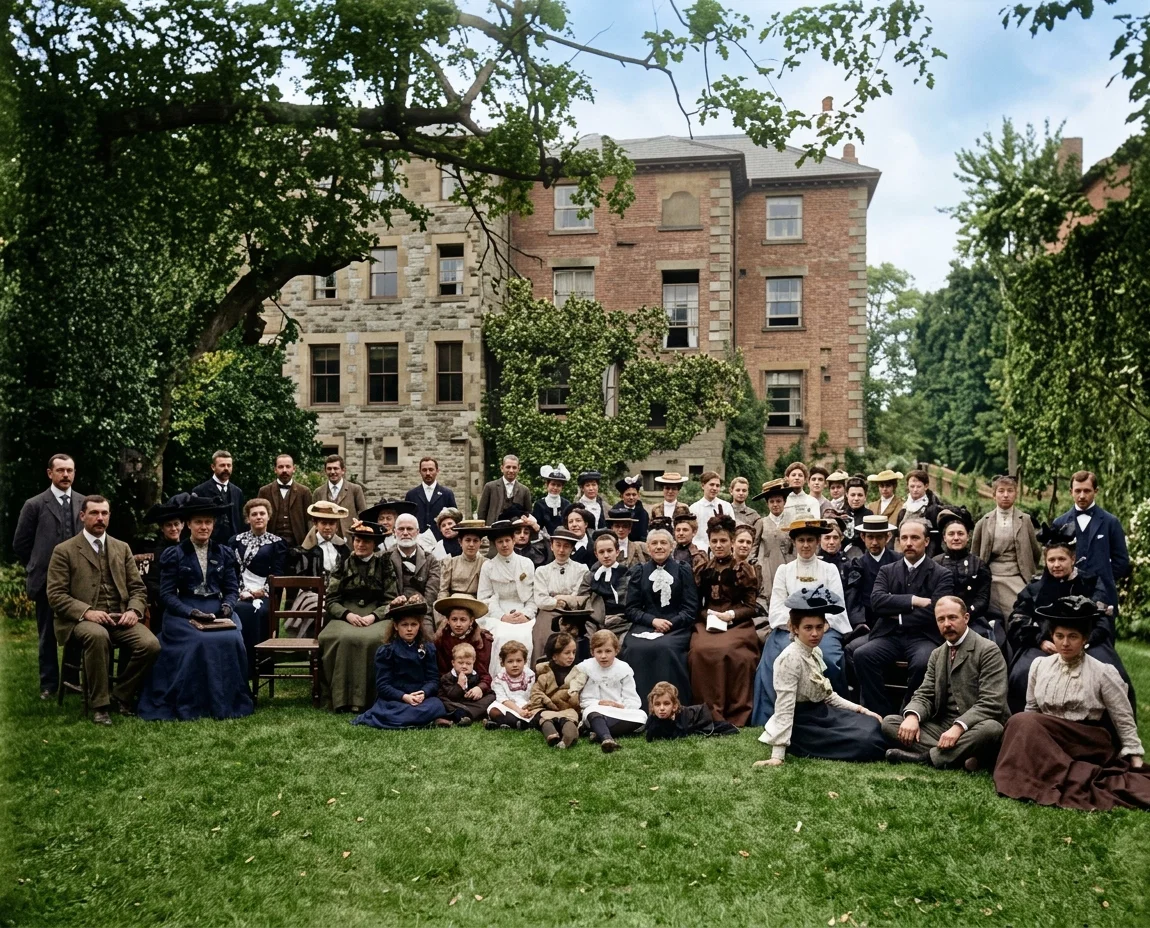
ON THE LAWN AT THE LEICESTER SANITARIUM
We have with us now a clergyman and the matron of the Cottage Hospital. The former is so well known, and has such a wide circle of friends, that his being here has proved quite an advertisement to us. Our sanitarium was recommended to the matron of the hospital by one of their patients whom we had greatly benefited. Almost from the first day of her arrival she has improved, and leaves at the end of this week, well pleased with her progress.
The majority of out-patients suffer from gout, rheumatism, sciatica, lumbago, and liver and stomach troubles, although we also have cases of paralysis, anemia, and nervous debility. The Lord seems to bless us in every case by restoring health and strength to those who come under our care. On account of the success that has come to us during the past eighteen months, we have been able not only to clear the institution of debt, but to paint and decorate the most of the bedrooms, besides the drawing-room and bath-rooms, and likewise add considerably to our electrical plant, bringing it up to modern requirements. Our greatest want is to get suitable young people to give themselves to medical missionary work. Our family numbers only eight at present,—four nurses in their first year, a second-year lady nurse from Rostrevor, and a gentleman nurse from Caterham assisting in nursing and bath-room work (both dropping a year to help us out), and myself and wife.
We could get along nicely with two or three more helpers. Our hands are full, but we count it a great privilege to be workers together with the Great Medical Missionary, and we have much encouragement to keep us happy and thankful. WM. M. SCOTT.