CAPE HAYTIEN.—Last week I returned home from Port de Paix, where I had been assisting Brother Emil Fawer with an interest. At that place, seven or eight bright, honest souls, mostly Guadaloupeans, have accepted the truth.
The work is more than holding its own among those who have accepted the Sabbath the past two or three years, and is making gains in new places, as, for instance, in Port de Paix, where a little company has been observing the Sabbath for a few weeks. Letters from Port au Prince tell me that recently three or four persons have begun the observance of all the commandments, so that now we have a company of seven or eight in the capital, a place where we have as yet done no public work.
The political unrest makes it hard for me to keep up with the work at present. All indications make it clear that if trouble once breaks out here at the Cape, we shall be in danger. This seems to be the general impression among all foreigners. I feel, however, that we are better protected than those who may see strength in the presence of foreign war-ships; for are we not right where God put us, in order that we might carry on his work? Nevertheless to be away from home under such circumstances is more or less of a strain on one, and especially where the means of communication are so meager.
If we had a man whom we could now put at Port au Prince to look after the growing interest in that part of the field, it would do a great deal toward helping me to look after the three-hundred-mile string of lights that now stretch from one end of the republic to the other.
I feel that the two and one-half years I have spent here have been surprisingly full of immediate results, although I have had to work through an interpreter a part of the time, and am still heavily handicapped for want of fluency and a better accent.
At present we are all quite well, for which we are truly thankful.
W. J. TANNER.
Mississippi
By Page Shepard
CANTON.—I find this place ripe for the truth. There has been a breaking up among the orthodox churches here, many of their members falling away to the Holiness people. But now there is a decided reaction against them, and some have left them. It seems that God is thus shaking the people for the entrance of the truth. I have met some anxious, interested ones, whose hearts are open for the message. One has already decided to take a stand with us, and we know that the Lord will turn the honest in heart to him when the call of the third angel’s message is given. Brother Willie Cobb has been living here, an isolated Sabbath-keeper, whose life is witnessing to the sanctifying power of the truth. Brethren, pray for the work here. I can but rejoice to add that “my soul doth magnify the Lord,” abundant in goodness and truth.
PAGE SHEPARD.
South Africa
By E. R. Williams
AFTER arriving in Africa, it was decided that we should labor in the towns and cities instead of going to one of the missions; so in company with Elder I. J. Hankins and wife, we came to Kroonstad, Orange River Colony, and began meetings in a tent. Although we have had a great deal of opposition, the interest has been fairly good, and a few have begun keeping the Sabbath. Many others are convinced of the truth, and feel that they ought to obey it; but a number of these are railroad men, and they know that to obey means to lose their employment,—a serious matter just now in South Africa.
Thousands are out of work; other thousands who could do so, have left for England, Australia, and other places. Many more would go if they had money to get away. Hence our work in the towns is very hard.
Many of the farmers have become interested through reading the reports of our meetings in the papers, and other reading-matter. We have been doing some work out at the farms also, but we are at a great disadvantage in this respect, since most of the farmers are Dutch, and can understand very little English. We are studying the Dutch language, however, and hope to be able to do more for these people after a time. This field is in great need of Dutch workers.
Besides its two or three thousand white people, Kroonstad has three or four thousand natives. These natives are in two little villages called “locations.” One of these is at the outskirts of Kroonstad, and the other is about half a mile from town. We have been doing some work among the natives also. Most of these meetings at the locations have been held in the open air, and we have had from two to six hundred present. We have found the stereopticon very useful in teaching the truth to these people. I secured the services of a young native minister, Gabriel Mabeni, to interpret for me. He interprets in both the Dutch and Sesuto, and also speaks two or three native dialects. He has under his care some five hundred people, and has become much interested in the truth.
The president of the division of the Methodist Church to which Mabeni belongs, Solomon Molotsi by name, was at this place visiting last week. There was also another minister with him from Bloemfontein, and I had a number of Bible studies with them. At the last meeting we had, Molotsi said, 'I have known something of the Sabbath before, and from what you have said to me I am convinced that it is the truth of God. I and my people do not want to depart from God, and we should be very glad to return to God's Sabbath.'
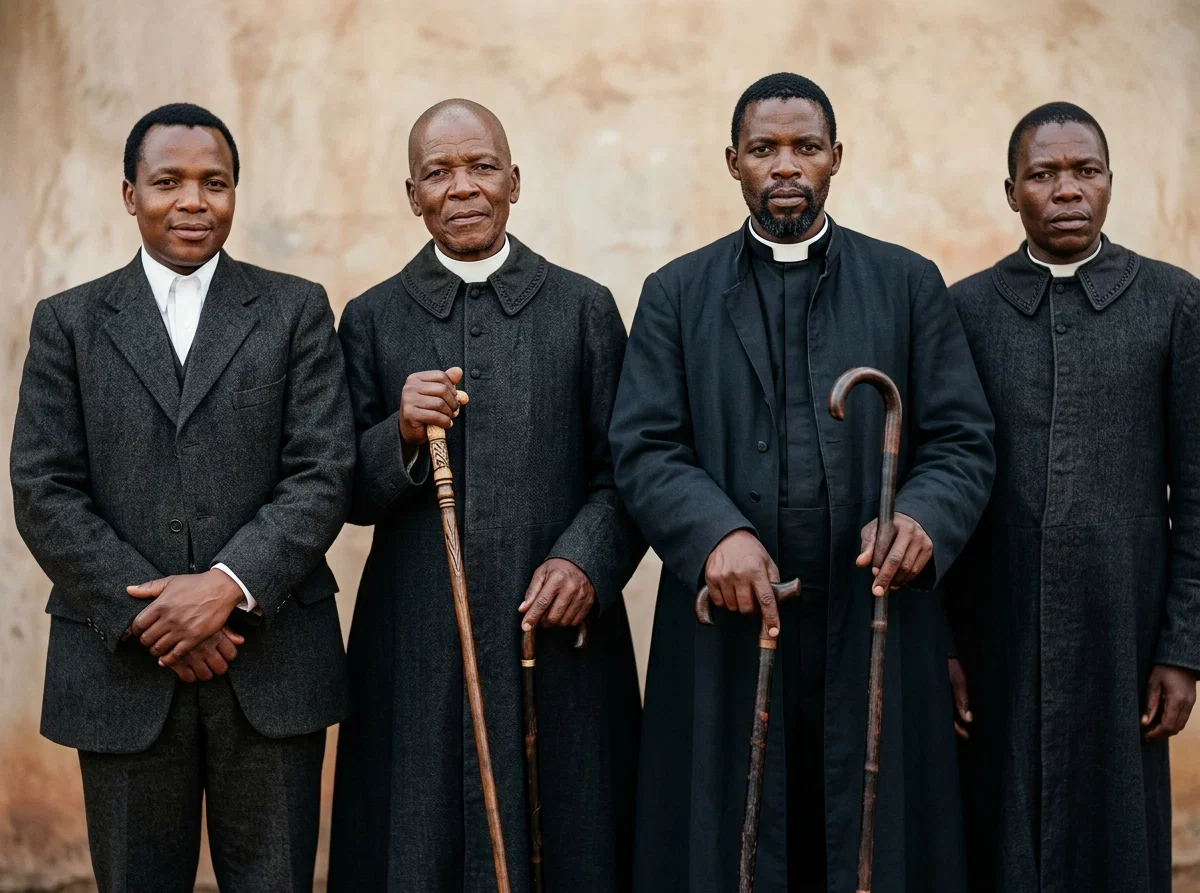
MABENI MOLOTSI MATLI MTIMKOLO
He then told me of some of the hardships they would have to meet if they should begin to keep the Sabbath. I will speak of these later. He bought a number of our books, and regretted that he could not stay longer to talk about these things. He gave me a very cordial invitation to come to Bloemfontein and work among his people. He has charge of about three thousand people, and we feel that God is opening the way for a great work to be done among them.
Around all these cities and towns, and also in the country, there are thousands of natives. Here is a great mission field, practically untouched as yet. Among them are many intelligent natives, with a fairly good education, and I believe we shall yet see many of these carrying this message to their own people in the interior.
Mtimkolo, one of our native workers, has been here with us for a few days, and is doing a good work. I am sending a picture of these people. We trust our brethren will remember this work in their prayers.
E. R. WILLIAMS.
Mexico
By M. C. McCULLOCH
LA RIVERA.—In the REVIEW I saw that at the council of the General Conference Committee it had been decided to send help to some parts of Mexico, but Tampico was not mentioned among them. I have started to teach three children but I realize that without help I can not continue and build up a work here, as I can not be teacher, housekeeper, matron, and everything in one.
If we could have a little help (one teacher would be enough for the present), we could soon build up a self-supporting work that would be a great help to the cause in this field, and a blessing to the children. There are many Mexican children in the village who would like to come in as day pupils, but I can not take them. My desire is to go on with the work here, and see a good, strong mission built up; it seems as if I can not give up now.
I have a small piece of land cleared, and about ready to plant; and as we had a nice rain yesterday, we want to get something out as soon as possible. The good wood has been cut, and they are getting it out on the canal bank now, to sell to the steamers. It pays the expense of clearing the land.
M. C. McCULLOCH.
The California Camp-Meeting
By Stephen N. Haskell
THE general camp-meeting for the California-Nevada Conference was held at Melrose, a suburb of Oakland, June 4-14. This meeting was one of unusual interest; and the attendance of our own people was much larger than at any previous camp-meeting held here since California was divided into two conferences. This was owing in part to the fact that a special session of the California-Nevada Conference was held in connection with the camp-meeting. About two hundred tents were pitched on the grounds, and a large number of our people occupied rooms in the vicinity of the camp.
Among the speakers present was Mrs. E. G. White, who spoke six times to the large company with as great clearness and power as in early times. Elders H. W. Cottrell, J. N. Loughborough, Luther Warren, H. Schultz, W. T. Knox, J. O. Corliss, E. J. Hibbard, G. A. Snyder, Fred Brink, and others were also present, and spoke to the people. Elder Warren labored for the young people, and Elder Schultz for the Germans.
The entire plan of this camp-meeting was unique, and departed in some respects from the usual customs. There were four distinctive features in this meeting; namely, Bible studies, missionary meetings, health and temperance meetings, and social meetings.
One hour each day was wholly devoted to Bible study throughout the entire meeting, and the large attendance at all these studies witnessed to the fact that the earnest study of God's Word will build up the church of God. The hour from nine to ten o'clock each morning was devoted to good, old-fashioned missionary meetings; and many took hold of the work, and went out into the city and sold tracts, books, and papers during the camp-meeting.
As the importance of the tract work was presented to the people, packages of tracts were offered for sale, and the brethren and sisters purchased quantities of these tracts to take home with them to distribute. In the two days devoted to the tract work, over two hundred fifty dollars' worth of tracts were purchased by the brethren at wholesale prices. By special arrangement, packages containing $9 worth of assorted tracts were sold for $5 each; cash; also $4.17 worth for $2.50 each; and $1.50 worth for $1. It was a glorious sight to see the people coming forward and laying down their money,18and going to their tents with packages of tracts in their arms.
One missionary meeting was devoted to the importance of distributing “Great Controversy” among the people, and nearly two hundred copies of this book, bound in cloth, were stacked up on the stand. These were offered in lots of four for five dollars to all who would buy them to use as a circulating library in their homes, or to sell to their neighbors. In a few minutes all the books were taken by the brethren and sisters. Additional orders were given, making over two hundred copies of “Great Controversy” sold and taken to be scattered. As the people left the tent with their arms filled with these books, I think the Lord was pleased, as well as the leaders of the missionary meeting.
When the importance of the periodical work was presented in the missionary meeting, there were large quantities of our different periodicals stacked up on the stand, and the people bought thousands of them to take home, while others went out and sold them in the city. In one meeting a special offer was made that any who would take ten copies of the one-dollar edition of “The Story of the Seer of Patmos” could have them for $5. Over six hundred books were taken on this proposition. Many remarked, as they saw the brethren and sisters carrying away armfuls of literature from the large tent, “Surely, this is the loud cry!” The sales of literature, and the subscriptions taken for the various periodicals on the camp-ground, amounted to about eighteen hundred dollars.
Every evening at five o'clock an old-fashioned health and temperance meeting was held by Dr. Maria L. Edwards and others from the St. Helena Sanitarium. Instruction in simple treatments, fomentations, foot-baths, etc., was given; also much practical instruction in caring for the health, and on the subject of diet. These health and temperance meetings were greatly appreciated by the strangers who came on the ground, as well as by our own people.
In the young people's meetings the old-fashioned pledge cards were presented by Elder Warren and Sister Augusta C. Bainbridge, and many signed them. There were two pledges, one to abstain from the use of all alcoholic drinks, and another requiring abstinence from alcoholic drinks, tobacco, and tea and coffee.
The plan for the camp-meeting was to hold a Bible study, a missionary meeting, a health and temperance meeting, and a social meeting every day; but owing to the fact that it was necessary to spend a good portion of two days in conference meetings, the plan was somewhat broken. Many testified to the blessing received, and said it filled them with a new desire to work for souls.
It was voted by the conference to close Healdsburg College, and to remove it to a more rural district. Our people pledged liberally to pay off the old indebtedness, and also to establish a new college. It was unanimously voted that the new college should be established on a strictly cash basis. Besides the money given, and the pledges made, about three thousand books were given by different individuals toward the college enterprise, on the condition that others would volunteer to sell them for that purpose. A large number pledged themselves to canvass for a certain length of time, and thus turn these books into money for the school. Sister White and the writer each donated one thousand dollars' worth of books for this work.
Several hundred dollars was also raised for the foreign mission work by individuals paying $5.20 each in advance to carry out the plan recommended by the General Conference of ten cents a week per member. Some donated much more than the $5.20. This does not excuse any from the payment of the regular weekly Sabbath offerings for this purpose. Much interest was manifested in foreign mission work, and, besides the offerings mentioned above, the Sabbath-school offerings at this meeting and the Lodi camp-meeting amounted to over three hundred dollars.
Much of the preaching was clear and well-defined argument on different phases of present truth. As the meetings proceeded, the interest increased, so that before the close, meetings were almost continuous in the large pavilion, and also in the smaller tents, where instruction on different lines was given to the people. A number made a start in the Christian life for the first time, and many backsliders were reclaimed. It was a common expression that this camp-meeting was the freest and best meeting they had ever attended. Union and harmony prevailed throughout the entire meeting. Reports were given in the different city papers, and so great was the outside interest that the meetings have been continued with a large attendance.
Seven tent-meetings and one hall effort had been conducted in the conference before the camp-meeting, and, in nearly every case success attended the effort. A larger number of tent-meetings will be held after this camp-meeting. Two churches that had lately been organized were taken into the conference; and other companies are ready to be organized as the fruit of the efforts put forth during the present season.
It is evident that we have reached a new era among our people. The Spirit of God is moving upon hearts to arouse them to scatter the truth “like the leaves of autumn.” Our cities must be worked, and nothing is better to meet the business men than our periodicals filled with the message. Many will not take time to read a large book, neither will they become subscribers to any of our periodicals; but they will buy papers and magazines containing short articles on present truth. Our periodicals should be filled with short, clear articles on different points of the truth, so that each one will preach the whole message. Then, different periodicals can be taken and sold, going over the same ground again and again. The forty-seventh chapter of Ezekiel will yet be fulfilled by our people scattering a variety of our books and periodicals.
It has been demonstrated here in California that a variety of books and papers is demanded by the people, both by those who sell and those who read. To concentrate all our strength upon one or two books or papers will not meet the minds of those who dispose of the publications, nor the mind of the reading public.
During the past three and one-half months about forty-seven thousand copies of the Signs, Liberty, Life and Health, and Special Bible Training-School have been sold in Oakland, San Francisco, and neighboring cities. The more papers sold, the greater the demand.
There is every indication that we are in the closing of this work. This is shown by the way our people, as individuals, are distributing our literature, and also by the demand of the public for it.
S. N. HASKELL,
President California Conference.
Closing Exercises of Keene Academy
By GEO. A. IRWIN.
THESE exercises commenced Sabbath, June 20, with a sermon by Elder C. Santee. On Sunday evening a musical program was rendered in the church. Monday was devoted to examinations and the making out of grades, and the evening was taken up with class exercises. The commencement address, entitled, “True Christian Education, and Consecrated Workers the Need of the Hour,” was delivered by the writer, Tuesday morning, after which Elder C. Sorenson, principal of the school, in a few well-chosen words of counsel, encouragement, and good wishes, presented the diplomas to the graduating class.
The graduating class consisted of Misses Enie Martin, Robin Hunter, Sidney Smith, Nellie Sturgeon, Daisy Butka, and Mr. Ray Goss. Of the six, all are from Texas except Miss Sturgeon, whose home is in Oklahoma. While the number of graduates was much smaller this year than usual, they gave evidence of having done faithful work, and are full of the missionary spirit.
The past school year has been one of marked prosperity, both in point of attendance and financially. Two hundred twenty students were enrolled in the academy proper, and eighty-five in the church-school (which is under the supervision of the academy), thus making three hundred five in all. Eighty-two of the academy students were in the home. The school has furnished work to needy students to the amount of five thousand dollars during the school year. Although the balance sheet is not yet out, the manager is confident that it will show quite a good sum on the right side.
The store, broom, and tent factories are all sources of income to the school, and enable it to overcome any deficit that might otherwise occur in its operation.
A company of forty from the school have gone into the canvassing work, most of whom have the earning of a scholarship in view. The canvassing work and the cotton crop have in the past been factors with which the school board have had to reckon in determining the dates of the beginning and ending of the school year. For the coming year, however, it has been decided to begin September 30,—two weeks earlier than usual,—and close May 11, in time for the General Conference.
In the main the same faculty has been chosen to continue the work another year, and it is expected that there will be a fuller school than ever before. The building erected by the conference for a sanitarium and used for a time for that purpose, has been purchased by the school board, and will be moved to the school campus during vacation, and fitted up for a boys’ dormitory, thus increasing19the facilities for the accommodation of students.
There are many children and young people in the States composing the Southwestern Union Conference, and as our work extends in that field, the Keene Industrial Academy is becoming more and more a necessity and an important factor in the work of the union as well as to the work at large.
May the Lord give wisdom to the teachers in this school to train the children and young people placed in their charge, in the nurture and admonition of the Lord, and to aid them in forming characters that will stand the test of these evil times while they are engaged in the Lord’s work, and the final test of the judgment above, when their work is finished. GEO. A. IRWIN.
Guatemala
By Ethel T. Nowlen
GUATEMALA CITY.—One’s heart can but be saddened, as he sees the number that are continually going into some of the many large cathedrals here, seeking in different ways to atone for their sins, and he longs to be able to point them to the great Burden-bearer. We watched them one morning recently. One white-haired old lady in particular went from the image of one saint to that of another, repeating prayers before each one, and I wondered how many years she had been going through that same form. The harvest is indeed white in this country; and not only are the laborers few, but great wisdom will be needed in order to work without creating alarm and prejudice. The one comforting thought in it all is that the battle is not ours; but the Lord’s, and that though there are great walls to be encountered, his Word can cause them to fall, as did the walls of Jericho.
We already have made quite a start on the language—not altogether as a matter of choice, but of necessity; and now if the school work opens up as Brother E. L. Cardey anticipates, I see no reason why we should not soon gain an entrance to some homes and hearts.
This certainly seems to be a beautiful climate, and we already feel much better for the change. The air is cool and bracing. There is an abundance of fresh fruit and vegetables all the year round; in fact, we counted in the market between thirty and forty varieties the names of which we knew, besides many native fruits. All kinds of foodstuffs are very cheap. Imported goods, especially clothing and furniture, are much higher-priced than in Belize. We are making most of our furniture from dry-goods boxes and native wood.
We have a good native woman go to market every day and do any other errands we require, for six dollars paper (not quite thirty-six cents gold) a week, and this is considered good pay. All the labor is equally cheap.
Mr. Nowlen was not able to come up here with us, but had to stay at Puerto Barrios for nearly a week longer, to get our goods through the customs and on the train. He is here now, and expects to stay a week or so, before starting out to canvass again.