“JUDGMENT is turned away backward, and justice standeth afar off; for truth is fallen in the street, and equity can not enter.” Isa. 59:14. In our day this condition of things is accentuated through the medium of jury bribing. An instance is given by a Chicago paper of recent date, in which a little girl was run over by one of the cars of the West Chicago Railway Company and had both her arms cut off. A damage suit was brought against the company, and a verdict in favor of the plaintiff was prevented by the bribing of two or three jurors through the instrumentality of the bailiff. The case was brought to the attention of the grand jury, and the following deliverance by that body brings to view a significant sign of the times:—
Outside Fleischmann's Bakery Waiting in the Cold for Bread.
“The grand jury has investigated various charges of bribery of jurors and finds that bribery has existed for some time in the courts of Cook County to an alarming extent. The conditions and practices of the courts have made the bribery of jurors a comparatively easy and safe practise. Sufficient evidence was adduced before the grand jury upon which indictments were returned in two cases of bribe giving and one case of offering a bribe. Evidence of other improper conduct of court bailiffs also came before the grand jury. The people have always had an abiding faith in the integrity of the courts. Suspicion has at times attached to the legislative and executive departments of government, but rarely has it happened that a judge or jury has been suspected of anything improper. In one case before the grand jury, wherein a jury was bribed, it appeared that the child plaintiff had lost her limbs and had become a helpless cripple for life. The great majority of the trial jury were in favor of awarding substantial damages because of the negligence of the defendant company in running a street-car at an unreasonable rate of speed in a populous part of the city. A minority, two of whom at least were purchased for the benefit of the street-car company defendant at a cost of $150, prevented a verdict in favor of the plaintiff, whereby she lost the only opportunity which she had of being compensated for the terrible injury which she had received. A failure of justice in such a case is simply anarchy, the prostitution of the courts, and a robbery, underhanded and despicable, for the benefit of a street-railroad company. With such instances as this, the grand jury has felt that too much prominence can not be given to this investigation and too much attention can not be paid to the subject of jury bribing by the people and by the men in position to check or prevent it.”
“The grand jury is satisfied that an organized system exists in the civil courts which has been used for the benefit of street-railroad companies. True, the responsible officers of a street-railroad company deny that money is advanced by the company for illegal purposes of any kind, yet the grand jury is loath to believe that any one, court bailiff or other person, has the interest of street-railroad companies so much at heart, or that there is a concert of mania among a number of individuals to contribute money for the purpose of debauching juries and robbing plaintiffs of their just rights of action.”
If the case referred to in the foregoing was an isolated one, or if Chicago was the only place where such things were happening, it would not be so bad. But every one knows that just such cruel bribery has become one of the alarming conditions of our times.
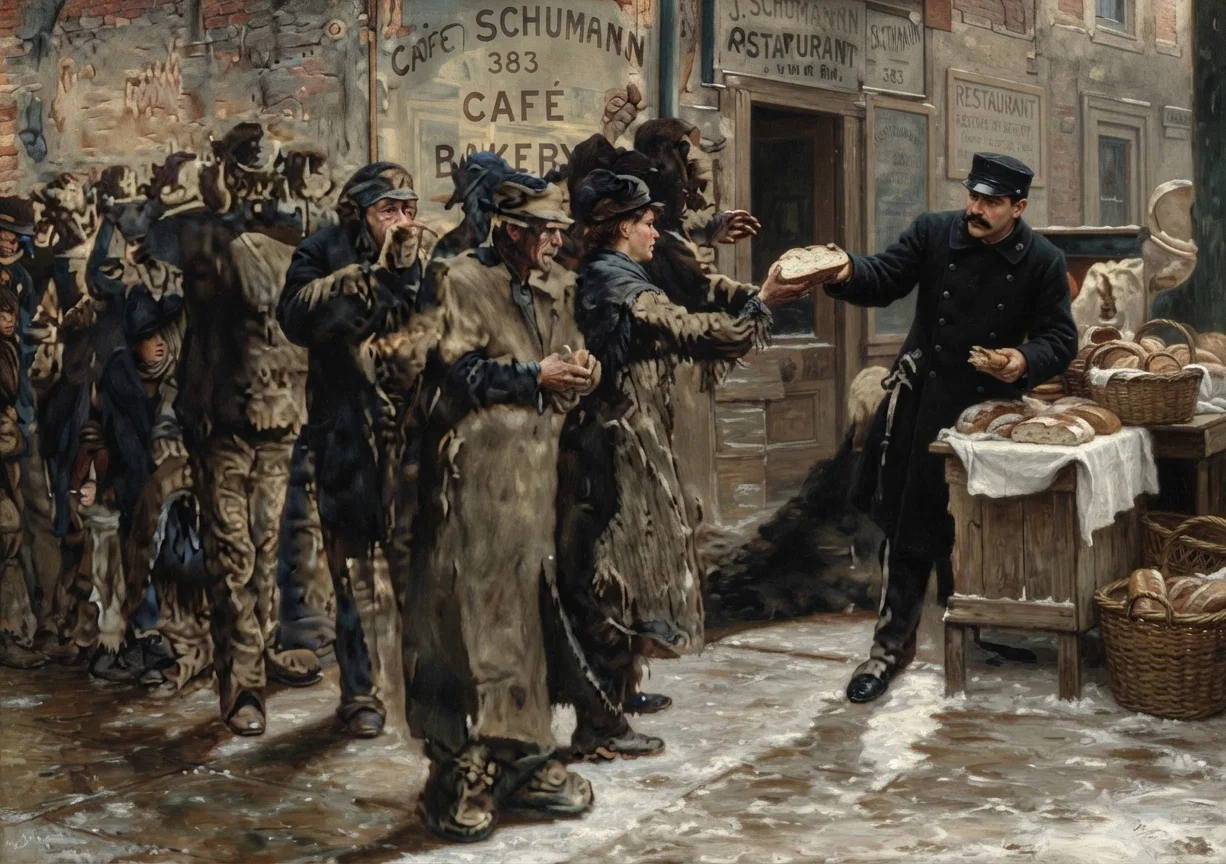
Outside the Schumann Cafe Handing Out Bread to the Hungry.
THE INFLAMMABLE MATERIAL IN FRANCE.
By T.
A FEW days since France's president died and the work of electing a new one was entered upon, but it was not without considerable disorder and some revolutionary demonstrations. And this is only a part of the evidence that is before the world all the time showing the turbulent condition of that country.
In all this there is a great lesson for America in particular, and the rest of the world in general. The question is, Will it be heeded? Toward the close of the last century the seeds of revolution sprung up into a most terrible harvest in France. And poor France is not through with the reaping even till now.
That revolution had its underlying cause. In the first place, France was filled with infidelity. And her infidelity was not confined to the non-professor. Some of her worst infidels were in the professed church itself. For when any one departs from the living Word of God, ceasing to study it closely, and no longer allowing his life to be guided by it, he may still make his pretensions, but he is, nevertheless, the worst kind of an infidel.
France, a hundred years ago, had her church and church-men, and her imposing display of what passed for divine service. She had bishops and priests who belonged to the "nobility" and who sat not only in the councils of the church but in the high councils of State as well. But, regardless of all this, France was infidel to the core. None of her outward service was a manifestation of the inner work of grace upon the heart. There were individual exceptions, of course, but they were an unnoticed minority.
Under this condition of things,—the infidelity concealed beneath the hypocrisy in the church, and the avowed and open unbelief,—the selfish greed of men gathered the wealth of the country into the hands of a few lords of Church and State, who spent their time in the revels of luxury. The people groaned under the burden for a long time, but finally the revolution came as a sure result of the seed sown. And it is a melancholy truth that France has not, after a whole century of turmoil, recovered from the evil.
The conditions of France before the beginning of her revolution were strikingly identical with the conditions in this country to-day. There is no lack of churches and oratorical lectures from the pulpit, and grand musical programs and church societies and special organizations. Rich men build magnificent structures and decorate them with all the art and skill that money can buy. They dedicate these edifices to the worship of God with a great show of outward display, but all the while the poor are crying in our back lanes and alleys for bread, and protection from the cold.
Where is the Christianity in all this?—It is not to be found. The pretension is a hollow sham. And the day of reckoning can not be long delayed. Why will not men listen to the voice of history even if they will not hear the Word of God? T.
EUROPE.
By W. T. Bartlett
From a religious standpoint, Europe falls into three great divisions, Protestant, Roman Catholic, and Greek.
The Protestants, who number some eighty-eight millions, are found principally in Germany, Scandinavia, Switzerland, and the United Kingdom. It must not be assumed, however, that the religious standard in these countries is a very high one. In Germany, with a total population of fifty-three millions, there are nearly eighteen million Roman Catholics, and a careful computation shows that of the Protestant portion at least ten millions must be without even a portion of the Scriptures. The Lutheran pastors in many instances discourage the reading of the Bible among their flocks, and socialism, almost invariably associated with avowed infidelity, makes rapid growth in numbers and influence.
The principal Roman Catholic countries are Austria, Belgium, France, Italy, Spain, and Portugal. The Church of Rome has in Europe 170,000,000 adherents, but, notwithstanding ecclesiastical tyranny, always ready to display itself in medieval methods, and the poverty of the people, who are largely dependent upon charities administered by the priests, there is, in more than one country, an evident breaking away from Rome. While this too often develops into a violent hatred for all religion, the faithful and persistent effort to circulate the Scriptures is, in many places, beginning to bear fruit. In Italy Rome is rapidly regaining her old influence over the populace. Yet priests and monks are leaving her ranks and preaching the Gospel to large audiences. The
same is here in France, where a number of the guests, desiring the purification of their church, have formed an Evangelical Reform Association, which publishes a paper of its own. In France, as in other countries, the Secularist hatred for all forms of religion grows more and more bitter. One missionary says that nine-tenths of the so-called Liberals would cast out any member of their family who should dare to read the Bible. At present Protestantism shares with the Jews the rancor which has been stirred up over the Dreyfus agitation. There are 700 Protestant pastors in France, as against 43,000 Roman Catholic officials. Nearly eight millions of the population refuse to make any declaration of religious belief.
The ice-covered Fuerst Bismarck coming up the Lower Bay. See the article, "The Earth Waxed Old," on preceding page. LANDING OF STEERAGE PASSENGERS.
Yet the Gospel finds a footing. The McAll Mission, now in its twenty-sixth year, has established eighty-two stations where the Word is preached. It also sends a floating mission hall, Le Bon Messager, which will seat 160 persons, up and down the rivers and canals of France. The population of Belgium is professedly Roman Catholic, but here also an increasing proportion are Free-thinkers. In priest-ridden Spain, various societies distribute 100,000 copies of the Bible annually, and fruit occasionally appears. In Austria, as in every other Catholic country, bitter political strife bars the way to the reception of the Gospel, but among the common people some hear it gladly. The principal work done is by colporters, a very necessary feature of evangelistic enterprise in countries like Austria, where, with a population of forty millions, there are only six cities with more than 100,000 inhabitants.
The Greek Church comprises the Slavonic races in Russia, Greece, and the Balkan Peninsula, and has a following of eighty-eight millions. Altho it shows little mercy to deserters, the Greek Church, unlike the Roman, encourages the circulation of the Scriptures, and the Russian Government offers many facilities to the societies engaged in this work, such as free passes over the railways for books and colporters. In view of this friendly attitude towards the Bible, it is easy to see how the Lord can turn to good account the rapid expansion of the Russian Empire over Northern Asia.
In Turkey there are, besides Greeks, about six million Mohammedans. These are mostly in deep poverty and a continual state of revolution. If any among them receive the Gospel they are subjected to considerable persecution, but the seed is being sown. There are also about seven million Jews scattered throughout Europe, for whose conversion to Christianity a number of societies are laboring, with very small success.
Europe is abundantly supplied with ecclesiastical organizations, but, considered as a missionary field, its need is not less than that of any other dark continent.
W. T. BARTLETT.
THE LAST CALL.
By Hattie C. Kelley
COME ye to the marriage supper;
Come, O come; the feast is spread!
Come ye to the living Water;
Come, and taste the living Bread.
Haste, put on the wedding garment;
'Tis the marriage of the Lamb;
And the feast is spread and waiting
'Neath His royal oriflam.
But those bidden to the supper
One and all made quick excuse;
Houses, lands, and lowing cattle
Seem to them of greater use.
Then the Master, filled with anguish,
Lest the feast untasted go,
Quickly through the lanes and byways
Sent His servants to and fro,
Searching out the poor and needy,
Faint and weary, lone and lost,
Bidding to His waiting supper,
Without money, without cost.
"Come; for all things now are ready;"
Come, partake of milk and wine,
Heav'nly manna, fruit abundant
From the True, the Living Vine.
But the guests around that table
Are the meek and poor of earth,
Humble children, pilgrim strangers,
Who have prized that home of worth.
Over there the Master's waiting—
Waiting to receive His own;
Waiting till His guests are seated
Round His Father's great white throne.
HATTIE C. KELLEY.
Crystal Valley, Mich.
MODERN MISSIONS IN MEXICO.
By J. J. Gilchrist
A Wonderful Work Accomplished by One Converted Man.
NEVER since the days of Esther, the Hebrew captive, have there been more marked proofs than those of to-day that God uses the humble and unprepossessing as His instruments in bringing the world to Christ. Surely in the mission fields of to-day we find glorious fulfilment of the "greater things" promised to be revealed in the kingdom of Christ in this world. I recall nothing that surpasses the story I now tell as to bristling facts to incite intelligent Christians to active service in order to win some persons for the Master.
Less than six years ago a slender Mexican of seventeen years of age, ignorant, and never of very strong mind, came into Southern Arizona to work in the mines; he knew nothing of Protestantism and Scripture truth. Only a little time passed until, owing to the explosion of a blasting charge, which had "hung fire," the poor Mexican lad was carried to the hospital so fearfully mutilated that when he came to know his condition Alejandro pleaded with the doctor for veneno (poison) to finish what little the giant powder had left of life and body. But the Lord had something more for the boy to do on earth, and caused health to come back slowly; but there was little left—mind shattered; ears dulled of hearing; one eye gone and the other dimmed; one arm crippled; one side partly paralyzed—surely even the Lord would expect little service from such a mortal.
A Presbyterian minister took pity on the little Mexican, gave him a Testament, taught him a little English, then aided him to enter our mission school at Las Vegas. Bible truth drew the tender-hearted boy, who soon confessed his faith, then began to tell to others "what Christ has done for my heart." This was the theme, while the desire burned more and more "to go and tell my people in Mexico what Christ has done for my heart." I have met many Protestant Mexicans, but never have I known one who had such a personal experience in spiritual life.10Less than two years passed till Alejandro came before the Presbytery and was received as a candidate for the ministry. We questioned other candidates as to their experience and reasons for entering the ministry, but we had few questions to put to Alejandro Villa, as he told in simplest language and with burning earnestness his desire to tell his people of what he had experienced in his soul. During two weeks before he started to Del Norte College, he visited eighty-five Romanist families, and talked only of "what Christ has done for my heart." In the special theological course for training some of our young Mexicans so as to prepare them for local evangelists, the young man did fairly well in study, but seemed inclined to spend too much time talking to those who were not Bible Christians, even becoming rather a chum with the Jesuit priests, but none ever suspicioned aught against Alejandro, as his conversation was always about experimental religion.
With the first vacation, the young man undertook active preaching work. He visited everybody, talked religion to the most fanatical Romanists, and was well received, for very few can resist the winning voice and ways of young Villa. You have heard of the Penitentes, the Mexican order of Flagellantes, composed of the most ignorant and fanatical; a body of people interested to save their souls or they would not whip, bruise, and bleed themselves seeking pardon for sin. Some of these heard our boy preacher, invited him to preach at one of their funerals, then asked him to visit their moradas (chapter houses) in order to tell them why he was not a Penitente after their sort. He accepted the invitation, gave them his reasons for not being a Penitente, and later preached to them as to why they should depend upon the Saviour only for redemption. Large audiences were present in the moradas. Apparently Villa has no sense of fear when speaking about the Saviour, and the Lord protects while His "child" leads the people. Nearly three years were spent in Del Norte, but never for a moment did Alejandro forget his gente; he was writing constantly to father, mother, and relatives in the Sonoran home; he sent them some four thousand tracts and papers, with a few Bibles. Just a year ago his father (aided by the minister patron of the boy) sent money for the long trip to Sonora, and urged him to come home for a visit. He had left home an ignorant Catholic, his people Catholics; what joy that day as the youth returned home!
There was greater gladness because parents and friends who embraced him were fellow-believers, walking in the light of the Sun of Righteousness. There were some twelve avowed believers, three or four of whom had lived in San Francisco, and there united with a Protestant church, but were now silent through fear of priest and people. Our boy roused them, saying, "Brethren, if you do not tell what Jesus has done for you, the Lord will make these rocks to speak."
The priest came to bid him welcome home, but learning that Alejandro was a Protestant, he ran from the house, and has since avoided the boy as he would a wild beast. Not so the people. The first Sabbath Alejandro preached to a large congregation; the priest said mass with only a few present. Surely a spiritual baptism as of fire fell upon that people; the interest spread; congregations gathered; three hundred, five hundred, once one thousand were reported present.
The work began in March, 1897; in August the Rev. J. G. Pritchard, of Bisbee, Arizona, visited his ward, Alejandro, and organized a church of ninety-six adults and baptized eighty-four children; one hundred and eighty souls were thus in one day brought into organic relation with our Presbyterian Church. As Mr. Pritchard was in his buggy to return home, thirty-five persons came to be received into the church. The work still grows; the interest does not lessen; the little church and its preacher have been tried as by fire. The preacher is more zealous; the believers, firmer than ever by reason of the trial.
It was after this fashion: That day of organization a woman of bad reputation wanted to unite with the rest, but was refused till such time as she should prove by life and conversation to be Christian in life and desires. Angered by the refusal, she plotted with the priest, got rumors started against Alejandro as a traitor, plotting sedition. In February, he was apprehended, like the Saviour in Gethsemane, by officers with a great mob, and hurried off in the night to prison. Like Paul and Silas, this little apostle to the Mexicans sang songs of deliverance, preached to guards and prisoners, talked about religion with them, was visited by his own people, scattered tracts and papers, in fact, his prison was only a new base for work. After suffering there some weeks, he was let out on bail. He writes me of the love, zeal, and fidelity of the brethren in the hour of trial; that the persons who instigated the persecution came and confessed their fault and sorrow; that they had tried to stop the movement initiated, but it had passed beyond their power.
The work grows, and the preacher is not puffed up. He begs that a minister be sent to Montezuma, so that he may go about his work of opening up new fields. He counts more than two hundred souls, altho there has been no minister there for months to receive and baptize those who cleave to the church—a church of more than two hundred adults, that has only once heard the voice of an ordained minister. See what God hath wrought by the hand of Alejandro Villa. What might He not accomplish through you, Christian reader, if you would tell your people "what Christ hath done for my heart"?—J. J. Gilchrist, in N. Y. Observer.
OUR WORK AND WORKERS.
By William Nelson Glenn
THE brethren at Cliff Island, Cumberland County, Me., are erecting a house of worship.
A CHURCH of eleven members has been organized at Bagwell, Texas, under the labors of Brother H. Woodruff.
A REPORT in the California Missionary from Brother A. J. Osborne notes the addition of six persons to the church at Con Cow.
THE following hint in the Worker's Bulletin is good for other conferences as well as Iowa: "Have all the people in your community had the opportunity of reading the Quarter-Centennial number of the SIGNS? If not, has not some one a duty yet to perform? If all your home territory has been canvassed, can you not enter new territory farther away from home? The matter in this paper is just as interesting to new readers as when first issued."
THE Lawler, Iowa, Despatch says: "We are in receipt of a copy of the Quarter-Centennial number of the SIGNS OF THE TIMES, published by the Pacific Press Publishing Company, of Oakland, Cal. The twenty-fifth milestone in the life of this excellent publication is celebrated by the management by the issue of a thirty-two-page edition, in an illuminated cover, and printed on book paper. As a family paper the SIGNS OF THE TIMES stands second to none."
A GOOD idea of our work was given in a Bible study conducted by Brother E. J. Waggoner, early in the present session of the General Conference at South Lancaster, Mass. It was that our work is but a continuation of the work of John the Baptist, preparing the way of the Lord. To prepare the way of the Lord is to prepare a people for the coming of the Lord. "The way of the Lord is prepared when His way is seen in His people; then the glory of the Lord is revealed."
OF the church work in San Francisco, Brother E. E. Andross says: "Since the organization of the second church on Valencia Street, which now numbers thirty members, the Lord's blessing has been with the Laguna Street church in an especial way. For a time the church felt very reluctant to having its membership divided, but finally they consented, and tho more than twenty withdrew to form the other church, and many of these among the most active workers of the body, yet their places have been taken by others, till our first church is fuller than ever before on the Sabbath, and the tithes and offerings are as large as before; besides, the tract society has done much more business the last quarter than any quarter previous."
OUR own Helping Hand Mission in San Francisco is prospering in a remarkable degree. The attendance and attention are very encouraging, but the labor of those who conduct the establishment is very taxing. The writer went over on a recent evening after the Sabbath to assist Brother Richards in the services. Nearly half an hour before the time for beginning the service the chapel was about full. And, altho the varied services last an hour and three-quarters, the closest attention was given by the motley audience. Even an alarm of fire called out but a few. Many stirring testimonies were given, several telling how they once had started to serve the Lord but had backslidden. In about every instance, strong drink had been the cause. A number asked for prayers, and five went forward and resolved to take a new start. The mission seems to be appreciated by the fallen habitues of the dens of vice in the midst of which it is located, and many drop in for a brief rest from their routine of wicked life, and are refreshed by memories of better days. But, best of all, a number find rest for their souls in conversion to God. W. N. G.
7 "THERE cometh a woman of Samaria to draw water; Jesus 8 saith unto her, Give Me to drink. For His disciples were 9 gone away into the city to buy food. The Samaritan woman therefore saith unto Him, How is it that Thou, being a Jew, askest drink of me, which am a Samaritan woman? (For Jews 10 have no dealings with Samaritans.) Jesus answered and said unto her, If thou knewest the gift of God, and who it is that saith to thee, Give Me to drink; thou wouldest have asked of 11 Him, and He would have given thee living water. The woman saith unto Him, Sir, Thou hast nothing to draw with, and the well is deep; from whence then hast Thou that living water? 12 Art Thou greater than our father Jacob, which gave us the well, and drank thereof himself, and his sons, and his cattle? 13 Jesus answered and said unto her, Every one that drinketh of 14 this water shall thirst again; but whosoever drinketh of the water that I shall give him shall never thirst; but the water that I shall give him shall become in him a well of water 15 springing up unto eternal life. The woman saith unto Him, Sir, give me this water, that I thirst not, neither come all the 16 way hither to draw. Jesus saith unto her, Go, call thy husband, 17 and come hither. The woman answered and said unto Him, I have no husband. Jesus saith unto her, Thou saidest well, 18 I have no husband; for thou hast had five husbands; and he whom thou now hast is not thy husband; this hast thou said 19 truly. The woman saith unto Him, Sir, I perceive that 20 Thou art a prophet. Our fathers worshiped in this mountain; and ye say, that in Jerusalem is the place where men ought 21 to worship. Jesus saith unto her, Woman, believe Me, the hour cometh, when neither in this mountain, nor in Jerusalem, shall 22 ye worship the Father. Ye worship that which ye know not; we worship that which we know; for salvation is from the 23 Jews. But the hour cometh, and now is, when the true11worshipers shall worship the Father in spirit and truth: for 24 such doth the Father seek to be His worshipers. God is a 25 Spirit; and they that worship Him must worship in spirit and truth. The woman saith unto Him, I know that Messiah 26 cometh (which is called Christ); when He is come, He will declare unto us all things. Jesus saith unto her, I that speak unto thee am He.
27 "And upon this came His disciples; and they marveled that 28 He was speaking with a woman; yet no man said, What seekest Thou? or, Why speakest Thou with her? So the woman 29 left her water-pot, and went away into the city, and saith to the 30 men, Come, see a man, which told me all things that ever I 31 did; can this be the Christ? They went out of the city, and 32 were coming to Him. In the meanwhile the disciples prayed 33 Him, saying, Rabbi, eat. But He said unto them, I have meat 34 to eat that ye know not. The disciples therefore said one to 35 another, Hath any man brought Him aught to eat? Jesus saith unto them, My meat is to do the will of Him that sent 36 Me, and to accomplish His work. Say not ye, There are yet four months, and then cometh the harvest? behold, I say unto 37 you, Lift up your eyes, and look on the fields, that they are 38 white already unto harvest. He that reapeth receiveth wages, and gathereth fruit unto life eternal; that he that soweth and 39 he that reapeth may rejoice together. For herein is the saying 40 true, One soweth, and another reapeth. I sent you to reap 41 that whereon ye have not labored; others have labored, and 42 ye are entered into their labor.
"And from that city many of the Samaritans believed on Him because of the word of the woman, who testified, He told me all things that ever I did. So when the Samaritans came unto Him, they besought Him to abide with them; and He abode there two days. And many more believed because of His word; and they said to the woman, Now we believe, not because of thy speaking; for we have heard for ourselves, and know that this is indeed the Saviour of the world."
NOTE.—The texts inclosed in marks of parentheses, while not essential to the lesson study, will be found to throw much light upon the lesson, and are suggested for those who wish to study further.
SUGGESTIVE QUESTIONS.
What favor did the Saviour ask of the woman of Samaria, at Sychar's well? John 4:7.
With what words did the woman apparently resent Jesus' request? Verse 9. Note 1. (Acts 10:28; Gal. 2:12.)
Not knowing the gift of God, how did the woman reply? Verses 11, 12. (Jer. 2:13; 17:13.)
How did the Saviour meet this objection? Verses 13, 14. (John 6:35.)
Did the woman comprehend Christ's meaning in the use of this similitude? Verse 15.
Without condemning the woman for her loose life, but rather desiring to lead her to make voluntary confession, what did Jesus ask her to do? Verse 16.
What did she say to this request? Verse 17.
How did the Saviour then begin to reveal Himself to her? Verses 17, 18.
By these words what did the woman dimly see in Christ? and what question did she ask Him in consequence? Verses 19, 20. (Deut. 12:5, 11.)
How did the Lord then reveal to her the result of His coming to earth? Verses 21-24. Note 2.
Hearing this, what did the woman tell about what she knew of the anticipated Messiah? Verse 25.
What plain words did the Lord then speak to her? V. 26.
When the disciples returned from the city with food, how were they affected at finding Jesus talking with the woman? Verse 27. Note 3. (John 10:16; Gal. 3:28.)
What did the woman then do and say? and with what result? Verses 28-30.
While she was gone, what did the disciples desire Jesus to do? Verse 31.
What was His answer? Verse 32.
In reply to their private questioning regarding the situation, what did He say to them? Verses 34-38.
What effect did the woman's words have on the Samaritans? Verses 39, 40.
To what happy conclusion did many of those come who went out to hear Christ? Verses 41, 42.
Give the principal circumstances connected with the birth of Christ.
State what you have learned of His childhood.
Tell briefly the story of His baptism and temptation in the wilderness.
Recite the leading events in His ministry as far as studied.
Side Lights.—"Desire of Ages," pp. 183-195; "Spirit of Prophecy," vol. 2, pp. 140-151.
NOTES.
1. How is it that Thou, etc.?—The hot climate of that country made a drink of water of so much value that under ordinary circumstances no one would think of refusing it. But continued strife for centuries between the Jews and Samaritans had created a most bitter and permanent hatred between the two sections. In the first place, the Samaritans were made up of people from Babylon, Cuthah, Ava, Hamath, and Sepharvaim, taken there by the king of Assyria when he carried the ten tribes of Israel into captivity. A few stragglers, also, from the ten tribes found their way back again to their native land. For certain reasons, the king of Assyria returned one of the exiled priests to that land, who taught the people the worship of Jehovah, which they added to their own worship of idols. 2 Kings 17:24-33. When the tribe of Judah returned from its captivity, these people desired to join with them in building the temple at Jerusalem, which was refused. The Samaritans in consequence built a rival temple at Mount Gerizim. Eternal enmity sprang up; greater holiness was claimed for Mount Gerizim than for Jerusalem; the Samaritans accused the Jews of corrupting God's Word. On the other hand, the Jews called the Samaritans Cuthites, and forbade all intercourse with them; to receive one into the house was to bring down the curse of God.
2. Woman, believe Me.—Note how carefully the Saviour led the mind of the woman, not only to voluntarily confess her sinfulness, but to ask questions for the enlightenment of her darkened mind. He precipitated nothing, but let her open the way for the line of truth she sought to receive. A worthy lesson for many now who would make assertions people are not prepared to receive.
3. They marveled that He was speaking with a woman.—The relations of the sexes in that day, even in common life, were very narrow and suspicious among the Jews. An unvailed woman in public was counted immodest. For a rabbi to speak to a woman publicly was highly indecent. The Talmud forbade it, even tho the woman was the rabbi's own wife. He could not even treat her courteously. The disciples, however, dared not question the act of their Master, even tho the woman with whom He talked was a hated Samaritan sinner. He went so far over the bounds of prescribed custom as to conclusively show that true religion recognized no social difference between the sexes. In Christ all are one.