A CONTINUED supply of our periodicals for ship missionary work at Tacoma, Wash. Address, post-paid, Arthur Lister, 614 Steele Street.
SIGNS, Review, and Sentinel for missionary work in Reading, Pa. Address, post-paid, C. V. Achenbach, corner Winsor and Hampden Streets.
CLEAN back numbers of the Review, Instructor, and Our Little Friend. Please send, post-paid, to L. Drawbridge, 1513 Burt Street, Omaha, Neb.
Unawares
"YE DID IT UNTO ME."
"And He said, 'The sin is pardoned,
But the blessing is lost to thee,
For, failing to comfort the least of Mine,
You have failed to comfort Me.'"
Such is the closing verse of one of the two poems found in No. 54 of the Apples of Gold Library under the above title. They are very touching and very good. Price, 50c per 100.
PACIFIC PRESS PUBLISHING CO.
New York City. Oakland, Cal. Kansas City, Mo.
REVIEW OF THE QUARTER'S LESSONS.
Golden Text: "My sheep hear My voice, and I know them, and they follow Me."
LESSON I.—Christ the True Light. John 1:1-14. Jesus Christ is the Word of God. By Him were all things made. "By the Word of the Lord were the heavens made; and all the host of them by the breath of His mouth." Ps. 33:6. Being the Word of God, He is consequently the Light of the world; for, as the psalmist says again, "Thy Word is a lamp unto my feet, and a light unto my path." Ps. 119:105. The Man Jesus was the Word made flesh, "full of grace and truth." He was "the true Light, which lighteth every man that cometh into the world." John 1:9. "And this is the condemnation, that light is come into the world, and men loved darkness rather than light." Chap. 3:19.
LESSON II.—Christ's First Disciples. John 1:35-46. After His forty days' fast in the wilderness, His temptation and signal victory over Satan's wiles, Jesus returned to Bethabara, where John was baptizing. John recognized Him as the One whom he had baptized, and upon whom the Spirit had descended like a dove, and he pointed Him out to his disciples as the Messiah. It was but natural that the first disciples of Jesus would be from those who had been most closely connected with him whose mission it was to "prepare the way of the Lord." Having been taught by one who was filled with the Spirit, they would instinctively incline to Him whose Spirit it was.
LESSON III.—Christ's First Miracle. John 2:1-11. Not only as a man, but as a prophet and teacher, as the Son of God, Jesus honored the marriage relation, with the attendant social amenities of its celebration, by His presence. He also honored the occasion by a miracle of divine power. This beginning of His public ministry and manifestation of heavenly grace was a fitting symbol of the introduction of His saints to the heavenly kingdom by the marriage supper of the Lamb.
LESSON IV.—Christ and Nicodemus. John 3:1-16. Jesus shows why it is necessary to be born of the Spirit in order to become a subject of the kingdom of God. That is a spiritual kingdom which flesh and blood can not inherit. The spiritual life can not be produced by natural generation. "That which is born of the flesh is flesh," and can not by any fleshly power gain any other nature. A spiritual life can come only through a spiritual birth. "If any man be in Christ, he is a new creature." 2 Cor. 5:17.
LESSON V.—Christ at Jacob's Well. John 4:5-15. Jesus makes even His weariness a means of conveying the Gospel to thirsting sinners. There could be no circumstance under which He could not labor in the furtherance of His mission. He even placed Himself under apparent obligation to one who would naturally revolt from speaking to Him on account of His nationality. But human appearances all vanish before "a teacher sent from God."
LESSON VI.—The Nobleman's Son Healed. John 4:43-54. When the nobleman came from Capernaum to Cana to have Jesus "come down" and heal his son, it was because he had heard of the wonderful miracles He had performed. So Jesus said to him, "Except ye see signs and wonders, ye will not believe." This reading of the man's thoughts convinced him at once that Jesus was the Son of God; therefore he became the more urgent, and was ready to believe when Jesus said, "Go thy way; thy son liveth."
LESSON VII.—Christ's Divine Authority. John 5:17-27. During one of the feasts at Jerusalem, as Jesus was walking about on the Sabbath-day, He came to the pool of Bethesda, where were many sick folks. As He was always seeking to do good, the Spirit with which He was filled always led Him to the opportune occasion. He found the one who most needed help, and healed him. Thus He fell under the false charge of Sabbath-breaking, and delivered the instruction given in the lesson scripture.
LESSON VIII.—Christ Feeding the Five Thousand. John 6:1-14. Jesus and His disciples went from Capernaum across to the northwest shore of the sea for a much-needed "rest." Mark 6:31. But the multitude followed them. When He saw their eagerness and their need, He "was moved with compassion toward them." Verse 34. As usual all consideration of self was laid aside. He fed them with the "bread of life" until evening, and then performed a notable miracle in order to relieve their physical necessities. Jesus is a whole Saviour, caring for our every need.
LESSON IX.—Christ at the Feast. John 7:14, 28-37. At the feast of tabernacles the rulers of the Jews sought to take Jesus because He told the people that He was sent from God. But many believed on Him because of the miracles which He did. They said, "When Christ comes, will He do more miracles than these which this Man hath done?" He told them of His approaching departure from among them, but they could not understand Him. Their traditional ideas of the Messiah, that He would be a permanent king of the literal Israel, was a continual barrier to their understanding of the mission of Christ.
LESSON X.—Christ Freeing from Sin. John 8:12, 31-36. "God is light, and in Him is no darkness at all" (1 John 1:5); therefore Jesus, being the Son of God and the "manifestation of God in the flesh," is the Light of the world. Logically, any one following Him, who is "the way, the truth, and the life" (John 14:6), would be led out of darkness, and consequently out of sin, which is the cause of darkness. "Whosoever committeth sin is the servant of sin," and only the Son of God can make him free.
LESSON XI.—Christ Healing the Blind Man. John 9:1-11. Here was manifested the real object of the poor man's lifelong afflictions—"that the works of God should be made manifest in Him." There is a purpose in all affliction, which will always be revealed when the sufferer comes to realize that "all things work together for good to them that love God." Rom. 8:28. Altho all suffering is the result of sin in a general way, it can not in any sense atone for sin. Yet it may be a means of bringing the sufferer to Him who can heal both body and soul.
LESSON XII.—Christ the Good Shepherd. John 10:1-16. The "sheepfold" represents the kingdom of God, both in its spiritual jurisdiction in this world and in its glorious fulfilment in the new earth. The "door" represents Christ, by whom all must enter. The "porter" is the Holy Spirit, who opens the "door" to the kingdom. This He does by guiding the "sheep" "into all truth," which is the Word of God. Chapter 16:13; 17:17; Ps. 119:142. All who faithfully follow the voice of the good Shepherd will be kept from every evil way, and led in "green pastures" and by "the still waters."
How to Live a Century
By B. F. Richards
HOW TO LIVE A CENTURY. No. 6.
MAN is an animal, and is constituted with the same physiological powers, and upon the same great physiological principles, as the ox or horse and other animals; take from the ox the plain and simple food, and feed him on substances that are not natural to him, then mark the rapid deterioration that takes place in his constitution and nature; man is affected and changed in the same way. The plainer, and simpler, and more natural the food is, the more perfectly will the laws relating to the body be fulfilled and the more vigorous, healthy, and long-lived will the man be.
Every part of this wonderful living machinery should be carefully studied and understood. It is the duty of every person to study the laws that govern the house in which he lives, and then comply with them; for he who violates one of them, tho it be through ignorance, must pay the penalty.
Among the fruits, grains, nuts, and vegetables, man finds a perfect food which is especially adapted to him, and the more entirely he subsists on them, the more perfectly he fulfils the laws of his nature, and the greater will be his reward.
Fifty years ago Dr. Sylvester Graham said: "After having carefully and minutely examined all the anatomical and all the physiological evidences in relation to the natural dietetic character of man, we perceive that there is not the slightest reason for considering man an omnivorous animal, but that every jot and tittle both of anatomical and physiological, and I may add of psychological evidence relevant to the question, go to prove most clearly and conclusively that man is naturally a frugivorous and granivorous, or a fruit and vegetable-eating animal."
It must be admitted by every lover of flesh food that the taking of the lives of the lower animals to satisfy hunger in man, is akin to cannibalism, and is directly opposed to humanity and the feelings of a refined nature.
Those who live on grains, fruits, nuts, and vegetables, live long, have power of endurance, and will not die with disease contracted by eating the flesh of dead animals.
"Live and let live" is a good motto to follow; let the poor animal live, for he is full of disease, and his flesh, that is so freely eaten, is slaughtering the members of the human family, annually, by the thousands. So if you would live a century, let him live, and in return he will grant you the same privilege. Goldsmith says:—
"No flocks that roam the valley free,
To slaughter I condemn;
Taught by the power that pities me,
I learn to pity them."
Why should we seek happiness and pleasure through the pain and death of another? "They shall not HURT nor DESTROY in all My holy mountain" (Isa. 11:9), are the words of the Creator, who made the animal—man, and his fellow, the beast.
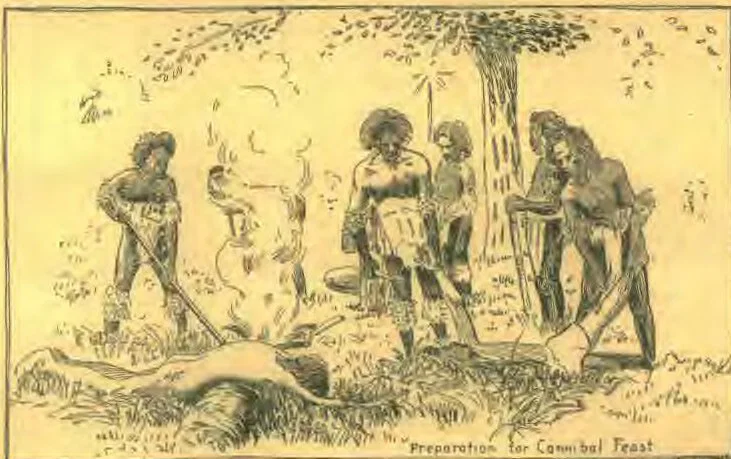
Preparation for Cannibal Feast
The vegetable world is the great storehouse of nature, from which animal, man, and beast receive energy and nutritive power. The thought that we can not have the ruddy glow to our cheeks, or be able to produce gems of thought from the brain, without first taking the life of some poor, innocent animal, and devouring his carcass, is a belief resting on ignorance.
The dumb animal goes to the vegetable storehouse for his energy; we can do the same. Vegetable fibrin and animal fibrin are identical, vegetable albumen is identical with animal albumen. There are grains, fruits, and nuts that far exceed roasts, steaks, and chops in albuminoids. Nuts furnish from 8 to 25 per cent. albumen, besides 50 per cent. of fat; grains, 7 to 15 per cent.; beans, 22 to 35 per cent.; peas, 22 per cent.; lentils, 25 per cent.; while pork contains on an average of 16 per cent.; fish, 13 per cent.; beef, 17½ per cent.
It has been demonstrated over and again that persons who live on fruits, grains, and nuts have more strength and power of endurance than those living on flesh diet. How could it be otherwise? The animal took the best, or "the cream," from the vegetable or grain when he ate and digested it, in order that his life might be sustained. And if we insist on eating the animal, we use the grain and vegetable in a second-hand manner; the first and best wear has been taken from them when they were first eaten by the other fellow; first, wear gives the best satisfaction.
Proteids, fats, carbohydrates, and minerals are the elements required for the perfect nutrition of the body. Proteids are found in abundance in beans, peas, and lentils, and are represented by gluten, albumen, fibrin, casein found in the wheat, milk, and eggs; nuts contain fully fifty per cent. of their weight in fats, also a large amount of proteids or albumen. Fats are also found in limited quantities in grains. Starch and sugar in various forms are carbohydrates. Rice and potatoes consist chiefly of starch; the heat and energy of the body are maintained by fats and carbohydrates, and as there is perhaps not a single article of food containing all of the elements necessary to keep the body in a perfectly healthy condition, it is highly important that a careful selection of food be made in order to combine one food that is deficient in suitable elements with others that have a surplus.
Dr. De Neville says: "Four classes of substances are necessary for the maintenance of life,—the albuminoids, the carbohydrates, the fats, and the minerals. Now meat contains but three of these, while the vegetables contain all four. Vegetable food is also necessary for our intellectual life; the phosphorus contained in vegetable food is almost double the amount contained in animal food. . . . Those who believe that meat gives the rose color to the cheeks and lips are in error. As Professor Musso has shown, the amount of iron oxide contained in vegetable food is much greater than that found in meat."
Dr. Lamb says: "The use of animal food hurries on life with an unnatural and unhealthy rapidity. We arrive at puberty too soon; the passions are developed too early, in the male acquire an impetuosity approaching to madness; females become mothers too early and too frequently; and, finally, the system becomes prematurely exhausted and destroyed, and we become diseased and old, when we ought to be in middle life."
In the words of another we say:—
"Murdering is the business of the people;
Beasts, birds, fish, all are murdered.
The pelted ox is in the car; he is crazy at the rush.
How wild and big his eyes!
He snuffs murder ahead.
A man knocks him down and stabs him.
Dead so quick?
His carcass is 'decently' cut in slices,
And eaten by civilized cannibals.
"Is there no other way to live?
Angels, are there any slaughter-houses in your country?
O chemists, phycologists, ethnologists,
Try your skill at extracting pabulum from all things.
With the destruction of life!
Save us the universal crime of murdering
And devouring the innocent."
B. F. RICHARDS.
GOD KNOWS BEST.
By Mrs. Hattie King
STRANGE is my path, my future all unknown;
Yet I am blest
If Jesus does but keep the key
I would not have Him trust to me.
His way is best.
I oft have dimness in my sight,
Yet I'm secure;
Tho groping in a narrow way,
I hold His hand, I hear Him say,
Thou shalt endure.
I can not trace His every plan,
And so I rest;
I know He smiles on my life's race,
And in my weakness gives His grace,
And so I'm blest.
Enough for Him to read my want,
For this I know,
What I can not He can foresee,
And in His hands I sure shall be
While here below.
Mrs. Hattie King.
Huntington, Ind.
WHICH? OR WHAT THE SUN SAW.
By Helen A. Steinhauer
SCENE I.
A BOY on a bicycle, riding down the street. Two old ladies standing talking to each other on an elevated plank walk at the corner. The younger of the two, standing at the edge of the walk, was not far from sixty years of age. The other must have been older still, as her hair was snowy white. She stood directly in front of the boy, who evidently had no idea of stopping, as he rang his bell and rode ahead, seeming to be quite unconcerned that she might neither see nor hear him. Her back was turned toward him, and she was quite hard of hearing.
Seeing this, the younger lady said pleasantly, "Jump off, my boy; don't make old ladies get out of your way."
At this the elder lady started, and, taking in the situation, stepped off the sidewalk into the street, while the boy rode on triumphantly, passing her without swerving an inch from his course.
Then a thing stranger still happened. The boy rounded the corner, and when in the middle of the crossing beyond, dismounted, turned, and, looking the old ladies full in the face, an ugly sneer disfiguring what might otherwise have been a comely countenance, exclaimed, with an offensive drawl: "Old ladies! I guess old ladies ain't as great as they think they are!" And, having thus freed his mind, deliberately mounted and rode off, leaving his aged hearers gazing at each other in mute astonishment, they having been taught to regard such conduct much as the prophet Elisha might have done. (See 2 Kings 2:23-25.)
SCENE II.
A bright morning in June. Two boys seated on the side stoop of their rented home, heads close together in boyish confab. Presently one of them, glancing up, saw an old lady of the neighborhood approaching, probably on her way to church, as she had her hymn-book in one hand, while the other held her silk sun umbrella.
A pleased look flitted across the face of the younger boy, who nudged his companion, and said, in what was meant to be an undertone, "Don't she look nice?" and then, as she came nearer, grabbed his worn cap from off his curly head, and sang out, boy fashion, and with a beaming smile, "How d'ye do?"
The old lady smiled back, as she returned a cheery, "Good-morning!"
His salutation made the pleasantness of the day just that much more enjoyable to her; for old people who keep their hearts young never lose their loving appreciation of friendliness from boys and girls.
Altho no Jew, this lad had unquestionably been reared in accordance with the spirit inculcated in Lev. 19:32 and Prov. 23:22.
Now, lads and lassies, I leave it to you which was the gentleman, the rider of the bicycle, or the boy who doffed his cap?
HELEN A. STEINHAUER.
COLD APPLICATIONS.
By John Harvey Kellogg
THE primary effect of a cold application is excitant.
The secondary effect is invigorating, restorative, and tonic.
The actual effect of an application of cold depends upon the method of making the application, the temperature, the susceptibility and condition of the patient, and many other factors; in general, it may be said that—
A short application of intense cold is excitant, and if repeated daily, tonic.
A more prolonged application of cold at a moderately low temperature is less exciting and less tonic.
A prolonged cold application is both excitant, or tonic, and sedative, the depressant effects resulting from the exhaustion of the nerve centers from prolonged excitation and the lowering of the temperature of the body.—J. H. Kellogg, M. D., in Good Health,
SIT UP.
If most of us could see ourselves as others see us when we sit—"down" or "up" and generally "down" hard upon our spinal columns—we should wish to join a school of health immediately to learn how to make ourselves more graceful objects. But, altho incorrect attitudes are bad enough from the standpoint of beauty, they are even worse from the standpoint of health.
The writer once saw a tall, thin woman sitting at a table eating her dinner, whose body was curved forward to such an extent that the food she swallowed must have been obliged to travel almost in a semicircle to reach her stomach. Nature does her best to accommodate herself to all kinds of deformities and unnatural positions, but it is not reasonable to suppose that she can do her work as well when the body is out of shape as when it conforms to her original plan.—Good Health.
Lessons by Mail on Medical Electricity or How to Use the Battery
By Prof. G. L. Abell
By Prof. G. L. Abell
Member of the Board of Directors of the Electro-Medical Society of San Francisco.
Learn how to use the battery and treat yourself. Many diseases are quickly cured by the proper application of electricity. The course embraces the treatment of every organ and part of the body. The lessons are written in plain language and are illustrated. Course, five dollars. Send for circular. Address,
PROF. G. L. ABELL, School of Chemistry and Electro-Therapeutics. 22½ Geary St., San Francisco, Cal.
Charles M. Sheldon's Books
OVER 440,000 SOLD
In His Steps—"What Would Jesus Do?"
The Crucifixion of Phillip StrongRobert Hardy's Seven DaysThe Twentieth DoorHis Brother's KeeperRichard Bruce
All bound in paper
at 25 Cents, and cloth
at 75 Cents each
Also uniform with the above
and selling at the same price
A Matter of Business
By Rev. W. C. Stiles
Other Books by C. M. Sheldon
Malcom Kirk, paper, 25 Cents; cloth, 50 Cents
Redemption of Freetown, cloth, 25 Cents
ANY FIVE of the 25 Cent Books $1.00
to one address for............
Any Five of above in Cloth
to one address for $3.00
IN HIS STEPS
Large type, gilt top, 12 full-page
illustrations, cloth, cover design
in blue, white and gold. In box,
$1.25.
ILLUSTRATED
Sent post-paid on receipt of price by
THE ADVANCE PUBLISHING CO.
215 Madison Street, Chicago
POLITICAL SPEECHES
By Editor
and DEBATES OF LINCOLN AND DOUGLAS......
A BOOK FOR THE TIMES. The following is one reason why this discussion by these two able lawyers and statesmen should find a large place amongst the people of this country to-day; Another attack is made upon the Declaration of Independence and the Constitution in an attempt once more "to turn a free people back into the hateful paths of despotism." Then, the attack was upon the clause which declares that "all men are created equal." Now, the attack is upon that clause which declares that governments derive their just powers from the consent of the governed. Then, there was rendered a decision of the Supreme Court of the United States which perverted the Constitution in the interests of that attack. Now, there is a decision of the Supreme Court of the United States which perverts the Constitution in the interests of this attack. The careful study of this history-making discussion and of the principles involved will prepare the people successfully, and in the right way, to meet all attacks upon the immortal Declaration, and to correct any and all perversions of the Constitution.
Buckram Cloth, 555 pages - - - - - - - - - $1.75
Sent post-paid with the SIGNS one year - - $1.75
Book sent Free for Three New Yearly Subscriptions and One Renewal at $1.00 each.
NUTS
Healthful Delicious Nut Foods
EASILY and cheaply made in any household by the use of our complete equipment for grinding and emulsifying nuts. The production of our mills is unsurpassed. Full directions and a booklet containing many valuable nut food recipes, free with each mill.
NUTS
Shelled and unshelled, of all kinds at reasonable prices
For further information, catalog, price-list, etc., write to
JOSEPH LAMBERT
Battle Creek Michigan
When you write, please mention the SIGNS OF THE TIMES.
HEART-LIFE CLASSICS
By Editor
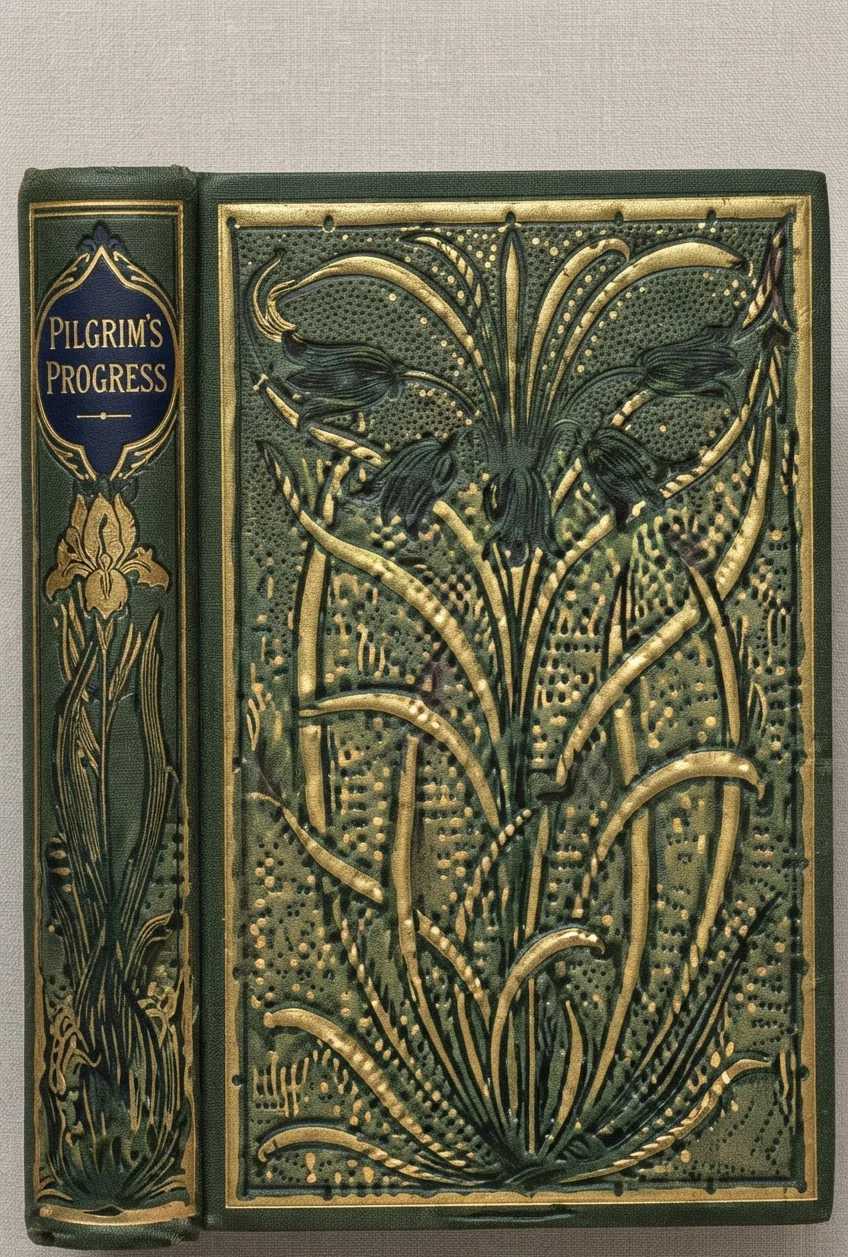
A choice line of devotional story books bound in cloth, size 6 1/2 x 4 1/2 inches. Excellent books for Sabbath-school libraries. Will be read with much interest and profit by both old and young.
Pilgrim's Progress, Jessica's Prayer and Jessica's Mother, Nobody Loves Me, Olive's Story, Helps over Hard Places—for Girls, Helps over Hard Places—for Boys, Line upon Line, Heart-Life, A Bag of Stories, Shepherd Psalm. Each price 40 cts.
One copy, post-paid with SIGNS one year . . . $1.20
Any single book sent Free for One New Subscriber and One Renewal at $1.00 each.
If you desire the whole set of ten volumes mentioned above, we will send them post-paid FREE for Eight New Yearly Subscriptions at $1.00 each ($8.00).
ADDRESS
SIGNS OF THE TIMES, OAKLAND, CAL.
DICTIONARY OF THE BIBLE.
By Editor
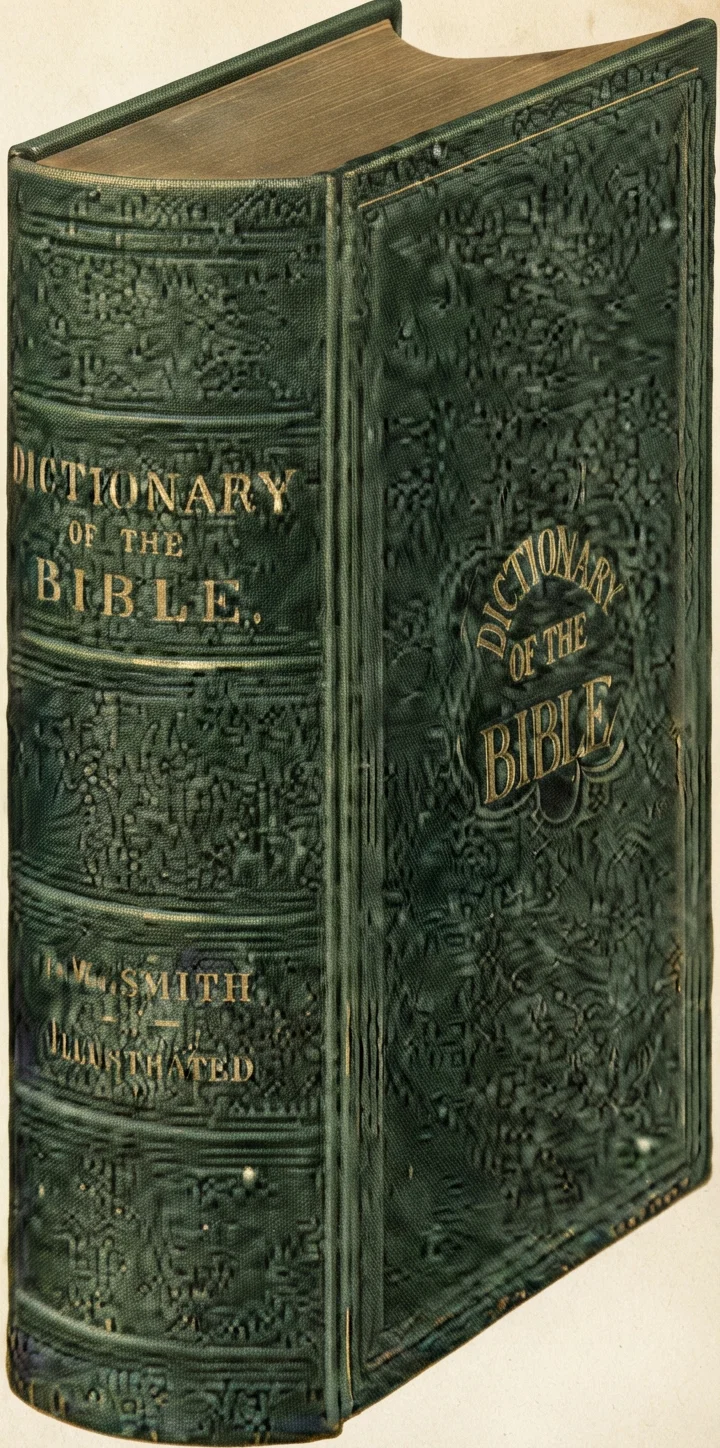
By DR. WM. SMITH.
Size 6 1/4 x 9 3/8 x 2 1/4 inches,
Cloth bound.
SMITH'S DICTIONARY OF THE BIBLE.
Dr. William Smith's Dictionary of the Antiquities, Biography, Geography, and Natural History of the Bible is admitted by those most competent to judge to be the best of its kind in the English language. Its editor and his associate contributors are well known as among the most eminent Biblical scholars of our time, in both Europe and America.
The book contains over one thousand pages, is illustrated, and gives a full and accurate account of every name and place mentioned in the Bible, which can possibly need explanation; of every animal, plant, or mineral alluded to by the Sacred Writers; and of every custom and article of use among Jewish and contemporary nations.
This Dictionary is published by Scranton & Co., of Hartford, Conn., and sells at $4.50.
Our Price, post-paid, with the SIGNS, one year, $2.25
Book sent Free for Five New Yearly Subscriptions and one renewal at $1.00 each.
Combination Offers
By Editor
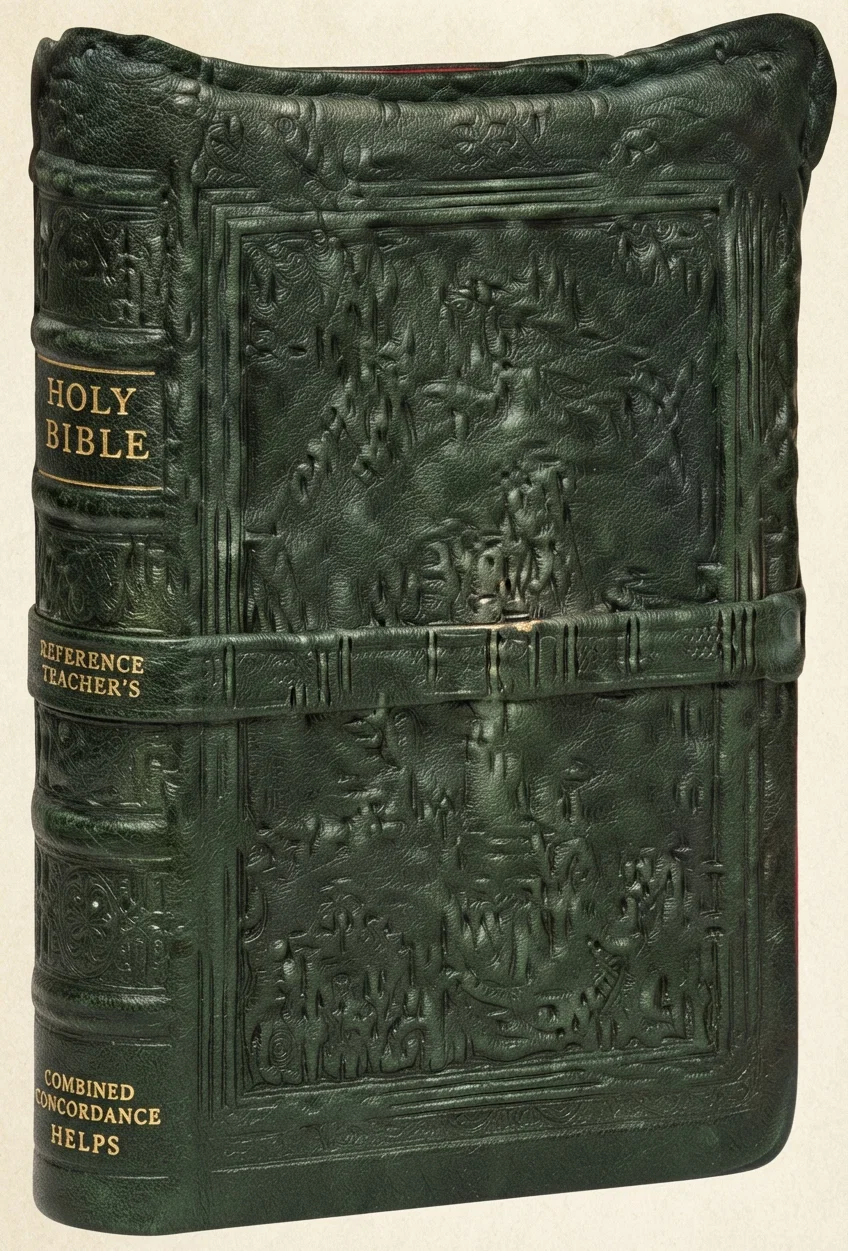
REFERENCE TEACHER'S BIBLE
Minion Type
Page 5 1/2x8 inches...
The Bible is substantially bound in morocco, divinity circuit, leather lined to edge, round corners, red under gold edges, minion type, and contains over 650 pages of finely illustrated Helps to the study of the Bible.
One feature of special value in the Helps contained in this Bible is the COMBINED CONCORDANCE, which unites, in a very convenient form for ready reference, a Concordance, Subject Index, and Pronouncing Dictionary of Scripture Proper Names.
Sent post-paid with the SIGNS one year — $2.75
Bible sent free on receipt of 7 new names and $7.00