A toiler rested in the field,
Mid sheaves of golden grain;
In discontented mood he looked
Across the lovely plain.
White cloud-ships sailed the deep blue sky;
Bird songs were in the air;
The grass, the buds, the flowers, the wheat,
Shed perfume everywhere.
But naught he saw of all there was,
Save barren spots and weeds;
The hills beyond in mellow light,
Seemed fairer than the meads.
Up there the trees were tipped with gold,
Alluring to his eyes;
He left his homely task undone,
And sought the fairer prize.
The dizzy heights at last attained,
Revealed rough rocks and bare;
The trees were dwarfed; the flowers, weeds;
The north wind chilled the air.
He heard no answer to his cry;
Alas! his hope was vain;
The light that had illumed the hill
Now rested on the plain.
Thus, rudely startled from his dream
Of fanciful ideal,
He turned from that which had misled,
And welcomed back the real.
He stood again mid fields of grain,
True to his guiding voice.
Divine content had touched his soul:
The Master's will his choice.
O toiler on life's battle-field!
Content and happy be;
Each humble duty bravely done
Will cause dark doubts to flee.
Do with thy might thy humble task
With loving care each day;
For it will ne'er be granted thee
To pass again this way.
Mrs. L. Flora Plummer.
TEDDY’S SCHOOL
By Lydia M. Droll
“TIME for garden work, isn’t it, mama?” called Teddy from the kitchen.
The morning’s work was all done; and Teddy, with Ben and Ray, had helped do it.
Mama was in the dining-room. She had just seated herself in the rocker at the large window to do some sewing.
Teddy had been so busy he had not noticed that it was raining. He did not even hear her tell the boys to take the big umbrella to school with them.
“Come, dear,” said mama, in answer to Teddy’s question, “and look out the window.”
Teddy bounded joyfully into the room.
“Look out the window,” repeated mama.
When Teddy stepped to the window, and saw the little raindrops pitter-pattering against the glass, a gloom spread over his face. Just then mama saw two big tears rolling down his cheeks.
“Oh, I wanted to work in the garden,” sobbed Teddy, “and now I can’t!”
“Don’t cry, dear,” said mama; “let us be very happy for this nice rain. Think how much good it will do the seeds we have planted. We can be happy for that, can’t we? And then you know there are many other things that we can do to-day.”
Teddy was a little home-school boy. His mama did not care to send him to day-school: she wished to teach Teddy his first lessons herself. Teddy thought his home school was the best school there could be. Mama let him play in the big yard every pleasant day.
When mama said, “There are so many other things that we can do to-day,” Teddy smiled and brushed the tears from his eyes.
“Get your marrowfat peas and assorted wires,” said mama. The peas had been soaking in water all night. When Teddy had found them, he sat down in his little red chair by mama’s side.
“A long, long time ago,” said she, “the first man was made. God made him, and put him in a garden to work.”
Teddy thought that now mama was going to tell him again about Adam and the garden of Eden. But no; she had another story to tell—a new one, that Teddy had never heard.
“Of all the creatures that were made at that time, man is the most wonderful,” she continued.
“God, who knows all things, saw that man would find true joy in working. He gave man a body so nicely arranged that he could work with ease and comfort. He gave him a head in which was a mind to think, eyes with which to see, ears with which to hear, a nose with which to smell, and a mouth with which to taste. He gave him arms and hands with which to work, and legs and feet with which to walk.
“He put joints in different places in man’s body, so he could move the different parts to aid him in his work.
“Did you ever notice any of these joints at work, Teddy? Just bend your arm. Ah, how nicely this joint allows your arm to move backward and forward! Not a creak nor crack do I hear. In machines, joints have to be oiled often, or they will get dry and creak; but God has made the joints in our bodies to oil themselves.
“There are many joints in our bodies. Wherever you can bend any part of your body, you may be sure a joint is to be found.
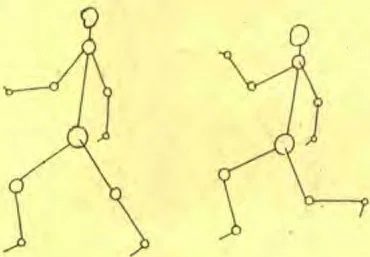
“I wonder if you can find some of these joints. I think you can. With your peas and wires you may now make some little skeletons. Use the wires for bones, and the peas where you think there should be joints.”
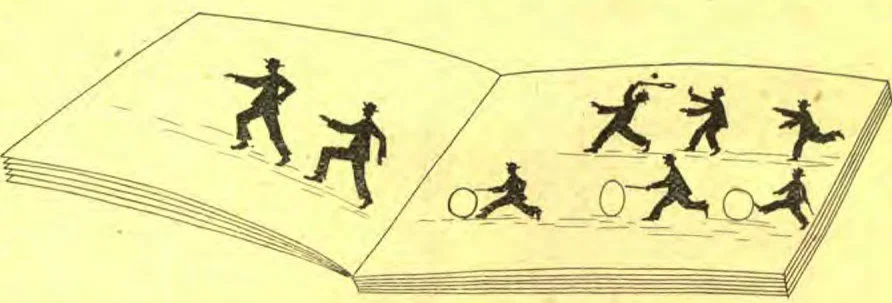
Teddy was delighted with his lesson story on joints, and with a few hints from mama he soon had a little skeleton made. When she had finished her sewing, mama was surprised to see what a number of skeletons, in different positions, Teddy had put together. That afternoon at the lesson hour she gave him a piece of heavy white paper, and suggested that he get his brush and black water-color paint, and make pictures of some of the best skeletons. Teddy enjoyed this; and after he had made a number of pictures, mama showed him how, with a few wide strokes of the brush, to make his skeleton-pictures look like dressed boys. This pleased Teddy; and by and by, when he had made all the skeleton pictures look like dressed boys, he asked, “Mama, may I make some joint-pictures in my nature painting-book?”
When mama looked at the pictures he had made, and said, “Yes, you may,” Teddy was delighted.
“I b’lieve I’ll keep two whole pages for skeletons, just to see the different ways the body can be in, on account of joints,” he declared. LYDIA M. DROLL.
GOING TO MARKET IN KOREA
By A. M. Barnes
A quaint old city is Seoul (pronounced Saool), in Korea. I doubt if there is another just like it anywhere. How amused and interested you would be if you could see it! Think of thousands and thousands of houses,—many of them could hardly be called that,—looking like nothing so much as a great field of hay-mows, each flattened at the top, and spreading out in shape like a horseshoe, one almost touching the other. Most of these roofs are so bowed in that they look as if they must surely drop inward of their own weight. Over the tops of these houses you will see line after line of clothes hung to dry. The streets are narrow and crooked, and you must be on the watch when you walk through them, or you will be run over. Why, one water-carrier with his pole and buckets can fill a street from side to side!
What fun you would have going to market in Seoul! The markets are usually held not far from the principal gates; for around Seoul runs a great wall, and entrance is had to the city through the gates. At these markets can be found almost anything that is needed, from a load of grain to a package of the queer, shaving-like matches.190
Now we will start off to the market. Remember what I told you about the streets. Here is the water-carrier. Quick! dodge under his pole, or he will tumble you over. Now you must go around this place. See how wet and slippery it is. Two men with dippers have been ladling out the water from the gutter, and pouring it over the street, to lay the dust.
The crowd grows larger and larger. The greater part of it seems to be going all one way; that is, toward the market. The white dresses of the common and middle-classes are mixed with the violet, pink, and purple robes of the higher class. What odd hats the people wear—all sorts and sizes and shapes! Some of them look like a flower-pot turned down over a round table. Korea is sometimes called “The Nation of Hats.”
Occasionally a noble goes by, carried in his chair by his big-hatted servants. The doors of the chair are open, so we can see him plainly. Indeed, he wishes to be observed. His robe is of a brilliant violet color, his girdle of flashing blue stones. His hair is rolled up in a knot, or ball, on top of his head. In his hand is a fan of silk, stretched on a frame, and set with pearls. Here are clerks in their tight sleeves, with chimney-pot hats tied under their chins; servants and slaves in pantaloons and jackets of white cotton; and policemen and constables displaying the sign of their office.
The crowd pushes and jostles and hurries along, but luckily no one is hurt. Now we have come to a kind of open space. A boy tries to sell us some candy and chestnuts from the tray suspended from his shoulders, and hanging across his waist in front. We hand him twenty “cash,” the queer copper coin of the country, with the little square hole through the center; and he takes them eagerly, and strings them on a piece of twine, the only purse he has.
Now we are coming to the markets. What a hum! We can hardly get about, so great is the crowd. There are hundreds, yes, thousands, of men, women, and children. Some have come to buy, others to sell. Many of the latter are fishermen, with loads of fish brought all the way from the sea-coast, twenty-five miles away. Yonder are the butchers, noisy and important, with all kinds of meat for sale. All around are booths in which are rice, millet, ginseng, macaroni, beans, dried persimmons, and many other things. See these men squatting about on the ground! Do they not look queer? In front of them are spread lily-bulbs, seaweeds, acorns, turnips, and pecks of red peppers. All these things the people eat, and so these squatting merchants do a thriving trade. They sit upon their heels most of the time, and one would think they must get very, very tired; but they do not: they are used to it.
Boys run about selling the Korean matches, which are nothing but shavings, with the ends dipped in sulphur. Other boys are selling mochi, a paste made of boiled rice pounded into a mass. It resembles pie-crust, and is a favorite dish with the Koreans. Women, too, are taking part in the sales; others are acting as carriers. A few have come in from the country with loads of brushwood drawn by oxen. But not much of this is sold; for the principal fuel of Korea—that is, of Seoul—is straw.
Now we will go to that booth, and buy some eggs. Don’t make the mistake of asking for them by the dozen. If you do, the merchant will only stare at you: he will not know what you mean. Eggs in Korea are sold by the “stick.” They are laid end to end, and wrapped around with straw, being tied in such a way that each egg stands out straight and stiff. Thus when you buy eggs in Korea, you may be sure of carrying them home without breaking.
If one intends to do much marketing in Korea, it is a problem to know what to do with the money. Even one hundred “cash” make quite a weight, and ten cash are only one cent. Gentlemen going to market often take from two to three servants loaded down with the “cash,” which is strung on stout cords, and slung over their shoulders.—A. M. Barnes.
THE REASON
When Minnie and Mamie are both at their play,
Everything runs in the smoothest way;
Each dear little face is so sunny and sweet,
To watch them together is surely a treat.
They never quarrel nor disagree,
Nor snatch the playthings, nor come to me
With pitiful stories, as Jennie and Sue,
When they play together, are sure to do.
I wondered what the reason could be,
Since they are all sweet little girls, you see;
So I called them up, and the case made plain,
And asked if they could the riddle explain.
And Minnie looked puzzled, and shook her head,
But our wise little Mamie quickly said,
With a wee, droll smile: "I think it must be
'Cause I 'let' Minnie, and Minnie 'lets' me!"
— Selected.
JUDGING
By Parrie L. H. Roberson
“WHAT a green acting fellow that Clyde Williams is! he looks like a simpleton,” said Harry Potts to Elbert Rogers, not stopping to think that perhaps others were saying the same thing about himself.
Clyde Williams, Harry Potts, and Elbert Rogers are all young men not yet twenty-one; and if one has any pre-eminence over the other in the way of intellect, those about them have not yet been able to determine which is the superior.
All three are alike unripe in years and experience. But some of us have such a habit of judging and misjudging others. Oh, that we might be able to see ourselves as others see us! then our judgment and speeches would surely be kinder toward one another. There must be a lack of charity in our souls; for there is nothing that so illuminates our minds, broadens our sympathies, and beautifies human character as genuine charity.
I have not given you the real names of the young men mentioned in this article; nevertheless the young men are real, and it is a homely reality that there are many more like Harry Potts. How careful should all be to remember the command, “Judge not, that ye be not judged. For with what judgment ye judge, ye shall be judged: and with what measure ye mete, it shall be measured to you again.”
MRS. PARRIE L. H. ROBERSON.
LITTLE LIGHT MOCCASIN
LITTLE Light Moccasin swings in her basket,
Woven of willow and sinew of deer;
Rocked by the breezes, and nursed by the pine tree,
Wonderful things are to see and to hear.
Wide is the sky—from the top of the mountain,
Sheltered the cañon from glare of the sun;
Ere she is wearied of watching their changes,
Little Light Moccasin finds she can run.
Brown is her skin as the bark of the birches,
Light are her feet as the feet of a fawn;
Shy little daughter of mesa and mountain,
Little Light Moccasin wakes with the dawn.
All the rare treasures of summer-time cañons,
These are the playthings the little maid knows,—
Berry time, blossom time, bird calls, and butterflies,
Columbine trumpets, and sweet-brier rose.
When on the mesa the meadow-lark, stooping,
Folds her brown wings on the safe-hidden nest,
Hearing the hoot of the owlets at twilight,
Little Light Moccasin goes to her rest.
Counting the stars through the chinks of the wickiup,
Watching the flames of the camp-fire leap,
Hearing the songs of the wind in the pine trees,
Little Light Moccasin falls fast asleep.
— Indian Advance.
PLAIN SILVERED PAPER
By J. Edgar Ross
A few years ago there was a craze for photographs having a glossy surface. Photographers reaped a rich harvest from the extra prices charged for the showy but inartistic “aristo” prints. But the fad was short-lived; and now the glossy gelatin and collodion papers are used by professionals only in making prints for reproduction in half-tone, and for their cheapest grade of portrait work.
When the reaction set in, some photographers went back to albumen paper; others took up platinotype, or other of the more troublesome processes, until matt-surface print-out paper began to appear on the market.
The matt-surface paper can hardly be called a fad. It is simply a process by which the old-fashioned pictures may be obtained with less trouble and uncertainty than by the old methods. Of course there is some difference between the pictures printed on modern matt-surface paper and those printed on plain silvered paper, such as was used by the early experimenters in the photographic art. But few artists will admit that the difference is favorable to the modern method. There is no silver-printing process that possesses such pictorial possibilities as the old plain silvered paper.
The process is neither difficult nor expensive. Its one great drawback is that the paper will not keep. It should be sensitized, printed, and toned the same day. It may, however, be sensitized in the evening, and hung up to dry during the night, to be printed and toned next day. If you arrange everything conveniently for sensitizing, this will not be as troublesome as it sounds to tell it.
What was said about paper to be used for the blue-print process applies with equal force to that sensitized in the silver bath. Photographic paper is best, but any kind will do.
Before sensitizing, the paper should be “salted.” I will give several formulas for salting, and you can take your choice:—
Gloss starch, ¼ ounce
Chloride of sodium, ¼ ounce
Water (boiling), 24 ounces
Dissolve the starch in a little cold water, and add it to the boiling water. When clear, add the salt, and allow the solution to cool before using.
Water, 24 ounces
White gelatin, ¼ ounce
Chloride of sodium, ¼ ounce
Soak the gelatin in the water until it is soft; then dissolve it by heating the water. Add the salt. When cool, the solution is ready for use.
Neither of these solutions will keep more than two or three days, but both are quite simple. Here is another that is better, though more complicated:—
Dissolve the arrowroot in a little cold water, and add to the boiling water. When clear, add the salt and the acid, and one ounce of tannin that has been previously dissolved in twelve ounces of water.
In any of these baths the paper should be soaked about ten minutes. It may then be hung up to dry. As it keeps indefinitely, a large amount of paper may be salted at one time, and it will then be ready to sensitize when needed.
There are many different formulas for silver baths; but the indispensable condition of success with any of them is purity of water. Distilled water is of course best. Rain-water stands next; but where it falls in the vicinity of large cities, it will often gather so many impurities from the air as to ruin a silver bath. The water from some wells is so nearly pure that it may be used with safety. Get the best water you can, and mix the bath according to one of the formulas given. If it looks turbid, or if it gives spotted or streaky prints, pour it into a glass jar or bottle, and set it in the sun for a few days. Then decant it, throwing away the sediment, and you will not be likely to have any more trouble.
The paper may be floated in this bath, or the surface may be swabbed with the solution, as recommended for sensitizing blue-prints. But do not use the same swab for both processes. The slightest trace of foreign chemicals in the silver bath is fatal to success. After using a swab in this bath, it must be thoroughly washed, or the acid will play havoc with the fabric of which the swab is composed. After sensitizing, the paper must be dried in the dark; then it is ready to print.
Print quite deeply, as this paper tones out more than the commercial print-out paper.
This paper can not be toned in a combined bath. Almost any single-bath formula will do; but I prefer the acetate bath, a formula for which was given in a former paper. The toning is carried on just the same as with gelatin paper, but the fixing-bath requires no hardener. One ounce of hypo., dissolved in six ounces of water, will fix the paper in about fifteen minutes. After fixing, it is washed like any other paper.
Some surprisingly beautiful effects may be obtained by using these formulas for printing on silk. No additional instruction will be needed, except that if the silk is new, it should be thoroughly washed in hot soap-suds before sensitizing. Thin China silk, such as is used in making handkerchiefs, is best for this purpose.
When you use a silver bath, you need not be surprised at seeing brown stains on your fingers. They may be removed by washing in a solution of cyanide of potassium,—but remember that cyanide of potassium is a deadly poison.
J. EDGAR ROSS.
Repentance: A Heart's Sorrow and a Clean Life
“REPENTANCE is a heart’s sorrow, and a clean life ensuing.”
1. In his relation to the life of others, what principle is the Christian invariably to follow? Matt. 7:1. What is certain to be the result of a wrong course in this matter? V. 2; note 1.
2. To show that man is utterly unable to judge his neighbor, what questions does Jesus ask? Vs. 3, 4. What must one do before he can aid in removing another’s imperfections? V. 5; note 2.
3. Against what useless sacrifice does Jesus warn us? Why? V. 6; note 3.
4. If we would have God’s blessing, what are we to do? V. 7. What strong assurances are given to all who thus seek? V. 8. By what questions does Jesus show the willingness of man to help those in need? Vs. 9, 10. How does God’s goodness compare with that of man? V. 11.
5. What blessed rule of life is given for the child of God to follow? V. 12.
6. If we would enter into life, what way is to be chosen? Why? V. 13. What additional reason is given why great care should be exercised? V. 14.
NOTES
1. Judging, as brought to view in Jesus’ discourse, is altogether different from simply seeing the faults of another. For the Lord has said that “we can not help seeing” the “faults and imperfections” of our brethren, but that we are “to love and respect” them notwithstanding. The spirit of judging is one which views the fault in order to condemn and criticise. When one takes this course, it is sure evidence that he himself is wrong. Rom. 2:1; James 4:11, 12. He is doing Satan’s work. On the other hand, when he sees the fault, and in love seeks to aid the one who is overcome, he is accomplishing the work of Christ, fulfilling his law. Gal. 6:1, 2. The results of the two ways are also in contrast. He who judges drinks in the spirit of the evils he beholds; he partakes of the sin upon which his mind dwells; for by beholding we become changed. But he who seeks to restore is not thus affected by the evil; for love covers the sin, and sees only a soul for whom Jesus died. The result of the work of such a person is to bring Christ more fully into his own life, and at the same time to make beautiful the life of his brother. With these thoughts in mind it becomes easy to see how he who judges will also be judged. For as judging a sin makes prominent that same sin in the life of the one who judges, it thereby makes him the target of others’ criticism, and the fit object of God’s condemnation at last. “Judge not.”
2. He whose fault is like a beam is far more imperfect than he whose trouble may be likened to a mote. The beam is of such proportions that it must entirely eclipse one’s view of the mote. Many times the mote that appears in the eye of another is but a splinter, or part of the beam, in our own eye. But in any case one must be free from sin himself before he can deal with sin in a brother’s character. “He that is without sin among you, let him first cast a stone.” John 8:7; see also 2 Cor. 10:6.
3. Precious truth is never to be placed before those who simply wish to cavil. The more that is placed before such, the more the injury done the cause of God.
WORRY AND SUCCESS ARE ENEMIES
By Edison J. Driver
“John,” said an old gentleman, as he lay dying, “whatever you do, never worry. If I could impress the importance of this indelibly on your mind, I could die assured of your success.”
We give the following anecdote as showing in one man’s life the results of two solutions of the world-wide question—to worry or not to worry:—
Some years ago in one of our Eastern cities lived a man noted for his success in business. In a short time he rose from poverty to independence and even riches. While gray hairs and wrinkled faces were telling the story of his associates’ care-worn lives, he retained the vigor of strong manhood. Close application and diligence characterized his daily life; yet, though great, the strain of his work had no other effect than to make his endurance greater. The man lived a contented and happy life. His pleasant face won him custom; his cheerful greeting and kindly manners made friends of all who knew him.
And the secret was his home life,—a suburban home, where business worry never entered. All the world of business, with its greed and grind, was left outside the gate. Garden and house had been planned to insure seclusion and rest, and everything spoke of comfort. The library was filled with choice books. Music graced the parlor; and chosen friends came there to enjoy reading and games, or to contribute something of their own. As the children studied, they found a helpful and encouraging friend in their father. And above all, the wife and mother took delight in making home the pleasantest place in the world. With these surroundings this man was fortified for life’s duties, and rose from success to success.
But changes came. Death claimed the wife, and college took the children, thus leaving his home desolate. And now, with nothing to divert his attention from them, business worries and cares crept in, filling his mind. Recuperation was no more complete: the glow of health faded from his cheek; and with ill-health his manners changed. The cheerful smile was gone, and friends were passed unnoticed on the street. “He is growing childish and forgetful,” they remarked. In less than two years he sold his business, and began to travel for his health. But health never came. He went to a sanitarium at last, where, in spite of the best of care, he died. Worry had completed its work. EDISON J. DRIVER.
The Sanitas Nut Food Co., Ltd.,
requires immediately
100RELIABLE, INTELLIGENTMENAND WOMEN
to handle a bona fide article that is in universal demand, sells readily, and brings in large returns. Write to-day for particulars.
SANITAS NUT FOOD CO., Ltd.,
Washington Ave., N. Battle Creek, Mich.
CHICAGO & GRAND TRUNK R'y
E. W. Meddaugh and Henry B. Joy, Receivers.
CHICAGO & GRAND TRUNK R'y.
Trains arrive and leave Battle Creek.
WEST-BOUND FROM BATTLE CREEK.
No. 9, Mail and Express, to Chicago. 12.15 P. M.
No. 1, Chicago Express, to Chicago. 9.00 A. M.
No. 3, Lehigh Valley Express, to Chicago. 3.40 P. M.
No. 5, Pacific Express, to Chicago, with sleeper. 1.10 A. M.
No. 75, Mixed, to South Bend. 8.20 A. M.
Nos. 9 and 75, daily, except Sunday.
Nos. 1, 3, and 5, daily.
EAST-BOUND FROM BATTLE CREEK.
No. 8, Mail and Express, to Pt. Huron, East, and Detroit. 3.45 P. M.
No. 4, Lehigh Express, to Port Huron, and East. 8.27 P. M.
No. 6, Atlantic Express, to Port Huron, East, and Detroit. 2.25 A. M.
No. 2, Leh. Exp., to Saginaw, Bay City, Pt. Huron, and East. 6.50 A. M.
No. 74, Mixed, to Durand (starts at Nichols). 7.15 A. M.
Nos. 8 and 74, daily, except Sunday.
Nos. 4, 6, and 2, daily.
A. S. PARKER, Ticket Agent,
Cincinnati Northern Railroad Co.
TIME TABLE NO. 3.
IN EFFECT SEPT. 24, 1899.
Trains Pass Battle Creek, as follows:
WEST-BOUND.
No. 21, Mail and Express ................. 6.58 P. M.
No. 23, Accommodation .................... 2.07 P. M.
No. 27, Local Freight .................... 8.25 A. M.
EAST-BOUND.
No. 22, Mail and Express ................. 8.25 A. M.
No. 24, Accommodation .................... 1.45 P. M.
No. 28, Local Freight .................... 5.30 P. M.
Direct connections are made at Toledo with all roads diverging. Close connections for Detroit and Cincinnati.