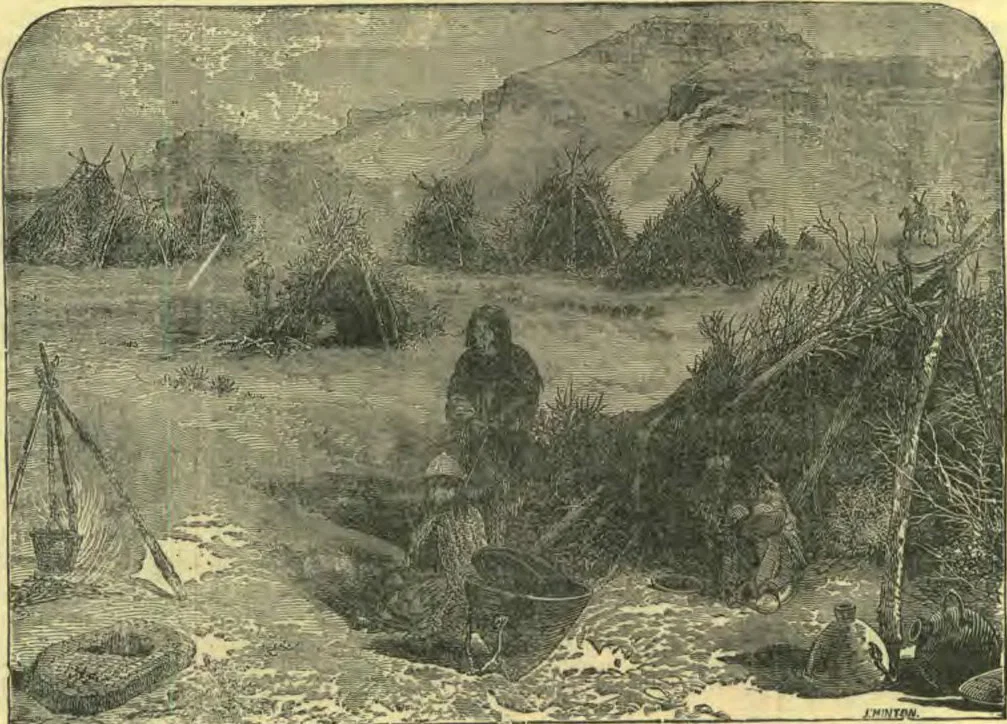
We are apt to think of Indians as wild, savage creatures, such as we see in the picture, whom we would fear, but could never learn to love, and who could be taught nothing that we would think worth knowing. Now I want to tell you about some Indian boys and girls who love to go to school as well as you do.
You know Uncle Sam has not been very good to the Indians. He has taken away their broad hunting grounds, and has turned them into beautiful farms and thriving towns. Of course it is better for other people to have this land where they can use it, but it was not fair to take the Indians' homes away from them, and give them nothing in return. Every year these people have been driven farther and farther West, until I suspect they think there is no room in the world for them.
I should not wonder if Uncle Sam's conscience gave him a few sharp twinges when he thought of this unfair conduct, and perhaps that is the reason why he has opened some schools for them. He could not give them back their land, but he could give them the benefit of an education, and teach them to live by other means than hunting and fishing.
In Carlisle, Penn., there is an interesting school where over three hundred and fifty Indian boys and girls are taught to read and write and cipher; and they learn readily. Such odd names as the children have! They choose a Christian name, and then add their Indian name to it; so in looking over the rolls, we see, “Amos Cloudshield, Conrad Killsalive, Luther Standing-Bear, Katy White-Bird,” etc.
They are taught other things besides reading and writing. The boys have a fine brass band, and they play many pretty marches, waltzes, and other airs. They think this is prime fun, and grow enthusiastic when their leader strikes up “America.”
The little girls have a pretty play-room, with a toy cooking-stove, a little dining table and tea-set, and all sorts of doilies and furniture dear to girls. They cook real meals in their play.
But of course the older girls do real work, learning to sew, cook, and take care of the house; so that in vacation they often go out to work in families, and are very proud to earn their own way.
The boys, too, learn to be good farmers, carpenters, blacksmiths, tinners, shoe-makers, etc., and it is delightful to go around in the shops and see them all so busy and happy at their work.
“One day,” says a lady in writing of this school, “Red Cloud, the well-known Sioux chief, visited the school and addressed them in his own language.” Luther Standing-Bear made the best translation of this speech, and she gives us this little part of it:—
“You seem,” said Red Cloud, “like my grandchildren; and now I went pass through the shops and saw what you can be done. I saw the shoe-maker, harness-maker, tailor, carpenter, tinner, blacksmiths, and they all doing well. Here you see I wear a boots which is you make it. I was surprise that the blacksmith doing very good. Also the girls can washing clothes and sewing. Also I went pass through the school-rooms, and I saw some of you can write very fast, and read, and I was glad. Now, this is the thing what we send you here for, to learn white men's way. There is two roads, one is good and one is what we call a devil road. Another thing is, you know, if who do nothing, just put his hand on his back and lie down, so any dime not come to in his pocket itself, so you must do something with your hands. Now you must not homesick any; but you must try to be good and happier.”
And indeed, the most of the boys and girls do not “homesick any;” they are very unwilling to leave their pleasant school home when the time comes for them to go. They say they cannot remain civilized when they get back among the savages. It is hard work, but they do very well at it. Some of them find work in the East, and never go back to their wild life. Let us hope the time will come when the Government, instead of paying soldiers to fight the Indians, will pay men and women to teach them; for that would be the best way to conquer these savage neighbors.
W. E. L.
Letter Budget.
MAUD CLARK writes from Tuscola Co., Mich. She says: “I am a little girl eleven years old, and live in the country. I have two brothers and a baby sister. My parents were not baptized until last winter, when they heard the truth from Eld. Leland. Father used to have a class in the Baptist Sunday-school, where he nearly always went alone; but since we have kept the Sabbath, all go to Sabbath-school every Sabbath, if well, and it does not storm. We have to go seven miles one Sabbath, and four the next. The INSTRUCTOR family have probably read ‘Sunshine.’ It has one piece about an old colored lady who said she could remember seeing the Ulster Gazette in mourning at the death of George Washington. I believe we have the only Ulster County Gazette now left in the world. It is draped in mourning for Washington. It was printed by James Freer and Son, Jan. 4, 1800. It was made of good paper, but it is yellow with age. Although so old, it is not torn. Probably this paper is something the boys and girls of the INSTRUCTOR have never seen. I like to go to Sabbath-school. My brother and I have gone through with Book No. 1. I read in fourth reader at school.”
We have a letter from Goodhue Co., Minn., written by MYRTA and MABEL BATSON. Myrta is about eight and Mabel about seven years old. “We go to Sabbath-school and write in Book No. 1. We have kept the Sabbath nearly two months. We have a good teacher, who pictures our lessons all out on the blackboard. He made Jacob’s ladder last week, with the angels going up and coming down. We try to have our lessons perfect. We have a little sister Josie, who goes to Sabbath-school with us. She is not quite five years old yet. She will write to you when she gets older. She sends her love, and says she likes to go to Sabbath-school. Then we have a little baby sister named Endora. Our father keeps a store, and we live over it. Our grandmother Moulton keeps the Sabbath. We want to be good little girls and meet you in the earth made new. We love to talk about Battle Creek because our grandparents spent the winter there and went to the Tabernacle to meeting. Our uncle is in the printing Office there.”
WILLIE T. LINDSAY writes a letter from Columbia Co., Wis. He says: “I am a little boy seven years old, and go to school every day. The teacher boards at our house, and she is writing this letter for me as I cannot write very good yet. I have one brother, little Frankie. He is almost three years old. We go to Sabbath-school with papa and mamma. The church is only a little way from here. I study in Book No. 2. We went to camp-meeting at Madison last summer. We went up in the capital building, where we could see all over the city. I have a grandma and two aunties in Battle Creek, and one aunt in Washington Territory. It was so warm there Christmas day, they had to have the doors open. I am trying to be a good little boy.”
We have a letter from Nebraska, which reads: “We are two little girls, LULU and MAGGIE STREETER, five and seven years old. We always go to Sabbath-school when the weather is nice. We wash the dishes and sweep the floor for our mamma, and help her all we can. We have one brother and a sister, and we keep the Sabbath with our papa and mamma. We are trying to be good children so we may meet the INSTRUCTOR family in the new earth.”
From Bay Co., Mich., ELNORA BLISS writes: “I have four sisters and one brother. We take the INSTRUCTOR and like it much. We go to Sabbath-school, six miles from here every Sabbath. I have only missed two Sabbaths in a year, and then I had the diphtheria and could not go. I have been through Book No. 1. I attended day school nine months, and did not miss a day. I am trying to be a good girl.”
I WON'T HEAR BAD WORDS.
A LITTLE boy in the city, who had no nice play yard, was sometimes allowed to play in the street. His mother always told him to have nothing to do with boys who used bad words, and Johnny felt as if he must be good when trusted alone.
One day another boy, to whom he had lent his drum, got vexed, and broke out in rude, disagreeable language. Johnny marched right up to the boy, and asked for his drum, saying, “I must go to my mother.”
“Why? What for?” the children all inquired.
“Mamma never lets me play with boys who use bad words,” said Johnny.
“Well, I won't use any more bad words if I may play with you,” said the boy, sorry to lose the music of the drum.
“I'll ask my mother,” said Johnny, “and if she says I may, then I will; but I shouldn't like to learn such words.”
“Tell your mother,” answered the boy, “I'm done now; she needn't ever be afraid any more of my using bad words, for I won't,—if she thinks so.”
Johnny's mother watched the children at their play for a time afterward, and she never learned that the boy broke his promise not to use bad language any more.—Philadelphia Methodist.