The Youth’s Instructor, Vol. 35, No. 39.

DOLLARS FOR SELF AND CENTS FOR CHRIST

The Youth’s Instructor

Sep 28, 1887

S. D. A. Publishing Association · Battle Creek, Mich. · Sep 28, 1887

DOLLARS FOR SELF AND CENTS FOR CHRIST.
“Yes, I always give for missions and everything else,” said Phil. “I give something every Sabbath; don’t you?”
“Why, no; I give five or ten cents when I think I can spare it, when I have a good deal of money, and don’t want it for anything,” said Tom.
“I give whatever papa or mamma give me for it,” said James. “Sometimes it’s more and sometimes it’s less.”
“Oh, I always give my own money!” said Phil. “I don’t think it’s any giving at all unless you do that.” “Your’s is the best way, I’m sure,” said Tom, soberly. “They say it’s the regular giving that counts.”
“And then, of course, what you give is just so much out of what you’d like to spend on yourself.”
“Yes,” said Phil, feeling very virtuous.
“I’m going to try your way,” said Tom. “And I’m going to keep an account and see what it will amount to.”
The three boys were on their way home from Sabbath-school, where they had heard from a missionary some very interesting accounts of the great work which is going on in Africa. He had treated his subject with all the power which comes of a heart glowing with zeal in the grand work to which he had devoted his life, and love for the poor creatures whose eyes had learned to look to him in earnest seeking for the knowledge of the way of life.
And, as heart always awakens heart, he had succeeded in deeply stirring the sympathies of his young hearers as he told of lives wretched and degraded in this world and hopeless as regards any other; of down-trodden women and neglected children who are crying out to those in our favored land, “Come over and help us.”
So that many of them went away with the solemn feeling that they should in some sense be held answerable if they did not strive to hold out a helping hand to those in such sore need. For the present it was plain that the missionary interest was to be centered in the “dark continent,” and little societies were formed among Sabbath-school children, they believing it would be pleasanter to put their gifts together than to offer them separately.
Several boys came to Phil’s house on the next afternoon to talk it over, and Phil brought his account-book to put down their names as the first members of their society, with a preamble in which occurred many high-sounding words setting forth their resolves and intentions.
“What’s this, Phil?” asked his uncle, picking up the book on the same evening after tea.
“Oh, that’s my account-book, uncle. I brought it down to take names and draw up resolutions for our missionary society.”
“May I read it, or is it a secret organization?”
“Certainly you may. I am simply, you know, trying to work up liberal giving among the boys.”
“A most excellent idea,” said his uncle, concealing his amusement at Phil’s rather pompous tone. “Let me see—bananas, twenty-five cents; soda water, ten cents; peanuts, twenty-five cents; bat, thirty-five cents; candy, fifteen cents; base-ball cap, seventy-five cents; Sabbath-school, six cents—”
“Oh, stop, Uncle George; that isn’t in it! That’s when I was visiting at Cousin Tom’s, and I promised mamma I’d put down every cent I spent.”
But Uncle George seemed not to hear, and went on—“Peanuts, fifteen cents; bananas, twenty-five cents; getting shoe mended, forty cents; soda water, ten cents; missionaries, five cents; getting bat mended, fifteen cents; lemonade for the boys, fifty cents; collection in church, two cents.”
“Please give me the book, uncle.”
“I’m glad you don’t forget your charitable duties, Phil,” said his uncle, giving up the book with rather a mischievous smile.
Phil took it in some confusion. He had heretofore thought but little more of his spendings than to remember his mother’s wish that he should keep an account of the money with which she kept him so liberally supplied. Now, in looking over his hasty entries, he was astonished.
“Well, well!” he exclaimed, as he added up one page, “two dollars and ninety cents for eating and play, and seventeen cents for giving, and I bragging to the boys what a good thing it is to give regularly!”
He was a conscientious boy, and his heart smote him as he ran over the long list, and thought, with his newly-awakened feelings, of the bread of life which that money might have carried to starving souls. If his mother had aimed to teach him a lesson through his account-book, she had not failed.
He got up at last and stood before the glass.
“Now, my young man,” he said, shaking his head very threateningly at the boyish face he saw there, “you know very well that a quarter for peanuts doesn’t look any larger to you than a pin’s head, and that a quarter for giving looks as big as a cartwheel—but that’s got to stop, sir! This book isn’t going to hold any more accounts of dollars for trash and cents for Sabbath-school.”—The Christian Giver.

A NOBLE MISSION.

In every age of the world, men have been suddenly called from the business of earning their livelihood to higher work in the service of God or their fellows.
Miss Gordon-Cumming, the well-known traveler in the more remote parts of the world, gives us a remarkable instance of this in a story of a workman in a saw-mill in Scotland, who, by the loss of an arm, was compelled to give up his trade, and become a colporteur in Glasgow. While thus employed, he was so much interested in the blind men who bought books in embossed type from him, that he set himself in the evenings to learn all the different systems of reading and writing for the blind.
In course of time, he was sent as agent for the Scottish Bible Society to North China. He was appalled by the large number of blind beggars who travel through the country in gangs, asking for alms. They are the victims of ophthalmia and small-pox, diseases which, in China, are unchecked by any scientific knowledge. These wretched beggars, in their filth and ignorance and misery, have reached the very lowest condition of humanity.
The poor missionary conceived the idea of lifting them at least up to the level of their fellows, by reducing the Chinese language to the blind symbols, and then by teaching them to read it. When we remember that this language consists of five thousand intricate characters, all of which must be committed to memory before a Chinaman with sight can read, we can understand how stupendous a task lay before him.
He was obstinately bent on accomplishing it, and during eight years gave all his leisure time to puzzling out a system which should enable the blind to read. He succeeded at last. The number of characters is so reduced in the embossed type that any blind Chinaman of average intelligence can learn to read fluently in two months.
During the nine years which have passed since he perfected his system, he has taught it to a large number of these poor creatures, inculcating at the same time the truths of the Christian religion, and has educated several young blind men to be efficient colporteurs.
As his pupils had no other means of livelihood than begging, he supported them while he was fitting them for work by his own scanty salary. He is endeavoring now to train intelligent men, who can see, to found a blind school in each of the eighteen provinces of China, but is greatly crippled by his poverty in this endeavor.
Such a story of the devotion of a life to the help of these most wretched of God's creatures comes to us even from the other side of the world like the sound of a bugle-call to one who sleeps. To what blind brother have we given help? To what soul, sitting in darkness, have we shown the Light?—Companion.

“STILL WATERS.”

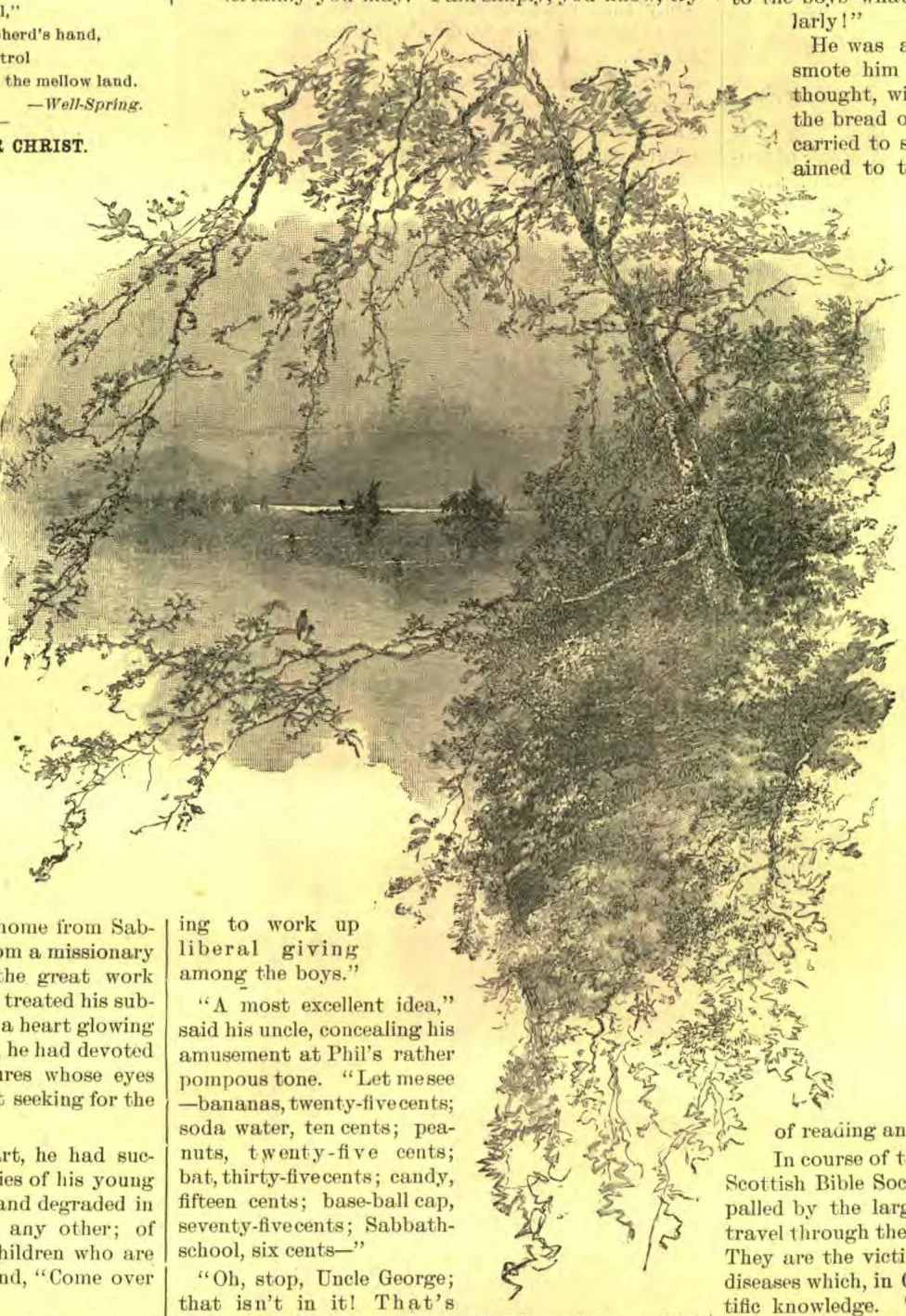
ONE rests himself in scenes like this—so still! The placid water, with its noonday calm; Green, shadowing trees and swinging birds all fill Their part and give the picture endless charm.
Some lives there are, thus heaven-blest and sweet; Fair, wooded islands, set in summer nooks, With peaceful rivers flowing at their feet, And smiling skies to meet their upward looks.
“Waters of quietness!” The weary soul, Walking their shores, led by the Shepherd’s hand, Slips from its carefulness, gives full control To peace, and heart’s-ease blesses all the mellow land.
—Well-Spring.

FOOLISH BARGAINS.

An agreement between parties about the sale of property is, you know, what is termed a bargain. Even little boys who trade their playthings “make bargains;” and what boy is he who has not at some time been told that he had made a foolish bargain, or had received something not nearly as good as the thing he had traded off?
In trade, persons talk of good and of sharp bargains, of bad and of foolish ones. It is considered fair to make a good bargain; but you may beware of the person who makes sharp trades.
One does not need to make a sharp trade to make a good one. A good bargain is one which, while it proves satisfactory to ourselves, does not wrong another party. But a sharp bargain results in some one’s being wronged. There are persons who make it their business to “drive sharp bargains.” “It is naught, it is naught,” the buyer says, but when he has bought the goods at the lowest possible price, he goes his way boasting at his sharp trade.
Instances of foolish bargains are very common. Perhaps you remember having made some yourselves which were as unwise as Benjamin Franklin’s when he gave all his money for a whistle. We hope none of you have as yet acted as foolishly as did Esau, who for a morsel of meat sold his birthright.
The world is full of speculators, crying their wares, and there are so many gilded baits set to decoy one into foolish trades that to avoid unwise bargains requires great foresight, and almost superhuman effort. But the most foolish of all bargains is one which involves the loss of the soul. Should we, by bad bargains, lose all our earthly possessions, it would be nothing compared with the loss of the former; for “what shall a man give in exchange for his soul?” “The world passeth away, and the lust thereof,” so even should we, by scheming, gain the whole world, it would profit us nothing. The Scriptures also say that “if any man love the world, the love of the Father is not in him.”
Our great danger is that we love the world too well. We are satisfied with present blessings, and so are all the time seeking these, losing sight of the “far more exceeding and eternal weight of glory.”
Who is he that keeps the tinsel and glitter of earth before the eye?—The same who tempted the Saviour when he said he would give him all the kingdoms of the world if he would fall down and worship him. Alas, for fallen man, if the Saviour had negotiated with Satan! But Christ made no such rash bargain as to bring himself and us forever subject to this great deceiver. The devil is aware of this, and so he holds out inducements to attract us earthward; it matters not with him how he deceives, only that he can cheat us out of the birthright that the righteous inherit through Christ.
Dear reader, none of us can have the faintest idea of all the joy that is in reserve for the overcomer. If he were to be in possession of it only for a thousand years, don’t you think it would pay to let go the present world and try to obtain it? What is there here that so attracts? It is trouble of some kind at every turn; why cling to such uncertainties and lose the infinite reward of obedience to God’s truth?
But when a thousand years have expired, the redeemed have but just entered upon their reward. They are the sons and daughters of God, and their life measures on and on throughout the ages of eternity. Oh, who will barter his soul for the tawdry things of Satan’s dominions, for the things of earth while under the curse? Rather let us transfer our affections to the rightful Heir, rendering homage to him. What does he require of us?—That we honor him by a well-ordered life and a godly conversation. That we serve him as the rightful King, the chiefest among ten thousand, and the one altogether lovely. Then we shall not find at the last that we have bargained our birthright for a mess of pottage. How many of the Instructor family will double their diligence to obtain the heavenly inheritance so very soon to be given to the people of God? M. J. C.

AUTUMN

Season of mists and mellow fruitfulness! Close bosom-friend of the maturing sun; Conspiring with him how to load and bless With fruit the vines that round the thatch-eaves run; To bend with apples the moss'd cottage trees, And fill all fruit with ripeness to the core. —Keats: To Autumn.

ELSIE’S MESSAGE.

“Take my lips, and let them be Filled with messages for thee.”
For the first time the words came from the depths of Elsie’s heart as a songful prayer. She had often sung them before, carelessly, with no thought of their meaning; but this afternoon her face grew thoughtful and earnest as her sweet, girlish voice rang out.
Only that morning she had openly professed her love to the Saviour to whom she had given her heart but a few short weeks ago; and perhaps it was because she longed to do something to prove her allegiance that the words of the beautiful consecration hymn came to her with new meaning. Surely it would be but a small service for the Master to carry a message from him to some one who did not know his infinite love and tenderness, to tell of the peace which filled her own heart; and yet, will you wonder when I tell you that at the thought of speaking a word for Jesus, Elsie’s heart beat faster and her cheeks flushed crimson?
“I could not, oh, I could not!” she whispered to herself.
Near her lived a young girl whom Elsie had often heard jesting at sacred things, and avowing her indifference to the earnest appeals that the pastor uttered.
“What would be the use of my saying anything to her, when she will not listen to Mr. Moore?” thought Elsie. Then something whispered: “Speak your message, and God can bless it to her, even if your words are weak and faltering.” But could she summon courage to run the risk of indifference, perhaps of ridicule?
That evening the two girls walked down the aisle after church, side by side. Elsie turned to Jennie with timid, prayerful resolution.
“Jennie, I have been so happy since I have learned to love Jesus. Won’t you love him, too?”
Her voice fluttered like a frightened bird, and tears were very near her brown eyes, as she uttered the words that cost her such an effort; and the look of haughty surprise upon her companion’s face did not tend to reassure her. All the way home she wondered sadly whether she had not done more harm than good by her words, and she was half-tempted to wish that they could be recalled.
Days passed away and became weeks, and as Jennie had never made any allusion to Elsie’s words, she concluded that they had been forgotten.
One night she was surprised to see Jennie at the weekly prayer-meeting, with a new expression of earnestness upon her face that made Elsie’s heart beat fast with hope. Were her prayers for her friend answered at last?
Jennie was waiting for her when she reached the door, and slipping her hand into Elsie’s, she whispered:—
“Elsie, dear, I can’t rest till I thank you for what you said to me one day as we were coming out of church. I could not get your words out of my head; and it seemed to me that there must be something very real in your love for Jesus when it made you so happy that you wanted some one else to share it with you. And Elsie,—I want to tell you first of all, for I owe it to you,—I love Him too, and I am going to serve him; and I have never felt as happy as I have since I have made up my mind to be a Christian.”
Do you not think Elsie was repaid a hundred times for her sacrifice of self as she listened to Jennie’s words, and knew that God had blessed her message and let it bring a soul to the knowledge of his love?—The Well-Spring.

HER GOOD CHILDREN.

WHEN the case of Mary Silk was called in Justice White's court, the most interested spectators were a little boy about seven years old and a girl a year or two older. The woman had been disorderly, and had been fined eleven dollars and costs.
The boy stepped up to an officer, and asked, “What are they going to do with my mamma?”
“I am afraid they will have to send her to Bridwell, unless you can raise eleven dollars to pay her fine,” was the response.
The boy looked up at him a moment, while his lips quivered and his eyes grew moist. Then, with an air of determination, he said, “Come, Hattie, we'll get the money.”
A few hours later the lad came back to the station, and stood in front of the desk-sergeant, twirling his hat in his hand. His head just came above the desk.
“Well, my little man,” said the sergeant, “what can I do for you?”
“Please, sir, I came to see if I couldn't get my mother out of jail,” replied the urchin, as two big tears rolled down his cheeks. “I've got two dollars and sixty cents which was given to me. Please take it, and let me go in mamma's place. I can't work as hard, but I'll stay longer.”
With this the little fellow broke down, and began to sob.
“Don't cry, my lad,” said Bailiff Kelly, who had overheard the conversation. “I'll not send your mother to Bridwell. I'd pay ten fines myself first.”
The officers of the station became interested in the poor boy's manly bearing and his efforts to get his mother released.
Justice White was seen, and consented to suspend the fine. The children were taken down to their mother, who was told how they had tried to beg the money to pay for her release.
It was the one touch of nature, and mother, children, and officers held a little jubilee in the station.
“A woman with such children as yours ought not to be here,” said the bailiff.
“No,” was the sobbing answer; “and I never will be again.”—Chicago Tribune.

ACT YOUR LOVE.

It is not enough for us to love those around us; we must try to manifest that love. Kind feelings are good; kind actions springing from them are better still.
“Provoke one another to love,” says the Apostle. It is as easy to provoke to love as to provoke to hate. All persons have some weak point, some sore spot, where, if we touch them, we may vex and torment them. How many, in the family, or in society, make it their business to single out such spots as these, for the purpose of teasing and tormenting their associates! And they like nothing better than to allude to and mention the most perplexing, vexatious, and mortifying things with which they are acquainted.
Just as men may thus provoke each other to wrath and anger, we may also provoke to love. We may find out what will please them, watch for their weaknesses, learn how we can strengthen them, and comfort them, and help them; and in these small, sweet, gentle courtesies of life, we shall not only bless and benefit others, and scatter sunshine in the world, but in provoking others to love, we shall receive into our own bosoms the rich returns of affection from all around us.
How many wretched homes might be made happy, if persons dwelling there would strive to suppress their disquiet and their anger, and manifest their love in words and deeds.
I shall always care for others, Nor suppose myself the best; For to love like friends and brothers, ’Twas the Saviour’s last request. —Little Christian.

FACE YOUR TROUBLE.

“I HAD plowed around a rock in one of my fields for five years,” said a farmer, “and I had broken a mowing-machine knife against it, besides losing the use of the ground in which it lay, all because I supposed it was a large rock that it would take too much time and labor to remove. But to-day, when I began to plow for corn, I thought that by-and-by I might break my cultivator against that rock; so I took a crowbar, intending to poke around and find out its size once for all. And it was one of the surprises of my life to find that it was little more than two feet long. It was standing on its edge, and so light that I could lift it into the wagon without help.”—Pleasant Hours.

PRAYER

LESSON 8.—PRAYER FOR DELIVERANCE.

1. How does David address the Lord in Psalms 143:6?
2. How urgently does he press his petition? V. 7.
3. As in faith he contemplates deliverance from trouble, what comfort does he implore? Verse 8.
4. In what words does he seek the guidance of the Lord? Same verse.
5. How does he pray for instruction in righteousness? Verse 10.
6. How does he pray for the life-giving power of the Holy Spirit? Verse 11.
7. How did Moses appeal to the Lord in a time of great distress? Ex. 17:4.
8. How did the Lord answer his prayer? Verses 5, 6.
9. How did David cry out in his anguish? Ps. 40:12.
10. What supplication did he make? Ps. 40:13.
11. Did David cry to the Lord in vain? Ps. 118:5.
12. With what tender mercy does God look upon the afflicted? Ps. 22:24.
13. What passage shows that the Lord has compassion on the poor and needy? Ps. 40:17.
14. Why is it safe to cast all our care upon him? 1 Pet. 5:7.
15. When the rebellious Israelites rejected the counsel of the Most High, into what distress were they brought? Ps. 107:11, 12.
16. When they cried to the Lord in their trouble, what did he do for them? Verses 13, 14. (Read the entire chapter).
17. What is a good prayer for the Christian to make when he feels almost overwhelmed with trouble? Ps. 57:1.
18. What prayer does the Psalmist offer for protection against his enemies? Ps. 143:9.
19. What may we learn from the example of David? —To cry to the Lord for protection against our enemies, instead of opposing them in our own strength. Ps. 59:9.
20. Who sent a great army against Jerusalem in the time of Hezekiah? Isa. 36:1, 2.
21. To whom did Hezekiah go for counsel? Isa. 37:1, 2.
22. How did he ask deliverance from the mighty host of his enemies? Verses 14-20.
23. How was his prayer answered? Verses 33-36.

SUPPLEMENTARY QUESTIONS.

(1) What comforting promises are made in regard to hearing the prayer of the righteous? Ps. 34:15; John 9:31; Prov. 15:29; 1 Pet. 3:12. (2) How does God regard the prayers of those who persist in wickedness? John 9:31; Prov. 15:29; 1 Pet. 3:12. (3) What particular classes of persons are mentioned as being among those whose prayers will not be regarded? Job 35:13; 27:8, 9; Ps. 66:18. (4) Whose prayers are said to be an abomination to the Lord? Prov. 28:9. (5) How does God regard the course pursued by wicked men? Prov. 15:9. (6) What counsel does he give to those who are defiled by sin? Isa. 1:16, 17. (7) What kind message does he send to those who will try to follow this counsel? Verse 18. (8) What further words of comfort may be found for those who are departed from God? 2 Chron. 7:14.

COMPENDIUM.

THE true spirit of prayer is shown in Psalms 143:6, and the extreme urgency of this petition is brought out in the next verse. The faith of the Psalmist is seen in that he contemplates sure deliverance from his great trouble, and implores comfort on the ground that he puts his trust in God. In view of this contemplated deliverance, he asks the guiding hand of God, prays for instruction in righteousness, and for the life-giving power of the Holy Spirit. Verses 8-11.
A useful lesson of faith and hope may be learned from the experiences of Moses, of David, and of the children of Israel. In the wilderness Moses cried to God when the people were ready to stone him because they suffered of thirst. In answer to his prayer, the Lord wrought the wonderful miracle of bringing from the rock sufficient water to supply three millions of people, with their flocks and herds. Ex. 17:4-6. From the depths of his anguish, David cried unto the Lord, and the Lord heard him, and brought him out of his trouble. Ps. 40:12, 13; 118:5; 69:15; 18:6. For the afflicted, and the poor and needy, God has great compassion, and it is always safe to cast our care upon him, for he careth for us. Ps. 22:24; 40:17; 1 Pet. 5:7. When the Israelites rebelled against the counsel of the Most High, they were brought into great distress; but when they cried to the Lord in their trouble, he broke their bands in sunder, and saved them out of their distresses. So likewise should every Christian trust in the mercy of God, and take refuge under his protection until his calamities be overpast. Ps. 107:11-14; 57:1. From David’s example we may also learn to look to God for protection against our enemies, instead of trying to oppose them in our own strength. Ps. 143:9; read also 64:1-6; 59:1-4, 9. God’s power and willingness to deliver in answer to prayer is shown in wonderful examples, especially in that of the destruction of Sennacherib’s host. Isa. 36:1-36.

CONDENSED ANALYSIS.

1. David prays for deliverance, comfort, guidance, instruction in righteousness, and to be quickened by the Holy Spirit. 2. Lesson from the experiences of Moses, of David, and of the children of Israel. 3. God’s compassion for the afflicted, the poor and the needy, and for all his creatures. 4. God is able to deliver from the power of all enemies, as seen in the experiences of David and Hezekiah.

THE “LEVIATHAN,” OR “GREAT EASTERN.”

Doubtless most, if not all, of the readers of the INSTRUCTOR have either heard or read of the Great Eastern. Over thirty years ago it occurred to the mind of a great engineer to build a steam vessel surpassing in size and speed anything which had hitherto been launched. Mr. Isambard K. Brunel, C. E., F. R. S., is the man to whom belongs the credit of designing, for the “Great Eastern Steam Navigation Co.,” the Great Eastern or Leviathan, as she was originally called.
The keel of this monstrous ship was laid on the first of May, 1854. The company had great confidence in the success of the vessel, as was shown by the fact that they subscribed a capital of 1,200,000 pounds [about $5,732,000].
The length of the Great Eastern is 692 feet, width between the bulwarks 83 feet, and height 60 feet, exclusive of the masts. The hull is of wrought iron, 30,000 plates being used, measuring 60,000 superficial feet, and weighing 8,000 tons. The plates are secured by 3,000,000 wrought iron rivets. It is a singular fact that the grandson of Lord Byron was one of the workmen employed in fastening these.
The interior of the ship is divided into ten water-tight departments, so that the risk of sinking her is very small indeed. Unlike other ships, her bottom is flat, the keel being on the inside. The hull was three years in building.
The first attempt to launch the Leviathan proved fruitless. The day fixed for this event was Nov. 3, 1857. The present Dutchess of New Castle (then Miss Hope) performed the ceremony of christening her; and when all was ready, she dashed against the side of the ship, from a platform prepared for the occasion, a magnum of champagne gaily decked with flowers, with the words, “God speed the Leviathan.” Fearing that the ship would cause a deluge on the opposite side of the river, an order was issued to retard the motion of the ship. At this, the chain-winding apparatus gave way, the launch way broke, and there she lay unmovable for three months. This failure of the launch proved also to be a failure of the Steam Navigation Co. A new company undertook the second attempt to launch the stubborn monster, and made a success, but with a cost of $150,000.
She was fitted with both screws and paddles. In addition to her steam machinery she is provided with six masts, which give great sail power. Her ten anchors weigh 55 tons. The total weight of the anchors and gearing to make her fast, reaches the enormous figure of 253 tons. She is capable of accommodating 800 first class, 2,000 second class, and 1,200 third class passengers, and 6,000 tons of cargo can easily be stowed in the holds of the ship. She requires a crew of 400, a third of whom are employed in the engine department.
At last she was completed. Great anxiety was displayed in the behavior of the ship on her first trial trip. One writer, in speaking of it, says: “No mother ever watched with greater care the first steps of her infant from the nursery table to the window, than did the builders of the Great Eastern, in following her performance on the occasion of her initial voyage of discovery, when all the labor and calculations of years were to be put to a test.” Would she prove a success or a failure? was the question.
The Great Eastern hoisted her first “Blue-peter” in the Thames opposite Greenwich Hospital. Here was the starting point of her trial trip. This trip did prove quite a success. Notwithstanding this, many competent persons were not slow to express their opinion that the vessel would prove a failure as a trading ship. One Mr. W. S. Lindsay greatly offended Mr. Brunel by stating, in answer to the request for his opinion upon the future of the ship, that the only way in which she could be made profitable to her owners was by turning her into an exhibition. Mr. Lindsay’s remarks were prophetical; for although the Great Eastern found lucrative occupation in laying submarine cables, it was not until she had been employed in her present capacity, as “a show,” that lasting success was assured.
To-day the Great Eastern is anchored in the Mersey River, opposite Liverpool, Eng., and used as an exhibition! For one shilling you are allowed to board her. As a result of her being used as a “show,” the owners, Messrs. Lewis & Co., of Liverpool, are realizing a fair profit. R. S. ANTHONY.

TO-MORROW

To-morrow's fate, though thou be wise, Thou canst not tell, nor yet surmise; Pass, therefore, not to-day in vain, For it will never come again.

A CENSUS OF THE AIR.

WHEN no bird or winged insect is in sight, there yet are round about us in the atmosphere of many districts millions of living creatures called microbes, some of which, therefore, we must needs draw into our lungs if we breathe at all. Certain of them are manufacturers of alcohol, and there is nothing to be said in favor of any of them, there being reason to believe that among them are occasionally to be found those that give rise to special diseases in mankind, while all alike help to lower the vitality of the human frame. It is, therefore, of importance to know where they abound, and in what spots we may hope to be most free from their company. To learn this, Dr. Percy Frankland has been taking stock of them in different places, and making a rough census of their numbers, with results which are described by him in “The Nineteenth Century” for last month. An estimate has been formed of their proportions in the open country of France, on the Jura Alps, on the glaciers of Chamonix, in the crowded streets, and on the solitary sea; on the top of the educational buildings at Kensington; on a heath near Norwich, and on the cathedral of that city; on the downs of Surrey; at the bottom and at the top of Primrose Hill; in the room at Burlington House in which the Royal Society was holding its soiree; in the Natural History Museum, both on an ordinary day and on a public holiday; in a railway carriage with its usual average of passengers, and in the same carriage when crammed with racing men; and in a barn when threshing was in full swing. By such investigations it has been ascertained that the microbes abound in towns and houses; that they increase with the heat of the weather and the number of people; that where dust is, there they are, and that where it is not—as far out at sea—they cannot be found; that the wind distributes them high and wide; and that in calm air they fall to its lower levels. The same volume of air that yielded only four microbes in January yielded 105 in August, and while an open heath yielded but seven in a certain quantity of air, a garden near yielded thirty-one. The room in which the Royal Society meets yielded, when empty, 130 per two gallons of air, but when crowded 432. The highest result was reached in the dusty barn, where 8,000 organisms fell on a square foot of surface in one minute. This census of our unseen foes is the first step to getting rid of them.—Christian Weekly.

KEEPING THE CALENDAR.

No doubt most people remember the number of days in any particular month by recalling the rhymes which they learned at school. Another method is practiced in Iceland, and it is so simple and ingenious as to be worth knowing. Mr. Metcalfe gives it in his book, “The Oxonian in Iceland.”
“Shut the fist, and let the knuckle of the forefinger represent January with its thirty-one days, and the depression between that and the next knuckle will represent February with its less number of days. And thus every month that corresponds to a knuckle will be found to contain thirty-one days; and every month that corresponds to a depression, a less number of days.”
“The little finger will represent July, and beginning again with the forefinger knuckle, it stands for August, and from this one goes on counting through the months of the year.”—Selected.

A NEW CLOCK.

A NEW form of clock has recently been patented in France. The novelty of it is in the dial, which is made of parchment, and painted with garlands of flowers. Among these flowers are seen two bees, which literally flit from flower to flower; but while one gets round the dial in an hour, the other takes twelve hours to run its course.
The parchment has no opening in it, and it puzzles many to understand how the busy bee can be made to move without any connection with the interior works of the clock. Here is the explanation:—
Just underneath the parchment face are the ordinary hands of the clock, each forming a magnet. The bees, being made of light steel, readily follow the unseen magnets below the parchment dial.

BACK AGAIN TO SCHOOL.

All in the sweet September morn the little feet are trooping Through city street and country lane, along the pleasant ways, And in the school-rooms far and near are sturdy figures grouping. In eager haste for happy work these bright autumnal days.
From frolics on the pebbly beach, from dreaming on the shingle, From scrambles up and down the hills, from gathering wild-wood flowers, The children like an army come, and merry voices mingle In greeting as they answer swift the call to study-hours.
Dear little sunburnt hands that turn the grammar’s sober pages, Sweet lips that con the lesson o’er to get it all by heart, Afar from your soft peace to-day the great world’s battle rages, But by and by ’t will need your aid to take the better part.
There’s always in the thinning ranks and in the vanward column A place for brave and buoyant souls, for truth without a flaw; And, somehow, as I look at you the hour grows grave and solemn, And prayer ascends that God will give you strength to keep his law.
You ask a motto for the days, a motto bright and cheery? Look at me straight and fearlessly, sweet eyes of brown and blue; For not a motto have I found, but just an earnest query: In every trying place you meet, ask, “What would Jesus do?”
And follow Jesus every day in all the loving labor; The hardest tasks will give you joy, the tangles cease to vex. Be honest, open as the day, be gentle to your neighbor, And Christ will always give you aid, whatever may perplex. —Margaret E. Sangster.
Continue reading: AN INDIAN SCHOOL