4. Till what time was it to continue? Verse 35. (See note 1.)
5. What instruction was given to Daniel concerning his prophecy? Dan. 12:4.
6. What would then take place? Verse 4, last clause. (See note 2.)
7. What question was asked of one angel by another? Verses 5, 6. (See note 3.)
8. What was the angel’s answer? Verse 7. (See note 4.)
9. What is said of Daniel’s understanding of the answer? Verse 8.
10. What question did Daniel ask? Verse 8. (See note 5.)
11. What answer was given? Verse 9.
12. What is said of different classes during that period? Verse 10. (See note 2.)
13. What other prophetic period is introduced in this prophecy? Verse 11.
14. From what event was it to begin? Verse 11. (See note 6.)
15. Then to what date would it reach?—1798. (See note 6.)
16. Upon whom is a blessing pronounced? Verse 12.
17. To what date does this period reach?—1843. (See note 7.)
18. What command was given to Daniel? Verse 13. (See note 8.)
19. What promise was made to him?
NOTES.
1. The time of the end is not the end, but a brief period commencing at a certain time and reaching to Christ’s second coming. This period—the time of the end—begins with the close of the papal persecution, in 1798, when the papacy received the deadly wound. Rev. 13:3.
2. “The time of the end” is marked especially as a time when “many shall run to and fro, and knowledge shall be increased.” This does not refer to the great amount of travel that will be carried on and an increase of worldly wisdom and knowledge in general, although these things may be seen in the social world in a remarkable degree. The book of Daniel was to be closed “till the time of the end.” Then “many shall run to and fro,”—that is, run to and fro through the book, searching its pages diligently; and thus “knowledge [of the Scriptures] shall be increased.” (See “Facts for the Times,” page 59, fourth edition.) This view is also confirmed by the statements in verse 9, that the wicked will do wickedly, and none of the wicked shall understand, but the wise shall understand.
3. The question asked in verse 6 means: How long will it be till we reach “the time of the end,” when the long period of persecution will cease, and God’s people will be free to study the word of God, and these things which have been a source of wonder and astonishment to them will be more fully understood?
4. This period is identical with that in Dan. 7:25 and Rev. 12:6, 14, which we have found to be twelve hundred and sixty prophetic days, or literal years, beginning A. D. 538, and ending in 1798. The one who answered this question is evidently Christ, the same one who answered the question relating to time in Dan. 8:13.
5. Daniel’s question (verse 8) means: When will God’s people be delivered from these terrible troubles and persecutions?
6. The “daily,” or paganism (“sacrifice” is a supplied word), was taken away in A. D. 508. This was to prepare the way for the setting up, or establishment, of the “abomination that maketh desolate,” or the papacy, in A. D. 538. (See margin.) To A. D. 508 add twelve hundred and ninety prophetic days, or literal years, and we are brought to A. D. 1798, the same date to which the twelve hundred and sixty years extend. (“See Thoughts on Daniel and the Revelation,” chapters 11, 12.)
7. Beginning at the same date as the twelve hundred and ninety years,—namely, A. D. 508,—the thirteen hundred and thirty-five prophetic days, or literal years, would extend to A. D. 1843, at which time a great blessing came to God’s people as they feasted upon the unsealed book of Daniel, which was then open, and increased in the knowledge of the prophetic word, and rejoiced in the clear evidences of the Saviour’s soon coming to redeem his people. Luke 21:28.
8. “Till the end be,”—that is, till the end of all these great prophetic periods. This would certainly include the twenty-three hundred days of Daniel 8, which ended in 1844, as well as the shorter periods, which ended prior to that time. Then, in 1844, Daniel and all the righteous dead stand in their lot on the place decided by the Judge, in the judgment, which began when that date was reached.
ADDITIONAL NOTES.
The vision of the tenth chapter of Daniel, like that of the ninth, was given in answer to prayer; and it would seem from the book of Daniel that he was much given to prayer. It was by taking advantage of his frequent prayers that his enemies undertook to compass his destruction. At the time he saw the vision recorded in the tenth chapter, he was evidently upon the “king’s business.” He had been mourning and praying “three full weeks.” Suddenly, as he stood by the banks of the river, a new sight was given to him, and he saw things not of this world. Where a moment before only natural objects could be seen, he saw a glorious personage. How thin is the veil between us and the unseen world! and the angels of God, who are sent to minister “for them who shall be heirs of salvation,” are nearer to us than we are aware. The nearer we can approach their character in holiness, the easier it seems to be for them to communicate with us.
It was a most comforting message that the angel bore to Daniel. His prayers had been heard. Not only his prayers on that one day, but he was told that from the first day when he began to seek the Lord, his words were heard.
The God of Daniel is our God. He has told us to pray to him, and will he not hear us?—Yes; the feeblest prayers, if truly from the heart, are heard, and, though not always in our way, in God’s way they are answered.
The truthfulness of the statement made by Paul that the “powers that be are ordained of God,” is well illustrated in the last two verses of chapter 10 and the first verse of chapter 11. The angel tells Daniel that he was taking an active part in the governmental affairs of the nations; that when Darius was king, he “stood to confirm and to strengthen him.” Thus does God sustain kingdoms and kings, and by his providence guides the affairs of the world. When a nation has shown its entire worthlessness, the Lord withdraws his protecting and supporting hand, and then comes national downfall.
The words of chapter 12, verses 9 and 10, indicate that in the time of the end there will be a revelation of the mysteries of this prophecy, which was to be sealed until that time. Evidence may be also gathered from verse 10 that the bringing forth of this truth will cause a test to come upon the inhabitants of the earth, making a separation; and as the final result, “many shall be purified, and made white, and tried.” These can be no others than those who accept the light which is revealed, and thus God is able to do for them a work of purification. On the other hand, those who reject the revealed light go into greater darkness. They “do wickedly,” and are not able to “understand.” Certainly that time has arrived. The light from the prophecy of Daniel has been shining for forty years; many have embraced the truth which will purify their souls; others, by rejection, are becoming so darkened that they cannot see that those who have received the truth have any rights whatever. Jesus left his followers hated by the world; he will find his disciples, upon his return, in similar circumstances, and will readily recognize his own. M. E. K.
WHO WAS GRANDPA TALKING TO?
By C. C. Mc Cabe.
“MAMA, who was grandpa talking to just now?” said a little girl, in the home of a friend of mine, not long ago.
In a sort of awestricken way she had been gazing upon the pale face of her dear old grandpa while he was leading in the morning prayer. The closed eyes seemed to be looking at some one. The tears crept swiftly out from under the lids, and fell from wrinkle down to wrinkle over those aged cheeks. The white hair was thrown back, and the hand which rested on the old family Bible, from which he had been reading, trembled a little.
The old man did not know that his little granddaughter was watching him. When the prayer was over, and the family fold was placed for another day under the guardian care of the Shepherd of Israel, this little lamb crept to her mother’s side, and asked: “Who was grandpa talking to just now?”
In answer to that question, what a chance the mother had to tell the child about the glorious privilege of prayer! What an opportunity to cast an anchor which will hold in the wildest storm! Grandpa will soon be gone. We can see the gleam of his eternal triumph in his countenance. His steps are feeble, but his faith is that of a giant. No doubts disturb the quiet of his spirit. Every day he reminds everybody in the family that Jesus has been in the world, and that he dwelt among us. A happy home with such an altar and such a priest! — C. C. Mc Cabe.
Nuggets from the Golden West.
By Kittie Wagner
IN FIVE PARTS.—PART III.
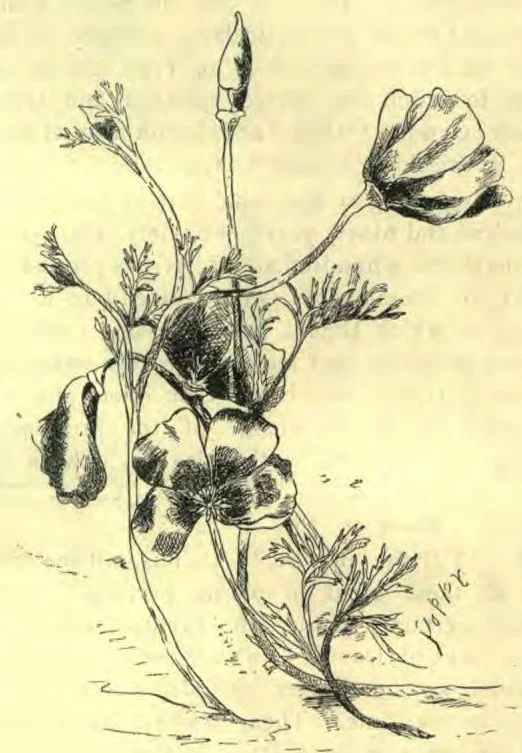
Doubtless the greater number of Instructor readers have heard of the California poppy, even if they know but little or nothing about it. There is no county in the State but can boast of a few of these lovely flowers. The fields of southern and central California are covered with them, but they decrease in number as we go north; so in the extreme northern part the poppy is quite a rarity. The color of the flower changes with the climate, varying from a deep orange to a light lemon. It is of the genus Eschscholtzia. This may seem to be a very awkward name, and hard to remember, yet most of our school-children know and have learned to love it. The Eschscholtzia can be found in some parts of the State any time of year. If the throne of Henry VIII had been erected in a field of our poppies, the field might, in a double sense, have been styled, “The field of the cloth of gold.”
One of the most beautiful summer resorts of southern California is Pasadena. From the eastern side of this city are seen some of our large ranches, at the foot of which are beautiful orange groves. This corner of our extensive garden seems to be especially favored with many of our choicest flowers. Here it is we find the wild peony, wild heliotrope, and many other flowers that are found in our cultivated gardens here and also in the East. The wild peony resembles, in growth, the cultivated peony, being somewhat smaller, yet extremely rich in color. Although Pasadena seems to be especially favored with its presence, this sturdy plant endures a great range of station and climate. While it is found in abundance on the hot plains of southern California, its rugged structure adapts it to the colder regions; for it may also be found in the near confines of perpetual snow.
I have already described some of our early visitors and some that call on us much later; yet there are numberless others. But there is one more which I must mention, lest many who have the privilege of roaming among these flowers will think I have forgotten it. Our Dodecatheon, or shooting-star, with its lavender loveliness, has not been forgotten; but it, like some persons, because of its modesty, has stepped back, and having quietly drooped its beautiful face, listens with pleasure to the words of praise spoken of its companions; and now, after considering many others, I bring it forth.
“The shooting-star may be found growing in a modest sort of way, here and there,—a little bush shooting straight up as if to hold its head above its neighbors before uncovering its handsome face to the gaze of its companions, then modestly looking to the earth, never again daring to raise its pretty face.” The flower grows from four to ten inches high; its inflorescence is umbel, and can be found from three to twelve-flowered. In reality one, and only one, species occurs; but there are several varieties, loosely arranged according to features.
I need but to mention the bluebell, and you will all, no doubt, recognize the name as that of a welcome spring visitor; for its presence graces nature’s garden not only in the “El Dorado of the West,” but also the gardens of the extreme Eastern States. How perfectly it represents a true bell! As we see these dainty flowers growing thickly about us, they seem like bells ringing out a dirge to the departed winter and chiming a welcome to spring.
CALIFORNIA POPPY.
The last I shall add to the collection of wild flowers selected is the white dog-tooth violet. Were it not so familiarly known by that name, we certainly would give it another; for the name lacks so much of expressing its beauty—it rather detracts from it. There is no flower, however carefully nursed it may be, that can, in my opinion, equal it in its simple beauty. It belongs to the Liliaceae family, and is of the order Erythronium. The flowers differ slightly in color, the pure white ones enjoying the deep shade of the wood, where they may hide behind some friendly tree, or, growing bolder, venture to the side of some mountain stream. Its twin sister is a light cream color deepening to yellow at the center. She is quite robust, and prefers to bask in the sunshine, that her cheeks may receive some touches of the great Painter’s brush. In order that she may be thus favored, she is content with but a scanty layer of soil on some friendly rock, or a mere sprinkling of sand among pebbles.
Kittie Wagner.
GERMAN STUDENT-LIFE.
By C. B. Morrill
(Concluded.)
AFTER some three years of attending lectures, the student may apply to be examined for his degree. If his request is granted, he will be given a subject, or often two subjects, upon which he must prepare a thesis or theses. The range of the subject is generally very narrow, and the thesis must exhaust it. If the thesis is accepted, the candidate is then examined. This is the only examination. It goes over the entire ground. If the subject of the candidate’s study has been German history, the entire subject, and probably many other subjects which bear in some way upon it, will be covered. Imagine a committee of five professors, probably with years of experience in conducting examinations, each taking his turn upon the subject most familiar to him, each keeping up a rapid fire of questions for three quarters of an hour or an hour, shifting quickly from one branch of the subject to another as fast as the candidate shows familiarity with the matter, and you can guess something of the nature of the ordeal.
This method has its advantages and its disadvantages in comparison with ours. It puts more responsibility upon the student. In this country, a reckless or indolent young fellow, if he keeps his connection with his college unbroken, must as a rule learn a reasonable amount of industry; while in Germany such a character finds in student life only increased opportunities for the exercise of idleness. On the other hand, the hard-working investigator — he alone is taken account of in the German theory — can pursue his chosen line of research without the interruptions occasioned by daily and weekly quizzes and recitations. Moreover he learns originality, and he learns to go without being wound up. When a student is quizzed every other day, whether he will or no, he soon gives up in despair his cherished plans of study; he loses his interest in learning, and devotes himself to preparing for the quiz-master after the standard set by the average of his class. The result is, that in the course of four years his youthful fire is gone out, and he has become a commonplace drudge. Our method too often prepares the raw material of genius for inglorious mediocrity.
The dormitory system, which finds its most ideal development in the English universities, has never come into favor with German students. The traditional freedom of German student-life is against it. The students live in rooms or apartments rented of private families, of whom many live upon the rent of rooms. Often they are not the most comfortable nor the cleanest that might be desired, but they are moderate in price. Chumming is almost unknown, except at Berlin and some other places where the rents are high. The rooms in strictly university towns are generally rented by the semester.
Boarding is, like chumming and dormitories, not a strong feature of the university life. Most students take their breakfast in their rooms, whence it is brought by the house servant. Lunch is often taken at a restaurant counter with an acquaintance or two, and dinner at the restaurant or a hotel. Supper, like lunch, is eaten almost anywhere.
Dueling is supposed to form an important part of the recreations of German students. Among the evidences of culture which the university alumnus bears are his scars, and he can tell you of thrilling encounters upon the mensur. The truth is that a large number of students engage to some extent in fencing and dueling. The mensur duel is not a very serious affair, however. Sometimes an encounter in real earnest, with sabers, is fought; but such business is always done in secret. The mensur is a public place,—that is, it is open to all members of the “corps” to which it belongs. The duels fought on the mensur,—which is a hall with the floor measured off like a tennis-court, whence the name,—are conducted according to the rules of some “corps,” and are rarely dangerous. The contestants are well protected except about the face. The body is encased in a buckskin jacket, the neck is covered by a very thick silk cravat, and the eyes are shielded by iron goggles. Besides these precautions, a cap is generally worn upon the head. The fighting is done with the schläger, a thin, straight, narrow sword. To guard, the schläger is held vertically in front of the face, the arm and hand being held above the head. The attack is made from the same position by dexterous movements of the wrist. The fighting lasts for fifteen minutes, or till one of the combatants is led away wounded. The mensur is foolish and barbarous, as are all duels and all fighting, and is a blemish upon the universities; but it is not cowardly, as191common fighting generally is, and it is not usually dangerous.
The life of the German student is, in general, the freest period of his whole existence. In all its customs and institutions it preserves the old Teutonic spirit; as one writer puts it, it is a reminder of what the whole life of Germany used to be. His university is a little world and a little state within itself; and in this little world, built specially for him and his wants, he spends three or four years of his life in being himself,—in studying for study’s sake, and in shaking out the wings of his soul before folding them forever in the murky atmosphere of that other, sordid world, beyond his alma mater. C. B. MORRILL.
MAN'S SPEECH TO THE BRUTES.
By Alfred H. Peters
The words by which man communicates his will to the domesticated animals, although filling but small space in the dictionaries, are nevertheless among the oldest words in every language. They are for the most part exclamatory monosyllables, the earliest forms of speech, oftentimes monosyllables which are the roots of a whole family of words; and they have descended through the different languages, having a common origin with perhaps less variation than any other words. Some of them are the very names by which our prehistoric ancestors called the animals to which they apply—names that in many instances are imitations of the animal’s voice. Some are Sanscrit, or ancient Indian, words; some are Greek, some Latin, some Teutonic, and some are old English words long since forgotten and obsolete.
Were an English-speaking driver to bid a continental horse to back, or to get up, or to gee up, he would not be understood; were he to chirp at him with one side of his tongue, he might be understood; but were he to cry “ho” or “whoa,” he surely would be understood, inasmuch as this horse command is the same throughout all Western Europe. The origin of this command to the horse is not determined. From its being the same throughout all Roman Europe, the word has been supposed to be the interjection ohe of the Latins and Greeks, a simple call to attract attention, another form of which was heus, which may have come from the Sanscrit yu, meaning to keep or to hold back. Ho is found in Old English in the sense of hold, both as noun and verb, and it is said that ho on is sometimes still used for hold on among the mountaineers of the southern United States. The word has been considered to be a shortened form of hold, but as words tend to lengthen rather than to shorten, hold is more likely to be a later and lengthened form of ho, which itself may be the primitive Aryan word meaning to stop.
On account of his being guided by the rein, man commonly uses no words to direct the horse to one or the other side, although some horses, and mules very often, are taught the words signifying right and left, the same as oxen. These words vary in different languages, hence they are supposed to have no common origin. The Englishman and the American say gee and haw, the German hott and hist, the Frenchman hue and dia, the Spaniard cho and ven acá, and the Italian gio and venez. Moreover, the teamster does not in all countries keep to the left of his cattle as with us. In Great Britain and in many parts of the Continent he keeps upon their right, hence gee and haw, or the words corresponding thereto, are in his case reversed; but gee, or its equivalent, is always away from, and haw, or its equivalent, is always toward the driver. Gee and haw are imperative of the Anglo-Saxon verbs gegan, to go, and hawian, to look, whence they are supposed to have become ox commands in that language, the one in the sense of away, and the other in the sense of hither.
Except a whistle, man has no call for the horse, as he has for all the other animals, of which one of the most ancient is his call to the cow and to the whole bovine race. The farm-bred boy who is put to the study of Latin soon discovers that he has been calling his cows by the Latin name of their race whenever his Bos! bos! bos! has summoned them at morn and eve. If he be taught Greek, he finds the name in that language to be very nearly the same as in Latin; and if his studies in language include the Zend and the Sanscrit, he recognizes the familiar Co! co! co! in ko and go, the words which respectively signify cow in those ancient tongues, both of which are derived from the Sanscrit verb gu, to low, as a cow.
Less clear is the etymology of the milker’s admonitory so! or soh! Some make it to be the adverb so, in the sense of in that way, or as you are, derived from the Sanscrit pronoun sva or swa, one’s self or one’s own. This, however, is hardly satisfactory, and if not an aspirated form of ho, like soho, soh may be the Sanscrit sagh or sah, meaning to endure, or to remain,—that is to say, keep still, which it will not be disputed is the meaning meant to be conveyed to the cow.
The sheep owner, who would bring his flock about him, cries, Ca-day! ca-day! ca-day! as he enters the field where they are at pasture, to which the answer is a chorus of bleats and a loping line headed toward the direction of the cry. This undoubtedly is the old English word cade, a lamb, meaning also tame or gentle, which pronounced in two syllables becomes the well-known sheep-call. It is curious that this call, as in the case of several other animal calls, is addressed to the young, rather than to the mature, ones of the flock.
No primitive name of the swine family appears to have come down, in English at least, as a swine call, although the word chuck has been supposed to be an ancient name for the hog, whence wood-chuck, wood-hog. This word is said formerly to have been used as a call to swine both in England and the United States, but the writer has never heard it so used either in New York or New England. There is sometimes heard a call like Puoy! puoy! puoy! for which there is no explanation, but the common call to this tribe is the name of its young, Pig! pig! pig! a word of unknown origin, having in the Teutonic languages the meaning of little, and being applied to the young of one animal as much as another.
The rural words whee and st’ boy are ignored by lexicographers entirely. Perhaps whee is a shortened form of away, or it may be the old English provincial whew, meaning to hurry or to fly. St’ boy is evidently a compound of hist, to incite, and by, in the sense of off, or else of boy, which in old time was often used in the sense of fellow, knave, or any other term of contempt.
The fowl call, Chick! chick! chick! and its variation, Kip! kip! kip! are as old as the call to the cow, being the Sanscrit kuk, the name of the domesticated fowl, whence cock, and kik or chick, together with kip, chip, and chuck—words all clearly imitated from the note of the bird, which in Sanscrit was kak, to crow, or to laugh, whence cackle. The country house-wife who cries shoo to the trespasser upon her kitchen-garden or flower plot, uses almost the same exclamation that the ancient Greeks used to scare away fowls in their day, which may be derived from the Sanscrit su, to hurl or to drive.
No study of animal calls can leave out the calls to the cat and the dog, to which the child, like his primitive ancestor, gives names imitative of their voices—the mew and the bow-wow. The word puss is supposed to be an imitation of the spitting, or, as the English say, the swearing of the cat, for which the Hindu word is phis. Kit is but a variation of cat, of which kitten or kitty is the diminutive, and scat is probably hist and cat compounded and shortened, or it may be the Sanscrit skat, to scatter.
The dog, perhaps because of his always having been given individual names, and because of his almost human intelligence, has no general call nor particular word of command. Many different words are contained in the dog vocabulary, of which among us the ejaculatory sick ’em is the only expression understood by all dogs alike that have English-speaking masters, which is plainly enough seek ’em, seek being from the Sanscrit sak, to chase or follow.
These calls and commands to our brute companions in civilization are doubtless but a few of all that are used by man in his converse with them in all parts of the world. It would be an interesting study to find out the brute vocabulary of all nations, and a new one withal, for philologists and dictionary-makers find so much material for study in man’s converse with his own kind that they have hardly as yet noticed his converse with the brutes. In every language, however, the words so used will generally be found to have a racial more than a national significance, their origin dating from the beginning of human speech. As our command to the horse and our call to the cow are the same as were used by the prehistoric men of our race, so in all probability the Arab’s call or command to his camel or his ass are the same now as they were in the days of Abraham and of Noah.—Alfred H. Peters, in Chautauquan.
JIMMY'S CHILD.
LUCY ROOME was taken up for vagrancy in the great city. The austere judge said: “Who claims that child?”
A little boy stepped forward and said: “I do, sir.”
“What is your name?” asked the judge.
The boy said: “I am her brother.”
“Officer, take the girl.”
“O judge, do not take her from me; she is all that I have to love in the world!”
“If you will get some good man to go your security, you can have her, but I cannot give her to you,” said the judge.
The honest little fellow, with tears in his eyes, walked up close to his poor sister, and said: “Sir, I have no one to give. I did take care of her till the man I worked for died; and while I was looking for a place, she begged some bread, and they took her up; but now I have a good place, where I get three dollars a week, and I will put her to school. I have no security, but I do not lie, nor swear, nor drink, and I work hard. Judge, will you please let me kiss her before you take her from me?”
The judge wept and said: “Take her, my boy; I will go your security.”—Selected.
ROCK-A-BY BABY!
By Alice M. Avery-Harper
Rock-a-by baby! now slumber and sleep;
Let drooping lids close o'er the blue eyes so deep;
Close them now tightly,—there, never a smile,—
And mother will sing to her baby awhile.
Come, little baby, to dreamland away,
And rest for awhile, this long summer day.
There, nestle your head in your pillow so white,
While mother's own hand rocks her darling aright.
The dear blessed Master, with visage so mild,
Had heart kind and tender—he once was a child.
His mercy is boundless, he loves us just now;
But hard was his pillow, while thorns pressed his brow.
He loved little children; he blessed them while here—
Be quiet, my precious, for still he is near.
He tenderly watches my little one still,
And all who submissively bow to his will.
He strengthened the sick, he gave sight to the blind,
And ministered oft to the woes of mankind,
And then gave his life on the hard, cruel tree,—
Was shamefully mangled, died, bleeding, for thee.
Since Jesus is near,—the crucified One,—
And watches us all till life's journey is done,
Just nestle those ringlets, those tresses of hair,
In your cradle of down, on your cushions so fair.
Hush, little darling! O, why do you weep?
Beautiful angels will guard while you sleep;
Then, dear little baby, now quietly lie
While mother is rocking you,—rock-a-by-by!
MRS. ALICE M. AVERY-HARPER.
FORCE OF HABIT.
MANY unreasonable and even foolish actions are indulged in by men because, at some time in their lives, they contracted the habit of doing so, and that habit has become so fixed that it is a part of their very being. Something is done; it is often repeated; the habit becomes fixed; and although there is no reason for the repetition of the act, and perhaps good reasons why it should not be continued, it has become a habit, and so it is perpetuated. It may not be generally known that animals have habits as well as men, but they do. The writer once observed a case of the force of habit upon animals, which well illustrates what habit often is to men.
A troop of horses in a pasture, during the summer weather, repaired often to the shade of a large tree to shelter themselves from the burning heat of the sun. They stayed there so much that their stamping finally laid bare the roots of the tree, causing its death. Then, of course, it did not leaf out the following spring, and the refreshing shade, which was what drew the horses there in the first place, was gone. But did the horses cease going there?—No; indeed! They had gained the habit of visiting that particular tree, and to that tree they went, and stood around under its leafless branches in the hot sun, stamping, and fighting flies! Silly horses! Yes; but do not men, and women, too, who are supposed to have good reasoning powers, do things equally absurd, because habit has bound them as with bands of steel?
THE GREAT TREASURE.
By J. H. D.
THE Bible is said to contain 3,566,480 letters, 810,697 words, 31,173 verses, 1,189 chapters, and 66 books. That it was intended for the common people to read and understand is evident when we consider the fact that it has no words or names of more than six syllables. Most of its words are of one, two, three, and four syllables. The word “and” is found 46,227 times, the word “reverend” only once (Ps. 111:9), the word “Lord” 1,855 times.
We are told that the middle and least chapter is psalm 117; the middle verse, Ps. 118:8, and that all of the letters of the alphabet, excepting “j,” are found in Ezra 7:21. The last verse in this great treasure house is John 11:35; and the ending of each verse of psalm 136 is alike.
While it is both interesting and profitable to search out these peculiarities, it is much more profitable to search for the food that it contains, that we may grow in the divine life. “Man shall not live by bread alone, but by every word that proceedeth out of the mouth of God.” J. H. D.
DANIEL WEBSTER ON THE GREAT WEST.
When we think of the teeming population which now fills many portions of our country west of the Rocky Mountains, and remember how famous, all over the world, is their singular beauty, and their incomparable value to the tourist, the health-seeker, the agriculturist, and the horticulturist, as well as to the miner, it is interesting to read what so intelligent a statesman as Daniel Webster thought of them just fifty years ago, and to know that his views were shared by many other prominent public men of the time. In a speech delivered in the United States Senate in 1844, with regard to the proposal that a mail service should be established between Missouri and the Pacific coast, Webster said: “What do we want with this vast worthless area, this region of savages and wild beasts, of deserts, of shifting sands and whirlwinds of dust, of cactus and prairie-dogs? To what use could we ever hope to put these great deserts, or these endless mountain ranges, impenetrable, and covered to their bases with eternal snow? What can we ever hope to do with the Western coast, a coast of three thousand miles, rock-bound, cheerless, and uninviting, with not a harbor on it? What use have we for such a country? Mr. President, I will never vote one cent from the public treasury to place the Pacific coast one inch nearer Boston than it is to-day.”— Scientific American.
MISTAKES
By M. E. K.
It is told of Horace Greeley that he once said: “I have made many mistakes in my life, but they were always new ones; I never made the same mistake twice.” If Mr. Greeley did as well as he said, he did better than most people do; but really, is not that a good way to use mistakes? It is as if a man, having fallen into a deep pit, and after great difficulty getting out, sets up a mark at that place, that he may avoid it in the future. A mistake, then, may prove a blessing in the end.
Not only should we avoid our own mistakes, but we should gather lessons of instruction from the mistakes of others. Not many years ago a gallant steamship left Boston for Florida. When only a few hours out, the captain went to sleep, the ship drifted out of her course, struck a reef of rocks known as the Devil’s Bridge, and went down with nearly all on board. A great mistake!— so great that though the captain had made many voyages, his license as a captain was revoked, and he finally went insane at the terrible result of his own carelessness. Now if another ship, a little later, had left Boston on the same course, and her captain, knowing all that had happened to the previous ship, should repeat the first captain’s carelessness, and wreck his vessel, would he not be held more guilty than the first captain?—Certainly he would. And this is because he should have learned from the experience of the other captain.
This illustration holds true in spiritual as well as in secular matters. The Lord expects us to profit by our own mistakes, and also by the mistakes of others who have lived before us, or whose mistakes we have seen. Many a fine human craft has been wrecked on some particular sin, which is a “Devil’s Bridge” to the sinner; but by each dangerous reef of sin which Satan has placed in our way, God has erected a danger signal as a warning. How often in the Scriptures the follies, failings, and sins of previous generations and individuals are rehearsed, with the evil results of the same, that the people may learn wisdom without the painful personal experience of blundering and recovering! and sometimes blunders are so bad there is no recovery. A philosopher has said: “By others’ faults wise men correct their own,” and an apostle has declared: “Now these things were our examples, to the intent we should not lust after evil things, as they also lusted.”
M. E. K.
Bicycle Race Accidents at Chicago
A GREAT bicycle race took place at Chicago May 30. Fifty of the riders were overpowered by the heat, and there were so many accidents that a Chicago paper says that “the red cross of the ambulance corps might with propriety have been raised over the tents of the various clubs.” One rider was taken to the hospital unconscious; another delirious rider continually works his hands and feet in his anxiety to “get there.” A bicycle, like a horse, may be used to a good purpose, or it may be perverted so as to become a positive injury. There is but a step between the proper use and the abuse of both horses and wheels.
Missionary Gardens and Letters to the Instructor
By Editor
LETTERS have been received giving accounts of missionary gardens planted. We are glad that some of the readers of the INSTRUCTOR have begun this good work. We hardly think we shall print any such letters this year; for if we should admit one, we could not exclude others who would write, and we have not the space; but we will receive the money and print the names of the donors.