The Youth’s Instructor, Vol. 43, No. 24.

Crossing the Atlantic

The Youth’s Instructor

Jun 13, 1895

S. D. A. Publishing Association · Battle Creek, Mich. · Jun 13, 1895

Crossing the Atlantic.
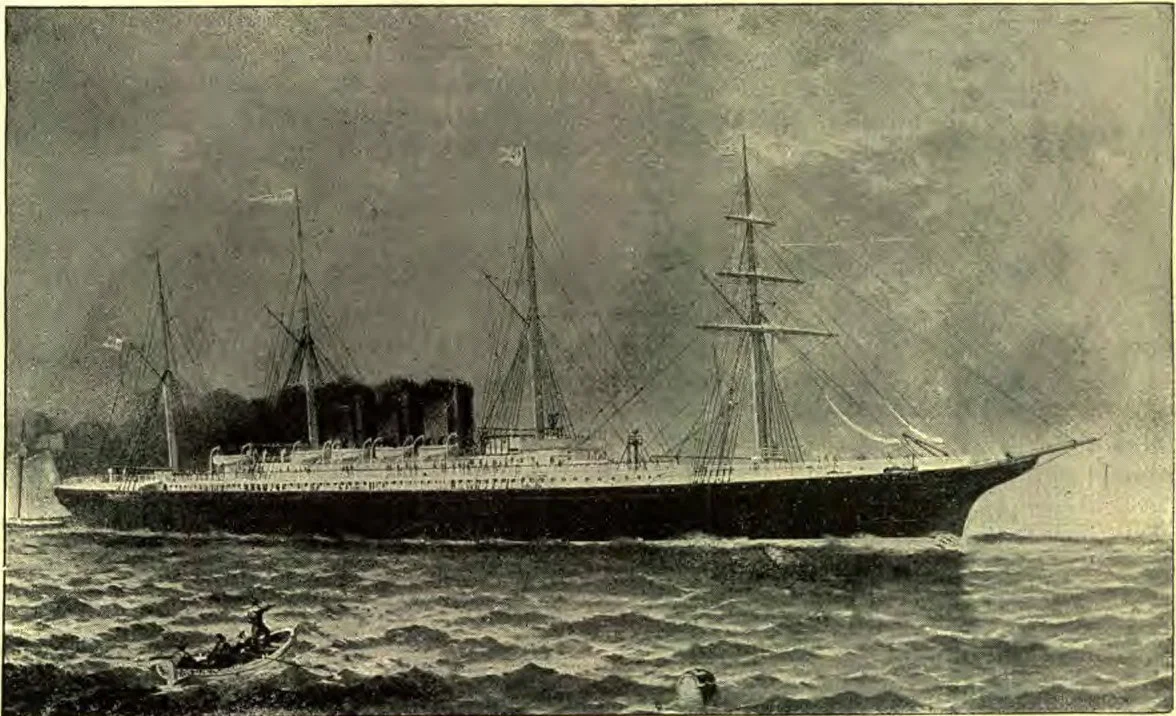
Doubtless many Instructor readers will be interested in a brief account of a trip across the Atlantic, especially since so many of our people cross this great body of restless waters in their mission to carry gospel truth to all the world.
When about to make the voyage, the first thing necessary is to select a line of steamers. There are numerous lines running from New York to Liverpool and Southampton in England, to Glasgow, Scotland, to Havre, France, to Antwerp, Belgium, and to Bremen and Hamburg in Germany, etc. These lines usually have one or two first-class fast boats, each trying to beat the records of others in order to “draw.” Having decided on some line, the next point is to choose the steamer; and of course those acquainted with the facts take the best boats. In consequence, these, though higher in price, are usually full, while the poorer boats often go with a light load.
To make sure of a place, it is necessary to engage passage from one to four weeks before the time of sailing. All the berths are numbered. When a ticket is sold, the number of berth is given; and when all places are taken, no more tickets are sold.
The hour for sailing is fixed and made known days in advance. When this hour draws near, the pier where the steamer lies presents a lively scene. Great loads of mail-bags, express wagons of baggage, hacks, carriages, and passengers afoot with numberless pieces of hand-baggage, are pressing toward the ship, and crowding up and down the gangways; while sailors are hustling trunks into the hold.
AN OCEAN STEAMER.
AN OCEAN STEAMER.
Usually a large number of relatives and friends accompany the ten or fifteen hundred passengers to the ship, many of them going into the boat, making it extremely crowded just before starting. Before loosing from the pier, a signal is given on board, and all who are not passengers are warned to get off the ship. In the meantime, tug-boats have taken position at the end and sides of the mammoth steamer, and when the ropes are loosed from the pier, these begin puffing and tugging in earnest, but ply for some time before the great mass begins to move. The tugs move the ship away from the dock, where she can work her own engines, and then the steamer handles herself with ease.
The parting moments at the pier present an affecting scene. To many it is in effect a final farewell. Emotions too deep for words find a partial expression in tears and sobs. As the steamer moves slowly away, the pier presents a bank of upturned faces and waving kerchiefs.
Steaming out from the harbor, many an interesting sight is in view. Behind is a fine panorama of the densest business portion of New York; to the left, like a cobweb across the sky, the great Brooklyn bridge; and to the right, on a small island, the gigantic statue of Liberty holding aloft her torch.
The distance down the harbor to Sandy Hook, where the ocean is entered, and whence the time of crossing the Atlantic is reckoned, is twenty-five miles. Soon after leaving Sandy Hook, the steamer slows down, and a little row-boat approaches to receive the harbor pilot, who now leaves the steamer. Now the mammoth engines begin to ply at full speed, the spray flies in front, and the ocean boils behind the steamer, and in a few hours, we are out of sight of land. Many on leaving native land, home, and friends to cross the ocean for the first time, and not knowing whether they will ever see their childhood home and friends again, linger on deck till the last point of land has sunk below the horizon. To many these are moments of sober reflection.
Having left the harbor, let us now give some attention to our floating palace, for such indeed are these marvels of naval skill. Our boat, the “Paris” of the American line, is forty-two feet deep, sixty-three and one fourth feet wide, and five hundred and sixty feet, or over thirty-four rods, long. She is of ten thousand eight hundred tons, and has four engines, aggregating twenty thousand horse-power, and requiring some three hundred tons of coal daily. Her speed is twenty nautical, or twenty-three statute, miles an hour, which is equal to that of the average passenger train. Unless something unusual occurs, the engines never stop night or day till the ocean is crossed.
The passengers are divided into three classes, each being assigned to a definite part of the ship. The first-class rooms and board are the finest that can be provided, the price for each person being from sixty to five hundred dollars, according to location and size of room. The second-class passengers, having the second best portion of the boat, pay thirty-five dollars and upward for the passage; while the third-class, or steerage, passengers have the poorest portion of the boat, with plain fare, and pay at the present time ten dollars. The price in all classes includes board, room, and furnished bed.
When the waves run high, and the boat begins to roll and pitch, many are taken with that unavoidable malady,—sea-sickness. Some soon recover, while others are sick all the way; and some who are not really sick feel so miserably that existence is not worth much to them. It is common for some to resolve that if they ever reach shore, they will never go to sea again.
At sea, passengers are usually free and sociable, not waiting for a formal introduction. There are stewards to care for the sleeping apartments, dining-rooms, and decks. On some ships they are kind and accommodating; while on others, they are less obliging. To pass the time away, passengers play various deck games, smoke, drink, play cards, read, visit with one another, etc. Sometimes the monotony is broken by the appearance of a steamer, and again by a shoal of sporting porpoises, or the spouting of a whale.
Every day the number of miles made by the ship is posted on the track chart. As land is neared, the spirits of the passengers revive; and when nearing port, all are astir, getting ready to embark. The weak begin to feel strong, and the hardships of the voyage give place to pleasant anticipations. Once at the wharf, our floating community of fifteen hundred breaks up, and soon its members are speeding in all directions to the various nations of Europe.
The distance from New York to Southampton or Liverpool, over three thousand miles, is made by the fast boats in seven days, and by the slower ones in nine days; but to many of the passengers these are extremely long days,—days that afford more pleasure when in the past than at the time.
H. P. Holser.

THREE SHIPS.

Three ships there be a-sailing Betwixt the earth and sky; And one is Now, and one is Then, And one is By and By.
The first little ship is all for you— Its masts are gold, its sails are blue, And this is the cargo it brings: Joyful days with sunlight glowing, Nights where dreams like stars are growing; Take them, Sweet, or they'll be going! For they every one have wings.
The second ship is all for me— A-sailing on a misty sea And out across the twilight gray. What it brought by gift and blessing Would not stay for my caressing— Was too dear for my possessing— So it sails and sails away.
The last ship, riding fair and high Upon the sea, is By and By. O wind, be kind, and gently blow! Not too swiftly hasten hither. When she turns, Sweet, you'll go with her— Sailing, floating, hither, thither, To what port I may not know.
—Harriet F. Blodgett, in St. Nicholas.

DON'T BE A COWARD.

“I won’t tell a lie! I won’t be such a coward,” said a fine little fellow, when he had broken a little statuette of his father’s in showing it to his playmates, and they were telling him how he could deceive his father and escape a scolding. He was right. So Charles Mann was right, and was rewarded for it, as the following story will show:—
“A young offender, whose name was Charlie Mann, smashed a large pane of glass in a chemist’s shop, and ran away at first; but he quickly thought: ‘What am I running for? It was an accident; why not turn and tell the truth?’”
“No sooner thought than done. Charlie was a brave boy. He told the whole truth—how the ball with which he was playing slipped out of his hand; how frightened he was, how sorry, too, at the mischief done, and willing to pay if he had the money.”
“Charlie did not have the money, but he could work, and to work he went at once, in the very shop where he broke the glass. It took him a long time to pay for the large and expensive pane he had shattered, but when he was done, he had endeared himself so much to the shopkeeper by his fidelity and truthfulness, that he could not hear of his going away, and Charlie became his clerk.”
“Ah, what a lucky day it was when I broke that window,” he used to say.
“‘Charlie,’ his mother would respond, ‘what a lucky day it was when you were not afraid to tell the truth.’”
“Lying lips are abomination to the Lord: but they that deal truly are his delight.”—Selected.

AVOID TRIFLING SPEECH.

“And you hath he quickened, who were dead in trespasses and sin; wherein in time past ye walked according to the course of this world, according to the prince of the power of the air, the spirit that now worketh in the children of disobedience: among whom also we all had our conversation in times past in the lusts of our flesh, fulfilling the desires of the flesh and of the mind; and were by nature the children of wrath, even as others. But God, who is rich in mercy, for his great love wherewith he loved us, even when we were dead in sins, hath quickened us together with Christ, (by grace ye are saved;) and hath raised us up together, and made us sit together in heavenly places in Christ Jesus.”
But while we are saved through grace, the apostle presents the part that we are to act. He says: “Work out your own salvation with fear and trembling [lest you become an influence to lead others astray]: for it is God that worketh in you both to will and to do of his good pleasure.” In these scriptures is presented the co-working of God with man and man with God. How important it is that the work shall go forward harmoniously, so that, as a result, the perfection of Christian character may be obtained through the union of the human and divine! Where this coöperation is found, these words are appropriate: “And you, that were sometime alienated and enemies in your mind by wicked works, yet now hath he reconciled,” that he may “present you holy and unblamable and unreprovable in his sight.” Let every soul remember that the Christian armor cannot be laid aside for one moment. We are called upon to keep up the warfare, to resist Satan, to watch and pray.
Where the heart is purified and refined, and made fit for the indwelling of the Holy Spirit, the tongue will be sanctified to the glory of God. When you hear young men jesting and joking, do not join in the merriment that dishonors Jesus Christ who died for them, but rather reprove them. Watch over one another for good. Pray for and with one another. You can surround your souls with an atmosphere that will be like breezes from the heavenly Eden. Open your heart to the Lord Jesus. Guard your tongue. Let not your tongue run at random in jesting and joking. These are signs that your heart needs to be cleansed from its defilement. Those who are earnestly striving to obtain the world to come, will act according to Christian principles in all the concerns of life. They will bring into practice the injunction: “Not slothful in business; fervent in spirit; serving the Lord.” If we are sincere Christians in meeting, we shall be sincere Christians at all times and in all places. I am very desirous that all who are acquainted with Christ shall manifest the fact by the spirit revealed in their words. Christ said: “A good man out of the good treasure of the heart bringeth forth good things: and an evil man out of the evil treasure bringeth forth evil things. But I say unto you, That every idle word that men shall speak, they shall give account thereof in the day of judgment. For by thy words thou shalt be justified, and by thy words thou shalt be condemned.” Our words index the state of our heart; and whether men talk much or little, their words express the character of their thoughts. A man’s character may be quite accurately estimated by the nature of his conversation. Sound, truthful words have the right ring in them. “The end of all things is at hand: be ye therefore sober, and watch unto prayer.”
MRS. E. G. WHITE.

SURFACE MOISTURE.

LIGHT and moisture are among the most important agents in promoting both animal and vegetable life, hence the Scriptures make use of these figures in illustrating the conditions necessary for a thrifty spiritual life. Thus salvation itself is frequently expressed by the term “water of life.” God’s people are said to drink water from the wells of salvation.
One whom God constantly sustains and supplies with spiritual food is compared to a “tree planted by the rivers of water.” When David felt great need of the help and blessing of God, and was most earnestly seeking these priceless treasures, he represented himself as being very thirsty: “My soul thirsteth for thee.” “As the hart panteth after the water brooks, so panteth my soul after thee, O God.” Another time he complained that his moisture was “turned into the drought of summer.” The figures of water and moisture are also commonly used to designate thrifty conditions in other respects.
Those who engage in the business of agriculture, gardening, etc., have constant occasion to note how apt and forcible these illustrations are. How vigorous and thrifty the plant appears which has had a sufficient supply of moisture, compared with the one which has lacked this valuable aid! Nevertheless the gardener also observes that plants which have been accustomed to an undue amount of artificial watering appear very flourishing as long as this constant supply is kept up; but if it is withheld, even for a short time, the plant quickly withers and dies much sooner than those which have had far less surface moisture, and more soil cultivation. The gardener wisely concludes that the over-watered plant, finding an abundance of moisture near the surface, has not been impelled to send its roots deep into the earth to get the moisture by natural means. It depended entirely upon the artificial supply; and when that was withheld, having no connection with deeper sources, of course it must quickly wither, whereas the plant which has had more judicious management has sent its roots deep into the soil, and draws its life-sustaining moisture from the provision there made for it; hence it could much better sustain the loss of the surface supply.
What a lesson there is here for us! What danger we are in of constantly looking for the approbation of others in all our efforts to do right, and if we receive this, of coming to depend upon it to sustain and encourage us, instead of seeking a deep experience for ourselves, and drawing our support and daily spiritual food from God and his word! This course is well illustrated by the plant which depended only on the shallow means of sustenance the surface treatment afforded, and neglected to send its roots deep down where the steady, constant supply could be reached.
Then let us dig deep, and become “rooted and grounded in Christ;” then, although we will have due regard for the opinions and counsels of those whose position or sound judgment entitle them to such respect, we will nevertheless be enabled to stand firmly for right principles, regardless of either praise or censure, if we may but know that our feet rest upon the word of God. David says: “All my springs are in thee;” and when we can truthfully say that all our strength comes from God, all our incentives to right-doing from the divine Source, then indeed the words of Hosea regarding Israel will be true of us: “He shall grow as the lily, and cast forth his roots as Lebanon.” JULIA H. DUFFIE.

THE POPE'S TROUBLES.

The people of Italy are intending to hold a great celebration of Italian unity on September 20, which day will be the twenty-fifth anniversary of the entrance into Rome of the troops of Victor Emmanuel. This celebration is very displeasing to the pope, who looks upon the king of Italy as a usurper in the “states of the church”; and as an expression of his feelings, and to show that like his predecessor, Pope Pius IX, he is irreconcilable to the idea of Italian unity, he declares that he regards such a celebration “as injurious and insulting to the pontiff and the Holy See.”
When the French troops left Rome in September, 1870, for the first time in one thousand years the papal throne was left unsupported by foreign bayonets. The king of Italy immediately occupied the city, and since then Rome has been the seat of the kingdom of Italy. As an excuse to his Catholic subjects, the king wrote to the pope that if he did not take possession of the city, a republic would be established there. At that time republics were a great scare to the papacy; but the pope has learned that a republic, as well as a king, can be molded so as to favor the papacy.
The New York Times has this to say about the pope’s objections to the celebration:—
“It is really about time that his Holiness ceased to harp on that particular string. It is true that his predecessors did govern Rome, and they did it very badly. The “states of the church” that used to figure in the geographies, were very injurious to the reputation of the church for ability and integrity. In those days Rome was run by a kind of sacerdotal Tammany, and the beginning of any Roman municipal reform movement must have been directed at the papal ring. In the second place, twenty-five years is too long for anybody to keep on complaining of a grievance which is perfectly certain of not being redressed. Whoever keeps it up so long is a bore. The present pope had an excellent opportunity to strengthen the church in Italy by dropping the subject, which his predecessor could scarcely have been expected to drop. By continuing to nag the Italian government, the pope has forced every Italian to choose between being a good Italian and being a good Catholic—with results very disastrous to the church.”

REPORT OF THE ARMENIAN COMMISSION.

The commission appointed by the powers of Europe to investigate the atrocities said to have been perpetrated upon the Christians of Armenia by Kurds and Turkish troops, has finished its labor and rendered its report. The members of the commission have spent months in the towns where the events occurred which gave such a shock to Europe and the whole civilized world; and although the Turkish officials appear to have thrown every possible obstacle in the way of their learning what really took place, the commission was not thwarted in its efforts. The tragic events were of such a nature that they could not be concealed, and it now is revealed anew to the world through the report of the commission, in all its horrid and ghastly features.
The report of the commission is that the stories of cruelties inflicted by the Kurds and troops of Turkey were substantially correct. It now appears to have been a parallel to the massacre of the people of Scio by the Turks in 1822, which so aroused the sympathy of the world for Greece, and their animosity against the barbarous Turk. Those who have contended that the reports were exaggerated, and have tried to believe that the Turkish government is not to blame in this matter, find that the report of the commission completely demolishes their theory, and with unsparing hand lays bare the barbarities of the unspeakable Turk. Although the Turks had taken every precaution possible to conceal their work, even to burning the bodies of their victims, they were not successful. Such wholesale slaughter could not be covered. In some towns the stench was so dreadful as to interfere seriously with the work of the commission.
The commission recommends many reforms in the administration of the government of Armenia, prominent among which are the following: The governors of many of the provinces to be Christians, who shall first be approved by the powers; the police are to be equally composed of Christians and Mohammedans; the funds necessary for local uses are to be retained in the provinces, and the remainder sent to Constantinople, which is a reversal of the former system; and there shall be no compulsory conversions to the religion of Islam.
The report of the commission, with the note of the powers thereupon, has been presented to the sultan, and it is said that he regards it favorably. The plan will probably therefore be attempted, but it cannot be anything more than a transitory makeshift. No governmental regulation, though backed by all the powers of Europe, will eradicate the innate cruelty which has been inseparably connected with the fanatical and ignorant followers of Mohammed through all their history. The Turk will never be regulated into good behavior. He has always been a robber and a tyrant, and his civilization is but the thinnest veneering of respectability covering a corrupt and cruel nature, which needs but slight provocation to burst forth into deeds of fiendish atrocity. Europe has been again and again stirred by the outrages which the Turks have committed upon the Christian people of the provinces under their sway; but Europe is apparently not yet quite ready to rise in its might and blot out this travesty on government, whose seat is at Constantinople. It will come, though.

JAPAN AND FORMOSA.

Now that Japan has made arrangements satisfactory to the powers, and everything bids fair for a peaceful adjustment of all the questions arising from the war and the terms of peace that followed, the people of Formosa, the large island which China gave up to Japan, have risen in rebellion, and declared a republic! But if the South American republics have hardly yet sufficient intelligence to govern themselves, what can be said of Formosa? A republic there would soon become anarchy.
It is not at all likely that any of the great nations will recognize the independence of Formosa, since such an action would be an insult both to China and Japan. China cannot make the people of Formosa submit to the treaty, but Japan will have no serious difficulty to do so. It will be a good training place for such of her soldiers as have not yet had any experience in war. It would be a great benefit to Formosa to come under the government of Japan. Barbarous peoples, like dangerous diseases, sometimes require heroic treatment; but the results are often satisfactory, and if Japan is allowed a free hand in Formosa, the island will become an important and valuable part of the “Empire of the Rising Sun,” as Japan is called.

Mexico Proposes Swift Death Penalty for Train Robbers

MEXICO has drafted a law for the punishment of train robbers that shows a true apprehension of the gravity of that crime. The law provides that, in case of such a robbery, or the death of a passenger or other innocent person, the death penalty shall be enforced with as few legal preliminaries as possible. Those captured at the time shall upon conviction be executed within fifteen days of the commission of the crime.

Manitoba School Question Settled Through Lord Aberdeen

THE Manitoba school question, which threatened serious trouble in the province, has been settled through the kindly intervention of Lord Aberdeen, the governor-general of Canada. The plan agreed upon is something like what was called the Fairbault plan in Minnesota. The school law will be so amended as to allow Catholic instruction in schools for a half hour every day. This is a Catholic victory, and it will be the means of teaching Catholic doctrines at the expense of the province to hundreds of non-Catholic children.

Pope's Encyclical on Christian Union and Indulgence

AGAIN the pope of Rome has written an encyclical letter, this time to the Catholic Church. The subject-matter of this communication is the union of Christendom, which he would be glad to see accomplished, by the return of all dissenters to the Roman fold. He promises to all who will for nine consecutive days repeat a special prayer for this purpose, an indulgence, which if the one making the prayers so desires, may be given to the souls in purgatory. It is probable that the pope believes all this; but it sounds very strange in the nineteenth century.

Loss of the Colima and Dom Pedro Steamers

Two great ocean disasters are reported to have occurred lately. May 29 the Pacific mail steamship “Colima,” from San Francisco to Panama, foundered off the coast of Mexico. One hundred and sixty-seven persons perished. One boat, with fourteen persons, reached Monzanillo, Mexico, in safety. This ship was built by Roach, of Philadelphia, and was on her one hundred and twenty-ninth voyage to Panama. On May 27 the French steamer “Dom Pedro” struck a reef of rocks on the west coast of the province of Galicia, in Spain, near Corunna, and went to pieces. There was a terrible panic, and one hundred persons were lost. The captain and twenty-six of the crew and passengers escaped.

Venezuela, Britain, and the Protection of Capital

A SCHEME is said to have been developed in Venezuela to thwart the British government in its efforts to annex a portion of that country to the British empire. It is that wealthy men from the United States shall locate there, establish a large bank under the governmental auspices, and so generally mingle capital from this country with that of Venezuela that the United States government will be under the necessity, in protecting United States capital, to protect also to some extent the property and interests of Venezuela. England can hardly complain if this should be done, for it is simply an English custom, long practised by her in her relations with other countries. “The protection of British interests” is an expression that means the protection of British capital; and the British tars and the union jack are always present where those interests are in danger. Perhaps the United States will learn to do the same. M. E. K.

TRUST NOT IN MAN.

“Put not your trust in princes, nor in the son of man, in whom there is no salvation.” Ps. 146:3, margin. It is no very uncommon thing to hear young Christians express themselves in favor of some certain minister and his preaching. They want to hear that certain man, have him labor with them, and they can hardly listen to any other person. If Brother A. is to speak, they must go without fail; but if it is Brother B., they sometimes say, “O, I don’t care to hear him; so I will not go.” This is wrong. While one method of instruction may be more interesting than another, all of God’s servants are sent to bear his message to us. Then the permission of this decided dislike to some and strong attachment to others soon brings us to the place where we are trusting in the man rather than in the Lord.
Luther said of his confidence in the pope of Rome: “I had an unfeigned veneration for the pope,—not seeking after livings or places, and such like; but whatsoever I did, I did with singleness of heart, with upright zeal, and for the glory of God. So great was the pope in my esteem, that I accounted the least deviation from him a sin, deserving damnation; and this ungodly opinion made me hold Huss as an accursed heretic, so much so that I esteemed it a sin only to think of him; and to defend the pope’s authority, I would have kindled the flames to burn the heretic, and should have believed that I was thereby showing the truest obedience to God.”
The church at Corinth fell into the man-trusting spirit. It led to strife and divisions, which brought to the surface the carnality of the heart. The apostle Paul thus addressed them: “While one saith, I am of Paul; and another, I am of Apollos; are ye not carnal? Who then is Paul, and who is Apollos, but ministers by whom ye believed, even as the Lord gave to every man?” All God’s ministers are to be respected as servants of God, but none are to be worshiped. Even an angel from heaven forbade John to worship him. Rev. 19:10. If we are forbidden to worship angels, how much less should we bow in our minds to men! Men may please us, may instruct us, may speak words of comfort to us; but they cannot save us.
“Happy is he that hath the God of Jacob for his help, whose hope is in the Lord his God.” Ps. 146:5. Then let our trust be in Jehovah; for in him is all strength. We can respect all God’s servants for the message they bring to us from the Lord; but we should receive the message as from God, and worship him, and him only. J. H. D.

CHRIST IN THE BELIEVER.

The Woman’s Journal, of Ottawa, Canada, contains in its issue of May the following statement:—
“The Rev. Joseph Cook, the celebrated orator and writer, is soon to make his second journey around the world. The White Ribbon movement—indeed, every progressive reform that seeks to incarnate Christ in custom and in law—finds in this great man a devoted and powerful ally.”
Yes; this “great man,” and many others with him, desires to incarnate Christ in law. This may sound very well to those who do not stop to consider what is involved in that expression, and what will certainly grow from it.
The meaning of the above somewhat ambiguous statement is that the laws of nations should be made to sustain and foster Christianity, and by Christianity is meant some particular system of theology that those who are in this kind of incarnation business believe is the true Christianity. It is just that, no more and no less. There are many believers in Christianity who hold views in regard to the doctrines of Christ widely different from those who are laboring so assiduously to have their views and ideas of what Christianity is, incarnated in the law; but of course the rights of such will not be respected in the least by these laws, should they once be established. Stripped of all false disguises, this work, with its fair and pretentious Christian outside, is an attempt to secure the aid of the civil law to compel one party to receive and practice, in some outward aspects at least, the religion of the other. Then instead of its being an incarnation of Christ in the law, it is simply an incarnation of the selfishness and pious bigotry of those who, because others will not accept their ideas of religion, want to compel them by law at least to seem to do so.
There is nothing particularly new in this idea; it was a fundamental principle in pagan Rome. The religion of Rome was incarnated in the laws of Rome. Because of this, Paul was beheaded, and millions of Christians found a martyr’s grave, and will find a martyr’s reward. Papal Rome borrowed this idea of religion incarnated in the law from paganism. What was thought to be the incarnation of Christ in law swept from the earth fifty millions of true believers in Jesus. Protestants have clung to the same mistaken notion, and state churches and laws for the punishment of heresy have been the result. Laws for the observance of Sunday are an outgrowth of this idea. This old pagan and papal plan of religion and religious observances by law crossed the ocean in the “Mayflower,” and has imbedded itself in the laws of nearly every State of the American Union.
The enforcement of these laws, in which Christ is supposed to be incarnated, thrusts his humble followers into jails, and subjects them to vexation, loss of property, and has in some instances caused the loss of life. Instead, then, of its being Christ incarnated in law, it is really Christ, in his followers, incarcerated in jail by law. All this is done now; but still those who are back of this unchristian work, carried on in the name of Christ, are not satisfied. They want more, and no one can express their wants better than did Pope Leo XIII, when, in speaking of the Catholic Church in this country, he said that “she would bring forth more abundant fruits if, in addition to liberty, she enjoyed the favor of the laws and the patronage of the public authority.” So in the movement discussed in this article we may see a new papacy, so like the original that their kinship cannot be disputed. There is no Christ in it. Inside and outside it bears the marks of the enemy. Service to Christ, compelled by the civil law, is not acceptable worship. It may please a corrupt church; it will not please the holy God. Jesus does not want a place in our laws; he does want a place in our hearts. He wants access to our hearts,—not by the power of the civil law, but by the power of his wonderful love. It is not Christ in the law, but “Christ in you the hope of glory,” that is his desire. While we see the false way, let us also see and accept the true. M. E. K.

DRUNK BUT ONCE.

Many men who are in the habit of indulging in intoxicating drink often pride themselves that they were never yet found drunk, or never were “drunk but once.” But he who has begun to meddle with strong drink knows not how soon he may be drunk, and how soon he may take the last step that ends in utter ruin.
At an execution, the sheriff took out his watch, and said to the criminal: “If you have anything to say, speak now; for you have only five minutes to live.” The young man burst into tears, and said: “I have to die. I had only one little brother, and he had beautiful blue eyes, and flaxen hair, and I loved him; but one day I got drunk, for the first time in my life, and coming home I found my little brother gathering strawberries in the garden, and I became angry with him without a cause, and killed him at one blow with a rake. I did not know anything about it until the next morning when I awoke from sleep, and found myself tied and guarded, and was told that when my little brother was found, his hair was clotted with his blood and brains, and he was dead. Drink has done this; it has ruined me! I never was drunk but once. I have only one word more to say, and then I am going to my final Judge. I say it to young people: Never, never, never touch anything that can intoxicate!”
Let every young man who reads the above take warning, and shun the evil cup as he would a deadly serpent. Not only shun it, but be energetic in warning those who are turned that way. J. H. D.

THE IOWA CAMP-MEETING.

THIS meeting was held in a beautiful grove in the suburbs of Des Moines. There was a good attendance, and the meeting was an excellent one. There were a large number of young people on the ground. Many of these were enjoying the presence of the Lord, and ready to work for others. There were some that came to the meeting unconverted, but the most of this class seemed to have an interest in the services, and some of them gave their hearts to the Lord.
Elder Watson, with other assistants, had charge of the young people’s services, and did good work. I had the privilege of speaking to them a few times in their early morning meeting. The Spirit of the Lord was present, and some were led to seek the Lord.
One interesting feature of the work at this meeting was that there were some twenty or more of the young people that offered themselves for training for the foreign missionary work. Several of these made arrangements to go at once to the Sanitarium to take the training course, while others will go later. The Iowa Conference employs quite a large number, while there are a goodly number that think of attending Union College the coming year.
We are glad that the Lord is working on the hearts of our young people to give themselves to the cause of God. The field is a large one, and the laborers are few. We must look to our young people for the laborers to fill the calls. But they cannot go unless they have a training for the work.
I called attention to the INSTRUCTOR as their paper. There was a good response, and a willingness to make an effort to increase its circulation in the future. J. H. D.
Continue reading: LESSON 13.— THE TIME OF THE END