IT has been said that no man can get money without earning it unless some other man earns money without getting it. Nothing truer could be uttered. We all know that never before were there so many men whose sole labor consisted in scheming and plotting to get something for nothing, to get their daily bread by the sweat of another's face. One of Emerson's tart epigrams yields a pertinent thought: "Every drop of man's sweat is his own. Who steals it is a thief. So sacred a being is man that whoso wrongs him robs God." How horrible the thought that one man—to fatten his own purse—should lay hands on another man, to coin his sweat and toil! But this is precisely what most men, who can, are doing.
To further illustrate how the love of money inevitably issues in deeds of sin and crime, I shall first briefly tell the story of how the slaves to greed are
Stealing the Public Lands.
Only a few months ago the Federal Government discovered that, during the last eight years, it had been systematically swindled out of twenty million dollars' worth of land in Oregon, California, and Arizona, alone. The vast areas that have been thus fraudulently appropriated by ravenous individuals and corporate speculators include 2,000,000 acres of the most valuable timber lands on the Pacific Coast. A Minnesota newspaper has estimated that the loss sustained by the Government, in the year 1904, was $500,000,000, as the result of the criminal appropriation of the public lands.
The Government has instituted a sweeping investigation of these gigantic frauds, and, as a result, the moral sense of the nation has received a terrific shock in view of the undreamed-of magnitude of these stealings. In the words of another, "Such a mass of fraud you will find nowhere else on earth."
Perhaps the most surprising and deplorable of the many black things that have been dragged into the light by this investigation, is the fact that persons of high repute, of national esteem, have been the arch conspirators in this monstrous campaign of Land Graft. Among those indicted on a charge of conspiracy to defraud the Government, are included an aged United States Senator, two Congressmen, a United States District Attorney, a half-dozen Surveyors-General, and other high Federal officials. It is now certain that eight or ten of the wealthiest and best-known land kings of California, Idaho, and Washington, will soon be hopelessly enmeshed in the legal net, by Federal indictment. In reference to large numbers of prominent men who have been robbing the Government and are now indicted, Mr. Bailey Millard writes: "It would be tiresome to give all the names; it would be a sort of roll-call of nearly all who
have secured large holdings of fertile lands in Oregon and California." At any rate, the iron hand of Federal law has fallen upon the shoulders of so many high-caste robber-barons that an epidemic of terror has seized upon this province of the Kingdom of Graft.
It is bewildering to contemplate the enormous tracts of land which have been unlawfully acquired by individual adventures. A well-known land magnate of California owns (?) an aggregate of 14,539,200 acres, in various parts of the Pacific States. That is a territory equal to the combined area of New Hampshire, Massachusetts, Connecticut, and Delaware. There are a score of these landed barons, each of whose estates are only a little less in extent. Many of these men stole their lands so long ago that, owing to the time-limitation of the laws, they are no longer amenable to the statutes they transgressed.
It is impossible to appreciate the enormity of these villainous transactions unless we know something of the detailed iniquities involved in the schemes by which land-stealing is perpetrated. Briefly summarized, the principal methods employed are, first, swindling the Government by fraudulent surveys made on the application of fictitious persons; second, securing, by perjured testimony, title to worthless lands which are then exchanged, by an adroit system, for good land; third, the acquisition of large tracts of land by corporations or their agents, by means of "stool pigeons," or dummies, who, on perjured testimony, secure title to the land and immediately turn it over to the parties who, supply the money; fourth, by fencing of Government land by persons or corporations owning large tracts adjoining that which they fence, and which they then use to the exclusion of bona fide settlers.
The third scheme has been far more extensively used than the others. Of course the dummy performs his diabolical part of the infamous business for a consideration in the form of a conscience-soothing bribe. He must perjure himself by swearing that his application is made in good faith, for the purpose of actual settlement and cultivation and not for the benefit of any other person or corporation; he must swear that he is not in collusion with any person to give him the benefit of the land entered; he must swear not to make any agreement with another by which the title he acquires should inhere in whole or in part to the benefit of any person except himself. All this swearing, both before a notary and repeatedly in a court of justice, mind you, is naked perjury. Speaking of these lying affidavits—these compound, doubly-distilled perjuries—the agent of one of the largest companies of land grafters, said to Mr. Millard: "It's the regular thing. Spurious applications and affidavits are filed every day for the benefit of men who are acquiring thousands of acres. . . . Yes, it's done every day; they all do it." In thousands of these nefarious transactions, the officers of the law, through whom the transactions10were executed, knew that the whole thing was a farce.
In the face of all this, we are continually exhorted by preachers and the yellow newspapers to believe that society is growing better and that the millennium of universal peace and righteousness is actually dawning!
Vicious Politics of Yellow Journalism.
The ideals for which the “yellow” newspaper stands were conceived in the brain of Mr. Joseph Pulitzer, editor of the New York World, twenty-three years ago. He was quick to note that the psychological moment for so radical a change in the controlling policy of a great city newspaper had come. His ability to detect this subtle fact was owing to the obvious inability of the newspapers of the old school any longer to control public opinion as they did in the halcyon days of Horace Greeley. Mr. Pulitzer avowed that his business was not only to publish a newspaper, but to SELL it. Hence he determined to publish just the kind of paper that would most effectually pander to the popular taste, not to please the people for pleasure’s sake, but to please them for the sake of their patronage. Again, we see that the motive leading to so startling an innovation was a raw commercial motive, just as we should expect in an age of rampant GREED.
In submitting his unique scheme to his chief assistant, he reasoned substantially as follows: The trouble with the American people to-day is their assumed independence. They imagine they are alone in the universe. They are wealth-mad. They see it on every side of them—money and the work of money. They have created fortunes and they don’t know how to spend them. Those who have not succeeded in amassing money worship those who have, and these worshipers are in the majority. Their every thought is to become like the rich; to emulate their every act and success. It is a sensation with them; they crave sensation. To be rich is the one object of the masses in every walk of life in this country to-day. There is nothing akin to this money craze in the older countries of Europe; but in place of it they have an aristocracy. They expend their sentiment on that.
Hence he reasoned that since the American people had become snobbish, he would make money by truckling to their snobbery. The people, he said, were craving an aristocracy, and hence they must have it. He would tell his readers how the nobility of wealth had become rich, how they spend their money, how they live, and what their ambitions are. He saw that the rich had become a class, and that that class was America’s counterpart of Europe’s aristocracy. He would make that fact the key-note. He declared that the “400” should be made the nucleus of the new aristocracy.
A noted writer asks: “Was Joseph Pulitzer correct in his analysis of the people?” He answers his own question thus: “The public has been saying ‘yes’ every hour of every day since then, if not to him and his institutions, then to his imitators and theirs.” The dawning of the day of the yellow newspaper was the dawning of the day of the fake story.
The writers for the sensational papers know that the distinctive weakness of modern society is a love for exaggeration, for the abnormal, the scandalous. They themselves confess that they deliberately misrepresent current facts; that they enlarge the most inconsequential events into matters of seemingly great moment.
No scruples of conscience dare stand in the way of pandering to whatever is morbid, prurient, melodramatic, in the tastes of society. The controlling axiom of the yellow journal office is, “All the world’s a fake, and men and women merely fakers.” “The people love to be startled, shocked; and they are willing to pay for these sensations; therefore we must give them what they want, and they will give us what we want—dollars.” There you have the logic of the yellow journalist.
One of the ablest writers on the staff of a leading yellow daily, recently admitted that all the romantic stories purporting to bear on the operations in the field, during our war with Spain, which appeared in those papers were “fakes” pure and simple. In his anonymous confession (in Public Opinion) the same writer says: “It is an easy task to wash a man’s reputation through a trough of printer’s ink and make it of no more worth than a cigar butt you may cast into the gutter. Yellow journalism is doing this every day. The veriest whisper of scandal against a man or woman is sufficient unto the evils of the longest columns and the blackest heads.” The persons must, of course, be of wealth or position to warrant the retailing of the whisper. It is an axiom in the yellow world that no other story is so good a story as that which tells something of bad import about a person of distinction.
One of the blackest illustrations of this fiendish policy was the vile scandal that was reeked by these papers on the occasion of the murder of a public-spirited citizen of New York City, a few years ago. An obscene incident of the murder was seized upon by the yellow writers, with which to weave around the memory of the dead man one of the foulest stories that ever leaped from a wicked brain. In respect to this incident the same writer confesses: “We snatched at his name, as birds of carrion snatch at a morsel from some rotting carcass, and dragged it down to the purlieus of a fetid city. . . . We went out of our way to take some trivial incident in his career, to take some man’s recollections of a peculiar trait to justify our plan of damnation.” He says further that he could name an innocent, virtuous young woman, who is alive, and who, by the workings of the yellow system of sensationalism, suffered a wrong that can never be righted in this world. The yellow papers stopped at nothing in their awful purpose to brand this innocent woman as one of lost honor. This dark slander was fabricated to supply the people with spicy romance. That they wanted; that they would pay for. Ah, it’s all a matter of having a fat balance on the right side of the ledger!
I dare not further illustrate the atrocious maxims of the yellow press. It is regrettable to think that society not only tolerates, but fosters, such enormous evils. The public is chiefly to blame. That the people give their fealty to these journals is proved by the free, unstinted support they give them. The same unhealthy, vicious tastes prevail among country folk. They too demand “Spanish dishes” in their mental bill of fare. Hence the melancholy fact stares us in the face, that in the small cities, and in the villages and towns, are found all the accessories of the yellow system. “We need the money, and hence we must give our readers what they are willing to pay for,” say the village editors, in justification of their base truckling.
The love of money is the root of all kinds of evil.
Extortion by Manipulating Stocks.
Referring to the making of great trust corporations Mr. Lawson writes:
Into the rigging and launching of almost every big financial operation in the United States during the last twenty years, double-dealing, sharp practice, and jobbery have entered; and, what is more, the men interested have participated in and profited thereby. To correct a popular fallacy I want to say that I am not referring here simply to moral derelictions, but to actual legal crimes. If the details of the great reorganization and trustification deals put through since 1885 could be laid bare, eight out of ten of our most successful stock-jobbing financiers would be in a fair way to get into state or federal prisons.
The principal species of “sharp-dealing” and “jobbery,” which has entered into the equipping and launching of the great industrial corporations, in recent years is the iniquitous practise of issuing vast blocks of “watered” stock. By watered stock is meant stock not based upon actual capital or value, and hence often called inflated capital. The reader will recall that during the years 1899 to 1902 this country was “trust mad.” A veritable mania for creating and launching Titanic corporations, largely on inflated capital, seized upon our people. The capitalization represented by the monster trusts conceived during those years, actual and watered, aggregated many billions of dollars.
Even so conservative a financier as Mr. Henry Clews, president of one of the strongest New York banks, tells the readers of the Cosmopolitan Magazine that the obvious purpose of the promoters of these trust companies, in issuing hundreds of millions of stocks based on nothing but wind and water, was, first, to sell as much of it as possible to the unsuspecting and “confiding” public, and by that means loot the “dear people” to the tune of upwards of a billion dollars. The editor of the Arena wrote last February: “Certain coteries [of capitalists] are acquiring millions of unearned money through inflation or stock-watering and through gambling with loaded dice.”
A concrete illustration will serve to make clear how this modern system of rapine and pillage is carried out by the “respectable,” and often “pious,” votaries of “high finance.” Mr. Lawson has graphically described the methods by which a few millionaire gamblers in stocks fleeced the public of many millions by manipulating Amalgamated Copper. These modern robber-barons secured the copper properties that made up what is known as Amalgamated at a cost of $39,000,000. This they immediately capitalized for $75,000,000, or $36,000,000 above its cost and actual value. In this way the public were led to believe that a property which was worth $39,000,000 had an actual value of $75,000,000, being wholly ignorant of the fact that $36,000,000 was a fictitious creation.
The next step necessary to success in this predatory enterprise was to inflame the public imagination and stimulate the passion for dollars by exhibiting pictures of vast fortunes to be won by getting possession of this stock, which was described as representing enormously-rich properties. And now followed that game so thoroughly mastered by the giant gamblers of Wall Street, who always play with loaded dice. In the parlance of the stock-market the game is known as “washing” stock. It is simply a fake auction on a big scale. Having a lot of watered stock which they desire to unload on the investing public,11at a handsome price, these manipulators (the great millionaires whose names we hear every day) enter the arena and begin to bid against each other until the price is pushed up to a high figure. They pretend, of course, that it is a legitimate transaction, yet, all the while, it is a fake procedure pure and simple, for the express purpose of creating the impression in the minds of the “outsiders” that the stock is of exceptional value. Then the poor, gullible creatures, in good faith, begin to bid, and it is not long until the worthless stuff is handed out to the dupes in exchange for millions of good money.
It was thus, through the magic of this little game, that a few of the Masters of Standard Oil traded off the fictitiously-created stock of Amalgamated Copper for $36,000,000 of the people’s gold. And this instance is purely typical of the methods by which, during the one year of 1901, hundreds of thousands of families were plundered of all they had. Through this consummate game of false pretense, of wretched, wholesale faking, the American people were wheedled into handing over to a handful of Wall Street bandits nearly two billion dollars worth of hard-earned property, in less than three years. And even today the Wall Street merry-go-round still gyrates.
The following excerpt from the Saturday Evening Post contains a most pertinent thought in this connection:
Many are coming forward and announcing in their deepest chest tones that they purpose to abolish what is popularly called “frenzied finance.” And each gets a hearty round of cheers. But “frenzied finance” goes on unabolished.
The reason is that it, like so many of our great national “problems” is a “local issue.” It is local to each individual who has had the industry to accumulate money for investment. Every man can abolish “frenzied finance” for himself—and that is the matter of prime importance to him. The way to abolish it is simple—don’t invest your hard-earned money in Wall Street wind.
This thought is good as far as it goes; but the writer does not reach the root of the trouble. To abolish “frenzied finance” it is necessary first to banish avarice from the individual heart. This can be done by nothing less than the power of the Gospel, which “is the power of God unto salvation” from sin; and greed is a glaring form of sin.
Doubtless we have all remarked that it is scarcely possible to pick up a current newspaper or magazine, without our eyes catching something of this sort: “This is an age of dollars, big and senseless.” “Dollars run things in these days.” “Ours is an age of unmatched greed,” and so on. Yes, so often have the changes been rung on this obvious truth, that to repeat it is to lay oneself open to a charge of uttering platitudes. Perhaps some of us have not only apprehended the truth of these trite sayings, but by painful personal experience, have felt their truth. This wealth-lust has become a disease, acute,—and chronic, too.
Our knowledge and experience, however, only confirm the prophetic verdict of Holy Writ. Clear as the white light of the noonday sun is the following inspired foretelling respecting the religion of money which so despotically dominates humanity in these stressful and crucial last days. Note how sharp and clear it rings: “But know this, that IN THE LAST DAYS grievous times shall come.” Why—“FOR men shall be lovers of self, LOVERS OF MONEY.” How wonderfully exact and full is the fulfilment of this startlingly laconic prophecy, in these very days in which you and I live, dear reader!
We see, then, that to-day men’s hearts fairly pant for riches, and that God foresaw and foretold this terribly-sad truth. But what is supremely important to us is to recognize the fact that God revealed this truth for the express purpose of enabling us to know that we are actually living “in the last days”—in the days when the Son of man is about “to be revealed.” Ah, it was in the spirit of “everlasting kindness” that He condescended to inform us of this solemn truth. In every age, God would have the people live in the full blaze of the prophetic light that shines for that age. “Surely the Lord Jehovah will do nothing, except He reveal His secret unto His servants the prophets.” Amos 3:7. In respect to the day of the coming of Christ, the Holy Spirit bears repeated testimony that the “children of the kingdom” would know, at the appropriate time, that that day is near. He has graciously revealed the tokens, the signs by which they not only can know, but ought to know the time of the approaching of that momentous day. And one of the most marked and conspicuous of those many signs is that men would “be lovers of money,” and would, accordingly, heap up treasures “in the last days.” Shall we not with David pray: “Open Thou mine eyes, that I may behold” the manifold tokens of the imminence of “that blessed hope, and the glorious appearing of the great God”?
[The next article in the series will be, “In the Lap of Luxury.”]
SAVED BY A GIFT.
A MAN of wealth and culture had just buried his wife and child, whom he idolized. He was in utter despair, for he was all alone in the world. As he walked the streets one night trying to get courage to commit suicide, he was met by an outcast child, who begged him to give her something to eat. Impatiently he flung a coin at her feet and then followed her to see what she would do with it. She bought a loaf of bread and ate as only a starving child could eat. His interest was aroused, he forgot his own trouble and then and there undertook the support of the child, and lived to become a Christian philanthropist. He was saved by a gift to an unknown beggar. "A heart opened by love for man," writes Ida Q. Moulton in The Record of Christian Work, "soon comes to know the love of God and gives to Him." Giving not only creates, but increases, love.
“LET NOT YOUR HEART BE TROUBLED.”
By N. P. Neilsen
BY N. P. NEILSEN.
RINGING down through the ages come the cheering words from the lips of the Saviour of mankind, “Let not your heart be troubled.” Perplexity, trouble and distress are found on every hand, but “let not your heart be troubled.” Anchor your soul in Jesus. He speaks peace to the troubled heart. The storms of life may rage, the billows of sorrow roll, and the waters of trouble sweep over your head, but listen to the cheering words: “Let not your heart be troubled.” “Come unto Me, . . . and rest.” Sweet indeed is this rest, buried in the depths of the soul beyond the reach of the rising tide! When men’s hearts are failing them for fear, “and for looking after those things which are coming on the earth” remember the blessed words, “Let not your heart be troubled;” and, unruffled by the troublous times, you can sweetly rest in the Saviour’s love. Trembling soul, take courage! The Saviour loves His own. He loves them unto the end. Soon the dark night of sin will be ended, and the eternal reign of peace be ushered in. Then you may rest in the city of God and the storms will rage no more.
TWO PROMINENT ORDINANCES.
1. As Christ engaged in His last Passover supper with His disciples, what spirit did they manifest?
“And there was also a strife among them, which of them should be accounted the greatest.” Luke 22:24.
2. As this spirit was notably manifest, what did Jesus do?
“He riseth from supper, and laid aside His garments; and took a towel, and girded Himself. After that He poureth water into a basin, and began to wash the disciples’ feet, and to wipe them with the towel wherewith He was girded.” John 13:4, 5.
3. How was this act to be regarded by believers?
“Ye call Me Master and Lord; and ye say well; for so I am. If I then, your Lord and Master, have washed your feet; ye also ought to wash one anothers’ feet. For I have given you an example, that ye should do as I have done to you.” Verses 13-15.
4. What blessing is pronounced in connection with this ordinance?
“If ye know these things, happy are ye if ye do them.” Verse 17.
5. What further proof have we that this was to be a permanent ordinance?
“And Jesus came and spoke unto them, saying, All power is given unto Me in heaven and in earth. Go ye therefore, and teach all nations, baptizing them in the name of the Father, and of the Son, and of the Holy Ghost: teaching them to observe all things whatsoever I have commanded you; and, lo, I am with you alway, even unto the end of the world.” Matt. 28:18-20.
6. At the close of the Passover supper, what other ordinance was instituted?
“And He took bread, and gave thanks, and break it, and gave unto them, saying, This is My body which is given for you; this do in remembrance of Me. Likewise also the cup after supper, saying, This cup is the new testament in My blood, which is shed for you.” Luke 22:19, 20; also Matt. 26:26-28; Mark 14:22-24.
7. What later apostle received special instruction concerning this ordinance?
The apostle Paul says: “I have received from the Lord that which I also delivered unto you, That the Lord Jesus the same night in which He was betrayed took bread,” etc. 1 Cor. 11:23.
8. Why was it necessary to repeat instruction regarding this ordinance?
Because many of the Corinthian brethren were perverting its observance. See verses 18-22.
9. What is especially shown in this ordinance?
“As often as ye eat this bread, and drink this cup, ye do show the Lord’s death till He come.” Verse 26.
10. What admonition is given by the apostle?
“Let a man examine himself, and so let him eat of that bread, and drink of that cup. For he that eateth and drinketh unworthily, eateth and drinketh damnation [margin, “judgment”] to himself, not discerning the Lord’s body.” Verses 28, 29.
NOTE.—“Unworthily” here means in an unworthy manner, as the apostle had before indicated. They had been partaking in a way that manifested self-gratification, overlooking the solemn significance of the ordinance. It is well to realize that no one is of himself worthy of any privilege under the Gospel, but by faith and careful observance of the Lord’s instruction, we may partake of the supper in a proper and acceptable manner. Let each examine himself, but he is not to judge others.
Opium in China
Opium in China.—The wrong done to China by forcing upon her the opium treaty of 1841 will not cease to disturb the conscience of the people of Great Britain until the treaty is abolished. That it will be abolished sometime we have little doubt, for truth and righteousness will ultimately prevail. Special pressure is to be brought upon Great Britain at the present time to bring about this happy result speedily.
It is said that Japan proposes to ask the United States to join with her in interceding with Britain in this matter. The poverty, desolation, and wo among the Chinese, caused by the use of the drug, are terrible beyond description. It does not meet the case to say that China is now cultivating the poppy to such an extent that she can obtain a supply without the Indian product. The Chinese will never forgive Britain for compelling them to receive the foreign product until she ceases such compulsion. No doubt Great Britain would annul the obnoxious treaty at once, were it not for what are regarded as the necessities of revenue in India. But there is no necessity which involves a wrong like this. Let the prayers of Christians in all nations join with those of the Christian people of Great Britain, who deplore the position of their government, in seeking such influences from above as shall lead those in authority to abrogate the unrighteous treaty.—Missionary Herald.
FROM CANTON, CHINA.
By Ida E. Thompson
[A letter, dated March 5, 1905, from Sister Ida E. Thompson, to the Wisconsin Reporter.]
To you who have so kindly and generously given of your means to open and support the Chinese Girls' School, we feel indeed grateful. Could you spend a few hours with us, you certainly would say it was not given in vain. The school opened March 17, 1904, and continued until January 15, 1905. Of the first twenty-five girls who enrolled, twenty-two remained with us throughout the year. About the middle of October, we added a second teacher, and increased our number of pupils. We spent the first half of the day on Bible and Christian Gings, as the lessons from the Bible for beginners are called, and Chinese books teaching semi-foreign ideas of education, industries, Chinese customs, etc. The latter books are written in the scholarly language, while the former are colloquial. We refused to teach Confucian books, which was not well received by some at first, but none left the school permanently on this account.
Our first class studied the Gings mentioned, and then committed to memory Mark's entire Gospel. I could begin where I would in any chapter, and any one in the class would take it up, and repeat from memory to the end. I was surprised and greatly pleased to see what such small children could do. This class consisted of girls thirteen years of age. We also learned to sing thirty-five hymns translated from "Gospel Hymns." All above the primary class were required to write any character in their Chinese books which they read. I conducted oral reviews each week, and, at the close of the year, gave regular examinations by which they are to be graded this year.
China Waiting for the Gospel Message.
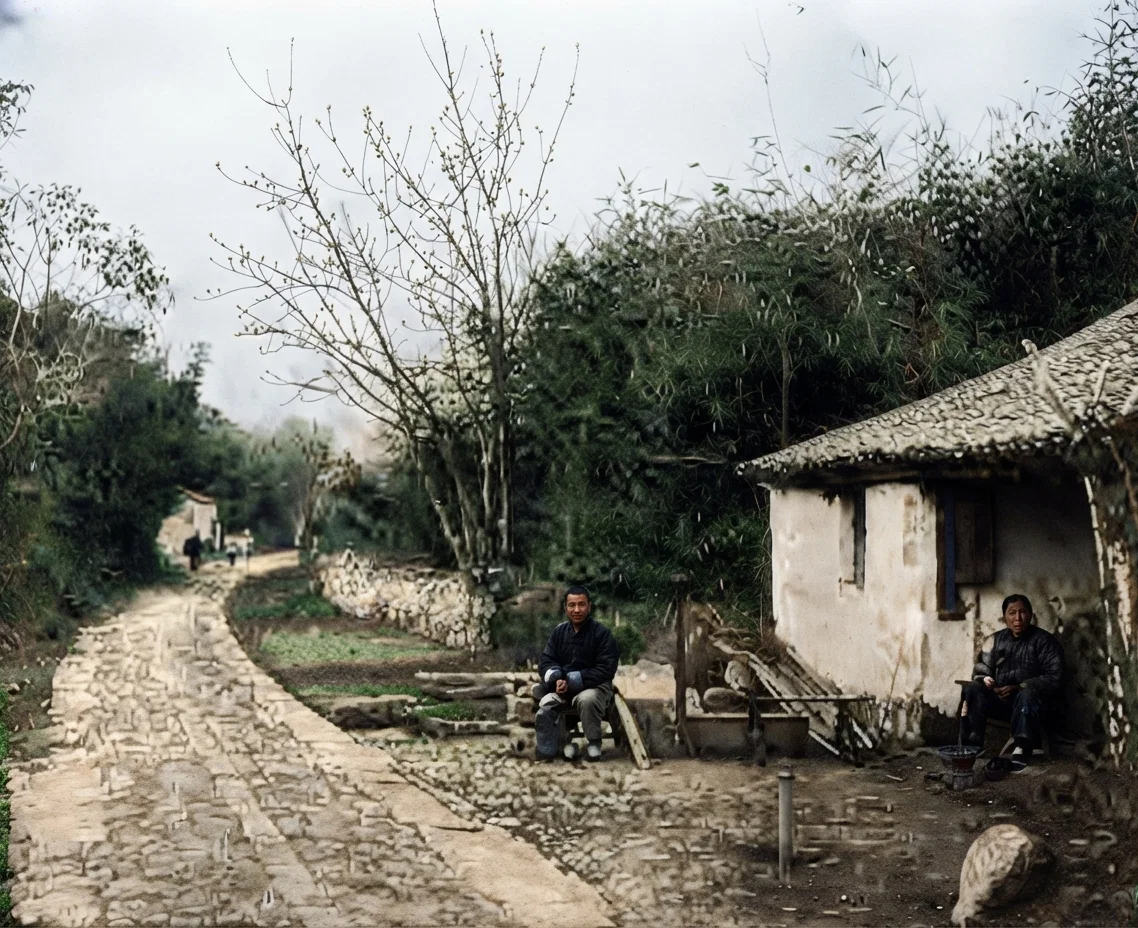
On Sabbath we held Sabbath-school for two hours, and all attended unless there was a reasonable excuse offered. It was not a hard matter to interest them in Bible lessons, nor did the hours seem to drag, only too soon the time was gone. The majority of the girls assure us they do not now worship Joss. In a few instances we have proven them true to their Christian teaching. One little girl, nine years of age, lost her grandmother by death. The Chinese custom would demand of her to worship the departed spirit, and also worship at the altar, entreating evil spirits to depart from her and the home; also they must send gifts in the form of paper, clothing, money, and food to the departed spirit. This ceremony took place right in view from my window, but this dear little girl took no part in the worship, tho she walked in the procession of relatives, all of whom took part. By this one act I felt paid for all my efforts put forth in her behalf.
The girls come to my rooms on Sunday, and learn to knit. On Friday afternoons the teachers taught them to sew. They made the greater part of five pieced quilt covers, table spreads, etc. These articles were sold, and thus but little, if anything, was lost in the purchase of needed materials. If we could buy prints here as cheaply as you can in America, it would help us much; but common calico is twenty to twenty-five cents a yard, or about ten cents or a shilling, gold. Remnants sell the same as a whole bolt. Some did very neat work, indeed. I took some work to a friend, who declared it was machine work, so even were the stitches.
A Humble Home in China.
The entire expense of the school for desks, books, house rent, teacher's salary, and material for work, amounted to about $125 of your money. The balance of the money is on deposit, drawing a small rate of interest. I hope next year we may be able to build a simple schoolroom, if we can buy a mission home. What do you think of the plan? We must have a boarding-school, but this has been deferred one year more, for several reasons. It would require my whole time, were we to open it this year, as we are so dependent on others for help, and we do not want to train our girls, and then find they are taught doctrines not founded on the Scriptures.
This year we have engaged a teacher who is not a church-member, feeling we could better manage affairs under her supervision. We are praying daily for God to send us another teacher who will not be an injury to the work, and who loves God, and will forward the cause of truth.
I am sure it is not easy for you to understand our situation in starting the work in China. In the first place, we have a peculiar truth which makes other missions slow to allow their teachers and helpers to come to our assistance. The remaining alternative is to select from heathen, who know not God, and who, in most cases, are idolaters. We are not discouraged, for our trust is in Israel's God who opens ways in the sea. "He shall save the children of the needy." "Thus saith the Lord, Even the captives of the mighty shall be taken away, and the prey of the terrible shall be delivered; for I will contend with him that contendeth with thee, and I will save thy children."
THE DIFFERENCE.
SOME murmur when the sky is clear
And wholly bright to view,
If one small speck of dark appear
In their great heaven of blue.
And some with thankful love are filled
If but one streak of light,
One ray of God's good mercy, gild
The darkness of their night.
—Selected.
SPREAD OF WESTERN EDUCATION IN CHINA.
Colleges have now been founded in fifteen of the provincial capitals, and primary and secondary schools, mechanical schools, agricultural colleges, and police and military schools are springing up on every hand. Akin to this is the wide diffusion of translations of Western literature, and the growing power and authority of the native press. A few years ago there were only seven newspapers, but now there are 157 daily, weekly, and monthly journals, in which public questions are discussed with courage and independence. Not long since a provincial editor gave a paragraph of statistics concerning Christian progress in India, heading it with the words, "Christ flourishing exceedingly;" while a leading article in a popular Shanghai daily lately urged the formation of charitable institutions on a more genuine basis than that beneath the existing charities of China.—Missionary Review.
IS YOUR FAITH KNOWN ABROAD?
By Editor
FROM the "Home Department" of the Missionary Herald, conducted by Cornelius H. Patton, a corresponding secretary of the American Board, we take this sentiment:
"First, I thank my God through Jesus Christ for you all, that your faith is proclaimed throughout the whole world." Rom. 1:8. We place a verse of Scripture at the head of this department each month as a sort of anchor in this work. The task of winning the world to Christ is so hard, the distractions of minor matters so constant, and the danger of dropping into business routine so imminent, that we need to fall back again and again upon the scriptural basis of the undertaking. The thought we present this month is the advertising of our faith throughout the world by means of foreign missionary work. By faith here Paul means the quality of faith. The fact of faith in the church of Rome was taken for granted. That their faith was of such a nature as to provoke world-wide commendation was something the apostle felt profoundly thankful for. He could not speak thus of some of the churches to which he wrote. Do all of our churches to-day deserve this word? Take your own church for example. Is it the first thing to be remarked in your case—"that your faith is proclaimed throughout the world"—or is your faith a parochial affair? The attention which a church gives to foreign missions is a sure test of the quality of its faith. In proportion as our churches are interested in this work, and contribute generously to it, the people far away will estimate our faith as large or small. Let us see what account we gave of our faith the past month.