Your ShelfYour Projects

Signs of the Times, Vol. 31, No. 25.

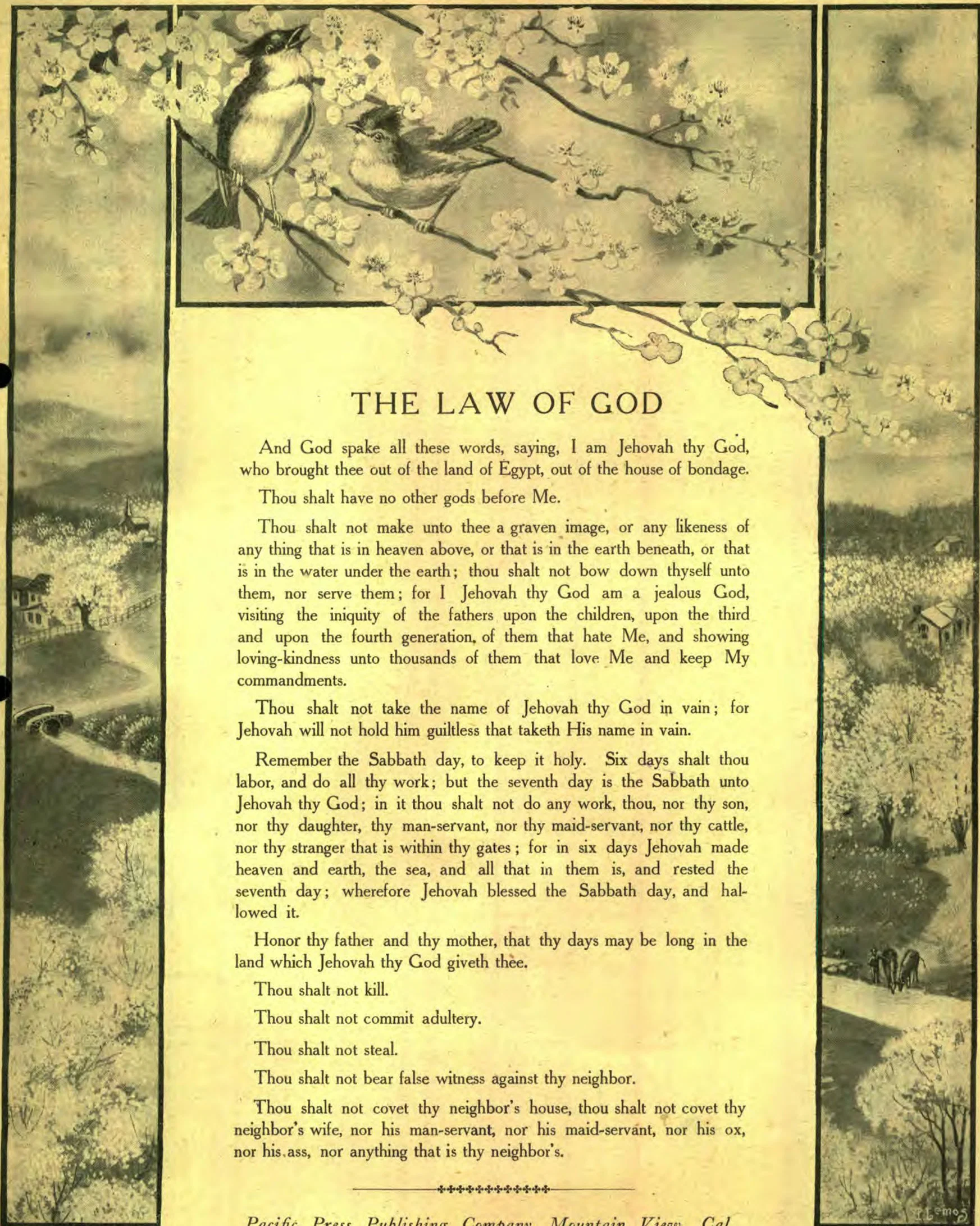
THE LAW OF GOD
Earlier text: OUR WORK AND WORKERS

The Witness of a Converted Life

The blameless, regenerated life of the truly converted soul is the mightiest witness to the world that "Christ is risen indeed."

Christ’s Delight to Do God’s Will

Our Lord said, before He came to this world, "Lo, I come; . . . . . I delight to do thy will, O My God; yea, Thy law is within My heart." And when here, He said: "My meat is to do the will of Him that sent Me;" "I have kept My Father's commandments, and abide in His love." "If any man have not the Spirit of Christ, he is none of His." "He that turneth away his ear from hearing the law, even his prayer shall be abomination."

Religious Liberty in Russia

The religious liberty granted to dissenters from the Orthodox Church in Russia, by a late edict from the emperor, is said to be designed as a palliative to allay the broader demand for political freedom. Be that as it may, if the people be allowed to really enjoy the religious liberty thus nominally decreed, the political freedom will surely follow as a natural consequence. Where freedom of conscience has absolute sway, the civil liberties of the people are practically guaranteed. Satan is an enslaver of soul and body, and his broadest and most tyrannical achievements have been wrought through the agency of religious intolerance.

Legalized Vice and Government Revenue

Gen. Leonard Wood, the military commander of the Philippines and governor of Mindanao, in his report on conditions in the islands, takes very strong and sensible grounds upon the matter of the opium traffic there. He declares it to be the worst vice the Filipinos have to fear. In regard to the matter of legalizing its importation and use, and deriving a revenue therefrom, he says: "It is poor policy in developing a people to count on the income of legalized vice for a large portion of the revenue, as is done in most eastern colonies." That statement can not be made too emphatic. But Governor Wood could have said just as truthfully that it was poor policy among any people, in any country, to count on the income of any kind of legalized vice for any portion of the revenue. We wonder if the governor of the Philippines sees the logic of his argument as applied to the liquor traffic in these same islands. It may be—indeed it is quite probable—that he does. But we must remember that the liquor power is no weakling in the matter of shaping government policy where its interests are concerned. It is too much to expect, under the present circumstances, that Governor Wood will speak out on the liquor question as he has on the opium question. But who can say that he has less reason to do so?

Rome’s Benefit

Rome's Benefit.—Rome has a prospective harvest in the recent religious liberty decree issued by the Czar of Russia. The effect is especially noticeable in Poland, as indicated by the following telegram, dated Warsaw, May 23:
Since the promulgation of the emperor's ukase concerning liberty of worship, and abolishing the religious disabilities of the Roman Catholic Church and other religious communities, 26,000 persons are reported to have left the Russian Church for the Roman Catholic Church, in the governments of Seidlie and Lubin. The censor has ordered the press not to make any reference to the subject. In one village of 680 inhabitants, 678 have changed their faith.
This indicates that the change is not so much a matter of doctrinal belief as of political prejudice. The Poles all hate Russia, of course, and leaving the Russian Church is all the means they dare use to manifest their hatred in a practical way. It is safe to say that all the changes from the Orthodox to the Roman Church will be mainly on this account, even in Russia; for the difference between the two religions is entirely a matter of detail in formalism, and not in fundamental doctrine. The despatch also states that "the authorities of the Russian Church are taking stringent measures to prevent these desertions."

A Christian Nation in Name

The National Reformers would fain impress the world with the idea that "this is a Christian nation" by a religious amendment to the Constitution. For many years they have urged that the Preamble be so amended as to contain the name of God, and so make the document a nominally Christian declaration. They insist that to omit such formal acknowledgement of God in the fundamental law is virtual infidelity. According to such argument, the book of Esther is virtually an infidel book; it does not contain the name of God. But the principles and lessons of the book are none the less salutary. Shouting the name of the Lord is not in itself virtue. "Why call ye Me, Lord, Lord, and do not the things which I say?" Luke 6:46. "Not every one that saith unto Me, Lord, Lord, shall enter into the kingdom of heaven; but he that doeth the will of My Father which is in heaven." Matt. 7:21. "Thou shalt not take the name of the Lord thy God in vain; for the Lord will not hold him guiltless that taketh His name in vain."

The Messenger

We have received Vol. 1, No. 1, of The Messenger, published by Bro. Lewis C. Sheafe, in the interests of the cause of truth among the colored people of Washington, D. C. We wish success to Brother Sheafe in his work there and to The Messenger in its important mission. Address, 2107 Tenth St. N. W., Washington, D. C.
Pacific Press Publishing Company, Mountain View, Cal.
THE HOME
THE HOME

You have reached the end of this edition.

Signs of the Times · Jun 21, 1905