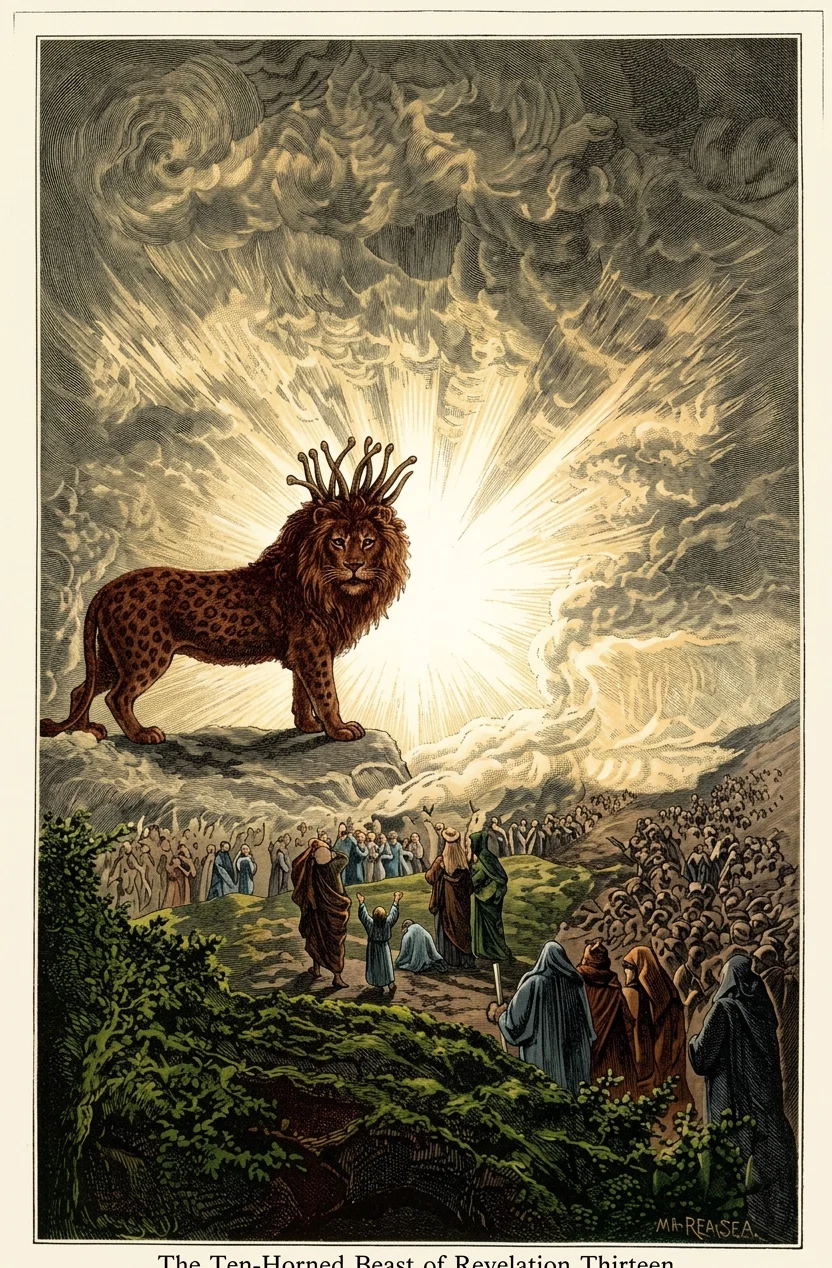
In all the Bible there is no more fearful penalty pronounced than that to be visited upon the worshipers of the beast and his image. See Rev. 14:9, 10. "If any man worship the beast and his image, and receive his mark in his forehead, or in his hand, the same shall drink of the wine of the wrath of God, which is poured out without mixture into the cup of His indignation." In order to understand what is meant by the beast and his image, it will be necessary to consider briefly the prophetic symbols in chapter thirteen.
The Symbol of Persecution.
In the first part of the chapter the prophet beholds a beast rise up out of the sea, making war with the saints, and speaking blasphemies. This prophetic symbol is quite generally understood to represent that condition of affairs which characterized the Middle Ages, during which so many millions of so-called heretics were put to death because they dissented from the teachings of the self-styled orthodox church.
The political rulers of those times conceived it to be their highest duty to enforce the dogmas of the State-church upon all their subjects, and those who refused to subscribe to the established creed were counted heretics and punished as prescribed by law.
A Striking Utterance.
History records the following striking reply of Theodore Beza, a leading heretic, to a persecuting ruler: "Sire, it is the lot of the church of God, which I represent, to receive blows, and not to give them; but may it please you also to remember that it is an anvil that has worn out many hammers."
As we near the close of the medieval night, and behold the gray dawn of the modern age, we find so-called heresy making a desperate struggle for the right to worship according to the dictates of conscience. We also find most of the great nations striking terrific blows on the anvil of heresy, which answers the shock by sending out its ringing impulses for freedom until they echo round the world.
The dawn of the modern age witnessed the old medieval idea of Church and State, with its intolerance and despotism, symbolized by the beast which rose up out of the sea and made war with the saints, gradually on the decline. At the same time the new idea of religious liberty and equality was coming up out of the earth where it had so long been trampled into the dust. What could be more natural than that the prophet should see something to represent the rise and progress of the long-buried principles of religious freedom?
The Two-Horned Beast of Revelation Thirteen.
The Symbol of the Image Power.
Chapter thirteen, beginning with verse 11, supplies the very symbol we should naturally expect to see: "I beheld another beast coming up out of the earth, and he had two horns like a lamb." Nothing could better symbolize the rising power of the principles of civil and religious liberty than this lamb-like beast coming up out of the earth. Just about the time that the rapidly growing spirit of freedom began to need more room for expansion, the New World was discovered, and became first an asylum and then a citadel for the refugees who fled from the intolerance and despotism of the Old World. It was not the opening up of the New World that gave birth to liberty, but rather the expansion of liberty in the Old World that made the opening up of the Western Hemisphere a necessity.
When the Netherlanders, the Puritans, and the Huguenots laid the foundation for a new nation in the New World, they used material which had already been fashioned in the quarry of liberty and tested by the pressure of persecution. When the great American nation started on her track of destiny, the two great rails of civil and religious liberty underneath the train had already been forged in the furnace of affliction. The soundness of the great principles of political and religious freedom, which we have just likened to two great steel rails, has been duly attested by the wonderful progress of the train; but "eternal vigilance is the price of liberty," and if the rails of freedom are unspiked, or warped, or twisted, there is danger of a wreck. That the prophet foresaw just such a danger may be seen by the further description of this second beast.
He Changes His Character.
After noting that this second beast "had two horns like a lamb," the prophet immediately says that "he spake as a dragon;"6and a little further on he says that this same beast says "to them that dwell on the earth, that they should make an image to the [first] beast." To make an image to the first beast would be to repudiate the principles of civil and religious liberty, and return to the dreary paths of intolerance and despotism.
It is a well-known fact that even in this country there is a strong and rapidly growing tendency to make religious observances a subject of State and national legislation. But whenever any government attempts to regulate anything pertaining to religion by human legislation, it thereby commits itself to the old medieval idea of Church and State union, and just to that extent is helping to "make an image to the beast."
The first beast is represented as receiving his power from the dragon, which is a symbol of Satan. See Rev. 12:9. The second beast has two horns like a lamb to represent the principles of liberty which came from Christ, "the Lamb of God." What a contrast! After all the plainly written warnings on the pages of prophecy and history, shall we retrograde from the principles of the Lamb, back to those of the dragon? God forbid!
World-Wide Apostasy and Deliverance.
Let us thank the Lord that while this prophecy clearly points to a world-wide apostasy from the principles of Christian liberty, it also clearly points to the eternal triumphs of a few who choose to remain faithful to those principles while the many are engaged in making "an image to the beast." Returning for a moment to the warning message quoted at the beginning of this article and recorded in Rev. 14:9, 10, we find a little further on in verse 12 a people of whom it is said: "Here is the patience of the saints: here are they that keep the commandments of God, and the faith of Jesus." Just a little further on the prophet beholds "a white cloud" bearing the Son of Man with a sharp sickle in His hand, coming to reap the earth's harvest. Still further on, in chapter 15, he sees the faithful little company on the sea of glass, victorious at last over the beast and his image. God grant that the readers may all meet the writer there where liberty will at last triumph over tyranny.
Liberty
By G. A. Snyder
LIBERTY! O ancient hero
Of the world-wide battle-field!
On thy head shines Hope's bright helmet,
In thy hand Faith's ample shield.
On thy brow I see imprinted
Many deep and lasting scars
Made thru time's succeeding ages
In thy foe's unholy wars.
Tyranny, thy pale oppressor,
Tho of later birth than thou,
Ever watches thee for evil
With a frown upon his brow.
Strong art thou with constant struggling
'Gainst thy unrelenting foe
Who with subtlety hath ever
Compassed thee with pain and wo.
Thou must keep eternal vigil
To escape th' oppressor's ire,
As he hurls at thee his javelins,
Forged in Envy's raging fire.
Deep he digs thy silent dungeon,
Strong he welds thy binding chain;
But his rule will soon be over,
Then shall dawn thy peaceful reign.
Thou must often be derided
While a cruel crown of thorns,
Shaped by Tyranny's devising,
Thy pale, bleeding brow adorns.
Thou may'st even be deserted,
Hanged upon a cruel cross,
Buried in a cold sepulcher,
While we mourn our fearful loss.
But the day is fast approaching
When thy wounded form shall rise
Over Tyranny triumphant,
And be carried to the skies.
Then shall thou thru times eternal
From all strife at last be free,
Gladly will we share thy struggles
On this road to victory.
G. A. SNYDER.
The Seal of God
By Asa O. Tait
EVERY power that promulgates a law must have authority to do so, and the law, in order to be operative, must have a seal upon it or within it that shows the territory of the one giving the law.
Does the law of Ten Commandments contain such a sign of authority? Does the law that was given by the Lord Himself contain a seal or a sign by which all the world, yes, by which all the universe of worlds, may know of His power to give the law in the territory of which He is the rightful ruler?
The law of the Lord as proclaimed by Him from the top of Mount Sinai is to be found in the first part of the twentieth chapter of Exodus. The last five of the commandments of this law do not contain at all the name of the Lord Jehovah who gives the law. Each of the first five makes mention of the Lord, but if you will take out the fourth, or Sabbath commandment, you will see that none of the other commandments give a description of the One making the law, nor tell the territory over which He rules, nor define His power. The fourth commandment, however, is ample and clear upon all these points. Let us read it together and note what it says:
"Remember the Sabbath day, to keep it holy. Six days shalt thou labor, and do all thy work; but the seventh day is the Sabbath of the Lord [Jehovah] thy God; in it thou shalt not do any work, thou, nor thy son, nor thy daughter, thy man servant, nor thy maid servant, nor thy cattle, nor thy stranger that is within thy gates; for in six days the Lord [Jehovah] made heaven and earth, the sea, and all that in them is, and rested the seventh day; wherefore the Lord [Jehovah] blessed the Sabbath day and hallowed it." Ex. 20: 8-11.
First, we are called upon to "remember the Sabbath day;" then we are told that the Sabbath is the "seventh day," and further we are told that neither ourselves, our family, nor our beasts are to work on that day. Then follows the sublime declaration that the One who proclaims this law is no less a personage than He who is the Creator of all things; He made the heavens and the earth. And being thus the mighty Creator, He tells us that this is the "wherefore" of His giving this commandment to observe the Sabbath, and His authority to give the Sabbath commandment is His authority for giving all the rest of the law.
When a general law is promulgated in this country, the law itself states it was made by the Congress of the United States of America; when England proclaims a law, it is said that it is done by her king, and so on thru all the nations. And when the great God of the universe proclaims His law, He upholds His right to do it by directing our attention to the fact that He is the Creator, and therefore He has the right to be the Lawgiver.
And so He says in His word, "Verily ye shall keep My Sabbaths; for it is a sign between Me and you thruout your generations; that ye may know that I am Jehovah who sanctifieth you." Ex. 31: 13. And thru His prophet Ezekiel He twice over repeats the same thought that the Sabbath is the sign of power by which we are to know the Creator. He says, "Moreover also I gave them My Sabbaths, to be a sign between Me and them, that they might know that I am the Lord that sanctify them." "And hallow My Sabbaths; and they shall be a sign between Me and you, that ye may know that I am the Lord your God." Eze. 20: 12, 20.
Observe that the Scripture tells plainly that the Sabbath is God's "sign" by which we may know Him. This fact is repeated and emphasized. God does not repeat and emphasize things that are of only ordinary importance. It must be that only special things are thus to be emphasized.
The Sabbath is much more than a mere day of rest. It is the "sign" of God's authority and of God's power. It is the "sign" by which we may know that He has the ability to sanctify us and fit us for the joys of eternity. The Sabbath is much more than a religious dogma or part of a creed. It is the sign of God's power, it is the seal of His authority. Then, when under the proclamation of the third angel's message, a people is developed who "keep the commandments of God, and the faith of Jesus" they will of necessity be keepers of the true Sabbath of Jehovah. For, as recently shown in this paper, they are to be worshipers of "Him that made heaven, and earth, and the sea, and the fountains of waters." Rev. 14: 7.
Sabbath-keeping, then, is far beyond and much broader than the mere resting from labor on a given day of the week. True Sabbath-keeping brings us in touch with the creative power of the Creator Himself. For Sabbath-keeping is God's sign to us that He doth sanctify us. His word says it and it is so.
"For we are His workmanship, created in Christ Jesus unto good works, which God hath before ordained that we should walk in them." Eph. 2: 10. We are "created in Christ Jesus." The converted man is a new creation. "Wherefore if any man is in Christ, he is a new creature: the old things are passed away; behold, they are become new." 1 Cor. 5: 17.
Then when we receive the Sabbath as the memorial of God's creative power it becomes much more to us than a memorial of the creation of the heavens and the earth; it is a sign to us of the power of God in creation, and that He is therefore able to and does create us anew in Christ Jesus. And thus do we see when we accept the Sabbath upon God's plan as given in His word that it has a broad, soul-satisfying and soul-uplifting power and significance in it.
But do not fail to note that if we would enjoy the blessings of God's plan of Sabbath-keeping we must be created anew; we must have the seal of the Sabbath truth impressed upon us by the Lord's great Sealer, the Holy Spirit of promise. "In whom [Christ], having also believed, ye are sealed with the Holy Spirit of promise." Eph. 1: 13. "And grieve not the Holy Spirit of God, in whom ye were sealed unto the day of redemption." Eph. 4: 30.7(Continued on Page 13.)
The Seal of God.
(Continued from page 6.)
The Holy Spirit is the agency that God uses in sealing us, and the sign or seal of His power of creation—His creation of the universe and His creation of us as individuals anew in Christ Jesus—is His Sabbath that He Himself has instituted. He is the Creator, and He has given a memorial of His creative power. Will we receive it for all that it is?
With these thoughts before us we can readily see the force of the following prophetic utterances: "Bind thou up the testimony, seal the law among My disciples. And I will wait for Jehovah, that hideth His face from the house of Jacob, and I will look for Him. Behold, I and the children whom Jehovah hath given Me are for signs and for wonders in Israel from Jehovah of hosts, who dwelleth in Mount Zion." Isa. 8: 16-18. Heb. 2: 13 quotes a part of the foregoing verses and makes the application to the Christian dispensation. Then one work for Christ's followers in this dispensation is to restore the seal to His law, and we have already learned that the Sabbath commandment is the sealing portion of that law.
And, coming as the grand climax, we find that in the view that John had of the remnant church that would pass thru the struggles incident to the stubborn efforts of Satan in the last days, he "saw another angel ascending from the east, having the seal of the living God: and he cried with a loud voice to the four angels, to whom it was given to hurt the earth and the sea, saying, Hurt not the earth, neither the sea, nor the trees, till we have sealed the servants of our God in their foreheads." "And I looked, and, lo, a Lamb stood on the Mount Zion, and with Him an hundred forty and four thousand, having His Father's name written in their foreheads." Rev. 7: 2, 3; 14: 1.
Origin and Meaning of Babylon
By Charles M. Snow
THE origin of Babylon was entirely outside the purpose of God. It was conceived in selfishness and brought forth in sin. If we wish to carry its origin back to its primal cause, we must look for it in the insurrection of Lucifer and his disloyal legions in heaven itself.
Confusion.
Babylon means confusion. Satan instituted confusion in heaven when he instigated rebellion against its government, and sought to exalt his "throne above the stars of God," and be "like the Most High." Isa. 14:12-14. Exaltation of self and distrust of God were the two germs out of which grew Babylon—both the Babylon that was created in heaven and cast out of it (Eze. 28:16), and the Babylon that was set up in this earth by that same wicked spirit that kept not his "first estate."
The Babylon of Nebuchadnezzar.
Nebuchadnezzar seems to have been the chief builder of the ancient city of Babylon. Concerning his part in its construction, he said, as he looked over its wonderful palaces, its hanging gardens, its colonnaded streets, and its mighty walls: "Is not this great Babylon, that I have built for the house of the kingdom, by the might of my power, and for the honor of my majesty?" Dan. 4:30.
Nebuchadnezzar was thinking only of his own glory, his own pleasure, his own exaltation. That was the same spirit that had actuated Satan in heaven; and as God cast that spirit out of heaven, so He cast this king out of his rulership until he should learn the lesson of his humiliation.
The beginning of earthly Babylon was back of Nebuchadnezzar, however. The world had been destroyed by a flood. God had promised that the water should not again cover the earth. The people distrusted Him, even tho they saw the bow of His covenant in the clouds. They must guard against the destruction of the world's inhabitants by another flood in spite of God's promise that there never would be another. Here is their reason for doing so:
"And they said, Go to, let us build us a city and a tower, whose top may reach unto heaven; and let us make us a name, lest we be scattered abroad upon the face of the whole earth." Gen. 11:4.
They Built a City Instead.
God had given directions to the descendants of Noah that they should go forth upon the earth and people it. But they said, We will build us a city and a tower here, "lest we be scattered abroad upon the face of the whole earth." In other words, they would defy Heaven, and make such an arrangement that God's express purpose could not be carried out thru them. Not only that, but they would build a tower that would reach into the very heaven itself and enable them to reach heaven by their own efforts without regard to the design of God, and in spite of Him. That is why they named their great tower Bab-il, or Bab-iln, the gate of God. Having in their control the very gate to heaven,—the "keys of the kingdom,"—the people would refuse to scatter abroad upon the whole earth, and the greatness of the city and the name of the nation would be assured. Surely he who holds the keys to the gate of God holds the destiny of the people in his hands.
Satan Wished to Be Gatekeeper.
But with all this God was not well pleased. Satan had conspired to control the kingdom of God and put himself between the creature and the Creator, and he had been cast out as a "profane and wicked prince." Now he inspires man to aspire to the position of gatekeeper on the road from earth to heaven, admitting and refusing whom he would, assuming to dictate even to Heaven itself, and placing himself between man and his Maker. This tragedy on the plain of Shinar (Genesis 11) had in it all the cunning ingenuity of the arch-deceiver; but God would not be thwarted in His purpose to people the earth. One word of His, dropped in that sea of people that surged around the base of Bab-iln, sent forth concentric waves of stammering people to the borders of the earth. They turned their backs upon their monument of defiance, and went out to subdue the wilderness and the desert, and to wage a battle for bread with the rocks, the thistles, and the thorns. Like Adam and Eve, they had found that to disbelieve God is to court sorrow and wed hardship and death.
Satan Was Cast Out.
The cohorts of Michael had hurled Satan and his hosts out of heaven; the flaming sword of the angel had fenced Adam and Eve out of Eden; and a jibbering speech now drove the descendants of Noah away from the fancied gate of heaven which their calloused shoulders and horny hands had reared to the sky. What they named "the gate of God," God Himself denominated "confusion," and smote and shivered its head with His thunderbolts. Should not this be enough to teach men that God will not permit any being to stand between Him and His creatures; that there is but one gate and that is Jesus Christ, "the Way, the Truth, and the Life"?
The Propaganda of Confusion.
But men have not learned this lesson yet. The descendants of the Babel builders went out into all the earth, carrying with them the doctrines taught around their tower. So in every part of the earth the propaganda of confusion has been carried on, and men have been seeking to save themselves by works which they might do—building little towers of their own by which to climb the skies or scale the walls of the eternal city. So men have undertaken works of penance that they might wipe the record of their sin off the books of heaven, forgetting that "there is none other name under heaven, given among men, whereby we must be saved." The Babel teaching has given us works of penance, absolution, purgatory, and "the keys of the kingdom," and so we find a great religious body denominated in the Bible "Babylon," confusion.
A terrible name is given her—written upon her forehead—"Mystery, Babylon the Great, the Mother of Harlots and Abominations of the Earth." She has carried on her work of sin and confusion with the utmost cruelty so that Inspiration could say of her, "I saw the woman drunken with the blood of the saints, and with the blood of the martyrs of Jesus." Rev. 17:5, 6. She has not been content with self-salvation, but has insisted that salvation must be by her formula, and has carried her insistence to the point of demanding and taking the lives of those who preferred to seek salvation in God's appointed way. That has brought in confusion of the darkest kind. They who claimed to be the representatives of God on earth have sought to change the very constitution of God's government, turning wrong into right, and substituting human ordinances for those Divinity had established.
Where Spiritual Babylon Originated.
The Babylon of the spiritual world had its origin in the Babylon of the temporal world; for spiritual Babylon to-day sits upon her throne and teaches a religion of penances to purge away sin, and traffics in the souls of men (Rev. 18:11-13). Babylon of old sought to make herself mistress of the very gates of heaven; spiritual Babylon to-day claims possession of the keys to the gate of heaven—claims power to open and shut heaven. Babylon of old reveled in a host of idols; spiritual Babylon fills her sanctuaries with them, and her votaries bow down to images and pictures of saints and perform painful and arduous tasks to cleanse their souls from sin. The cities of ancient Babylon had their patron saints; the cities of those countries dominated by spiritual Babylon have theirs. Ancient Babylon mocked Heaven with her infractions of the law of God; spiritual Babylon claims the right and authority to change that law itself, and of the wrong to make right. Ancient Babylon oppressed the people of God even to the death; spiritual Babylon has written her history in the blood of "heretics."
All this that has grown up in spiritual Babylon was germinant in Babylon of old, and all is alike contrary to the law of God and the Gospel of Jesus Christ.
“Tormented with Fire and Brimstone.”
“Forever and Ever.”
WHAT fearful thoughts are expressed in the above words! Looking at them in any way we will, if we believe them to be true, they express possibilities fearful to contemplate. What do the words mean?
They are found in Rev. 14:10, 11, and are there used to express the penalty to be visited upon those who worship the beast and his image and receive his mark. Of him who does this it is said:
“He also shall drink of the wine of the wrath of God, which is prepared unmixed in the cup of His anger; and he shall be tormented with fire and brimstone in the presence of the holy angels, and in the presence of the Lamb; and the smoke of their torment goeth up forever and ever; and they have no rest day and night, they that worship the beast and his image, and whoso receiveth the mark of his name.”
To him who truly believes God’s word, there must be the most diligent care not to incur this awful penalty.
It has been held that this meant indescribable, unending misery, torture, world without end. It has been said that it meant remorse of soul and torture of a guilty conscience to all eternity. Yet such punishment is not like God. It is vindictive, and God is not vindictive. His punishment is merciful and vindicative.
Let the “forever and ever” stand as meaning to all eternity, to the ages of ages, altho good scholars argue that it may refer to limited tho unknown duration. We will not discuss it here.
What does “torment” mean?
The word “torment” comes from the Greek basanos, defined by Liddell & Scott as “the touchstone,” Latin, lapis Lydius, a stone from Lydia, which rubbed upon gold would show, it is supposed, whether it was pure or not. The word basanos came to be used to mean “a trial whether a thing be genuine, solid, or real.” Basanizo, the verb, meant “to rub upon the touchstone; to try the genuineness of a thing;” “to make proof of;” to try, to examine, sometimes, tho not always, with torture. But as the ancient heathen often used torture to try to elicit truth, the word came to be used in a secondary meaning. This meaning our translators and theologians have tried to thrust into the New Testament, yet it seems evident that it is used by Inspiration in its primary meaning, to try or test, and basanos as the thing by which we try or test.
What is God’s touchstone?—Let the word speak: “Every man’s work shall be made manifest: for the day [of judgment] shall declare it, because it shall be revealed by fire, and the fire shall try every man’s work of what sort it is.” 1 Cor. 3:13. “The sinners in Zion are afraid; fearfulness hath surprised the hypocrites. Who among us shall dwell with the devouring fire? who among us shall dwell with everlasting burnings? He that walketh righteously and speaketh uprightly.” Isa. 33:14, 15. God’s test then is by fire.
Satan has led men to believe that they are immortal, that no material agency can destroy them. God will demonstrate that only those worthy of immortality can endure the test of His eternal and infallible touchstone.
Of God’s own immediate presence and glory it is said: “Dwelling in the light which no man can approach unto.” 1 Tim. 6:16. “Our God is a consuming fire.” Heb. 12:29. “The glory of Jehovah was like devouring fire.” Ex. 24:17. “For Tophet is ordained of old; . . . the pile thereof is fire and much wood; the breath of the Lord, like a stream of brimstone, doth kindle it.” Isa. 30:33. “That Wicked . . . whom the Lord shall consume with the spirit of His mouth, and shall destroy with the brightness of His coming.” 2 Thess. 2:8. Putting these scriptures together, it is evident that the unveiled presence of God destroys sin and those permanently allied with it. Before man sinned he walked and talked with God. When man sinned, God veiled the glory of His presence lest men should look and die. When sin was cast out and the presence of God came into the heart, man could talk with God, as did Moses, “face to face.” When Israel had confessed their sin, and laid it all upon the altar in their substitute, the goat, God’s presence consumed the goat, and the people rejoiced. Lev. 9:24. But when two of God’s priests went in before His presence with sin upon them, identified with the sin, fire came forth from His presence, and “devoured them.” Lev. 10:1, 2.
Sometime God will come into His own, with the undimmed glory of His outshining righteousness, before which all of sin will wither and burn. Those who have His righteousness within will change from glory to glory, from the glory of eternal life and incorruptible character to the glory of immortal sons of God. Those who do not know His righteousness will consume as a part of the sin with which they have identified themselves.
The consuming glory of God’s presence, which will kindle and purify a sin-corrupted world, is God’s great touchstone, or test (not torment) of character. Then shall “the sinners in Zion” be “afraid;” then “fearfulness” shall surprise “the hypocrites;” then “trembling” shall seize “the godless ones.” All vain boastings of human, inherent immortality die upon every lip. Instead is raised the cry, “Who among us can dwell with the devouring fire? who among us can dwell with everlasting burnings?” Isa. 33:13, 14. Then will God’s “might” be acknowledged. Then will all wickedness perish at the forthshining of His presence. Spontaneously shall the sin-cursed earth burn to its lowest depths of iniquity, and all marks of the curse shall be consumed.
That testing (not torment) shall be forever final. Misery then doubtless will be of mind and body, night and day, till it ends in surcease of existence; yes, it is forever, and forever and ever. When the last curling column of smoke shall ascend from this sin-corrupted earth, it is forever. “The wicked shall perish, and the enemies of Jehovah shall be as the fat of lambs: they shall consume; in smoke shall they consume away.” The falsehood and challenge of the devil (“Ye shall not surely die; . . . ye shall be as God,” Gen. 3:4, 5) has been met in the mills of inevitable justice, in the ripening fruitage of age-long sin, and righteousness and God’s goodness, mercy, and justice are vindicated in the eternal death of the incorrigibly sinful and rebellious.
Then shall the universe be clean. “Affliction shall not rise up a second time.” “And there shall be no curse any more [where the curse rested on this earth]; and the throne of God and of the Lamb shall be therein; and His servants shall serve Him.” “Forever and ever” wickedness is tested and destroyed. “Forever and ever” righteousness shall reign triumphant.