The Most Indifferent Are Sought—The Lost One in Our Homes—Christ Risked All
By Mrs. E. G. White
At the foot of the cross, remembering that for one sinner Christ would have laid down His life, you may estimate the value of a soul.
AFTER giving the parable of the lost sheep, Christ spoke another, saying, “What woman having ten pieces of silver, if she lose one piece, doth not light a candle, and sweep the house, and seek diligently till she find it?”
In the East, the houses of the poor usually consisted of but one room, often windowless and dark. The room was rarely swept, and a piece of money falling on the floor would be speedily covered by the dust and rubbish. In order that it might be found, even in the daytime, a candle must be lighted, and the house must be swept diligently.
The wife’s marriage portion usually consisted of pieces of money, which she carefully preserved as her most cherished possession, to be transmitted to her own daughters. The loss of one of these pieces would be regarded as a serious calamity, and its recovery would cause great rejoicing, in which the neighboring women would readily share.
“When she hath found it,” Christ said, “she calleth her friends and her neighbors together, saying, Rejoice with me; for I have found the piece which I had lost. Likewise, I say unto you, there is joy in the presence of the angels of God over one sinner that repenteth.”
Even the Indifferent Are Sought
This parable, like the one concerning the lost sheep, sets forth the loss of something which with proper search may be recovered, and that with great joy. But the two parables represent different classes. The lost sheep knows that it is lost. It has left the shepherd and the flock, and it cannot recover itself. It represents those who realize that they are separated from God, and who are in a cloud of perplexity, in humiliation, and sorely tempted.
The sheep wandered away from the fold; it was lost in the wilderness or upon the mountains. The piece of silver was lost in the house. It was close at hand, yet it could be recovered only by diligent search.
May Be Lost in the Home
This parable has a lesson to families. In the household there is often great carelessness concerning the souls of its members. Among their number may be one who is estranged from God; but how little anxiety is felt lest, in the family relationship, there be lost one of God’s intrusted gifts!
The coin, though lying among dust and rubbish, is a piece of silver still. Its owner seeks it because it is of value. So every soul, however degraded by sin, is in God’s sight accounted precious. As the coin bears the image and superscription of the reigning power, so man at his creation bore the image and superscription of God; and though now marred and dim through the influence of sin, the traces of this inscription remain upon every soul. God desires to recover that soul, and to retrace upon it His own image in righteousness and holiness.
Earnestly Seek That One
The woman in the parable searches diligently for her lost coin. She lights the candle and sweeps the house. She removes everything that might obstruct her search. Though only one piece is lost, she will not cease her efforts until that piece is found. So in the family, if one member is lost to God, every means should be used for his recovery. On the part of all the others, let there be diligent, careful self-examination. Let the life practice be investigated. See if there is not some mistake, some error in management, by which that soul is confirmed in impenitence.
If there is in the family one child who is unconscious of his sinful state, parents should not rest. Let the candle be lighted. Search the word of God, and by its light let everything in the home be diligently examined, to see why this child is lost. Let parents search their own hearts, examine their habits and practices. Children are the heritage of the Lord, and we are answerable to Him for our management of His property.
Neglecting Parental Responsibility
There are fathers and mothers who long to labor in some foreign mission field, there are many who are active in Christian work outside the home, while their own children are strangers to the Saviour and His love.
The work of winning their children for Christ many parents trust to the minister or the Sabbath school teacher; but in doing this they are neglecting their own God-given responsibility. The education and training of their children to be Christians is the highest service that parents can render to God. It is a work that demands patient labor, a lifelong diligent and persevering effort. By a neglect of this trust, we prove ourselves unfaithful stewards. No excuse for such neglect will be accepted by God. But those who have been guilty of neglect, are not to despair. The woman whose coin was lost searched until she found it. So in love, faith, and prayer let parents work for their households, until with joy they can come to God saying, “Behold, I and the children whom God hath given me.” Heb. 2:13, A. R. V.
This is true home missionary work, and it is as helpful to those who do it as to those for whom it is done. By our faithful interest for the home circle, we are fitting ourselves to work for the members of the Lord’s family, with whom, if loyal to Christ, we shall230live through eternal ages. For our brethren and sisters in Christ we are to show the same interest that as members of one family we have for one another.
And God designs that all this shall fit us to labor for still others. As our sympathies shall broaden and our love increase, we shall find everywhere a work to do. God’s great human household embraces the world, and none of its members are to be passed by with neglect.
The Lost Silver Is There
Wherever we may be, there the lost piece of silver awaits our search. Are we seeking for it? Day by day we meet with those who take no interest in religious things. We talk with them, we visit among them. Do we show an interest in their spiritual welfare? Do we present Christ to them as the sin-pardoning Saviour? With our own hearts warm with the love of Christ, do we tell them about that love? If we do not, how shall we meet these souls,—lost, eternally lost,—when with them, we stand before the throne of God?
Christ Risked All
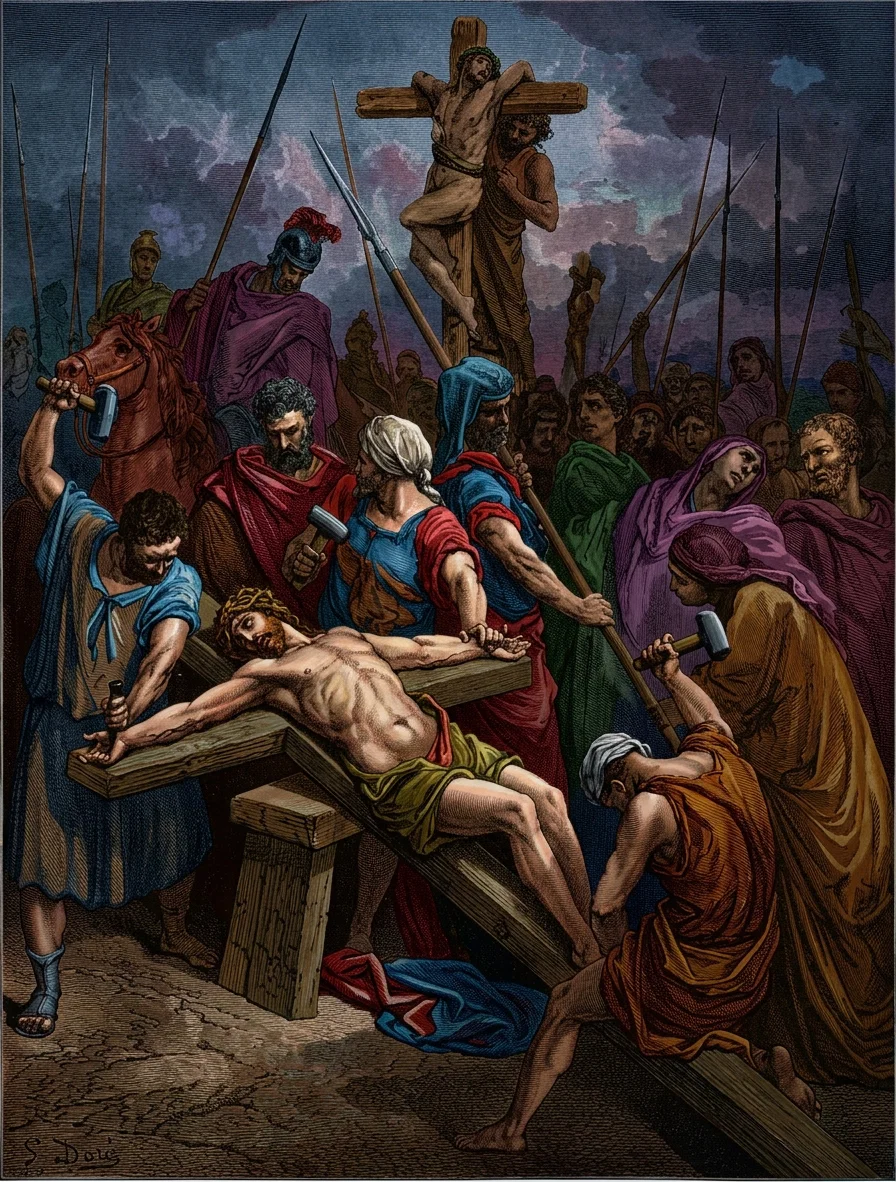
The value of a soul, who can estimate? Would you know its worth, go to Gethsemane, and there watch with Christ through those hours of anguish, when He sweat as it were great drops of blood. Look upon the Saviour uplifted on the cross. Hear that despairing cry, “My God, My God, why hast Thou forsaken Me?” Matt. 27:46. Look upon the wounded head, the pierced side, the marred feet. Remember that Christ risked all. For our redemption, heaven itself was imperiled. At the foot of the cross, remembering that for one sinner Christ would have laid down His life, you may estimate the value of a soul.
If you are in communion with Christ, you will place His estimate upon every human being. You will feel for others the same deep love that Christ has felt for you. Then you will be able to win, not drive, to attract, not repulse, those for whom He did. None would ever have been brought back to God if Christ had not made a personal effort for them; and it is by this personal work that we can rescue souls.
Your Sympathy Will Hold Them
When you see those who are going down to death, you will not rest in quiet indifference and ease. The greater their sin and the deeper their misery, the more earnest and tender will be your efforts for their recovery. You will discern the need of those who are suffering, who have been sinning against God, and who are oppressed with a burden of guilt. Your heart will go out in sympathy for them, and you will reach out to them a helping hand. In the arms of your faith and love you will bring them to Christ. You will watch over and encourage them, and your sympathy and confidence will make it hard for them to fall from their steadfastness.
In this work all the angels of heaven are ready to cooperate. All the resources of heaven are at the command of those who are seeking to save the lost. Angels will help you to reach the most careless and the most hardened. And when one is brought back to God, all heaven is made glad. Seraphs and cherubs touch their golden harps, and sing praises to God and the Lamb for Their mercy and loving-kindness to the children of men.
The Law and the Entrance of Sin
By A. C. Gilbert
Sin Originated in Heaven—Its Transfer to Earth—The Controversy Involves God’s Government and Law
By A. C. Gilbert
Sin originated in heaven. Where once all was joy, peace, and perfection, sin intruded, with its baneful influence, and brought sadness, discord, and imperfection into the society of heaven’s sinless inhabitants. The originator of evil was Lucifer, the most exalted of angels—the light-bearer, the day-star. Isa. 14: 12-14; Eze. 28: 12-19.
Cast Out of Heaven
The first field of conflict was heaven. Here it was that the forces of righteousness engaged the forces of evil, thrusting them out of heaven. See Rev. 12: 7-9. By his deceiving man, whom God created perfect, the earth was made the second field of controversy, and it has ever since remained the scene of the bitter struggle between good and evil.
Here have been and are being worked out the distinguishing features of the characters of God and Satan,—the leaders on the two sides of the conflict,—and their respective followers. It is being revealed that God is “the blessed and only Potentate, the King of kings, and Lord of lords” (1 Tim. 6: 15), and that “the Lord is righteous in all His ways, and holy in all His works.” Ps. 145: 17. It is also being shown that he who was the day-star, and perfect in all his ways (Eze. 28: 15), has become a “devil, and Satan, which deceiveth the whole world” (Rev. 12: 9); and that “he was a murderer from the beginning, and abode not in the truth, because there is no truth in him.” John 8: 44.
The Point in Controversy
The point of controversy is the supreme authority of God, and the moral obligation of all creatures to His sovereign law. The principles of the moral law are supreme love to God, and equal rights of all men. Matt. 22: 36-40.
The first and second commandments make plain the supremacy of God, and that there is no God besides Him. Ex. 20: 3-6; Isa. 44: 8; 46: 9. These facts were recognized by the first man, Adam. Gen. 2: 16, 17; 3: 3. This recognition was an admission of the first and great commandment, or principle, in which are comprised the first four of the Ten Commandments. Matt. 22: 36-38.
Cain, the first murderer, violated the second great commandment, or principle, in which are comprised the remaining six of the Ten Commandments. Matt. 22: 39, 40; Gen. 4: 5-8. Cain realized the serious fact that he had transgressed the moral law, and he admitted the justice of a punishment—“my punishment.” Gen. 4: 13; 1 John 3: 12. Adam and Eve sinned. Cain sinned. Many others back there sinned. The moral standard defined the nature of their inconsistent course, and called it sin. “Sin is the transgression of the [moral] law.” 1 John 3: 4.
Sin Was Defined
The moral standard not only defined sin for man at the outset of his sinful career, but it kept on doing so throughout the antediluvian period. It disclosed the actions that were in harmony, and those that were out of harmony, with the character of God. It approved the good, and condemned the bad. See Gen. 5: 24; 6: 5, 9, 11. And this same rule of moral conduct was the standard for man during the days intervening from the Flood to the time of the only recorded visible proclamation of the moral law of Ten Commandments at Sinai.
There was not the slightest difficulty for individuals and nations, during that period, to know whether their actions would be classed as works of sin, which is “the transgression of the law,” or as deeds of righteousness, in harmony with the law, which is “holy, and just, and good.” Rom. 7: 12.
Abraham Kept the Commandments
It is said of Abraham by God Himself, “Abraham obeyed My voice, and kept My charge, My commandments, My statutes, and My laws.” Gen. 26: 5. Abraham received these principles into his own life, and taught them to the “souls they had gotten,” because he knew there was no other character measure provided, no other set of laws ordained by God by which the character-building can be built, than the Ten Commandments, termed the moral law, and which every “friend of God” (James 2: 23) will obey. See John 14: 15, 21.
The people of Sodom and Gomorrah were grievous sinners before the Lord, and hearkened not to the saving messages that were sent them, but went farther and farther away from the glory and character of God, till at last they brought upon themselves the punishment of death as a logical sequence of continued violation of both physical and moral laws. See Gen. 13: 13; Luke 17: 28, 29. The filling up of the “cup of iniquity” of the Amorites, and the terrible retribution that fell upon them, is a solemn lesson to those who neglect to obey God and love Him supremely, and their neighbors as themselves, upon which two principles “hang all the law and the prophets.” Matt. 22: 37-40. Joseph’s integrity toward God, as recorded in the book of Genesis (Gen. 39: 9), stands out as a beautiful illustration of loyalty to the Ten Commandments.
The Ten Commandments Before Sinai
The Ten Commandments, and obedience to them, were not unfamiliar facts to the Israelites before they reached Mount Sinai. Ex. 16: 9, 28. Their having been down in Egypt for over two hundred years serving as slaves in rigorous bondage, caused them to lose, to a large extent, the pure knowledge they formerly had of the true God and their obligations to Him. Therefore “Israel was to receive the most wonderful revelation ever made by God to man. Here [at Sinai] the Lord gathered His people, that He might impress upon them the sacredness of His requirements by declaring with His own voice His holy law.” Here He was to outline with A B C simplicity the broad, deep principles of love to God and love to man, as detailed in the Ten Commandments recorded in Ex. 20: 3-17, and later illustrated and applied by the ritual of the ceremonial law. The perfect standard that guided and regulated in the development of man’s moral nature in the days of old, has never been abrogated.231The very nature of the whole controversy with sin requires the recognition of the same moral rule, for the following reasons: (1) God has not changed His character and purpose since the entrance of sin into the universe. (2) Satan has not changed his character and purpose since he introduced sin. (3) The sinful nature of man is still the same, and requires the same righteous standard to be set before him, to tell him what sin is, that was placed before him in the days of his innocence, and approved his perfect obedience.
Change in Character, Not in the Law
Since Satan failed in his attempt to overthrow the sovereign law and government of heaven, the conditions of citizenship in the kingdom of God, which were challenged by Lucifer, are still in force. And every person who expects admittance into that kingdom, must, during this solemn present, undergo such a change of character as will conform to the rules, or laws, or principles, of that heavenly government. It is a change of character, and not a change of the law, that insures to every soul an eternal life of joy with God. Man must come into line with the requirements of God. He must understand and feel the working of that mighty power of love for the Lord Jesus which led patriarchs, prophets, and apostles to say with the apostle Paul, “I delight in the law of God after the inward man” (Rom. 7: 22); and also to know that “blessed are they that do His commandments, that they may have right to the tree of life, and may enter in through the gates into the city.” Rev. 22: 14.
PETER WAS NOT A POPE
By G. W. Caviness
Christ Forbade Popes—Paul Recognized No Such Thing—Peter Himself Condemns It James and Not Peter Presided in the Church
By G. W. Caviness
ONE of the strongest arguments the Roman Catholics use to prove that theirs is the only true apostolic church, is that the succession of popes begins with Peter, one of the twelve disciples.
When the disciples were discussing among themselves as to who should be the first, and head of the rest, Christ reproved them. He reminded them of the fact that the scribes and the Pharisees always tried to call attention to themselves by dressing in long robes and by claiming the first seats in public gatherings. They also loved to be called rabbi, or master, and each sought for himself the first place.
Christ taught His disciples just the opposite of this conduct, and said: “Be not ye called rabbi: for one is your Master, even Christ; and all ye are brethren. And call no man your father upon the earth: for one is your Father, which is in heaven.” Matt. 23:8.
CHRIST FORBADE A POPE
In this text, Christ positively forbids His disciples to call any one of their number father, or pope. So the disciples never could call Peter pope without disobeying this clear and unequivocal command of Jesus Christ. It is no less true that the Roman Catholics disobey this strict command of the Master when they elect one as head of the church, and call him pope, or holy father.
PAUL RECOGNIZED NO POPE
The apostle Paul certainly never considered Peter as a pope, and head of the church. Speaking of his own calling to the work of the Lord, he says, “Paul, an apostle, (not of men, neither by man, but by Jesus Christ, and God the Father, who raised Him from the dead.)” Gal. 1:1. The great apostle to the gentiles distinctly says that he is not an apostle by the will of men. He received his call and his authority direct from Jesus Christ. In verses 11, 12 he says: “But I certify you, brethren, that the gospel which was preached of me is not after man. For I neither received it of man, neither was I taught it, but by the revelation of Jesus Christ.” Not only his calling, but his understanding of the gospel, came from God, through a study of the sacred Scriptures.
It is true that Paul preached the same gospel the other disciples preached, but he did not receive it from them. As he says further on in the same chapter, “When it pleased God . . . to reveal His Son in me, that I might preach Him among the heathen; immediately I conferred not with flesh and blood: neither went I up to Jerusalem to them which were apostles before me; but I went into Arabia, and returned again unto Damascus. Then after three years I went up to Jerusalem to see Peter, and abode with him fifteen days. But other of the apostles saw I none, save James the Lord’s brother.” Verses 15-19.
PETER ADDED NOTHING TO PAUL
From this it is evident that Paul, after three years of preaching, did go to Jerusalem, and saw Peter and James, and was with them fifteen days; but he says emphatically that they added nothing to him by way of doctrine or of authority. In the following chapter, verse 6, he says, “They who seemed to be somewhat in conference added nothing to me.” Those who appeared to be pillars of the church he mentions, in verse 9, as James and Peter and John, and adds that when they heard of his work among the gentiles, they gave the right hand of fellowship to him and Barnabas.
PAUL PUBLICLY REPROVES PETER
After saying that he received nothing from the other disciples in Jerusalem, Paul tells us that Peter came to Antioch, where Paul and Barnabas had raised up a church. At first Peter mingled with the gentiles, and ate with them; but when some other Jews from Jerusalem came there, Peter separated himself from the gentiles, and began to practice his Jewish exclusiveness. When Paul saw how Peter acted, he took occasion to reprove him before the whole church. He says, “When Peter was come to Antioch, I withstood him to the face, because he was to be blamed.” Verse 11. It appears that Peter accepted the reproof as just, for he made no defense of his conduct, and never found any fault with Paul for having reproved him. When he speaks of Paul in his second epistle, chapter 3, verse 15, he calls him “our beloved brother Paul.” Peter was Christian enough to receive reproofs and profit by them, and never considered himself the head of the church, or above reproof. From this episode, we see clearly that Paul never looked upon Peter as the pope, or head of the church.
Only imagine a pope of the present day permitting a cardinal or a bishop to reprove him publicly! The popes of our time think it is their business to reprove everybody else, and that no one should dare to reprove them in any sense.
JAMES AND NOT PETER PRESIDED
Later on, there arose difficulties in the church, among the gentiles; and in order that there might be harmony between Jewish and gentile believers, Paul and Barnabas desired to bring the matter before the church in Jerusalem. A council was called. The disciples and the elders and all the church in Jerusalem were present. James presided in the council. Various brethren spoke in turn, and there was a full and free discussion. Peter was present, and told how the Lord sent him to preach the gospel to the gentiles, which he did on his visit to Cornelius, and how the Holy Spirit fell upon the believing gentiles. Then Paul and Barnabas related their experience as they had gone preaching the gospel among the gentiles. At last James arose, and gave the final decision. As this seemed good to the apostles and the elders and all the church, it was committed to writing, and sent by two of the leading brethren, along with Paul and Barnabas, and was read to the church in Antioch. The entire account of this council is found in the fifteenth chapter of the Acts of the Apostles.
From this we see that Peter was not the president of the council, nor had he more to do in the matter than the other brethren. In fact James was the most prominent on this occasion. This document was not signed by Peter as pope and head of the church. It was given as the unanimous opinion of the disciples, the elders, and the church.
IF PETER HAD BEEN POPE
Had Peter been pope, as is claimed, the decree would have been something as follows: “I, Peter, head of the church, by my divine authority, decree the following,” etc. But no such thing was done. Evidently the disciples still followed the instructions of their Lord, and did not consider any one of their number as the supreme head, but all counseled together, and by the influence of the Holy Spirit, were brought into perfect agreement, and sent out their decision as the opinion of the apostles, the elders, and the whole church.
The apostle Peter himself, when writing to the brethren, never assumed the first place of authority and dignity in the church. He says: “The elders which are among you I exhort, who am also an elder, and a witness of the sufferings of Christ, and also a partaker of the glory that shall be revealed: Feed the flock of God which is among you, taking the oversight thereof, not by constraint, but willingly; not for filthy lucre, but of a ready mind; neither as being lords over God’s heritage, but being ensamples to the flock. And when the chief Shepherd shall appear, ye shall receive a crown of glory that fadeth not away.” 1 Peter 5:1-4.
PETER AN UNDER-SHEPHERD
In these words of Peter himself, we see that he considered himself as one of the under-shepherds of Jesus Christ. He did not command the other shepherds, as one having authority over them; but he entreated them as an equal, saying that he was also an elder, or pastor, of the church of Jesus Christ. Peter was a humble follower of his Lord, and never pretended to exercise an authority that his Master had forbidden to any of the disciples.
A Menace to American Girlhood
By Mary Alice Hare Loper
Fashions That Menace Morals — Will American Mothers Be Aroused?
By Mary Alice Hare Loper, M. S.
The god of fashion puts forth strenuous efforts to rule over men and women, regardless of age, occupation, or character; and it is to be deplored that his efforts receive such substantial support as they do from all classes of society.
Never Such Coarse Criticism
The trend of feminine fashions during recent years has clearly demonstrated that an additional effort is being made to destroy the divine standard of morals. The vulgar styles have caused thinking minds to pause, and consider the legitimate consequences that are sure to follow such marked departures from the divine path of modesty and purity. Never before have the women and girls of America been subjected to such coarse, low criticism as has been heaped upon them by men of all classes; and evidently there is a reason for it.
A man who is not given to profanity, said recently, “There is nothing that comes nearer to making a good man swear with disgust, than the travesty on decent clothing seen frequently on our city streets the past few years.” It goes without saying that the better class of men are unanimous in their condemnation of freak fashions, which place the womanhood of America in a very undesirable light, and which afford just cause for ridicule.
The Best of Paris Rejects It
American women have aped Paris fashions — fashions which Parisian women themselves who respect good morals and a spotless name, have frowned upon. It matters not how inconvenient a style may be, or how absurd it may appear at first, the shock soon subsides, and the living fashion plates appear in all their hideousness. “The daughters of Zion are haughty, . . . walking and mincing as they go.” Isa. 3: 16.
If half a century ago a woman had appeared on our city streets arrayed in a “hobble skirt,” a “slit skirt,” or an “X-ray gown,” it is certain the impression would have been extraordinary; and she probably would have been interviewed officially for the purpose of ascertaining her mental status. We breathe a sigh of relief at the passing of such questionable attire, but it is with a recollection of the saying so often applicable, “The worst is yet to come.”
Rapidity of Changes
It is surely marvelous with what rapidity the kaleidoscope of fashion revolves, and what unheard-of combinations it reveals, rivaling or surpassing some of those of the mythical goddesses of the ancient world. The story of the woman who entered a millinery establishment to procure a hat of the latest style, and was told to please be seated, as the styles were just changing, is not far from the truth, after all. The hobble skirt and the slit skirt are entirely out of date now, while the woman who does her own ironing is again confronted with starched petticoats and wide dress skirts — no telling how wide they will be when the limit is reached.
At one time, hats resemble “round tires like the moon” (Isa. 3: 18), encroaching upon space which justly belongs to others; at another time, they are so contracted as to be neither useful nor ornamental. At one time, the trimming suggests a flagpole, placed perpendicularly in front; at another time, it must assume the same position in the back, or perhaps be placed horizontally, describing the arc of a circle with every movement of the head. Sometimes a side trimming is the only thing strictly up to date; and it is very important (?) that it be perpendicular at one time, horizontal at another, or perhaps at an angle of forty-five degrees either above or below the horizontal plane of attachment.
In Varied Colors Too
And the variations in color are as marked as is their adjustment, no two consecutive seasons admitting of the same predominating colors or shades. And what is true of hats is more or less true of the entire costume—change, change, change, bringing hardship to those who are unable financially to meet the unjust demands, and calling for an outlay of means that ought to be used for a better purpose.
The great Creator clothes nature the best possible from the standpoint of beauty, and of service to man and the lower animals. Nature wears her robe of white in winter, and of green in summer, with artistic touches of color here and there to beautify the landscape. As the cycles come and go, we never tire of the snowy white, the living green, and the exquisite beauty manifested differently in every tree, shrub, and flower, each preserving its own individuality. Nature’s robes change with the changing seasons, but those of one year closely resemble those of another.
How Would It Look?
How would poor Dame Nature look if the god of fashion had the designing of her robes? No doubt he would spring some startling changes, which would come as a distinct shock to our sensibilities. Think of X-ray earth, revealing the outlines of roots and worms beneath the surface! Think of king blue trees, with burnt orange grass and cerise flowers; or seal brown trees, with Roman-striped grass and black and white flowers!
Moreover, the trees might assume a variety of shapes at different seasons of the year. For example, the graceful weeping willow might be made occasionally to turn its branches upward, resembling an inverted umbrella on a windy day. The stately poplar might grow its branches horizontally for a change, or perhaps downward close about the trunk.
Now, all this sounds supremely ridiculous; but it is on a par with the late X-ray gown, and the monstrous “rats” and “waistfalls,” the “camel’s humps” and “kangaroo shapes,” that died years ago,—but which may yet have an unwelcome resurrection,—and the “wig-to-correspond-with-gown” idea of the present day. The individual who admires a woman’s tresses nowadays, may find, the next time he meets her, that her lovely brown hair has given place to a decided scarlet or purple, a sky-blue or delicate green.
Then, too, the waist line is placed by the Creator just where it properly belongs, its location and size varying to suit the symmetrical outline of each individual. But the god of fashion decrees when everybody’s waist line shall be large or small, high or low, or lose its identity entirely.
Recently so little clothing was worn below the waist, that the outline of the body beneath it was discernible with every step. At this minute, while there is an increase in clothing below the waist, there is a decided decrease above.
Persons familiar with mountain scenery are well acquainted with the term “timber line,” above which no trees are visible. Just now, the apparel of woman seems to have reached a definite clothing line, above which little or no covering is required. A few years ago, fashion demanded so much material for sleeves that the remainder of the waist was of minor importance. Now no sleeve at all is required on reception and9evening gowns, and only a rudimentary waist, visible as far as the armpits, with delicate straps over the shoulders — décolleté plus!
Seeking a Lower Level
All these things and many more demonstrate beyond a doubt that the god of fashion is surely seeking to lower the standard of morality. It suits his purpose just as well to have evil suggestions couched in scant waists as in scant skirts. Immodest apparel paves the way for immodest actions; and many a young girl goes the downward way and is lost in the whirlpool of wickedness, because of imitating the example of—it may be church members, and thus gratifying the desire to be considered fashionable.
No one in poor circumstances can keep pace with the ever changing fashions, and at the same time keep the soul spotless. Herein lies the sequel to many a divorce story and many a ruined business enterprise.
Sacrificing Health
Nor are moral pollution, ruined homes, and financial failures the only results of vulgar and extravagant fashions. Many a precious life is sacrificed upon the altar of unhealthful dress. Schoolgirls easily fall a prey to the deadly ravages of disease following the practice of wearing low necks, short sleeves, thin underwear, gauze hosiery, slippers, and, even in chilly weather, perhaps no hat or wrap. Again, we see the living—dying—paradox of a heavy winter wrap with nothing over the long V-shaped exposure of the neck, except, perhaps a dainty lavaliere.
It does not affect the health of humanity for the goddesses of mythology to be represented in a nude or seminude condition; but for living beings to dress contrary to all the laws of health, is supreme folly. May American mothers come to the rescue of those who are seeking to raise the standard of dress in regard to health and morals. Let them teach their daughters that style is secondary to health; that “modest apparel” (1 Tim. 2: 9) is necessary to the enjoyment of a true character. Let the demand for respectable styles of ready-made wear, which has already been voiced by leading women of our country, be increased until garment makers are convinced that success in their business depends upon the production of garments that harmonize with decency and morality.
THE SPECIAL DANGER PERIOD
By G. B. T.
Hold Fast — Signs and Wonders May Deceive
“Because thou hast kept the word of My patience, I also will keep thee from the hour of temptation, which shall come upon all the world, to try them that dwell upon the earth. Behold, I come quickly: hold that fast which thou hast, that no man take thy crown.” Rev. 3: 10, 11.
THE TIME OF SPECIAL DANGER
This scripture has special application, as the connection shows, near the close of human history. As we approach the end, this instruction to hold fast is given.
The time of greatest danger to those navigating the ocean is when the vessel is nearing port. While sailing the high seas, a long distance from shore, there is not so much danger. Accidents may happen, but the probability of such is minimized. The captain can take matters somewhat easy. But when approaching shore, then the danger from rocks and breakers and various other causes increases.
It is somewhat like this in the voyage of the church of God. As we near the close of human history, the danger will increase. The temptations of the devil will grow stronger, the resisting power of man will be weakened, and there will be a greater tendency to relinquish our hold upon God, and be lost.
This is suggested in other scriptures. After speaking of the development of the mystery of iniquity, Paul says: “Even him, whose coming is after the working of Satan with all power and signs and lying wonders, and with all deceivableness of unrighteousness in them that perish; because they received not the love of the truth, that they might be saved.” 2 Thess. 2: 9, 10.
SIGNS AND WONDERS NOT DEPENDABLE
Down in the closing history of the world, the great leader of darkness is to work “with all power and signs and lying wonders, and with all deceivableness of unrighteousness.” What will people do then who are depending for faith on signs or wonders? Our faith must needs stand on the word of God, and not upon some sign that we may behold.
But notice: Satan is to work with all signs and all power and with all deceivableness of unrighteousness. Every counterfeit that he can produce, every agency that the enemy has used all through the six thousand years of sin and rebellion, will be brought into the field to deceive souls in these last days.
WORKS WITH FRENZIED WRATH
Other scriptures emphasize this same thought. Rev. 12: 12: “Woe to the inhabitants of the earth and of the sea! for the devil is come down unto you, having great wrath, because he knoweth that he hath but a short time.” What does he know?—Why, that he has but a short time in which to work and deceive souls. We find persons occasionally who pretend to believe in the coming of the Lord, but they are not quite sure, and are holding fast to this world, afraid to let go. Yet the great prince of darkness knows when the end is near. Has the Lord revealed His purposes to the arch-enemy, and withheld them from His people? If so, He says to the deceiver: “You have cursed and damned souls for six millenniums. You have rebelled against My government. But I want to give you special light. I won’t tell My people, but I will let you know it. It is this,—I am coming in a short time.” Does God work this way?—No, indeed!
Satan knows when this event is near, from the statements of the Bible. He reads the Scriptures, and knows that God’s word is true. And I am glad that we can know, from the same source, when the end is near, and prepare for this great event.
HOLD TO THE NAKED PROMISES
In this dark hour, when satanic agencies are being marshaled, when there is being brought upon mankind the strongest temptation they have ever had, the most trying things being experienced, it is then that the voice of the text comes to us, saying, “Hold . . . fast, . . . that no man take thy crown.” It is then that we must hold fast to the naked promises of God—when we must be firmly anchored to the eternal rock of Scripture.
Counterfeits of a most deceptive and dangerous character will appear; but the word of God will enable us to detect these, and cleave only to the truth. Now, in this age of infidelity and higher criticism, we are to hold fast to the chart and compass,—the Bible,—that we may not flounder in the sea of skepticism, and perish outside the port at last.