Did Christ Change the Sabbath?—The Record Will Reveal the Facts
The making of the Sabbath at creation is plainly recorded in Gen. 2: 1-3. This record is further confirmed in the law, Ex. 20: 8-11. The institution of the Passover is also explicitly recorded in Exodus 12. The annual feast-day sabbaths are clearly set forth in Leviticus 23, and their repeal in Col. 2: 14-17; Eph. 2: 14-16. Therefore if Christ revised or repealed the law of the Sabbath, He has given us as plain information of that revision or repeal, as He has given of the repeal of the ceremonial sabbaths, which were abolished by His death upon the cross.
Noted Protestant Finds No Change
From pages 2-4 of a tract entitled “Some Mistakes About the Sabbath,” by the Rev. James Russell, the following important statement is extracted:
“The first mistake made by Christian people is in supposing that the Sabbath law, as laid down in the Old Testament, was abrogated by our Lord Jesus Christ.
“Christ Himself affirmed that He came not to destroy the law, but to fulfill it. The ceremonial law, in its symbols and prophecies, was intended to point forward to the coming of Christ; and at His coming it passed away, because it was fulfilled in Him. So it is written, He nailed to His cross the handwriting of ordinances which was against us, taking it out of the way. But the moral law, as contained in the Decalogue, is as eternal as the constitution of man. It was written in the nerves and fibers of the human system before it was transcribed on tables of stone. The fact that it was thus written on stone, if it meant anything, meant that it was to abide forever. It is difficult to see how any one could suppose that Jesus would select one of the ten precepts thus recorded,—and the very one which was expressed in the most positive terms,—and, leaving the others intact, abrogate that one. At this point attention is called to the singular terms of the Sabbath law. Here it is: Remember the Sabbath day, to keep it holy. Six days shalt thou labor, and do all thy work; but the seventh day is the Sabbath of the Lord thy God: in it thou shalt not do any work; thou, nor thy son, nor thy daughter, thy manservant, nor thy maidservant, nor thy cattle, nor thy stranger that is within thy gates: for in six days the Lord made heaven and earth, the sea, and all that in them is, and rested the seventh day: wherefore the Lord blessed the Sabbath day, and hallowed it.”
Significant Opening
“The opening word is significant: ‘Remember!’ It is precisely as if God foresaw that the time would come when some of His people might say that this commandment was intended to be only234of temporary force, and thus forestalled it. Observe, also, the two illative conjunctions in which the rationale of the Sabbath is set forth: ‘For in six days the Lord made heaven and earth: wherefore the Lord blessed the Sabbath day, and hallowed it.’ The Sabbath is thus established in the fact that God made the world in six creative days and then rested. This being so, is it not obvious that the law is of binding force so long as it continues to be true that God created the world in that way?”
“If the Sabbath law, as thus formulated by God Himself, were to be abrogated, it surely would not be done by His only-begotten Son. Let me say it reverently, Christ would not have done this if He could, and, considering His relations with the Father, He could not if He would. He came into the world not to destroy the law, but to fulfill it.”
Christ Tore Away the Rubbish
“The inquiry is pertinent, What did Jesus teach with respect to the fourth commandment? He had much to say about the Sabbath; what was the purport of it? He certainly did not approve the Sabbath law as taught and enforced by the religious leaders of His time. He tore away the Toldoth with which they had encumbered it, as barracks are cleared away from a vessel in dry-dock that she may sail free. He did for the Sabbath exactly what archaeologists have recently done for the pool of Siloam. It is known that Solomon built this reservoir for the purpose of bringing fresh water into the city. It was supplied by a subterranean aqueduct from a fountain gushing out of the rock of Ophel. The prophet Isaiah referred to it as ‘the waters of Shiloah that go softly.’ John Milton sang of ‘Shiloah brook that flows fast by the oracles of God.’ But in the successive calamities which befell the holy city, the fountain and its channel were blocked up with stone and rubbish, and Siloam became a stagnant pool. In 1881 the aqueduct was uncovered, the rubbish was cleared away, and the waters of Siloam again ‘flowed softly,’ so that to-day the wayfarer refreshes himself at the brook. Now this is what Jesus did with the Sabbath. Destroy it? Abrogate it?—O, no! He restored it to its primitive terms as a divine law.”
Not One Jot
There are twenty-three jots in the fourth commandment, and seventy-five words in the whole law, and Jesus says not one jot shall pass from the law till all things be accomplished. (See revised edition of the New Testament.) Wesley says, “The word ‘all’ does not mean all the law, but all things in the universe; as neither has the term ‘fulfilled,’ any reference to the law, but to all things in heaven and earth.”—Wesley’s “Sermons,” volume 1, page 223. “One jot or one tittle shall in no wise pass from the law, till all be fulfilled.” The word “law” is translated from the Greek word nomos, which is in the masculine gender and the singular number. The word “all” is from the Greek word pas, and is in the neuter gender and the plural number, and therefore cannot agree with nomos, “law,” but with “things” understood. Thus Matt. 5:18 should be understood as follows: “For verily I say unto you, Till heaven and earth pass, one jot or one tittle shall in no wise pass from the law, till all things (in the universe) be fulfilled.” And as all things cannot be fulfilled while the world stands, neither can even one jot pass from the law while the world stands.
It is necessary, in revising a civil statute, that a plain record of such a repeal or revision be kept. The revision or repeal of a law by the civil legislature, and the introduction of a new statute embracing the enforcement of a penalty for its violation, without a plain record of such an act, would be too ridiculous a procedure for any civil authority. Much less can we charge Christ with any such inconsistency.
Did Christ Change or Repeal the Sabbath Statute?
It is assumed that Christ changed or repealed the Sabbath statute, and introduced Sunday, the first day of the week, instead of the seventh-day Sabbath. It is assumed that this was done at the time of His resurrection, and to commemorate that event.
Where is there any record of such a transaction? There is no such record to be found in the New Testament. If such a revision had occurred, it would have been recorded in the Gospels, the Acts, or the Epistles. There could be no change made in the Sabbath statute from the seventh to the first day of the week, without a reference to it. The expression “the first day of the week” is used but eight times in the New Testament. It will therefore require but a short time to refer to each text where the expression “first day of the week” occurs, in order that we may know with certainty whether such a revision of the Sabbath statute has been made by Christ.
The first passage is in Matt. 28:1: “In the end of the Sabbath, as it began to dawn toward the first day of the week, came Mary Magdalene and the other Mary to see the sepulcher.” The Gospel of Matthew was written six years after the resurrection. He says at that time that the Sabbath was the day before the first day of the week. He makes no mention of a revision or repeal of the Sabbath statute.
The second text is found in Mark 16:1, 2: “And when the Sabbath was past, Mary Magdalene, and Mary the mother of James, and Salome, had bought sweet spices, that they might come and anoint Him. And very early in the morning the first day of the week, they came unto the sepulcher at the rising of the sun.” This was written thirty-two years after the resurrection of Christ. Mark says the Sabbath was past when the first day of the week came.
In verse 9 we have the third reference: “Now when Jesus was risen early the first day of the week, He appeared first to Mary Magdalene, out of whom He had cast seven devils.” This text merely mentions the first day of the week, but says nothing of the Sabbath or the Sabbath law. Mark recognizes the Sabbath to be the seventh day of the week as late as thirty-two years after the resurrection. He does not intimate any repeal or revision of the Sabbath statute.
Convincing Statement of Luke
The fourth reference is found in Luke 23:56; 24:1: “And they returned, and prepared spices and ointments; and rested the Sabbath day according to the commandment. Now upon the first day of the week, very early in the morning, they came unto the sepulcher, bringing the spices which they had prepared, and certain others with them.” This record was written twenty-four years after the resurrection. Luke, twenty-four years after the resurrection, recognises the original Sabbath as still binding according to the commandment. He does not give the slightest suggestion of any revision or repeal of the Sabbath commandment by Christ. His testimony emphatically enjoins the seventh day as the Sabbath, according to the original commandment.
The fifth reference is John 20:1: “The first day of the week cometh Mary Magdalene early, when it was yet dark, unto the sepulcher, and seeth the stone taken away from the sepulcher.” John’s Gospel was written sixty-four years after the resurrection. Neither the Sabbath nor the Sabbath statute is mentioned in the reference.
The sixth reference is verse 19: “Then the same day at evening, being the first day of the week, when the doors were shut where the disciples were assembled for fear of the Jews, came Jesus and stood in the midst, and said unto them, Peace be unto you.” Here, as in verse 1, no reference is made to the Sabbath statute. So John knew of no revision or repeal.
John and the Christian Sabbath
In chapter 5, John says positively that the day the Jews observed as the Sabbath is the Christian Sabbath. Christ had healed a man on the Sabbath, and John records it thus: “Jesus saith unto him, Rise, take up thy bed, and walk. And immediately the man was made whole, and took up his bed, and walked: and on the same day was the Sabbath.” Verses 8, 9. John does not say that it was the Jewish Sabbath, or the day that used to be the Sabbath, but is now changed; but, writing sixty-four years after the resurrection of Christ, he says that the man was healed on the Sabbath day.
Thus, according to John’s record, the original Sabbath, instituted at creation, confirmed in the law given from Sinai, and customarily kept by Christ, is still the Sabbath day. The next verse says that the day which John says is the Sabbath, is the Sabbath day kept by the Jews: “The Jews therefore said unto him that was cured, It is the Sabbath day: it is not lawful for thee to carry thy bed.” Verse 10. There can be no doubt that John’s record, instead of teaching a repeal or a revision of the Sabbath statute, teaches that the original Sabbath day, which is still observed by the Jews, is the Sabbath of the New Testament.
R. C. P.
The two remaining texts in which the expression “first day of the week” is used, will be considered next week.
Gossip as a Beast of Prey
“Gossip is the beast of prey that does not wait for the death of the creature it devours.”
Let Your Light Shine
“If we are going to let our lights shine simply to illumine our own faces, we might as well let them go out.”
The Restored Papal Head
By M. C. W.
The Socialistic Kingdoms to Arise — The Last Human Experiment
“And the angel said unto me, Wherefore didst thou wonder? I will tell thee the mystery of the woman, and of the beast that carrieth her, which hath the seven heads and the ten horns. The beast that thou sawest was, and is not; and is about to come up out of the abyss, and to go into perdition. And they that dwell on the earth shall wonder, they whose name hath not been written in the book of life from the foundation of the world, when they behold the beast, how that he was, and is not, and shall come. Here is the mind that hath wisdom. The seven heads are seven mountains, on which the woman sitteth; and they are seven kings; the five are fallen, the one is, the other is not yet come; and when he cometh, he must continue a little while. And the beast that was, and is not, is himself also an eighth, and is of the seven; and he goeth into perdition. And the ten horns that thou sawest are ten kings, who have received no kingdom as yet; but they receive authority as kings, with the beast, for one hour.” Rev. 17: 7-12.
Combining Two Heads
First of all, the seventh head seems to be made up of a combination of two heads or phases of the beast power, the last development of which is the restoration of the fifth or papal head. For the beast which John saw in the wilderness, we have learned, was Rome under papal supremacy, A. D. 538 to 1798. It is therefore one of the seven; and when restored, it will be the last phase of beast power. In the seventeenth chapter, it is the eighth; but uniting with the seventh, together they form the seventh head of chapters 12 and 13.
Seven denotes completeness. The whole career of the antagonistic Babylonian system of government is to be developed under seven forms, molded more or less by the instigation of the devil. Rev. 12: 3; 13: 1. As there are but seven, the last two of chapter seventeen naturally constitute the last one of chapters 12 and 13.
The first development of the seventh head is the rise of a confederacy of ten republics, symbolized by the ten horns, “who have received no kingdom as yet; but they receive authority as kings, with the beast, for one hour.” Rev. 17: 12.
These are not the ten kingdoms of Daniel 7 and Revelation 12 and 13. These first ten horns, which arose in the breaking up of the Roman Empire, between the years A. D. 351 and 476, were as follows: the Alemanni, the Franks, the Burgundians, the Vandals, the Suevi, the Visigoths, the Saxons, the Ostrogoths, the Lombards, and the Heruli.
Three of these were to be plucked up, the prophecy declares, before the development of the papal power; and even so it came. Between the years 493 and 538, the Heruli in Italy, the Vandals in Africa, and the Ostrogoths in Italy, were overthrown, leaving seven.
There were just ten between the years 476 and 493, as predicted in Daniel 7. After that, the number of the states in Europe differed, until to-day we have Great Britain, Germany, France, Spain, Portugal, Belgium, the Netherlands, Switzerland, Italy, Austria-Hungary, Denmark, Norway, Sweden. Some of these are outside the boundary of the early Western Roman Empire, but these thirteen may be said to lie within the natural extension of that empire northward.
Then, too, those first divisions were never united in giving their power and authority to the beast, or the church and state régime, during the time of their existence. The tenure of papal domination was a great deal of the time uncertain or disquieting. Nor were ever all united in a concentrated effort to carry forward any general scheme. The papacy oftentimes played one power against another, thus making capital out of their differences. During the papal régime of the past, there was never a complete confederacy to exalt it. But the last ten divisions “have one mind, and they give their power and authority unto the beast.” The ten divisions of the Middle Ages are symbolized by ten horns bearing crowns; but the horns of Revelation 17 have no crowns in the symbol, which might seem to indicate that they are republican or socialistic in form.
From the chronological application of that prophecy of Revelation 17, which we have learned is the present time, the last ten divisions “have received no kingdom as yet”; and when they do, they continue but “a little while.”
There have been no such developments in the past as here predicted. The only conclusion is that they are a development of earth power which lies just before. That it is near is indicated by the language, “about to come,” in verse 8. It is what the student of prophecy may soon expect.
“Out of the Abyss”
The character of this development differs from that of other heads. It comes up “out of the abyss,”—“the bottomless pit,”—out of incomprehensible and deplorable confusion. The same language is used in the prophecy concerning the French Revolution, and its outcome, in Rev. 11: 7. That unique, socialistic, iconoclastic government arose out of the confusion preceding the Revolution, the reaction from the long papal domination.
That movement was limited to one tenth part of the great typical city of Babylon, the tenth part of the empire of Rome,—France,—Rev. 11: 13. Conditions then were a fitting type of conditions even now—conditions that will be even more manifest at the close of this great war. The conditions then are the conditions now in larger measure. Prominent men see it. To quote one witness, the North American Review of October, 1914, page 492:
“This war is no more inexplicable, though on a vaster scale, than the French Revolution. It is in a sense a working out of those inscrutable forces of humanity on a more tremendous scale, a more fearful plan, but along the same lines as that which gave us the most stupendous enigma in history until now, the French Revolution.”
“Revolutionary Chaos”
The “inexplicable” and “inscrutable” have their origin in the bottomless pit, in the unexplored abyss of rebellion against God.
Striking are the words of the Economist, of London, in a leading editorial in its issue of March 27. Commenting on a recent speech by Sir Edward Grey, it says:
“As soon as the main issue for which we are fighting can be achieved, it is just as much the duty of our statesmen to make peace as it was in the view of Sir Edward Grey to make war at the end of July. . . . The time may come before long when it will be possible to consult the dictates of humanity and at the same time secure the objects indicated by Sir Edward Grey. If such an opportunity is lost, the war will not go on forever. It will end in revolutionary chaos, beginning no one can say where, and ending in no one can say what.”
As the French Revolution arose out of the failure of fifteen centuries of church and state government and perverted Christianity, which brought all Europe to a crisis, so out of the failure of modern civilization, issuing in this fearfully destructive war, unutterable confusion is resulting; and there will result in this, and out of this, the greatest war yet of the world. In it the sixth head, in its various forms of government, has been proved utterly inadequate to meet the world problems.
The Coming Program
To what kind of government will the world look? It has tried imperial autocracy, aristocracy, man-made theocracy, oligarchy, monarchy, republic. Some of these have done well for a time and then have gone down. And now failure is written large over all in the political heavens.
But there is one form of government that has not yet been tested in a general and large way. Its advocates are stalwart critics of other forms of government. They are excellent diagnosticians respecting the diseases under which the bodies politic suffer. They think they have the remedy. The world has not tried it, save in limited fields. It will grasp it as a drowning man grasps at a straw. The world will try socialism. God has given man, who rebelled against Him, the privilege of testing every kind of government he could invent or devise. And man has followed the weary way of his own devisings. Empires, kingdoms, republics, have perished. The socialistic, the rule-of-the-people, of-the-mass scheme is left, and the next and last world attempt will be socialism.
Men Looking for It
Socialism has not been slain by this war. The masses yet uncommitted are not satisfied. When this war closes and the wrecks of government strew the ravaged territory of Europe, and the people see how they have served and starved and slaved beneath unbearable burdens, how they have fought and bled and died with nothing to show for it all but ruined governments, ruined homes, ruined families, ruined fortunes, lands filled with sick and crippled men, trenches filled with dead, and the survivors236loaded with bonded, unpayable debts, they will rise in their might, throw off the custom yoke of kings, and form socialistic states. The imperialism of iron will be set aside for the clays of the social democracy. Daniel 2. As quickly as Brazil turned from an empire to a republic, so will the imperial, monarchical, republican militarism of Europe yield to the socialism of the masses. The last experiment will be socialism.
Men are looking for it. The editor of the British Weekly, Sir Robertson Nicoll, about three years ago, in speaking of the coming of the people into power, said:
“Nor is there going to be any substitute for democracy [social democracy]. Every other instrument of power has been exhausted and thrown aside, and from the judgment of the people there is no earthly appeal.
“Very much may be said and has been said about the evils and dangers of democracy. But while it is easy to criticize democracy, it is by no means easy to answer the argument that democracy is necessarily the righteous form of government.
“In any case, Demos is not going to abdicate. What he has gained by long labor and travail he is going to keep. . . .
“But the fact that confronts us is that democracy is the last experiment, that there will never be another. The only hope for Demos is that Demos should be a Christian. A people’s impulses are often capricious. Israel, Athens, Rome, and England all show that the people have had cowardly and bloodthirsty fits as well as moods of magnanimity and faith.
“Take away Christianity, extinguish public worship and private prayer, reduce the Bible to a book like any other book, give us a faithless world, and we shall have the inevitable end of black despair and bitter spite.”
Federation, the Trend of the Age
Therefore out of this war, or at least after it, if we read the prophecy aright, will come ten republics forming a confederation, a United States of Europe. Federation is the trend of the age. By federation they believe they will form a stable government, which can meet the waves of unrest and the storms of anarchy and lawlessness sweeping over the world.
Just how it will be brought about, just how long it will take, we do not know; but history makes with extreme rapidity in these days. Who would have dreamed that Brazil in a few months would change, by a bloodless revolution, from an empire to a republic, as she did in 1889? or that China, the oldest of nations, would completely remold her government into a republic, as she did in 1911?
We may well believe, as able men have repeatedly predicted, that after this war there will follow representative government, and the dominant center will be the ten-horned confederacy. But it is not wise to speculate as to details. There are various ways that look reasonable to various men. These we leave with God. The great facts of prophecy are assured.
But in that socialist democracy, too, there will be failure. Stability, peace, and prosperity, however guarded by law, can persist only through the righteousness of unselfishness. And that righteousness can come only through the creative power of the religion of Jesus Christ, by faith, and not by evolution, or revolution, the demonstration of the failure of which is before us. The righteousness of the everlasting nation, says the Lord, “is of Me.” Isa. 54: 17. The righteousness of socialism is of the human, of evolution, apart from God. It will fail in the mass as it has failed in the man. It will fail in the end as it has failed in this present time.
The Papacy Steps In
Mindful of this, the confederated republic will demand more than federation. The prejudices of the people, the superstition of masses, must be considered. The demand of the papacy will have to be regarded, and the forms of professed Christianity will be accepted for its life. The restoration of the fifth head, the placing of the papacy again in power, will be the union effected through the influence of the federation.
In other words, the restoration of the papacy as the head over the churches, the power to define and declare heresy, with its penalties, and the punishment of heretics, will be the restoration of the fifth head, the healing of the deadly wound of the papal phase of the beast, finally inflicted in 1798. These ten powers shall “have one mind,” to “give their power and authority unto the beast.” The two together form the last head, the eighth of chapter 17, but the seventh head of chapters 12 and 13.
It seems reasonable to believe that in some such way the angel’s words will be fulfilled: “And the ten horns that thou sawest are ten kings, who have received no kingdom as yet; but they receive authority as kings, with the beast, for one hour;” that is, with the beast under the restored fifth head, the papal beast. The beast, let it be remembered, has a continued existence from its Babylonian origin; but the special phase with which this chapter deals is the beast under the fifth head, and the restoration or healing of that head, which will constitute again the papal beast. The sixth head, decentralized in its government, anti-papal to a large extent, was not such a fearful foe to God and His people; and this not wholly because it was professedly Protestant, but because it did not have the power to persecute that the centralized papal head had, and which that head will again have when restored, out of seeming necessity, by the ten horns. Soon, therefore, after that confederation is formed, or in the last steps of its formation, will come the restoration of the beast.
The Prejudices of the Masses
The prejudices of the masses must be satisfied, as Napoleon found out when he desired the throne of France. He had to bargain with the papacy for influence, even as he played on the religious prejudices and sentiments of the Moslems in Egypt in 1798, for policy’s sake. And for this the ten divisions of the confederacy “have one mind, and they give their power and authority unto the beast” restored.
The Central Point of Apostasy
There is one institution upon which apostasy—whether called papal, Protestant, or social—can unite, and will; and that is that institution which the papacy claims as the mark of her authority, the change she has sought to make in God’s law, the substitute for the sign of God’s creative and re-creative power, namely, the Sunday-sabbath. The adherent of the papal power will accept it as a sign of loyalty to that power. The apostate Protestant will accept it as a “patriotic,” professedly Christian duty; the socialist and all others, as a “politic” and an “expedient” measure. But all together they will exalt, by statute, the false sabbath in the place of the true; and what power can better direct and control in this than the papacy, with whom the institution had its origin?
For this has the papacy been working. For this the two-horned beast—the false prophet—is working in the Western Continent (Rev. 13: 11-17). In this the ten horns unite. To secure religious support, the papacy is again exalted. Against this world agreement and apostasy, God thunders His great threefold message of Rev. 14: 6-12. M. C. W.
(Continued in our next number)
INDESTRUCTIBLE MESSAGES
By J. O. C.
KING Jehoiakim once received a message from the Lord that was displeasing to him. Instead of profiting by it, he cut it up and threw it into the fire. He doubtless grinned with satisfaction as the embers lay smoldering at his feet. But alas, the message was not destroyed! God repeated it, and added to it other words of doom, which were fulfilled to the letter.
Men to-day should learn a lesson from this godless act of this ancient king. Critics are cutting and slashing at the messages of God's word to-day. That which does not appeal to their shallow dictum is pronounced a myth and figurative. They decide it is not true, cut it out, and cast it into the fire. But the messages of God are true nevertheless, and will be fulfilled to the very letter. The word of our God shall stand forever. J. O. C.
J. O. C
By J. O. C.
ENTHUSIASM is a commanding factor in every great accomplishment. The enthusiast looks ahead only to see great possibilities. He is also persistent in adventure, and nothing but death restrains his efforts. He never thinks in circumscribed limits, because, in the very nature of things, he knows that limitation of thought means limitation of accomplishment. In spiritual pursuits, enthusiasm is necessary in order to be an ardent follower in the path of childlike faith, such as takes God at His word, and believes that nothing is impossible with Him. This mental fervor is the highway to ultimate spiritual success; because as a man “thinketh in his heart, so is he.”
J. O. C
Breathe Deeply
WHEN the demand of the body makes you take a deep breath, give it three for good measure — get the habit.
Successes and Progress in Bombay
An Enterprise and a Need — It Will Interest Us
THE readers of the SIGNS OF THE TIMES will remember several articles that were furnished us some months ago by Elder G. W. Pettit, who is laboring in Bombay, India. His articles were packed full of information regarding developments in that country, particularly in the direction of transportation facilities and the high state of perfection of the post office service and the telegraph.
Elder Pettit has just written us a few lines concerning the success of his work in that difficult field, and we pass his letter on to our readers, believing they will greatly appreciate it. His words are:
“Here in the great city of Bombay, where the Lord is helping us to pioneer the work, we have been working hard for over two years, and have reached the place where fruit is seen. We feel the greatness of this undertaking, as this is the ‘Gateway’ to the India empire. Not long ago I organized a church with twenty-five members, and others have since been added; and next week, the Lord willing, I will baptize five more dear souls.”
“These new Sabbath keepers are helping in a very commendable way, and are already meeting my salary and that of a Bible worker. But they are very poor. I am anxious for them to have a good opportunity to read our books. I have secured funds for buying several; but we need more, that we may have a full library in our hall here in the city, to be used not only by our own believers, but also by other interested persons in the city.”
“If you can send us a few of these books, it will be a help to us, and will be greatly appreciated by our Bombay S. D. A. Church.”
“Yours in His service,
“G. W. Pettit.”
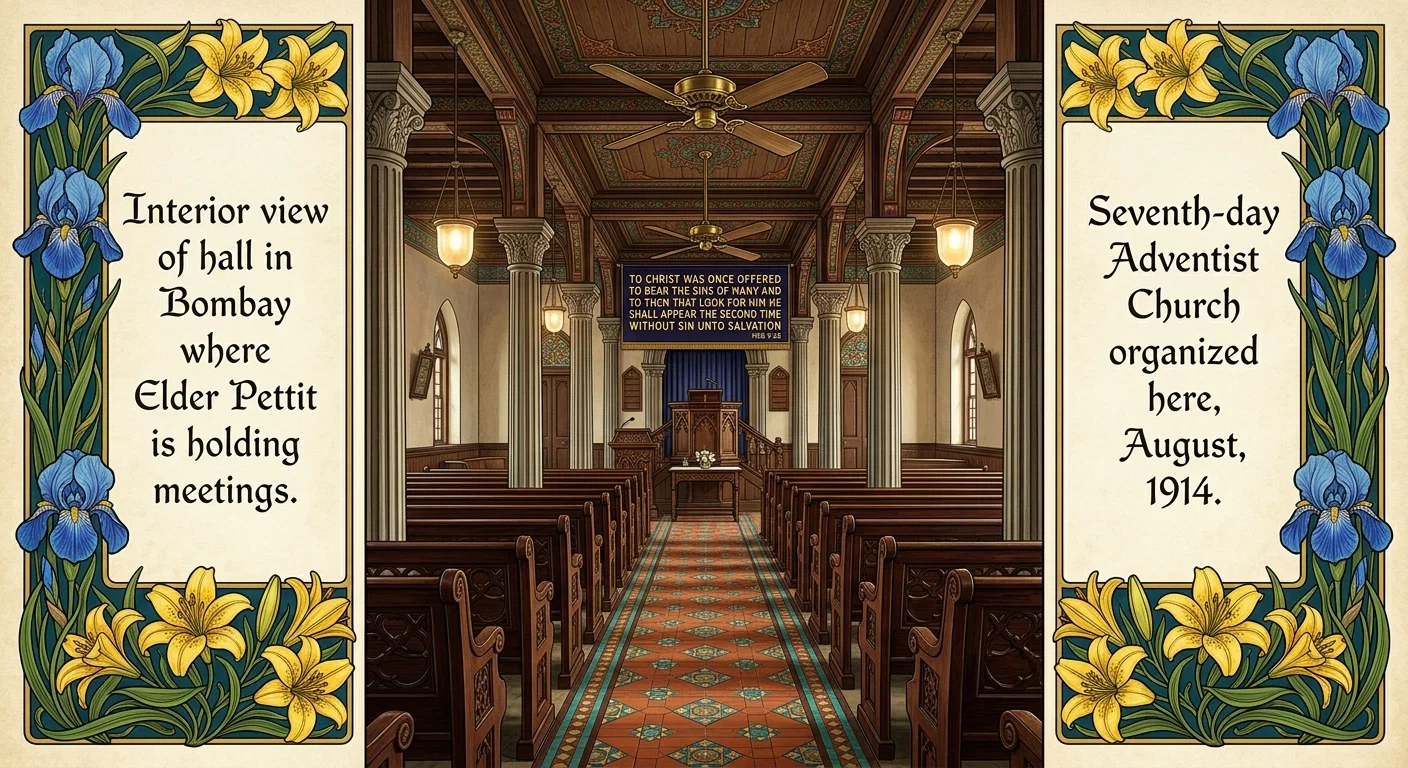
Two views are given, on this page, of the hall in which Brother Pettit has been conducting meetings. The first series of meetings ever held in Bombay by our people was held in this building. Here our first church was organized in August, 1914. The small beginning is growing in a very satisfactory manner. The city of Bombay contains 987,000 inhabitants, and consequently is a great field for labor.
Bombay Seventh-Day Adventist Church Hall
Interior view of hall in Bombay where Elder Pett is holding meetings
Seventh-day Adventist Church organized here, August, 1914
It will be observed that Brother Pettit can make good use of our standard religious publications, in lending them to the new church members and interested persons where he is laboring. Our publishing house is sending him a consignment of books for their local church library in Bombay. We believe that the work will appeal to many of our readers, and that they would like to have a part in it. He ought to have more books than we are sending to him. Any one who would like to help the good work along may send their donations to the treasurer of the Pacific Press Publishing Association, Mountain View, California, and we will see to it that Brother Pettit is supplied with the literature that he needs for his important and growing work.