There was an unusually large crowd in attendance at the meeting on Friday night to hear the address of Elder Harris on “The Christian Sabbath—Is It Saturday or Sunday?” It was clear that this subject of the Sabbath seemed of much greater importance to the people as a result of the studies on the sanctuary question than it ever had before. For the first time they began to see the vital importance of learning the truth of the Sabbath when they saw that their lives and characters were to be judged by the law of God.
And an atmosphere of real earnestness pervaded the audience that night. They wanted to learn the truth about this subject. They really wanted to know what their duty was in the light of the Bible, and so they listened closely to the words of the preacher.
The minister, too, was unusually serious. He spoke with impressive earnestness, and seemed to feel that the meetings had come at last to an issue of vital importance, a place of testing for the people. He outlined carefully the studies of the preceding nights, in order that his hearers might have fresh in their minds the fact that it was by this law which contained the Sabbath question that their lives were to be measured and judged. Having established that point, the minister launched into the subject of the evening:
“Two Sabbaths are being observed by Christian people today, the seventh and first days of the week. The great majority are observing the first day, Sunday, as the Sabbath. There is, however, a rapidly growing minority who are observing the seventh day, Saturday. We shall attempt to find from the Bible which of these days is the Sabbath of the Lord, and then the duty of each individual here must be decided in the light of the teaching of the Bible, and in view of each one’s personal accountability to God.”
“I shall preach an old-fashioned sermon tonight, with its firstly, secondly, and thirdly. And in order to bring out the full truth of this subject I shall add a fourthly, fifthly, sixthly, and seventhly, all in the form of questions.”
“My firstly is, Who made the Sabbath? The answer to this may come as a surprise to many here. That answer is that Jesus Christ made the Sabbath. There are many who think that Christ had everything to do with redemption and nothing to do with creation. This is a mistake. Christ is creator as well as redeemer. It was Christ who brought this world into existence in six days, and who rested on the seventh day. Christ is not only the author of the Christian religion, but is also the author of the Sabbath. This truth is clearly taught in the New Testament in John 1:1–3, 10, 14; Col. 1:12–17; Heb. 1:1, 2.”
“Inasmuch, therefore, as Jesus is both the author of the Christian religion and the author of the seventh-day Sabbath, it is clear that unless he later made another day to take the place of the seventh day, the seventh day is still the Christian Sabbath.”
“Secondly, When was the Sabbath made? It has been taught that the Sabbath originated at Mt. Sinai at the time of the giving of the law. This claim is not true. The Sabbath was made two thousand years and more before the law was given on Sinai. It was made at the time of creation. We have the testimony of Moses himself, inspired by God, concerning this fact. Gen. 2:1–3.”
“From these verses it is clear that the Sabbath was made at the very close of the creative week, at the very beginning of time, at the starting point of the human race. This same truth is taught in the Sabbath commandment itself. We learn from this commandment that the Sabbath was not then a new institution, but that it had been given when the Lord made the earth. It bids all ‘remember’ an institution which had already been established.”
“Thus it is plain that the Sabbath was made by Jesus Christ at the time of the creation of the world.”
“Thirdly, How was the Sabbath made? Turning again to Gen. 2:1–3 we learn the steps in the making of the Sabbath. These are four in number; namely, labor, rest, blessing, and sanctification.”
“The labor was creative labor. From this labor, Christ rested. He rested, not because he was weary, but in order to lay the foundation of a divine institution, and as an example of true Sabbath keeping. It should be noticed in this connection that rest must come after labor, and therefore the Sabbath, to be a day of rest, must, in the very nature of things, fall on the last day of the week.”
“Then the Lord, having rested on the seventh day, blessed that day. When the Lord places his blessing on a thing, that blessing remains there forever, unless he himself removes it. 1 Chron. 17:27. Man cannot remove or reverse it. Num. 23:19, 20. It is plain, therefore, that since God has not removed the blessing from the seventh day it will remain a blessed and holy day as long as time lasts, and throughout all eternity.”
“The fourth step in making the Sabbath was to sanctify it. This means to make it holy. What it means to make a thing holy may be seen by reading Ex. 3:2–5. From this passage it is plain that the ground where Moses stood was holy because God’s presence was there. God’s presence is what makes a thing holy. God’s presence is in the seventh day. Therefore the seventh day is holy. God is in that day as he is in no other day. Therefore, in a peculiar sense it is his day, ‘my holy day,’ ‘the Lord’s day,’ ‘the Sabbath of the Lord thy God.’”
“Fourthly, Out of what was the Sabbath made? Read again Gen. 2:1–3. Notice what it was that Christ used to make the Sabbath. He ended his work on ‘the seventh day.’ He rested on ‘the seventh day.’9He blessed ‘the seventh day.’ He sanctified ‘the seventh day.’”
“Jesus took a day and made a Sabbath out of it, and the day he used was the seventh day. The Sabbath is made of the seventh day. Nothing is said in the Bible of a Sabbath institution, apart from the day. Some would have the commandment read: ‘Remember the Sabbath institution to keep it holy.’ They would have the blessing and sanctification placed on the institution apart from the day. But God plainly placed his blessing and sanctification on the day. God did not say, ‘Remember the Sabbath to keep it holy;’ but he did say, ‘Remember the Sabbath day to keep it [the day] holy.’ It is the day that is to be kept holy, because it was the day which was blessed; it was the day upon which God rested; it was the day which he appointed to be kept.”
“The Sabbath institution is not a movable institution that was placed on one day, and can be changed and transferred to some other day, as many seem to think. It is the day itself which is the Sabbath. ‘The seventh day is the Sabbath of the Lord thy God; in it [the day] thou shalt not do any work.’ This will be seen also by reading the Sabbath commandment (Ex. 20:8–11), and by reading in the New Testament the passages in Luke 23:52–56; 24:1.”
“Fifthly, Was the Sabbath difficult to make? I ask this question because there are many people today who think they can make a sabbath of their own. They claim that merely by selecting a day and resting on it makes that day the Sabbath. But going back to our third point, How was the Sabbath made? we learn from the example set in the beginning, that in order to make a Sabbath a person must be able to create, then rest from that creative labor, bless the day on which it was performed, and make that day holy.”
“The first requisite, therefore, in making a Sabbath is the power to create. And with this we may bring our study of this point to an end, for all will admit that no man, no body of men, no congress of men, and no denomination of men possesses creative power. And from this it is plain that only the Creator can make a Sabbath. And he has made a Sabbath. He does not ask us to make another. He does ask us to keep holy the one he has made.”
“Sixthly, For whom was the Sabbath made? There are many today who claim it was made for the Jews. But when we recall that it was made at creation, more than two thousand years before there was a Jew, it is plain that this cannot be true. In Mark 2:27, Jesus tells us for whom the Sabbath was made. It was made for man, for all mankind. It was given to the father of the race, Adam. It was set apart, sanctified, appointed in Eden to be the Sabbath of the human race. Therefore all mankind is under obligation to observe it.”
“Seventhly, For how long was the Sabbath made? Turn and read Ps. 111:7, 8, on this point. Here we are told that all God’s commandments ‘stand fast forever and ever.’ Read also Isa. 66:22, 23. Here we find that the Sabbath is to be kept, not only during time, but during eternity. All who are saved on the new earth will observe it.”
“If, therefore, we shall keep the seventh-day Sabbath on the new earth, do you not think it would be well to begin here?”
The people passed quietly out of the tent after the service. They were thinking hard. What they had heard was very clear, but a lifetime of habit and custom was behind them, and they found it rather difficult to adjust themselves quickly to this new truth which they were hearing for the first time. Donald Hunter heard some openly scoff and ridicule the speaker and the points he had made, but there were also many who defended him, and pointed out the fact that every point made had come directly from the Bible. As for Donald himself, he was thoroughly convinced that the seventh day is the Sabbath, and that he ought to keep it.
Kissing the Rod
O HEART of mine, we shouldn't
Worry so!
What we've missed of calm we couldn't
Have, you know!
What we've met of stormy pain,
And of sorrow's driving rain,
We can better meet again,
If it blow!
We have erred in that dark hour,
We have known,
When our tears fell with the shower,
All alone!
Were not shine and shadow blent
As the gracious Master meant?
Let us temper our content
With his own.
—Selected.
For the Finding-Out Club
By Editor
[Every one who sends in a correct list of answers to this or any future set of questions will be entered as a member of the Finding-Out Club, if the list is received within three weeks after the date of the paper containing the list. Membership lists of answers to be accepted must follow the rules given below:
The list must be written neatly.
Pen and ink must be used.
Writing must appear upon only one side of the sheet of paper.
The answers must reach the editor's desk within three weeks after the date of the paper containing the questions answered.
All lists must be folded and not rolled.
The questions must not be repeated in the list of answers.
Each answer must bear the same number as the question it is intended to answer.
Every list must give the date of the INSTRUCTOR containing the list of questions being answered; for example, “Answers to questions in INSTRUCTOR of December 8.”
Every list must bear at the bottom the name of the one sending in the list.
The number of lists that one has successfully answered is indicated by the small figure at the upper right-hand corner of the name.
Failure to heed any one of these rules is sufficient to bar one from membership in the Finding-Out Club. Let us watch the membership grow.—Ed.]
1. WHAT is meant by “dog days,” and how did the name originate?
2. How do the population and area of Germany compare with those of Texas?
3. Explain the origin of the term “Teuton,” and also of Teutonic people.
4. How are the crews of submarines supplied with air when their craft is running under water?
5. What is the highest point on the continent of North America?
6. Of what does the crime of treason consist, and how is it punished?
7. What are the words of the salute to the flag?
8. Referring to specific directions for making a cake, should one say, “I have the receipt” or “I have the recipe”?
9. How does the Panama Canal compare in size with the Suez Canal? Can the largest ships pass through the Panama Canal?
10. Does the President of the United States have to pay income tax?
11. What is the meaning of the German motto, “Deutschland über alles”?
12. Of what materials are the mantles used for gas, gasoline, and other lights made?
A Dollar in the Head
By Benjamin Franklin
A DOLLAR in the head is worth five in the pocket, and you might say fifty on the back, because that in the pocket will get out, and that on the back will wear out, but that in the head will grow sharper by constant use.—Benjamin Franklin.
Grandpa
My grandpa says he was once
A little boy like me.
I s'pose he was; and yet it does
Seem queer to think that he
Could ever get my jacket on,
Or shoes, or like to play
With games and toys, and race with Duke,
As I do every day.
He's come to visit us, you see.
Nurse says I must be good,
And mind my manners, as a child
With such a grandpa should.
For grandpa is straight and tall,
And very dignified;
He knows most all there is to know,
And other things beside.
So, though my grandpa knows so much,
I thought that maybe boys
Were things he hadn't studied—
They make such awful noise.
But when I asked at dinner for
Another piece of pie,
I thought I saw a twinkle
In the corner of his eye.
So yesterday, when they went out,
And left us two alone,
I was not quite so much surprised
To find how nice he'd grown.
You should have seen us romp and run!
My! now I almost see
That p'raps he was, long, long ago,
A little boy like me.
— Selected
The Difference
THE little dark-eyed girl in the shabby coat boarded the car at Tennyson Street.
Every seat was filled except one. A little girl sat in that, occupying it alone. She had dark eyes, too, but her coat was new instead of old. She wore a wrist watch, and she had on bronze shoes.
The little girl in the shabby coat came in and sat down beside her.
The little girl who wore a wrist watch continued to stare out of the window. She had a frown on her face, and the corners of her mouth turned down.
“Oh, dear!” she was thinking, “how I do dislike high school, and how I do wish mother would get me that pearl pendant at Fisher’s. I think it is a shame I have to wait for things. I have the hardest time in the world, having to go to high school and study when I don’t want to—I wish there wasn’t such a thing as ancient history, and as for algebra—oh!”
At that moment the little, dark-eyed girl in the shabby coat touched her arm.
“Would you mind telling me what time it is?” she asked, timidly. “I have only an hour at noon, and I’m so afraid I’ll be late. I don’t usually go home, but my little sister is sick today and I wanted to take her some oranges.”
The little girl who wore the wrist watch turned. The frown was yet on her face; the corners of her mouth were still turned down.
“It’s a quarter to one,” she replied, and then she asked, as she saw the wistful look in the dark eyes of the little girl in the shabby coat:
“What school do you attend?”
The little, dark-eyed girl in the shabby coat shook her head. “I don’t go to any, though I wish I did,” she answered slowly. “I wrap goods down at Mills & Phelps. You see,” she went on, “mother died and father got sick. Aunt Nancy, who came to live with us, thought I ought to earn at least my own living. Perhaps I had, because father can’t earn much, but, oh, how I did hate to leave school! I can remember yet how I cried the day I took my books home.”
“However, there are bright spots in everything.” she went on, cheerfully. “I like my work, and every one in the store is good to me. It’s only when I see girls like you going to school that I realize what I’ve missed. I would have so liked to go on. If mother had lived, she would have found a way—mothers do, you know—but,” her eyes filled with sudden tears. “she couldn’t. She got hurt in a street-car accident and lived only six weeks.” She stopped, then went on bravely, “You are in high school, aren’t you?”
The little girl with the corners of her mouth turned down nodded. “Yes, I’m a freshman—and, do you know, I was just sitting here thinking how hard ancient history is, and that I am not going to like algebra, and that my English teacher is cross. And that isn’t all. I’ve been wanting a pearl pendant—the loveliest thing—and mother told me I must wait awhile.”
The dark-eyed girl in the shabby coat looked at her. “I wouldn’t mind about the pearl pendant if I were you,” she replied, with a little smile. “You look so nice and well dressed. You have a good home, I know, and a good mother, too, and your room—oh, I can just see it!—a little white bed and pretty curtains and a soft rug, and there are pictures on the walls, a great many of them, and a dear little rocker. And you come home from school and eat bread and jelly, and make fudge when you want to, and get invited to parties and to go automobiling.”
“Why, how did you know?” she cried.
The little, dark girl in the shabby coat smiled. “I don’t know. I just seem to see it somehow, and that isn’t all. I see you going out into the big world, by and by, equipped with knowledge and understanding, and able to do so many things that girls without education never can.”
“I wouldn’t mind about the pearl pendant a bit, if I were you. Good-by; I get off here.”
She smiled again. “Keep at that ancient history and it will get easier. I only wish I had a chance at it. Good-by.”
“Good-by,” said the little girl with the corners of her mouth turned down.
She watched the little, dark-eyed girl in the shabby11coat get off the car, and then a strange thing happened. The frown vanished, the corners of her mouth turned up instead of down, and she was smiling. “What a sweet, brave little girl she is,” she mused. “I wish she could go to high school too. After all, I shouldn’t want to stop, and I will try to like ancient history—and I don’t care whether I get the pearl pendant or not. I didn’t know I had so many blessings.”
The car stopped. The little girl with the corners of her mouth turned up got off—the high school was just across the street.
“Just see if I don’t conquer that ancient history,” she whispered, as she skipped along.
The sun shone, and the corners of her mouth were still turned up. The little, dark-eyed girl in the shabby coat had carried the message.—Girlhood Days.
Strange Cry in the Washington Zoological Park
By Robert Yocum
It was indeed a strange cry. The two Leadbetter boys, whom I was conducting through the zoological park at Washington, stopped short to listen, with their eyes opened wide. Mee-oo! Mee-oo! Mee-oo! came the sound, long drawn out and repeated over and over. It came apparently from one of those small valleys among the trees that make the new Washington park the most picturesque of all our “zoos.”
“Why, that sounds just like our little Bloody Murder at the try-works!” Charles Leadbetter exclaimed.
“That seems a strange name to give an animal,” I said. “What sort of creature was it?”
“We don’t know. We never knew. But we supposed that it was some kind of Mexican elk. We named him Bloody Murder because he yelped and yowled so fearfully—exactly like this one.”
“Yes,” his brother Hugh put in. “The animal that gave that cry must be Bloody Murder’s own brother.”
“Where did you see this Bloody Murder?” I asked.
“Up the barranco in the oat grass valleys above our try-works.”
The boys had already told me something of their story. Mr. Leadbetter had, with his brother, been engaged in the whaling business up the Gulf of California—a favorite breeding ground of the sperm whale. Their haven and try-works for oil were situated in a deep cove on the peninsula side of the gulf thirty miles north of Angel Island and the Ballenas Channel. They had built a comfortable house there, and Mr. Leadbetter had his family with him. It was a remote, lonely place. Natives of the country were few, and had rarely visited them.
The Leadbetters had never had any trouble with the Mexican authorities, who indeed had little jurisdiction except in name over the peninsula of Lower California. But a few weeks before, an armed gang of bandits had crossed over from the Sonora side of the gulf, and had attacked the Americans; they had looted and burned the establishment there and killed three of the hired whalemen. The Leadbetters had fled for their lives into the mountains behind the cove, from which, after much hardship, they had made their way over to Ensenada, on the Pacific, and from there to San Diego. Mr. Leadbetter was at that time in Washington, with his two sons, to take the matter up with the government.
I was rather puzzled by the boys’ identifying so positively the cry that we had just heard with that of their Bloody Murder; for I knew the animal that was making the rumpus over among the trees was a baby camel. It seemed impossible that the Leadbetters should have come across wild camels on that remote peninsula. Thinking that they must be mistaken, I asked them to describe their pet at the try-works.
“He was just about as big as a week-old colt, and had long, slim legs,” Hugh Leadbetter said. “He had a little bare tail about a foot long and the queerest and crookedest neck that you ever saw. It crooked down and then up like the gooseneck of a hoe, turned bottom up. His head wasn’t quite so long as a colt’s head, but it was chunkier; and his mouth and lips had an odd twist to them.”
“What color was he?” I asked with keen interest.
“Brown, but he didn’t seem to have much hair,” Charles said. “What hair he had was more like wool and was in curly tufts, some at his knees, one on the top of his head, one on each jowl, and two larger ones on his back.”
“And his skin was sort of warty and wrinkled in spots,” Hugh put in. “When he lay down, he folded his knees under him and drew his head clear back on to his shoulders with his neck doubled under.”
“How did you happen to find this curious animal?” I inquired.
“Uncle Henry had gone up the barranco with us, to shoot speckled grouse in the oat grass,” Hugh began; but I had to ask what they meant by barranco.
“Oh, that is a deep hollow or ravine,” Hugh explained. “When it rained, a torrent came down it to the cove; but it’s most always dry there.”
“To reach the oat grass we had to go up this ravine for as much as two miles. It’s very steep, for the mountains rise four or five thousand feet right behind the cove where we had our house and try-kettles; it’s awfully craggy and dry up there, except near the top, where there are moist valleys and lots of oat grass. After you get up there, you can look down on the cove and off to sea, all along the coast both ways. My, it’s great up there, with the sea right at your feet and the gulls and the condors sailing round in circles!”
“It was up there in the oat grass that we found Bloody Murder. We had gone a mile or two along the foot of some high cliffs where there were hundreds of rocks, some of them as big as a house, with the oat grass growing shoulder-high round them. As we went along through it, we heard condors gasping and hissing at each other, and pretty soon came upon four of them feeding on the carcass of some large animal, the bones of which they had picked nearly clean. It had been dead for some time. I don’t suppose the condors killed it; there are jaguars in those mountains, and probably they had killed it and eaten the best of it. Uncle Henry guessed that it was some kind of Mexican elk. The bones looked as large as those of a horse, or larger, but the flesh was all gone. Uncle Henry fired at the condors and they flew away.”
“While we stood there, looking at those bones and wondering what sort of animal it was, we heard the queer cry that we just heard here. First it was a soft, low whimper, as if the animal had been afraid to let itself be heard; but pretty soon the cries began again and got louder. It seemed to be in the high grass behind one of those great rocks. ‘I guess that’s a little jaguar,’ Uncle Henry said. ‘We had better look out. The old one may be near by.’”
“After listening to it awhile we went cautiously toward the place, and found little Bloody Murder. At first sight we took him for a colt, but soon saw that he wasn’t. We thought he might be a young elk, and that the bones of the animal that had been killed were those of his mother.12What made us think so was that the poor little creature seemed nearly starved to death, and was so weak that he could hardly walk. I suppose he had been hiding behind that rock and had had no milk for several days. After we caught the little beast, he grabbed hold of our fingers with his lips and tried to suck them. We couldn’t help pitying the poor little thing. He was so famished that I don’t think he weighed more than a hundred pounds.”
“Uncle Henry swung him on his back and, taking his fore legs in one hand and his hind legs in the other, carried him down the barranco to the try-works.”
“The first thing we gave the creature to eat was a can of our condensed milk, dissolved in warm water. We let him suck it out of a bottle. After he had learned to drink, we fed him on thin porridge, made of meal. He was hungry all the time, and if he didn’t get his food promptly, he yelped and cried till some of us brought it to him. There was no peace for us till he got his gallon of porridge.”
“He didn’t grow much, but when the Mexicans drove us away, he had begun to run about and crop grass and weeds. I suppose he is wandering round there now, if those bandits didn’t shoot him.”
“So you thought he was an elk,” I said. “Come with me down the hill here and see if this one we have just heard crying looks like the one you found.”
When we reached the camel yard and the boys spied the baby camel, they both exclaimed that the little fellow was exactly like Bloody Murder.
“Looks just like Bloody Murder every way—woolly hair, little crooked neck, twisty lips, and all!” Hugh said.
“But this is a camel,” I said.
“Then ours was one,” they both declared.
How came a young camel into that uninhabited waste of Lower California? The boys had told me all they knew about it. I pondered that matter for days afterward. And then one evening, when I was reading a history of the Southwest, I came upon an item that solved the mystery.
Rather more than half a century ago, and long before transcontinental railways had been built or thought of, a plan had been proposed in Congress for carrying the mails and passengers to and from California by means of camel caravans. Congress voted an appropriation for the experiment, and a drove of about thirty camels was imported and taken to Texas and Arizona. The plan proved a failure, however, and after a year or two, twenty or more of the camels were turned loose to shift for themselves.
As time has passed, stray camels have been seen occasionally in the delta of the Colorado River and elsewhere near the Mexican boundary. It seems wholly possible that the camel calf that the Leadbetters found was a descendant of those camels that the United States government had years ago imported from Egypt.—Robert Yocum, in Youth’s Companion.
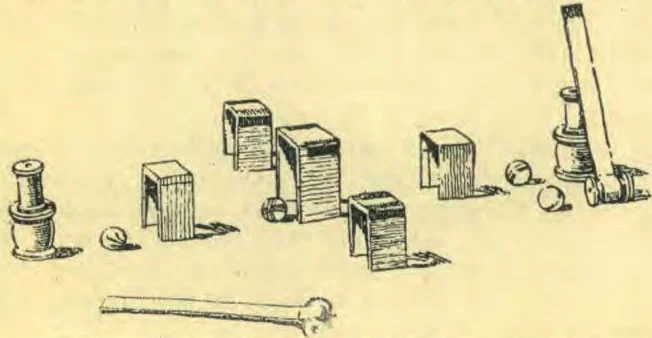
INDOORS CROQUET SET THAT ANY BOY CAN MAKE
The Fitfulness of Princes
By J. O. Corliss
ONE might casually read that injunction of the psalmist, “Put not your trust in princes,” without receiving any deep impression, unless it were followed with a mental survey of history regarding the unstable movements of many notables of earth.
Talleyrand
Take for example the celebrated French statesman Talleyrand. Born of a noble family, and educated for the priesthood, his precocity soon gave him the lead over all his ecclesiastical compeers, by whom he was early elected a member of the States-General. Political preferment soon made him president of that assembly, when his course in a short time brought excommunication to him from the head of the church.
Being thus released from religious responsibility, his energies were quickly bent toward securing political power for himself. Casting about for a suitable channel through which to reach the height of his ambition, he shrewdly selected a young army officer whose fame was then in the advancing scale, and through letters of semiconfidence, secured the coöperation of that bold Corsican soldier in a plan not only to rule the empire of France, but also greatly to enlarge its borders.
To carry out this secret plot the Egyptian campaign was suddenly abandoned by Napoleon to return to France. Then the hand of Talleyrand became the lever in shaping the events of the ninth and tenth days of November, 1799, referred to in history as the 18th and 19th Brumaire, which resulted in the overthrow of the governing Directory, and in placing Napoleon at the head of the French consulate. From this time forward until the peace of Tilsit, July 9, 1807, Talleyrand was the constant attendant of the great conqueror. But from the attitude of the emperor Alexander of Russia at that time, who was one of the sponsors at that gathering, he readily divined the fate of the ravager of the peace of Europe, and at once changed his political posture, while diplomatically appearing still to favor the cause of Napoleon.
Talleyrand’s deceptive standing was soon detected, and in the fury of invective which Napoleon alone knew how to employ, he reproached his minister, charging him with the murder of the Duc d’Enghien, an Orleanist claimant to the throne of France, for which the nations of Europe were holding Napoleon himself responsible. At this, Talleyrand stood as impassive as a statue, but when it was over and he was well out of the room, he simply remarked: “What a pity that such a great man has been so badly brought up.”
Of course this was said merely to show his contempt for the emperor’s lack of education in diplomacy. He himself having been made a prince of the empire by Napoleon, and holding the post of foreign minister, his place of residence became a popular resort for politicians of every stripe, both domestic and foreign. Under these conditions the opportunity was open to make secret advances to those whom he could trust. So having become dissatisfied with his former benefactor, he determined to undermine the empire, and so by the aid of the Russian emperor Alexander, he succeeded in bringing about the revolution that put Louis XVIII on the throne, and sent Napoleon to the island of Elba.
When Napoleon returned to Paris from Elba, Talleyrand, not wishing to meet his former colleague, coolly betook himself to the springs of Carlsbad. Upon13being questioned about this course, he only remarked that the first duty of a diplomatist after a congress is to attend to his liver. He was indeed a notable example of princely duplicity, the pattern of which has been perseveringly followed to the present time, as will be more fully emphasized when the history of the past three years has been fully written.
Murat
Another sad case, though one of a little different nature, is that of Murat, another prince of French creation. Though having been trained for military service, as a young man out of employment he was wandering about the streets of Paris in the summer of 1795, when he fell into company with young Napoleon Bonaparte, who was in a like situation. They formed mutual friendship, and their future was destined to be similar in nature. When Napoleon went to Egypt, Murat was his companion, and won fame for his celebrated cavalry charge at the Battle of the Pyramids.
Returning with Napoleon to France, he was united in marriage with Caroline, the sister of Napoleon, and was made titular governor of Paris. He was next appointed grand admiral of France in 1805, and given the title of prince of the empire. He was further advanced by Napoleon to be king of Naples in 1808, but through some unfortunate behavior on the part of his officials, the people of Calabria became greatly displeased with him as king. Not long after, he was offended by Napoleon, and his wife making common cause with him, he was led to intrigue with Austria, and form an offensive and defensive alliance with that government.
Because of this, and because of other considerations, he was obliged to abandon the throne of Naples, but after the defeat of Napoleon at the Battle of Waterloo, Murat was refused an asylum in England, and so went to Corsica, where some restless spirits prevailed on him to strike another blow to regain the kingdom of Naples. Instead of accepting a retreat in Austria offered him by Metternich, chief minister of that country, he landed in Calabria in the interest of his lost kingdom, when he was at once arrested and sentenced to be shot. It was said that the influence of Talleyrand had much to do with this unfortunate end of Murat.
As a consequence of these and other intrigues the entire Bonaparte family met untimely fates. The sovereigns of Europe had courted and intermarried with the Bonapartes in the time of that family’s grandeur, but when adversity came they were treated with extreme rigor as criminals. This conduct of the nations was not influenced by the principle of legitimacy, for had this been the motive, they would have respected their own theory of divine appointment of kings, and not have made their existence depend on the fate of war.
These are but a few instances recorded in history of misplaced confidence in earthly princes. There is, however, One, and he the Prince of Peace, who has said, “I will never leave thee, nor forsake thee. So that we may boldly say, The Lord is my helper, and I will not fear what man shall do unto me.” Heb. 13:5, 6. He is therefore the only safe personage in whom to place confidence, because he is “the same yesterday, and today, and forever.” It is well to remember that his attitude toward those who serve him is never disappointing. J. O. CORLISS.