The Youth’s Instructor, Vol. 65, No. 44.

To Tell Ranks of Officers
Earlier text: THE CHRISTIAN SABBATH

The Christian’s Hopes and Longings

(Texts for November 4-10)
It was ever the same. The good-by always left a deep hunger for the greeting that lay beyond. The months in school were pleasant, but home was always on the horizon of thought, and the longing heart kept the hand of hope pointing homeward. Each spring when the school year closed and the trunk was packed, the college good-by over, the ticket in hand, one dear old spot on the map loomed up before me to the exclusion of all else. And when the train made the last curve, crossed the bridge where the old familiar country road smiled back to me, I fairly burst with suppressed shouting.
As we drove up over the hills and down through the hollows, the changes along the way were all discussed, and an up-to-date acquaintance with the old road once again established. One of those hilltops was crowned with special interest. No matter how tense the conversation was, it was bound to be interrupted when reaching the top of that hill, for over there on yonder hillside lay the dearest spot on earth—the spot toward which my heart was ever turning. I can close my eyes this morning and see the dear old home again; tender memories still enshroud it and ever must, for there once lived the best friends of other days.
But time changes all things. Sooner or later death knocks down the pillars of earth’s choicest home,—your home, my home,—and it is no more. Yet if the bitter tears of our loss can wash the scales from our eyes, and help us to see more clearly the home above, then it is not all loss. If the sweet memories of our happy homes here make the blessed hope of “the home where changes never come” loom up before us with ever-increasing brilliancy, then all is well.
And for the Christian, the changes and losses of life are ever deepening his longing for the home of endless bliss. His heart yearns for the time when he shall be at home with Jesus, his best Friend, and for the reunion which that happy home-going will bring.
No wonder the Christian longs to be there. Jesus left all to come to the world to purchase this home for him; he went all the way to the cross that he might obtain it. The road he traveled was rugged. There were misunderstandings and loneliness such as we cannot comprehend; there were ridicule and opposition on every hand; there were temptations to choose a more popular course; there was everything for him to meet that makes a leader’s work hard. Often his heart ached sorely because he knew that so few of us would care that he had suffered; so few would accept the gift that he had purchased at infinite cost. But he did not falter; for your sake and mine he persevered.
But the grave could not hold him. He rose from it that he might help us to prepare for the home he had procured for us. He arose that he might come to live in our hearts, to fight our battles for us and give us victory day by day in our lives. He came to go with us all the way—to guide us when puzzled; to comfort us when grieved; to inspire us when discouragement comes; to strengthen us when tempted; and to love us always. All along life’s changing pathway he will be all things to us. For every sorrow he will be the antidote; for every loss he will be our gain.
No wonder that “a hunger, deep, unsatisfied” is urging the Christian to strive to be ready to go home when the Saviour shall gather there all who really love him. And no wonder that the Christian is consumed with a desire to have others prepare to go there. There will be home room for all who will go; there will be a warm welcome for every one; and no one who goes there will be disappointed, for Jesus knows every unuttered desire of our hearts; his love we cannot question; and since all things are his, we may be sure that the home he is preparing for us will please us. Best of all, we shall have him there.
Yes, our hearts are yearning for this beautiful home; but are we ready for it? Our Saviour has purchased the home and paid our traveling expenses to it; but we must make the required preparation. We must—with his help—put off the rags of sin and put on the robe of righteousness. The rags of sin hang on tenaciously, but with his skilful help, they may be removed and the robe he provides be put on. We must say with the psalmist: “I will behold thy face in righteousness;” and we need to say it with all the will-power we possess. Then, too, you and I must know by faith that “the Lord will perfect that which concerneth me.” This will add hope and courage to our determination. And as we pray, “Forsake not the works of thine own hands,” we must try hard not to hinder him in his work. Finally, day by day we must pray from the very bottom of our hearts: “Cause me to know the way wherein I should walk.” Then he will guide us all the way, and soon lead us into the blessed “home where changes never come.”
MEDITATION.—This morning I am reviewing some of the blessings that have come into my life. There have been many exceedingly precious ones; but somehow I can see how all of them bear the mark of uncertainty. A few times I have gone to bed feeling rich because a certain blessing was mine, only to wake up to a feeling of intense poverty because that blessing, too, had been snatched from my hands. But this morning, thinking of the uncertainties of earth makes me deeply grateful for the certainties of heaven.
SPECIAL PRAYER.—O Father, let the fleeting blessings of this life teach me to value eternal things. Help me to learn the lessons they should teach me. Prepare me for the home that thou art preparing for me, and help me to lead others to it.
M. E.

Knowledge Is Power

“KNOWLEDGE is power.”

The Bible Year

Senior Assignment

November 4. John 16 to 18: Jesus comforts and prays for his disciples.
November 5. John 19 to 21: Scourged; crucified; risen; by the seaside.
November 6. Acts 1 to 3: Jesus’ last words and ascension; Pentecost.
November 7. Acts 4 to 6: Love of believers; prison doors opened.
November 8. Acts 7 to 9: Defense and death of Stephen; conversion of Saul.
November 9. Acts 10 to 12: The gospel goes to the Gentiles; persecution.
November 10. Acts 13 to 15: The first gospel missionaries: persecution and opposition.

Junior Assignment

November 4. John 17: Jesus prays for his disciples.
November 5. John 18: Jesus betrayed and tried.
November 6. John 19: Scourged and crucified.
November 7. John 20: Raised to life.
November 8. John 21: By the sea of Galilee.
November 9. Acts 1: Jesus ascends to heaven.
November 10. Acts 2: The day of Pentecost.

The Acts

It goes without saying that you boys and girls like to read books full of surprising and unusual incidents; and for that reason you are sure to enjoy the book of Acts. It is truly inspiring. We are told that originally the book had no name; but since it is a book of deeds, its present title seems very appropriate.
“And who was that man Theophilus?” do I hear you ask? You mean the one mentioned in the first chapter, to whom Luke dedicates the book? It is thought that he was a Roman officer, and a great friend of Dr. Luke. Isn’t his name a queer one? One’s tongue gets twisted up in trying to pronounce it, if he isn’t pretty careful.
Don’t you like the word “hero”? It makes one think of some one brave and strong. Well, there are two heroes who stand out most prominently in the book of Acts. If you were to guess their names, I wonder if you would have them correct. Yes, they are Peter and Paul. Of course, many other people are mentioned, but these two are the leading characters. The first twelve chapters of Acts deal especially with Peter, while in the remaining chapters Paul is the principal figure. These two divisions of the book are known as the Petrine and the Pauline portions.
Nobody knows just where or when this book of Acts was written, but it seems likely that it was at Rome about 62 A. D. Anyway, it was before the destruction of Jerusalem, in A. D. 70.
“I don’t see how Luke ever remembered all the things he wrote in his book, especially the sermons,” some boy or girl may say. “If he did, he had a remarkable memory, and I wish I had one like it.” No, naturally, he couldn’t have kept so much in mind, but you know God especially helped him. Then, too, I imagine he had a diary or notebook, and when anything of importance occurred, he very likely jotted it down. The notebook habit is a good one to form, for boys and girls as well as for older people. Whenever you hear anything that seems especially worth remembering, write it down, for some day you will find it very useful.
This is the month of November, and the days are crowded full of work and study and play. But although you are as busy as bees, and do not have many spare moments, you will not allow anything to hinder your daily Bible reading, will you? We are on the “home stretch” now, but it is only “he that endures to the end” that can be called a faithful soldier. Some people get discouraged and drop out, and have to be listed with the deserters; but we expect our Junior Missionary Volunteers to have the grit and determination to complete what they undertake.
ELLA IDEN.

The Best You Have Will Return

THEN give to the world the best you have, And the best will come back to you. — Madeline S. Bridges.

Missionary Volunteer Society Programs for Week Ending November 10

The programs for this date, with notes, illustrations, and other helpful material, will be found in the Church Officers' Gazette for November.

VI — Proper Observance of the Sabbath

(November 10)
LESSON HELP: “Testimonies for the Church,” Vol. VI, pp. 349-368.
MEMORY VERSE: “Wherefore it is lawful to do well on the Sabbath days.” Matt. 12:12.

Questions

1. Repeat the fourth commandment. What is the first word of the commandment? When should we remember the Sabbath? Note 1.
2. For what purpose are we to remember the Sabbath day? Ex. 20:8. Note 2.
3. Who made the Sabbath day holy? Verse 11, last part. Note 3.
4. What day is especially mentioned as the day to prepare for the Sabbath? Luke 23:54; Ex. 16:22, 23. Note 4.
5. According to the Bible, when does the Sabbath begin? Gen. 1:5, 8, 13, 19, 23, 31. Note 5.
6. Then at what time should all be ready to keep the Sabbath? Note 6.
7. What indicates that there should be public worship on the Sabbath? Lev. 23:3. Note 7.
8. What question about Sabbath keeping did the Jews once ask Jesus? Matt. 12:10.
9. What was the reply of Jesus both in precept and example? Verses 12, 13.
10. What should God’s holy day be to us? In what three ways may we especially honor the Lord? Isa. 58:13.
11. What promise is given to those who thus honor him? Verse 14.
12. What does the “psalm for the Sabbath day” suggest as proper acts and topics of thought on the Sabbath? Ps. 92:1-5.
13. What do the works of God declare? Ps. 19:1-3. Note 8.

Notes

1. “At the very beginning of the fourth commandment the Lord said, ‘Remember.’ He knew that amid the multitude of cares and perplexities man would be tempted to excuse himself from meeting the full requirement of the law, or would forget its sacred importance. Therefore he said, ‘Remember the Sabbath day, to keep it holy.’ Ex. 20:8.
“All through the week we are to have the Sabbath in mind, and be making preparation to keep it according to the commandment.”—“Testimonies for the Church,” Vol. VI, p. 353.
2. “All through the week the keeping holy of the Sabbath day is to be remembered, or borne in mind. No business contracts or arrangements are to be made, no manner of living indulged in, which will prevent or interfere with the proper or holy observance of the day when it comes. The keeping of this commandment, therefore, is in the interests of, and with a view to, holy living all the time. The commandment itself enjoins a duty, and is to be kept, all through the week; the Sabbath is to be kept when it comes. The Sabbath commandment, therefore, like every other precept of the decalogue, but contrary to the conception of many, is to be kept all the time, and not simply one day in the week. In this matter we should distinguish between the Sabbath and the Sabbath commandment.”—“Bible Readings,” p. 425.
3. God made the Sabbath day holy; we are to keep it holy.
4. All food that is to be used on the Sabbath day that is to be baked or boiled, should be made ready for use on the “preparation day.” To “seethe” means to boil. In cold weather the food may be heated, and it is not necessary to eat cold food.
5. The day begins with the evening. The evening begins “at the going down of the sun.” See Mark 1:32. The Bible recognizes the “even” as the proper time for beginning and ending the Sabbath. See Lev. 23:32.
“One great advantage of keeping the Sabbath according to the Bible method of reckoning the day, that is, from sunset to sunset, over keeping it according to the Roman reckoning, or from midnight to midnight, is that by the former, one is awake to welcome and to bid adieu to the day when it comes and goes, while by the latter he is asleep when the day begins and ends. God’s ways are always best. The setting of the sun is a great natural sign for marking the division of time into days.”—Id., p. 426.
6. “Before the setting of the sun, let the members of the family assemble to read God’s Word, to sing and pray. There is need of reform here, for many have been remiss. We need to confess to God and to one another. We should begin anew to make special arrangements that every member of the family may be prepared to honor the day which God has blessed and sanctified.
“Let not the precious hours of the Sabbath be wasted in bed. On Sabbath morning the family should be astir early. If they rise late, there is confusion and bustle in preparing for breakfast and Sabbath school. There is hurrying, jostling, and impatience. Thus unholy feelings come into the home. The Sabbath, thus desecrated, becomes a weariness. and its coming is dreaded rather than loved.”—“Testimonies for the Church,” Vol. VI, pp. 356, 357.
7. “The word ‘convocation’ means ‘a calling together,’ and is always used in the Bible with reference to meetings of a religious character.”—“Bible Readings,” p. 427.
When it is possible, we should always go to church and Sabbath school on the Sabbath. The Lord meets with his people on that day, and we shall surely miss a blessing if we carelessly stay away. Some may live so far from the place of meeting that they cannot go every Sabbath, but they can worship the Lord and study his Word on that day.
8. “God designed that the Sabbath should direct the minds of men to his created works, and through these to him, the Creator. Nature itself speaks to our senses, telling us that there is a God, the Creator and Supreme Ruler of the universe. The Sabbath, ever pointing to God through nature, was designed to keep the Creator constantly in mind.”—Ibid.

A Relic from the Front

BISHOP TAYLOR SMITH, chaplain-general to the forces, recently showed as a relic one of the prayer cards he had circulated among the troops. It was the only one that had come back to him out of more than a million sent out.
It was a crumpled piece of paper, soiled and stained, the letters almost obliterated, and had been returned with these words attached: “The inclosed was at Mons, on the Aisne, all through the engagement at Ypres, and is now just in from the trenches. The man who gave it me said it did all that it was meant to do for him.” There will be many short and simple prayers of which that will be said at the last. With us in all life’s stiffest fights, we shall say they did for us all they were meant to do.—Christian Endeavor World.

A Toddler's Preference for Dairy Butter

A TWO-YEAR old lad had a decided preference for dairy butter over that of the new vegetable butter that had recently been introduced into his home. So one evening when his father at the evening worship prayed, “Give us this day our daily bread,” he interjected, “and dairy butter, mother?”

The Red Cross

What the Red Cross is doing:
Sending more than $100,000 worth of Red Cross supplies to Europe each month.
Sending 700 tons of food to France each week for refugees.
Providing $200,000 for immediate relief work in Rumania, and a like amount for the same purpose in Italy.
Maintaining two hospital ships for the United States Navy.
Operating a motor transport service in France, thus reducing the enormous strain on the weakened railroads of France.
It has raised and equipped 50 base hospitals, 15 of which are already on the field or en route.
What the Red Cross needs:
1,000,000 sheets and 375,000 pillowcases.
220,000 blankets.
500,000 suits of pyjamas are wanted by the Red Cross within a year. You can make a suit.
10,000 uniforms for nurses.
54,000 white gowns for the Red Cross surgeons.
The Red Cross must have 5,000 auto ambulances, besides one hundred army ambulances at $18,000 each.
Here is another thing the Red Cross wants for our soldiers — 2,000 comfort kits.
1,000,000 mufflers.
1,000,000 sleeveless sweaters.
1,000,000 pairs of mitts before the snow flies.
1,100,000 bath towels.
2,000,000 socks.
The Red Cross needs 10,000 ice-bag covers.
$180,000 a year is needed by the Red Cross to help the families of men in the navy.

The Red Cross Headquarters

The enormous mail received at the National Headquarters was the chief reason for the policy of decentralization decided on during the summer. This new system will mean better service to those who make inquiries of the Red Cross, and will also enable the National Headquarters to do better work. Thirteen divisions have been created centering about thirteen large cities, in which division headquarters are established. Each division is in charge of a business man of recognized eminence and ability, serving without pay for the period of the war. Each division manager’s office will be a miniature National Headquarters, with competent specialists in every kind of Red Cross work and management. Henceforth no one will need to write to National Headquarters for Red Cross information; all inquiries will be handled at the division headquarters of each section.
You can easily tell where the headquarters of your section are located. Here are the names of the thirteen cities which are division headquarters. Just write to the one nearest you, addressing your letter to “The Division Manager, The American Red Cross.” The cities are: Boston, New York, Philadelphia, Washington, Atlanta, New Orleans, Cleveland, Chicago, St. Louis, Minneapolis, Denver, Seattle, and San Francisco.

'Tis Not the Weight of Jewel or Plate

“’Tis not the weight of jewel or plate, Or the fondle of silk or fur; ’Tis the spirit in which the gift is rich, As the gifts of the wise ones were,— And we are not told whose gift was gold, Or whose was the gift of myrrh.”

One Sin Destroys

BOTH Balaam and Judas had received great light and enjoyed special privileges; but a single cherished sin poisoned the entire character, and caused their destruction. It is a perilous thing to allow an unchristian trait to live in the heart. One cherished sin will, little by little, debase the character, bringing all its nobler powers into subjection to the evil desire. The removal of one safeguard from the conscience, the indulgence of one evil habit, one neglect of the high claims of duty, breaks down the defenses of the soul, and opens the way for Satan to come in and lead us astray. The only safe course is to let our prayers go forth daily from a sincere heart, as did David, “Hold up my goings in thy paths, that my footsteps slip not.”—“Patriarchs and Prophets.”

The Y. M. C. A. in War

WHEREVER there are soldiers there the Y. M. C. A. makes itself felt in a very acceptable way. It is international in spirit and word. There are 429 Y. M. C. A. centers in France, 47 in Mesopotamia, 45 in India, 35 in the Mediterranean, 58 in Egypt and Palestine, 1,000 in the training camps in the British Isles, 200 centers in similar camps in the United States, and one at every important naval base here and abroad.
These centers furnish to the soldiers hot cocoa and crackers for two cents, besides providing them with free reading matter, writing facilities, spiritual instruction, and wholesome recreation and entertainment.
The association secretaries established at these centers have varied duties. The following experience of one of these gives a sample of their service:
“One-thirty A. M., called out of ‘bed’ to give directions to a ration party looking for the trenches; three-thirty A. M., aroused by three men seeking shelter from falling shrapnel; six A. M., called up by eight men, advance party of a battalion, wanting breakfast. That started the regular day’s work, during which he served over three hundred soldiers—British, French, Canadian, and Belgian—with cocoa, made the cocoa between times, and washed mugs.
“In the morning he washed out the eyes of a soldier who had got some dirt in them; in the afternoon he gave shaving facilities to a man going on leave. He discussed war, religion, nationalities, and politics with men of every shade of opinion, distributed papers, etc. As a shell burst close by and rocked the dugout, one customer said: ‘I wouldn’t stay here for a thousand dollars a month.’
“‘Neither would I,’ was the quiet reply. The triangle sign received two rents from shell splinters the first week it was up.”
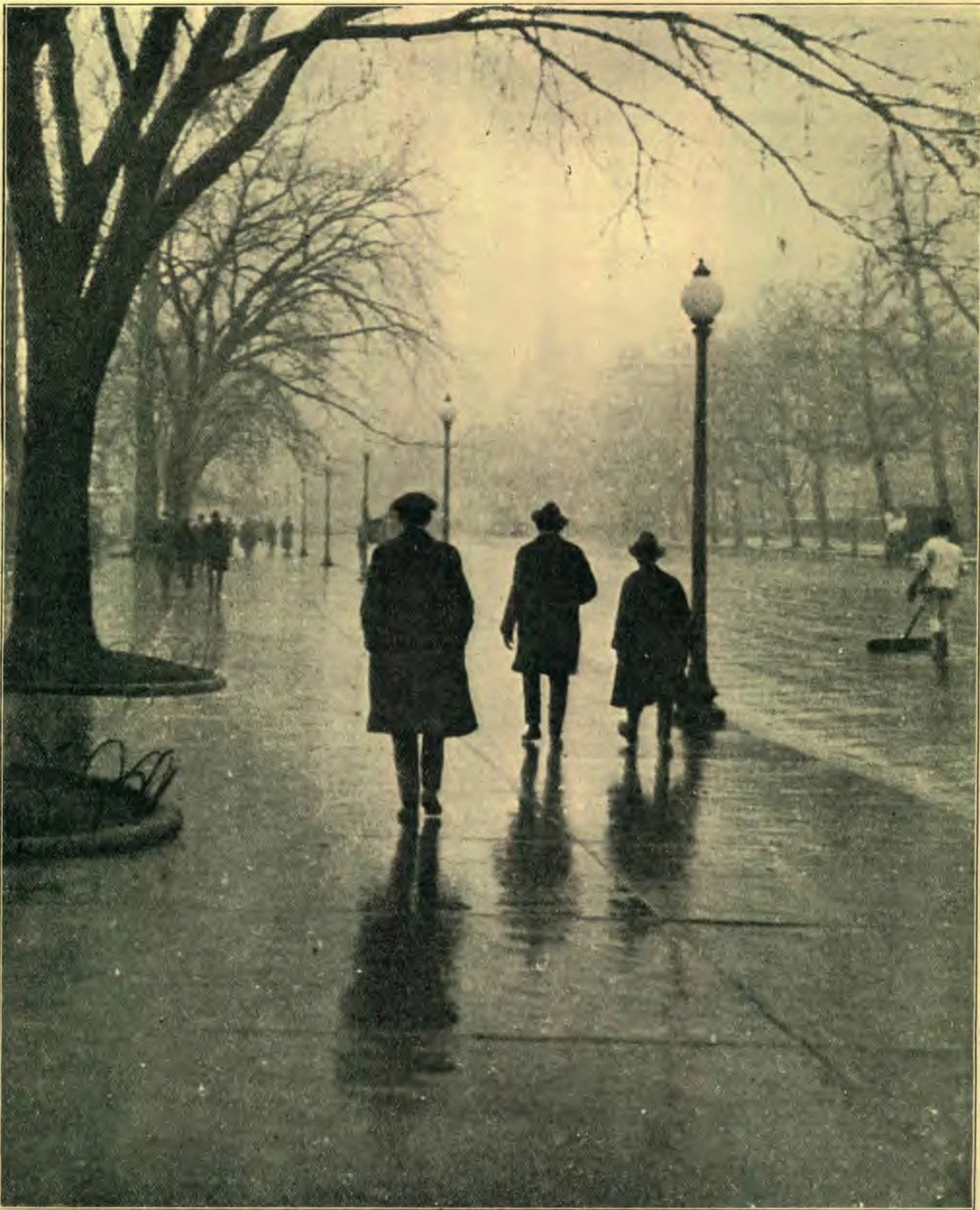
Photo by C. T. Chapman, Kensington, Maryland.
PENNSYLVANIA AVENUE, WASHINGTON, D. C., IN TIME OF STORM
Photo by C. T. Chapman, Kensington, Maryland. PENNSYLVANIA AVENUE, WASHINGTON, D. C., IN TIME OF STORM
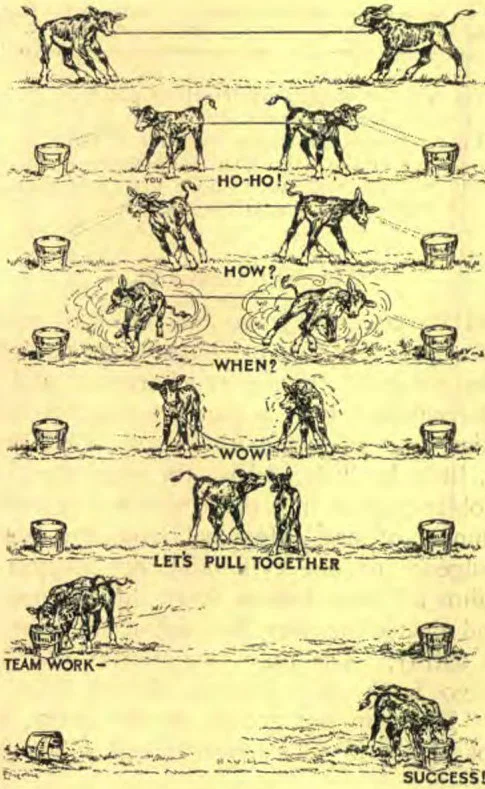
“CO-OPERATION”
“CO-OPERATION”

You have reached the end of this edition.

The Youth’s Instructor · Oct 30, 1917