The Youth’s Instructor, The Youth's Instructor, Vol. L, No. 4
BIRDS IN WINTER
Page 1
The Youth’s Instructor
January 23, 1902
Review and Herald Publishing Company · Battle Creek, Mich. · January 23, 1902
BIRDS IN WINTER
By L. A. Reed
Some Common Snow Birds
BIRDS are not so common in winter as in the warmer days of spring and summer. This is due not so much to cold weather as to scarcity of food. In the fall, as the usual forage fails, one after another, the birds migrate to the South.
Many birds, however, remain with us all through the winter months. If you will go out during the warmer hours of the day, when there is no strong wind blowing, you will find a number of these winter-dwellers feeding in favorable, sheltered places.
If you have not been a close observer of birds, you may be surprised to learn that August is one of the poorest months in which to study them. During this month they leave their accustomed haunts, and retire to secluded places to renew their worn-out plumage. They are inactive and silent, and it is difficult indeed to find them. Later in the month they have grown their new uniforms, and are ready for their long journey southward.
Winter is the best time of year to begin the study of birds. The varieties at that season are not so numerous; and if the beginner makes the acquaintance of all that are to be found during the cold months, he will have a much easier task to identify those that arrive in the spring.
In the Middle States during the winter you should find now and then the following birds:—
Barred Owl
Blue Jay
Crow
Meadow-lark
Bob-white
Ruffled Grouse
Hairy Woodpecker
Flicker
Downy Woodpecker
Finch
Long-eared Owl
Great Horned Owl
Purple Finch
Song-sparrow
White-breasted Nuthatch
Chickadee
Sharp-shinned Hawk
Screech-owl
These birds are all permanent residents; and occasionally the Waxwing, Bluebird, and Robin pass the winter in the North. Besides these we sometimes have visits from the following:—
Saw-whet Owl
Horned Lark
Snowflake
Redpoll
American Crossbill
White-throated Sparrow
Tree-sparrow
Junco
Northern Shrike
Winter Wren
Golden-crowned Kinglet
Brown Creeper
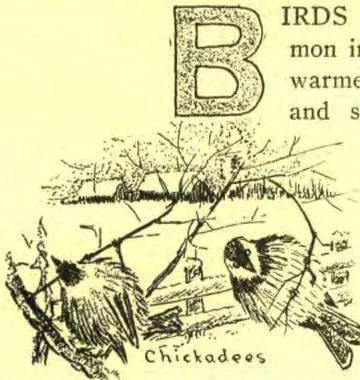
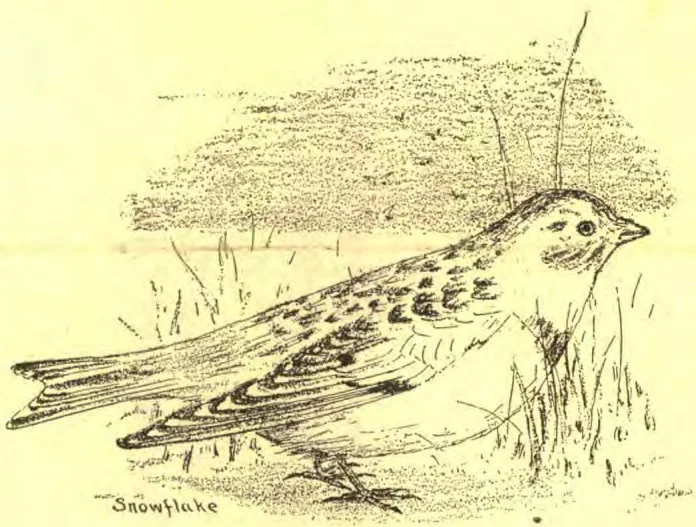
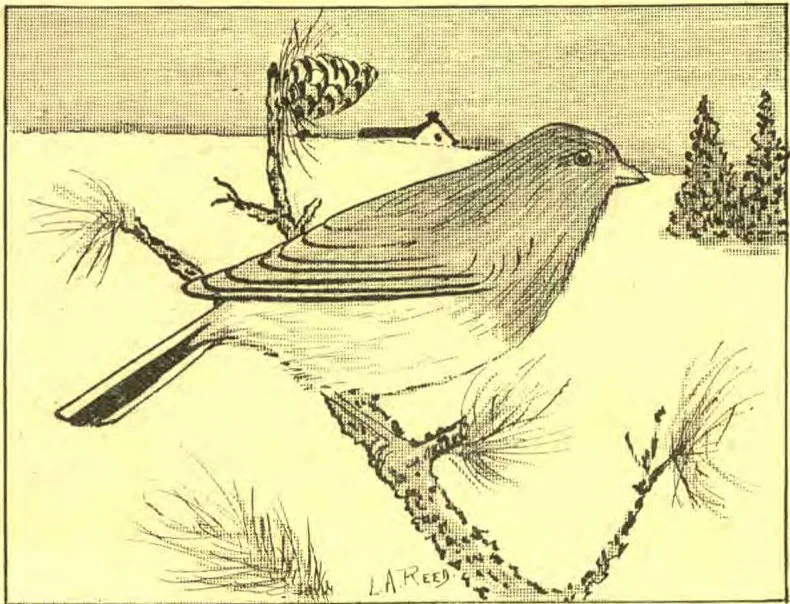
In this paper are given pictures of the Junco, Snowflake, and Chickadee. In following numbers we will describe other of our winter birds, and tell you something about them.
Always remember that in order to study nature, you will have to go to nature; she will never come to you. Though the days may be cold, choose some time when there is bright sunshine; and you will be almost certain to find some of these interesting little creatures. If you live near the edge of town, or, better yet, in the country, you may attract many birds to your door-yard by protecting them from danger when they do come, avoiding frightening them, and above all, by giving them food. A piece of fat meat nailed to a tree will attract Chickadees, Blue Jays, Nuthatches, and Woodpeckers. If you throw out crumbs of bread or grain, they may be blown away or snowed under; but if you will nail up a box with open front, placing it with the back to the prevailing wind, you will have a place where many birds will delight to come for food, if you are faithful in providing it. Some birds prefer to feed on the ground. It is therefore well to have a small cleared place where you can strew waste food, at the same time being careful not to frighten or disturb them. I have heard of one lady who cared so much to have the birds about, that she baked bread especially for them, using one third wheat and two thirds corn-meal, as such bread will not freeze so hard as bread made from wheat flour alone. She had many birds around her home. She also fed them hemp-seed, sunflower-seed, nuts, and finely crushed corn.
Snowflake
God cares for the birds. We should always remember what the Saviour said about them. Having the birds about us will be the best reminder that our souls are in his sight worth infinitely more than many of these creatures, not one of whom falls to the ground without his notice. L. A. REED.
A SHREWD MOTHER PLOVER
Down on the beach among the sand-dunes at Cape Lookout there is a certain small stretch of land where the sun shines warm, and the wind never strikes except when it whisks in little eddies around the dunes, and blows the dry sand rattling among the broken sea-shells. Here a pair of Wilson’s plovers, one summer, had their home, and, despite the vigil of many enemies, successfully guarded their nest in the sand, until two of the three spotted eggs it contained hatched out little down-covered balls of peeping bird life. These odd baby birds did not remain long in the nest; and their slender legs were soon carrying them rapidly about after their parents.
One day some men came to the part of the beach where the plover family lived. The little ones were much frightened, so they sat very close to the sand, and the men did not see them. Father and Mother Plover were quite uneasy, however. They flew near the men and cried, and tried to get the intruders to follow them away. The mother-bird even pretended to be lame. When the men saw this, one of them said: “Look at that bird; she has a nest of young ones near here, or she would not act so. I have seen partridges on the mainland act in the same manner when I was near their young.”
Then they began to search among the shells. This alarmed the parents so much that they determined to try their last and best trick. The little mother ran up close to the men, fell on her side, and fluttered and cried as if she were dying. The father-bird, with two other plovers, who had a nest farther up the shore, ran to her, and rubbed her with their bills, as if they were very anxious and sad concerning her illness.
“Look there,” said the man who had spoken before; “that bird really must be hurt. I have seen many kinds of birds pretend to be injured, but have never seen two play different parts in the same trick.” So they started to catch her.
But Mrs. Plover seemed to get better, and ran26on for fifteen or twenty yards, and then appeared to fall ill again. The other plovers gathered about as before, and put their bills under her, as if to raise and help the sick one. The men went hurrying on; but the lady bird again recovered enough to run for a little distance. The young plovers saw the group pass off among the dunes, the four birds in front and the men following after. Twenty minutes later the shrewd old birds were back with their children; and the men, entirely outwitted, were far down the beach toward their boat.
THE JUNCO
Pretense of injury or lameness is a common habit with many species of birds to attract a supposed enemy from the vicinity of their nests.
— St. Nicholas.
THE FAIR FLOWERS OF PROMISE
By Ellen G. White
As we look at a beautiful garden, with its opening buds, let us remember that this is an expression of our Father’s love. As we note the varied tints of the flowers and inhale their delicate fragrance, let us think of the words, “Consider the lilies of the field, how they grow; they toil not, neither do they spin: and yet I say unto you, That even Solomon in all his glory was not arrayed like one of these.” God has given us the flowers to teach us lessons of trust. “Wherefore, if God so clothe the grass of the field, which to-day is, and to-morrow is cast into the oven, shall he not much more clothe you, O ye of little faith?” If the great Master Artist makes perfect and lovely that which is to-day, and to-morrow is cast into the oven, will he not care much more for the beings purchased by the blood of his only begotten Son?
We are pilgrims and strangers on this earth, looking for a city which hath foundations, whose builder and maker is God. The path in which we travel is narrow, and calls for self-denial and self-sacrifice. We meet with trial and conflict. But God has not left us to travel without help. Our pathway to the heavenly Canaan is bordered with the fair flowers of promise. They blossom all along the way, sending forth their rich fragrance, like the flowers in the gardens of this earth.
To blot the promises of God from the word would be like blotting the sun from the sky. There would then be nothing to gladden our experience. God has placed the promises in his word to lead us to have faith in him. In these promises he draws back the veil from eternity, giving us a glimpse of the far more exceeding and eternal weight of glory which awaits the overcomer. Let us, then, rest in God. Let us praise him for giving us such a glorious revelation of his purposes.
All along our pathway, God places the flowers of promise to brighten our journey. But many refuse to gather these flowers, choosing instead the thorns and thistles. At every step they weep and mourn, when they might rejoice in the Lord because he has made the road to heaven so pleasant.
As we look at the promises of God, we find comfort and hope and joy; for they speak to us the words of the Infinite One. Properly to appreciate these precious promises, we should study them carefully, examining them in detail. How much joy we might bring into life, how much goodness into the character, if we would but make these promises our own! As we journey in the upward way, let us talk of the blessings strewn along the path. As we think of the mansions Christ is preparing for us, we forget the petty annoyances which we meet day by day. We seem to breathe the atmosphere of the heavenly country to which we are journeying, and we are soothed and comforted.
Do not think to find happiness in selfish amusement. The flowers thus gathered soon wither and die. True happiness is found only in the Master’s service. In him who is the Light of the world we shall find comfort and hope. Our happiness comes not from what is around us, but from what is within us; not from what we have, but from what we are.
It is our privilege to sing the songs of Zion now, to turn our eyes to the light, to bring hope into our own hearts and into the hearts of others. God wants us to gather his promises, that we may be strengthened and refreshed. Let us take our eyes from the curse, and fix them on the grace so abundantly provided for us. God is dishonored when we fret and worry. Thus we show that we are not trusting in him, but in ourselves.
This life will have much brightness for us if we will gather the flowers and leave the briars alone. Comfort, encouragement, and support have been provided for every circumstance and condition of life. No temptation comes to us that Christ has not withstood, no trial that he has not borne. He knows each one of us by name. When a burden is placed on us, he stands by, to lift the heaviest weight. He has given us precious promises to lighten every burden. He assures us that his grace is sufficient. To-day we have his help. To-morrow we may be placed in new circumstances of trial, but the promise stands fast, “As thy days, so shall thy strength be.”
Let us rejoice in the love of God. Let us praise him who has made us such royal promises. Let these promises keep our hearts in perfect peace. Let us honor God by weaving more of Jesus and heaven into our lives. Jesus lives. His hand is guiding us. This present life is not the summer but the winter of the Christian, nevertheless he may constantly enjoy the sunbeams of Christ’s righteousness. He may have in his heart the peace “which passeth all understanding,” even the peace which Christ gives.
MRS. E. G. WHITE.
THE 'SPRING THAT WAS' COVERED
I WANTED water in a certain pasture on my farm up in the New Hampshire mountains, and was talking about the probability of finding it by digging a well, when an old neighbor, who had lived in the community for sixty years, said:
“You don't need to dig any well in that pasture, for you have one of the finest springs there I ever saw.”
“I think you must be mistaken,” I replied, “for I have searched pretty thoroughly, and can find no trace of water anywhere.”
“I am sure I am not mistaken,” said the old man, sturdily. “I used to mow that pasture when it was a meadow, many years ago; and if you will go over there below that tall spruce tree, within forty feet of it you will find a beautiful spring. I have had a drink out of it many and many a time, when I mowed around it.”
I felt sure that the old man was honest in his faith that there was a spring there, and so we went again to make the search. This time, with the old man's story to guide us, we could trace where the spring had once been. There was still a little hollow there, and the skeleton of a trench that had carried away the water, but the spring itself had disappeared; it had all filled in as the years passed, and the soil had become solid above it, and the turf was as heavy over where the spring had once sent forth its sweet waters, as it was anywhere else in the pasture.
As I looked on the dry and hard covering over the one-time spring, it occurred to me that that was what has happened to some young Christians. Christ awakened in their hearts the fountain of the Water of Life, but through lack of use of their spiritual abilities, the fountain ceased to flow; and as they grew idle and indifferent in religious work, worldliness came in upon them27as the turf encroached on the hillside spring, until its edges met above the water, and the little stream was smothered underneath the soil of earthliness and self-indulgence.
Of course if this spring had been developed and constantly used, it could never have become thus covered up. If there had been more water, it would have pushed itself out, and gone splashing and singing down the hillside, carrying with it any impertinent soil that got in its way. I have another spring on that same farm, which comes gurgling out between two great ledges of granite, and pushes itself, with a stream full-born, over the edge of the hill. He would be a bold man who would undertake to stop that stream or cover it up. It comes because it must come. The reservoir behind is so strong and full that it bursts forth into the air with a triumphant song on its lips.
Shall we not learn the secret of the two springs? If your religious life is small and timid, there are two ways you can treat it. One is, not to use it; keep it in the background as much as possible; never say anything about it; never give any of it away to anybody else, for fear you may not have enough left for home consumption. Continue to do this for a while, and any one searching for your spiritual life will be in the same quandary that I was when searching for the spring in the hill pasture. He will not be able to find it. The turf of worldliness will have covered it over hard and dry.
There is another way, however, that you may treat a timid religious experience. You may make much of it, looking out for little trenches for it to flow in, so as to be refreshing in appearance and make the world more beautiful; you may offer a cupful of its cool, refreshing water to weary and hungry hearts among your acquaintances; you may be careful to dig away from it all worldliness that threatens to pollute or smother its waters; you may, in many ways known to those who are in close touch with Christ, the Fountain Head of the Christian life, increase its flow; and if you do that, your spring of deep, abiding religious life will refuse to be covered up, but in the purity and sweetness of its waters every weary traveler who drinks at the fountain of your faith will thank God and take courage.—Young People's Weekly.
A WEED PICTURE
To one who cares little for natural objects, a bit of bottom-land in autumn has few attractions; but to the botanist of experience, or to a student of nature, from late July till the first frost comes, such a place is a continual delight.
Perhaps you have seen this very picture. If so, have you studied its details?
A half-acre of swamp, which in the spring presented a dainty background of yellowish-green willows, and a foreground of green pasture, dotted with dandelions and blue violets, has now transformed itself into a Persian effect of gorgeous color. Blue, pink, brown, green, red, purple, white, lavender, yellow, orange-brown, and these through tintings and shadings that a modern Titian would never produce, even should he wear his brush to a stub.
Among the showier members of this very mixed growing effect, brightest in color are the purple ironweed and the helianthus. But joe-pye-weed tosses up his woolly pink head, and flauntingly asks, “With that big yellow-and black butterfly on my crown, am I not more showy than they?” He has to be gently reminded that all his brothers are not wearing butterflies, which fact leads to a negative decision; still he is a beauty.
Then the corners festooned with clematis, hop, bindweed, and even dodder, give to the raw edges a finish that can not be excelled. Little dots of cardinal, here and there, show a belated cardinal flower; and bittersweet just ready to open hangs over the elder bushes, which form one edge of this picture.
The paler asters in eight or ten shadings, with the exception of the New England variety, begin to fill in the neutral patches, and goldenrod is waving yellow plumes here and there. It is a beautiful color, but looks rather pale compared with the later sunflowers. Boneset and yarrow and spurge each have a place, and great bunches of bedstraw fill up the crannies, till not a square inch of earth is visible.
Some of the plants which help complete the perfect whole, but which are less numerous and showy, are the tall dead stalks of angelica, parsnips in seed, milkweed, ragweed, mallow, nettles, vervain, blackberry, and wild rose with scarlet bolls.
Some of the finishing touches to this composite picture are the huge green dragon-flies, the brilliantly colored butterflies and moths, and the catbirds and bird kindred which live in the heart of all this magnificence, but manage to keep well on the wing, especially when the sun shines bright, and the air is soft and cool.—Selected.
Thinking Twice Before Speaking or Acting
“We shall never be sorry afterward for thinking twice before we speak; for counting the cost before entering upon any new course; for sleeping over stings and injuries before saying or doing anything in answer; or for carefully considering any business scheme presented to us before putting money or name into it. It will save us much regret, loss, and sorrow always to remember to do nothing rashly.”
ADORATION
By B. F. M. Sours
The world was tired and lonely,
Its joys were dull and weary,
Till Jesus came.
He filled our lives with brightness,
He filled our hearts with gladness;
Then praise his name!
His violets are lovely,
His woods are full of mosses,
His world is bright.
Our hearts are full of singing,
With joy our lives are ringing,
Since that glad night.
Then we should love him all our days,
And little lips should sing his praise.
B. F. M. SOURS.
A VISIT TO THE TRANSVAAL CAPITAL
By Joel C. Rogers
On the eleventh of December, 1898, I left Johannesburg by an early morning train, in company with two friends, to visit Pretoria. December is well into the summer in South Africa, but the spring rains had been late, so the fields and hills over which we passed were just putting on their most glorious green.
The first twelve miles of our journey lay along the main line of railway leading to the Cape and Natal. The traveler passes many of the richest and best-known mines, whose great smoke-stacks rise high into the blue, some near the road, others away to the east and west as far as the eye can see. Near by the great piles of cyanid-treated ore, now left as finely powdered sand, glisten in the sun like huge banks of snow.
A few halts at some of the mining suburbs, then at the village of Germiston, and we are at Elandsfontein, the junction. Here a population of a few thousand has collected, living within easy reach of the mines, which extend in all directions except southward, along the lines of railway. At the junction our train takes on a few more passengers, and puffs away up-grade toward Pretoria. In Africa, railway trains are never in a hurry; so we proceed at the leisurely rate of fifteen miles an hour, stops excluded. The common difficulties of making observations and obtaining good landscape views along the way, on account of rapidly moving trains, are almost wholly obviated here.
We are traveling northward, and the first thing noticeable is what is said to be a lime-kiln on our left near the railroad. Not far from it is a villa, almost hidden by beautiful ornamental gardens, the property of a Johannesburg gentleman of wealth. Now and then a farmhouse may be seen in the distance, but every mile brings us farther into the hills, so that all but nearer views are cut off.
The recent December showers have given a good start to the grass and early flowers of the veld. The Boers usually burn over their lands once a year, and now they are covered with the freshness of new-grown meadows, rich in their natural beauty. Riding for about two hours, with hills growing in size and roughness, a few stops at sidings to “pick up” or “set down” a passenger, and our attention is drawn to a prominent eminence away on our right several miles ahead. On its top there is an appearance of excavations, or at any rate evidence of some disturbance, shown by the patch of reddish-gray (characteristic of Transvaal soil) near its crest. Soon we become aware that we are approaching within range of one of Pretoria’s far-famed forts. Soon another reddish-capped hill, farther away in the same direction, comes into view; then another, on our left. Still our train climbs higher and higher, until, passing a rugged, rock-strewn kopje, we quickly emerge, with Pretoria lying away below, in a rounded valley shut in by high hills. The first impression is that the place is indeed “beautiful for situation.”
The station is soon reached, and passing through it we notice street-cars drawn by horses, waiting at the other side. Several hotel buses are also in waiting, and in one of these we decide to ride up-town. It is about a mile and a half over level and well-kept streets to the central part of the capital. Making a turn down one of the principal streets, our bus stops in front of the Royal Hotel. There is nothing imposing about this one-story building, which, like all other up-country hotels in Africa, has its sleeping-apartments at the rear, surrounding an open square.
We had purposely selected Sunday for this visit, that we might attend service at President Kruger’s Dopper church, and possibly hear him preach, as he often did there. While waiting a short time for the hour of service, several carriages passed our hotel, among whose occupants were pointed out members of the Executive Council and of the Government Raad, or Congress. Eagerly expectant, we watched for the imposing turn-out of the president, of which we had heard so much. In this we were disappointed, afterward learning that he had obviated the necessity of driving to worship by building a residence opposite the church.
At 10:30 A. M. our Dutch friend, Mr. De Beer, reminding us that the time of service was near, led the way toward the lower part of town. Crossing two blocks to Government Square, we walk down a long street, where we observe that while the houses are unpretentious, the gardens are often beautiful and extensive. A walk of three quarters of a mile brings us to the lower end of the street, where it merges into a country road. Here, on the left, is a plain brick church, with no spire. Directly opposite is a house, well shut in by trees and shrubs, built of brick, plastered over and painted white,—a one-story structure in no way imposing,—the president’s residence.
Entering the church, which stands only a little back from the street, we are seated by one of the pleasant wardens. I notice that there are two entrances, one at the front, where we entered from the street, the other opposite the pulpit on the right. The seats are plain, uncushioned benches, the furniture altogether being plain, finished in a modest brown. While interested in the service soon to begin, of course we anxiously wait the arrival of the president. As the minister takes his place for the opening service, a small party enters by the side door,—an elderly lady of medium build and short stature, dressed in black, a younger woman by her side, and two gentlemen; but the well-known form of President Kruger is missing. The elder lady was Mrs. Kruger, the others being members of the family. The service was one of devout simplicity, and was conducted entirely in Dutch. At its close Mrs. Kruger was seen greeting many of the congregation, then walking quietly over to her home. We learned that Mr. Kruger was confined at home by illness. Knowing this would be our only opportunity of visiting Pretoria, we determined to make an effort to see him.
Going across to the house, Mr. De Beer spoke28to the single sentry at the gate, saying at my request that I desired very much to see the president before returning to America. The sentry, a nephew of Mr. Kruger, went inside, and soon returned, explaining that the president was suffering from a disease of the eyes, making it necessary to bandage them to exclude all light, so it was impossible for him to see anybody. I had brought a small book in Dutch, which I had intended to present him, and this I now sent in, with my card. The attendant returned, expressing the president’s sincere thanks, regrets that he was unable to receive our party on that day, and an invitation to come at another time.
We now had time to visit several interesting parts of the capital. Of course the government buildings were all closed, so we could see them only from the outside, with the exception of the Palace of Justice, then being erected. This is acknowledged to be one of the finest structures in South Africa. For an hour we walked along clean, well-kept streets, the dwellings on either side being surrounded by gardens among the most beautiful to be found anywhere.
After dinner we visited the public park, and the botanical gardens, which are famed for their luxuriance and beauty. The whole town bore an air of quiet and good order. Little did we think that within a few months the peoples of this country would be engaged in deadly strife.
JOEL C. ROGERS.
DON'T WAIT TO BE TOLD
If you would advance rapidly in your position, or get on faster in the world, don't acquire a habit of waiting to be told what to do. Anticipate the wants of your employer. Use your common sense and ingenuity in trying to solve the problems that come up from day to day. Nobody ever advances who constantly waits for directions. It is the man who decides promptly and with precision, without being told what is to be done, and then does it, who gets on in the world.
A habit of doing nothing without orders or directions is paralyzing to one's faculties and death to individuality and originality. Don't labor under the delusion that to imitate the actions and methods of those above you is all that your position requires. Original work commands attention, and will be of great service in helping you to advance in your position, or in directing work of your own. The valuable employee is the one who anticipates the needs of his position, and attends to them before he is told.
Keep your eyes wide open for the things which need to be done, and do them before you are asked to. You may think that actions which are not prompted by the presence of your employer will never be heard of by him. Put aside this illusion. There are innumerable ways in which an employee's habits of work are brought to the attention of his employer; and, in the near future, the right person will be sure of reward.—Success.
CHRISTIAN COURTESY
(Study for January 26 to February 1)
PLACE the lesson outline upon the blackboard, leaving room to fill in the references as they are given.
1. What is the Bible standard of courtesy?—The golden rule. (Give all the references where this is found.)
2. What does the Bible tell us about bearing the burdens (cares, trials, perplexities) of others? Two references.
3. Should one person expect another to bear the burdens which rightfully belong to him? Gal. 6:5. Find another text.
5. How does Peter sum up the requisites for right living? 1 Peter 3:8.
Selected Thoughts on the Topic
“It is the little attentions, the numerous small incidents and simple courtesies of life, that make up the sum of life’s happiness; and it is the neglect of kindly, encouraging, affectionate words, and the little courtesies of life, which helps compose the sum of life’s wretchedness. It will be found at last that the denial of self for the good and happiness of those around us, constitutes a large share of the life record in heaven. And the fact will also be revealed that the care of self, irrespective of the good and happiness of others, is not beneath the notice of our Heavenly Father.” — “Testimonies,” Vol. II, page 133.
“It is little things which test the character. It is the unpretending acts of daily self-denial, with cheerfulness and gentleness, that God smiles upon. We should not live for ourselves, but for others. We should be a blessing by our forgetfulness of self and our thoughtfulness of others. We should cherish love, forbearance, and fortitude.” — Id., page 647.
“Be careful of your words; cultivate refinement of manners, courtesy, gentleness, and you will be rewarded for so doing.” — Id., page 84.
“His mind has been exercised for some time that it was his duty to carry the message. He has the ability, and, as far as his knowledge of the truth is concerned, he is capable; but he lacks culture. He has not learned to control himself. It requires great wisdom to deal with minds, and he is not qualified for this work. He understands the theory, but has not educated himself in forbearance, patience, gentleness, kindness, and true courteousness.” — Id., page 220.
“The minister of Christ should possess sobriety, meekness, love, long-suffering, forbearance, pity, and courtesy.” — Id., page 568.