“If I only knew what I ought to be, I would begin and prepare for it.” I know that that question troubles young people, for it has troubled me. But I also know that, like all the other troubles of life, it has its solution, and can be settled by every one.
But, young man, young woman, there is a question that must come first. You read: “The Lord is my shepherd.” Do you believe it? Can you read that sentence, and say, “Those are my words as truly as they were David’s words”? Can you? There are very few people who do read them so; but that is the first thing. It is of little use to launch into any enterprise, or undertake to prepare for a life-work, till you can say, from the depth of your heart, “The Lord is my shepherd.” It is all uncertainty till you can say that.
Perhaps you answer: “I can say that now! He has promised to guide me in the truth, to keep my feet from ways of sin, and give me a home in his kingdom. Yes, I can say that, and I do believe it now!”
That’s good; but it isn’t enough. The true shepherd not only keeps his sheep from the great dangers; but he looks after all the interests of their lives. He keeps them from every wrong path, and from every way that is not for their highest good. Just so the Good Shepherd has promised to lead us in every good way, and our life-work is to be one of those good ways.
Says one: “Why doesn’t he, then? Here’s Uncle Dan, and there is brother Walter, and they don’t know where to take hold, and I don’t. Why doesn’t he lead?”
O, how I wish every young man and woman who reads these words would ask that question, and ask it so often that it would demand an answer in the hearts of all the people,—“Why doesn’t he guide?”
But, my young friend, he does guide! He is guiding just as fast as you will follow,—but no faster. If you have not followed up to the point where you are prepared to go to college, or to begin a great life-work, do you think he will lead you to select it, only to fail therein?—You know he will not. He is not the author of failures. He never works that way. When you fail, it is because you run ahead of the Lord, and get lost. Do one thing at a time; do that well; and when you have graduated from that duty, you will be ready for the next. God will see to that part of it. He will recognize the merit soon enough. Listen: “The eyes of the Lord run to and fro throughout the whole earth, to show himself strong in behalf of them whose heart is perfect toward him.” He is eager. He is seeking by his strength speedily to advance the young man and woman who will to be led.
If you will, begin right now. Who is that acquaintance you’ve been passing on the street without a smile? Where is that pleasant word you might be saying, but neglect? Where is the little service you might render, but never think to perform? Where are the dimes and nickels you spend foolishly? O, what are you doing with all these little opportunities? Isn’t it just possible that you haven’t graduated from the home school yet—from the duties that lie all around you?
Don’t you know David was a good leader of a few sheep for a long time before he became a great leader of men? God helped him kill the lion and the bear as much as he helped him slay the giant enemy of Israel? And don’t you know how, in all those years he fled from Saul, he was being led by the Lord to prepare him for his great work as king? Suppose he had taken the matter into his own hands, and said, “Why, see here! I’m wasting lots of time. I’ll just kill Saul at once, and enter my life-work.” If he had done that, do you think there would be a great King David in history?—Of course not.
Look at Christ. Thirty years an obscure carpenter’s son!—but just as faithful in that lowly life as when he stood before the multitudes, the one of all men sought out and marveled over. But when the thirty years were over, and the time came for him to do another work, what happened?—God called him to John, the Spirit led him into the wilderness, and he returned in the power of the Spirit into Galilee. He knew what his work was when the time came: there was no question about it. And so it will be with the young person who is content to follow Jesus where he is, among the small things of his daily life. Christ will lead. There will be no guess-work. What he does will seem and will be the right work, and he will be eager for it.
Let us seek God for power to live the Christ life right where we are; to be kind and helpful to the folks at home; in the faith of Jesus to forget ourselves, and remember others; study to know more of God, and to understand his truth,—to do with our might what our hands find to do; for this is our life-work now, and there is no other!
Edison Driver.
THE END OF A PAIR OF SHOES
THE termite, or white ant, is one of the pests of Rhodesia. It probably causes the settler more annoyance than wild animals or sickness. Rev. A. Leboeuf, a missionary worker, says that this little scourge respects no perishable article, and is indefatigable in its work of destruction. It is no uncommon experience to have one's clothing disappear in the night. Added to the many trials of a missionary life, it may happen that on awakening in the morning you are astonished to see in the dim light a cone-shaped object rising from the brick floor a short distance from your bed, with two holes on the top, like the crater of a miniature volcano. Upon closer examination you discover that the holes have just the size and shape of the inside of your boots, which you incautiously left on the brick floor the night before. They have given form and proportion to an ant heap.—Sunday Magazine.
GIVING
What do we give to each other
Who meet on life's troubled way?—
A tear, or a smile, or a helping hand,
A brave “God-speed” to the Fatherland,
Or merely a brief “Good-day”?
What do we give to each other?
Do we tender mere stones for bread?
Or living grain from God's garnered store?
Who borroweth hence may return for more
Till each hungry soul is fed.
But as we give to each other,
Pray God that his love may flow
Through our pitying hearts to the hearts that ache,
For loveless hands may no comfort take
To the secret haunts of woe.
— Selected
THE MUSIC OF THE LIFE
By Edith E. Adams
The story is told of some monks of old who loved and worshiped God, and spent all their time in working for the poor and the sick around them. This they did, not as a hardship, but as a delight, saying,—
“How good is God, who hath
such love for us,
He lets us tend his suffering
children thus!”
But they had one trouble. Perhaps it was because of the damp air of the marsh where they lived, that not one monk in all the house could sing. When they met together to worship God in their little chapel, they grieved that none of them could make the sound of his praise to be heard in sweet and holy song.
They heard of a young monk with a very beautiful voice, not so far away but that they could invite him to come and sing the Magnificat for them on Christmas eve. The Magnificat, you most likely know, is the hymn of praise beginning, “My soul doth magnify the Lord.”
How the good monks looked forward to that Christmas eve, when for once they would be able to offer acceptable praise to the Lord. The day came, and the young monk thrilled their hearts, and held them breathless, while his sweet song seemed to mount up to heaven, and mingle with those of the angel choir.
The abbot who was the head of the monastery went to bed that night happy and satisfied that for once, at least, God was pleased with their worship. But hardly had he fallen asleep when he was awakened by a bright light that filled the room, from a glorious angel, who asked him, “Why was Magnificat not sung to-night?” The astonished man told the angel of the young monk who had sung it so sweetly that they had all rejoiced to think how it would be heard on high. Then the angel told him that the young man’s mind had been filled with thoughts of himself and his fine voice, and that he had sung for his own glory, and not for the praise of God. So his song had fallen to earth, instead of mounting up to heaven. He said that each evening God and the angels had listened with pleasure to the praises of the monks, and that they had greatly missed that part of the service that evening, when the Magnificat should have been sung; for no sound of it had been heard on high.
It is not the trained voice and the beautiful singing that please the Lord, though these have their place; but it is in the heart that the melody and music must be made, that reaches the ear of the Most High, and gives him pleasure. He delights to hear the voice of the humblest of his children, if their songs or their petitions come from an honest and sincere heart.
The angel said:—
“The sweetest of earth’s music came from you,
The music of a noble life and true.”
This made the good monks very happy. They did not sorrow any more that they had no voices, nor get any one else to sing their praises for them; but they sang and made melody in their hearts to the Lord, and the Magnificat was never again missed from their service.
EDITH E. ADAMS.
BUSY BEES
By Elizabeth Rosser
THE daisies and the honey-bees
Long from the fields have flown;
Yet in my kitchen have I found
A beehive all my own.
One with discretion tried the broth,
Testing if it were done;
Then added salt, or cream, or rice.
Be Careful was this one.
And one a dish of apples pared
(Swift round and round they spin);
I knew Be Thrifty was her name,
The parings were so thin.
One kneaded dough with gentle hand;
She folded, rolled, and beat;
Then pricked and pinched and pinked the edge;
For this one was Be Neat.
And one but washed the cups and spoons,
Yet smiling came and went,
Nor coveted her sisters’ tasks;
For this was Be Content.
And not a daisy ever bloomed
With brighter face than these;
No hive could better workers boast
Than my four Busy Bees.
ELIZABETH ROSSER.
HOW MUCH IT COST
One, two, three! Kenneth nestled uneasily. Four, five, six! He bored his tousled head deep into the pillows, and tried not to hear the seven.
Lazy little Kenneth! The next time the clock spoke, it said “eight,” imperatively, and sent him into his shoes and stockings in a panic.
Kenneth hurried bravely; but buttons didn’t behave, and where could the other shoe be? Where was the hair-brush? If he’d only got up at seven!
After all, he didn’t dare to stop to eat but three bread-bites and a cooky. Then he snatched his lunch-pail from the pantry shelf, and was off. Mama was up in the berry garden, picking currants. It wouldn’t do to run up after his good-by kiss; there wasn’t a minute to spare.
He was late to school, anyway, just by an unlucky minute or two; and on his way to his seat he could hear Miss Periwinkle’s pencil-point, hard and rasping, tracing his poor little black mark.
Well, it was a sorry morning, and a sorry boy in it. Kenneth was too hungry and too crestfallen to study, so his spelling-lesson came to grief. He had to stay in at recess to study it.
When noon did come, how he ran for his dinner-pail! It looked so shiny and comforting; and he snuffed little, spicy, consoling smells round the edges of the cover. Didn’t he know just what was in there?
“My mother puts up the splendidest dinners in this town!” he cried. “The splendidest in—this—town!”
Some of the boys objected; but Kenneth, tugging at the pail-cover, was insistent. “You wait an’ see! Any o’ you fellows got—”
The cover snapped off. The boys peered into—an empty pail,—empty as poor Kenneth’s little hungry stomach. It wasn’t his lunch-pail at all. Why hadn’t he noticed there wasn’t any small red-worsted bow on the handle? This was mama’s milk-pail, and he got it in his hurry. Oh, dear!
Of course the boys—being boys—laughed at him loudly; and of course Kenneth’s face reddened angrily. But he made a big, brave effort, and joined in the laugh. There was a great lump in his throat, and it was hard work squeezing the laugh through. It got caught, and broke into two pieces. Still, it was a laugh. He put his hands in his pockets, and walked off, trying to whistle.
“My mother puts up the splen——” called one of the boys after him; but he didn’t get any further.
Benny Brown’s grimy little hand was clapped over his mouth. “No, you don’t,” Benny said, stoutly. “Ken’s a brick. I guess you wouldn’t ’a’ laughed yourself. You’d ’a’ been hoppin’.”30
“That’s so. So would I,” agreed Emil Smith. “Good for Ken!”
“Let’s make it up to him. Come on,” cried Benny, excitedly.
When Kenneth went back to his desk, there was a generous dinner spread out on it, waiting for him. Every boy had shared his choicest bits. So you see Kenneth wasn’t hungry when he got home to mama at night, except for his missing kiss. But he was ever so much wiser.
“You see, mama,” he confided to her aside, “it don’t pay to be a lazybones. It’s dreadful ’xpensive.”—Selected.
DIVISION II—PHILOSOPHY
By Dr. O. C. Godsmark
Chapter XVIII—Heat
§187. THAT heat is one of the manifestations of vibration, needs no discussion; but the subject of heat has, for several reasons, never received the careful study that the other forms of vibration have. The importance of this field of physics has not been fully realized, nor the bearing it has upon the whole display of God’s love and care for man.
§188. In the field of sound we have a definite scope of vibration; as, for instance, we know that when we lessen the number of vibrations a second to a point below thirty-two, they cease to be recognized as tone, but merely as separate strokes, or shocks; likewise when we increase the number of vibrations to thirty-six thousand or more a second, the human ear ceases to respond at all to the sensation. The same is true of light. When the vibrations reach about 400,000,000,000,000 a second, we get the lowest form of light, or the red ray; and when we increase the vibrations to about 800,000,000,000,000 a second, we get the violet ray,—the highest manifestation that the eye recognizes. Above this point it ceases to be light.
§189. With heat this is not so. How low the vibrations go, we do not know. Cold and heat, each being but the opposite of the other, become only relative terms. It is estimated that interstellar space has a temperature of some—240° F. What the number of vibrations can be a second at this extremely low temperature, we do not know; and it is only as we are able to compare its higher manifestations with light, that we can judge the nature of heat. We consider an object as being hot even before the vibrations have become sufficiently rapid to produce the red ray. The close relation existing between chemical affinity and heat, is such that definite experiments along this line are exceedingly difficult to make.
§190. Heat, like sound, is usually conducted better by solids than by gases. Water is a poor conductor, while dry air is one of the poorest. To illustrate this with water, one may freeze a small piece of lead within a bit of ice. Place this in the bottom of a test-tube, fill with water, and apply heat at the upper end of the tube by inclining it over an alcohol flame. The lead will keep the ice at the bottom of the tube, and it will still remain frozen for some time after the water begins to boil at the top. This experiment shows how poorly water conducts heat, yet dry air is a far worse conductor, and ether is supposed to be equally poor.
§191. Inasmuch as heat will traverse a vacuum, we might consider it as traveling in the ether, and as being hindered or accelerated in its journey by the introduction of various gases, fluids, and solids in its pathway. Any artificial heat that human ingenuity has been able to produce seems, however, to be largely devoid of the power of progression that is so universally seen in what we call “solar” heat. Why is this so? How can a “solar” heat ray, as such, reach us after having spent nearly eight minutes in its journey of ninety-three million miles from the sun, surrounded by a temperature of at least—200° F.? There can be but one of two answers given,—either solar heat differs materially from any known form of artificial heat, or else what we term “solar heat” does not originate, as heat, in the sun at all. This, however, will receive further consideration later on.
§192. When we realize that sound, heat, light, and electricity are but different manifestations of one and the same force, we readily discern how one of these manifestations may present itself to our senses in an entirely different form from some other manifestation of the same force. There is some truth in what is stated by Steele in his work on “Physics,” where he says: “While the pupil, for convenience, uses the terms ‘heat,’ ‘light,’ and ‘chemical rays,’ he should bear in mind the truth that these rays differ not in quality, but only in pitch.”
§193. Heat-force drives the molecules of a body into longer vibrations, and so increases its size. This expansive force of heat, acting on a given body, is enormous. A rise in temperature of 45° C., which may occur during a summer day, will lengthen a rod of wrought iron, ten inches long, 1/16 of an inch, and if its ends are fastened, it will exert a strain of fifty tons. On cooling, it contracts with the same force. The long, heavy spans of our iron bridges, that settle but one fourth of an inch under the strain of a loaded train of cars, rise and fall two or three inches between the heat of a summer day and the cool temperature of the following evening. It is for this reason that railroads must be laid with open joints, else the expansion and contraction of the steel rails between the extremes of natural temperature would destroy the road. Between 4° F. and 100° F., the expansion of one mile (5,280 feet) is five feet and seven inches.
Questions
In what form does vibration manifest itself when carried above the field of sound? What are the relations existing between heat and cold? What is the temperature of interstellar space? In what respect does solar heat differ from artificial heat? What effect does heat have upon the size of a body?
Dr. O. C. GODSMARK.
2005 Magazine St., Louisville, Ky.
WHAT GOOD DOES IT DO?
“I AM just as cross as I can be,” said Fanny, shortly, throwing her books down on the table before her.
“Why, I didn’t suppose you could be cross, my dear,” said Miss Allen, gently, lifting her eyes from the exercises she was correcting. “I have always considered you such a sensible little body.”
“You would be cross, too, if anybody had treated you as Janet has treated me,” argued Fanny. “Now wouldn’t you?” she asked, after repeating her grievance.
“I don’t know whether I would or not,” replied the teacher. “Perhaps I should if it would do anybody any good. Do you feel any better because of your anger and the display of temper you have made?”
“No, I don’t,” answered Fanny, truthfully. “But Janet was so mean, and really meant to hurt my feelings.”
“Did your crossness make her feel any better, do you suppose?” asked Miss Allen.
“I didn’t want to add to her comfort,” pouted Fanny.
“That is evading my question,” said Miss Allen. “Be candid now, and tell me if you think your conduct did her any good.”
“No, I do not think it did,” Fanny admitted.
“Did it do anybody any good?” insisted the teacher.
“No,” came the answer, hesitatingly.
“Then is there any sense in being cross, my dear?” asked Miss Allen. “It has done you no good, neither has it added to Janet’s good-feeling and you are quite sure no other person has been made happier or better by it. If I were in your place, I wouldn’t allow myself to be cross or ill-natured again. It does not pay.”—Selected.
A TRUE STORY
By Ruby Merrell
It was the day of the contest, and all was excitement. The two highest grades in the school were to engage in a sort of “spelling bee,” only it was on the Revolutionary War. Our class had been reviewing for several days, and our hopes of winning were high.
The ranks thinned rapidly on both sides. Pupils and teachers gathered about the few who remained standing, as they dwindled to seven, five, four, three, till at last only one on each side remained. Then came the question, “When did Cornwallis surrender?” It was very warm, and I was really getting frightened. “In 1781,” I barely jerked out; but the day and the month had fled.
Our side had lost; and I, for the first time in my school life, had made a flat failure. The tears would come; and the nine blocks that lay between the schoolhouse and home seemed a long way.
Mama was away, so at last I sought the Bible for consolation. I turned to my favorite passages, and read: “Do nothing through strife or vainglory;” then, “Be patient in tribulation;” and, “Forgetting those things which are behind, and reaching forth unto those things which are before, I press toward the mark for the prize of the high calling of God in Christ Jesus.” I closed the book, satisfied, and kneeling down, prayed that I might win the prize of the heavenly world.
Hoping that some other disappointed little girl may be encouraged by my experience, I tell it here.
RUBY MERRELL.
A WORD TO THE CHILDREN
By Mrs. P. Alderman
It is natural for children to think there will be time by and by for getting ready for the work of life. They expect to live a long time; yet many children die.
Childhood is the sweetest and best part of life, as well as the most important for building character. If you put in poor material, like slack habits, disobedience, or untruthfulness, it will be there to give you trouble as long as you live, unless God himself shall help you cast it out.
O, make the foundation right! Then can you build a beautiful and useful life.
Let early life be fragrant
With little deeds of love;
For life is built of little things,
The record kept above.
MRS. P. ALDERMAN.
WANTED
In one hundred thousand households in America, a willing, sunshiny daughter, who will not fret when asked to wash the dishes, nor sigh when requested to take care of the baby,—a daughter whose chief delight is to smooth her mother's wrinkles, and who is quite as willing to lighten her father's cares as his pocket,—a girl who thinks her own brother quite as fine as some other girl's brother. Constant love, high esteem, and a more honored place in the home guaranteed. Employment assured to all qualified applicants. Address, Mother, at home.—Boys and Girls.
God, Give Us Grace
“God, give us grace,
Each in his place,
To bear his lot,
And, murmuring not,
Endure and wait and labor.”
PARABLE OF THE FOOLISH RICH MAN
(February 1)
MEMORY VERSE: “A man’s life consisteth not in the abundance of the things which he possesseth.”
13. And one of the company said unto him, Master, speak to my brother, that he divide the inheritance with me.
14. And he said unto him, Man, who made me a judge or a divider over you?
15. And he said unto them, Take heed, and beware of covetousness: for a man’s life consisteth not in the abundance of the things which he possesseth.
16. And he spake a parable unto them, saying, The ground of a certain rich man brought forth plentifully:
17. And he thought within himself, saying, What shall I do, because I have no room where to bestow my fruits?
18. And he said, This will I do: I will pull down my barns, and build greater; and there will I bestow all my fruits and my goods.
19. And I will say to my soul, Soul, thou hast much goods laid up for many years; take thine ease, eat, drink, and be merry.
20. But God said unto him, Thou fool, this night thy soul shall be required of thee: then whose shall those things be, which thou hast provided?
21. So is he that layeth up treasure for himself, and is not rich toward God.
Synopsis
An innumerable company of people were gathered before Christ, and he had been teaching them concerning the Holy Spirit. With severity he had rebuked the Pharisees, and sought to turn his disciples from their doctrines. But one of the company, seeing what an influence Jesus had, thought to get him to use this over his brother with whom he had quarreled about the property. This covetous man would have the Saviour turn from his work of saving men to provide things for this life only. The Saviour said that he had not come to do such work, and as a warning against covetousness spoke the parable of the Foolish Rich Man.
Questions
1. As Jesus was teaching, what selfish request was made by one of the company?
2. What trouble had evidently come up between this man and his brother?
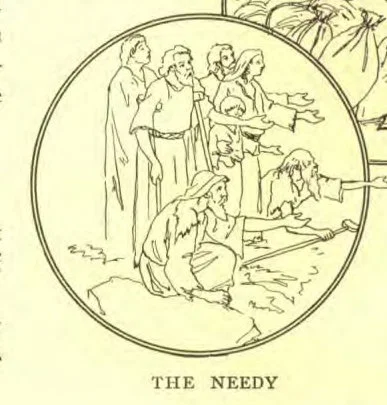
THE NEEDY
3. How did Jesus answer him?
4. What warning did he then give the people?
5. Why is covetousness a thing to be shunned?
6. How did Christ further warn against sin?
7. What had made a certain man rich?
8. As his fruits increased, what did he think within himself?
9. What did he decide to do with them?
10. For whom were his goods to be laid up?
11. How long did he think they would last?
12. In what way did he plan to spend this time?
13. But what did God suddenly require of him?
14. What did he call this covetous man?
15. What startling question did he ask him?
16. To whom is the sad fate of this man a warning?
17. Is it so that one who lays up treasure for himself is not rich toward God?
Notes
1. The foolish rich man looked upon those things which he had laid up as my fruits, my goods. He did not pay his tithe, and thus acknowledge that all things come from God, and therefore belong to him.
2. Hence God sternly calls him to account with the question, “Then whose shall those things be?” The rich man could not answer (Ps. 39:6); but one thing was certain, they would not be his.
Quotations
1. Through Moses God had given directions concerning the transmission of property. The eldest son received a double portion of the father’s estate, while the younger brothers were to share alike. This man thinks that his brother has defrauded him of his inheritance. His own efforts have failed to secure what he regards as his due; but if Christ will interpose, the end will surely be gained. He has heard Christ’s stirring appeals, and his solemn denunciations of the scribes and Pharisees. If words of such command could be spoken to this brother, he would not dare to refuse the aggrieved man his portion.—“Christ’s Object Lessons,” page 253.
2. Jesus could have told this man just what was right. He knew the right in the case; but the brothers were in a quarrel because both were covetous. Christ virtually said, It is not my work to settle controversies of this kind. He came for another purpose,—to preach the gospel, and thus to arouse men to a sense of eternal realities.—Id., page 254.
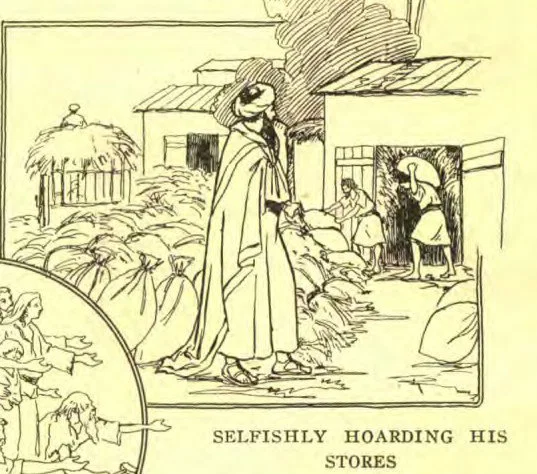
SELFISHLY HOARDING HIS STORES
3. This foolish rich man in his supreme selfishness had laid up for himself treasures that he could not use. He had lived only for himself. He had overreached in trade, had made sharp bargains, and had not exercised mercy or the love of God. He had robbed the fatherless and widow, and defrauded his fellow men, to add to his increasing stock of worldly possessions. He might have laid up his treasure in heaven, in bags that wax not old; but through his covetousness he lost both worlds.—“Testimonies for the Church,” Vol. III, page 402.
4. I have given you, says God, nine tenths; I ask one tenth of all the increase. That one tenth the rich man withheld from God. If he had not done this, he would not have accumulated so great treasures that there would be lack of room to bestow them. Had he bestowed his goods upon his needy brethren, there would have been no need of tearing down and building greater barns.—Id., page 546.
5. Men may have boundless wealth; yet if they are not rich toward God, if they have no interest to secure the heavenly treasure and divine wisdom they are counted fools by their Creator, and we leave them just where God leaves them.—Id., page 154.
SHORTHAND BY MAIL.
YOUR spare time can be well improved by studying shorthand, and this can be done at small expense to you by taking a mail course at your home. We are using “The Rogers Compendium of the Graham System of Shorthand,” a method arranged especially for home study, and giving an epitome of a system of shorthand acknowledged to be the best, the briefest, and the most complete. The only presentation of Standard Phonography in which all shorthand outlines are written as first learned, thus greatly abbreviating the work on the part of the student. A complete course in thirty lessons, illustrated by facsimile notes, with key. The correction of all students’ papers given special attention by experts. Reasonable tuition rates. If interested, write for full particulars. Practicing stenographers wishing to prepare for rapid reporting work should secure the last twenty lessons.
FIRESIDE CORRESPONDENCE SCHOOL,
Battle Creek, Mich.
GRAND TRUNK R'Y SYSTEM.
By W. C. Cunliffe
Taking Effect June 2, 1901.
Trains leave Battle Creek.
WEST-BOUND.
No. 2, Mail and Express, to Chicago.......................... 12.15 P. M.
No. 7, Limited Express, to Chicago............................. 7.10 A. M.
No. 3, Lehigh Valley Express, to Chicago....................... 3.50 P. M.
No. 5, International Express................................... 2.17 A. M.
No. 75, Mixed, to South Bend.................................. 7.30 A. M.
Nos. 9 and 75, daily except Sunday.
Nos. 3, 5, and 7, daily.
EAST-BOUND.
No. 10, Mail and Express, East and Detroit.................... 3.45 P. M.
No. 8, Limited Express, East and Detroit...................... 4.14 P. M.
No. 4, Lehigh Express, East and Canada......................... 8.22 P. M.
No. 6, Atlantic Express, East and Detroit..................... 2.10 A. M.
No. 2, Express, East and Detroit.............................. 7.00 A. M.
No. 74, Mixed (starts from Nichols yard)...................... 7.15 A. M.
Nos. 10 and 74, daily, except Sunday.
Nos. 4, 6, 8, and 2, daily.