The Youth’s Instructor, Vol. 50, No. 4.

BIRDS IN WINTER
Earlier text: YOUR LIFE-WORK — WHAT SHALL IT BE?

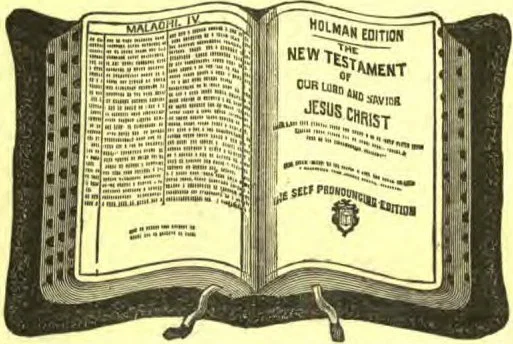
THE INSTRUCTOR PREMIUM BIBLE.

A Self-Pronouncing Teachers' Reference Bible, containing the celebrated * Teachers' Helps *, and comprising nearly 400 pages. Also a complete series of 15 new maps.
This beautiful book is bound in Imperial Seal Binding, Tuck Edges, known as “Divinity Circuit,” Rounded Corners, Full Red under Gilt Edges.
We offer this Bible, postpaid, for only six new yearly subscriptions at 75 cents; or twelve new six-months' subscriptions at 40 cents.
We will also send it, postpaid, with the INSTRUCTOR one year for $2.25. For 20 cents extra we will stamp your name in gold upon the cover. Address—
THE YOUTH'S INSTRUCTOR, BATTLE CREEK, - - - MICHIGAN.

What Is Going On in the World.

Recent Changes in the President’s Cabinet.

— Henry C. Payne, of Wisconsin, has been appointed to fill the place made vacant by the resignation of Postmaster-General Smith. Hon. Lyman C. Gage, who has held the office of Secretary of the Treasury since the beginning of the first McKinley administration, has also resigned; and President Roosevelt has appointed as his successor Leslie M. Shaw, of Iowa. Mr. Shaw is a prominent lawyer and banker, and has been for four years governor of his State.

Wireless Telegraphy Across the Atlantic.

— The scientific world is inclined to regard seriously Signor Marconi’s assertion that he has received signals at his station near St. John’s, Newfoundland, sent from Cornwall, England, seventeen hundred miles distant; and conservative investigators attach the highest importance to his work. The first experiments have not been repeated, owing to the fact that the Anglo-American Cable Company, which holds a monopoly of the telegraph privileges in Newfoundland, has served an injunction on the inventor, forbidding him either to send or to receive signals of any kind,—an act which he considers a high testimony to his success.

The New Prince of Wales.

— The Duke of Cornwall and York received his title of Prince of Wales and Earl of Chester on the occasion of his father’s sixtieth birthday. The new prince is the seventeenth person to bear the title. “Of his predecessors, five died before coming to the throne; four came to the throne, but were deposed and put to death; one came to the throne and reigned long, but was insane; five had unbroken reigns; and the remaining one is now reigning.” His father, King Edward, not long ago signed the proclamation which officially fixes his new title: “Edward VII. by the Grace of God of the United Kingdom of Great Britain and Ireland, and of the British Dominions beyond the Seas, King, Defender of the Faith, Emperor of India.” By this somewhat lengthy title the king will hereafter be formally designated,—a title in which, as a contemporary remarks, “a good deal of history is wrapped up.”

A New Flag for Federated Australia.

— Although the new government of Australia has been in existence for over a year, the question of an appropriate flag for the commonwealth has only lately been decided. A prize of seven hundred and fifty dollars had been offered for the best design, and the interest in the subject may be judged from the fact that more than twenty-five thousand designs for the flag and seal were submitted to the committee in charge. Out of this vast number there were five which were almost identical; these were selected by the committee, and the money was divided among the successful contestants.
New Flag of Australia.
The accompanying picture shows the new flag, which Young People’s Weekly describes as follows: “It is practically the Victorian ensign, with the addition of a large six-point star. The banner may consist of a blue or a red ground, on which the Union Jack occupies the place of honor in the top left-hand corner. Immediately below is the star of Australia, each point representing one of the States of the Union. Future States will be provided for with additional points on the big star.”

FOR EVERY DAY OF THE WEEK

SUNDAY:

Life is not measured by the time we live.— Crabbe.

MONDAY:

There is no use in calling ill temper “a high spirit,” because it isn’t. A really high spirit controls its low tendencies, among which petulance and anger must certainly be classed. — Well Spring.

TUESDAY:

It is not the boy who is surrounded with great laboratories and elaborate apparatus, but some Michael Faraday who, in the attic of an apothecary shop, experiments with a can of water and an old syringe, who becomes eminent.— Success.

WEDNESDAY:

“It is in the little things of life, done well, that honor lies. Be not deceived by the glitter of great deeds; it is a firmament sown with stars as countless as the sands of the ocean that constitutes night’s charm; and in a life jeweled with Christlike deeds, sown as the stars, is the Christian’s charm.”

THURSDAY:

Only in service does a man find his life and save it. The idler joins the procession of the perishing. He is the degenerate, the parasite among men,—kindred to the fruitless mistletoe of the forest, the eyeless fish of the cave.— January Success.

FRIDAY:

“I can forgive, but I can not forget,” is only another way of saying, “I will not forgive.” Forgiveness ought to be like a canceled note,—torn in two and burned up, so that it never can be shown against the man.— Beecher.

SABBATH:

“Wait on the Lord: be of good courage, and he shall strengthen thine heart: wait, I say, on the Lord.” Ps. 27:14.

A SPLENDID OPPORTUNITY

WOULD you like to have Dr. J. H. Kellogg’s “Home Hand-Book,” latest edition, full leather binding? It contains over eighteen hundred pages, with useful information on every page for sick and well alike. The regular price is $5.50; but it will be sent to any one who will obtain fifty subscriptions to that excellent little magazine, the Life Boat, at twenty-five cents a year. Many of our young people could obtain that many in two days in the average community. Or a church school might divide up its territory, work for the subscriptions, and thus add a copy of this excellent reference-book to its library.
Sample copies and full directions will be sent to all who are interested. Address the Life Boat, 2 & 4 Thirty-third Place, Chicago.

A GOOD DEFINITION

A LITTLE waif, when asked to give her reason for declaring that a new teacher in a College Settlement was “a perfect lady,” replied, “I know she’s a perfect lady, because she makes me feel polite all the time.” Wise little child! There is many a teacher who can make his charges act polite; but the number is too few of those who make all who know them “feel polite all the time.” True courtesy can come only from a heart where gentle thoughts dwell, and must always win those with whom it comes in contact, and unconsciously lift them up to its own high plane of thought and action.

WHAT SHE SAW

PEOPLE are very apt to see what they look for in this world—or to note only its absence. An incident in illustration is told of an Arab woman, who had lived as a nurse in an English family for a number of years. On her return to her native land, she was met by interested friends, and asked to describe the strange sights and scenes she had beheld during her absence.
It was a beautiful country, she told them; like a garden; the people were rich, and lived in fine houses; but it lacked one thing.
“What is that?” asked the Arabs, eagerly.
“There is not a single date-tree in the whole country!”
“Are you sure?”
“Positive; I looked for nothing else, and looked in vain.”
Before we smile at the disappointment conveyed by her words, let us ask ourselves if we never do the same thing that this homesick woman did,—look with longing eyes for the one thing that is not ours to have, and so miss the unnumbered beauties and blessings that encompass our daily path.

GROWING CHRISTIANS

God has every reason to look for and expect growth in those who take his name, and profess to become his children. Notice how this idea of growth is dwelt upon and emphasized in the Sacred Word. Peter, writing to those young in Christian experience, admonishes: “Wherefore, . . . as newborn babes, desire the sincere milk of the word, that ye may grow thereby;” and, “Grow in grace, and in the knowledge of our Lord.” “Be no more children,” writes Paul to the Ephesians; and the word he uses means “little babies.” He encourages them to put away the indecision, the waywardness, of childhood, and to “grow up into him in all things, which is the head, even Christ.”
The well-developed physical life, the life that fulfills its high purpose, is not a circle,—not a treading round and round of the same experiences year after year; neither is it a limited stretch of road, to be traveled, then retraced and traveled again, and so again, and yet again. No; it is a continuous journey, an upward climb, with new experiences, fresh views, broader outlook, and greater strength, as difficulties are conquered, and new heights gained.
So with the Christian. He must not be content to repeat again and again his experience of yesterday, last week, a year ago: such a course is fatal to his growth in spiritual things. Neither should he be always retracing his steps up to a certain point, then going back to the beginning, and traveling the same ground again. Rather, he should set out as one who has a definite object to attain, and should move straight forward toward it. If he falls in the way, he will rise again, and press forward, adding to his character the Christian graces, and keeping ever before him the ideal of one whose highest ambition is to “grow up into him . . . which is the head, even Christ.” Thus will his Christian growth be vigorous and sturdy; and thus, too, will he come to be indeed one of “the sons of God.”

You have reached the end of this edition.

The Youth’s Instructor · Jan 23, 1902