[From the Amory (Mississippi) Argus of June 2, 1899.]
A SHORT time since Elder R. S. Owen, an upright gentleman and a Seventh-day Adventist residing near Hatley, was arrested on the charge of violating the law forbidding labor on Sunday. Mr. Owen says he was taking a little exercise in his garden after a Sabbath rest the day before. Of course he considers Saturday the Sabbath. Bond was given for his appearance at the city hall in Amory, July 19.
Commenting upon a similar arrest in Georgia very recently, the Gainesville Eagle observes:—
The hauling of these Adventists before the grand juries is religious persecution pure and simple. It is always instigated by some fellow who is utterly devoid of religion himself—some hypocrite who does not care a rap for the sanctity of the sabbath. If this were not true, why is it that none but Adventists are ever prosecuted for working on Sunday? And these sensitive, tender-hearted bigots who are so utterly outraged by seeing an Adventist plowing on Sunday in his field four hundred yards from the road—why is it that they can go on Sunday and sit for hours and spit tobacco juice and listen to smutty stories, in front of a livery stable, while the establishment is in full blast, breaking the sabbath by hiring the tired and protesting dumb brutes to sabbath-breaking picnickers?
Can any one tell why a man who believes the first day of the week is the sabbath, is not prosecuted for desecrating that day? Is it not as sinful to break the sabbath, knowing you are breaking it, as it is to break it, believing you are not breaking it? Is it not as sinful to break the sabbath for pay as it is to break it for conscience? The idea of the religious informer and the grand juror is that you may sin, but mustn't believe you are doing right.
And right here is where the unspeakable infamy of the thing comes in—this censorship over conscience, participated in by the law and the religious spy. And here is where the rudimentary fang shows at its best, and here you see on it the blood-mark of the rack and the thumbscrew, those precious implements that were so effectual in persuading the minority to conform their belief to that of the majority.
MINISTRY.
By Anon.
Did we but know the truth and what we may become,
Our feet would forward press with greater speed
Along the road that leads to life and heaven.
Then let us haste to render such poor aid
As we can do to such as service need,
That, serving others, we ourselves may grow divine!
—Anon.
PRESENT TRUTH AMONG MOHAMMEDANS.
By H. P. H.
AMONG few people has the work of the Christian missionary produced so little fruit as among Mohammedans. For eighty years work has been carried on in Mohammedan lands, but the efforts of the missionaries have been chiefly in behalf of Christians in those countries. This is especially true of Turkey, Egypt, and North Africa. Occasionally, a Mohammedan was converted, but in nearly every case he was soon disposed of. It seems to be an unwritten law for Mohammedans to kill those that apostatize from their faith. As a result, efforts in their behalf have dwindled down to a minimum, and the feeling has become quite general that it is of little use to preach the Gospel to Mohammedans.
But according to Scripture, “This Gospel of the kingdom shall be preached in all the world for a witness unto all nations; and then shall the end come.” From this scripture alone we must conclude that the Gospel, in its closing work, will be preached among Mohammedans, especially as they number so many millions. From the opening of our work in Turkey, I have watched for a beginning among Mohammedans, and am now much rejoiced to see it.
J. H. Krum, our missionary in Palestine, having made visits to Mt. Carmel, Jerusalem, and the plain of Sharon, returned to Jaffa, to continue his efforts there. Unexpectedly, his work turned among the Mohammedans. First, one accepted Christ and immediately began to work for others; soon a second began, and he likewise worked actively for others. This work has continued till Jaffa and surrounding country is considerably stirred. Of his experience Brother Krum speaks, in a letter of May 14, as follows:—
Since I last wrote you, the interest has been growing, and indeed so rapidly and unexpectedly that I could not leave the house any more. For the last few weeks the Muslims have been coming in to morning worship, and also at the going down of the sun. These have nearly all been brought in by our converted priest of the law. [A sheik from Lydda.] He returned from his trip Wednesday evening. He had visited six villages and Ramleh. In Ramleh, he visited a meeting held by a lady employed by the Church Missionary Society. She was speaking on the resurrection of Christ, and that therefore Sunday should be observed. He arose and told them that according to the Bible that was all wrong, and gave the Bible proofs for his assertion. The government in Lydda owes him 350 piasters for teaching, but as he has professed Christ, it refuses to pay him.
He confessed everywhere in Ramleh and Lydda where he is known. He also brought a young man with him to Jaffa,—an “efendi,” i.e., a gentleman. He is the son of one of the richest families in Jerusalem. He has now confessed Christ among those that congregate in my house. . . . He also brought along a peasant from one of the villages, who has since come here daily. Shakker [the name of this sheik from Lydda] has thus far brought in many people. He has been the fisher, while Hafiz and I dress them. Yesterday, we had a most glorious meeting. . . .
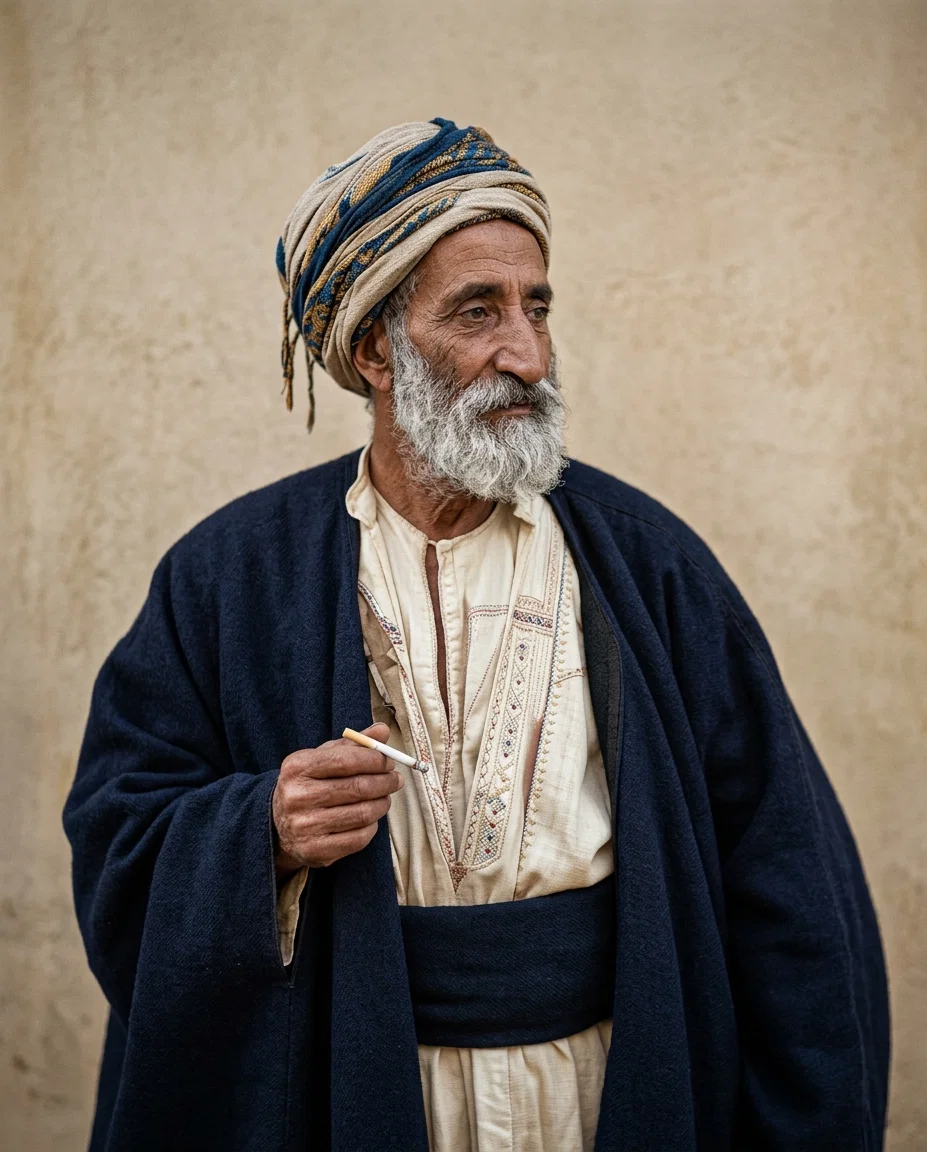
A Mohammedan Sheik.
A remarkable feature of the Mohammedans is that they are very quick to decide for the truth. I preached to them Christ only, and no sooner did they see Christ than they knew all the rest. They were all inveterate smokers; but yesterday morning, when they came dressed up in their very best white linen and silk in honor of the Sabbath, I noticed that not one used tobacco. I asked Hafiz, “Do you think they have given up tobacco?” He answered: “Certainly. They said to me, ‘Kall bass,’ i.e., ‘We have finished.’” Yesterday there were seven Mohammedans, eight with the mother of Hafiz, who kept the Sabbath with me. . . . Five of these have committed the Koran to memory, and all except Shakker earn their living by going to the houses of Mohammedans and to the cemeteries to sing parts of the Koran for the people. In other words, they give what we would call Bible readings, and sing hymns from the Koran.
The Germans are all surprised, and indeed all who hear are wondering. The Church Missionary Society has a hospital here since thirty-five years and preaches to each patient before giving him medicine, and only one convert from among Mohammedans is reported. The Jewish Society has operated here seventeen years, and has not one convert among Jews or Mohammedans. The German colonies are here twenty-seven years, and have not one convert from the Jews, Mohammedans, or Arab Christians. I am here six months, and the blessed Lord has given me at the least six already. The Lord be praised. Amen. . . .
I thought Shakker had left for the villages again, but to my surprise he came in yesterday afternoon, bringing in the highest teacher of the Mohammedans in the city. He had talked with him a few hours, and he finally accepted what Shakker told him as truth, and, like all the rest, he immediately expressed a desire to see me. . . . This teacher is an educated, mild man, and really a hopeful case. He prayed with us twice as a little child. He believed all, and appears to love us. He said he would come to me at night, about three times a week. . . .
I had twelve Mohammedans here yesterday, and gave eight Bible readings. . . .
The other Christians are afraid to speak to the Muslims about Christ, and so this work has been neglected.
Already Mohammedans have made efforts to persecute those who have professed Christ. Several narrowly escaped being arrested, while an effort was made to enlist the leading one into the army. This is a common way of entrapping and disposing of such. As this work continues, there will doubtless be bitter persecution. Let all Christians remember these souls in their prayers, that they make a noble beginning, and that the power of God may be manifested in their preservation and deliverance.
H. P. H.
Mission Work in Uganda
Uganda, Africa.— In the Uganda country is a lake with several islands. From an article in the Missionary Review, referring to mission work in that country, we take this extract:—
“A missionary visiting a small island in the lake two or three years ago, found but one person who could read at all. Two teachers were sent, and, after nine months, sixty were reading the Gospel. Two teachers were sent to another island, and in a year one very rude church building, that even when uncomfortably full could hold but one hundred, had multiplied into four, one of which would hold seven hundred; the congregation of a hundred had multiplied tenfold. On the large island of Sese all the chiefs are Roman Catholics. Yet there are some three hundred twenty Protestants, nicknamed ‘the people of the Holy Ghost,’ which, like the nickname ‘Christians,’ at Antioch, is an honor, not a reproach; and these disciples, ignorant as they are, evince a like readiness with the early Christians to face opposition and persecution for His name; and nowhere has a greater desire for reading been shown.”
Missionary Work in Siam
In Siam the American Presbyterians work among the Buddhistic Siamese and the Laos of the northern hill country, occasionally visiting the Siamese of the lower peninsula, who in turn wander down among the Malays. But nothing is done by any missionary, papal or Protestant, among the Malays and Chinese of the east coast of British Malaya.—Missionary Review.
14 “And when they were come to the multitude, there came to Him a man, kneeling to Him, and saying, Lord, have mercy on my son: for he is epileptic, and suffereth grievously: for oftentimes he falleth into the fire, and oft into the water. 15 And I brought him to Thy disciples, and they could not cure him. And Jesus answered and said, O faithless and perverse generation, how long shall I be with you? how long shall I suffer you? bring him hither to Me. And Jesus rebuked him; and the devil went out from him; and the boy was cured from that hour. Then came the disciples to Jesus apart, and said, Why could not we cast it out? And He saith unto them, Because of your little faith; for verily I say unto you, If ye have faith as a grain of mustard seed, ye shall say unto this mountain, Remove hence to yonder place; and it shall remove; and nothing shall be impossible unto you.”
“And while they abode in Galilee, Jesus said unto them, The Son of man shall be delivered up into the hands of men; and they shall kill Him, and the third day He shall be raised up. And they were exceeding sorry.”
“And when they were come to Capernaum, they that received the half-shekel came to Peter, and said, Doth not your Master pay the half-shekel? He saith, Yes. And when he was come into the house, Jesus prevented him, saying, What thinkest thou, Simon? the kings of the earth, from whom do they receive custom or tribute? from their own children, or from strangers? And when he said, From strangers, Jesus said unto him, Therefore the children are free. But, lest we should offend them, go thou to the sea, and cast a hook, and take up the fish that first cometh up; and when thou hast opened his mouth, thou shalt find a shekel: that take, and give unto them for Me and thee.”
“And they came to Capernaum; and when He was in the house He asked them, What was it that ye disputed among yourselves by the way? But they held their peace: for by the way they had disputed among themselves, who should be the greatest.”
1 “In that hour came the disciples unto Jesus, saying, Who then is greatest in the kingdom of heaven? And He called to Him a little child, and set him in the midst of them, and said, 2 Verily I say unto you, Except ye turn, and become as little children, ye shall in nowise enter into the kingdom of heaven. 3 Whosoever therefore shall humble himself as this little child, the same is greatest in the kingdom of heaven. And whoso shall receive one such little child in My name receiveth Me; 4 but whoso shall cause one of these little ones which believe on Me to stumble, it is profitable for him that a great millstone should be hanged about his neck, and that he should be sunk in the depth of the sea. 5 Woe unto the world because of occasions of stumbling! for it must needs be that the occasions come; but woe to that man through whom the occasion cometh! 6 And if thy hand or thy foot causeth thee to stumble, cut it off, and cast it from thee; it is good for thee to enter into life maimed or halt, rather than having two hands or two feet to be cast into the hell of fire. 9 And if thine eye causeth thee to stumble, pluck it out, and cast it from thee; it is good for thee to enter into life with one eye, rather than having two eyes to be cast into the hell of fire. See that ye despise not one of these little ones; for I say unto you, that in heaven their angels do always behold the face of My Father which is in heaven. 11 For the Son of man came to save that which was lost. How think ye? if any man have a hundred sheep, and one of them be gone astray, doth he not leave the ninety and nine, and go into the mountains, and seek that which goeth astray? 13 And if so be that he find it, verily I say unto you, he rejoiceth over it more than over the ninety and nine which have not gone astray. Even so it is not the will of your Father which is in heaven, that one of these little ones should perish. 15 “And if thy brother sin against thee, go, shew him his fault between thee and him alone; if he hear thee, thou hast gained thy brother. 16 But if he hear thee not, then take with thee one or two more, that at the mouth of two witnesses or three every word may be established. 17 And if he refuse to hear them, tell it unto the church; and if he refuse to hear the church also, let him be unto thee as the Gentile and the publican. 18 Verily I say unto you, What things soever ye shall bind on earth shall be bound in heaven; and what things soever ye shall loose on earth shall be loosed in heaven. 19 Again I say unto you, that if two of you shall agree on earth as touching anything that they shall ask, it shall be done for them of My Father which is in heaven. 20 For where two or three are gathered together in My name, there am I in the midst of them. 21 “Then came Peter, and said to Him, Lord, how oft shall my brother sin against me, and I forgive him? until seven times? 22 Jesus saith unto him, I say not unto thee, Until seven times; but, Until seventy times seven. Therefore is the kingdom of heaven likened unto a certain king, which would make a reckoning11with his servants.”
24 “And when he had begun to reckon, one was brought unto him, which owed him ten thousand talents. 25 But forasmuch as he had not wherewith to pay, his lord commanded him to be sold, and his wife, and children, and all that he had, and payment to be made. 26 The servant therefore fell down, and worshiped him, saying, Lord, have patience with me, and I will pay thee all. 27 And the lord of that servant, being moved with compassion, released him, and forgave him the debt. 28 But that servant went out, and found one of his fellow-servants, which owed him a hundred pence; and he laid hold on him, and took him by the throat, saying, Pay what thou owest. 29 So his fellow-servant fell down and besought him, saying, Have patience with me, and I will pay thee. 30 And he would not: but went and cast him into prison, till he should pay that which was due. 31 So when his fellow-servants saw what was done, they were exceeding sorry, and came and told unto their lord all that was done. 32 Then his lord called him unto him, and saith to him, Thou wicked servant, I forgave thee all that debt, because thou besoughtest me: 33 shouldest not thou also have had mercy on thy fellow-servant, even as I had mercy on thee? 34 And his lord was wroth, and delivered him to the tormentors, till he should pay all that was due. 35 So likewise shall My heavenly Father do also unto you, if ye from your hearts forgive not every one his brother.”
NOTE.—The texts enclosed in marks of parentheses, while not essential to the lesson study, will be found to throw much light upon the lesson, and are suggested for those who wish to study further.
2. What did Jesus say and do in response to the father's petition? Verses 17, 18. (Mark 9:23-27.)
3. Inasmuch as power had been conferred upon the disciples to cast out demons, what was the secret of their failure in this case? Verses 19-21. (Mark 11:23.)
4. Passing through Galilee, what particular truth did the Saviour try for the second time to impress upon His disciples' minds? Verses 22, 23. (Luke 9:44, 45; Mark 9:31, 32.)
5. What was the evident reason for the disciples not being more deeply impressed with this important matter? Luke 9:46. Note 1. (Mark 9:28.)
6. On their arrival at Capernaum, what question was put to Peter by the tribute collector? Matt. 17:24. Note 2.
7. Knowing what Peter had said, with what question did the Lord meet him immediately upon his entering the house? V. 25.
8. Receiving the only answer possible, what conclusion did Jesus draw? What did He instruct Peter to do? Verses 26, 27; Note 3.
9. To what was the Saviour's attention next directed? Mark 9:33, 34.
10. Not being able to agree among themselves, how did they undertake to settle the controversy? Matt. 18:1.
11. How did Jesus answer this question? Verses 2-6. (1 Cor. 14:20.)
12. What did He then say of those who in any way led others to do wrong? Verse 7. Note 4. (Luke 17:1, 2.)
13. In what way does He apply this principle to our members which lead us to do wrong? Verses 8, 9. (Matt. 5:29; James 3:6.)
14. What warning does He give us regarding those who become like children for Christ's sake? Verse 10. Note 5. (Heb. 1:13, 14.)
15. How far will the Lord go to save one such? Verses 12-14. (Matt. 18:35.)
16. What counsel does the Lord give regarding differences between brethren? Verses 15-18. Note 6. (Gal. 6:1-3.)
17. In perfect agreement, what may two persons expect concerning their petitions? Verse 19. (Matt. 5:23, 24.)
18. Why is this sure to be so? Verse 20.
19. When Peter desired to know how many times this agreement was to be reached by forgiveness, what did the Lord tell him? Verses 21, 22. (Col. 3:13.)
20. Relate the parable by which the Lord further illustrates this subject. Verses 23-35. Note 7.
Side Lights.—“Desire of Ages,” chapters 47, 48.
NOTES.
1. Which should be greatest.—The disciples were still clinging to the idea that the Saviour's kingdom was to be an earthly, tangible one, with His throne in Jerusalem, and that at the proper time He would there assume the reins of government. So on the journey toward Capernaum they fell to discussing the question of their relative fitness for positions of trust in the new commonwealth. This material view of the Lord's kingdom so barred the door of their hearts that the spiritual truths their Master wished to impress upon them could not find entrance.
2. The half-shekel.—Not “tribute,” as in Common Version. It was not a civil tax, but the half-shekel (Greek, didrachma) of Ex. 30:11-16, which was required of every Israelite above twenty years old, for the current expenses of the tabernacle, and afterwards the temple. It was a piece of silver, in value about thirty-two cents, or one shilling and fourpence of English money.
3. From Strangers.—Strangers being those only who were subject to tribute, the temple could not exact means from Him who was the Son of God, the great King, to whose temple service the money was to be applied. Priests and prophets were exempt from this tax. But the Son of God in that instance gives a beautiful example of waiving personal rights, in order to prevent wrong impressions, which would produce unnecessary friction. The money necessary to meet the demand was not on His person, but was to be found in the mouth of a fish. The stater, thus miraculously produced, was just enough to pay the needed amount not only for Christ, but also for Peter, His follower, who likewise was counted a resident of Capernaum.
4. Occasions of stumbling.—The Greek word usually rendered “offense” in the Common Version, means cause, occasion of wrong, or an inducement to sin.
5. Despise not.—Ancient kings shut themselves away from the gaze of men, but their counselors were privileged to behold their faces. See side text. The angels are thus said to behold the face of God, which is hid from mortals. Ex. 33:20. These same angels being ministering spirits to the humble saints (Heb. 1:14), the latter have counsel with God through their ministering spirits, and so are the subject of heavenly counsel, regarding their difficulties and dangers.
6. As an heathen.—While a man may be regarded as a heathen, or a publican, and so unfit for church-fellowship, yet the Spirit of Christ teaches us to labor earnestly for the conversion of all such. This can not be accomplished by harsh treatment, or hateful words, or by abandonment. The only way to win any one, in whatever state or condition, is by kindness.
7. Ten thousand talents.—An expression conveying the idea of a hopelessly large debt. Literally it would be $8,000,000 to $15,000,000. The smaller debt was about $15. In other words, sinful man is owed $15, but is not willing to forgive the debt, tho he owed God $15,000,000, who freely forgave all. How many will allow an unforgiven sin to destroy them?
FLOODS IN CHINA.
Some of our readers will already have heard of the severe suffering caused by the recent floods in northern China. China's Millions for April gives the following sad account: "The news of the floods in north China is distressing beyond measure. On account of a sudden rise of water in the Yellow River, the great stream has broken its banks, covering hundreds of acres of land, destroying the crops, washing away whole towns and villages, and leaving death in its train wherever it has gone. It is said in the one province of Shan-tong that thousands of people have perished, and that over 1,000,000 are homeless and starving. These last are moving southward in great masses, seeking for food and shelter, and for new places to locate and to earn a living. The southern provinces, however, are already overfull of people, and those resident there are not ready to welcome hundreds of additional persons, where the land but barely supplies the needs of its present occupants. The result of this condition of things has been that serious rioting has occurred in the provinces of Hunan, An-huei, and Kiang-su, while the refugees are reduced to a state of beggary and famine of the worst kind."—Christian Worker.
PLAGUE IN BOMBAY.
The most recent news from India indicates a very terrible state of affairs in Bombay on account of the plague, which should cause us to remember the missionaries and native Christians there much in our prayers. "In Bombay alone 300 victims die daily. On Sunday, March 5, the number of deaths was 391, which is the greatest number ever known to occur in a single day. The total number of victims of the plague for the week was 2,247. The plague has interfered with the work of the missionaries. The natives imagine that all Europeans are employed by the government to spread the disease, and threaten to do bodily injury to the missionaries if they do not move away."—The Faithful Witness.
IS THE READY WAY THE RIGHT WAY?
By W. H. B. M.
You can nearly always decide with confidence that the ready way is not the right way. When Jonah disobeyed the word of the Lord and fled from Nineveh he found a ship waiting to convey him to Tarshish. If a Christian decides to-day to forsake the Lord and serve the devil, to-morrow morning he will find thousands of ready ways. This oft-quoted maxim is one of the devil's proverbs. The Christian's only guide is the Word of the Lord. It is always the right way whether it is the ready way or not. W. H. B. M.
Religious Liberty in Finland.
A missionary to Finland, writing to the Bulletin, Des Moines, Iowa, says:—
“This country is passing through a critical time. A manifesto has been sent from the czar of Russia saying that the Finnish people must accept certain laws forced upon them. It is their wish to have the same liberties which they have had before, but these will be curtailed by the new law. The people are mourning. On February 19 a mass of people met at the railway station and walked up to the capitol, where stands the statue of Alexander II. On the way the band played mournful strains, and the ladies were dressed in black. Sunday, February 26, was appointed as a day of fasting and prayer and mourning for the whole land. I can not say where this will end, but I am glad that the Lord knows.”
OUR WORK AND WORKERS.
Brother R. W. Munson is making preparations to go as a missionary to the Philippines.
In the church in this city, on the 1st inst., five persons were baptized by Brother J. W. Bagby.
The addition of four members to the church at Eureka, Iowa, is noted by Brother E. G. Olsen.
Seven members added to the church at Monticello, Texas, is part of a report of Brother H. Woodruff.
A camp-meeting is to be held at Canastota, N. Y., August 10–20. The location is on the New York Central Railroad, between Rome and Syracuse.
At a quarterly meeting held by the church at Beverly, Kansas, in May, eleven members were added to the church. Brethren J. W. Westphal and A. R. Ogden were present.
Brother A. O. Burrill has been transferred from Michigan to New York Conference. He is now engaged in tent-work at Addison, in connection with Brother J. W. Raymond.
At a recent general meeting in London, it was decided that Brother S. C. Haughey should labor in Ireland for a time. Brother Haughey was assigned to the British field by the late General Conference, having previously labored in Ohio.
The seeds of truth sown among the colored people of Houston, Texas, several years ago, are now bearing fruit. Brother Felix Conway reports that six of them are now keeping the Sabbath of the Lord. He also states that Brother J. F. Bahler is doing a good work selling the special number of the Signs in that city, and the blessing of God is attending his efforts.
From the Atlantic Chesapeake News we take this item:—
“A company of four canvassers, consisting of Brethren E. V. Orrell, W. H. Luce and wife, and Geo. Edwin Tack, are now engaged in the exalted work of canvassing on the resident canvasser’s plan. They are combining industrial work with their canvassing, and are located on a little farm at Reisterstown, Md., near the Hannah More Academy. They expect to work the country about there for a radius of fifty miles. They have in a nice lot of produce already, and expect another year to carry on the industrial part more extensively.”
At the recent camp-meeting held at Warren, Pa., there were present Brother A. T. Jones and Sister S. M. I. Henry, of Michigan; Brother G. B. Thompson, president of New York Conference; Brother J. E. Jayne, secretary of the foreign mission board; Brother S. N. Curtiss, manager New York branch of the Pacific Press Publishing Co., and Brother H. G. Thurston, of California, representing the Signs of the Times. Thirty-six persons were baptized. Conference officers were elected as follows: President, R. A. Underwood; vice-president, Lee S. Wheeler; secretary and treasurer, W. M. Lee.
After an absence in America at the General Conference, Brother C. A. Hall returned to Jamaica. Writing to the Kansas Worker of his subsequent labors, he says: “I have visited and held quarterly meetings with several churches, helped put up the framework of a church, and organized the company for whom I have labored since September last. Seventy persons have signed the covenant at that place, and thirty-eight were organized into a church, with others to follow soon. I am now in a new place [Santa Cruz] and have a motley crowd of hundreds in attendance every night. Some are interested, and many are noisy and troublesome. The people tell me there is only one family of whites in the city. I have not seen any yet.”
A letter from Brother I. D. Richardson (who is canvassing India) to the Visitor, of Mount Vernon, Ohio, gives an encouraging account of his work. The letter is dated Lahore, March 30. The writer says: “During the past month, I have canvassed 19 days, taking 183 orders, which amounts to $518. ‘Patriarchs and Prophets’ and ‘Great Controversy’ are the books being handled here. Many times I take an order for one of each in the same house. I also sell ‘Man the Masterpiece’ and ‘Ladies’ Guide.’ These books take well among natives and Europeans who care nothing for religious books. . . . I am now about 1,264 miles north-west of Calcutta; and I suppose by the time this letter reaches you I shall be about 1,600 miles from there, on the frontier between India and Afghanistan. The natives there are very bitter against Europeans. Several white people have been killed there. But the God of Israel, who delivered His people from the enemy, is just as able to deliver now.”
LESSON V.—SUNDAY, JULY 30, 1899.
DANIEL IN THE LIONS' DEN.
NOTE.— From last week's lesson we learned that Darius the Median took the kingdom, when Belshazzar, the last of the Babylonian monarchs, was slain by the Medo-Persian army under Cyrus. By reading the first nine verses of this lesson chapter it will be seen that the incident here recorded occurred in the second year of Darius' reign. There were one hundred and twenty princes over the various provinces; over these were three presidents, of which Daniel was first. Practically he was next to the king in the empire, and the fact that he was one of the exiled Jews excited a spirit of envy against him on the part of the other officials. So they made great pretense of loyalty to the king, and flattered him with the suggestion that a decree be issued that no one should “ask a petition of any god or man for thirty days,” excepting of the king. Of course this pleased the old man's vanity, and he signed the decree.
10 “And when Daniel knew that the writing was signed, he went into his house (now his windows were open in his chamber toward Jerusalem); and he kneeled upon his knees three times a day, and prayed, and gave thanks before his God, as he did aforetime. Then these men assembled together, and found Daniel making petition and supplication before his God. Then they came near, and spake before the king concerning the king's interdict: Hast thou not signed an interdict, that every man that shall make petition unto any god or man within thirty days, save unto thee, O king, shall he be cast into the den of lions? The king answered and said, The thing is true, according to the law of the Medes and Persians, which altereth not. Then answered they and said before the king, That Daniel, which is of the children of the captivity of Judah, regardeth not thee, O king, nor the interdict that thou hast signed, but maketh his petition three times a day. Then the king, when he heard these words, was sore displeased, and set his heart on Daniel to deliver him; and he labored till the going down of the sun to deliver him. Then these men assembled together unto the king, and said unto the king, Know, O king, that it is a law of the Medes and Persians, that no interdict nor statute which the king establisheth may be changed. Then the king commanded, and they brought Daniel, and cast him into the den of lions. Now the king spake and said unto Daniel, Thy God whom thou servest continually, He will deliver thee. And a stone was brought, and laid upon the mouth of the den; and the king sealed it with his own signet, and with the signet of his lords; that nothing might be changed concerning Daniel. Then the king went to his palace, and passed the night fasting: neither were instruments of music brought before him; and his sleep fled from him. Then the king arose very early in the morning, and went in haste unto the den of lions. And when he came near unto the den to Daniel, he cried with a lamentable voice: the king spake and said to Daniel, O Daniel, servant of the living God, is thy God, whom thou servest continually, able to deliver thee from the lions? 21 Then said Daniel unto the king, O king, live forever. 22 My God hath sent His angel, and hath shut the lions' mouths, and they have not hurt me; forasmuch as before Him innocency was found in me; and also before thee, O king, have I done no hurt. 23 Then was the king exceeding glad, and commanded that they should take Daniel up out of the den. So Daniel was taken up out of the den, and no manner of hurt was found upon him, because he had trusted in his God.”
(1) What circumstances led up to the incident described in this lesson? See introductory note. (2) When Daniel learned of the decree, what course did he pursue? V. 10. Note 1. (3) What did his enemies soon find out? V. 11. (4) To whom did they report the matter? In what cautious manner did they broach the subject? What was the king's answer? V. 12. (5) Then what charge was boldly brought against Daniel? V. 13. (6) How did the king feel when he heard this report? What steps did he take in the matter? V. 14. Note 2. (7) How did Daniel's accusers still urge their case? V. 15. (8) What then did the king command? As Daniel was being put into the den of lions, what did the king say to him? V. 16. (9) How was the den and the decree further secured? V. 17. (10) How did the king further manifest his deep concern for Daniel? V. 18. (11) What did he do in the morning? V. 19. (12) How did he express his feelings as he came near to the den? What did he say? V. 20. (13) What was Daniel's reply? Vs. 21, 22. Note 3. (14) Then how did the king feel? What command did he give? V. 23.
NOTES.
1. Daniel's honesty.—Daniel was honest with God, honest with the government, and honest with himself. He would not defraud the Lord of the honor due to His name; he would not defraud the government or the king by secretly disobeying the law while publicly professing to observe it; he would not defraud himself by depriving himself of the blessings of faithfulness in all things. It was this “excellent spirit” that procured for him his position, that “the king should have no damage.” In ancient times it was customary for governors of provinces to fraudulently enrich themselves at the expense of the general government; and one in Daniel's position could have gained wealth and friendship by allowing such things to pass without note or comment. The king knew this tendency on the part of officials, and knew that Daniel would conscientiously look out for the public weal. Hence the king's confidence, and hence the animosity of presidents and princes whose official acts and financial accounts were closely scrutinized.
2. The king's displeasure.—He “was sore displeased with himself” (A.V.). When Shadrach, Meshach, and Abed-nego disobeyed the decree of Nebuchadnezzar, he was “full of fury” toward the men who disregarded his power. But Darius was displeased with himself because he had unwittingly allowed himself to become a tool of designing men.
3. “Shut the lions' mouths.”—The writer of the epistle to the Hebrews refers to the prophets “who through faith subdued kingdoms, wrought righteousness, obtained promises, stopped the mouths of lions, quenched the violence of fire,” etc. The Angel of deliverance still lives, and faith is as effectual to invoke the power of God as ever it was; for our God is “the same yesterday, to-day, and forever.”