Is now nearly ready for the market. Exact date of publication will be given in these columns in a week or two.
Prices remain the same as on the English, viz:—
Cloth, marbled edges $1.25
Cloth, gilt edges - - 1.50
PACIFIC PRESS PUBLISHING CO., Oakland Cal.
39 Bond Street, New York City
18 West 5th Street, Kansas City, Mo.
Reduced Cover of English Edition
Heralds OF THE Morning
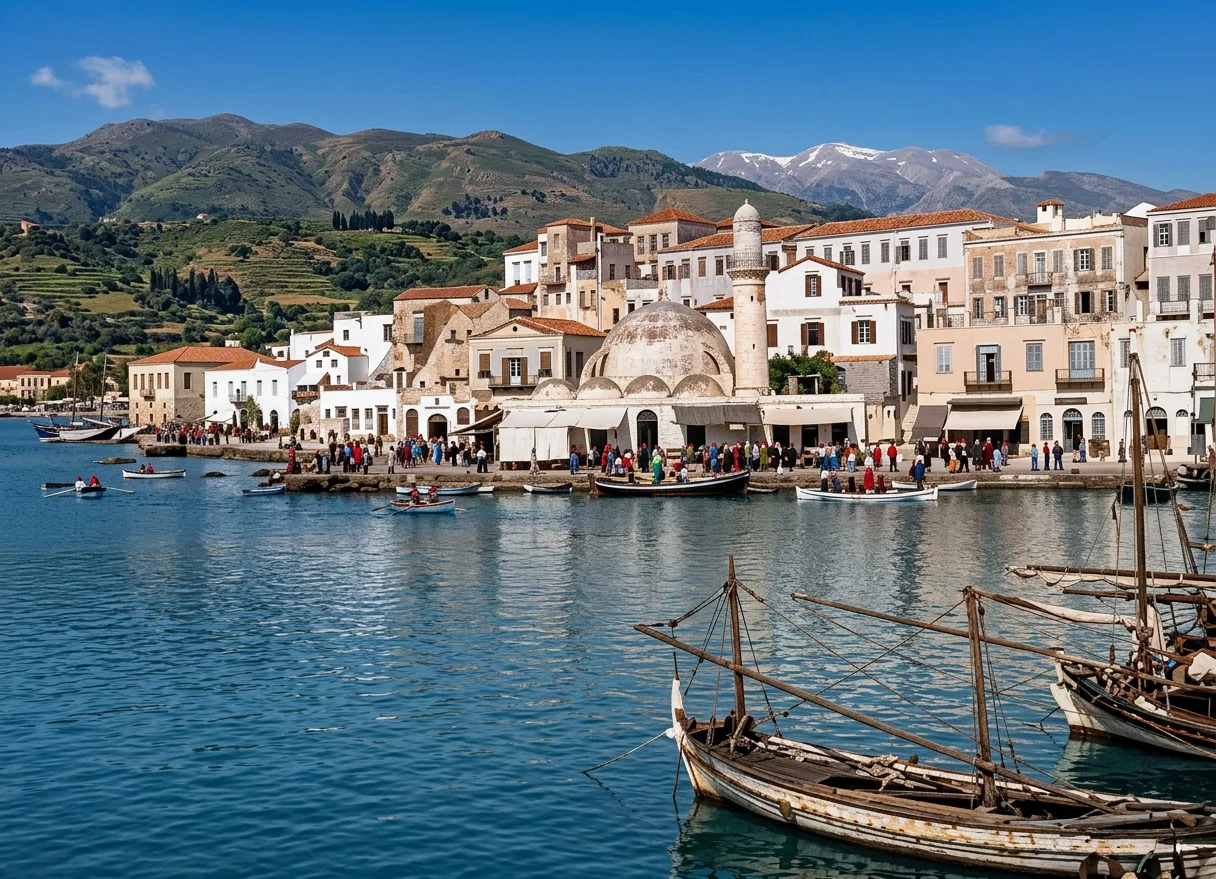
CANEA, CRETE.
By HERVY A. HENDERSON
THIS morning strange voices, near the port-hole of our stateroom, aroused us from a sound slumber. The and hastily looking out, we saw the red-capped head of a Turk only a few feet from us; a closer inspection showed that our boat had cast anchor, and that a number of small boats were about her, some having come to carry away freight, mostly sulphur, brought from ports of Sicily, and some to take passengers ashore.
As we were going to stop only about six hours, and our boat being quite large for the small artificial harbor, we anchored almost a mile from the wharf in the open bay. Appearing on deck, one is surrounded by eager boatmen, who always know an English-speaking person, so accost him with all the English they know, which is, “Go ashore, mister?” Altho one expects to go ashore, experience soon teaches him to show no special desire, for financial reasons; so, shaking our heads, we walked along the deck to get a view of Canea, one of the principal cities of Crete. It is situated along the shore, on the slope of a range of hills, which seem to rise almost out of the sea, and which seem to be but a terrace to those cloud-piercing, snow-capped mountains just behind them.
Having made a bargain with a boatman for about one-sixth his original price, a party of us go ashore. Fortunately it is a holiday, commonly called Prince George’s Fête-day, in honor of St. George. The first impression on reaching the shore was very much like the one received in the Midway Plaisance at the Columbian Exposition in Chicago—people of almost every nationality and in as many different garbs.
Passing up through many winding streets, some so narrow that a carriage can not drive in them, we found ourselves following a stream of people into the country, and, desiring to see what was their purpose, we went along,
CANEA, FROM THE NORTH.
The people seemed to be enjoying themselves, many of the women, imitating the English ladies in their dress, with a good supply of paint on their faces, were sitting, with great dignity, upon their little donkeys, while the gallant youths, with their very loose knee trousers and buskins, traveled on foot. It is quite warm, and the way is dusty. On our way we pass a large olive orchard, between a vineyard on one hand and a rye-field, with the grain all headed out, on the other. The fences, where there are any, are of cactus or rose-brier hedge. The land seems fertile and is well kept. We approach a high wall, which incloses a building like a church. There are many people gathered without the wall. Temporary stands are erected, upon which are displayed for sale various articles, and especially refreshments. As the people are constantly entering at a large door in the wall, we follow the impulse of our curiosity, and endeavor to follow. A man with a turban on his head and something like a white blanket wrapped around him, stops us, and, after considerable useless talk, because we could not understand him, we hand him five centimes each (about one cent in our money), and we are allowed to pass in.
Inside the inclosure we find a number of people in a yard surrounding the church building, trying to enter the already well-filled church. The church is built in the form of a cross, the entrance being at what might be called the base of the cross. Seeing that we were strangers, the people made way, and we entered the church. In front of us were a number of images and paintings of the Passion, the Virgin Mary, and of apostles and saints. These the people were constantly approaching, kissing the feet of the images and crossing themselves. Through a small door, which opened into the head of the cross, could be seen a large image of Christ on the cross, and before it were several priests, with long hair, performing the ceremonies. During the entire time there is a ceaseless chanting, mostly by a boys’ choir. While this form of worship does not differ materially from that found all through Europe, and to some extent in America, it makes us desire more earnestly that the full liberty of the glorious Gospel of Jesus Christ might be manifested to this people.
Returning to the city, we again follow the crowd, and soon find ourselves on the seashore before the royal palace, which is just to the left of the flag-pole in the accompanying picture.
Crete, having been the bone of contention between Greece and Turkey, is now governed by Prince George, son of King George of Greece, placed in his position by the Powers, and supported by soldiers of England, Russia, France, and Italy, the flags of which nations are to be seen displayed in promiscuous confusion.
To-day we found the soldiers of these nations drawn up before the palace, while within the prince was receiving visitors. Not being in court dress, we had to content ourselves mingling with the crowd. Soon there was a great stir among the people; an open carriage drove up to the door, and Prince George, with an attendant, came out of the palace and entered it, lifting his hat to the crowd as he drove rapidly away. The soldiers and company dispersed, some running after the carriage, while we hastened back to the ship, and were soon on our way to Athens.
HERVY A. HENDERSON.
LOVE ME NOW.
By Amos
If you're ever going to love me,
Love me now while I can know
All the sweet and tender feelings
Which from real affections flow.
Love me now while I am living,
Do not wait till I am gone
And then chisel it in marble—
Warm love-words on ice-cold stone.
If you've dear, sweet thoughts about me,
Why not whisper them to me?
Don't you know 'twould make me happy,
And as glad as glad can be?
If you wait till I am sleeping,
Ne'er to waken here again,
There'll be walls of earth between us,
And I couldn't hear you then.
If you knew some one was thirsting
For a drop of water sweet,
Would you be so slow to bring it?
Would you step with laggard feet?
There are tender hearts all round us
Who are thirsting for our love;
Why withhold from them what nature
Makes them crave all else above?
I won't need your kind caresses
When the grass grows o'er my face;
I won't crave your love or kisses
In my last resting-place.
So then, if you love me any,
If it's just a little bit,
Let me know it now, while living
I can own and treasure it.
—Amos.
WHAT THE FLESH TRAFFIC INVOLVES.
By T.
A CORRESPONDENT of the Milwaukee Sentinel tells this pitiful tale of what he saw going from Wisconsin to California:—
Before reaching Kinsley, and between Kinsley and La Junta, the fields were literally covered with dead and dying cattle. The uncommon cold in Colorado had caused them to go south.
Reaching the Sante Fe road, their further progress was barred by wire fences, but could they have passed this, the Arkansas River, which is partly frozen, would have prevented them from reaching any more southern point.13Freezing and without food, there was nothing for them to do but to wait for death. Their lips were frozen and they were unable to eat the bits of grass that were above the snow. It was the most pitiful sight, I trust, that I shall ever be obliged to witness. It was estimated that one hundred thousand were in sight from the car windows; and when to this number is added the almost countless herds between Arkansas River and northern Colorado, the amount of suffering is beyond human computation. Many lay under the wire fences dead, having pushed their way as far south as possible. Little calves leaned against the wires with no strength to release themselves from the cruel bars—waiting for death.
At Dodge City, where we were detained by a wrecked car, the starving creatures were walking through the town, or standing with their mute, appealing eyes turned toward the people, who were powerless to help. The white snow that covered their bodies was the only touch of mercy that we saw. Some of them were Texan cattle, wholly unfitted for northern climates unless sheltered and fed when necessary. Surely the moans of the cattle upon the thousand western hills ascend unto the ear of the Almighty. Thirteen hundred sheep lay in one pile—dead—frozen to death.
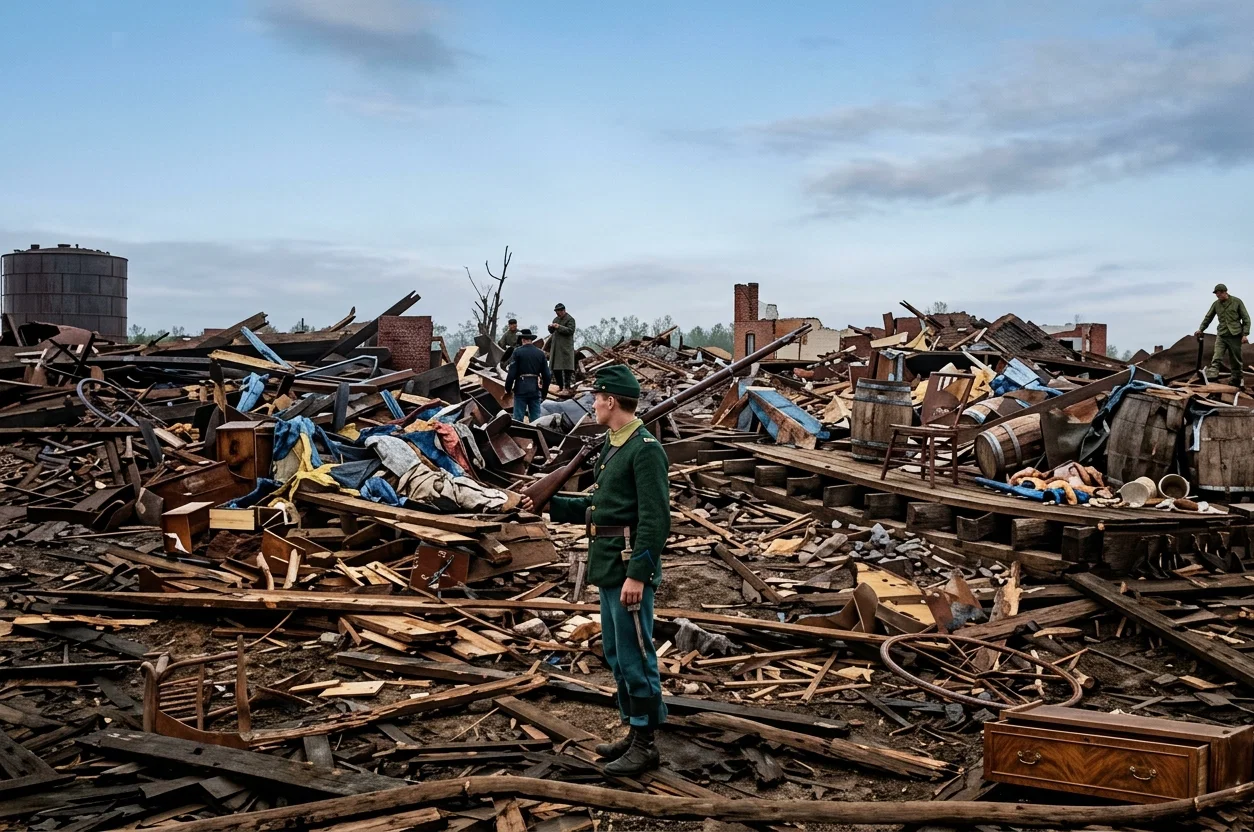
Another View in New Richmond after the Tornado of June 12.
And all this suffering of the poor animals comes in consequence of man's gratification of an unnatural appetite for flesh. Flesh foods are disease producing, and if man's nature was not perverted he would revolt at the thought of eating the quivering carcasses of dead animals. The abundant harvests of fruits and grains, and vegetables and nuts, furnish foods that give more physical and mental strength than flesh meats can possibly give, and then the morals are not depraved by the influences of bloodshed. For he who can learn to look with indifference on the suffering and slaughter of the animals, may learn to take the still further step of torturing and killing his fellow-men. T.
THE LACK OF BIBLE KNOWLEDGE.
By E. J. D.
It is passing strange to notice how little real interest the young people of to-day have in the Book of books. And yet, if we take into consideration the false ideals and systems of education that prevail, the result is not greatly to be wondered at. The following paragraph from the Youths' Companion shows the situation admirably:—
A pretty long bow was drawn the other day by the superintendent of education in a great city, when he told Rev. Dr. Huntington that among the children of school age in his jurisdiction there were one hundred thousand who did not know of the existence of such a book as the Bible. But it is probably no exaggeration to say that, taking the country through, there are millions who know very little of the Book of books beyond its name. College presidents testify that a large per cent. of college students are lamentably ignorant of the Scriptures. Sunday-school instruction does not go far, and the only safeguard against the heathenization of a part of our population seems to lie in a reviving sense of parental responsibility—a re-enthroning of religion in the family.
E. J. D.
LITERARY NOTICES.
FACING THE TWENTIETH CENTURY. OUR COUNTRY; ITS POWER AND PERIL. By James M. King, General Secretary National League for the Protection of American Institutions. 640 large 8vo pages, copiously illustrated, maps. American Union League Society, 156 Fifth Avenue, New York.
The scope of the book is indicated by the following titles of the parts in which the book is divided: “The Sources of American Republican Christian Civilization;” “American Institutions [the State, the church, the school];” “Anglo-Saxon and Latin Civilization;” “The Menace to American Institutions from Politico-Ecclesiastical Romanism;” “Powers to Protect American Institutions;” “Manifest Destiny;” and a most useful reference appendix, with a copious index. The book is a warning note against the dangerous intermeddling of the Roman Catholic Church in politics. The author has evidently endeavored to faithfully, clearly, point out the nation’s peril from Rome. He has bravely done his work. The book contains many things which should cause the Christian and patriot to pause and ponder. But, and we say it regretfully, we wish, O, how we wish, that Dr. King had discussed the matter of his book, the perils that menace America, from the only true view-point, the principles of true religious and political liberty and the natural rights of men. Of course this is the standpoint of the Gospel. It is the standpoint of true Americanism as set forth by the founders of this government. If Dr. King had done this, he would not only have seen a foe to liberty in Romanism, but foes to liberty in the politico-religious organizations among so-called Protestants. He would have seen in the clamor for “Sabbath laws” (never mind the day, that is not the question) the very principles of Romanism. He would have seen in the very nomenclature of the “American Sabbath” the “American church,” and kindred religio-political terms, the very principle of Rome. An evil principle is no better held by Protestants than it is if held by Catholics. We wish the author could see this. He would then oppose all religio-political movements, organizations, and institutions.
WHY MEN DO NOT GO TO CHURCH. By Cortland Myers, minister at Baptist Temple, Brooklyn, N. Y. 16mo, cloth. Price, 60 cents. New York and London; Funk & Wagnalls Company.
The author says in his introductory remarks: “There are many problems which need the mathematics of heaven for their solution, but none more so than the absence of men from our churches. More than one-half of the inhabitants of this country do not attend our churches to-day. There are millions of men in this country who have no connection whatever with the Christian Church. What are the forces in modern life which are the producers of this evil? If we discover the cause of the illness, we are more liable to furnish a cure. Let us be bold in our diagnosis, but patient and skilful and hopeful with the remedy; by all means save the men. Whatever has been said or written upon this problem has been usually a fragment of the truth, a segment of the whole circle.”
Mr. Myers has made an earnest study of the question, and he considers boldly under three heads, the faults of the church, the faults of the man, and the faults of society, urging at the same time cures for these faults. The book will repay a careful reading.
WHAT A YOUNG WOMAN OUGHT TO KNOW. The second volume to women by Mrs. Mary Wood-Allen, M.D., published in connection with the companion books to men, by Sylvanus Stall, D.D., under the joint title of the Self and Sex Series. Vir Publishing Co., 27 Hale Building, Philadelphia. 264 pages. Price, $1.00.
The book is divided into three parts: the first treats of the value of the body and its hygiene; the second of special physiology and the laws of maturity, and the third of love, engagements and marriage. The author brings to her task the training of a physician, the sympathies of a mother, and the character of a teacher who is discerning the higher ideals.
The chapters on the care of the body are simple, sensible, and practical, and the directions given have in mind one result, and that is the attainment and maintenance of good health. In treating the subject of special physiology, the author avoids technical medical terms, and tells the young woman of the physical laws governing her nature, how to obey them intelligently, and what penalties follow their violation.
When we first looked through the book we wished that every true mother in the land (and would there were one to every girl, if not her own, some other good mother) would take the book and in quiet holy hours read it with her daughter.
POEMS BY RICHARD REALF. Edited by Col. Richard J. Hinton, the poet’s intimate friend and literary executor. 12mo, cloth, deckle edges. Price, $2.50. New York and London; Funk & Wagnalls Company.
The life of Richard Realf was a sad, eventful one, full of storm and stress, hopeless and disappointing. He wrote none till nineteen; in 1857 he joined the John Brown movement, was a member of the famous Chatham convention, and then went to England and France to lecture for the benefit of the movement. During his absence the tragedy of Harper’s Ferry occurred. He afterward served five years in the army. He died by his own hand in 1878 in San Francisco, pursued to his death by a woman he had married, supposing his first wife to be dead. Some of his poems are equal to the best of the masters of song.
BABY’S FIRSTS. By Mary Wood-Allen, M. D. Price, 35 cents. Wood-Allen Publishing Company, Ann Arbor, Mich.
The aim of this little work is to teach mothers the first necessary things for the new-born child. These come under the head of “The First Bath, First Dress, First Bed, First Food, First Tooth, First Year, First Work, First Education, The Baby Who Must Travel, The Baby Who Must Stay at Home, The Ownership of the Child, Nervous Children.” Dr. Wood-Allen has told in a simple charming way what mothers ought to know. There are those who will get along without such directions, but they are few indeed who would not be greatly benefited by following them; at least the little ones would. It is an exceedingly useful little book.
THE NATURAL FOOD OF MAN AND HOW TO PREPARE IT. By Mrs. J. R. Leadsworth, Healdsburg, Cal. 40 pages, neatly bound in cloth. Price, 40 cents; paper, 25 cents. Address the author.
This little work contains more than 150 recipes for cooking the natural food of man so as to dispense with the use of meat, eggs, butter, and milk, and these articles do not enter into the recipes. How to cook (or make) grains, sauces, breads—leavened and unleavened—legumes, vegetables, nuts, fruits, is told concisely and clearly. “Food for the Sick” is treated by J. R. Leadsworth, M.D., a successful, conscientious and skilful physician, with 28 recipes of food preparations for invalids.
MY YOUNG MAN. By Rev. Louis Albert Banks, D.D. 12mo, cloth. Price, 75 cents. New York and London; Funk & Wagnalls Company.
This is a companion volume to “The Christian Gentleman,” by the same author, a book which has had a large sale. This book consists of a series of ten addresses to young men in their relationships as sons, brothers, church-members, members of society, lovers, husbands, citizens, to wealth, and to themselves. The aim of these addresses, or character studies, is to awaken in young men a love and respect for things that they are too apt to regard lightly. The reader may not always agree with the author, but the book is a helpful one to any young man.
July McClure’s contains the interesting articles: “The Unsolved Problems of Astronomy,” by Prof. Simon Newcomb, fully illustrated from recent telescopic photographs by Prof. E. E. Barnard and other eminent astronomers. “The Automobile in Common Use; What It Costs, How It Is Operated, What It Will Do,”—in short, the Automobile, or horseless vehicle, as we find it in actual service to-day. The articles are illustrated with pictures of all the more-important types now under trial.
Among the interesting articles in the July Cosmopolitan are: “The Building of an Empire—Omar,” by John Brisbaine Walker, “The Organization of a Home on $2.50 per Day,” and “What One Should Know about Swimming.”
Funk & Wagnalls Co., New York, announce that they have in preparation and will publish about the end of the present year the latest work of Dr. Parker, the “Pulpit Bible.” The size will be quarto; the Bible text will be in pica type, and the wide margins of the page will contain pithy, suggestive comments on the verses of the text. The practical value of these marginal comments is seen at a glance. The “Parker’s Pulpit Bible” is declared by those who have examined the work to excel both the “People’s Bible” and “Studies in Texts.”
Domestic
Domestic.—In the recent elections in Alaska, not a single town voted for prohibition. At Skagway the vote stood 460 for license and 68 against; at Juneau the vote was 401 to 40. Applications for saloon and brewery licenses are coming into the district court without protest from any quarter..... President McKinley has decided to enlist the full quota of the provisional army (35,000) allowed by law, thus increasing the whole military force to 100,000 men. This decision is based on the demand for more troops in the Philippines, where it is expected that 60,000 will be in the field by the close of the rainy season—the end of September..... The American proposition concerning the Alaskan boundary has been met by a counter proposal on the part of Canada, which bids fair to postpone a settlement for a long time..... A fight between white and colored miners, near Cardiff, Jefferson County, Ala., June 27, resulted in the death of three negroes and the serious wounding of two other participants..... Of the soldiers that left San Francisco on the Zealandia, June 22, for Manila, four companies were colored troops of the Twenty-fourth Infantry..... The anti-trust conference of governors and attorneys-general, proposed by Governor Sayers, of Texas, to be held at St. Louis, Mo., promises to be fairly well attended. Nineteen governors have promised to attend, and others will, if possible..... Treasury bureau statistics state that the exports of manufactures from the United States for the fiscal year just closed have averaged more than $1,000,000 for each business day, and for the first time in our history have exceeded the importations..... The Carnegie Company, of Pittsburg, has contracted to furnish the Russian Government with 180,000 tons of steel rails. The contract amounts to about $4,500,000. This amount of rails will lay from 1,300 to 1,600 miles of track, according to weight of rails. It is also stated that a representative of the Russian Government is likely to place a large order for ordnance with the American Ordnance Company, of Bridgeport, Conn..... A Washington despatch says: “The President has ordered that no copies of the complete report of the beef court of inquiry be printed at the Government Printing Office. Hitherto nothing but a synopsis has been published. The German embassador asked for ten copies to send to his government. The President saw that the report would be used to the detriment of the commercial interests of the United States, hence his order.”..... It is reported that the government is testing a new shell of very high explosive power at Sandy Hook, and that so far results have been quite satisfactory. It is claimed that it can be exploded at ordinary artillery range, and that its effect is most deadly. The government has guarded the secret of the new missile and expects to use it in the Philippine campaign..... Dr. Stone, formerly of San Francisco, writes from the Kotzebue country, in Alaska, that 1,500 men, who were attracted to that region by the glowing circulars of transportation companies, have found nothing but hardship and suffering. All the stories of gold discoveries were wholesale fabrications. Very few of these victims have the means to get back home, even if they had the opportunity, unless the government sends for them. Dr. Stone adds that “one-half of the terrible suffering of the people in this district has not been told.”..... U. S. Marshal Shoup, of Alaska, will investigate the cause of the death of eighteen passengers and crew of the steamer Jessie, who either perished in the wreck of the vessel or were massacred by Indians a year ago, on the Kuskokwim River.
Miscellaneous
Miscellaneous.—The prospect for active hostilities between Great Britain and the South African Republic is of interest to Americans because of the great number of Americans engaged in mining operations in the Transvaal. The cruiser Chicago, which was to have gone from Madagascar around Good Hope to Brazil, has put into Delagoa Bay, to look after American interests in case of war. It is said that President Kruger has recently sent some valuable presents to Pope Leo, expressing a desire that friendly relations should exist between the Vatican and the Transvaal, in return for which the pope has advised prudence in dealing with Great Britain...... The steamer Nippon Maru was placed under quarantine by the Honolulu board of health, June 18, because there had been a death aboard from bubonic plague, the victim being a Chinese passenger from Hongkong. Arriving at San Francisco, the vessel was again quarantined, and two Japanese who at-
Miscellaneous
tempted to escape, were drowned. These bodies were examined by the bacteriologist of the board of health and found to contain the bacilli of the bubonic plague. The bodies were cremated. .....
The International Council of Women was opened in London, June 26, by the Countess of Aberdeen, president. She introduced Mrs. May Wright Sewell, of the United States, vice-president, then a delegation of Chinese women, and afterward representatives of twenty-six nations. .....
The Antarctic exploring steamer is now in South American waters. When at Montevideo, Commander de Gerlache said that his expedition had been a success. Besides uncovering the Belgica Channel and discovering Dancoland, the expedition found many errors in British charts. They also found evidence that a continent exists in the Antarctic region, and found important flora and fauna. .....
The Secretary of State for the colonies of Great Britain states that the enormous military preparations of the South African Republic had necessitated the increase of the British garrisons in Cape Colony at an expense of $2,500,000 annually. .....
Affairs in Samoa have again been nominally settled. After being recognized as king by the joint commissioners of the three powers—the United States, Great Britain, and Germany—Malietoa Tanu abdicated in favor of the commissioners. They then appointed a provisional government, consisting of the consuls of the three powers. Their report recommends the abolition of the kingship and the presidency of Apia, and the appointment of a governor, with a legislative council nominated by the three powers, assisted by a native house of representatives. Chief Justice Chambers is to remain in office. Both of the hostile parties have surrendered their arms.
European
European.—Again there is friction between Great Britain and France,—this time it is caused by alleged violation of the Newfoundland fishery laws by French vessels......Riots occurred during the last week in June in several cities of Spain. At Saragossa, and also at Valencia, the troops fired into the mobs, wounding several people. Anti-budget demonstrations also occurred at Burgos, Toledo, and Logroño. Martial law was declared at Valencia and Grenada. ......A Rome despatch of June 25 says: “Serious riots have broken out at Ceccano, about fifty miles southeast of Rome, in consequence of a priest having excommunicated a parishioner for a private quarrel. The man defies and ignores the excommunication, and the priest has ceased holding mass. The commune is divided into rival factions, and already several men have been killed. Troops have been sent to occupy the town.”......A London despatch says: “Famine in seven provinces of east European Russia is sinking the wretched peasantry deeper and deeper into misery. They need about a penny a day to live on, and there are not nearly enough pennies to go around, for in a population of 11,000,000, more than 5,000,000 are hungry every hour of their lives. Actual starvation in the afflicted territory is said to be immeasurably worse than the famine of 1891-92.”
European
..... Captain Dreyfus, of the French army, who has been in solitary confinement on Devil's Island for over five years, on a charge of furnishing information concerning military affairs to the German Government, and who has been granted a new trial, was landed in the night of June 30 at Quiberon, France, and secretly taken to Rennes, where he was safely secured in prison. The prisoner's wife was granted a half hour's audience with her long-absent husband.
......At the opening of the municipal council of Badalona, Spain, on the 1st inst., a crowd assembled on the outside of the building, and shots were fired into the council chamber, killing three of the councilors.
Casualties
Casualties.—The bark Rufus E. Wood, ninety-nine days from Sydney, Australia, recently arrived in San Francisco. The captain reports that on April 2 a severe earthquake shock occurred at sea. It was a hot, sultry day, and the sea was almost still, when there was a sudden jar of the vessel, as tho it had struck a reef. Then the bark rocked and shivered, and all hands were called on deck; but it was soon discovered that there was no material obstacle in the way, and evidently an earthquake had caused the commotion......A tremendous waterspout in the Pine Ridge region, South Dakota, June 24, extended over thirty miles and caused great destruction of crops, besides damage to bridges, highways, live stock, and farm improvements......The old town of Carrizo, Zapata County, Texas, has been swept away by a flood of the Rio Grande. The town had a population of several hundred, mostly Mexicans of the poorer class, and the houses were nearly all adobe. The river is said to be higher than at any time in forty years......A fire causing $200,000 damage occurred at Laurel, Del., on the 24th inst. Seventy-eight houses were consumed, including two hotels, a bank building, and the post-office.......A storm struck the town of Bradley, Neb., on
Casualties
the 25th ult., totally wrecking a large brick building and a frame structure containing the post-office. Other buildings were damaged, the ground was torn up in places, and several head of stock were killed. ..... Advices from San Diego, Cal., report a shocking tragedy in connection with the rush to the gold mines in the Sierra Pintada, whose richness has proved to have been greatly exaggerated. The report is that a party of sixty prospectors, having lost their way, perished from thirst, and their bodies had been found by other wanderers. ..... Recent floods in western Texas have damaged the Southern Pacific tracks and bridges to the extent of $400,000.
Oriental
Oriental.—Since the introduction of the trolley in Corea, several children have been run over and killed in Seoul. The people, to the number of several hundred, burned one car and smashed another. The Japanese and European engineers narrowly escaped death. The ignorant people attribute the drought, which has continued for some time, to the construction of the electric railways,.....The Chinese Government has interdicted the export of rice from the Wuhu district, for the alleged reasons that China is on the eve of war, and the requirements of the people will not justify the exportation of this staple product.....Several important ports in the Philippines have been opened to trade, including San Fernando, on the west coast of Luzon; Aparri, on the north coast; Currimao, and all ports on the islands of Samar and Leyte. This revival of business will greatly relieve the stagnation in trade and the consequent hard times.....The greatest obstacle in the way of establishing a republican government in the Philippines is the difficulty in enforcing the “consent of the governed.” The effort is costing the United States about $300,000 a day. Besides the money expense, something over 700 lives have been sacrificed, and nearly 7,000 men have been wounded or invalided by disease. It is stated that General Otis recently received a letter signed by native women of the province of Cavite, declaring that if all the men were killed the women would still keep up the fight against the Americans.....An armed band of Chinese sacked and burned the French Consulate and Chinese custom-house at Meng Ting, Hunan Province, June 22. Consul de la Batie and the foreign staff at the custom-house escaped, but had to flee from Hunan....General King, who recently returned from the Philippines, says that the Filipinos are far better qualified for self-government than the Cubans, or the uneducated negroes of the South who have been granted citizenship.
COOK WANTED.
Seventh-day Adventist, single man, one who has a burden for lost men; good chance to develop in the present truth. Address,
HELPING HAND AND MEDICAL MISSION,
641 Commercial Street, San Francisco, California.
Lady Agents Wanted
LADY AGENTS wanted at once, to handle Health Garments. Will give credit to those that can furnish references. Send for catalogue to W. S. DANN, 1515 Burt St., Omaha, Neb.
RETURN OF THE JEWS
The question as to whether or not the Hebrew nation will be reunited and return to Palestine is one that interests a great many people, and one that should be thoroughly understood.
We have in press an illustrated treatise on this question by Henry P. Holser, who has spent several years in the Orient, and who is thoroughly conversant with the subject in all its bearings. It will be ready soon.
Its title is
The Return of the Jews
Price will be $2.00 per 100
Advance orders solicited
PACIFIC PRESS PUBLISHING CO., Oakland, Cal.
39 Bond Street, New York City
18 West 5th Street, Kansas City, Mo.