In our last article we showed, by an unbroken chain of Scriptural facts, that the Sabbath given to Adam in Eden before his fall is the only recognized day of rest in all the Bible. We noticed also that in the great hereafter the Sabbath will be kept by all the redeemed hosts of God when "from one Sabbath to another, shall all flesh come to worship before Me, saith the Lord." Isa. 66:23. From these facts, therefore, it must be clear to all that in God's plan and purpose no change of the Sabbath was anticipated. But that the world at large to-day is observing the first instead of the seventh day is apparent to all. We are led to inquire, then: When, why, and by what power was the change brought about? Was it authorized by Heaven, or is its source earthly? We wish to give some bits of historical facts relative to this question.
An examination of the eight texts of the New Testament where the first day of the week is referred to will evidence the fact that there was no transference of the sabbatical institution from the seventh to the first day. Six of those texts simply refer to the fact that Christ was raised from the dead on the first day of the week. But a careful reading of the context in these cases will make it clear that the Sabbath was the day just previous to the first day. We will notice the one text in Luke. The 23d chapter, the last verses, gives us the account of the events in connection with the burial of Christ. After He was taken down from the cross, Friday afternoon, and laid in Joseph's new tomb, the women returned to their homes, prepared spices and ointments, "and rested the Sabbath day according to the commandment;" then, "upon the first day of the week, very early in the morning, they came unto the sepulcher, bringing the spices which they had prepared." Thus we have the Sabbath according to the commandment, which says, "The seventh day is the Sabbath of the Lord thy God," wedged in between Friday, the crucifixion day, and Sunday, the resurrection day. The Lord has thus in His Word made it clear beyond contradiction as to which is the Sabbath. Read Luke 23:50 to 24:1.
The New Testament, having been written by and for Christians, should record a change of the Sabbath if it is of divine authority. But any such record is conspicuously absent. "Where no law is, there is no transgression." We herewith append a few statements from eminent sources of authority:
There is no express commandment for observing the first day of the week as a Sabbath, and yet it is almost of universal custom.—Lee's Theology, page 562.
The Scripture nowhere calls the first day of the week the Sabbath. . . . There is no Scriptural authority for so doing, nor of course any Scriptural obligation.—Watchman (Baptist).
The current notion that Christ and His apostles authoritatively substituted the first day of the week for the seventh, is absolutely without any authority in the New Testament.—Lyman Abbott, in "Christian Union," January 19, 1882.
It is true that there is no positive command for infant baptism, . . . nor is there any for keeping holy the first day of the week.—Dr. Binney, M. E. Theological Compendium, page 103.
Edward T. Hiscox, author of the Baptist manual, in an address before a Baptist ministers' meeting in New York City, and reported in the Examiner, November 16, 1893, said:
To me it seems unaccountable that Jesus, during three years' intercourse with His disciples, giving them instruction as to His kingdom, constantly coming in contact with the Sabbath question, often discussing it in some of its aspects, freeing it from its false glosses, and teaching its true nature and purposes, never alluded to the transference of the day; also that during the forty days of His resurrection life, no such thing was intimated. . . . Of course I know that Sunday did come into early Christian history as a religious day, as we learn from the Christian fathers and other sources. But what a pity that it comes branded with the mark of paganism, and christened with the name of the sun-god, when adopted and sanctified by the papal apostasy and bequeathed as a sacred legacy to Protestantism.
There was and is a commandment to "keep holy the Sabbath day," but that Sabbath was not Sunday. It will, however, be readily said, and with some show of triumph, that the Sabbath was transferred from the seventh to the first day of the week, with all its duties, privileges, and sanctions. Earnestly desiring information on this subject, which I have studied for many years, I ask, Where can the record of such a transaction be found? Not in the New Testament—absolutely not. There is no Scriptural evidence of the change of the Sabbath institution from the seventh to the first day of the week.
Much more and many other quotations might be given, from different church leaders of all denominations, admitting that the New Testament absolutely does not sanction the change of the Sabbath from the seventh to the first day.
If the Bible does not authorize the change of the Sabbath, it must have been made by some apostate power. We will now call the attention of the readers to a few facts relative to this question. The first Sunday law ever enacted of which history gives us any account was the edict of Constantine, 321 A.D., which provided, "On the venerable day of the sun let the magistrates and people residing in the cities rest, and let all workshops be closed."
To this historical fact agrees Alexander Campbell in an address in Bethany College in 1848:
Was the first day set apart by public authority in the apostolic age?—No.
By whom was it set apart, and when?—By Constantine, who lived about the beginning of the fourth century.
Perhaps the only reason that can be assigned for this act on the part of Constantine was that he desired to please his pagan subjects, so made this law favorable to the "venerable day of the sun," "the wild solar holiday of all pagan times." It was an edict establishing the sun-day in the Roman Empire above the Sabbath of the Lord.
Later the Catholic Church, in her councils, ratified the action of the pagan emperor, and finally went so far as to style Sunday the Lord's day, while the Bible teaches us that "the seventh day is the Sabbath of the Lord thy God," and Christ in His earthly life said that He is "Lord of the Sabbath." Mark 2:27, 28. But does the Catholic Church admit the fact of her having tampered with the Sabbath question? A few authoritative statements from standard Catholic works will suffice in evidence upon this point. First it might not be out of place to state that the prophet Daniel, who foretells of the work of this apostate power, says that it would think to change the times and the laws of the Most High. See Dan. 7:25.
Question. What warrant have you for keeping the Sunday, preferably to the ancient Sabbath, which was the Saturday?
Answer. We have for it the authority of the Catholic Church and apostolical tradition.—The Catholic Christian Instructed, page 202.
Question. How prove you that the church hath power to command feasts and holy days?
Answer. By the very act of changing the Sabbath into Sunday, which Protestants allow of; and therefore fondly contradict themselves, by keeping Sunday6holy strictly, and breaking most other feasts commanded by the same church.
Question. How prove you that?
Answer. Because by keeping Sunday they acknowledge the church's power to ordain feasts, and to command them under sin: and by not keeping the rest by her commanded, they again deny in fact, the same power—The Abridgment of Christian Doctrine (Catholic), page 58.
Many other quotations from this source could be given showing that the Catholic Church admits the change as an act of her authority, but time and space forbid more. Should not the above facts cause each Protestant to examine anew the foundations of his faith and practise? Christ says, 'In vain they do worship Me, teaching for doctrines the commandments of men,' and further, 'Every plant, which My heavenly Father hath not planted, shall be rooted up.' The Sunday institution is a commandment of man. It is a plant that the heavenly Father has not planted. Shall we root it up in our lives and practise, and come into harmony with the commandment of God? 'Remember the Sabbath day, to keep it holy. Six days shalt thou labor, and do all thy work: but the seventh day is the Sabbath of the Lord thy God: in it thou shalt not do any work.' Which day will you, dear reader, observe, the day that God has given and made holy, or the day given by an apostate power? All must choose. Let us decide in the light of this text: 'Blessed are they that do His commandments, that they may have right to the Tree of Life, and may enter in through the gates into the city.' Rev. 22:14.
GAIN and again we read of the prediction of scientists that the world will come to an end; that there lies beyond the sin and sorrow, the perturbations, the abnormal conditions, of this world, a great blank void of darkness and death and oblivion. Either the world will turn into a frigid ball, which will go roaming on forever in the great void of the universe, or else it will burn up by concussion with some other heavenly body. But this is not God's plan. We have been brought through the great drama of sin and righteousness, the great controversy between these antagonistic principles, in our studies in the Revelation, until we have come to the end — God's end, so to speak, the thither side of the great gulf, or chasm, which sin has made in God's universe; the glorious outcome to which the prisoners of hope have looked with longing, eager eyes through all the ages, that hope which has cheered the mourner as he has laid his loved one in the grave, cheered the poor, toiling slave who had found freedom in Christ, cheered the martyr dying at the stake, cheered men in the common, every-day toil of life. Their hopes built in Christ Jesus will all be consummated, and our lesson of this week is the beginning of that consummation. Let us —
Question the Text
1. What new vision was given the prophet?
And I saw a new heaven and a new earth: for the first heaven and the first earth are passed away; and the sea is no more. Rev. 21:1. Note 1.
2. What did he then see?
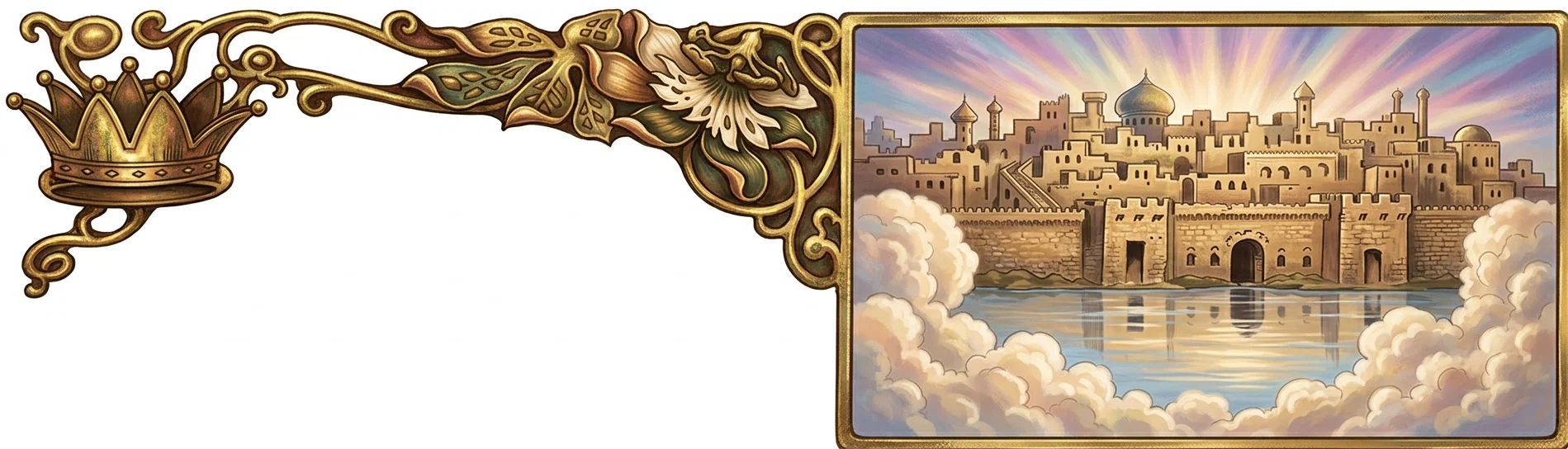
And I saw the holy city, New Jerusalem, coming down out of heaven from God, made ready as a bride adorned for her husband. Verse 2. Note 2.
3. What did he then hear?
And I heard a great voice out of the throne saying, Behold, the tabernacle of God is with men, and He shall dwell with them, and they shall be His peoples, and God Himself shall be with them, and be their God. Verse 3. Note 3.
4. What happy conditions would result from God's dwelling with His people?
And He shall wipe away every tear from their eyes; and death shall be no more; neither shall there be mourning, nor crying, nor pain, nor more: the first things are passed away. Verse 4. Note 4.
5. What marvelous change takes place?
And He that sitteth on the throne said, Behold, I make all things new. And He saith, Write: for these words are faithful and true. Verse 5. Note 5.
6. What wonderful invitation is given in connection with this?
And He said unto me, They are come to pass. I am the Alpha and the Omega, the beginning and the end. I will give unto him that is athirst of the fountain of the water of life freely. Verse 6. Note 6.
7. What is said of the overcomer and the opposite class?
He that overcometh shall inherit these things; and I will be his God, and he shall be My son. But for the fearful, and unbelieving, and abominable, and murderers, and fornicators, and sorcerers, and idolaters, and all liars, their part shall be in the lake that burneth with fire and brimstone; which is the second death. Verses 7, 8. Note 7.
Note and Comment
1. NEW HEAVEN AND A NEW EARTH. — This earth was once new. If it had never been blasted by sin it would have remained new forever. When it came from the hand of God it was pronounced very good. Deity could see no fault in it, as the home of man; and if sin had never entered, there would have been poured out upon it continually from the fountain of life, great streams of vitality and fertility, which would have forever kept it young. And those who dwelt upon it would have had a life paralleling that of the earth, because "in the way of righteousness is life, and in the pathway thereof there is no death." But sin came in, God's law was perverted, and the perverted law of righteousness became sin in man; and the life which from the fountain flowed through that sinful channel, itself became perverted; and as perverted righteousness is sin, so perverted life becomes death, and man became a dying being, and the earth a dying planet. Through God's goodness it has been kept alive through all the ages. Ever and again He has given us evidences that it is sick, fearfully so. All the mighty, distressing, destructive storms which sweep over its surface show that conditions are abnormal. All the mighty earthquakes which have ruptured and torn it reveal that the disease of sin has been preying upon it. The belching volcanoes reveal the inward fire of the fever of the auto-intoxication of the earth. Sometime that fever will have run its course. The earth will have demonstrated to the whole universe the exceeding sinfulness of sin. God's presence will again be manifested in its glory to the earth; the old earth shall be set on fire to its very foundations, purified and purged. For that purpose God has reserved it, so that the last of earth's abnormality perishes with the last of sin and death. "But the day of the Lord will come as a thief; in the which the heavens shall pass away with a great noise, and the elements shall be dissolved with fervent heat, and the earth and the works that are therein shall be burned up. . . . But, according to His promise, we look for new heavens and a new earth, wherein dwelleth righteousness."
We learned in our previous studies that God created not the earth "in vain, He formed it to be inhabited." Isa. 45:18. And every demonstration that God has given in the regeneration and re-creation of the sinful soul, is a pledge that the same power will change the sinful earth, and make it new. The first heaven and the first earth means the earth as it is now. The earth in its present condition will pass away.
AND THE SEA IS NO MORE. — In the study of the first chapter of Genesis, it would seem that the earth was divided between land and sea — one body of land, one body of water, evidently very much smaller than we find at the present time. Some of the high, mighty mountains did not then exist. There was more land surface and less sea surface. When sin entered the world, the existence of the sea became necessary as a sanitary measure. The great, salt sea is a blessing to the old, sinful earth; but when the earth is restored to its normal condition, the uninterrupted currents of life will do away with the necessity of the salt sea.
2. THE HOLY CITY. — The holy city is the capital of the new earth. It has been before referred to in chapter 19:7, 8; 20:9. The prophecy of Revelation 19 refers to the city in heaven. Rev. 20:9 refers to the city as it first descends upon the plain made and sanctified by Christ's feet, according to Zechariah 14. That and the subsequent judgment are passed over in the 21st chapter, when John sees the holy city again descending, made ready as a bride adorned for her husband. The kingdom belongs to Christ. The earth is His by creation and purchase. Men are the children of earth; the earth is the great mother of the earth-children. The new Jerusalem, as the capital of the earth, represents the entire earth, and is therefore said to be the Lamb's bride. All those who will inhabit that new earth are begotten from above. While they are the children of the earth, they are also children of God. Isaiah, looking forward to that time, in speaking of that city, declares, "Thou shalt no more be termed Forsaken; neither shall thy land any more be termed Desolate: but thou shalt be called Hephzi-bah, and thy land Beulah; for Jehovah delighteth in thee, and thy land shall be married." And the thought is carried still farther, that God's children will receive inheritances in that new earth, and so they are spoken of as marrying the land; that is, the inheritance of the kingdom comes to them likewise. See Isa. 62:1-5. And this explains why it is that Christ, the Son born, is called the "everlasting Father." Isa. 9:6. And Jerusalem which is above is said to be "the mother of us all." Gal. 4:26. The adornment of that bride is her own children, clothed in righteousness. Rev. 19:8.
3. BEHOLD! — The voice comes from the throne of God. A new thing is announced, something that earth in its sorrow has never known. The tabernacle, the dwelling-place, of God is with men. God is to dwell with His children; the High and Lofty One that inhabits eternity, dwells in the heart of the humble and the contrite. Isa. 57:15. He dwells in His church by dwelling with her children, but His throne has never been placed among men with Himself and His glory visible upon it. He has not walked among men without a dimming veil between. Sinful, mortal men could not endure the sight. But that time has now come when, cleansed from everything of sin,7man can behold the face of God, and the blessing pronounced by our Lord can be demonstrated in all its fulness: "Blessed are the pure in heart: for they shall see God." They shall look upon His face and rejoice. "The tabernacle of God is with men, and He shall dwell with them, and they shall be His peoples, and God Himself shall be with them, and be their God." What glorious honor is coming to this old earth! Here has been wrought out the great problem of sin for the universe. Here the Son of God lived and suffered and died, gave demonstrable proof of the mighty, hoarded love of the Creator for His sinful children. Here the mighty grace of God has been manifest in the changing of the earth, crushed by sin, into a glorious home for the redeemed. And here, also, will that redeemed host, saved from all the power of the enemy, shine forth as the stars in the kingdom of their Redeemer. Why should not also the throne of God be here? Jethro, in referring to the work of God with the Egyptians, declared that wherein the gods of Egypt "dealt proudly," the Lord, "was above them;" and it will be sung through all the universe of God, that wherein Satan and all his minions dealt proudly, the Lord was above them. His grace has abounded above the sin.
4. AND HE SHALL WIPE AWAY EVERY TEAR. — What a glad day it will be! A thousand years in heaven does not bring that. We can well believe that as the saints of God sit in judgment during that period of time, there will be tears shed over the course of those who had it within their power to turn to God, and yet who took the other course. They will see how those who were almost delivered by Christ, turned again to the enemy, and were enchained by him. Doubtless they will shed tears of sadness as they examine the records; and yet they will see in all things that God is just. And the conclusion of that judgment work will demonstrate that Infinite Love did that which was best, even for the sinner, and best for the universe. All tears shall be wiped away. Death has been destroyed in the lake of fire; it shall be no more; no sad funeral trains will wend their slow and mournful way over the highways of the new earth. There will be no silent cities of those who sleep in death. Men will build no mausoleums, nor throw those who die from pestilence by the multitudes into huge trenches. Death is forever past. There will be no mourning, no mourning garbs, no crape upon the door, no hearse, no sad fathers or mothers, wives or husbands, children or parents. Every tear is wiped away. There will be no crying nor pain any more; the first things are passed away. The Christian heart that has been touched by Jesus Christ, knows a little of what that means; he has received the earnest of it in his own experience. "Wherefore if any man is in Christ, he is a new creature: the old things are passed away; behold, they are become new." And so the old things of earth will forever pass away. How every true heart ought to long for that time!
5. BEHOLD! — Another new thing is to be seen. We are told who it is that will work the wonderful change; it is He that sits on the throne. "I make all things new." And then, for fear that some one would yield to the suggestion of the skeptic, that all this is poetical, or visionary, He emphasizes it all by saying, "These words are faithful and true" — not that His words are not all faithful and true; but He would have men understand that despite all that unbalanced science has said,
all these things promised of God will come to pass. Science never takes into consideration the great fact of sin. Evolution does not take into consideration the fact of sin; consequently they are bound to go astray. God recognizes it as a great fact; but towering high above that fact, is the great power of His grace, and the glory of that grace makes all things new.
6. THEY ARE COME TO PASS. — It will not forever be a future thing. There will come a time, after the judgment of sin is past, when it will be a great present fact; they are come to pass. The Alpha and the Omega, the beginning and the end, has completed the work, has solved the problem of sin; but now, before that time shall become present, He pleads with every soul upon earth who is athirst for something better than earth can give, to come and drink of the fountain of life. He gives it freely; it is open to all. No cordon of priests, or pontiffs, or councils can bar men from that free-flowing fountain. It is open for every soul. Drink and live.
7. HE THAT OVERCOMETH . . . BUT THE FEARFUL. — It is the last division between the two classes: on the one side those who have trusted in the Lord Jesus Christ; on the other, those who have rejected His words — those who have been fearful that He could not, would not, do as He promised; those who would not believe; those who have been abominable in their deeds of wickedness; those who have taken life, and loved hatred; those who have trampled underneath every righteous law; and those who have been false to every principle of truth, — all shall have their part in the lake that burns with fire and brimstone. In choosing sin, they have chosen that; in rejecting God by faith, they have said that "we are gods ourselves;" but when the glory of God shall set on fire the very foundations of the earth, they shall perish in it. That is the second death. But the overcomers, those who in their insufficiency have trusted the great God, shall inherit these things — the new heavens and the new earth — heirs with God, and joint heirs with Christ; and of every one of those God declares, "I will be his God, and he shall be My son."
With My Lord Content
Trusting God has planned my lot,
Knowing that He changes not,
I am satisfied to dwell,
If for Him, in prison cell;
Or in palace grand, sublime,
If He's with me all the time;
Dear the humble cot as well,
If His presence there doth dwell,
Should dread penury embrace,
I will still trust in His grace;
Whether road be rough or smooth,
Trusting still, by faith I move;
Tho good or ill men may say,
With my Saviour I will stay;
And my Lord I'll walk beside,
Fearing naught that may betide.
Saving faith in God, I ween,
Naught my soul can come between.
Thus you see my heart is bent,
With my Lord, to be content.
—Selected.
A Gathering and a Supper
By H. A. St. John
Gather yourselves together, yea, gather together, O nation not desired; before the decree bring forth, before the day pass as the chaff, before the fierce anger of the Lord come upon you, before the day of the Lord's anger come upon you. Seek ye the Lord, all ye meek of the earth, which have wrought His judgment; seek righteousness, seek meekness: it may be ye shall be hid in the day of the Lord's anger. Zeph. 2:1-3.
THE above prophetic exhortation is the Old Testament version of both the Laodicean message (Rev. 3: 14-21) and the great threefold message (Rev. 14: 6-12). The wrath of God is filled up in the seven last plagues. These are hanging over a guilty world now, only waiting for the remnant church to gather themselves together by seeking the Lord, seeking righteousness, seeking meekness, opening the door of the heart and letting Jesus in to sup with them and they with Him. Then when the gathering call has done its work, when the remnant church, as overcomers, are hid with Christ, in the secret of His pavilion, supping with Him, then will the decree go forth, "He that is unjust, let him be unjust still: and he which is filthy, let him be filthy still: and he that is righteous, let him be righteous still: and he that is holy, let him be holy still." Rev. 22: 11.
Then will the fierce anger of the Lord come upon all who are not hid, and they will cry bitterly for rocks, mountains, anything, to fall on them and hide them from deserved wrath. Before the decree went forth was the time to find the only shelter.
Not less than four times the prophet uses the word "before," thus making it very emphatic that now, in the gathering time, is the only time when we may obtain the "gold tried in the fire," the "white raiment," the "eye-salve," the righteousness and meekness that will be our shield and covering in the day of wrath. And O, who can describe the preciousness and sweetness of that communion with Christ represented by supping with Him, and He with us! Reader, be not deceived. Seek the Lord, seek righteousness, seek meekness, and rest not till you have found the Lord, and received Him as your constant guest and guide.
H. A. ST. JOHN.
The Most Illustrious Seventh-Day Adventist
By G. W. Reaser
By G. W. Reaser
THIS question was raised by the Pharisees of old, relative to the doctrines taught by Christ: "Have any of the rulers or of the Pharisees believed on Him?" John 7:47, 48.
From the fact that the world's so-called "great men" are not measured according to God's standard of greatness, we do not admit the above question as worthy of consideration in making the vital decision as to "what is truth," or in settling the question as to "what church cherishes God's truth," unless our precedent be taken solely from men who meet God's standard of greatness and righteousness: for the vast majority of the world's great men do not cherish truth, and therefore do not choose to make the necessary sacrifice in order to identify themselves therewith.
There is a sense, however, in which this inquiry concerning the attitude of great men toward a certain thing, is vital and well worth weighing in making the important decision as to where we will seek to place our church-membership.
The truly great men of all times, are those who have had the fullest approval of Heaven as regards their acceptance with God, and through whom God has spoken by the Holy Spirit, in writing His Word,—
the Bible,—and in serving as His messengers.
This list would include Enoch, Noah, Abraham, Moses, Samuel, David, Isaiah, Jeremiah, Ezekiel, Daniel, and all other true prophets, also Matthew, Peter, James, John, Paul, and all the rest of the apostles, save Judas.
Now let us suppose that the question to be decided, is the claims of the Sabbath of Jehovah upon us, as opposed to the keeping of Sunday, as a sacred day: for many to-day are brought face to face with the making of this important decision.
Where will we take our stand, if we are influenced, in making our decision, by the only truthful answer to the following question: "With which of these two institutions, the Sabbath or the Sunday, did the above list of great and good men identify themselves?" There can be but one truthful answer to this inquiry. Every honest Bible student must admit that all of these "worthies" were Sabbath-keepers. None of them were Sunday-keepers. Not one of them ever wrote a single line to teach or to support the holiness of Sunday above other days of the week.
The Greatest of All
But we have yet to cite the most illustrious of the great and good men who have been Sabbath-keepers, or, in fact, who were Seventh-day Adventists. This Person is none other than Jesus Christ, the Lord of Glory. The fact that He was a Sabbath-keeper, is indisputable; for in coöperation with Jehovah, He made, kept, sanctified, and blessed the first Sabbath of this world's history, with the first man, in Eden. Gen. 2:1-3 with John 1:1-3. And because He established it "for man"—for the race—in Eden, He said, "Therefore the Son of Man is Lord also of the Sabbath." Mark 2:28. He kept the Sabbath perfectly while He lived as a man among men. John 15:10.
He was and is an Adventist, because in conjunction with the Father, He is the Author of the advent. It is His coming which makes, or, better, which is the advent, in which event our hopes are centered.
Being, therefore, the Author, both of the seventh-day Sabbath and of the advent, He is, beyond controversy, a Seventh-day Adventist; and being by inherent right as well as in character the Pre-eminent One, "the One altogether lovely," among all the sons of Adam's race, we can safely take Him for our example in all things. He was the most illustrious Seventh-day Adventist.
As, therefore, from all Bible revelation, from Eden until the second advent of our Lord, all the great men who meet with the full approval of Heaven must be Sabbath-keepers, the question as to whether the truly great men of all time have been Seventh-day Adventists, throws all its weight of precedent in deciding where to identify ourselves in church fellowship, in favor of casting our lot with those who "keep the commandments of God, and the faith of Jesus." Rev. 14:12.
Every Bible character who met the approval of Heaven, was in fact, if not in name, a Seventh-day Adventist.
And surely, in choosing companionship,—church fellowship,—the illustrious company of prophets and apostles, with Jesus Christ as their living Head, are not to be despised. It can not be an objectionable fellowship9to be identified with Jesus in Sabbath-keeping, but rather, a blessed privilege, a holy communion.
Does this fact give occasion for boasting on the part of Seventh-day Adventists?—By no means, but rather for deep humility, and profound thanksgiving for the unspeakable privilege of being associated with the Saviour of men in Sabbath-keeping and in giving the advent message to the world.
It is true that men both great and good have been Sunday-keepers; but, lacking the full light of truth, in this they did not follow the example of Christ.
We are all more or less prone to follow the example of great men. Why not follow—and especially in those things which pertain to our eternal peace—the example of the truly great, Heaven-approved men?
What a striking contrast between following Christ in Sabbath-keeping, and in obeying the Papacy in Sunday-keeping! for the Papacy claims the honor (?) of setting apart Sunday as a holy day. Jesus is the sinless Man, the Law-keeper. The Papacy is the lawless one, the law-changer and law-breaker. Who would care to follow such authority?
And now this question of keeping, with our living Head, the true Sabbath, confronts each of us, and each person must decide it for himself. We can not escape the issue; for the message is even now being proclaimed "to every nation, kindred, tongue, and people." Rev. 14: 6-14. There is both absolute safety and profound obligation in following the example of the Crucified One in Sabbath-keeping. "He that saith he abideth in Him ought himself also so to walk, even as He walked." 1 John 2: 6.
There Is Time
By Eliza H. Morton
By Eliza H. Morton
There's time, ah, yes, there's time enough
For what is near the heart.
That which we really want to do,
Of life becomes a part.
We say, "No time," when burdens press,
And let the chance go by
To cheer a lonely, weary soul,
To check a homesick sigh.
There's time; it takes not long to speak
A word, not long to give
A smile, not long to clasp a hand.
Then sweet 'twould be to live.
We never see the tears concealed,
We never know the pain
We might have eased, unless it comes
In circles back again.
There's time for all that's noble, true,
Tho time is on the wing;
But ah, there're things forever gone
That time can never bring.
But time will heal what sin has marred;
And in the future days,
For us it is to reflect Christ
In all our words and ways.