HOW are you wearing this life away? Are you care-free and reckless, not believing in eternal life, and saying to yourself, “This is all of life, and when I am dead some one else will take my place, and so on and on to eternity”? If this is the case, my dear friend, let me ask you a few questions. What do you think of the Bible? And what better book can you give me in exchange? And do you believe it to be the Word of God?
“O,” you will say, “some of it is all right.” Now why should parts of the Bible be all right, and others not? Either ALL is fake, or it is all good. Can not God, the Creator of all things, protect His own Book, His Word, so that it should not be corrupted or perverted?
I tell you, dear reader, it is Satan putting these doubts into your heart. Do you listen to him? He is a liar. Did he not lie to Eve when he told her that she would not surely die even tho she disobeyed God and ate of the forbidden fruit? Satan now speaks in your heart and tells you not to partake of the fruit of life—not to believe on our Lord Jesus Christ, lest you should be converted and live. If he deceived our first parents, who were pure of heart and innocent of mind, how much more can he deceive us, who are spiritually blinded, and inclined to sin and unrighteousness?
Satan is ever present with us. We may say that God is at our right hand, while Satan is close beside us on the left. He puts evil desires into our hearts, puts doubts into our mind concerning good things, is quick to throw obstacles into our path when we would do good, and stirs our anger every time we allow him to rule our disposition.
One thing we must realize: we are sure to serve ONE master. Either God is our Master to righteousness and glory, or the devil is our master to unrighteousness and condemnation. We are destined to be either a blessing or a curse. We can not stop at a certain degree of evil; we keep going down, down, to the bottomless pit, or else we are advancing in the divine life.
Reader, on which side are you? This is no trifling question. On it depends our future life. Jesus said, “Enter ye in at the strait gate: for wide is the gate, and broad is the way, that leadeth to destruction, and many there be which go in thereat.” Matt. 7:13. Read how entreatingly the Lord pleads with you: “Come now, and let us reason together, saith the Lord: tho your sins be as scarlet, they shall be as white as snow; tho they be red like crimson, they shall be as wool.” Isa. 1:18.
Then come to Jesus! Cast your burden of sin at His feet. He will not turn you away. No sin is so great that the Lord can not pardon. Jesus said, “They that be whole need not a physician, but they that are sick.” Matt. 9:12. Take Him at His word. Come to Him to-day. Give yourself up to do His will, “which is our reasonable service;” and when Jesus comes with ten thousand of His saints, He will say to you, “Come, ye blessed of My Father, inherit the kingdom prepared for you from the foundation of the world.” Matt. 25:31-34.
The New Earth
1. For what purpose does the Lord say He created the earth?
For thus saith the Lord that created the heavens; God Himself that formed the earth and made it; He hath established it, He created it not in vain, He formed it to be inhabited: I am the Lord; and there is none else. Isa. 45: 18.
2. What class of people did the Lord design should inhabit the earth?
Blessed are the meek: for they shall inherit the earth. Matt. 5: 5.
3. What does the psalmist say will be the lot of the wicked when the “meek” come into their inheritance?
Cease from anger, and forsake wrath: fret not thyself in any wise to do evil. For evildoers shall be cut off: but those that wait upon the Lord, they shall inherit the earth. For yet a little while, and the wicked shall not be: yea, thou shalt diligently consider his place, and it shall not be. But the meek shall inherit the earth; and shall delight themselves in the abundance of peace. Ps. 37: 8-11.
NOTE.—From the foregoing texts we learn that the purpose the Lord had in creating the earth was that it might be “inhabited.” And since that was His purpose, He has determined that His work of creation shall not have been in vain. The “meek” persons are those who are to be the dwellers in the earth, and they are to delight themselves in the abundance of peace; but this abundance of peace will have to be brought about by the cutting off of the wicked.
4. Is the earth in its present condition to be the eternal home of the “meek” amid the delights of the abundance of peace?
And I saw a new heaven and a new earth: for the first heaven and the first earth were passed away; and there was no more sea. . . . And God shall wipe away all tears from their eyes; and there shall be no more death, neither sorrow, nor crying, neither shall there be any more pain: for the former things are passed away. And He that sat upon the throne said, Behold, I make all things new. And He said unto me, Write: for these words are true and faithful. Rev. 21: 1, 4, 5.
5. Through what will this present earth pass before the promised new earth is given to the “meek”?
But the day of the Lord will come as a thief in the night; in the which the heavens shall pass away with a great noise, and the elements shall melt with fervent heat, the earth also and the works that are therein shall be burned up. . . . Nevertheless we, according to His promise, look for new heavens and a new earth, wherein dwelleth righteousness. 2 Peter 3: 10, 13.
6. For what is the earth of the present time reserved?
But the heavens and the earth, which are now, by the same word are kept in store, reserved unto fire against the day of judgment and perdition of ungodly men. 2 Peter 3: 7.
NOTE.—Observe that the foregoing texts from Peter’s epistle show that the earth that now is, is reserved for the day of judgment and the perdition of those who are not meek, those who are ungodly. At that day of judgment, fire will dissolve or melt this earth, and out of the crucible will come the new earth, “according to His promise;” and this new earth will be the abode of righteousness, which is equivalent to saying it will be the place where the righteous will dwell.
Witnessing When It Costs Most
By Sunday School Times
“GOD wants our conspicuous crises to be occasions of conspicuous testimony.” When the strain is greatest, it is His call to us to let our witnessing for Him be greatest. When we are most deeply wounded in our feelings, or treated with greatest injustice, or ignored most contemptuously, or set aside most unfairly, that is the time of all times when we have opportunity to let Christ show what He can do with a life that has ceased to live to itself because it has lost itself in Him. If at such a time those who are watching us see only a radiance of selfless love and sunshine and trust pour out from us, they will begin to believe that there is something in this Christ whom we profess. But if we break down and act as any one else would in the crisis time of pressure, why should the world believe in our Christ? —Sunday School Times.
Church Machinery and Power
“SOME churches have too much machinery for the little power they have.”
Holy Living, Not Talk
By Dwight Lyman Moody
It is a great deal better to live a holy life than to talk about it. Lighthouses do not ring bells and fire cannons to call attention to their shining—they just shine.—D. L. Moody.
Morning Hour with God
"A QUIET hour spent with God at the beginning of the day, is the best beginning for the toils and cares of active business."
Let Your Light Shine
"LETTING your light shine does not mean turning a search-light on your neighbor’s weak spots."
The Irrepressible Struggle
By Editor
The Only Hope
THE struggle between capital and labor is irrepressible and intense. The forces on either side are enlisted in a life-and-death war. It is not a friendly conflict of men holding antagonistic principles. There is intense opposition and festering hatred on either side. There are times of quiet, it is true; but these are dictated by self-interest. There are times of patched-up peace; but that is demanded by exhaustion of resources. The compromising "understandings" are tentative, experimental; and the bonds which bind together, slender and brittle. It is not a modern struggle; it is a conflict of ages, and intensified by modern conditions.
The side of labor is strongly stated by Mr. Clarence Darrow, labor's leading legal counsel, a great lawyer, and confessedly biased by his sympathies for labor. We quote from his article in the September "American" magazine:
THE MOST VITAL ISSUE
The most vital issue of trade-unionism is the closed shop, and it is around this issue that capital and labor have gradually closed in. Wages, hours, trade agreements, have been fought for and won, the outer fortifications in the struggle between capital and labor conceded; but the closed shop is the master's final citadel of refuge, its possession most eagerly desired, most violently opposed. No one can maintain that the closed shop is ideally right. Few institutions, if any, are ideally conceived; they are only right or wrong in relation to the times which brought them forth and the conditions of life which surround them. Thus to discuss the closed shop means first of all to understand the present relation between capital and labor; for the closed shop is not a finality, but only meant to be adapted to the industrial relationships of to-day.
Mr. Darrow carries the closed shop idea to that extreme that the workman has the right to choose his companions. He says:
The workman has the same right to choose the companions with whom he associates in labor as to choose the friends with whom he will spend his pastime; and the employer has no more right to force the society of another upon him during his hours of toil than during his hours of recreation.
Our sympathies are with the laborer; for we have been a laborer all our life, on farm, in forest, in mine and mill, in shop and office. But it seems to us that there is a radical difference between the two conditions. The time one spends in pastime is his, and he is not under any obligation to others, unless he so elects. But the time which he spends in labor is that for which he is paid. If he choose companions in his off hours, it is for social purposes; but in his employment he does not sell his time for social purposes, but for compensation. If men with whom he labors be a matter of contract, he has the right; but if not a matter of agreement, it would seem to us that companionship, where safety or health is not endangered, has no standing as a matter of right. Nor is this the practical outworking of the matter. The ardent trade-unionist who was putting on the roof of a twenty story building, would object as strenuously to the non-union plumber or plasterer who was working in the basement, as tho he were working at his side, even tho the non-unionist was a father or a brother. The objection is not one of companionship of the individual per se; it is hatred of a class, and of the individual because he belongs to that class. The devoted trade-unionist has apotheosized his union; it is in his eyes sacred. All things must yield to it—capital, wealth, chattels, conscience, men. All who do not agree with him are enemies, traitors, worthy only to die. We do not overstate this. Mr. Darrow says (boldface is ours throughout this article):
In this world men are crucified not because they are good or because they are bad, but because they differ from their fellows. Trade-unionists have for centuries believed they were upholding the rights of men, protecting the welfare of their class, and promoting the interests of their homes; that without the union shop their liberty and their independence would be gone. They have come to regard non-union men not only as the enemies of their homes, the destroyers of their families, but as traitors to their class, as men who seek to undermine and destroy the organization which protects them, and therefore in the nature of things there is a constant feud between them. This is not a fact in trade-unionism alone, but a deep, abiding fact in human life. In its last analysis it is the law of self-defense; and the employers have exactly the same feeling toward one of their members who gives his influence to the other side. Both feel that the offending man is disloyal to his class, and, tho in both instances the offenders may be acting from the highest motives, they must pay the penalty of disloyalty. They must be regarded as traitors. And just so long as industry is carried on by two classes in hostile camps this feeling must continue with both.
In the great industrial strife that has been fought through the ages, and which will prevail until employers and laborers are one, trade-unionists have waged the battles of the workmen; and in fighting their battles they have fought for the greater liberty of man. War and strife are not ideal states, but they have been ever present with the human race; and so long as the struggle of classes shall continue, the weak and helpless must look to trade-unionism as its most powerful defender. But when the work is done, and the class struggles are at an end; then trade-unionism will have accomplished its purpose, and the organizations will dissolve; then the closed shop will become the open shop to the brotherhood of man.
Upon this we will remark briefly at this time:
1. Conditions in society and commerce are wretchedly abnormal; the trust is abnormal, the trade-union is abnormal. With them humanity is nothing; the class is everything.
2. This responsibility rests largely with the men of power and influence. If they would have right regard for the laborer, all this strife might be avoided. Mr. G. K. Chesterton, in the "Illustrated London News" of September 6, aptly expresses this selfishness of humanity. Commenting upon the great strike in Britain, he says:
Vox populi, vox Dei is not a maxim we are in any danger of overdoing; for the modern world has profoundly lost faith in both the two entities. But there is one sense in which the voice of the people is really like the voice of God; and that is that most of us take precious little notice of it.
Then referring to agitation in various groups for relief, he says:
Even where agitation is successful, it is seldom the actual people that agitate. Small groups do get great concessions; but it is only for brief periods that they can pretend to represent the whole mass. Thus, before a war the stock-brokers are the nation; during an education debate the Non-conformist ministers are the nation; during a budget debate a handful of landlords is the nation; and this sort of nation is certainly in a towering rage and sometimes really gets what it wants. But the real nation, the nation that drives the stock-broker's cab and the Non-conformist minister's omnibus, is really very little present in the minds of most educated people. Therefore there is value in such a thing as the railway strike. There are some who can never realize that a workman is there until they find he is not there.
And this is too sadly true, and especially so in the towns in England. But it is not to the same extent in this country, where the11trade-unionists does not constitute nearly one half of the working men, yet he counts himself the people. But if those outside his class should combine against him, they would utterly crush him.
3. But is that a true struggle for liberty, is that a manly self-defense, which utterly ignores the basic principles of liberty? That is not liberty for humanity which is liberty for ONE CLASS of humanity. That is not liberty of man which gives liberty to one CLASS ALONE, that may for the time being be a submerged class. That is not liberty which works for the liberty of CLASSES at all, religious, civil, or social. The only true liberty is liberty for the individual whoever he may be — equal liberty with all his fellows, special privileges to none.
4. There are those outside of trade-unionists who are working for that very liberty, and in working for that are working for the liberty of the laborer. Not for license that he may trample on the rights of others, but the liberty of equality which he will not grant; for he works for his class, counts as enemies all who are not of his class, and then excludes from his class many who would like to join. Surely, there is little hope for liberty from such principles. But if men, both employers and employed, small and large men, rich and poor men, would work for, legislate for, the rights of the individual soul, suppress everything in the over-weaning ambition of men which overrode those rights, the equality, the right, the justice of all would be guarded. There is no other way. Under the present strife, there is no relief. If trade-unionists should win as a class, they would find a horde of tyrants springing up among themselves, till their own class would be rent with internecine war. If capitalists and selfish employers conquer, it will only be for a time, and then the renewal of the struggle; and the process means continued and increasing hatred, involving in its final destruction all the nations of earth. There is no other solution from the present conditions continued on present prevailing principles. This is demonstrated in the history of the ages; it is the inevitable logic of the situation; and divine prophecy has pointed out the sure result.
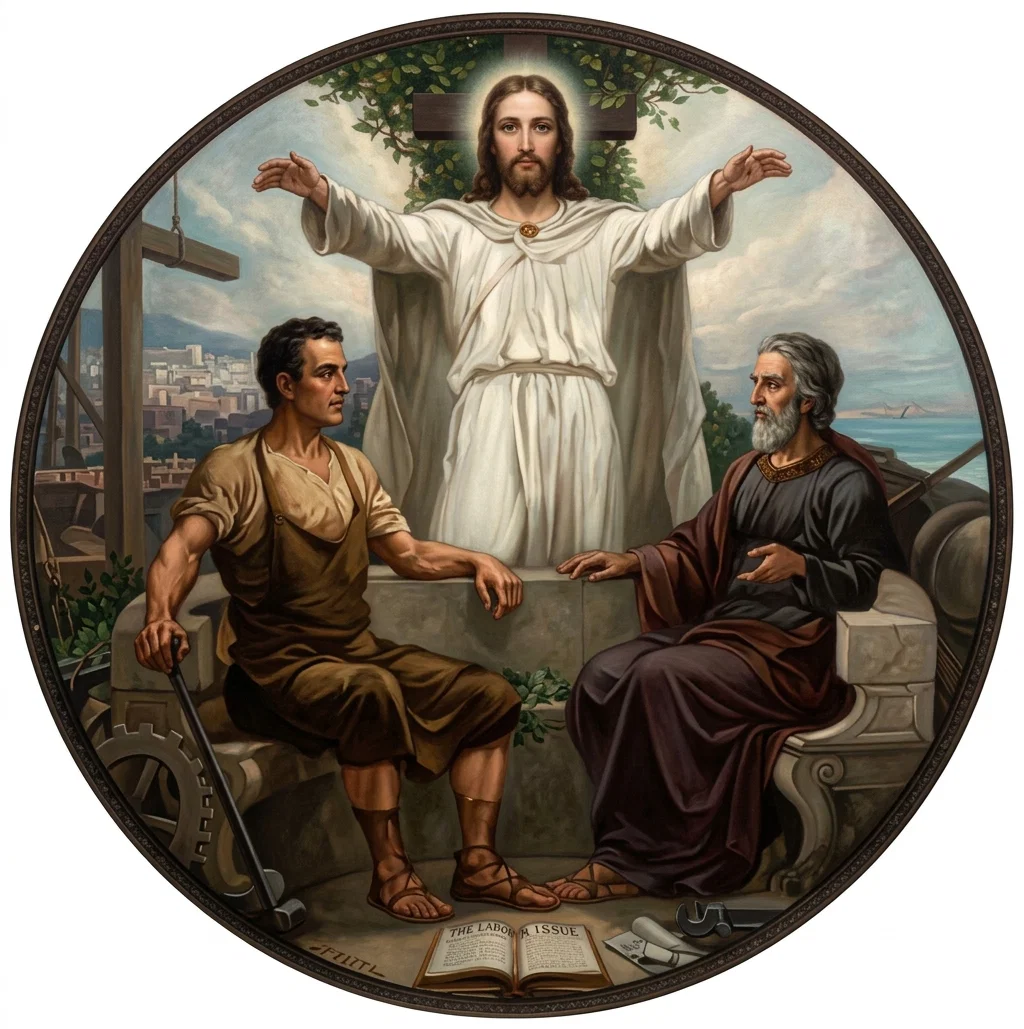
5. There is a better solution — in the Man Christ Jesus. In Him, as set forth in Mr. Mente's striking picture, there is peace, there is justice, there is fairness, there is equality, there is development of noble manhood. In Him is the demonstration of the only true process of freedom: that he only works for liberty — liberty even for himself — who works for the liberties and rights of the other man. He only is truly seeking to perpetuate his own freedom who is working for the freedom of the other man; for accident or conscience may place him in the class that he would strip of power or liberty and make subject to himself. Our appeal, therefore — we can in conscience as a man and a Christian make no other — our appeal to both classes to the controversy is to become one with Christ and so with each other. Let Him take away the hatred, the bitterness, and its basic selfishness. Take for the motto of life and business the Golden Rule, "ALL THINGS THEREFORE WHATSOEVER YE WOULD THAT MEN SHOULD DO UNTO YOU, EVEN SO DO YE ALSO UNTO THEM." In the words of Lowell:
Is true freedom but to break
Fetters for our own dear sake,
And, with leathern hearts, forget
That we owe mankind a debt?
No! true freedom is to share
All the chains our brothers wear,
And, with heart and hand, to be
Earnest to make others free.
Current Events
By Editor
The wholesale price of refined sugar was advanced September 12 to seven cents wholesale in the United States. That is the highest figure it has reached for twenty-two years. It is thus that the sugar trust pays the Government fine. There are seven billion pounds used annually in the United States. The raise of one fourth cent a pound means 175,000,000 dollars a year of extra profit to the sugar trust. This means that all manufacturers that use sugar to any extent, as in candies, will either advance prices, or diminish the amount sold, or substitute saccharin. The excuse is that there is a scarcity of sugar.
One of the aristocratic set of Massachusetts sought to bury her aristocratic pet dog in Lexington cemetery; but the local police, aroused by the patriot superintendent, protested and stopped the burial. The woman sought to have the dog buried in the family plot, directly beside her husband's body. She buried the dog temporarily at home. It is thought that she will contest the order.
Mount Etna, a despatch from Sicily, September 14, declares, is vomiting a perfect avalanche of fire at surrounding towns; 20,000 have fled from the vicinity, and the towns of Castiglione and Francavilla are threatened with destruction. The peasants are erecting before their vineyards and humble homes a cross of sticks, placing upon the top of it pictures of the Madonna and the saints; but these superstitious acts have not checked the flow of lava.
Riots still continue in numerous towns in the southern province of Italy, on account of the cholera epidemic. The ignorant people believe that the doctors and government officials sent to fight the disease are merely assassins in disguise, who poison wells and fountains, and scatter a mysterious little powder which is the real cause of the cholera. So much for the intelligence of a people that have been under Catholic instruction for centuries.
A ministers' club of Berkshire, Massachusetts, September 11 adopted a resolution scoring the Rev. Joseph Lambert, of Elmwood Temple Congregational Church, of Providence, for marrying John Jacob Astor and Madeleine Force. The resolution reads: "The members of the Berkshire Ministers' Club, and guests present at this meeting, desire to place themselves on record as disapproving of the marriage in another State of a man forbidden by the courts of a sister State to remarry. We express regret at the misuse of the ministerial office, and the stigma brought upon the denomination of Christians to which he belongs. If clergymen defy the just requirements of the civil courts, they set an example that is fatal to our well-being as a nation, and12destructive of good morals." All of which is probably true; but we would like to apply this same principle to ministers who are regardless of the "just requirements" of the Lord of heaven and earth, who declares: "Remember the Sabbath day, to keep it holy. . . . The seventh day is the Sabbath of the Lord thy God." If ministers persist in ignoring God's command, do they not by so doing set a far more grievous example, fatal to "our well-being" and "destructive of good morals"?
Looking Toward the Truth
THERE are many in the world who have supposed Darwin and Lamarck made decidedly solid and enduring contributions to science and truth, and two years ago the centenaries of their birth were celebrated by the English and French people. But another noted scientist, Elie de Cyon, declares that these celebrations were "but solemn funeral functions, in honor of dead theories;" and for those who understood, "these pompous discourses were merely the passing bell of the hypothesis of descendance." Professor de Cyon is of Russo-French origin, the Literary Digest tells us, for many years was a member of the Faculty of Sciences in the University of St. Petersburg. He has recently published a work called "God and Science," in which he declares that "the Creator reigns, and His Spirit governs." In a review of that book in the Record of Christian Work, it is said that M. de Cyon declares, "The atheistic, evolutionary speculation [of Darwin] found immense popular vogue among those who desired to see the Creator dethroned, who wished to be delivered from religion and the restraints imposed by the moral law on covetousness and human passion." He declares that Darwin's theories of "natural selection of the fittest, and hereditary transmission of characteristics acquired in the struggle for existence," "have been broken down by two evolutionists — H. Spencer and Weismann;" that "the theory that the marvelous operations involved in a transformation of species, are to be explained solely by the accidents of the struggle for existence, and for procreation, is the most supernatural conception that has been brought forward since the days of Empedocles."
A monument erected to a pet dog in the canine cemetery in Hartsdale, New York. It bears the inscription, "Babe, aged 10 yrs." In the far right is a stone erected to "Petie." At present there are 451 tombs, some of the stones costing as high as $500. Prices of burial are from $15.00 to $25.00, boxes from $5.00 to $6.00. Dogs or humans — which?
When in 1866, he says, "I showed Claude Bernard for the first time the marvelous mechanism of the cardiac nerves, especially the depressor, the nerve which transmits to the brain all the emotions of the heart, and at the same time watches over its well-being by regulating its action, and by warning at the first suggestion of danger the vasomotor centers of the brain, the first words of Claude Bernard were, 'I should like to know how the Darwinists would undertake to explain such wonderful mechanisms with the aid of adaptation or selection.'" He declares that Darwin "too often confused analogy with identity to be a safe guide;" and at Professor de Cyon's hand Professor Haeckel fares worse than does Darwin. He says: "I have read the world-riddle of Haeckel, and have reddened with shame at the thought of the general education of our people! That such a book should be possible, that it should be written, printed, bought, read, admired, and taken seriously by the nation of Kant, Goethe, and Schopenhauer, is a sad fact indeed." He points out how Haeckel pictured three different things — the fetuses of a dog, a chicken, a mole — "with a single plate labeled in three different ways." Yet "for decades this mountebank has imposed on the international public as a king in the world of thought." "Lamarckism and Darwinism," he declares, "mark but passing phases in the history of science. They offer but fragments of truth. Presented as dogmatic theories, they are but an obstacle to progress."
Hertwig, we are told by him, "insists that animals differ among themselves as much in their germ cells as in their full-formed organisms. This renders improbable, if not impossible, a common origin of different animals from the same cell." "The theory of an apish ancestry for man" de Cyon declares pure assumption. He quotes Fraas, who devoted his long life to the study of fossil animals, as saying: "The idea that mankind has descended from any simian species whatsoever, is certainly most foolish, put forth by a man writing on the history of man. It should be handed down to posterity in a new edition of 'The Memorial of Human Follies.'" "No proof of this baroque theory can ever be given from discovered fossils." And Virchow says, "I have never found a single ape skull which approaches at all the human one," and "if we compare fossil men with men of to-day, we can boldly affirm that individuals of a low development are much more numerous, relatively, among present-day men than among fossils." In other words, the race is degenerate rather than the fruit, of an exquisite development, says the Record of Christian Work. And the Literary Digest says, "Where Darwinism sees but accident and matter, de Cyon is awestruck at the evidence of supernal wisdom." Thus much to our readers of what some scientists say. They need not be troubled about the old Book. Its record of creation still stands.
Racing Auto Crashes Into Crowd
September 16 a big racing auto in Syracuse, New York, charged into a crowd, and the results were nine killed and fourteen hurt.