Map Exercise (voluntary). (Let each person point out upon the map a country mentioned in the February number of the Missionary Magazine, giving some message from that country.)
Unentered Fields (talk).
Closing Hymn—No. 1069 of “Hymns and Tunes.”
Benediction.
Note
Material for papers and talks will be found in the February number of the Missionary Magazine. Much may be found on unentered fields by referring to the last four or five numbers of the Missionary Magazine. Guard against having an undue proportion of time taken in rendering any one part of the program. In some societies it may be advisable to omit a part of the numbers. But if the papers and talks are short, all can be given, and the interest thus increased.
THE BOY WHO CARES
By Frank Walcott Hutt
The boy who cares if the world goes right,
And helps to make it so,
Is one that never shuts out the light
From any friend or foe.
The boy who cares if the world is true,
And does his best therein,
Shares noble zeal with the earnest few,
An honest goal to win.
The boy who cares if the world is kind,
And does his best thereto,
Is sure, wherever he goes, to find
Some gentle deed to do.
The boy who cares—that’s the boy who makes
His deeds for honor tell;
And everything that he undertakes
Is sure to be done well.
FRANK WALCOTT HUTT.
MY PET TOAD
By Floyd Bralliar
One day a few years ago I found a little warty toad, which was not more than a year old. I took him home, and gave him a residence under the kitchen porch. He seemed to like his new home very well, as the earth was soft and always moist,—two necessary things for a toad’s comfort.
“I found a little warty toad.”
My new pet spent most of his time during the day buried in the cool, moist ground. About sunset he would wake up, and come out to hunt for his supper. He would hop about, catching anything he could find in the way of bugs and worms, but he was especially fond of glowworms, and would go as far as he could see one to get it. Flies would often roost on the side of the house, and he soon learned to hop up to the side of the house near the door, and eat flies till he could not hop, but only crawl.
Another favorite dainty of his was rose-slugs. He would climb the largest rosebush in the yard, if he thought there were slugs on its leaves,—climbing slowly and carefully, to avoid the thorns. The slugs that eat strawberries were also favorites of his. Sometimes he would spend several days at a time in the strawberry patch. I have met many persons who think that toads eat the berries, because they find them in the patch where there is much partly eaten fruit. But this is the work of the slugs, which the toads will gladly destroy.
My toad was also very fond of fireflies. My nephew once fed a toad on fireflies till his stomach would light up every little while, just as a firefly does.
Mr. Toad soon came to know the members of the family so well that he paid no attention to their being near him; but he was always shy of strangers. I have seen him catching flies in the kitchen on a cloudy day, paying no attention to any one unless some stranger came in, when he would make for his hiding-place under the porch as fast as he could hop. Toads never seem to get enough to eat, but will hunt all night. They seldom eat bees, but are very fond of ants.
“Blink his eyes and cluck.”
When winter came, Mr. Toad would dig a deep hole in the ground under the house, and bury himself till spring. My nephew once buried two toads in the bottom of a post-hole in the fall, and in the spring they were all right. Indeed, one of them dug his own way out; but the other slept till he was dug out. Toads can live a long time without food, but they must have water to keep their skin moist. I once shut some toads up in a schoolroom from Friday till Monday, and in that little while they grew so thin that one could almost see through them, and they were all broken out with sores. They also seemed to have a sort of rheumatism, and were so stiff that they could scarcely crawl, much less hop. I gathered them up, and put them all in water; and within two hours their skins were healed, and they were as plump and active as any toads in the land. I could scarcely think it possible that they were the same toads. I have seen these animals go for weeks without food, and not show any apparent loss of flesh.
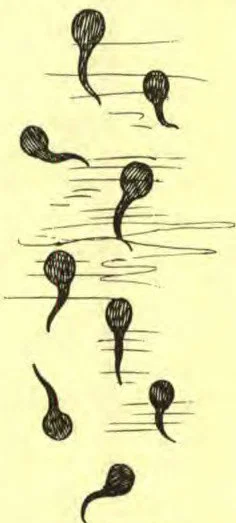
My pet toad had lived with us for several years when we sold our farm, and left him to take care of himself. He had grown into a very large toad. Once every year he would run away to the nearest frog-pond, choose a mate, and raise a large family of pollywogs. In June the toads lay long strings of eggs, which soon hatch. The old toads pay no attention to their babies unless they can catch some of them to eat.
At breeding-time toads sing a peculiar song, very different from the noise they make at any other time. It is really a beautiful song, and sounds almost like the song of a canary, except that it lacks the trill. Last year I had some toads at school, and no one who heard them sing would believe that they were not birds till I unwrapped the pail where they were, and showed them to be toads.
I was always interested in seeing my toad change his skin. This he usually did the last of May. He would act very impatient for a few days before the old skin would crack down his back. Then he would rub himself against anything he could find till the skin was well off his body, when he could rub it off his legs neatly with his hands. When it was all off, he would roll it up and eat it.
Strange as it may seem, my toad liked to be petted; and though he never got much coddling, he would hop to where any of us were sitting, and look up, and blink his eyes and cluck.
A toad will drown if kept under water when awake; but when he is in his winter sleep, it will not hurt him to put him under water and keep him there. Toads are very valuable animals to a farmer, doing him only good. They are also valuable to have in a greenhouse in the fall, as they will destroy the insects that infect plants.
FLOYD BRALLIAR.
BABY MAY'S STRANGE RIDE
“FRANKIE, I wish you would put Baby into the cab, and take her for a ride, while I am washing this morning.”
“Can’t I draw her in my little wagon, mama? I’m tired of pushing that old cab!”
“I’m afraid you might tip her over, sonnie.”
“No, I won’t, mama. I’ll be so careful! I’ll go just as slow and easy! Please, mama!”
Rubbing off the old skin
So mama put Baby May into the little red express-wagon, and tucked pillows all about her. Very carefully Frankie drew her out of the yard, and down the meadow lane to the big oak. There he pulled the wagon into the shade, and left Baby May squealing with delight at a red squirrel scampering along the fence, while he ran on down the hill for a cluster of the loveliest blue asters.
When he came back, dear me! there was Baby May all tangled up in a raspberry bush. She had climbed out of the wagon in her eagerness to get the “pitty kitty” on the fence, and had soon come to grief.
Frankie placed his small passenger in the wagon again, much to the disgust of Baby May, who screamed and kicked in a very unbecoming manner. As often as he loosed his hold on her, so often she scrambled out, until the little boy was in despair. How should he ever get her home again?
As he stood thinking, he noticed an empty nail-keg under the fence. Jim, the chore-boy, had brought it down one day with salt for the cattle. Why not put baby into that? Just the thing! She couldn’t climb out of it!
It was some time, however, before Frankie succeeded in getting little sister to see what a delightful thing it would be to ride in a nail-keg, but at last she submitted to being squeezed into her new coach.
Upright in the wagon stood the keg, and from out the top peeped just the tip of baby’s white sunbonnet. Frankie laughed at the funny sight as he started the express on its way, and the little passenger crowed with glee.
They were making a careful turn on the top of the hill, when the wheel settled into a rut. Frankie gave the tongue a sudden jerk, to start the coach, when, all in an instant, over tipped the keg, quite out of the wagon, and rolled away down the hill.6
Oh, oh! Oh dear! oh dear, dear! What would become of Baby May? The frightened little man started off in pursuit. Faster and faster rolled the keg, until baby’s white sunbonnet was only a twinkling streak shooting away to the foot of the hill. Was little sister killed? Frankie could hear no noise except the bump, bump, of the rolling coach.
On and on it sped, until, down in the hollow, long before Frankie caught up, it stopped in a mud-puddle. Then from inside the keg came such a piercing wail that Frankie’s heart was cheered. Baby May was surely alive!
A moment more, and he had rescued the dilapidated passenger. Her strange ride had so surprised her that she had not remembered to cry until it was all over, and then her small lungs were exercised with energy.
It was a sorry-looking, mud-bedragged, and tear-stained little figure that Frankie clutched bravely in his short arms as he toiled up the hill. There were scratches and bruises on Baby May’s face and hands, and her pink dress had been torn on a nail. Frankie placed her tenderly in the cart again, where she sat quietly while he very, very carefully drew her home.—S. S. Times.
POLLYWOGS
DIVISION II—PHILOSOPHY
By O. C. Godsmark
Chapter XIX—Light
§194. THERE is no physical manifestation of the power of God that reveals to our senses so much of the infinite goodness and wisdom of the Creator as does light. With it we see not only the things around us, but by it we find ourselves connected with the most distant systems of worlds, and feel that we are indeed children of the one great family, living in our allotted portion of “Our Father’s House.” He who had but to speak “and it was done,” but to command “and it stood fast,” even yet regards us more tenderly than an earthly parent can regard and care for his child.
§195. In our study of sound and of heat, we found them to be but different manifestations of vibration. This is true also of light. This manifestation seems to come next in the order of rapidity; for the vibrations that manifest themselves to our senses as heat merge into the field of light, the red ray of light being produced by the same number of vibrations a second that are found in a moderate degree of heat.
When a ray of light is analyzed by being passed through a prism, we find it to be composed of seven separate and distinct colors; namely, red, orange, yellow, green, blue, indigo, and violet. The number of vibrations a second that produce these different colors varies greatly, the red, or lowest form of light, being composed of the lowest number, while the violet, or highest form of light, is produced by the greatest number of vibrations a second that the eye of man is capable of recognizing. From this we see that white light, being made up of these seven distinct colors, is composite in the same sense that a chord in music is composite, in that it is made up of two or more separate sounds, the number of whose vibrations is such as to harmonize exactly.
§196. In the study of sound we found that while different tones would travel a given distance in the same length of time, yet they had not all the same vitality. Some of these—the higher tones—were either lost in the journey or were changed to some other form; so also with light; for while the higher forms of light, such as the blue, indigo, and violet rays, will travel a given distance in as short a time as will the red, orange, and yellow, yet they are not possessed of the same amount of vigor, or vitality, many of them becoming lost or changed to some lower form on the way. As a simple illustration of this, notice the distant headlight of a locomotive, a bicycle lamp, a lantern, or any other light in the distance, especially if it be a damp, foggy night, or when there is much dust in the air, and observe what a reddish-yellow light it gives. Notice that the blue, indigo, and violet rays are so lacking that the light seems to be really red or yellow; but look at the same light when near at hand, and we shall find that it is practically white: only the distance made the difference. Why is this so?—Simply this: the more rapid vibrations that go to form the blue, indigo, and violet rays have not so much power of penetrating the dust, damp, and dew as have the more vigorous red, orange, and yellow rays; consequently the light reaching us from a distance is robbed of those colors that give it its whiteness when combined with the others. If these principles be true, then we are on the highway to the settling of some, at least, of the seeming contradictions between accepted science and the word of God,—we may better say, between accepted science and the real facts.
§197. Now let us see if we can not understand why the rising and setting sun has so often a different color than when in the zenith. When directly overhead, the rays of sunlight come to us through a comparatively thin stratum of atmosphere, and so meet with but a small amount of resistance. But when on the horizon, the rays of light are compelled to pass through a much more dense stratum of air, that lying nearer the earth’s surface being laden with dust and moisture, all of which forms a resistance to the light-rays; consequently those colors possessed of the least vigor become lost, or changed on the way, so that there remains a preponderance of the red, orange, or yellow rays, these being the most vigorous. We never think of seeing the sun blue, indigo, or violet in color, but always in some of the colors produced by a lower number of vibrations a second than are required to produce the white ray. This of itself shows that there is a slowing down of the color-vibrations as the light-ray passes through a medium that offers considerable resistance to its progress. If the amount of resistance be very considerable, we may see the sun as yellow; that is, many of the rays above the yellow have been cut off, or changed, so that the yellow predominates, and we say it looks yellow; and if the resistance be still greater, so that the yellow rays are changed, or so much slowed down in velocity that they become orange or red, then we say the sun is orange or red in color, as the case may be.
This all seems so very simple that it may be asked, Are we justified in spending so much time discussing a matter so evident?—I believe we are; for if right so far, we are prepared to carry our investigations further. On a cold, frosty night, even the reflected light of the moon seems nearly white. The rays reach us in almost their entirety. They are but little distorted. They are nearly pure-white rays, having almost their full amount of blue, indigo, and violet rays. This is merely because of the purity of the atmosphere.
§198. In the illustration of the brass band, it will be remembered that when one is standing only a few yards from the musicians, he may be pleased with the general harmony of the various instruments; but when a long distance away, he can not hear the higher-toned instruments, but only the low, heavy tones of the bass horns and drums. It is so with the rays of light. In an ordinary atmosphere we get the perfect white ray, but when the light meets with much resistance, the higher-toned rays are lost or changed, and only the lower rays of the spectrum predominate.
§199. Light, like sound and heat, may be reflected; but like sound and heat, is changed by being so reflected. As the pitch of a tone is lowered by being reflected, so the tone of the light-ray is lowered by being reflected. We speak of the pale light of the moon. Why pale?—Because the light, in being reflected, has met with a resistance and loss. Its vibrations have been slowed down, and in being thus changed, the light is relatively paler, or weaker. The clouds also reflect to our vision always the lower colors.
Questions
Through what means do we learn of the other worlds? Has light, therefore, a place in gospel study? Name in their order the colors of which light is composed. Which possess the greatest vitality? Give illustrations. Explain why the sun often appears red at sunset. Does it ever appear violet or indigo? Why? In this respect how does light compare with the music of a band or an orchestra? Why do we speak of the “pale” light of the moon? Does the moon ever appear white? When and why?
DR. O. C. GODSMARK.
THE RICH MAN AND LAZARUS
(February 8)
MEMORY VERSE: “They have Moses and the prophets; let them hear them.”
19. There was a certain rich man, which was clothed in purple and fine linen, and fared sumptuously every day:
20. And there was a certain beggar named Lazarus, which was laid at his gate, full of sores,
21. And desiring to be fed with the crumbs which fell from the rich man’s table: moreover the dogs came and licked his sores.
22. And it came to pass, that the beggar died, and was carried by the angels into Abraham’s bosom: the rich man also died, and was buried:
23. And in hell he lifted up his eyes, being in torments, and seeth Abraham afar off, and Lazarus in his bosom.
24. And he cried and said, Father Abraham, have mercy on me, and send Lazarus, that he may dip the tip of his finger in water, and cool my tongue; for I am tormented in this flame.
25. But Abraham said, Son, remember that thou in thy lifetime receivedst thy good things, and likewise Lazarus evil things: but now he is comforted, and thou art tormented.
26. And beside all this, between us and you there is a great gulf fixed: so that they which would pass from hence to you can not; neither can they pass to us, that would come from thence.
27. Then he said, I pray thee therefore, father, that thou wouldest send him to my father’s house:
28. For I have five brethren; that he may testify unto them, lest they also come into this place of torment.
29. Abraham saith unto him, They have Moses and the prophets; let them hear them.
30. And he said, Nay, father Abraham: but if one went unto them from the dead, they will repent.
31. And he said unto him, If they hear not Moses and the prophets, neither will they be persuaded, though one rose from the dead.
Synopsis
This parable was spoken directly to the Pharisees. They had heard Christ teaching his disciples about the true riches; and being covetous men, they had “derided” the Saviour. Literally, they had “turned up their noses” at him. Christ then spoke to them words to this effect: Before men, you justify yourselves; but God knoweth your hearts, and although men highly esteem you, yet in God’s sight, you are an abomination.
These covetous Pharisees were the rich man of the parable. Afflicted beggars lay at their gate, but were given no notice. A priest or a Levite would pass one by while some good Samaritan would bind up his wounds (the Samaritans were looked upon as dogs). But the rich man and the beggar were not always to suffer.39The time would come when those who had received good things in this life, and had not shared with others, would find a wide gulf between themselves and heaven.
Questions
1. How did a certain rich man live?
2. Who was laid at his gate?
3. In what condition was Lazarus?
4. How was he cared for?
5. In accordance with Jewish belief, what finally became of him?
6. In the same way what became of the rich man?
7. In hell whom does he see afar off?
8. Crying out, how does he address Abraham?
9. For what does he beg?
10. What does Abraham answer?
11. Why does he say that Lazarus can not come?
12. To whom does the rich man then desire Lazarus to be sent?
13. How does Abraham show that this is unnecessary?
14. What does the rich man think would move his father’s house to repentance?
15. What does Abraham say as to this?
16. A little later in Christ’s ministry, one Lazarus was raised from the dead. Did this move the Jews to repentance as the rich man said it would?
17. In fact, what did they consult to do with Lazarus after he was raised by Jesus? John 12: 10.
Note
Many Jews believed that after a man died, he would live in one of two places until the resurrection,—hell or Abraham’s bosom. If he were wicked, he lived in hell; if he were good, he lived with Abraham. Here it would be decided whether one was to enter heaven. But Christ desired to show the Pharisees that it is in this life that men decide their destiny, and not after death. He therefore used their common belief, false as it was, to convey the truth that God does not value a man for his wealth, and that it is impossible for one to be saved after death if he has not accepted Christ before.
Quotations
1. “Lazarus represents the suffering poor who believe in Christ. When the trumpet sounds, and all that are in the graves hear Christ’s voice and come forth, they will receive their reward; for their faith in God was not a mere theory, but a reality.”—“Christ’s Object Lessons,” page 262.
2. “In this parable Christ was meeting the people on their own ground. The doctrine of a conscious state of existence between death and the resurrection was held by many of those who were listening to Christ’s words. The Saviour knew of their ideas, and he framed his parable so as to inculcate important truths through these preconceived opinions. He held up before his hearers a mirror wherein they might see themselves in their true relation to God. He used the prevailing opinion to convey the idea he wished to make prominent to all,—that no man is valued for his possessions; for all he has belongs to him only as lent by the Lord. A misuse of these gifts will place him below the poorest and most afflicted man who loves God and trusts in him.”—Id., page 263.
3. “When the rich man solicited additional evidence for his brothers, he was plainly told that should this evidence be given, they would not be persuaded. His request cast a reflection on God. It was as if the rich man had said, If you had more thoroughly warned me, I should not now be here. Abraham in his answer to this request is represented as saying, Your brothers have been sufficiently warned. Light has been given to them, but they would not see; truth has been presented to them, but they would not hear.”—Id., pages 264, 265.
THE TWO DEMONIACS AT GADARA
By W. S. Sadler
INTRODUCTORY
Preceding Events.—The healing of the two demoniacs in the country of the Gadarenes was the next important event in the Saviour’s life immediately following the stilling of the tempest.
Bible Story of the Miracle.—“And they came over unto the other side of the sea, into the country of the Gadarenes, which is over against Galilee. And when he was come forth out of the boat upon the land, straightway there met him two possessed with demons, coming forth out of the tombs, exceeding fierce, so that no man could pass by that way. And one of them for a long time had worn no clothes, and abode not in any house, but had his dwelling in the tombs, and no man could any more bind him, no, not with a chain; because that he had been often bound with fetters and chains, and the chains had been rent asunder by him, and the fetters broken in pieces, and no man had strength to tame him. And always, night and day, in the tombs and in the mountains, he was crying out, and cutting himself with stones.
“And when he saw Jesus from afar, he cried out, and ran, and fell down before him, and worshiped him; and crying out with a loud voice, he saith, What have I to do with thee, Jesus, thou Son of the most high God? Art thou come hither to torment us before the time? I adjure thee by God, torment me not. For he said unto him, Come forth, thou unclean spirit, out of the man. For oftentimes it had seized him, and he was kept under guard, and bound with chains and fetters; and breaking the bands asunder, he was driven of the demon into the deserts. And Jesus asked him, What is thy name? And he saith unto him, My name is Legion; for we are many: for many demons were entered into him. And he besought him much that he would not send them away out of the country, and entreated him that he would not command them to depart into the abyss. Now there was afar off from them on the mountainside a herd of many swine feeding. And the demons besought him saying, If thou cast us out, send us away into the herd of swine, that we may enter into them. And he gave them leave. And he said unto them, Go. And the unclean spirits came out from the man, and entered into the swine. And behold the whole herd rushed down the steep into the sea, and perished in the waters. And when they that fed them saw what had come to pass, they fled, and went away, and told everything in the city and in the country, and what was befallen to them that were possessed with demons. And behold all the city came out to meet Jesus, and to see what it was that had come to pass; and they came to Jesus, and found the man, from whom the demons were gone out, sitting, and clothed, and in his right mind, at the feet of Jesus; even him that had the legion: and they were afraid.
“And they that saw it told them how he that was possessed with demons was made whole, and concerning the swine. And when they saw him, all the people of the country of the Gadarenes round about besought him to depart from their borders; for they were holden with great fear; and he entered into a boat, and returned. But as he was entering into the boat, the man from whom the demons were gone out, prayed him that he might be with him. And he suffered him not, but sent him away, saying unto him, Go, return to thy house unto thy friends, and declare how great things God the Lord hath done for thee, and how he had mercy on thee. And he went his way, and began to publish throughout the whole city and in Decapolis how great things Jesus had done for him: and all men did marvel.” (The foregoing is an interwoven story of the miracle, gathered from Matt. 8:28–34; Mark 5:1–20; and Luke 8:26–39.)
Place.—Northeast coast of the sea of Galilee, not a great way from Capernaum. Given by Matthew as the country of the Gergesenes; by Mark and Luke as Gadara.
Circumstances.—This miracle was performed the morning after stilling the tempest on the sea of Galilee, and immediately upon reaching the shore. Gadara was not near at hand, but lay some distance back from the coast. At present there are certain ruins of a town near the shore, which are thought to be those of Gadara. It was in the early morning that these two men of the tombs met Jesus and his party as they landed. Immediately associated with the working of this miracle, is the episode of the devils entering into the herd of swine, and driving them into the sea. The loss of the swine so greatly alarmed their keepers and the inhabitants of the city near by, that they earnestly besought Jesus to depart out of their coast; this he did.
Great Lesson.—Very often the Lord, in delivering us from the power of evil habits and the spirit of devils, finds it necessary to destroy some of those things through which the devils work,—to deprive us of some indulgence of the flesh. We can not hope to rid ourselves of Satan and at the same time retain those things in our experience through which he always works—and through which God can never work. Our unwillingness to part with physical and moral uncleanness will mean to us what it meant to the Gadarenes,—the loss of the presence of God.
W. S. SADLER.
(To be continued.)
SHORTHAND BY MAIL.
YOUR spare time can be well improved by studying shorthand, and this can be done at small expense to you by taking a mail course at your home. We are using “The Rogers Compendium of the Graham System of Shorthand,” a method arranged especially for home study, and giving an epitome of a system of shorthand acknowledged to be the best, the briefest, and the most complete. The only presentation of Standard Phonography in which all shorthand outlines are written as first learned, thus greatly abbreviating the work on the part of the student. A complete course in thirty lessons, illustrated by facsimile notes, with key. The correction of all students’ papers given special attention by experts. Reasonable tuition rates. If interested, write for full particulars. Practicing stenographers wishing to prepare for rapid reporting work should secure the last twenty lessons.
FIRESIDE CORRESPONDENCE SCHOOL,
Battle Creek, Mich.
GRAND TRUNK R'Y SYSTEM.
By W. C. Cunliffe
Taking Effect June 2, 1901.
Trains leave Battle Creek.
WEST-BOUND.
No. 2, Mail and Express, to Chicago. 12.15 P. M.
No. 7, Limited Express, to Chicago. 7.10 A. M.
No. 3, Lehigh Valley Express, to Chicago. 3.50 P. M.
No. 5, International Express. 2.17 A. M.
No. 75, Mixed, to South Bend. 7.30 A. M.
Nos. 9 and 75, daily, except Sunday.
Nos. 3, 5, and 7, daily.
EAST-BOUND.
No. 10, Mail and Express, East and Detroit. 3.45 P. M.
No. 8, Limited Express, East and Detroit. 4.14 P. M.
No. 4, Lehigh Express, East and Canada. 8.22 P. M.
No. 6, Atlantic Express, East and Detroit. 2.10 A. M.
No. 2, Express, East and Detroit. 7.00 A. M.
No. 74, Mixed (starts from Nichols yard). 7.15 A. M.
Nos. 10 and 74, daily, except Sunday.
Nos. 4, 6, 8, and 2, daily.
W. C. CUNLIFFE, Agent,
BATTLE CREEK.
A PLEA FOR OUR VOICELESS PETS
By Irene Seeley
When business embarrassments made it necessary for W. B. Hunt, of E——, Ill., to sell his herd of Jerseys, his wife, who had tenderly cared for them, and fed them from her own hands, and whose call they had answered from pleasant plains and valleys, with tearful eyes saw them pass from her care into the hands of strangers; and out of her noble heart she made a touching plea for them. She said:—
“There are many things connected with our little Jerseys that will make the parting hard to bear for my husband and myself. The people of this country very well know that each Jersey in the herd has been reared by me. Each one has its special name, and comes at my call. They have been my constant care for years, and have been like children to me in affection and dependence, and I have given them almost a mother’s love; and now that the parting has come, I desire to plead not for myself, but for them, that the hands into which they pass may be kind and gentle, and that caresses, and not cruelty, be meted out to them.
“When I stand in the empty stalls of Panola farm, the greatest grief my heart will know will be that the dumb creatures that I loved so well will be beyond my power of aid. Hungry and unsheltered, they may be standing in blinding storms and drifting snow, and I powerless to protect and help them. And so I plead, whoever you may be, that if one of Panola’s Jerseys passes into your possession, remember that a woman’s care guarded it, a woman’s heart ached at its loss, and a woman’s pen was lifted up in a dark hour to beg for it the pity she did not ask for herself.”
There is a beautiful lesson in these words,—a lesson of love and tenderness and sweet compassion; and if the dumb creatures in whose behalf that tender plea was made could speak, their voices would chime in sweetest cadence in one woman’s heart.
“Blessed are the merciful: for they shall obtain mercy.” “Let not mercy and truth forsake thee: bind them about thy neck; write them upon the table of thine heart: so shalt thou find favor and good understanding in the sight of God and man.” In view of these words, how important it is that our young people be taught to be kind and merciful to the animals as well as to human beings. And how sad to see so many boys and girls take apparent pleasure in acts of cruelty to their dumb pets. We hope that the INSTRUCTOR family will love their dumb friends, and thus be enabled to reach a higher standard of excellency, and set a worthy example of the noble truths which they profess. IRENE SEELEY.