The Youth’s Instructor, Vol. 50, No. 5.

WINTER SPARROWS

The Youth’s Instructor

Jan 30, 1902

Review and Herald Publishing Company · Battle Creek, Mich. · Jan 30, 1902

WINTER SPARROWS

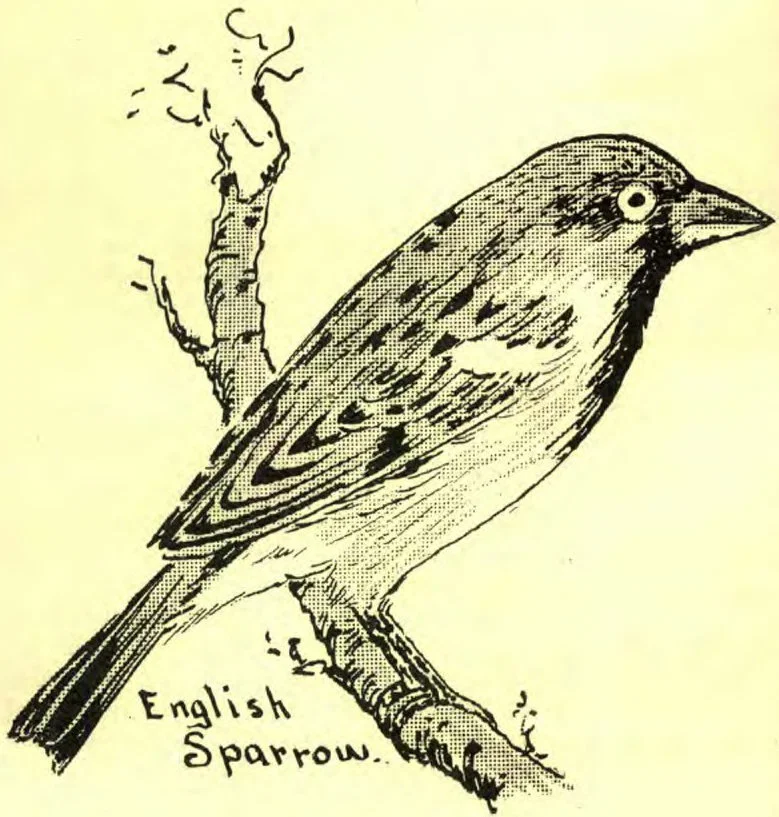
English, or House, Sparrow
If you do not already know the English Sparrow, these cold months are an opportune time to make his acquaintance, provided you think it worth while. Although this bird is fast becoming a veritable nuisance, it has its good characteristics; and I have learned many lessons from, and seen many things of interest in, the lives of these busy little creatures.
It seems that the English Sparrow was introduced into the United States at Brooklyn, N. Y., in 1851 and 1852. As late as 1870, it was largely confined to the cities of the Atlantic States. But the bird has rapidly increased, and being able to adapt itself to varied conditions, it has spread over most of the United States and Canada, and will soon be firmly established in the West. According to the reports of the United States government, the children of a single pair in ten years might amount to 275,716,983,698 sparrows!
These sparrows drive the bluebirds and the wrens from the bird-boxes and other nesting-places, taking complete possession. But I will tell you how to outwit the sparrows, and at the same time invite the bluebirds. The sparrow finds difficulty in entering a hole unless there is a perch beside it; but the bluebird has no trouble in flying directly into a nest-hole. If your bluebird-boxes are made without perches, therefore, they will serve the purpose for which they are intended. (Never use cigar-boxes; to do so would be an imposition on the birds.)
And if you wish martins to nest in the martin-boxes, be sure to keep them closed during the winter. In the spring, when the martins come back from the South, open the boxes. Once these sturdy birds get possession, they can hold their own against the whole tribe of sparrows.
Sparrows eat many seeds of weeds in the fall. I have seen them at such times in large flocks, feeding exclusively on these seeds. One very cold day this winter, I observed some sparrows feeding in the road. One of them hopped about awkwardly on one leg, and I was at first certain it had frozen the other. By watching it for a moment I learned my mistake. The other leg was pushed up into its fluffy feathers. The little creature hopped about until the leg “in its pocket” was warm, and then brought it down again, using it while it warmed the other leg after the same fashion. All the while it kept both legs up inside the feathers as far as possible, and as a result its little body lay in close contact with the ground the greater portion of the time. Thus we see that this bird has learned to travel about on the snow and ice, and not lose its feet.
But the sparrows now, as in the days when Christ was on earth, are little valued. They had a low price then (see Matt. 10: 29-31), and nowadays some States put a price on their heads. But Jesus declared that not one of these lowly birds falls to the ground without our Father’s notice. God cares for the seemingly worthless sparrows, even as he cares for us, who are often so unthankful and always so unprofitable. If we would remember this, it would give us a living trust in God, and make us kind and charitable of the mistakes of others.
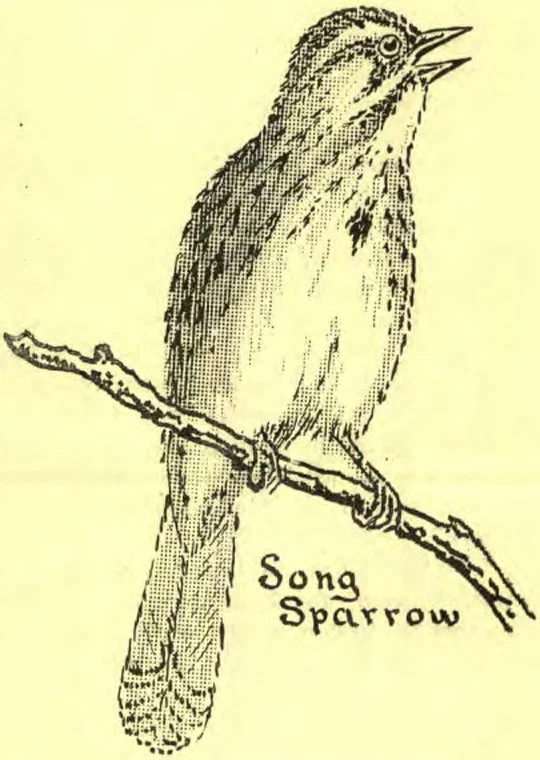
Song Sparrow
Song Sparrow
Description.— Adult male: crown gray, bordered from the eye backward and on the nape with chestnut; back streaked with black and chestnut; middle of throat and breast black; sides of throat white; belly whitish. Female: head grayish-brown; back streaked with black and deep ochraceous buff; under parts dirty whitish.

Song Sparrow

Another bird you should be able to find in winter is the Song Sparrow. This is one of the commonest and most familiar of the sparrows. It is with us both winter and summer. The bird is said to live on injurious caterpillars, grasshoppers, leaf-cutworms, and rosebugs. If not disturbed, the Song Sparrow is said to raise three broods in a season.
Though not a brilliant singer, it is well entitled to its name of Song Sparrow; for its song is as sweet as its good nature is unfailing. There is also a great variety in its song. Florence A. Merriam says that fifteen varieties of its song have been noted in one week, and the same individual has quite a number of tunes in his répertoire. The bird is full of life and good cheer, and its song may be heard in every month of the year, and in all kinds of weather, night or day. You will usually find the Song Sparrow near water. In early spring, I have seen fairly large flocks of Song Sparrows along the brook that flows through our town. When frightened, this sparrow never flies upward, but downward, or straight on into some low thicket, working its tail up and down as it flies.
Description.— Upper parts brown, streaked with black; under parts white, streaked with black, with a dark central blotch on breast; length, six and one-fourth inches. L. A. REED.

A LIBEL ON THE BIRDS

A few days ago I was watching the curious actions of a sparrow on the sidewalk in a rather quiet part of town. On either side of the street were lofty brick and stone buildings, with the usual multiplicity of little niches and cavities in and about the projecting cornices and ornamental architecture. These sheltered and inviting ledges had been utilized from year to year by divers smaller tribes of the feathered folk as nest-building sites, and the little bird which had attracted my attention had already laid the foundation timbers of its prospective house in a cozy niche of the cornice almost directly over my head where I was standing.
It was plainly evident that the sprightly creature was seeking sticks of proper length and strength to barricade a broad opening in the front part of the cavity it had chosen for its future home. This opening was angular in form, with the vertex at the bottom and its sides separating outward toward the top, where there was a span of perhaps four or five inches.
As I stood with my elbow resting against the low paling, the confiding sparrow hopped to within a yard or two of my feet in searching for tiny twigs that had fallen from the overhanging shrubbery. It picked up a great many pieces, and as quickly dropped them. Then it would stand perfectly still for a few minutes, intently scanning the limited landscape as if in a brown study as to what move it should next make.
Finally it set vigorously to work picking up bits of material from an inch or two to six inches in length. Instead of flying away with a load, it dropped them in a little heap, nearly if not quite parallel to each other. Then poking its beak into the pile, and throwing the sticks hither and thither, it settled down to practical business by seizing a stick of medium length, and flying away with its burden dangling in the air. Of course I watched the little architect, and saw her mount straight up to the chosen ledge, and deposit the twig exactly crosswise of the gaping notch. This operation she repeated several times, always throwing the sticks about as if intent upon selecting a piece of special dimensions. No human carpenter with measuring rule in his hand could have been more expert.
In a moment the truth flashed into my mind, and I realized that I was verily the human pupil of a little bird made famous by honored mention in Holy Writ.
Why, the cunning worker had foreseen, to the ridicule of my own confessed stupidity, that in order effectually to bar the exposed side of the chamber, she must of necessity select girders of successively increasing length and size. Thus, a short stick would not span the top of the dangerous gap; while, on the other hand, a long stick could not be used at the bottom, because it would strike smack against the side walls before it could be placed in position low enough. All this clearly explained why the bird should exercise such studied care in selecting the large “timbers.”
A few days afterward I visited the scene of operations again, and by using an opera-glass found that the nest was very nearly if not quite finished. The menacing gap in the ledge no longer existed; for there was a solid bulkhead in its stead composed of longitudinal sticks, tied and stiffened by interwoven bits of dry grass and such shreds of various waste material as only bird intelligence knows where to find. More interested now than ever, I took pains to climb into the attic of a three-story building, where, from a narrow gable window, I could look obliquely down into the pretty nest, now neatly lined with tiny feathers and thistledown.
It is very convenient for great men and ponderous books to tell us that the lower animals perform their actions by means of a tendency called “instinct;” and thus divest themselves of all further responsibility in the matter. Confronted with this obscure declaration, we are led, as pupils in natural history, to ask, “What is instinct?”
The following definitions of this much-abused term are, perhaps, the best to be found in the English language:—
“Instinct is a propensity prior to experience and independent of instruction.”—William Paley.
“Instinct is a blind tendency to some mode of action, independent of any consideration on the part of the agent, of the end to which the action leads.”—Richard Whately.
“Instinct is an agent which performs blindly and ignorantly a work of intelligence and knowledge.”—Sir William Hamilton.
Such names as Paley, Whately, and Hamilton stand high upon the roll of honor in the literature of our language; and yet the words of these great scholars are but as sounding brass and a tinkling cymbal when they undertake to tell us what is the real import and inwardness of that wonderful faculty in animals which scientists have agreed to call “instinct.”
“Aha!” my little sparrow would say, could she speak our language, “we perform our actions neither blindly nor ignorantly, as your famous Mr. Hamilton learnedly remarks; but God has taught us to both reason and work according to existing circumstances, from cause to effect. And although five of our little bodies were sold in the markets of Jerusalem for two farthings, not one of us ever fell to the ground without our Father’s notice!”
That is about the kind of sermon our little bird would preach, to the utter discomfiture of human wisdom, which, after all, is but “foolishness with God.”—L. P. Veneen, in Birds and All Nature.

PRINCIPLE VERSUS IMPULSE

A FIXED purpose is of far more value than the most brilliant impulse.
Every time we violate a principle, we betray our Lord.
Our personal influence does not amount to much unless measured by principle.
Those who, like Daniel, “purpose in their hearts” to do right, will pass through fire and water rather than sacrifice principle.
Many who point the finger of scorn at a man of principle possess in their hearts a secret admiration for him, and a desire to be like him.
If we have a divine purpose in our hearts, no matter where we may be found, or under what circumstances we may be placed, that purpose will remain steadfast with us.
If we live by principle, steering straight ahead, sometimes we may suit the people, and sometimes not; but we are always sure of pleasing God.
Do not ask permission to carry out your principles. Leave those with whom you associate to take it for granted that you are true to principle. They will never think to question, for instance, whether you are honest or not.
If we serve God from principle, he will make even our enemies to be at peace with us.
If you are situated where you are called on to do something which you can not conscientiously perform, do not arbitrarily substitute some other course of action, but in a quiet manner withdraw from the arrangement rather than compromise principle.
When a man is continually looking longingly back to various idols from which he has parted in order to live by principle, he is in a dangerous position. The moment he backslides, even a little, he will at once embrace the idol that is nearest and dearest to him.
When we turn our backs upon a great principle, we shall never have the same opportunity again. “How shall we escape, if we neglect [not forsake, but merely neglect] so great salvation?”
An impulse is like the artificial polish on a pair of shoes,—it will be washed off by the first rain.
The man who is led by impulse will be completely chilled by the first cutting wind that comes along.
If we are led merely by impulse, God will find it necessary to keep us continually working in a small capacity.
Jesus prayed for Peter when he acted from impulse; so we may know that he is praying for every one whose religious life is so far only one of impulses. DAVID PAULSON, M. D.

“ONLY TO BE WITH YOU”

A LITTLE child came quietly to a closed door, and rapped softly for admittance.
“What do you want, my child?” came the father’s voice; and the little one replied, “Only to be with you, papa. I just want to be with you.”
Can any one imagine that father turning away that little child?—No, indeed! How quickly would he drop his work, fling open the door, and gather the loving little heart into his strong arms, rejoicing to give himself freely to the child whose love for him was so great.
We often fly to our Heavenly Father for comfort and strength and refuge in sorrow or temptation or danger; but do you not think he would be pleased if we would sometimes come to him, as this little, loving child came to its father, just for the sake of “being with him”? Such companionship, such nearness to him, would have a transforming effect on the life.

WASTED TIME

“On the floor of the gold-working room in the United States mint at Philadelphia, there is a wooden lattice-work, which is taken up when the floor is swept, and the fine particles of gold-dust, amounting in value to thousands of dollars yearly, are thus saved. So every successful man has a kind of network to catch the raspings and parings of existence, those leavings of days, and wee bits of hours, which most people sweep into the waste of life.”
This quotation says, “every successful man.” Then how about those who waste the precious golden moments as they hurry by? If a man, to be successful from a worldly standpoint, finds it necessary to gather up the fragments of time, is it not still more essential for the Christian? We who are looking for the soon coming of the Saviour certainly have no moments to waste. But alas! few seem to appreciate time’s inestimable value. Each moment is fraught with opportunities and possibilities which, once gone, are lost forever from our grasp.
Michael Faraday so prized time that he once exclaimed, “O that I could purchase at a cheap rate some of our modern gentlemen’s spare hours, — nay, days! Time is all I require.”
How often time is spent in self-gratification or foolish pleasure, which might be improved to the salvation of precious souls. Think of the evenings wasted in the reading of exciting literature, which pleases only for a time, and leaves its certain sting. How much more profitably such time might be spent in gathering into the mental storehouse rich gems of thought, which would broaden the intellect and strengthen the character.
KATHRINA BLOSSOM WILCOX.

LIKE

My sins are like an arrow-flight That hurtles o’er the field,— Like arrows from an ambuscade; But God is like a shield.
My sins are like a wintry frost, And slowly, one by one, My joys and powers they seal in death; But God is like a sun.
My sins are like a malady Increasing through the years; But like a good physician, he, The healing God, appears.
My sins are like the ocean waves That surge with angry shock,— The treacherous, inconstant waves; But God is like a rock.
My sins are like a parched land With thirst and hunger dead; But like the living waters, God, And like the living bread.
My sins are like a wandering In deserts drear and cold; But God is like a shepherd kind, And God is like a fold.
Like all things hurtful, harsh, and foul, Are all my ravening sins; But God is like all graciousness That helps and heals and wins.
— Amos R. Wells.

WASTED JOYS

A SUNFLOWER grew in a small back yard, Her face turned up to the summer sun, Whose course she marked with a loving gaze, Till his signal fires in the west had sprung.
She took no note when a sparrow dropped To a restless perch on her rough green cup, And pecked at the grayish bracts that held Her bright aureole’s glory up.
She heedless seemed when a bumblebee Plunged, body deep, in her brown plush heart, And floundered there until, satisfied, He winged away where the midges dart.
Her steady gaze even wavered not For a butterfly on her golden rim, Whose brilliant wings, all a-tremble there, The yellow gold of their perch turned dim.
But day by day she adored the sun, And scorned her friends of more humble mien; Till her bright rays curled o’er her fading heart And withered there, in the sun’s fierce gleam.
And when no more she could gaze at him So far above her, each summer day, The sunflower found the wee sparrow gone, And bee and butterfly flown away.
It never pays to repine and strive For things above and beyond the grasp; For thus is constantly lost, the while, Much joy and beauty the hand might clasp.
MINNIE ROSILLA STEVENS.

Snow Treasures

Frost Potencies

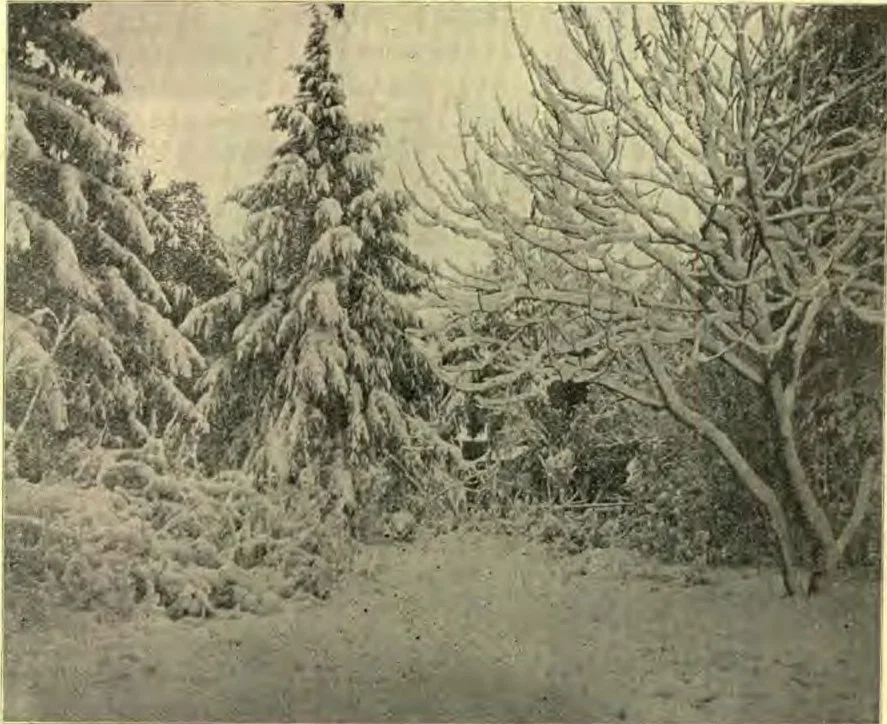
Have you ever thought of the power required to condense vapor and crystallize it into snow? We are told that to make snow enough for a snowball such as a boy throws, calls for as much energy as would be required to lift a ton one hundred feet. The great electric-power stations of the city have not capacity enough to produce the snow-power represented by a single drift along the highway. The snow also has power in another way. A single flake would melt on a babe’s hand, but too many flakes drove Napoleon from Russia, proving more powerful than the strongest armies. In its cumulative capacity snow locks the trade of a continent; roads are blocked and trains stalled as by a mighty hand. “Who can stand before His cold?” The power behind all these frost agencies is the power with which we have to deal. What a note of warning to those who oppose God! for nothing can withstand him. But what a message of cheer to those who trust in God’s power! for it never faileth.

Art in Snow

In forming snowflakes this power works skillfully and beautifully. What designs are exhibited in the little six-pointed crystals! What a marvelous geometry the student finds in flakes! When all the different figures have been drawn and counted, they number over one thousand shapes. And then, to think that every one of them that has ever fallen to earth is thus carefully and individually designed! Not content with this, the Creator’s skill is extended to his arrangement of the snow, as seen in the fantastic decorations of trees, grasses, houses, mountains, and meadows. Everywhere the touch of the artist is seen: Law and order are stamped on every snow-crystal, as upon all God’s works,—salt, quartz, and all else, up to man. What a blessed revelation of our Maker! What a bulwark to faith to feel that all things are under his forming hand! Winds, nor clouds, nor storms, can thwart his power and plan in our lives. This stimulates hope and faith in God.

The Silent Flakes

How silently the snow falls! In utmost quietude God makes his snow-treasures. While the earth slumbers, often while we slumber, the air is alive with feathery flakes descending. We do not hear them, unless perchance a gust of wind furiously blows them against the pane. But we awake, and with the morn look to see in frosty skill a kind of icy spray fantastically, as if by an enchanter’s hand, scattered over the glass. But it is no enchanter’s work; it is God’s wondrous art. We arise from our couches, pass to the window, and through a little open place in the glass, or through one made by our thawing breath, we look out of doors, and see with surprised eyes the great white veil which God has quietly and quickly and beautifully woven, let down from heaven, thread by thread, to cover nature’s face. It has snowed! O, the wonderful, the mysterious snow!

Crystallizing Righteousness

God’s skill is not exhausted in occasional snowstorms. His art does not all go to flakes. He who works so marvelously in the frost is able and desires to work even more wonderfully in human hearts, crystallizing righteous characters, working in us to will and to do his good pleasure, carrying forward through us his redemptive designs. If any man lack wisdom how to live, let him ask of God, who makes the snow, who is the source of skill, “who giveth to all men liberally, and upbraideth not; and it shall be given him.”

Nature’s Overcoat

A cold, snowless winter is the severest for plant- and tree-life. Snow is nature’s protector. “He giveth snow like wool.” This beautiful blanket covers all the flowers in their quiet winter sleep so that they will not catch cold. The wool-like snow is their winter overcoat. The snow is likewise a blessing to man. It increases our supply of moisture, fills the springs, swells the streams, helps forward the great lumber industries and the movements of machinery. Snowstorms make brisk work in chopping, logging, and sawing. Besides, what a number of odd jobs are given to men with but scanty employment at this season of the year! Think of the thousands of people called out by snowstorms to shovel walks, to clear car-tracks, to haul off the snow from busy thoroughfares in cities and towns! All this puts thousands of dollars into circulation, wonderfully helping those who otherwise would see little mercy in the cold snow.

Innumerable Mercies

Who can count the number of flakes that fall in a snow-storm? And who can count all God’s mercies to us? We may be able to tell the number of our disappointments and sorrows, for we are prone to dwell upon them and recount them. But who is so skilled in enumeration that he can count all God’s benefits? They are numberless as snowflakes.
A cheerful Christian entered a counting-room, and said to a friend who was brooding over his “hard times,” “What! wrapped in gloom again?”
“Yes,” replied the melancholy merchant. “Why not, when there is nothing but gloom in the outlook?”
“But,” replied the caller, “I can see rifts in the clouds which oppress you, and you would see them, too, were it not for your habit of looking only on the dark side of things. He who would see light must open his eyes. Suppose now, instead of dwelling on your present and prospective troubles, you spend the next half-hour in counting your mercies, past and present, and in searching for facts on which to build hope for brighter days to come. Good morning!” With these words the cheerful brother left, leaving a ray of light behind him.
“He bade me count my mercies,” thought the sad-hearted man. And he began to do so, casting swift glances over all the good things in his possession, over all God’s leadings in his past life; over the grounds on which faith and hope might safely build for the future,—until his heart leaped, his counting-room grew bright as with the presence of angels, his business prospects seemed no longer shrouded in utter blackness, and he began to sing a song of praise.

The Gospel like Snow

“HE GIVETH HIS SNOW LIKE WOOL.”
The prophet Isaiah saw this symbol in the snow: “As the rain cometh down, and the snow from heaven, and returneth not thither, but watereth the earth, and maketh it bring forth and bud, that it may give seed to the sower and bread to the eater: so shall my word be that goeth forth out of my mouth; it shall not return unto me void, but it shall accomplish that which I please, and it shall prosper in the thing whereto I sent it. For [as a result of receiving and obeying God’s merciful word] ye shall go out with joy, and be led forth with peace: the mountains and the hills shall break forth before you into singing, and all the trees of the field shall clap their hands.” How like these benefits in the vegetable world are the benefits of God’s gospel! What rejoicing God’s love begets in all who receive him! How impartial is God’s love, coming with mercy and forgiveness to all men alike, pardoning every penitent.

Nature’s Great Wash

How the snow cleanses the air! A snowy day is its wash-day. The wonderful rarity of the atmosphere after a snowfall is inexpressibly delightful. How we rejoice to inhale it! and how it invigorates us. However, the snow suggests something even more to be prized. Here again we are led up to God, who dwells, eternal and immutable, in spotless purity. “Holy, holy, holy,” is his name, nature, and habitation. And yet he is the blessed One forever, and desires to impart his holiness and blessedness to us. God will do more than mercifully cover our sins. He longs to make our hearts white like snow.

The White Life

A writer tells of going down with a party into a coal-mine. On the side of the gangway grew a plant which was perfectly white. The visitors were astonished that there, where the coal-dust was continually flying, this little plant should be so clean. A miner who was with them took a handful of black dust, and threw it on the plant, but not a particle adhered. There was a wonderful enamel on the plant, to which no finest speck could cling. Living there amid clouds of dust, nothing stained its snowy whiteness. Is not this a picture of what our lives should be? Unholy influences breathe incessantly upon us, but it is our mission to be pure amid it all, “unspotted from the world.” If God can make a little plant so wondrously that no dust can stain its whiteness, surely he can by his grace so transform our hearts and lives that sin shall not rule over us.

The Cross of Snow

The snow-line on the sides of lofty mountains is suggestive. Above certain altitudes there is perpetual snow, hence perpetual purity of air because of oft-recurring snow-falls. So, too, there are high spiritual places, lofty altitudes of spirit, near to the heart of God, where it is always pure, rendered so by constant communings with the sinless One.
You have seen the picture of a peak in the Rockies, a lofty mountain cut by two ravines in such a way as to form a perfect cross. In those ravines the snow never melts; and in summer, when the snow disappears from the rest of the mountain, far up on its side is displayed this cross of snow. When a traveler comes in sight of that divine symbol for the first time, a feeling of awe takes possession of him, and the head is bowed in respectful veneration. The snow-cross suggests the way by which moral purity is produced. It takes us back to Calvary’s cross, on which the Son of man was lifted up, and we recall the triumphant language of his atoning work: “And I, if I be lifted up, . . . will draw all men unto me.” Many a sinful soul, from that cross and that Saviour, has found the power to transform his character, helping him to live the white life. Let us come to Christ with utter consecration. Let us take from him holy inspiration. And let us become in character and conduct pure, “even as he is pure.”—L. H. Dorchester, in Young People’s Weekly.

GROWTH OF THE YOUNG PEOPLE'S SOCIETY AT COLLEGE PLACE

SUCCESS has attended the efforts put forth here during the week of prayer just closed. The deep movings of the Spirit of God have been felt to a marked degree. Souls have been turned to God, and are rejoicing in the freedom that they find in him.
This has indeed been a week of blessings to the people of College Place, young and old. One regular meeting was held each evening in the college chapel, at which the readings were given, the rest of the time being devoted to seeking the Lord together. Special prayer and consecration meetings were held with those who had just started, and our hearts were made glad to see new ones come in each evening, praising God that they had found the Saviour. Nearly every girl in the college home who was not already a Christian, has stepped out and acknowledged the love of God, and many of the boys have done the same. Several who, at the beginning of the week, were the most unpromising, at its close were working with a will for their fellow students.
Light school work was continued during the entire week, Elder Loughborough occupying the chapel hour each day with his studies on the rise and progress of the message, which he has been conducting for nearly a month. To these studies, and the interest that the students have taken in them, may be attributed much of the earnestness and power manifested in the week-of-prayer meetings from the beginning. They seemed to be just what was needed to prepare hearts for the special work that was to follow.
On Sabbath, December 28, twenty-three, most of them young people and students in the college, were baptized. A number more are expecting baptism next Sabbath, who were not quite ready at this time. The social meeting in the afternoon was indeed a good one. The chapel was well filled, and within half an hour by far the greater part of those present had spoken to the praise of God. Many hearts were rejoiced to see some who had been holding out for years against the strivings of the Spirit, now praising God that his love at last has conquered.
The Young People's Society meetings, Friday evening, have grown to such proportions that they can no longer be held in Room 1, the largest recitation room in the college, which has heretofore always been used, and have been taken to the chapel. Every meeting seems to be better than the one before, and we are glad to see the older members of the church and school taking more interest in the Young People's work. That all may labor together for the rapid spread of this glorious message is our prayer.
CLAUDE CONARD.

WHAT THE STRIP OF GREEN TOLD

Two friends were driving along a country road; and as they went, each kept calling the other's attention to some new charm in the scene. “How prettily the brook winds over there in the meadow,” said one, pointing to a zigzag line of brilliant green, in vivid contrast to the hues of the surrounding landscape.
The girl strained her eyes. “Why, I can't see any water; can you?”
Her friend laughed. “No, I don't see the brook itself. But that strip of green tells me that the water is there.”
Young people are sometimes troubled by the thought that they have so little opportunity to give their testimony for Christ. And yet, even when it is impossible to put their purposes into words, there are other things that speak as plainly. There is a kindness which springs only from love, a patience and courage which grow out of faith. One who can not see the waters of the stream knows of its presence by the fresh verdure which marks its course.—Selected.

NOTES FROM THE FIELD

HEALDSBURG, CAL.— We have organized a Young People's Society here at Healdsburg, and the prospects for carrying on the work are very encouraging. At our first meeting we had an attendance of about one hundred and fifty. I have been away from Healdsburg now for two Sabbaths, so do not know exactly what lines of work are being planned. We expect, however, to carry on a systematic study of the lessons prepared for this work, and to do what we can wherever the way opens. M. E. CADY.

Columbus Young People's Society Sells Health Journals

COLUMBUS, OHIO.—Our Young People's Society now has thirty-one members, whose purpose it is to become efficient workers for the Lord. We have elected a secretary, who keeps our records, and attends to all such work. We always call the roll, and every one responds with some text of Scripture. We have done a little work by taking a club of ten Signs, selling them every week, and giving the profits into our treasury to be sent to the Mission Board. Now the members are going to sell two hundred copies of the Midwinter Good Health, to earn something for the week-of-prayer offering. One young man wants fifty, and another one hundred; so I think we shall need more than two hundred. While asking them to see if they could not spend the holidays as the Lord would have them, I told them that I would make a “comfort” for one of our poor sisters, because I could not go out with them in the canvassing work, as my little boy was sick. After the meeting one of the boys came to me, and timidly asked how much cotton would be needed for that comfort, as he would like to buy that. This boy testifies to receiving much help from the Young People's meetings; and one young man has been reclaimed through the agency of our society.
Mrs. Lena Gramnan.

MISSION HYMN

(TUNE: “AMERICA”)
God of the Universe! Who knowest all the curse That sin has wrought, May light come from thy throne, And power from thee alone, To break the hearts of stone Thy love has bought!
Look, Lord, with pitying eye On those who’re doomed to die In heathen lands! Send us to point the way, Turn them from gods of clay To him,—the Light, the Way! Love, break their bands!
Let not our love of ease Seek only self to please, But seek the lost! May others’ needs be ours, To help with all our powers, Ere the last storm-cloud lowers! Nor count the cost!
MRS. M. D. McKEE.
Continue reading: SUGGESTIVE MISSIONARY PROGRAM