Your ShelfYour Projects

Review and Herald, Vol. 92, No. 17.

Our Refuge in That Day
Earlier text: Biennial Conference and Workers' Institute in India

Our Little Table, and How It Solves Some Home Problems

— No. 7

MRS. VINA SHERWOOD-ADAMS
WHAT do we find on our little table of sewing materials this time? Yes, sewing materials. Two round peach baskets have been converted into sewing receptacles, one with a pink cambric lining to harmonize with Ruth’s brown eyes, and the other with blue lining, for blue-eyed Irene. Inside is the usual sewing equipment — thimble, blunt scissors, strawberry emery, etc.
Now, to tell the truth, I do not enjoy sewing. When I was a small girl, I enjoyed making crude garments for my dolls, but as no one thought to show me just how to make them neatly, I soon lost my interest. My kind mother, a very busy woman, made the mistake of many another mother, and did not teach her girls to sew. Strange, is it not, when she herself was a beautiful seamstress from early girlhood? Sewing machines were unknown in her younger days; and I still have among my treasures some of her neat handwork. I have often thought of how many stitches we might have saved her, but she always told us that she preferred to sew, and had us do some other kind of work. For this reason my knowledge of sewing was acquired after I left the home nest, and some very discouraging times I have had. I wonder if some aunt or cousin, or mother if she could have taken time, had taught me to sew about the time I was interested in making doll clothes whether sewing would not have been more interesting to me in later years.
But, of course, for the sake of our children we have to put our ideas of disagreeableness aside; and so I have whipped up my dormant interest in the needle and thread, and have tried to encourage the interest of our girls in sewing, in as attractive a manner as possible.
I have investigated many different methods of teaching children sewing. For first principles the ready-prepared practice cloth and folders from the Louise Kirkwood System, Yonkers, N. Y., are very convenient. We used these as guides only, making our own sewing models. Any one well versed in sewing could prepare the models without a guide. Each child requires about one-half yard of medium-weight muslin. This, cut into strips ten by four and one-half inches, will provide material for twelve practice lessons in first principles. Each strip should be numbered. The length and distance apart of all the kinds of stitches, also the width of the hem, length of the buttonhole to be cut, etc., are marked with ruler and pencil on the strips for each child to follow.
For instance, in Lesson One, across strip No. 1, mark three rows of stitches one-half inch long with one-half inch space between the stitches, thus ——, etc. This strip will no doubt occupy the time of three lessons, as threading the needle and tying the knot has to be learned also at this time. When the three rows of stitches are completed, label the strip with the child’s name, even though you have only one child in your class. In preparing the guide strip for the hem, each of the two crease lines, where the hem is turned, should be indicated by a long straight mark across the length of the strip. The hem stitches are marked just below the second pencil hem line with short slant lines of the right depth and equal distance apart. After the lesson on hemming has been given, all strips used in future lessons should be hemmed. When the child has had sufficient practice, omit all pencil marks for stitches and hem lines.
Other sewing principles are:— 2. Turning cloth for hem and basting. 3. Turning cloth for hem basting and hemming. 4. Running stitch. 5. Stitching and overcasting. 5a. Finer stitching and more overcasting. 5b. Backstitching. 6. Fell seams. 7. Gathers, also basting and sewing on the band. 8. Buttonhole stitch practiced. 8a. The buttonhole cut and worked. 8b. Sewing on the button for coat; for dress. 9. How to work eyelets and thread loops; also how to sew on tapes and hooks and eyes. 10. Fancy stitches — herringbone and featherstitch. 11. Patching. 12. Darning.
These practice lessons used alone become rather uninteresting, but as a stimulus our two girls have been promised new dolls—just the kind they want — when they have mastered the stitches. Then we are to buy real doll clothes patterns, and learn to cut and fit from patterns. These patterns may be purchased for fifteen cents a set from the Ladies’ Home Journal, Independence Square, Philadelphia, Pa. Order according to the size in length of the doll. Set No. 7359 (sizes 14-26) contains a coat, cap, an overblouse dress with guimpe, a peasant dress, a kimono, a play suit, a nightgown, a petticoat, a combination suit, sandals, and stockings; also a guide chart. You see a little girl will be quite an accomplished seamstress by the time she has made all these garments.
Battle Creek, Mich.

A Practical Lesson

Two small boys were given a weekly allowance of twenty-five cents. One showed a decided tendency toward frugality, while the other was ready to spend his money foolishly. The wise mother took occasion to explain to them the advantages of having something saved up for an emergency, and endeavored to make clear the difference between stinginess and economy, real wants and imaginary ones. Still Number Two continued to spend his cash with careless disregard of value received. So, upon a certain date she presented each child with a small savings bank of the kind which can be unlocked only by the banker holding the key. The idea gave dignity to the task of saving, and they were told that upon a date some months distant they would have their banks unlocked, the contents counted, and that for every cent saved another would be added.
For a few weeks both saved industriously; then the old desire to gratify every whim seized Number Two. His mother saw, but said nothing. When the time came to open the small banks, that of Number One was heavy with eight dollars in pennies, nickels, and dimes, while that of Number Two poured forth ninety-eight lonesome pennies.
Without the least demur, but with a word of cheerful explanation to the banker, the little mother added eight dollars to one account and ninety-eight cents to the other.
An account was opened in the name of each, and each was handed his own deposit book. Number One was proud of his showing of sixteen dollars. Number Two was crestfallen over his paltry one dollar and ninety-six cents.
The lesson was not yet complete. They returned home, and Number Two was requested to produce what he could in the way of valuables which would even up matters. Only a battered magic lantern which never had worked, a few prize gum wrappers, and a half dozen partly used school pads were forthcoming. The lesson point went home, for the little spendthrift said, ruefully: “I’ll never do that way again, momsey. Just wait until we open those banks again and see if I do!” He never did.—Selected.

The Home Life Department

Conducted by Mrs. C. C. Lewis, Takoma Park, Washington, D. C.
Assisted by Miss Lora E. Clement
Through the columns of this department, hints will be given on all matters pertaining to the home life. Short articles and letters are solicited from home makers, telling of their everyday experiences,— their joys and sorrows, their failures and successes.

The Work in New Zealand

A New Conference Organized

GOOD progress has been made in the work of the third angel's message in New Zealand. The camp meeting has just closed at Napier. The meeting was held in a pleasant park, and the weather was all that could be asked for. The attendance of our people was good, and the attendance from the city was fair. Never have I seen our people appreciate the word more than they did at this camp meeting. An excellent spirit was manifest. Not one note of discord was sounded, although it was an unusually busy camp meeting for the Dominion of New Zealand.
There was a very full program. The question of the organization of a new conference in South Island was considered, and after full deliberation it was decided to form the territory south of Cook Strait into a new conference. This plan was entered into with great enthusiasm by our people of South Island, and no opposition was offered by those of North Island, for all realized that the work could be carried on better with the division, and there seemed to be a spirit of cooperation for the finishing of the work. The number of Sabbath keepers in the new conference is about one hundred and fifty, being a very much smaller number than is found in North Island, where most of the work in the past has been done.
One reason for dividing the conference was because the long strips of territory forming the two islands of the Dominion of New Zealand involved an immense amount of traveling and expense to the president of the conference and the tract society agent and other workers who are required to travel. Traveling expenses are high. There were other reasons for forming the conference, one of which is that the work in South Island can be looked after better from a closer range, with a conference office in its territory.
The brethren of North Island were very liberal in the division of funds. Instead of dividing on a pro rata basis, the proposition was made by these brethren that the surplus tithe, amounting to about £1,000, be divided equally between the two conferences, and that the tract society stock also should be equally divided. A very liberal division was made of the tent property, and the brethren from the northern conference also gave some of their best workers to this new field. Pastor W. H. Pascoe was elected president of the new conference. Pastor C. K. Meyers is another ordained minister for the new field, and besides these there are Brethren T. A. Driver, A. Currow, J. Thompson, and H. E. Sharp, who hold ministerial license. Brother and Sister Sharp, who labored for some time in the East Indian Islands and who have returned on account of their health, were called to take positions in the conference and tract society offices, Sister Sharp taking the secretaryship of the Sabbath school and young people's departments. Brother G. F. Joseph, of Queensland, who has already been laboring a few months in South Island, was appointed colportage agent for the conference, and he has with him a band of six or seven earnest canvassers. The canvassing work has been carried forward very successfully of late in South Island. Now that the division has been made, we feel certain that God has led in the matter, and we look for marked progress in the new field.
The camp meeting was an excellent one. Much progress has been made throughout New Zealand during the year. Over one hundred members have been baptized, about twenty of these at the close of the camp. Over $2,500 was raised in offerings during the meeting, the major part of which is to go for further equipment at the Australasian Missionary College. Over 26,000 copies of a new Signs Special on the war question were subscribed for by our brethren at the camp, and no doubt when the matter is taken up in the churches this number will be about doubled. Never in all my experience have I been at a camp meeting where a sweeter spirit was manifested by both workers and lay members. I believe our brethren and sisters in New Zealand are arising to finish the work.
Pastor J. M. Cole was again unanimously reelected president of the northern conference. His staff of workers are all of good courage, and new plans were laid for pushing the work vigorously in the unentered towns of North Island.
J. E. FULTON.

Jamaica

I AM glad to be able to report progress in the work in this corner of the vineyard. The year 1914 has been one of precious blessings. Although the storm clouds have been hanging over us, and the darkness deepens, yet we can trace the guiding hand of our kind Heavenly Father leading us on to victory. Our hearts have been stirred as never before as we see the time shortening so rapidly.
We have had a very good interest at Linstead. I have used this place as a center from which to work the surrounding territory. Our home missionary society has been doing good work. We set our goal for literature work at 100,000 pages, but we have passed the mark, having distributed 148,000, most of which was sold for cash. We have now set our goal for 1915 at 300,000 pages of tracts, and 5,000 copies of papers, among other plans for the finishing of the work. At our last missionary meeting it was voted that we should aim for at least two souls for Christ per member during the year; also that the society work for the conversion of each and all its members.
We have had many accessions to the faith, and the interest is good at present.
We have a baptismal class of twelve. Part of my time was spent in erecting a church building at Huidas Vale, where Brother Heron was laboring. It is now being used for services.
During the week of prayer I visited the churches in Northern Manchester,—Craig, Waterloo, Mahogany Grove, and Beverly,—and organized a church at Troy. At all these places we had most excellent meetings, and baptized twenty-five. We have had many calls, which, with the use of our portable tabernacle, we expect soon to answer. Remember us in your prayers.
HUBERT FLETCHER.

Brazil

“Bless the Lord, O my soul, and forget not all his benefits.” These words of the psalmist express our feelings as we think of what the Lord has done for us. Recently three dear ones were buried in the watery grave with their Master. We were all happy indeed that we could have baptism here. We encountered much opposition. Articles were published against us, and a threat was made that our meeting would be visited and an end put to it. Some persons stayed away from the meeting to avoid the danger, but we paid no attention to the threat. We told the people that Peter calls our attention to such experiences when he says: “Knowing this first, that there shall come in the last days scoffers.” And again, “Think it not strange concerning the fiery trial.” Jesus tells us, “Blessed are they which are persecuted for righteousness’ sake.”
The Spirit of God came into our meeting with great power, and many tears were shed. All received courage and strength. It does our hearts good to see these dear souls drinking in the water of life. They are hard pressed to make their livelihood, and many times are deprived of the meetings on account of that. The whole family may often be seen out in the fields—father, mother, and children—hoeing. They have no plows or farm implements. All their work is done with a hoe. They rise early, some at half past three o’clock in the morning, in order to get their work done.
Our method of labor is house-to-house work. We first distribute health literature. In doing this, we gain the confidence of the people. Then we follow up with tracts, papers, and books; and wherever the way opens for us to give Bible readings, we press in. After we have gone thus far, we get them to invite in their friends and neighbors, which they always do. In this way we have a chance to give the truth to their neighbors also.
My wife and I have all we can do. Many calls are coming for meetings, but we can do no more than to postpone them to some future time. There is a great demand for workers in this field. The whole state of Santa Catharina has only one ordained minister, one licentiate, and one Bible worker. There is no canvasser, but we ought to have canvassers to circulate our literature. May the Lord lay the burden for this field upon some good, consecrated canvasser. The doors are wide open for the truth.
Our hearts ache when we see these poor people without a knowledge of this truth. One day I was riding along the road on my way home. As I was passing a house, I saw a boy, about fifteen years of age, coming out, followed by his sister, both screaming at the top of their voices. A man came running with a large bottle in his hand. As he entered the house, I could hear him cry. I turned my horse around to see what had happened. By inquiring of the neighbors who had arrived, I learned that a boy was dying in this house. I went in to see if I could be of any help. There I found the boy, about nineteen years of age, lying on a bed in great misery. He was dying without hope, and his friends had no hope beyond the tomb to light up its gloom. These people need the saving message that will make noble men and women of them, and give them a preparation for heaven. HENRY HAEFFT.

A Brief History of Our Work in Ecuador

In the year 1904 the first effort was made to give present truth to the people of Ecuador. At that time Brother T. H. Davis, of California, settled in Ambato, and began to sell our literature in various parts of the country. Toward the close of the year 1905 Elder G. W. Casebeer arrived, and Ambato being a convenient center, he also settled there.
About that time Ecuador was set aside as a separate mission field. After learning the Spanish language and remaining more than two years, Elder Casebeer was called, in 1908, to Chile to become principal of the school at Pua, and Brother William Steele was sent to take his place in the Ecuador Mission. In the meantime Brother Davis's wife died, and he was called to take the oversight of the canvassing work for the entire west coast, making Chile his principal field of labor; and a young Chilean brother and his wife were sent to Ecuador, he to labor as a canvasser. Brother Steele and this worker made some progress in giving the message, but toward the end of 1908 Sister Steele became seriously ill, and it was necessary for them to leave the country.
Elder W. W. Wheeler was then called to this mission field, but he also had first to learn the language. Nevertheless he succeeded in effecting an advance in the work during the time that he was in the field. About the year 1910 Brother John Osborne arrived and began medical missionary work with canvassing. Soon after, the headquarters of the mission were transferred to Quito, the capital, the workers dividing their time between the coast country and the highlands, according to the seasons.
In 1912 Elder Wheeler was called to the River Plate Academy as Bible and history teacher, and the vacancy was filled by sending Elder Santiago Mangold from Chile. During that year all the believers in Ecuador were organized into a church at Quito. In the latter part of 1913, Sister Mangold died of yellow fever, in Guayaquil, her death being the second one among our workers. The graves of these workers testify to sacrifices made to give the message to Ecuador.
At the South American Union Conference held in Montevideo in 1914 several changes of laborers were made which affected Ecuador. Elder Mangold was invited to labor in Peru, and it was recommended that Elder C. E. Knight and wife labor in Ecuador, he to fill the vacancy made by the transfer of Elder Mangold. They arrived in Quito in June of the same year, and were soon followed by Brother Henry Mangold, who arrived in August to take the oversight of the canvassing work. About that time two native workers were added, making the number of laborers six at the close of 1914.
J. W. WESTPHAL.

Mexico

During the second week of September, I returned to Mexico. My first visit was to the city of San Luis Potosi, where I stayed for three weeks. From there I went to Moctezuma. At this place I found a little company of six baptized members, also a few interested ones. I had not seen them for about a year, but they had remained firm to the truth. Whenever they could get three or four dollars together, they would use it to add to the walls of a room they hoped to finish for church purposes. This next year, if the revolution ceases, we hope to finish this building. I stayed with these people five days, and held four meetings.
I then went to Matehuala. Here I found the family that was baptized three years ago just as firm as ever, and two other families were interested. One family wants to be baptized.
My next stop was at Visnaga. The work is prospering here. I remained with the believers two weeks, holding twelve meetings. There were present every night from thirty-five to fifty persons. If the political condition of the republic is more quiet next year, we must improve our work here. During the time I stayed in this place, I slept on the benches of the church. In the daytime the church is used for a school-room.
Last year the church in Visnaga, out of their poverty, gave $14.50 to help put up the walls for the church in Moctezuma, and while I was with them they offered to pay for ten beams. I paid for ten more beams for the roof of this small building in Moctezuma. They offered to carry them to the place. This means that they will have to carry them about forty miles on donkeys' backs, to save the freight expenses. They also promised to help put them up. From this you will see that they are doing almost more than they can afford.
Perhaps it will not be amiss to tell of some of the sufferings of this people during the revolution. One month the men dared not sleep in their houses for fear of being caught and carried away to the army. All their horses were stolen, leaving only their donkeys. Some of them were repeatedly robbed of things in their houses. The church was made a barrack for the soldiers for a few days, until complaint was made to the chief, and then it was returned to us. But during all these experiences the believers continued their meetings in private houses.
We missionaries cannot help loving these people when we look at them as the Lord looks at them; but when we forget and look at them as the world regards them, the outlook seems discouraging. Missionaries need much of the help of God to carry on their work in Mexico.
S. MARCHESIO.

Espirito Santo (Brazil) General Meeting

THIS general meeting, the first one of this season's series, was held at Serro Pellado, December 24-28 [the beginning of their summer]. Serro Pellado is about eighteen hours' ride on muleback from the Mac Lasky station of the Victoria and Diamantina Railway; and as railways increase, and extend farther into the interior of the different states, it becomes much easier than formerly to attend such meetings.
Upon reaching Serro Pellado, I was pleased to find that the brethren had enlarged their meetinghouse by an addition which made it double its former size. On the Sabbath, two hundred were present, and the building was comfortably filled. On Sunday I had the privilege of baptizing nine young persons. These brought the membership of the church up to one hundred. The meeting, according to the testimony of those who attended it, was a season of refreshing. As we studied the evidences of God's prospering hand in his work, and the signs indicating its soon and sure completion, the longing hearts of his waiting children were cheered.
One sad feature of this visit was that some who used to enjoy these seasons of refreshing with us were absent, having fallen out by the way. They had tired of the journey in the narrow way, even when almost at the threshold of Canaan. Our Master bids us, “Watch ye therefore, and pray always, that ye may be accounted worthy.”
Brother and Sister J. F. Peters are still doing good work in the Serro Pellado church school. Thirty-nine are enrolled. Aside from these, some of the young people are receiving special instruction. May the Lord continue to bless their work among these people, and may all the dear brethren in Christ in Espirito Santo grow in grace and in the knowledge of the Lord and Saviour Jesus Christ, is my prayer.
F. W. SPIES.

Field Notes

ON a recent Sabbath five new believers were baptized in Buffalo, N. Y.
THE baptism of six persons is reported from a mining camp in Clifton, Ariz.
ELDER P. C. HANSON writes of the conversion of fourteen persons in Poy Sippi, Wis.
SPECIAL meetings have been held during the past few weeks at Bryant, Colo. Twelve persons have accepted the truth of God for this time.
As the result of special meetings recently held at the Missionary Volunteer Institute in Viola, Wash., sixteen young people and children followed their Lord in baptism.
ELEVEN new believers received baptism at Duluth, Minn., a few weeks ago. Fifteen have taken their stand for the truth at Akely. The church in St. Paul was recently dedicated to the service of God.

Medical Missionary Work in China

“COME ye after me, and I will make you to become fishers of men.” With these words Christ not only called Peter and Andrew, but also made plain that in the catching of men, as in the catching of fish, there are various methods that may be employed. There are two methods commonly used in catching fish: one is the hook-and-line method, and the other is the net method. Needless to say that more fish are caught with the net than with the hook and line. Applying this to the work of fishing for men, the Lord has indicated a net method of catching men, which he himself made use of, and which has been made use of by his followers in every land; namely, the medical missionary work.
In showing what opportunities there are for the medical missionary work in China, and in helping those who are in training to get an idea of the conditions they will meet in the mission field, I shall give a somewhat detailed account of the work which Mrs. Selmon and I have done during the last few weeks.
Recently we left Shanghai for a trip to our mission station in Ying-shang. Ying-shang is a city in the province of Anhwei, seven days’ journey to the northwest of Shanghai. Our mission work there is in charge of a Chinese evangelist, Brother C. D. Han, and his wife. Before the coolies had brought all our baggage from the boat, two sick persons came for help. They had heard we were coming, and some days before our arrival they had come in from their homes in the country, a distance of more than ten miles.
A room ten feet long by eight feet wide was fitted up for a temporary dispensary, and here we cared for the sick every afternoon from two o’clock until five. During the remaining hours of the day we conducted for eight days a general meeting of all the Sabbath keepers in that section. Before the general meeting, a trip was made to the two outstations. Following the general meeting, we had a three weeks’ Bible institute. After closing the institute the forenoons were spent in teaching in our church school and in drilling the Chinese teacher in modern methods of teaching.
It was some days before the report of our arrival became noised abroad to any extent. There was also a downpour of rain for eight days, which made the roads impassable, so that our little dispensary was open only three hours a day for five weeks.
Every case was examined and treated by either Mrs. Selmon or me. It was our purpose to do the best that could be done under the circumstances for every one that came for help, rather than to run through a large number of cases with a snapshot diagnosis and a dose of Epsom salts for treatment. This is a method that is not so very uncommon in medical work where such large numbers are treated. But in this instance most of the treatments could have been given by trained assistants working under our direction; and with a dispensary properly fitted up and a corps of trained assistants, we could easily have cared for four or five times as many patients every afternoon as we were able to care for under the circumstances.
As the people came, they paid an examination fee of fifty cash (about two cents United States money), and were given a numbered slip. We are obliged to hold quite rigidly to the payment of this fee. Of course exception is made in the case of those who are really sick and cannot pay even this small sum. Where no examination fee is charged, crowds of idlers come and simply consume time. Out of one hundred Chinese it will barely be possible to find more than four or five who do not have some sort of bing (disease).
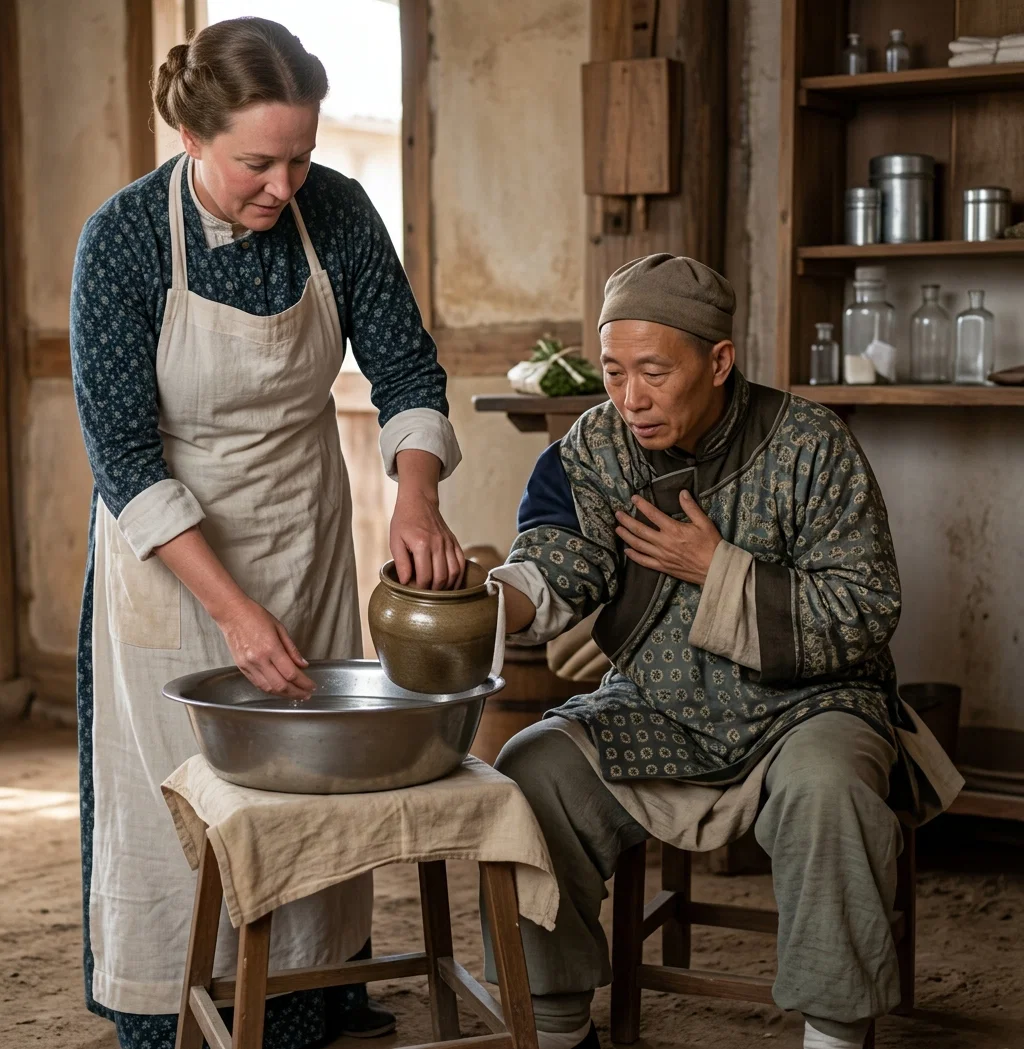
TREATING THE SICK
TREATING THE SICK
The chronic grumblers are very keen on coming to the foreign doctor for an examination and advice; but they are seldom willing to part with a cash for any treatment that may be required; and in case medicine is given to them, they may throw it away, or sell it to some one else supposed to be suffering with a similar malady. After paying the examination fee the patients wait in the chapel, where an evangelist and a Bible woman are either preaching or conversing with them.
During the five weeks 259 persons were treated. This number is exclusive of the several hundred who came with itch and ordinary malaria. As there were so many of these, and as they came at all hours of the day and were usually looked after by the Chinese assistant, no record was kept of them. A large number of the sick whom we treated came back the second time, and some had to return several times. There were in all 216 returns, making a total of 475 dispensary cases.
In the treating of diseases peculiar to women there is, in China, certainly a unique opportunity presented to the woman medical missionary. China has a superabundance of quack doctors, but, fortunately for the women, they are all men; and Chinese custom does not allow them to do more than feel the pulse of a sick woman and make out a prescription. The result is that no one professes to be able to cure the women, and so they do not even dream that there is any help for them, but suffer patiently year after year with conditions that can easily and quickly be relieved by modern methods of treatment. The condition of many of the Chinese women who come to the dispensary, shows that they are sufferers probably beyond the women of any other land, with the possible exception of India.
The widespread prevalence of disease in China should not lead to the conclusion that the climate is especially unfavorable to health; for, taking the country as a whole, climatic conditions are as good as will be found in any other nation of this size. But the people, old and young, high and low, are ignorant, densely ignorant, of the simplest principles of hygiene and the nature and treatment of disease. No thought has been taken in the past by the government for the physical welfare of this countless number of human beings. Very recently there has arisen some agitation over this among the leaders of the new China, but the task can be accomplished only by the education of about four hundred million people.
The principal diseases met with are affections of the eye, parasitic skin diseases, malaria, infections and abscesses, female pelvic diseases, tuberculosis, ear troubles, leg ulcers, intestinal parasites, digestive disturbances, syphilis, and bronchitis. The order of frequency of some of these diseases would of course vary greatly, depending on the locality and the time of year. There are numerous cases of tumors, stone in the bladder, and heart lesions; and, in fact, most of the ordinary cases met with in a general dispensary are included in the list, together with several of the diseases peculiar to the tropics, such as beriberi, kala azar, elephantiasis, etc.
Of the two hundred and fifty-nine persons examined thirty were afflicted with conditions that required a major surgical operation. Many of these pleaded with us to operate. Having neither place nor proper equipment, we were compelled to send them to a Presbyterian hospital, eighty miles to the east of Ying-shang. It is safe to say that not more than two of the thirty were able to go.
In the estimation of results accruing from such a work as is mentioned above, it should be stated at the outset that the most fruitful medical work, judged from the number who are led in a short time to accept the gospel, is that carried on in a hospital. In a hospital the patients are resident for some time, and cannot but see and hear the gospel daily. Many of them, having been helped physically after they had given up all hope, are ready to learn the doctrine that leads people to do for others what the doctors and nurses have done for them. Moreover, any line of efficient medical missionary work results in a kindly feeling on the part of the public toward the missionary and his work. He is looked on as one who helps people. In some cases the influence of the help received from a visit to the dispensary is very marked. Many who have publicly vowed they would rather die than enter a Yesu tong (Jesus hall), will, when seeking relief from physical suffering, come into a gospel hall to see the doctor. In some cases those of other missions who have heard nothing but evil reports of us and our work, are, through coming to our dispensary, brought into contact with us, and get a glimpse of the spirit of our work.
The work to be done in this field is a proposition that we can grapple with in but one way, and that is by the training of an army of Chinese young men and women who will give the message. Viewed from this standpoint, all medical missionary work should be training work. —the training of Chinese young men and women in the fundamentals of hygiene and in the recognition and treatment of the common maladies. The need of this training is surely not less than the need of such training for our young people in the homelands. To the one who has been in the mission fields the need for such training seems many, many times more imperative than is the need in the homelands. We find that the majority of our present staff of Chinese evangelists and Bible women are earnestly desirous of securing some training in medical ways. Any missionary who has ever been in the interior of China can testify to the fact that the Chinese people look upon the missionary as one who can help the sick; and being besieged day after day by the sick, has led more than one missionary without a medical training to leave his work for the time being, and enter school for a preparation that would enable him to treat the sick. Our evangelists in the interior have a similar experience, as the sick come to them for help. And why should it be thought strange for the sick to come for help to the man or woman who holds up Jesus and the work he did as the perfect example?
A. C. SELMON, M. D.

Medical Missionary Department

W. A. RUBLE, M. D. - General Secretary
L. A. HANSEN - Assistant Secretary
H. W. MILLER, M. D. - N. Am. Div. Secretary

“Medical Science of Today”

THE name of this first book in our Ministerial Reading Course frightens some of our workers a little because it has a somewhat technical, medical sound. One prospective reader said, “I guess I’ll leave the medical books to the M. D.’s,” and he did not read this book. Another said, “I think I can spend my time on something more practical than a medical book,” and he did not register for the course at all.
In view of this attitude of some, it is interesting to note what was said about this book in a recent number of the REVIEW by five who had read it. Now comes another testimony from one who felt a little faint-hearted at first, but who did not allow that feeling to deter him from registering for the course and reading the medical book. Here is the result as he puts it:—
“Before starting to read the book I felt afraid that it might be so filled with professional terms that it would be dry reading, but I found it very interesting all the way through. As to the benefit that I received from it, I can say first of all that it gave me an insight into a new field of knowledge. This will make it easier for me to get in touch with medical men, and perhaps lead some to Christ. I have also become better informed concerning the principles of health reform from the scientific standpoint. The chapter on ‘Idiosyncrasies’ was of great help along this line. I have known of ministers trying to prescribe an exact diet for those for whose salvation they were laboring. I see that principle must be the emphatic portion, the details to be fitted to the individual. I believe that one should read such a book before teaching health reform.”
This book is written by a medical man, but especially for the nonmedical reader. It is far from being technical, but is written in an easy, interesting style, and is very enlightening and helpful to the gospel worker who has an interest in health principles for his own benefit and for the benefit of those for whom he labors, and who desires to be up-to-date in his knowledge of the causes and prevention of common ailments.
It is not too late to enroll for the 1915 course. Registrations are still coming in at a good rate, more than three hundred being now on our roll. The reading schedule for the year is as follows:— “Medical Science of Today,” January to March. “The Minister as Shepherd,” April to May. New “Gospel Workers,” June to August. “History of the Ancient World,” September to December.
This course could be finished by the end of the year if half the year were gone, but it is an advantage to enroll as early as possible. Some are going back and making up the work for 1914. We shall be glad to register any who desire to do this, and send them our credit card for that year when the reading is completed and reported to us.
W. E. HOWELL.
Continue reading: An Important Mission Field —No. 1.