OLD Mr. Chang sat smoking his long bamboo pipe. The palm dust which filled it was the whiff of a moment. Then he filled it again, and offered it to his friend of many winters, Mr. Hsi. Hsi took it and blew a wreath of smoke skyward.
“Dun, the old one, will have a great funeral,” said Chang, looking reflectively at a large wooden coffin that ten years before he had purchased for his own use.
“Yes, he has many sons. He should certainly be well cared for. His spirits should be happy. The spirit that stays in his ancestral tablet is sure of a welcome, for he has provided well for his family; the one at his grave will never be lonely, since his fathers for generations have been interred there, and he that floats in the air will always find a resting-place.”
“When he passes by today,” resumed Chang, “I will set off twenty packages of firecrackers, to frighten away the evil ones. We are related distantly, you know. His father’s mother was my grandmother’s cousin, on the father’s side.”
“True, true,” answered the other with true Oriental suavity.
“I, too, have many sons, friend Hsi,” Chang remarked after a pause, looking again furtively at the coffin, “and you are my friend, and also somewhat related to my insignificant family.”
“Yes, it has ever been a source of satisfaction to me to know that I have a slight connection with your noble and illustrious name,” replied Hsi politely; and understanding, withal, that a solemn charge had been laid upon him, He was about to add, “May your years be many!” but thought in time that this would insinuate that they might be few, so he added, “Liao lived to be a hundred ten years old,” which remark served the same purpose and comforted the old man’s heart. If one lived for a hundred years, why could not two, and the second might be he, Chang.
But he didn’t. This morning the sweet calmness of the air was disturbed by the beating of gongs and the whining of bamboo flutes. Down the lane came a blue satin umbrella, and behind it were four little boys dressed as Buddhist priests. Twelve or thirteen old men followed, carrying long poles with carved metal tops, tops that were fishes, beasts, and birds. A beautiful sedan chair bearing a likeness of the deceased was borne by four hired men. Then came the ancestral tablet, followed by the little Confucianist priest-students. The Taoists were behind, dressed in wonderfully embroidered gowns of blue satin. Twenty sons arrayed in coarse white sackcloth or heavy linen came with bowed heads looking neither to the right nor to the left until they reached Mr. Hsi’s house. There the cortège stopped, and as the hundreds of firecrackers banged, filling the air with smoke, the sons bowed to the ground in reverence.
The coffin that Mr. Chang had gazed upon for so many years now held his mortal remains. It was covered with a bright-scarlet satin cloth. Ten stalwart men bore it high in the air. The women of the household were in sedan chairs, wailing and sobbing as if they were really sorry,—all but one. The rest of the family didn’t want her to go to the funeral. She was too poor, too stupid, she was out of favor since her husband’s death some time before, and altogether it
(Concluded on page 13)
My Boys
By Grace Duffie Roe
THE superintendent interrupted our lesson study, which was just beginning, and asked: “Will you teach a class, Miss Mary?”
“Oh, no, Mr. Hall, I am really not prepared,” I replied, and gave a little fluttering breath of relief as he turned away and passed down the aisle.
“We are short of teachers today,” I heard him explain; “can you help us, Miss Rose?” “Oh, no, sir,” said my friend’s musical voice. “Will you?” “Will you?” Still the same reply, until he turned, and, with a half-smothered sigh, left the room.
I felt ashamed of myself as it was, but when I heard the organ in the next room begin to play the familiar air,
“There’s a work for me and a work for you, Something for each of us now to do,”
I left my place and walked swiftly to where our superintendent stood trying to group three turbulent little classes within hearing and controlling distance of a bright-eyed girlish teacher. “I will do my best, Mr. Hall,” I said, and followed him as he led down the long aisle, past the winsome, daintily gowned little girls; past the sturdy little boys with clean, shining faces and well-brushed hair, the well-behaved tidy children of Christian homes; on, until we reached the corner held against all claimants by twelve as mischievous boys as ever lived. Bad boys they were, “Street Arabs,” many of them, and all there for the laudable (?) purpose of breaking up the school and routing the teachers. Ah, the missiles that were fired from that rebel fort! the music spoiled by those discordant throats! the tears of shame and anger that their heartless pranks had caused! Twenty-four eyes, defiant, critical, or sly, watched my approach. “This is your work, Miss Mary,” said Mr. Hall, and with a grave inclination of his head to the class, passed on.
Of course I was frightened. But then, I like boys, and you can be assured they knew it.
“Boys,” I said, as I tipped my chair before sitting down to shake off an inverted pin, “I don’t know anything about teaching. Suppose we try studying together and talking the lesson over just among ourselves?”
No answer. They were “sizing me up.” At last one graciously advised me to “sail in; they’d see if they liked it.”
Well, the lesson was just the one! We went from Joseph, the young lad in the Orient, occupying his first opening—the pit—to Joseph—any motherless boy in the class—seeking an opening in the great breathless city, so full of pits for unwary feet.
The lads behaved beautifully, and as the superintendent’s bell rang, I breathed a prayer of thankfulness that all had been well.
During the closing exercises my classmates held a whispered consultation which I did not feel brave enough to try to check, and then their spokesman, after an encouraging nudge from the sharp elbow of the boy next him, coughed formally and importantly, and said, “Say!” I waited. “Us fellers like you first rate, an’ if you’ll stay, we’ll do the square thing by you.”
“Why, boys!” I said, in surprise, “I could not take this class. You might act badly, and I could not control you. I would not try. But it would make me very sorry.”
Silence. Another consultation, and then: “Didn’t I say as we would do the square thing by you?”
“Boys,” I said, with a rush of something from heart to eyes, “I believe you, and I will stay!”
Oh, the joy I had with those dear lads! Not once did they fail me in those five delightful years. How I watched them, as a mother would her sons, as their bonnie heads left the height of my shoulder and crept up into the stature of glorious young manhood.
We learned so many things together. How the chivalric spirit of young America did spring into life and illuminate the characters of those boys, until I could count on every one as my knight, champion, and defender, “without fear and without reproach.” “Every one,” did I say? Yes, every one. Jamie, my “poor Smike,” as I always think of him, too. True, he was not so bright as his keen-witted mates. He had been kicked and cuffed about by a brutal father until his spirit was dulled and his poor body shrunken and deformed; but he was very dear to me, and always sat close by my side, and the boys never plagued him after they knew it hurt me. He worked on a coal barge, and had no one to care for him at home; and I did wish I could show him the next virtue to godliness. But Sabbath after Sabbath he came with grimy hands and unkempt hair and collarless throat, presenting a striking contrast to his classmates,10who had by this time reached what Mr. Burdette calls “the necktie age.” How much thought I gave to those unwashed hands! What could I do to call his attention to his defect without wounding his feelings?
At last, one day as he sat in his accustomed place, I saw his sooty hand spread on his knee, and drawing off my glove, I laid my own upon it. The action was a natural one, and all unnoticed by the rest, but I felt a sudden start, and knew, without looking, that a flush crept up to the roots of his matted hair. Back slid the hand from under mine—back till he had hidden it and its grimy fellow behind him. And Jamie had learned his lesson.
One day a messenger from the hospital came to tell me that one of my boys had been injured and had sent for me. One by one the faces of the dear lads flashed by. Which one was I to see stricken and changed—perhaps at death’s door?
“You wish to see the young man who was hurt today. Are you his teacher? Come.” I followed the low-voiced nurse as I had followed the Sabbath school superintendent so long ago, and at the end of the long aisle I found, as I did then, my poor Jamie. His blue eyes opened as I spoke his name, and the white, drawn face shone with a sudden, loving welcome. “I knowed you’d come, Miss Mary, fur to say good-by,” he whispered, as I clasped his hand. “You come to see me off the time I went to Canada to work, an’ now—I’m goin’ away again—down into the valley of the dark shadder, you know.”
(Concluded on page 14)11
My Boys
(Concluded from page 10)
“Yes, Jamie, dear laddie! But you are not afraid?”
“I would be—awful—Miss, but—I know the Cap’n.”
The lids dropped over the heavy German eyes, and for a moment I supposed he slept, but suddenly they opened and as his glance fell on our clasped hands, something like a smile crept around his pale lips.
“It’s clean now—Miss Mary—it’s—clean—like—my—Cap’n—wants—my—heart—ter—be, an—” but Jamie was gone.
Yes, dear Missionary Volunteers, there is work for every one of us to do for the Master. Perhaps it is teaching a Sabbath school class. And perhaps you do not care about teaching. But if the call comes, do not turn away unheeding. The fruitage will repay your efforts a thousandfold.—Grace Duffie Roe (Adapted).
Painting by J. H. Sharp
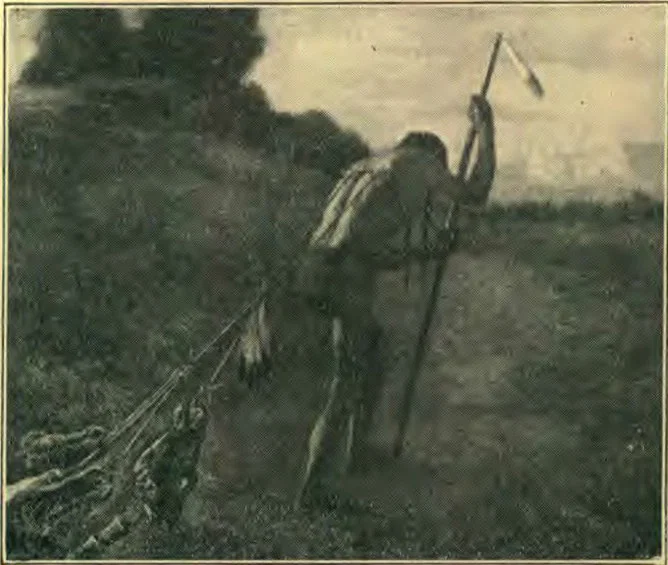
“The Stoic”
By Orno Follett
“This painting hangs on the walls of the art gallery in the State museum at Santa Fe, New Mexico,” writes Elder Orno Follett. “It is said to represent the ceremony following death in a family of the Crow Indians of Montana.
“The dearest one of the household has been taken by death, and the ‘Stoic’ goes to the near-by hillside, there to perform the rite which is to place him in harmony with the elements and powers. From sunrise to sundown he paces up and down the weary trail, demonstrating to the gods that he has not been crushed by bereavement or sorrow, that he is still able to bear the burden for himself, the family, the tribe. He reiterates that the supreme happiness can come only through suffering and sacrifice, and that man must conquer himself before he can be in harmony with the elements and the powers.
“Notice how the cruel, harsh rope has been thrust through openings cut into the flesh of his bare back. Sacred feathers are tied to the rope, and at the end dangle three or four horse heads, the bodies of which may have been sacrificed over the loved one’s grave. What excruciating pain this penitent must suffer while ‘demonstrating to the gods that he is not crushed by bereavement!’ O, to what end will men not go who know not Him who is able to be man’s Saviour!
“And this is not in heathen lands beyond the seas, but among one of the pagan tribes right here in our own homeland. Shall we not put forth greater efforts than ever before to give the last message of mercy to these neighbors of ours who are groping in midnight darkness, and in their soul blindness seeking for salvation which only God, through His Son Jesus, can give?”
Do You Dare to Be Different?
By Emily Johnson
EMILY JOHNSON
“Is the doctor in?” I turned to see who was speaking. In the door of the doctor's private office stood an old man dressed in working clothes.
“No,” I replied. “Is there anything I can do for you?”
“Oh, I just wanted to talk to somebody.”
Then I remembered that I had seen the bent old man hoeing weeds in the doctor's garden.
Without waiting for an invitation, he seated himself on a low stool in front of me, placed both elbows on his knees, and began to talk.
“And why do you have those copper wires twisted around your wrists?” I asked.
“Oh, that is to drive away the rheumatiz.”
Then followed a long story of how he had suffered. Doctors had been unable to do anything for him. Finally he had discovered this unique remedy, and he assured me that it was very effective. The entrance of another caller engaged my attention. The old man shuffled out of the office as unceremoniously as he had come. I never talked to him again, but for some reason that one picture of him insists upon remaining in my memory. Just why I cannot tell. Perhaps it was because he was unusual. His ideas seemed crude to me. Nevertheless they were his own.
“Hastings!” shouted the brakeman as he threw open the door of the coach. Just then I felt a friendly hand on my shoulder. I looked up into a wrinkled face. “If you see my friend, Mrs. Blank,” she was saying, “be sure to tell her you saw me.” Just a few minutes before, she was only one of a crowd waiting in the railway station. Her dress was extremely plain and somewhat old-fashioned. That did not attract my attention especially, because it harmonized so well with her quaint old-fashioned ways. But there was about her that indescribable “something” that singled her out from the crowd. I entered into a brief conversation with her. Although I have seen many hundreds of people since, the picture of her is so vivid in my memory that I should recognize her wherever I might chance to meet her.
A modern philosopher says: “For one man that thanks God that he is not as other men, there are thousands to thank Him that they are so like their neighbors that no one will notice them.” While every one of us is exceptional by nature and experience, our education cultivates conformity, and discourages originality.
At the close of an address, a number of the congregation asked the speaker why he had said, “I believe,” one hundred fifty times in his sermon. I do not know what reason the speaker gave, but if I were to venture a guess, I should say that it was because he did not believe what he was saying. If he had been stating his own thoughts and convictions instead of what some one else believed, there would have been no need of affirming it so frequently. Everybody would have known that he was presenting his own beliefs.
Some one has said: “The scribes and Pharisees were not used to thinking of God as Christ did, and it seemed to them improper.” It has always been true that any one who thinks for himself or in any way departs from the beaten path, runs the risk of being misunderstood, shunned, and persecuted. We are always afraid of the exceptional. We seem never to learn the lesson. We are as intolerant to-day of divergence from the customary ways of thinking and doing, as man has ever been. It takes superior courage to escape from old ideas and old standards.
What Is My Name?
By Henry De Fluiter
HENRY DE FLUITER
I have no tongue, but speak the loudest.
No feet have I, but encircle the earth.
A visitor in cottage and palace.
I am hated and loved.
I create sorrow and joy.
I cause murder and save life.
For my sake nations are crushed, and by me nations rise again.
For my sake religion is dragged in the mire, and because of me religion is made to prosper.
I save the lives of little children, and crush them through selfishness.
I cause strong men to fall, and encourage the weak.
There is no room for me in heaven, and hell is filled because of my influence.
Souls are damned because of me, and heaven will rejoice because through me love and sacrifice found expression.
I am Money.
How Ailsie Saved the Bible
By Mary S. Hitchcock
It was in the year 1555, when Queen Mary sat upon the English throne with her Spanish husband at her side, and filled the land with trouble because of her terrible persecution of the Protestants, that the following incident took place: In the western part of England was a little village called Harrant. At one end of the hamlet, standing apart from the few dwellings scattered along either side of its single street, was the blacksmith’s shop, with his small house just back of it, and a tiny garden in the rear.
The blacksmith’s wife was dead, but his blue-eyed little daughter kept his house. When lonely, she pushed aside a small panel in the end of the shop, and crept in and stayed with him, unless the sound of voices or hoofbeats on the road drove her away, for she was a shy child.
One day when she had stolen in, her father was standing behind the door. He had a sliver in his big hand, with which he touched the side of a great black beam in the corner. Suddenly a block of wood fell forward, disclosing a small opening. Into this he thrust a dark leather-bound book and quickly but carefully lifted the chip into its place, so that no sign of the hidden space remained.
Seeing his daughter, he started and said sternly: “Ailsie, child! How dare you spy upon your father?”
“Oh, father, I am not spying,” and the blue eyes filled with tears.
“Of course you are not. I was wrong to say so, child,” said the smith remorsefully. “But you saw what I did?”
“You put the Holy Bible into the beam, father. It is a fine hiding place, too; for surely neither priest nor soldier can find it there.”
“I would you knew not its place of concealment, for the knowledge may bring you into danger, lass. You must never betray it. When Parson Strowe went away to foreign lands, he gave me the Sacred Word, and told me to keep it as my life; for by the queen’s orders, all the Bibles have been gathered up and burned, and we are forbidden to read from its holy pages. This is the only one between here and the sea; and it is more precious than the crown jewels. You are fifteen, Ailsie, and old enough to understand, so I have told you all.”
“You need not fear, father,” said Ailsie firmly. “I will not tell.” But the rosy cheeks grew pale as she remembered all that her promise might mean. Now, there was a certain priest that came sometimes to Harrant to preach to the villagers. But being all Protestants, they would neither listen to him nor pay him tithes. He was angry at their behavior, and spied about until he became sure there was a Bible among them; and he knew that it was in the blacksmith’s home, because he was the only man in the village who could read.
After trying in vain to find the Holy Book, he went to the nearest town and lodged information against the village with the officers there; and one day, when the smith chanced to be away from home, an officer and six men marched into Harrant. They called upon the cottagers to surrender their Bible; but one and all declared they had none. Then the soldiers searched every dwelling, and threatened to burn them, every one, unless the Book was found. But that did not suit the priest at all. He would get fewer tithes than ever if the village were destroyed. So he told the soldiers to let the rest of the villagers alone, for the Bible was in the blacksmith’s possession. It was getting late, and the soldiers were in a great hurry to be gone. So they resolved to burn the two little buildings, and thus destroy the Book quickly and surely.
At first sight of the strange men, Ailsie had fled through the garden, out upon the moor, and hidden among the furze bushes. She was terrified, for she feared that they might find her and demand the hiding place of the precious Bible.
It was growing dark when she saw a bright light against the sky, and sprang to her feet. Her father’s house was on fire. The sight made the shy child a heroine. Forgetting all about her danger, she only remembered that she must save the Bible at any cost. She flew homeward.
The soldiers were intent upon piling straw around the burning buildings, and did not see the little figure that darted between the house and the shop, whose thatched roofs were all ablaze. Breathless and determined, she pushed aside the panel and stumbled through the blinding smoke.
The hungry flames scorched her dress and her hair, and burned and blistered her hands and face, before she secured what she sought. But at last she reached12the Bible and fled out into the open air. No one had noticed her in the darkness, and she crept safely into the garden and sank down, choked and suffering, among the vines.
She slipped off her woolen petticoat and wrapped it around the volume; then digging her little burned hands in the soft soil, she buried it under an immense cabbage. Then she crawled upon her hands and knees to the spring at the foot of the garden, where her father found her an hour later half unconscious with pain and fright. He never ceased while he lived, to praise his little daughter for her brave deed of that day.
The Bible always remained in the family, and years and years after, Ailsie’s great-granddaughter carried it with her when she followed her Puritan husband across the seas to the lonely coast of New England.—Mary S. Hitchcock.
The Experiences of a Diver
By H. Phelps Whitworth
If there is any place in the world where one wants a clear head, it is under water. There is an uncanny feeling about the bottom of the sea, a loneliness that causes one to start at the sudden appearance of a dark mass of rock, or the unexpected touch of a sea finger, and a vague feeling of apprehension that something may come out of the blue of the distance.
One's first thought on seeing a shark is to be pulled up or to take to one's heels; but, as fish have sufficient human nature about them to want a thing as soon as they see it being taken away, it is safer to stand perfectly still. In fear that my bare hands might attract the man-eating propensity that sharks are supposed to have, I invariably tucked them carefully under my breast weight, and when the fish had disappeared, gave the signal to ascend, kicking violently all the way up. If a diver remains quiet, he is quickly surrounded by an admiring crowd of fish, opening their eyes and mouths like curious countrymen. The smaller ones have assurance enough to nibble at his fingers; but let him throw up his arms, and with a flourish of tails they vanish. As the pearling fleet is dependent to a certain extent upon fish for food, the diver never misses an opportunity to catch anything edible. Crayfish are easily caught, and make quite an agreeable addition to the ordinary diet. Turtles, too, are plentiful, and being fresh meat, are valued more than fish.
The memory of my first tussle with one of these animals is impressed very vividly on my mind. I had been told to approach the creature quietly from behind, grasp the edges of the shell, lift it quickly to my chest, and give the signal to be pulled up. By so doing, I was given to understand that the turtle's head, being pointed upward, could not move in any other direction, and that, therefore, the journey to the surface would be a short one, as the turtle's flippers would be powerful enough to take me up without any other aid. Accordingly, when I saw my first turtle, feeding quietly on a patch of sea grass some distance ahead, I made a circuitous path, and crept cautiously up behind it. By the size of the barnacles on its back, I knew it was an old one, and it looked tremendous; but I put that down to the face glass. When I was within a few yards of the game, whether it was the bubbles from my escape valve, or the heavy tread of my 32-pounders that scared it, is a question; but suddenly up shot the turtle's head. I ducked immediately behind a sponge growth, and crouched there with beating heart, fearing that my opportunity was gone. In a few moments he resumed eating, and without waiting for further developments, I made a run and a jump and landed fairly on the turtle's back. In stretching out my hands to get under the shell I must have fumbled. Before I had a chance to raise the monster, I felt my feet being dragged over the bottom, and a moment later I awoke to the fact that my intended capture had captured me, and was swimming away with me at an astonishing speed. Away we went, the turtle trying to leave me behind, and I hanging on with might and main. In vain I tried to point his head toward the boat—he would have none of it. Drop, I dared not; for the bottom was out of sight, and I feared I should fall heavily. Signal, I could not; my hands were very much engaged. While in this state of uncertainty, we came to the end of our tether—the limit of the life-line. Then there was a sudden jerk, and we parted company. The turtle continued on his way, and I fell headlong down. Luckily I struck on a large sponge growth, and thus broke my fall; but I was a good deal shaken up, and was hauled up, thoroughly disgusted, and feeling sure that it would be a long time before I tackled another turtle.
Fishing on the bottom is carried on to quite an extent. Leaving one end of the line in charge of a “boy” on deck, the diver descends with hook and bait and conceals himself among the rocks or sea growths. Instead of dropping his hook, after the usual method of fisherman, he floats it a few feet above his head, by means of a piece of wood brought down for the purpose. If a shark or other objectionable fish heaves in sight, he hauls down his colors in double-quick time; but if it be a rock cod, a schnapper, or any of the large edible fish which abound, he tightens up his escape valve for a minute, lest a bubble frighten the fish, and hangs onto the line with both hands. As soon as the fish has the hook fairly in its mouth, a sharp pull hooks it, and at a signal to the “boy” above, the big fellow goes struggling to the surface.13
One of the most ludicrous and yet annoying things that happen to a diver is the discovery that a fly or other insect has been screwed up inside the dress. It is bad enough for his nose to itch, and be unable to scratch it, or for him to find something in his eye and be without means of taking it out; but when a fly that has been concealed in some part of the dress begins to crawl deliberately over his face, and play hide-and-seek up his nostrils, it is simply maddening. It is useless to butt the face glass or wildly knock your head against the inside of the helmet, or to make hideous faces, for all this only tends to make the insect more lively, and hurries it, in its excitement, into your ear or elsewhere. The only thing to be done in such a case is to shut eyes and mouth as closely as can be, and give the signal to ascend.—H. Phelps Whitworth.
SOMETIMES I wander through a maze
Of sights and sounds of other days;
And oft recall a salient rhyme,
A song, or symphony sublime;
I seem to hear a beauteous blend,
Affiliated artistry,
Where varied tonal bodies lend
Their aid to virtuosity.
A mighty instrumental mass,
Composed of strings, wood wind, and brass;
These three main groups, at sundry times,
The organ, kettledrums, and chimes,
The violins’ impassioned sweep,
That runs the gamut of the soul;
With thrills that laugh or tones that weep,
They sing with unrestrained control.
Their clean-cut accent often meets
The alto viol’s after-beats;
Or counter melodies are sung
As though from hearts with anguish wrung,
The cellos throb with grief and pain,
The darker shades they well portray;
And now a lilting glad refrain
Those master melodists essay.
While harp tones ornament the theme
With gold, and pearl, and crystal gleam,
It is with pleasure that I list
To that divine accompanist.
Like breakers’ boom on rocky shore,
Those great string basses ably manned;
They form the fundamental core,
The rhythmic guardians of the band.
This group may occupy the throne;
Yet, if unaided and alone,
Vain is the music master’s dream
Without a varied color scheme.
The voices of the wood-wind choir
Ethereal, plaintive, sad, grotesque,
They weave with silver and with fire
The flute and oboes arabesque.
Less brilliant, more expressive yet
Now sweetly chants a clarinet;
With here and there the drone and croon
Of English horn or low bassoon.
What wondrous tonal pictures glow
From these so little understood;
Few mortals ever really know
Those pipes of silver and of wood.
But ere from this bright scene we pass,
Let’s not forget the sounding brass,
Exponents of the lofty mood,
Of courage, faith, and fortitude.
Upon my list’ning ear, there falls
A voice distinctive, strident, keen;
I hear those thrilling trumpet calls
In Handel’s resurrection scene.
The horns, with mellow, blending tones,
The noble resonant trombones,
The tuba’s majesty profound,
Are waves on that great sea of sound.
When wild crescendos stir the soul,
The kettledrummer’s mallets play,
From rustling leaf to thunders roll,
From sounds of peace to battle fray.
Those harmonies have fainter grown,
Till I sit silent and alone,
And think that much of heaven’s bliss
Will be made up of sounds like this.
But sin-stained hearts and mortal hands,
No blunted auditory sense
Can e’er approach or understand
Angelic songs or instruments.
Divine, though oft perverted, art
Of God’s unchanging plan a part.
If ev’ry voice and pipe and string
Would their Creator’s praises sing,
And ne’er betray that sacred gift
To mammon, Venus, or to Mars,
From earth’s dark night the scenes would shift
And we would hear the op’ning bars
Of that exultant glory song,
From ransomed host and angel throng,—
Redemption’s climax of accord
Directed by creation’s Lord.
The world, ensemble, then will greet
The sphere, that moved discordantly.
Earth’s golden harps will just complete
The universal symphony.
Behind Prison Walls
(Concluded from page 6)
man good-by, he to return to his work, cheered, we hope, by our personal interest and encouragement.
As the great gate closed behind us, and we were again in the open, we felt to thank God anew for the gospel and for a hope in Christ that lifts men and women out of their troubles, and gives them something definite and tangible in which to place their trust. This visit gave us also a greater appreciation of the work our literature is doing even behind prison walls. And the whole Missionary Volunteer Movement with its thousands of young people, and the wonderful avenues it opens for service in times like these, seemed more dear to us than ever before.
A Heathen Funeral
(Concluded from page 8)
was not fitting that she should follow the coffin of the notable Chang. But here she was, dressed in a ragged white coat, carrying her young son in her arms, stumbling along after the coffin. Her wails penetrated the air. They were louder than the wails of all the others, and she had the attention of the lookers-on, which was more than the other women mourners could boast.
The tacit understanding between Chang and Hsi had been fulfilled. The devils had been chased far into other lands by the firecrackers which Hsi had offered.
“May some one do as much for me,” said Hsi as he went and bowed before the ancestral tablet of his father’s house.
1. What did Christ give His followers after He ascended into heaven? Eph. 4: 8. Note .
2. For what purpose were these gifts bestowed? Verse 12. Note .
3. How long will the gifts remain in the church? Verse 13.
4. Out of what condition will the proper use of these gifts lead us? Verse 14.
5. Into whom will they enable us to grow? Verse 15. Note .
To Whom Given
6. How many receive the gifts of the Spirit? How should they be used? 1 Peter 4: 10.
7. By whom are they distributed to men? 1 Cor. 12: 11. Note .
8. Although different gifts are received by each, what wonderful unity exists? Verses 4-6.
9. To what is the church which has these gifts compared? Verses 22-27.
10. What shows that the Bible recognizes a difference in the value of these gifts? Verse 31, first part.
11. What is held up as more excellent than the manifestation of any gift? Verse 31, last part; 1 Cor. 13: 1-8, 13.15
Notes
LYDIA A. FRANK
By Lydia A. Frank
Wanted
LYDIA A. FRANK
The boys who are wanted are good boys,
Good from the heart to the lips,
Leaving untouched earth's grimy things,
Lest sin soil their finger tips.
The boys who are wanted are strong boys,
Filled with the vigor of youth,
With shoulders held back for the on-coming foe,
Prepared to meet him with truth.
The boys who are wanted are wise boys,
With wisdom that comes from the heart;
Who measure the needs of a sin-sick world,
And will act there a true man's part.
The boys who are noble when error
Must be crushed with deadly power,
Courageous, will meet the withering scorn
Which follows the stand of that hour.
The boys who are wanted are not too big
To see and comfort a child.
They are not too young to talk with the old,
And be with them gentle and mild.
The boys who are wanted are boys of sense,
Whom pleasure can never deceive.
They place true values where they belong,
And dare what is worthless to leave.
Boys are wanted who will be brave
To meet the issues of life;
To grapple undaunted the problems that come,
And smile when frowns would mean strife.
The boys who are wanted are true boys,
True to the charge that's theirs —
To bear the heavier burdens of homes,
And share in mother's cares.
Boys who are wanted are mother's joy,
And father's stalwart pride;
These are the boys who in later years
The weaker hands will guide.
The boys who are clever and witty and gay,
A place in the world may fill;
But the work that counts in the reckoning day,
Is done by the men of will.
In Our Counsel Corner the Missionary Volunteer Department will be glad to answer questions concerning young people's problems, their society work, and Christian experience. The Department cordially invites your questions on these matters, and assures you of careful attention. Questions relating to general church problems had better be sent to the Editor of the Review and Herald. Address all communications to the Missionary Volunteer Department, Takoma Park, D. C., accompanied by the name and address of the sender, so that a personal answer may be given if the question cannot be printed. In publishing the question in Our Counsel Corner, the name of the questioner will be withheld if so desired.
Is it proper, according to the “Testimonies,” to have a worldly young man sing special songs in Sabbath school, his mother being a member. Please give me some information, and references where I can read up on that subject in the “Testimonies.” B. F.
The character and influence of the young man should determine the answer. If he is “worldly,” in that he is wild in his conduct and in his associations, frequents disreputable places, and follows worldly amusements, then the influence of his public appearance in the program of Sabbath school, church, or young people's meeting would be detrimental. But if, as a young man, his character and conduct are wholesome and exemplary, there ought to be no objection to his taking part in services. The Sabbath school is a missionary school, and who can tell what may be going on in the heart of the young man? While we do not approve of trying to draw people into the church membership by giving them a part in meeting, yet we ought not to reject help from people of good character who are associating with us, and thus make it harder for them to affiliate with us.
So far as we know, the teaching of the spirit of prophecy does not deal with this question in detail, but if one will follow through the index references for “Sabbath school” and for “youth,” he will find the thoughts just expressed, sustained in spirit. H. T. E.