The Youth’s Instructor, Vol. 71, No. 39.

Does an Education Pay?

The Youth’s Instructor

Sep 25, 1923

Review and Herald Publishing Assn. · Takoma Park, Washington, D. C. · Sep 25, 1923

Does an Education Pay?

Does it pay to learn to make life a glory instead of a grind?
Does it pay to open a little wider the door of a narrow life?
Does it pay to push one's horizon farther out, in order to get a wider outlook, a clearer vision?
Does it pay for an acorn to become an oak?
Does it pay for a chrysalis to unfold into a butterfly?
Does it pay to taste the exhilaration of feeling one's powers unfold?
Does it pay for a rosebud to open its petals, and fling out its beauty to the world?
Does it pay to know how to take the dry, dreary drudgery out of life?
Does it pay to escape being an ignoramus?
Does it pay to fit oneself for a superior position?
Does it pay to get a glimpse of the joy of living?
Does it pay to learn how to focus thought with power, how to marshal one's mental force effectively?
Does it pay to acquire power to get out of life high and noble pleasures which wealth cannot purchase?
Does it pay to acquire a character-wealth, a soul-property, which no disaster or misfortune can wreck or ruin?
Does it pay to make friendships with bright, ambitious young people?
Does it pay to become familiar with all the lessons that history and science can teach us in regard to making life healthy and successful?
Does it pay to change a bar of rough pig iron into hairsprings for watches, thus increasing its worth to more than fifty times the value of its weight in gold?
Does it pay to have expert advice and training, to have high ideals held up to one in the most critical years of life? — Orison Swett Marden, in “Success Nuggets.”

“A Million Dollars for Missions”

WHAT have you done to make this slogan of the Harvest Ingathering campaign a reality? Are you holding up your end? Every little bit helps in an enterprise of this kind, and even if we fall short of a ten-dollar goal, there is great satisfaction in having tried, and done our best.
You do not enjoy soliciting? Perhaps not. Few of us do. But did our Saviour think of His own pleasure when he left heaven and came to earth to travel the rugged, thorn-lined way? Do the workers out on our far-flung battleline in foreign lands consider their own convenience in the service they render? And did you ever stop to think of the blessing that your effort in this line might bring to those with whom you visit about our mission work, and to your own heart as well?
The Harvest Ingathering idea is just twenty-one years old. It had its beginning in Sac City, Iowa.
One of the members of the little company of Seventh-day Adventists there, Jasper Wayne by name, was impressed with the thought that the people of the world would be glad to give of their means to advance the gospel in mission lands if their attention could be called to the work being done, in such a way as to give them an intelligent knowledge of conditions and needs. As he thought and prayed over the matter, a plan came to his mind, and he decided to try it out at once. Just at this time a special issue of the Signs of the Times was published, a Capital and Labor special. He ordered fifty copies. When they came, he unwrapped them at the post office, and began handing them out to people who came in for their mail, with a brief reference to the important information contained in the paper, and stating that any money contributed in return for the paper would be applied to the cause of foreign missions. In a surprisingly short time all his papers were gone, and he had a heavy pocketful of small change—coppers, nickels, dimes, and quarters, amounting in all to four dollars—as the result. Encouraged by this beginning, he ordered four hundred copies of the Signs. These he carried in his buggy as he went on business from place to place, improving every opportunity to use them in the interests of offerings for missions. As a result of his work with these four hundred papers, he received one hundred dollars in donations. In 1908, six years after Brother Wayne’s first venture, the General Conference adopted the plan for a yearly Harvest Ingathering campaign. Interest has grown until the special papers used for this work are printed, not only in English, but also in twenty-one foreign languages, and the world goal for 1923 is $1,250,000.
The need was never greater. The calls from the far fields were never more insistent. The mission treasury was never so nearly empty. Have you done your bit to help fill it? Freely we have received from the Master; let us as freely give of our service in this campaign.

A Unique Memorial Service

Among the many memorial services held for the lamented President Harding the afternoon he was laid to rest in his home town,” writes Elder B. P. Hoffman of the General Conference Bureau of Home Missions, “perhaps one of the most unique was that conducted at the Buddhist temple in the little town of Guadalupe, California, under the auspices of the local Japanese Association. Inside the temple the shrine of black and gold lacquer with its prayer tablets, candles, vases of flowers, and other objects usually connected with their worship, made an impressive background for a crape and flag bedraped photograph of the President. The atmosphere of the room, with its faint odor of burning incense, also seemed charged with a sense of solemnity as upwards of one hundred worshipers waited in silence.
“To mark the opening of the exercises, the silk-robed priest, with bead chain and prayer book in hand, took his place in front of the photograph, to bow reverently and read in ritualistic monotone some of the ancient prayers of the Buddhist religion. The leader of the Japanese Association having heard of my arrival that morning, and knowing that I had been in Japan for some years, had requested me to make some remarks, and after the opening prayers had been said, he talked a little on the object of the gathering, and introduced me. I based my talk on a verse which is said to have been a favorite of Mr. Harding’s, found in Micah 6:8: ‘He hath showed thee, O man, what is good; and what doth the Lord require of thee, but to do justly, and to love mercy, and to walk humbly with thy God?’
“The principles found in that text, if followed by the rulers and peoples of the world today, would afford a solution to the many perplexing problems that exist between nations and races the world over. After my speech, several others spoke representing different Buddhist organizations, and all of them, including the priest, expressed appreciation of the words of the Bible that had been read to them. We hope that the lessons drawn from the Word, and the example of the life of the great American whose work was so suddenly closed, may be a help to these who, while not permitted to become citizens of our country themselves, yet are responsible for the home training and ideals of their children who have been born into citizenship of this nation.”

Whittier's Verse on Strength and Guidance

If there be some weaker one, Give me strength to help him on; If a blinder soul there be, Let me guide him nearer Thee. Make my mortal dreams come true With the work I fain would do.
— Whittier.

We Can and We Will!

ENNIS V. MOORE
“WHAT man has done, man can do better,” said a wise man, and it is this principle that causes us to be egotistical enough to say, “We can and we will.”
The work of the world is not done by the many. The majority of men are followers. Leaders are few. So many lack purpose, determination, or ambition during their youth when an aim in life counts for so much. It is aim that makes the man. Money, talent, or influential friends cannot take its place.
No small number of young people are content to drift aimlessly down the stream of life. They do not realize that the stream is becoming wider with each passing day. Soon it will be well-nigh impossible to extricate oneself from the whirl of the deepening torrents of purposelessness and average indifference. Every day it becomes harder to pull out from the old environment.
Have you been drifting? Have you awakened and found yourself slowly but surely gliding leisurely down the stream of rushing humanity, in the canoe of Aimlessness, steered by Indifference, passing surely out into the sea of Utter Uselessness? Rejoice that you are now awake. Steer straight for the shore. Do not sit and pine, reasoning, “Well, I have drifted this far, there is no use trying. I may as well drift on with the crowd. Anyway, it will be very hard to stem this mighty tide.”
If, through lack of use, you have lost control of the oars of Determination and Pluck, and should there be some one with you in the canoe who refuses to be alarmed by the precarious position of your canoe, forsake his or her companionship; cast yourself into the midst of the stream, hold your head high, fix your eyes on the shore, and make straight for it.
Once there, what are you going to do? Do not bemoan your missed opportunities. Others will come to you. Be not afraid! The world is yours! Made mistakes? Of course you have, but they are in the past, and the past belongs to God; let Him look after that. You can’t change it. Today is yours! Use it. Forget the past. “Fear looks back, courage looks forward.” Mistakes call us back, hopes beckon us forward. Defeat looks back, victory looks onward. Press onward! Do you say, “I have forgotten the past. I want to profit by my mistakes, but I am just one of the common herd; I am merely average. There isn’t anything I can do”?
“The man who wins is an average man, Not built on any peculiar plan; Not blessed with any peculiar luck; Just steady and earnest and full of pluck. “For the man who wins is the man who works, Who neither labor nor trouble shirks, Who uses his hands, his head, his eyes— The man who wins is the man who tries.”
I am certain, my reader, that you are very desirous of making a success in life. Just now you may feel as if there is little need of trying, for you say in your heart, or perhaps openly, “I have no talent. There isn’t one thing in which I am especially gifted.” Ungifted one, do not fear! You must believe in yourself. Talent is largely a growth,—a development of latent energies. Work, and go forward to success.
Lift yourself out of your present self. Get into a different environment, if the present one is not conducive to the proper development of your mind and soul. You can do it! The power is within you. The very fact that you are conscious of no extraordinary talent or ability, is one omen of a successful life. The Lord cannot use those who are lordly, self-sufficient, and proud. He said through Luke, “Whosoever exalteth himself shall be abased.”
There is no height to which a soul cannot attain when totally surrendered to the leadings of the Spirit of God. With our wills entirely subservient to His, we may become what we will.
Never think that accomplishment and success will bring you entire satisfaction, for he who is truly successful is not satisfied with his attainments. There will always be greater heights to reach, new problems to meet, and more rugged peaks to surmount. Life is indeed a constant growth, and its fullest joys will never be known until eternity is ours.
“Heaven is not reached at a single bound; But we build the ladder by which we rise From the lowly earth to the vaulted skies, And we mount to its summit round by round.”
“We can and we will” be a success in life, but it takes more than saying it to accomplish it. First, it will take personal contact with Jesus. He must be very real to us. We will want Him for our Counselor, our Friend, and our Adviser, if we expect to succeed. We can do nothing without Him. We must be yoke-fellows together.
Second, we will have to “launch out.” We will have to get down into the thick of the fight. Ours will have to be a life of toil and sacrifice. We dare not hold back because of apparent hardships. Ours may be a life of isolation and loneliness in some foreign field. Ours may be a life of sorrow and suffering, but it must needs be a life of willing endeavor, whenever and wherever God calls, if we would succeed.
Third, and the most important to success, “We can”—dare I say?—“and we will” give our minds, our hands, our lives, and our all to God for service now and evermore! A man might be called a success in this world, and the word “success” be engraved in large letters on his tombstone; yet on the ledgers of heaven would be indelibly written with ink eternal, “A failure.” Why? Success, not Christ, was his savior. Let us live the life that can merit, not only the earthly commendation, “He was a success,” but also the heavenly reward, “Thou hast been faithful.”
São Paulo, Brazil.

LETTERS TO A PROSPECTIVE MISSIONARY

Puno, Peru, Sept. 25, 1923.
My dear Arthur:
The mail goes in the morning, and I want to have this letter ready to send. There are two trains a week from Arequipa to Puno. They arrive at night, and leave again in the morning. We get mail here for most of the mission stations, and take care of it until there is opportunity to send it on. Flour, sugar, medicines, and other supplies also are sent out from Puno, so the mail doesn’t usually wait many days. The workers haven’t time to come in often, but they can trust our Indian brethren to make trips for them, and Indian labor is very cheap. “Medicines” include absorbent cotton, adhesive plasters, etc., for although a missionary is not a doctor, in any Indian community there is always much sickness, and often there are accidents, and so, helpless as he may feel, he must do something; no one else can. Fortunately, most of our workers have had some kind of medical training.
Just now I smiled as I remembered your objecting, as a little fellow, to a wooden potato masher. “There must be germs on it,” you said. You will have more reason for objecting to the Indians. Germs? Always! Lice? Usually. Yes, and fleas and dirt, to say nothing of the smell. But if because of this, you cannot call the poor, neglected Indian “brother” and love him from your very heart, I beg of you not to come. Your work would be a failure. A wholesome fear of germs is not to be despised, and you will have plenty to be afraid of. Consumptive lungs, fevers, old sores, skin eruptions, are constant reminders of the dangers to which one is exposed. But I believe if the Great Physician were here in person, He would touch the sick; He would put loving arms around the broken-hearted and console them; He would enter the low, dark huts, and eat of the unattractive food. And He is our Pattern.
We do not live on a mission station, but I have visited several, and, of course, know all the workers, and I think a mission director is really wonderful. To the Indians of his mission, he is preacher, teacher, doctor, adviser, and friend. “Friend” includes everything. He must be present when the new baby is named, to pray that it may be blessed and be a blessing; he must be present at the wedding feast, adding his good wishes and giving timely counsel; he must comfort those who mourn, and perhaps taste the sweetened water that the mourners drink at the grave before separating; he must visit, to encourage and pray with any family that is in serious trouble, whose son has been drafted for the army, whose donkey has been stolen, or whose house has been struck by lightning; he must encourage the persecuted one who is trying to live the truth alone while his family is still in darkness; he must rebuke the wayward son or daughter, and teach the parents gentleness; he must make peace between brethren; he must admonish the brother who beats his wife. There is no end to the duties that come to him, some serious enough to stagger, some so trifling that he is tempted to feel irritated, but these people are his children, and so he treats with due gravity whatever hurts them. To the poor Indian the death of some animal may be a greater trial than the loss of his house, for he can make another house, but he cannot make another cow.
A mission director is only human. He gets tired from overcrowded days and weary rides; he is far from home and kindred and civilization; the strain of living at such an altitude in the electric-charged air puts him on a nervous tension; he loses weight. There is nothing in nature to keep him from losing his courage and quitting. But always and always there is One who understands. Our Saviour spent many trying years in work like this. He understands the temptations, and He gives grace.
Don’t let this dark picture discourage you. I thought it only fair to let you see this side, but don’t imagine for one instant that there is more cost than gain in the work. The satisfaction you will have in relieving another’s pain, the real joy that will fill your heart at seeing a needy man confess his Saviour, the peace that God will give to you as you do His bidding,—these and many other blessings will make your cup full to overflowing. Any mission director will tell you so. Come over and help us.
With love and many prayers,
Aunt Gussie.

The Way that Leads Home

The Only Way to Save Us

MATILDA ERICKSON ANDROSS
The picture of Kate Shelly, and the story of how in the blackness of night she crept across the rushing torrent on the wrecked railroad bridge to save the midnight express, has grown dim in my mind. But somehow it still speaks to me of unselfish love for others. It pictures to me the love that counts not the cost, and helps me to understand the love that must rule every heart of those who would see Jesus. “Self-sacrifice is the keynote of the teachings of Christ. Often it is presented and enjoined in language that seems authoritative, because God sees that there is no other way to save man than to cut away from his life the selfishness which, if retained, would degrade the whole being.” —“Testimonies,” Vol. IX, p. 49.
A few years ago I was sitting in a large reception-room with a dear friend who had spent many years in Russia. She had known the hardships of the war when opposing armies, like the waves of the sea, surged back and forth over the land. Many of the things to which human hearts cling, she had seen disappear or become absolutely worthless in the storm of war. As we looked out on the happy, well-dressed crowd of men and women standing around in groups, or passing from place to place, her eyes filled with tears. I suspect she was thinking of Russia, and after a moment’s silence she said: “Oh, I am afraid these dear people will never learn sacrifice except through suffering.”
The changing crowd before our eyes was composed largely of church members who made exactly the same profession as did the friend who spoke. Her words called me to thought. Her simple, neatly made garb, added to the memory of her faithful life, preached a strong, silent sermon that I have often recalled. She had learned the joy of real sacrifice; and with it had come a love for others that knew no limits in self-denial. But alas, there is great danger that we shall find such satisfaction in a mere profession as to forget to let Jesus pour enough of His love into our lives to transform them. There is danger that we shall not let His love burn the curtain of worldly allurements that blinds our eyes to true values; and there is danger that we shall not let enough of His love into our hearts to burst open the vaults of selfishness, that He may take freely of the things we call our own, and use as He shall choose in His work for others.
But why speak of possessions in this connection?
Because just here we touch the taproot of all selfishness. Money is woven inseparably into the cells of the selfish heart. So much is this true that one Bible writer calls “the love of money” “the root of all evil.” It has become such an intricate part of life, that a man’s investment is a fairly good test of his interest in an enterprise. We hear much of the heathen’s worshiping mere idols. That is pathetic. But can a picture of greater pathos be produced than that of a so-called Christian bowing the knee to gold? He does it for the things gold will buy,—pleasure, fame, luxury. And ever Satan urges him on. He plants in his heart an insatiable desire that makes him add field to field, house to house, bond to bond. So the enemy keeps him employed while he robs his heart of life’s true riches and leaves him an impoverished soul.
All this scheme of Satan’s God foresaw when He called man into business with Himself, and in this greatest business on earth God calls us to invest our all. There is no other way to save us from the enemy’s snare. “In return for the great love wherewith Christ has loved you,” says a message from an inspired writer, “you are to bring to Him a thank offering. You are to make a gratitude offering of yourself. Your time, your talents, your means,—all are to flow to the world in a tide of love for the saving of the lost. Jesus has made it possible for you to accept His love, and in happy co-operation with Him, to work under its fragrant influence. He requires you to use your possessions in unselfish service, that His plan for the salvation of souls shall be carried forward with power.”
And to do this is the only way to be a successful soul-winner, a true Christian. But does that mean that we must sell what we have, and give all? To this question one careful writer says, “Possibly not; but you must be willing to do so for Christ’s sake, and it may even be demanded of you. . . . In every case, He requires us to forsake all that we have by acknowledging our possessions as absolutely His, and by employing them freely in His service to the full extent to which they are needed to secure the highest success of His cause.”
If all Christians followed this rule, God’s treasury would be full. “If its principle could be carried out even approximately,” said a young people’s leader in Christian Endeavor work, “the kingdom of God would advance by leaps and bounds. Every good cause at home and abroad would have sufficient money at its disposal to carry on its work, and the evangelization of the world in a single generation would be an accomplished fact in this generation.”
The work of God, however, does not need our money as much as we need the blessing that comes from giving. Moody must have had this in mind when he said: “Give until it hurts, and then keep on giving until it doesn’t hurt.” Such giving helps to support the cause of God on earth, and brings to the giver elements of character of inestimable value. The young people who are constantly helping to supply “the sinews of war” cannot continue to live selfish, self-centered lives. Giving develops unselfishness, it enlarges the interest of the giver, broadens his sympathies, increases his faith in God’s work, discovers for him the deep joy of giving, and helps him to see what true success in life really is. Wesley, who made it a rule to limit his annual expenses “to a specified sum, and give all the rest,” once said, “Having first gained all you can, and secondly, saved all you can, then give all you can.”
Then just as we have learned that regularity in partaking of food, rest, and recreation is essential to the best health, so the Master teaches us that the choicest blessings of giving are for those who are faithful and systematic in their benevolences according to His plan of tithes and offerings. Our tithe we pay as an acknowledgment of God’s ownership of all things—ourselves, our loved ones, yes, all “the earth . . . and the fulness thereof.” But our offerings are an expression of our love to Him and our interest in His work; and He would have us contribute regularly,—liberally, but always cheerfully and freely,—that He may bestow upon us those blessings that can come to us only through the channel of self-denial.
Somehow when we stop to think quietly and seriously, we can see that this is true. But who has time for such thinking these days? Generally speaking, meditation is a lost art. “The great error,” said a writer back in 1856, “is want of reflection.” What would he think if he were to wake up today? “We are pleasure mad,” said a magazine writer not long ago. As the world in pell-mell haste goes rushing on, many professed Christians go racing wildly after pleasure, or money, or fame, or prestige, or some other bait that Satan is dangling before their eyes to make them forget the one great purpose of life.
One day I saw a crowd standing quietly on a green lawn. Every one was gazing up into the azure blue canopy, and of course I too looked. Away up there in an aeroplane was a man writing in the sky an advertisement of a certain brand of cigarettes. Some of us commented on the feat, and wished that his life had been risked for a cause worth while. We wished he had printed on the canopy above, a message from heaven, instead of one that savored of hell. But after all, would many have taken time to heed it? For more than six thousand years the heavens have been declaring the glory of God; and for almost two millennia His word has been challenging men to consider their course. “What shall it profit a man, if he shall gain the whole world, and lose his own soul?” has been echoing down the corridors of the Christian era; and still, how many in the mad rush stop to consider the price of their course?

Something for Jesus

They brought their gifts to Jesus, And laid them at His feet; And love for this dear Saviour, Made every offering sweet; Good deeds and words of kindness, Help for the poor of earth, And not one gift among them Was thought of little worth.
Apart from other givers A poor wayfarer stood; He saw the gifts they offered, The poorest counted good, And he was filled with longing, A gift though poor to bring; Alas! all empty handed He stood before the King.
“Dear Lord,” he cried in sorrow, “I know how kind Thou art, Take all I have to give Thee, My sinful, wayward heart.” Then Jesus answered softly, “Count not the gift as small; Though all of them are precious, Thine is the best of all.
Wouldst bring a gift to Jesus, That He will count most sweet? Say, “Lord, my heart I give Thee,” And lay it at His feet.
— Eben E. Rexford.

Behind Prison Walls

J. R. FERREN
VISITING HOURS, 9:30 to 11:30 A. M.,” read the sign.
We were there at the right time. The officer from behind the great iron gate looked out at us, and decided that we were visitors. With his mammoth iron key the keeper turned the lock. We were within the walls of the Auburn, New York, State Penitentiary. At the office inside, our cards were presented, with request to see a certain young man. Back past other locked doors to the visitors’ reception-room we were taken. There, while we waited I had time for reflection. Here were 1,500 men imprisoned. There were heavy walls, guards, and locks on every side. But through these walls to one colored young man had come the light of truth by means of the Signs of the Times that some one had been sending since about the first of the year. About two months before our visit, we at the Signs office, had our first letter from this boy, saying that he had become fully convinced of the truth of the third angel’s message, and was anxious to study, and fit himself for service. Two or three letters were exchanged. We had sent him “Steps to Christ” and “Christ’s Object Lessons,” and had notified our Missionary Volunteer leaders in New York about him, and just a week or so before the day of this visit, two of our young people’s workers had been permitted to hold a meeting with some of the men in this prison. They gained the confidence of the officers, and were invited to come whenever they possibly could.
I wish our army of Volunteers could have been with us on this particular morning, in that inner visiting-room, and could have seen the spirit manifested by this young prisoner, as we talked about his new experience, his study, and heard him tell of how the Lord is blessing him.
He spends the day on the bench in a tailor shop, and then in his spare time he studies his Bible, with the aid of the Signs of the Times, “The Desire of Ages,” “Steps to Christ,” and “Christ’s Object Lessons.” He said, “I am going to prepare, so that if the opportunity does come, I can be of some service to the Lord.”
We found that his service had already begun in the influence he is having among his daily associates, and some have already begun to study with him. At the close of the interview, we bade the young
(Concluded on page 13)

A Visit to Jaffa, Palestine

W. E. PERRIN
A FEW days before we left New York, I visited the office of the steamer agents, and learned that, having a considerable quantity of cargo and a number of passengers for Palestine, our boat would touch at Jaffa. It happened that forty or fifty Jewish people were going to Palestine to assist in the plan for its restoration to their people, and were taking with them about seven hundred tons of agricultural machinery of various kinds.
Our trip across the Atlantic and through the Mediterranean was uneventful. On the Atlantic, we headed direct for Gibraltar, and so were considerably south of the usual steamship lines. For this reason, we saw few passing boats.
On a Sunday afternoon, we called at Port Said to discharge passengers, and just after dark, we crept back out of harbor for the night’s run to Jaffa.
Bright and early the next morning, some of the Jewish young people—there were three brides-to-be in the party—were out on the front deck, eager to catch the first glimpse of the Promised Land. But the first view of the coast south of Jaffa, was not so much of a land of promise as of a land of sand, “barren as the hills of Gilboa.”
It was about breakfast time when we reached Jaffa, and soon after we had eaten, our friends booked for Palestine were ready to go ashore. Large row-boats carried passengers and luggage across the quarter or half mile of water to the pier. Ashore, they found a detachment of soldiers gathered, with guns to protect—rather than welcome—them. The Arabs do not take kindly to the idea of other people’s coming in for permanent domicile, and a few months previous some newcomers had been killed.
Jaffa, the Ancient Port of Palestine
Jaffa is not a good port, and to add to the difficulty when we entered, not a member of our crew, from the captain down, had ever been there. Steamers cannot go close in, as the water is shallow, but must anchor out beyond a reef which shelters a little bay inside, and through which a passageway has been blasted, apparently, for the cargo boats which load and unload the steamers. We saw little evidence of tides during the two days we were there, but swells churned the little boats constantly, and made the work of unloading difficult. We had brought out several hundred tons of box material for an American fruit association operating in Palestine, and one man in a rowboat was kept busy gathering up the bundles dropped overboard in unloading, or thrown off the cargo boats as they rolled and tossed.
It was intensely interesting to watch the Arab boatmen. They are quite at home on the water, and no matter what position their boats took, they themselves were always right side up. Piles of the box material were built up four or five feet above the edge of the boats, and the oarsmen stood anywhere on their loads, in the middle or on the very edge, while the boats pitched and tossed, threatening every moment to spill their freight, both inanimate and living, into the sea. When a boat was finally loaded, it was a task for the three or four men to get it ashore. The oars were tremendous affairs, some of them eighteen or twenty feet long. Often the swells were against the boats, but the men managed skilfully, and always navigated the opening in the reef, and made harbor safely.
While unloading the machinery, a tractor, a Ford, of course, was dropped overboard. An Arab took two ropes, dived in about thirty-eight feet of water, and made the ropes fast to parts of the tractor. He went down four or five times, but did not get all of the machine. A marker was placed, and the men were to come out after we left, and finish the work.
It was not wholly a pleasure trip for some of our lady passengers to go ashore at times. When we first got to Jaffa, the swells did not seem so bad as they were a few hours later. In the afternoon and evening they were very heavy. When a rowboat approached us, it did so carefully. One moment a big Arab would be standing in his boat and reaching up as high as possible to grasp our ladder; then when the swell came along and lifted the boat, he pushed it out from under the ladder to avoid a spill.
To make the jump from ladder to boat or boat to ladder, without the help of two or three Arabs, was all but impossible. One man stood on the ladder, helping the passenger, and two stood in the boat to insure safety.
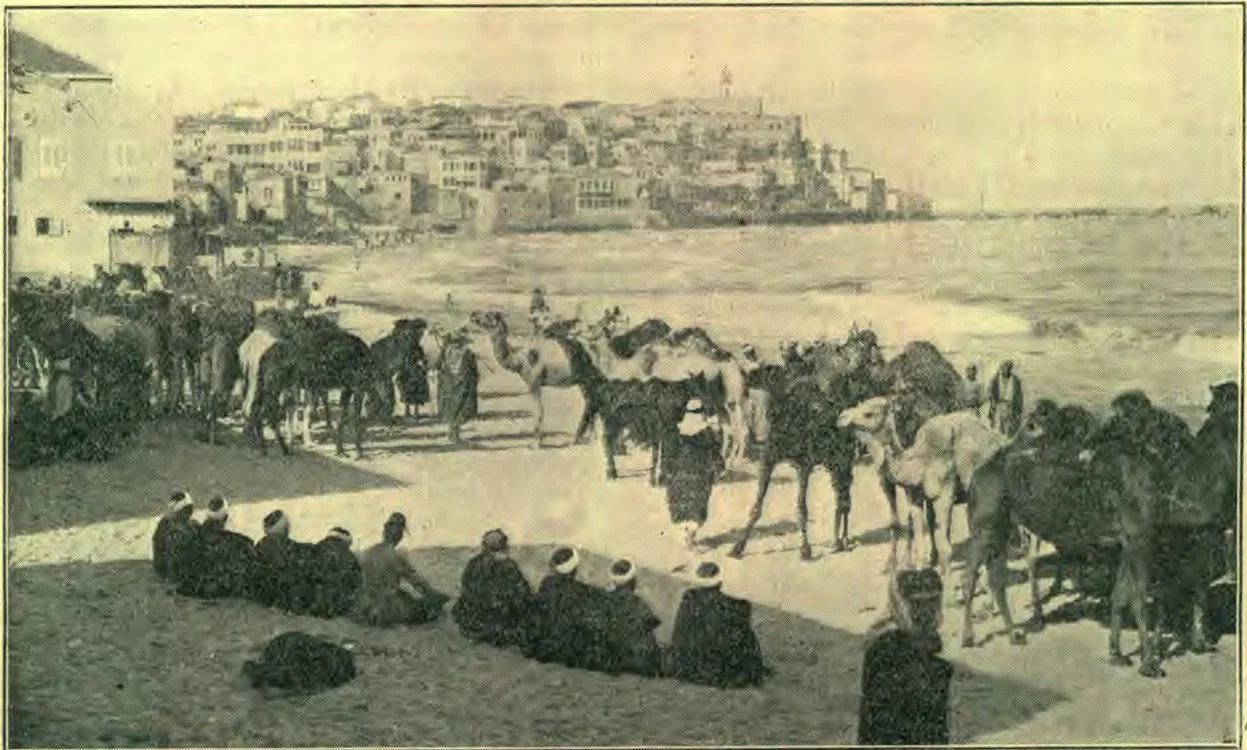
Jaffa has perhaps fifteen or twenty thousand inhabitants, and is built on a hill. Facing the sea, the hill is quite steep, and the houses appear almost to sit one on top of another. The streets are narrow and dirty, true to the East. The railway runs in the streets, and the switching crew obligingly leaves “wagons” almost anywhere, to suit the convenience of customers. The engines we saw were very small, and used gasoline for fuel. The driver sat on one side of his cab, facing the other, and looked forward and backward, first out of one eye, then out of the other. A new use, to us, of the track, a narrow gauge, was that of making it a runway for barrels. Placing a barrel across the rails, it was a simple matter to propel it down the street a block or two, to the desired destination.
North of the city is a sandy plain of some extent, on which quite a body of Indian troops were camped at the time of our visit. North and east of the city are hills and valleys, stretching back for miles, with here and there groves and buildings breaking the monotony, and making an interesting picture of this part of the ancient land of the Hebrews.
However, the most impressive feature of Jaffa, was its setting in sacred history. “Here the materials for building both the first and the second temple, sent from Lebanon and Tyre, were landed. Here Jonah embarked for Tarshish. Here, too, Peter raised Doreas from the dead, and in the house of Simon the tanner, by the seaside, was taught by the heavenly vision that salvation was for Gentiles as well as Jews.”
To visit Egypt or the Holy Land, and realize that worthies of old lived, labored, and died there, and that in those lands the Lord chose a people, led them through the centuries, and then was compelled to forsake them, because they forsook Him, impresses the traveler with a feeling of awe and reverence, and causes him to determine to be faithful. And the time when the saints shall possess the kingdom, when Abraham, Isaac, and Jacob shall receive their inheritance, the Land of Promise, is drawing on apace. That glad day is being hastened by the work of the missionaries out in the far fields as well as by the body of believers at home. May the readers of the INSTRUCTOR be among those who find abundant entrance into the New Jerusalem.
Poona, India.
Continue reading: A Heathen Funeral