“PRAY that we may willing be
Rough and rugged paths to tread,
And that we may always see
Yonder city just ahead.
For we know whate’er betide,
Our blessed Lord will always guide
Repentant sinners to his side.
May we of that tried One say,
‘Every day for him I’ll pray.’”
Persecutors Supernaturally Stricken With Fear
By W. A. S.
In the dark days of papal supremacy, opposers of God’s truth thought they were triumphing over the witnesses whom they put to the torture and the stake. But in the sacred record it is written that the victims were the victors. Of these martyrs of God it was said: “And they overcame him by the blood of the Lamb, and by the word of their testimony; and they loved not their lives unto the death.” Rev. 12: 11.
Even amid the fiery trial they knew that the living God was with them to deliver their souls from all evil and keep the confidence unshaken. And sometimes, it is evident, this presence of the Lord was so manifest even to wicked men and persecutors that they were stricken with fear. One such incident is recorded by Foxe, in his “Acts and Monuments.”
Arnold Moniere, of Bourdeau, had been condemned to death for Protestant8heresy in 1556. France was seeking to sweep back the wave of reform. Another man, John de Cazes, was in Bourdeau, a believer in the Word of God. Hearing of Moniere’s fate, he determined, like Onesiphorus, Paul’s friend in Rome, to search him out and bring him the comfort of Christian fellowship. He was warned of his danger, but persevered, and immediately his visit to the condemned Protestant led to his own arrest and condemnation.
The two men were drawn on hurdles to the place of burning. The persecutors had it all their own way; for there was no force of sentiment in the place to restrain persecution of Protestants. Yet the authorities were fearful. Foxe says:—
Moreover, albeit there was no such cause (they being two simple poor men), yet the magistrates commanded (upon what occasion I know not) all the gates of the city to be shut, and guarded with keepers.
The martyrs earnestly exhorted the people gathered round the stake, bearing witness to the truth of God. To drown their voices, the trumpeters sounded constantly until the men were dead. Then above the noise and tumult, and amid all the display of the power of arms, the still, small voice of God was heard in guilty hearts and consciences. They had killed the witnesses, but the angels of the living God were there. The old martyrologist continues:—
And further, to note the work of God that followed when these two mild and martyred saints were almost consumed in the fire to ashes, suddenly, without matter or cause, such a fear fell upon them at the execution that the justices and the people, notwithstanding that they had the gates locked for them, and were defended with all manner of weapons about them, knowing not wherefore, took them to their legs, in such haste fleeing away that they overran one another. The prior of St. Anthony’s fell down, so that a great number went over him. The judge Pontacke on his mule, with his red robe, fleeing as the others did, was overthrown with the press in the street called Potentin in such sort that he was fain to be carried to Pichon’s house, a widow, and there cried within, “Hide me; save my life; I am dead! I see even the like matter as at the last commotion! My friends! hide my mule, that no man see her nor know her.”
Briefly, such was the fear which came upon them that every man shut up his house. After the fear was past, every man asked what the matter was, but none could tell, neither could the enemies of God’s truth perceive who was He that put them so to flight and fear, without any semblance of any adversary about them.—“Acts and Monuments,” Vol. IV, page 425.
Well we know that the angels of the Lord were encamped round about these servants of God who sealed their testimony with their lives. Perhaps, as a forewarning of coming judgment, the Lord gave the persecutors just a sensing of the presence of the angelic hosts that could so easily have smitten the city with instant judgment. The Syrians about Samaria once fled in terror at “the noise of a great host” that God caused them to hear. See 2 Kings 7: 6, 7. David and his men rejoiced at the sound of the marching hosts of God, which was the signal that the victory would be won. “And it shall be, when thou shalt hear a sound of going [“marching,” R. V.] in the tops of the mulberry trees, that then thou shalt go out to battle: for God is gone forth before thee to smite the host of the Philistines.” 1 Chron. 14: 15.
It is good to know that the forces of the living God have been abroad through all the great controversy between good and evil in the earth. And they are still with us—more for us than all that are against us. W. A. S.
Which Day Is the Sabbath?
By F. M. W.
This is a question propounded in the September number of the Ladies' Home Journal, to Dr. Lyman Abbott, in charge of the religious questions and answers department of that magazine. Dr. Abbott gave the following reply:—
I do not think that on any proper interpretation of the fourth commandment it makes any difference what day is observed as a sabbath or rest day. The commandment simply says: “Six days shalt thou labor, and do all thy work; but the seventh day is the Sabbath of the Lord thy God: in it thou shalt not do any work,” etc. If this were a human statute, no lawyer would conceive that it required anything more than one day of rest out of the seven.
Saturday was the Jewish Sabbath. After the resurrection of Jesus Christ the Christian church observed the resurrection day with special services, and Saturday when Jesus' body lay in the tomb was not a natural festival day. At first both days were observed. But, as the Jewish element became less important and the converted pagan element more important, the first day gradually became the sabbath of the Christian in the place of the seventh day.
Paul makes it clear that which day was observed was a matter of no consequence. “Let no man therefore,” he says, “judge you in meat, or in drink, or in respect of an holiday, or of the new moon, or of the sabbath days.”
It would be a strange logic indeed, and one which we could not conceive of being recognized in any court of law, for a lawyer to argue that when the commandment of God requires the observance of a definite day—namely, the seventh day—of the week, any other day of the weekly cycle would answer as well. Suppose, for instance, that a note were drawn payable on the thirtieth day of a certain month. Would a judge admit a claim from the holder of the note that because there were thirty days in the month, therefore it was his right to demand payment on any one of the thirty, say the tenth or twentieth of the month, instead of on the particular day specified for the payment of the obligation? The admission of such a claim would be a travesty upon justice; but this is a fair example of the claim made regarding the Sabbath of the Lord in the quotation above.
The seventh day of the week God used as his own rest day. Upon it he placed his special blessing. Because he made it his own Sabbath, he set it apart as the Sabbath day for the human family. Gen. 2:1–3. He did not use the first or second or third or fourth or fifth or sixth day in this manner. Upon none of these days did he let his blessing rest, nor did he set apart any of these six days as a Sabbath of rest. He chose the seventh day from all its fellows for a special and holy use. See Ex. 20:8–11.
That the disciples of the early church, after the resurrection, observed the first day of the week rests wholly upon assertion. Dr. Abbott affords not one iota of historical or Biblical proof that they so observed the first day. It is true, as he says, that both days were for a time observed in the Christian church, but not in the days of the apostles. The historian Neander says:—
Opposition to Judaism introduced the particular festival of Sunday very early, indeed, into the place of the Sabbath. . . . The festival of Sunday, like all other festivals, was always only a human ordinance, and it was far from the intentions of the apostles to establish a divine command in this respect, far from them, and from the early apostolic church, to transfer the laws of the Sabbath to Sunday. Perhaps at the end of the second century a false application of this kind had begun to take place; for men appear by that time to have considered laboring on Sunday as a sin.—Neander's “Church History,” Rose's translation, page 186.
And to the truthfulness of this statement we have the added authority of Dr. Abbott himself as published in the Christian Union of June 26, 1890. At that time he said:—
The current notion that Christ and his apostles authoritatively substituted the first day of the week for the seventh, is absolutely without any authority in the New Testament.
The Sabbath of the Lord, according to historical writers, down to the fourth and fifth centuries was observed as a sacred day. William Prynne says:—
It is certain that Christ himself, his apostles, and the primitive Christians for some good space of time, did constantly observe the seventh-day Sabbath.—“Dissertation on the Lord's Day Sabbath,” page 33.
Morer, a learned clergyman of the Church of England, says:—
The primitive Christians had a great veneration for the Sabbath, and spent the day in devotion and sermons. And it is not to be doubted that they derived this practice from the apostles themselves, as appears by several scriptures to that purpose.—Morer's “Dialogues on the Lord's Day,” page 189.
Gradually, little by little, as the spirit of worldliness increased in the church and heathen influences prevailed, the observance of the Sabbath of the Lord was discontinued, and the pagan Sunday holiday was adapted to Christian uses and put in place of the Sabbath of the Lord.
The statement of the apostle Paul to which reference is made is wholly with respect to feast days and ceremonial sabbaths observed by the Jewish church, about which there was a dispute among the Christian believers. Compare Hosea 2:11 with Col. 2:16, 17.
It is better to accept the plain, positive statements of Scripture as a basis of our faith than the opinions of religious teachers, however eminent may be their reputation or honorable their position in the religious world. It is by the royal law, the law of liberty (James 2:8, 12), that we must be judged at the last great day, and not by the religious fallacies of those whose teachings set at naught the Scriptures of Truth. F. M. W.
Every Man in His Own Tongue
By C. M. S.
Joel's prophecy which the apostle Peter interpreted to his hearers on that memorable day of Pentecost, did not meet its complete fulfillment in the demonstrations which were witnessed at that time. The prophecy itself indicates that it would meet its complete fulfillment at a later date; for the Lord, after declaring that he would pour out his Spirit upon all flesh so that the sons and daughters would prophesy, the old men dream dreams, and the young men see visions, and that upon the servants and handmaids he would also pour out his Spirit, says:—
“And I will show wonders in the heavens and in the earth: blood, and fire, and pillars of smoke. The sun shall be turned into darkness, and the moon into blood, before the great and terrible day of Jehovah cometh. And it shall come to pass, that whosoever shall call on the name of Jehovah shall be delivered; for in mount Zion and in Jerusalem there shall be those that escape, as Jehovah hath said, and among the remnant those whom Jehovah doth call.” Joel 3:28-32.
There is no question that this scripture met one phase of its fulfillment on the day of Pentecost in the remarkable demonstration of the Spirit's working there given. Peter said, “This is that which hath been spoken through the prophet Joel.” He quotes the prophecy, and begins his quotation with these words: “And it shall be in the last days, saith God.” Acts 2:17. In quoting the prophecy, he quotes words from Joel which had not met their fulfillment at that time, and did not have their fulfillment until within this generation in which we live.
It will be noted that in the last verses quoted above from Joel, God speaks of certain ones who shall escape “in mount Zion and in Jerusalem,” and then adds, “and among the remnant those whom Jehovah doth call.” “The remnant” as there used must refer to those who are saved out of the last generation of men upon this earth. How appropriate, then, that Inspiration should point us to “the last days” for the complete fulfillment of this prophecy! And, further, it is impossible that it should have met its fulfillment centuries before men saw the signs which were to point out the period to which it applied. The sun was “turned into darkness, and the moon into blood” in our generation. Therefore we may expect to see the completion of that prophecy's fulfillment in our generation, with the remainder of the signs that were to accompany it.
Under the first phase of that prophecy's fulfillment we saw the remarkable outpouring of the Holy Spirit upon those who were giving the gospel message. In addition to that, we saw those gospel workers reaching, with the message God had given them, representatives of “every nation under heaven;” and those representatives heard that message, every man in his own language. It was God's wonderful preparation for a quick work in that day. It required four things: preparation and consecration on the part of the workers, the outpouring of the Holy Spirit, representatives of all the nations, and a provision whereby the representatives of each nation could hear the message in his own language.
The incidents of that remarkable occasion were more than a fulfillment of prophecy. That day was a prototype of our day. That beginning of the evangelism of the world with the gospel message has its antitype in the closing days of earth's history when “this gospel of the kingdom shall be preached in all the world for a witness unto all nations.” Matt. 24:14. “Then,” says our Saviour, “shall the end come.”
When the gospel message on that day went to all the world by being proclaimed to the representatives of all the nations, it was a harbinger, a forerunner, a prototype, of the threefold message committed to this people (Rev. 14:6-12), which is to go to “every nation and tribe and tongue and people.”
As those representatives of the nations heard, on the day of Pentecost, every man in his own tongue, so, in the carrying of this threefold message to all the world, they who hear will hear in their own tongue. And today in nearly every nation under heaven “this gospel of the kingdom,” this great threefold message, is being proclaimed to men in their own language, both by the living preacher and by books, periodicals, and pamphlets which proclaim it silently. Languages which never before were written have now been written and are now being written for the express purpose of enabling those who speak those languages to hear God's last gathering call in their own tongue.9
Thus we see that Joel's prophecy finds its fulfillment both at the beginning and at the close of the gospel dispensation, and the one is the type of the other. On that Pentecost day God did a short work and a quick work; and his facilities for doing a quick and short work in our day are not less than they were then. We read in Rom. 9:27, 28, “A remnant shall be saved: for he will finish the work, and cut it short in righteousness.”
The message on the day of Pentecost was spoken in many tongues; it is being spoken in many tongues today. The outpouring of the Holy Spirit upon the workers then quickened and shortened the work. When the Holy Spirit is poured out in its fullness upon the workers who are commissioned to carry God's threefold gospel message to the world, we may expect to see a mighty work done, a quick and short work. With such meager facilities as then existed, a work was done which astonished the world. What may we not expect to see in our generation with such facilities as the world now affords and the whole world one great neighborhood, when God sets his mighty hand to the work and pours out his Holy Spirit upon his chosen messengers in the unstinted plenitude of his power? He who made the nations hear so quickly in the apostles' day will most certainly not be handicapped in our day. He spoke to the world then a quick message, and left them without excuse who did not desire to hear. His last message is going to the world today; but soon, when he is ready, we shall see it speed with a speed that only God can give it, and the end will come.
They who expect a part in that quick and mighty work will live each day as if that day were now at hand.
C. M. S.
The Only Sure Anchor
By F. M. W.
ACQUAINTANCESHIP with the Lord Jesus Christ is the only anchor which will hold the soul in the storm and stress of the closing days of earth’s history. “And this is life eternal, that they might know thee the only true God, and Jesus Christ, whom thou hast sent.” Let the truth of this declaration be indelibly impressed upon the heart. No theory of the truth will bring salvation. No powers of logic or argument will enable the soul to stand against the deceptive opposing forces of evil. This knowledge of Christ will bring peace to the believer here and life everlasting in the kingdom of God. “Acquaint now thyself with him, and be at peace.” This was the counsel given by Eliphaz the Temanite to the patriarch Job. It was good counsel to him. It is equally good for us today.
A knowledge of Christ implies something more than a knowledge of the historical record of his life on earth. Infidels have acquainted themselves with the record of Christ’s earthly ministry, but this did not make them acquainted with the Lord Jesus Christ. To be acquainted with Christ is to know him in the precious attributes of his character. It is to know him not only as the Saviour of the world, but specifically and particularly as a personal Saviour; as one who saves us from our sins. It is to know him as a comforter, one who comforts us in our sorrows; it is to know him in the tender family relationship of father, brother; it is to know him in that dearest of all earthly relationships, as a friend; it is to come so near to him that we are conscious of his divine presence, that we can feel the support of his loving arm, the throbbing of his great heart of love; it is to know him as our burden bearer, as the one to whom we can carry every trial and difficulty for solace and for counsel, realizing that he rejoices in our joys, and sorrows in our tribulations.
This definite personal acquaintance with the Lord Jesus Christ is the privilege of every disciple. No human relationship can afford such joy and rest; no human agent can impart such strength and power. Into this communion the disciple may enter by a complete consecration to his divine Lord. As the believer’s will is subordinated to the will of the Master; as his heart is opened to receive the divine Spirit; as Christ becomes his one supreme joy, the chiefest among ten thousand and the one altogether lovely, he will come to know the sweetness of this divine companionship and realize the strength and power which will be imparted to his life through acquaintance with his blessed Master.
This knowledge will prove indeed an anchor to the soul. Others may deny their Lord, but the one who has come to truly know him knows in whom he has believed. No peril can shake his confidence; no covert sneer nor open assault can turn him from his allegiance to the10one whom, though not having seen, he has learned to love. His only fear will be the fear of grieving that loving heart; of bringing disgrace upon that worthy name and cause. Let us take time, by the study of the sacred Word, by meditation and prayer, by the cultivation of the heavenly graces in the life, and by willing, loving service for the Master, to acquaint ourselves with Christ our Lord.
F. M. W.
Where the Tax Money Goes
By C. M. S.
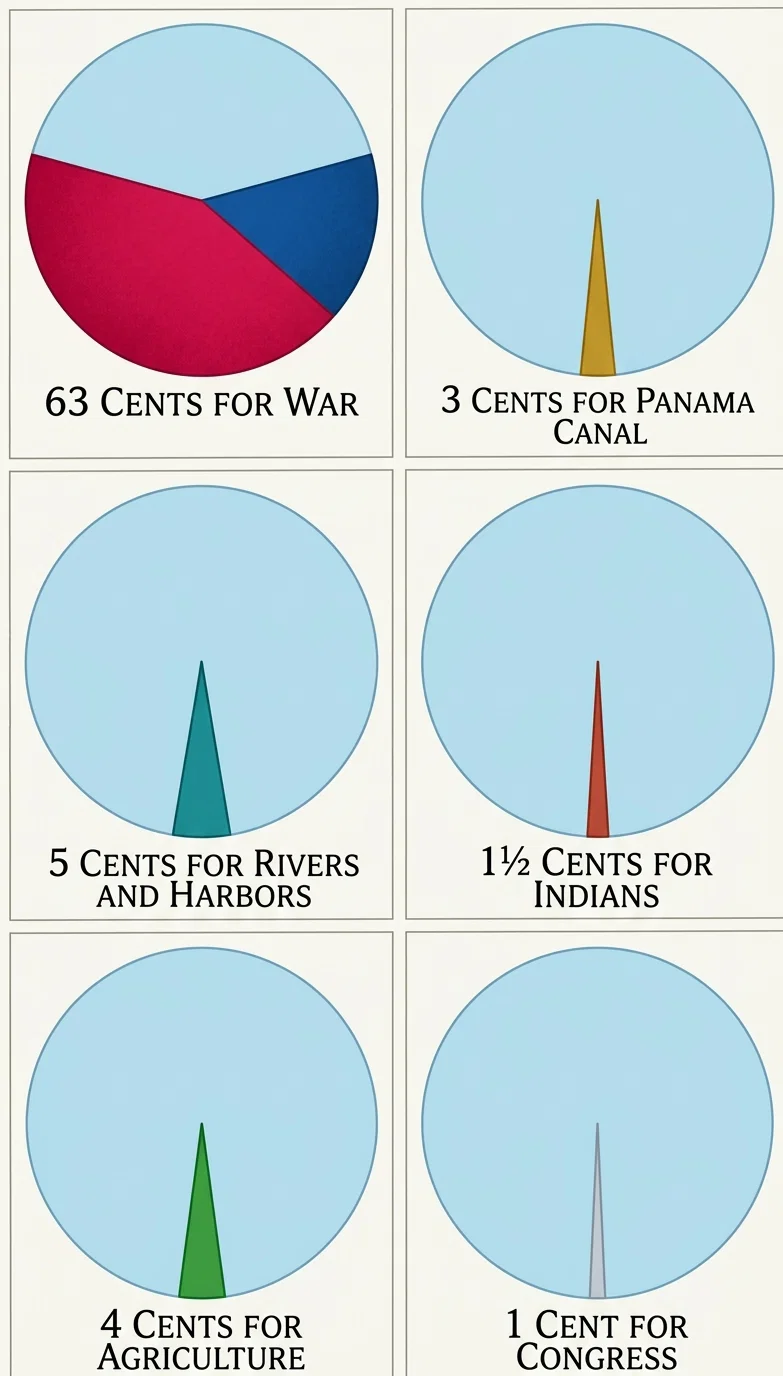
THE United States is not a warlike nation. It is not a nation in which militarism rules, at least not to the extent that it dominates other countries. Americans may be, therefore, not a little surprised to know that the greater portion of the money raised by taxation is expended to pay for war preparations or for the results of previous wars. The accompanying diagram will help us to understand more clearly the relation which our military expenditures bear to the other national disbursements.
63 CENTS FOR WAR
3 CENTS FOR PANAMA
CANAL
5 CENTS FOR RIVERS
AND HARBORS
1½ CENTS FOR
INDIANS
4 CENTS FOR
AGRICULTURE
1 CENT FOR
CONGRESS
When, therefore, we pay a tax of one hundred dollars, sixty-three dollars of that money is eaten up by war, war preparations, and the results of war. Only one dollar of that one hundred is used for the support of the national Congress. Four dollars goes for agriculture, forestry, and fisheries; three dollars for the building of the Panama Canal; five dollars for the improvement of rivers and harbors; and one dollar and a half for the Indians. Is it not an anomaly that that thing which links us closest to barbarism absorbs much more than half of all we pay for taxes? And how must the proportion stand for such nations as Germany, France, England, and Russia. The most hopeless feature of the situation is that the ratio of military expenditure is increasing instead of decreasing; and yet education, enlightenment, science, international communication, and missionary operations have increased in this generation as in no other. We see in these facts a sure indication that the forces of evil and of good are preparing for the culmination of the age-long struggle. C. M. S.
Our Work in Burma
By R. B. Thurber
R. B. THURBER
A Survey of the Past
THE powerful wedge of the truth, our literature, began to split the log of Burma’s Buddhism about twelve years ago, when an interest was created among the English-speaking people of Rangoon. The living messengers, in the persons of Elder H. H. Votaw and his wife, came in 1904. Like Judson, the first great Christian missionary to Burma, Brother Votaw left the homeland with his eyes fixed on India; but the “land of pagodas” has claimed him up to the present time. As the interest grew, other workers, Brethren Hansen and Cook, with their families, were sent, but they were unable to remain long in the field. This left the pioneers with much to do. No money could be supplied to rent a meeting place. The people gathered in private houses to study the Word. Many of the early days were dark. The missionaries’ efforts apparently were unappreciated, as is often the case in the beginning of a great work for God. The adaptation of oneself to the feelings and customs of the people is not to be classed among the least of our difficulties. But there is much good in all nations, although sometimes we have to look through our tears to find it.
From the first, a strong effort has been carried on in Rangoon for English-speaking people, giving special attention to Sabbath and Sunday night services, house-to-house Bible readings, and the sale of literature. As a result, we have a strong church organization there, which gives prestige to our other lines of work. Brethren Votaw, Cook, Comer, and Hamilton have been most prominent in this work.
Burma presents a very promising opportunity for the canvasser. Money flows more freely than in most other countries of the East. From time to time our bookmen have covered the field with English books and papers, and have been uniformly successful. A young Englishman, William Carratt, who accepted the truth under Elder Enoch in Poona, India, has had good success with our books here.
In 1906 Dr. Ollie Oberholtzer came to Burma and settled at Moulmein, where a great work was done by Judson and his successors. Her effort to start medical work was marked with some success, but we have found that in towns where the government maintains a good, free hospital, our efforts along this line are not so much in demand. Dr. Oberholtzer later married Mr. C. Tornblad, a mining prospector who accepted the truth, and they are now carrying on a self-supporting missionary, medical, and agricultural station far up in the Shan hills, about four hundred miles northeast of Rangoon. Just recently Brother Denoyer, from America, came here at his own expense, and is pushing the work alone at this station while Dr. Tornblad is on furlough.
Burmese Work
Although there are a number of other peoples in Burma, our chief work must be for the Burmese. For some reasons they are not especially susceptible to Christianity. They are easy-going and shun sacrifice; but this is a general statement, since there are many notable exceptions. The first requisite in working for them is to get their language; for he who would get the heart without first getting the tongue, will get the shoulder—and that cold. Burmese is second only to Chinese in being a difficult language to master; but its vocabulary is not large. We cannot say that great success has been attained by our workers in acquiring the language, mainly because on entering the field the workers have had to “get under the load” without being given a chance for a year or more of undisturbed study. It has been said that if one does not get over the chief difficulties of the language the first year, he will not get it later.
However, some of the workers now in the field are able to converse quite freely with the people in their own tongue. R. A. Beckner, who entered the work early in 1909, has been able to give his time almost exclusively to the Burmese work. Also A. H. Williams, who accepted present truth while engaged in business in Rangoon, is doing a good work for the Burmans at his station on the Salween River, thirty miles above Moulmein.
Brother Beckner has labored mostly in and around Mandalay, the old capital. Before these workers began, Brother Votaw had given the truth to several English-speaking Burmans in Rangoon and Moulmein. Of these, three are now engaged in our ministerial and teaching work.
The most effective and far-reaching effort for the Burmans, however, is the Kin Soung (Watchman), our quarterly magazine in the vernacular. It is only two years old, but from five to eight thousand copies of each issue are sold, more than half of which are in yearly subscriptions, at twelve cents a year.11
It is really the first magazine of any kind published in Burmese which sells to Christians and non-Christians alike, and pays expenses. It is easy for an energetic Burmese canvasser to make a good living by its sale. The literary quality of its Burmese has been highly praised by scholars. The true value of this journal cannot be estimated, for it has made many openings for our other literature and workers.
In common with the other divisions of the India Union, Burma is publishing a book of Bible readings in the native script. We expect this book to do a great work; for nearly every Burman can read. The different workers have already pledged to dispose of nearly all the first edition of two thousand copies. Brother Beckner has had excellent success selling the Kin Soung, and now has charge of the publishing and distribution of our vernacular literature. We are training boys at the school at Meiktila for this canvassing, a few having already been very successful in the field.
(To be concluded)
Note and Comment
Vital Differences Between Protestantism and Romanism
A RECENT number of the Presbyterian contrasts the vital differences between these two systems of faith as follows:—
Protestantism believes that the Bible is the only and infallible rule of faith and practice. Romanists hold the Bible is infallible, but not the only rule. There are traditions and continued revelations given to the church through the Pope, and these are of equal authority.
Both Protestants and Catholics believe in the triune God. But the Protestants believe that God alone can answer prayer, and he alone should receive worship, and to give worship to any other is blasphemy; and further, God is to be worshiped only as appointed in his Word. Catholics worship Mary, and offer prayers to her and the saints, and they also worship God by images, which is forbidden in his Word.
Protestants believe that, according to the Bible, all sin is a capital offense, and its penalty is death. Roman Catholics believe that there are two kinds of sin and two kinds of punishment for sin. One punishment is eternal, and the other is temporal.
Protestants believe that the only escape from the guilt and punishment for sin is through the atonement of Christ, and this is here and now freely offered to all, and those who accept pass from all condemnation, and the blood of Jesus Christ cleanses from all sin. Catholics believe that the atonement of Jesus saves from eternal punishment, but the temporal punishment must be paid by man himself, either in this world or in purgatory.
These essential differences lead to still other cardinal differences, both in conduct and in faith and any attempt to reconcile them means only the submission or withdrawal of the protest.
The editor cites the fact that Catholicism believes in the union of church and state, while this is opposed to the principles of Protestantism in general, and to American Protestantism in particular. The Catholic Church makes a strong bid for the Catholic vote. He concludes with the following exhortation:—
Therefore Protestantism must become all the more positive and determined to resist and resent any effort looking toward the betrayal of Protestantism or subsidizing it to Catholicism.
In Southern Rhodesia
By W. B. WHITE
W. B. WHITE
FEELING the need of becoming acquainted with our work in Rhodesia and Nyasaland, in company with Elder H. J. Edmed and Dr. W. C. Dunscombe, I left Johannesburg on Sunday evening, May 31, for the north. The next morning we reached Mafeking, the city that sustained such a protracted siege during the Boer war. Leaving this city, we were soon in Bechuanaland, or Khama’s country as it is known, from the fact of its being governed by Khama, the strong and powerful chief of the Bechuanas.
This is an unentered country as far as present truth is concerned, as no missionary has labored here, and no literature has been scattered in the vernacular. We are now getting “Steps to Christ” translated into the Sechuana, and hope when this is done to have the book printed, and circulated in this country by canvassers. This will be a beginning, and other efforts for the native population will come later. We are glad that the languages of Bechuanaland and of Basutoland are much the same; and as we are getting a fairly good start in the last-named country, we hope from that base to work the whole territory.
Tuesday morning, June 2, we arrived in Fig Tree, the nearest station to the Solusi Mission, just as day was breaking. Here we found Brother Walston with his large farm wagon, three yoke of oxen, and two native boys, one to lead the oxen and the other to follow behind and drive them. Soon we had our baggage loaded, and were off for the station eighteen miles away.
As we passed over the road, we could see that the country was in the grip of a terrible drought, as feed was very short and water scarce. From a farming standpoint, the last season has been a hard one for Solusi. Crops were light, and at the present time it is a serious question where grazing is to be obtained for the fine herd of cattle which the mission owns. And water, too, is as much a problem as feed. Wells, streams, and water holes are fast drying up, and the dry season is just beginning. Indeed, on this great farm of eight thousand acres there is only one water hole left where the cattle can find drink. This hole has never been known to dry up, but this is an exceptional year, and what the future may have in store for us we do not know.
Brother Walston took the precaution early in the season to rent the pasturage on two large farms adjoining him, which reach to the Gwaai River, four miles away, and water may have to be obtained from there if all other places fail. But this is a long way for stock to go for water, especially if they are weakened from lack of food. As yet the cattle look well, and with the pasturage that is on the farm, the large corn fields from which the corn has been picked will afford feed for a time; and, with two ground silos full of feed and other fodder in reserve, it is hoped that the stock can be brought through all right without loss. How good it is in such times of perplexity to know that God cares for his own, and will never leave us nor forsake us.
At Solusi there is a fine large school of native young men, the largest we have yet seen in Africa, and in it there is a12splendid interest. This is in charge of Brother and Sister R. P. Robinson, who recently came to this field from California. Their help is very much appreciated. This mission also sustains eleven outschools, and all the teachers were in to attend our meetings.
Sabbath, June 6, was a good day. About one hundred and seventy-five were present at the Sabbath school, which was conducted with as much order and precision as we have ever seen. At the close of the morning service, in answer to a call to definitely accept Christ as their Saviour, a goodly number yielded their hearts to him for the first time, while others who felt that their lives had been drifting away from God, pressed to the front to renew their consecration to him. The Holy Spirit was present, and many hearts were made tender. God is blessing the labors of Brother and Sister Walston and their associate workers at this station, which evidently is exerting a strong influence for good in Southern Rhodesia.
At the close of the morning service we repaired to the little cemetery near by, where a memorial service was held over the graves of Elder Byron Tripp, of Minnesota, and Dr. Carmichael, of California, who fell at this station. Probably one hundred and seventy-five natives stood outside the stone wall which surrounds this little plot of land, and witnessed the service, many of whom have since accepted the truth. These faithful men, with others, established the work of God in this section, diligently sowing the seed which is now springing up and bearing fruit. This memorial service was a blessed occasion, and we all look forward to the glad reunion when we shall meet these faithful laborers who gave their lives for the work in Africa.
Another feature of our visit to Solusi Mission, and withal a very interesting one, was the medical missionary work performed by Dr. Dunscombe during our stay. When the natives heard that a doctor was at the station, they came in crowds to consult him with reference to their physical ailments. All these cases were given kindly attention and treatment. They more clearly revealed to us the great need of medical missionary work in this land. I hope the doctor will report his medical experiences among these Rhodesian tribes, for I am sure such a report would be very interesting reading. We greatly enjoyed our visit to the Solusi Mission, and hope the workers at this station may be remembered at the throne of grace.