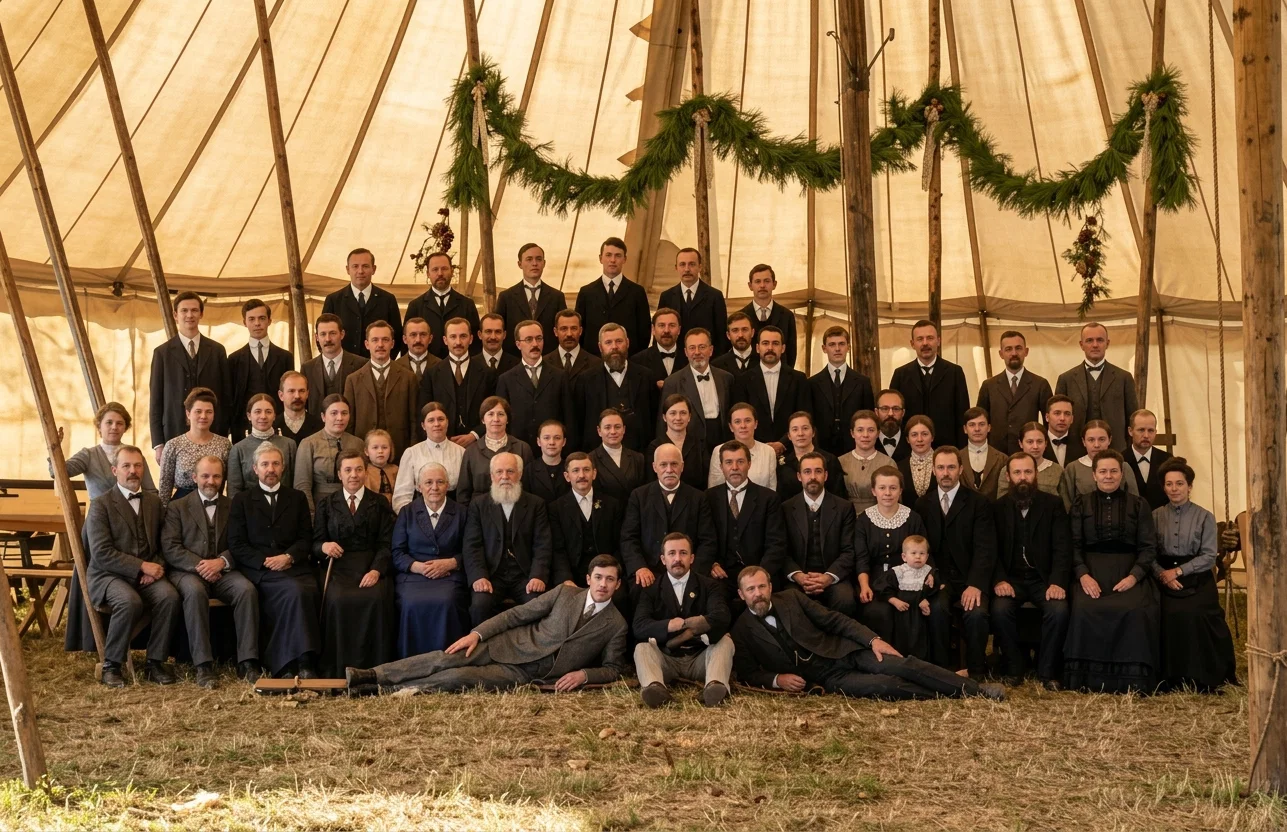
THE camp for the Central European Union meeting and the annual Swiss conference was pitched in a field just outside the city of Zurich, Switzerland. The first business session opened with the German song “Die Sach’ ist Dein, Herr Jesu Christ” (The cause is thine, Lord Jesus Christ). After this song the president read the sixty-sixth psalm. When the delegates were seated, the Moravian-Silesian Conference was received into the union. This conference was organized Sept. 12, 1913, and began operations Jan. 1, 1914. The president of this conference reported 350 members, one half of whom speak the Polish language.
The Central European Union Conference began its existence as a separate union, Jan. 1, 1913, so the president’s report covered a period of eighteen months. At the time of its organization there was a membership of 2,928, with 130 churches. At the end of July, 1914, the membership was 3,727, with 150 churches, making a gain of 799 members and 20 churches.
The tithe for 1913 was $48,560, a gain of $7,500 over the previous year. The offerings for 1913 showed a gain over the previous year of $5,500, an average per member of eleven cents a week. At the end of June, 1914, the Sabbath school membership was 3,824, with 144 schools, a gain of 20 schools and 755 members over the previous year. There are in the union 29 young people’s societies, with a total membership of 378, a gain of 5 societies and 39 members over 1912.
As Brother Boex, the general agent of the publishing houses, and six field agents were present at this meeting, some very interesting and profitable colporteurs’ meetings were held. In the German fields in Europe comparatively few of our books are sold on the regular subscription book plan; but when these leaders heard of the good work that is being done in Scandinavia, Spain, and other countries where the subscription book methods are being followed, they decided to give this method a good trial. At the present time they sell the most of their books for cash from house to house.
GROUP OF COLPORTEURS AT THE CENTRAL EUROPEAN UNION MEETING
Notwithstanding the very rainy weather which we had during several days of this meeting, from 350 to 400 of our people camped on the ground, and on the last Sabbath over 700 were present. The Sabbath school offerings amounted to over $117, and the special offerings in the afternoon reached the total of more than $604.50. Brethren O. Schildhauer and J. Frei were ordained to the gospel ministry; four church elders were also ordained.
EVANGELINE HYIAT CARR
By Evangeline Hyiat Carr
Sometime
EVANGELINE HYIAT CARR
Sometime, when the mists have lifted
And our clouded vision clears,
We shall view the long, long journey
Through these weary mortal years.
Ah! we dread to see the picture
Of the failures of life's day,
When we took our eyes off Jesus,
And so nearly lost our way.
But those trials, great and many,
Loss and failure, grief and pain,
All are gone. The Master Painter
Has retouched it all with gain.
Where we tried to do his bidding,—
Some one failed to understand,—
There's a halo round that trying
When we see it from God's land.
Then take heart, my fellow traveler,
Tell the message far and wide;
Storm clouds look like glorious sunsets,
Viewing from the other side.
An Interesting Meeting
The Parent-Teacher Association of the Washington College church held its regular session September 10, at the home of Mrs. Dr. Miller. The doctor himself showed his interest in the work the association is trying to do, by giving a very interesting and instructive talk on some of the preventable diseases of children.
Among other things, the doctor said the child has more surface of the body exposed to the cold air in proportion to its size than an adult. This is why children catch cold so easily; and colds lead to many very annoying and sometimes dangerous complications, such as sore throat, earache, and catarrh of the bowels.
In the autumn days the ankles, wrists, and neck of the child should be protected, especially nights and mornings. In these parts the blood vessels lie very near the surface, and easily become chilled. Nature in trying to protect the body contracts the blood vessels, thus pressing the blood back upon the internal organs, where it is not needed. In this way congestion is set up, and trouble begins.
Give the child plenty of fresh air and sunshine, but see that its arms, feet, and legs are protected.
A lady asked the doctor what he thought of the present style of dressing small children with very short dresses, and stockings just above the top of the shoe, leaving two or three inches of the child's leg exposed to the cold air. He replied that it is a foolish and dangerous custom.
A talk was then given on “The Teen Period,” or the training of the child in its teens. Many parents do not understand the development of youth, and often serious mistakes are made. The physical nature is undergoing rapid change, and the mental and spiritual natures change rapidly also. Sometimes the children are shy, awkward, and reticent, or bold, forward, and talkative.
The social side of the nature also needs careful supervision and sympathetic management at this time of life. Attachments are strong, and sometimes changeable. The youth are easily influenced, and character is impressed for good or evil according to the character of their associates. The speaker gave an illustration of this, taken from Miss Slattery’s little book entitled “The Girl in Her Teens.”
She says: “I remember a girl of sixteen, dreamy, imaginative, and so much interested in her boy companions that lessons, home interests, and everything else were sacrificed. What to do with her, and what interests to substitute, were questions that both mother and teacher failed to solve. At a most opportune time a ‘new girl’ moved into the neighborhood and entered school. She was practical, attractive, a good scholar, greatly interested in outdoor athletics. Because they were neighbors, the two girls were thrown much together. The companionship deepened into friendship. Soon the dreamy sixteen-year-old was playing tennis on summer afternoons, and reading aloud in the hammock afterward to rest. When winter came, she suddenly decided that school and study were worth while, brought up all her averages, and made up her mind to try for college.” The “new girl,” had wrought a great change in this young life, and did it unconsciously, too.
The following article from the Housekeeper, by John M. Greer, was presented by one of the members:—
“Permit me in a paragraph or two to outline to you just that phase of child growth upon which my subject touches. In the high school we deal with the child who, in many respects, is very different from any other child, and very different from himself when compared to any13other period of his growth. The adolescent student, if we may give credence to those who have most carefully studied his manifestations, is a strange and oftentimes wonderful being, out of joint with his past and unarticulated to his future. He is in a state of flux, when the soul is everything in turn and nothing long, exploring the whole range of feeling, will, and thought. This period marks physical changes most momentous, and mental changes equally important. Consciousness of dawning power marks the period as one of restiveness, lawlessness, and irresponsibility. In vain efforts to find his best self, he develops a sensitiveness to criticism, a reticence, and a changeableness that often strains the patience and effort of those who have his welfare at heart. Under unfavorable conditions this youth disregards parents and elders, becomes passive, indifferent, and finally insubordinate.
“Statistics show this to be the age when the largest per cent of criminals begin their careers, and often ‘just for fun.’ It is the age that needs for guidance caution, a kindly yet firm discipline, and the most experienced and mature judgment. Every high-school teacher daily stands appalled before this emotional maelstrom,—standards, ideals, restraints of childhood slowly going, and the self-control, self-mastery, incident to maturity not yet in the saddle. It is well characterized as ‘the age unlovable and unlovely,’ yet the age most needing love, sympathy, and appreciation.
“If at this age the wild dreams of unrest break loose and begin the process of destruction, it is also the age of seriousness, when the young reaches out after the unattainable; the embryo saint appears and faces the future with lips firmly set, groping after answers to the riddles of the universe. This is the period of outbursts of unusual physical growth and excesses and of consequent long, lank, lolling indolence, betokening exhausted energies, both physical and mental. There is no period in life so difficult to understand, fraught with so many and insidious dangers to our boys and girls, as this period between thirteen and twenty years. Now, anything that tends to intervene between this imaginative child and his parent, pastor, or teacher should not only be discouraged, it should be annihilated.”
Let every parent and teacher who has to do with boys and girls, deal with them tenderly and lovingly but firmly.
Going the Second Mile
“THE Christian is to accept hardness patiently. He is not to watch the clock lest he may work a few minutes overtime. He is not to keep account of all he does for others lest he may do more than he is required to do. Rather, when he is serving, he is to do more than strict duty demands. He is to go two miles instead of one.”
Conducted by Mrs. C. C. Lewis, Takoma Park, Washington, D. C
By Mrs. C. C. Lewis
Through the columns of this department, hints will be given on all matters pertaining to the home life. Short articles and letters are solicited from home makers, telling of their everyday experiences,—their joys and sorrows, their failures and successes.
MRS. MARY H. WILLIAMS
By Mary H. Williams
Truth
MRS. MARY H. WILLIAMS
TRUTH oft is likened to a light
Held far aloft and burning bright;
And sending forth each glorious ray
To light truth seekers on their way.
Then he who seeks with open mind
Some precious light must surely find;
And, following as the rays converge,
For greater light his search will urge.
Some follow men's reflected light,
And groping go as in the night;
Dimly the light of truth is seen
If human shadow lies between.
Some will not bear the effulgent ray,
From its pure radiance turn away.
How dangerous must their pathway be
Who ever their own shadow see!
And thus it seems our only course
The truth to seek at its pure source.
The Word a light for aye shall be,
And light the world from Calvary.
Charles City, Iowa.
Western Washington Conference and Camp Meeting
By O. A. Olsen
LEAVING the Southern California camp meeting at Alhambra August 15, I spent a few very profitable days with Elder W. C. White and other brethren at St. Helena and Mountain View, Cal., in counsel and study over literature for the many foreign nationalities in our country. Heretofore much study has been given to the production of needed literature in German, Scandinavian, French, and Spanish. Now thought must be given to such nationalities as Russians, Poles, Bohemians, Italians, Roumanians, Hungarians, and Servians. Proper literature in these languages is an urgent necessity.
While at St. Helena I had the privilege of several visits with Sister E. G. White. I found her remarkably cheerful and bright, and possessing the same deep interest and solicitude for the work that have been so marked these many years. I esteemed very highly the privilege of this visit.
While at St. Helena I made a short visit to the Pacific Union College, near St. Helena. This was my first visit to this interesting place. The situation is certainly a unique one, affording many facilities for developing a real industrial college. And wonderful achievements have already been made both in attendance and in financial success, during the short period of its existence. With good management and God's blessing it is bound to be a real success.
Leaving San Francisco the evening of August 22, I arrived in Auburn, Wash., August 24 at noon. The Western Washington camp meeting was located right in the edge of this village, very convenient of access. I found the meeting under full headway. This was the largest camp meeting held in this conference. There were two hundred tents pitched among the trees, and nearly eight hundred campers. On the last Sabbath of the meeting there were fully one thousand of our people in attendance.
The laborers from outside the local conference and union were Elders George Enoch, Meade MacGuire, H. S. Shaw, and Luther Warren, and the writer. The conference proceedings were harmonious. The report of the work showed good progress in all departments during the last year. Nine new churches, with a collective membership of 169, had been organized during the year and added to the conference. A very good gain, indeed. Very substantial gains were also shown in the tithe, Sabbath school offerings, mission funds, and book sales, but the conference was a good deal behind on its mission funds.
This matter received special attention during the meeting. Elder Enoch presented the situation and the needs of the great India Union Mission field, from which he recently returned, and $10,000 was subscribed in cash and pledges. Many of these pledges were made on condition of sale of property. Besides this the Sabbath contributions to mission funds for the two Sabbaths were $543.73, and $871.76 in cash and pledges for the home work of the conference. Our people in that conference are not among the wealthy ones, and times are not the most favorable, but they showed a real spirit of liberality, which God will bless.
The meeting was a good one. A spirit of deep earnestness prevailed throughout. One special feature I shall mention. Wednesday morning was set apart for a special season of prayer for the distressed cause and our afflicted people in Europe, because of the terrible war raging there. The camp omitted breakfast, so as to have more time for the service. At the opening a brief statement was made of the condition existing in Europe as far as we had had information. Then our own condition of unpreparedness for the great crisis was dwelt on. The Spirit of God made a deep impression on all present. The congregation was then divided into six groups, and the service continued with prayer, confession, and testimonies. Altogether, the meeting lasted three hours. It was indeed a very heart-searching and profitable occasion, and had a most excellent effect on the remainder of the camp meeting. I have rarely witnessed a more earnest and heart-searching meeting. We need more such experiences.
Personally, I greatly enjoyed the privilege of attending this camp meeting, and of greeting so many that I have known and been associated with in earlier days. I was so glad to find them faithful and true to the work of the Lord. I mention14particularly Elder Decker, Elder Flaiz, the president of the union, and Elder Lewis Johnson.
Elder Johnson was reelected president of the conference for the coming year. Regular meetings were conducted every day in the Scandinavian tongue, with a good interest. May the blessing of the Lord continue with the work there till its final triumph!
O. A. OLSEN.
The Rewards of Reading
I CAN with difficulty regret a single hour I ever gave to reading, and one of the greatest things I look forward to in the future is the chance of reading and rereading some things I have partially forgotten, and reading things which I know of but do not know. Reading is its own exceeding great reward, and a new brightness and expectancy and resource will come into the minds of all of you if you do as I have counseled you, and make lovers, friends, and acquaintances in the world of good books. —Sir W. Robertson Nicoll.
The Missouri and Kansas Camp Meetings
By R. A. Underwood
According to previous arrangements the North Missouri and South Missouri Conferences united in a union camp meeting upon the Clinton Seminary grounds, in Clinton, Mo. The meeting was a much larger one than had been held in that State for a number of years. About six hundred were encamped on the grounds. After a careful study of the question, both conferences unanimously voted in favor of uniting, making the State of Missouri one conference rather than two. This brought courage to our brethren, and the Spirit of the Lord came into the meeting in a marked manner.
There were some local debts hanging over the North Missouri Conference, and the South Missouri people united with the North Missouri people in lifting these. About $2,000 was raised on the General Conference Association debt that had been oppressing the two conferences for many years, and about $6,000 was contributed in cash and pledges on mission funds.
Thirty-one believers were baptized. Elders H. Shultz, G. F. Haffner, and J. H. Schilling labored for the Germans especially. Elders G. B. Thompson and J. W. Christian and other union conference laborers gave efficient help. Elder J. S. Rouse, of the Colorado Conference, was unanimously elected president of the united Missouri Conference, and reached the ground about two days before the camp meeting closed.
The Kansas Union Meeting
I am writing this on the closing day of the meeting, the Kansas Conferences (East and West Kansas) having met in a union camp meeting here at Wichita. The question of uniting, as the Missouri Conferences had done, was brought before15these two conferences. At first, considerable opposition seemed to exist in the minds of some toward uniting, but after the matter had been considered very carefully in a whole day's discussion from the floor, and careful study had been given to it on the part of the laborers and delegates, it was voted unanimously to unite. From the moment that this step was taken, great courage came into the camp.
The Wichita meeting was the largest camp meeting held in Kansas for many years, about one thousand being encamped upon the grounds. About two hundred of these were Germans. Our German brethren joined heartily in the plan of uniting the two conferences. They contributed during the meeting $7,939.14 to foreign missions, including $2,000 on the old General Conference Association debt; the English-speaking brethren contributed $14,010.86. In all, $21,950 was raised in cash and pledges at the Kansas camp meeting. About $2,400 of this was for meeting the General Conference Association debt. About $3,500 will be applied on local debts in the conference, and $500 on the fund for repairing Union College. The remaining portion, which represents much the larger part of the gift, will go to foreign missions.
Fifty-two persons were baptized at the meeting. Sabbath afternoon Brother A. G. Steinert was set apart by ordination to the work of the gospel ministry. Our brethren will go from the Kansas camp meeting with a spirit of courage and unity that they have not enjoyed for years. Elder W. D. MacLay was unanimously elected president of the conference: He reached the ground two days before the meeting closed, and was heartily welcomed.
We trust that the coming year will mark great advancement in this grand State, which in many respects is a model to the whole sisterhood of States, especially on the temperance question. That God may richly bless our brethren in Missouri and in Kansas in seeing many souls embrace this truth is the prayer of the united conferences of these two States.
The labors of Elders G. B. Thompson, Charles Thompson, and J. W. Christian, as well as other brethren, were greatly appreciated by all our brethren. Owing to my feeble condition, I did very little public work aside from acting as chairman of the conference sessions, and rendering such counsel as I was asked to give at both these meetings.
I have never been present in a meeting where we have seen greater victories for God and more of his working among the people than in these two conferences. Especially was this the case after the union of the conferences was brought about. I shall look to see advancement all along the lines in these two good States the coming year.
I was entertained at the Kansas Sanitarium during the Wichita camp meeting, and taken back and forth each day in the sanitarium automobile. Dr. L. A. Sutter and the sanitarium family showed me every kindness possible. The institution is much appreciated by the people of Wichita, from whom it receives about sixty per cent of its patronage. Now that the conferences are united, we believe that the institutions will receive stronger support. I was much pleased with the spirit and efforts of the sanitarium family.
R. A. UNDERWOOD.
The Kentucky Camp Meeting
By S. E. Wight
The annual camp meeting of Kentucky was held in Nicholasville, August 20–30. This place has about 3,500 inhabitants. The camp ground was located in the edge of the village on a beautiful plot of ground convenient to the business part of the city and to the residence district. At first it was thought that but few would be in attendance, but to the surprise of all, the camp meeting was well attended, and representatives were present from nearly all parts of the conference. A spirit of devotion such as had never been seen took possession of the people, and all entered heartily into the work of the conference and into the devotional meetings.
On account of hard rainstorms four evening services were not well attended, but the other evenings the large tent was more than filled. Some nights at least one half of the congregation were standing or sitting on the outside of the tent because of the lack of seating capacity inside.
One church was admitted to the conference, and the president’s report showed that ninety-six persons have accepted present truth during the first six months of this year. The two tent efforts held in Louisville, one for the white and one for the colored, reported that forty-five white and forty-four colored persons have accepted the truth and joined the church during this tent season. A part of these who accepted the truth in Louisville are included in the president’s report. The conference report showed that one hundred and twenty persons accepted the truth and united with the church during the year 1913.
The faithful canvassers placed the message-filled books in many homes, and from the reading of these books many began to keep the Sabbath. This is a great encouragement to the colporteurs and to those who have the work in charge. There was a large increase in book sales, and it is expected that the year 1914 will reveal an increase unparalleled in the work in Kentucky. This is as it should be. The spirit of the times demands it.
The home missionary work is also making advancement. The people have the old-time missionary spirit, and are using many tracts and papers to warn their neighbors and friends of the coming of Christ. It is reported that missionary meetings of the most interesting character are being held in many churches. Some have not yet taken part in this work, but it is expected that before many weeks the whole conference will be working in harmony with the plans outlined by the North American Division Home Department.
The offerings for missions by the Sabbath school department amounted to $1,048.25. It was unanimously agreed to raise fifteen cents a week per member for missions during the year to come.
Three church schools and one family school have been conducted during the past year. Five teachers have been employed, and one building has been erected.
We were pleased to have the assistance of Elder C. S. Longacre, secretary of the Religious Liberty Department, during this meeting. His services were greatly appreciated, and his encouraging report of the work at large brought into the meeting a spirit of devotion and consecration to the work.
The foreign mission offerings were large compared with other years. There were only about seventy-five persons on the grounds, and these in pledges and in cash raised $1,000 for missions and $200 for the conference work. A spirit of liberality took possession of all, and gifts were made of houses and lots and personal property. The general belief was that God has set his hand to close up the work in the earth. The laborers are all hopeful, and it is believed that with the cooperation of the earnest people of Kentucky a great work will be accomplished during the coming season.
S. E. WIGHT.
The Temperance Campaign in California
By Jas. Cochran
AUGUST 30 a committee of three from the Mountain View church called at the headquarters of the Dry Federation, located at San Jose, and offered the services of the church in the great temperance campaign now being waged in California. The executive committee of the federation and one of the lecturers were present, and received our committee most heartily.
We found the federation had arranged a lecture tour extending over two weeks, and providing for a meeting in practically all the larger places in the Santa Clara valley and the peninsula lying south of San Francisco. Our committee suggested that these lectures could be strengthened by sending workers into the different places the day of the lecture, placing literature in the homes, and extending a personal invitation to the people to attend the lecture in the evening. The practicability of this plan was apparent to all, but the possibility of getting a corps of workers to do this was very remote in the minds of our federation friends.
We proposed to put one or more automobile loads in each of these places the same day as the lecture, put out literature, and invite the people to attend the meetings. We also offered about seventy-five dollars’ worth of literature to use in the campaign. Our offer was very gratefully received, and every place of meeting, with one exception, has been visited by our workers. Dr. Glass, who delivered the lectures, says our work has helped him greatly. At different places he has told of the excellent work Seventh-day Adventists are doing in the temperance campaign.
At one of the towns, forty-five miles from Mountain View, we found fifteen saloons and one or more wineries. The Dry Federation had no organization at this place. We sent three cars, with fourteen workers, into this town. The church people had heard that we were coming, and on arriving we found the Methodist minister and the lecturer for the evening waiting for us. Free entertainment had been arranged for us by the Protestant churches of the place. Our workers visited practically every house in the town of five thousand. There was a large audience at the meeting that evening.
Sabbath afternoon, September 19, twelve automobiles, carrying sixty persons, left Mountain View to work the towns between Palo Alto and South San Francisco.
Our systematic efforts in this temperance campaign have been quite a revelation to the temperance forces. They say if the cause of temperance wins in California, it will be by the efforts of the Adventist people. Our literature is regarded as the very best. Mrs. Watson, president of the Dry Federation in this district, says of the Temperance Signs:
“Thanks for that very fine copy of the Signs of the Times in favor of California ‘dry.’ It is the finest thing I ever saw on the subject, and others have said the same. If you can spare more, bring them when you are down this way.”
The temperance clause to be voted on in the State of California next November is free from all entanglements that would prevent our people from uniting with other churches and organizations in waging a campaign. An opportunity for work of this kind certainly should be improved and carried on most vigorously by our people. JAS. COCHRAN.
Reporters Anxious to Interview Elder Daniells
By Walter L. Burgan
THAT the work of the Seventh-day Adventist denomination in various other countries of the world than the United States is becoming better known through the newspapers is shown by reports that tell of the liberality of editors in printing news about us. Readers of the REVIEW AND HERALD will be pleased to learn of the success Elder A. G. Daniells is having in bringing the progress of our message to the world through the newspapers in the different countries he is now visiting on his trip round the world. A letter was recently received from him from Melbourne, Australia, in which he says:—
“I have been treated very generously by the Australasian press since arriving in Auckland on June 30. The day of my arrival in Auckland the editor of one of the largest dailies rang up Dr. Keller for an interview with me. We arranged to meet the reporter the next day. I talked with him a full hour about the different phases of our work. He seemed deeply interested in the information I was able to give him. That evening a very good report of the interview appeared in his paper. I have had similar experiences in nearly all the places I have visited. I had no more than got onto the wharf in Sydney when a reporter began to ply me with questions. That evening there appeared about half a column of a long page, giving a synopsis of the interview. In most of the states where I have lectured the papers have given quite good reports of my addresses. I am sending you copies of two papers which came out yesterday morning, each giving a report of my lecture on temperance the night before. From my experience, I judge that the opportunities for using the press in this country are fine, and I shall do all that I can at our coming institute and conference to encourage the Press Bureau work.
“We made no mistake in taking up this line of work. The Lord is blessing such efforts, and I believe we shall see many souls in the kingdom who received the truth through the reports that are being sent out through the daily press.”
The truth is being heralded to the people in Minnesota and Wisconsin through the newspapers of Duluth, as is shown by the following from the workers now in that city:—
“We advertised quite often in the press, and good notices of our meetings are appearing from time to time in the dailies, oftentimes in war extras also, and are thus read in various parts of this State and in Wisconsin. ‘Turkey and Armageddon,’ ‘The Final Movements of Russia,’ and ‘Will the War Map of Europe Be Changed?’ were noted in both dailies.
“The Duluth church decided today to send at once for 5,400 of the REVIEW War Extra to put in as many homes of the city. On each paper will be stamped the personal invitation: ‘Attend the Bible Chautauqua tent on Second Street West, near the Y. M. C. A. Hear Evangelist White. Every night (except Saturday).’ This will create a deeper interest in our tent meetings. Because of newspaper publicity all Duluth knows of the Bible Chautauqua Tent, and is now becoming more familiar with the name Seventh-day Adventist. We see that our church notices go in both papers among the free church notices. Our people should certainly take advantage of all such free publicity.”
Let others take advantage of this excellent opportunity to secure the publication of articles treating on the European war, and thus introduce our doctrines to the editors, and open the way for the publication of sermons on other vital subjects. The possibilities of using the newspapers are many, and everybody should realize that there never has been a more opportune time to write for this medium than now.
WALTER L. BURGAN.
St. Catherines, Ontario
By F. C. Webster
We are glad to report, for the encouragement of our people, that the Lord has gone before us and with us and opened the hearts of the people in this city to receive the message of truth. Especially has he helped us in bringing the truth prominently before them through the public press.
Our tent effort began with a small attendance, which has gradually increased, largely as the result of the publicity given to our work, until now we have a fair attendance of an excellent class of people.
Up to the sixth week of the meetings every sermon appeared in the Daily Standard, which has the largest circulation of any paper in the city; and besides, these sermons have been printed in many of the war extras. These reports have averaged more than a half column, and have contained a synopsis of different phases of the message. One of the local ministers, who evidently became alarmed at the publicity of our work, attacked us through this paper in a most violent manner on the Sabbath question; but at the close of his second article, which was nearly two columns in length, the editor added the brief statement that this article would close the discussion so far as his paper was concerned. The next morning I called on the editor as usual with a report of the sermon the preceding night, and he informed me that they were glad to publish our sermons, and would continue to do so; that the idea was to shut out the minister who desired to monopolize so much space, and who had attacked us with such lack of courtesy. We have made no direct reference to this attack in a public way, but have gone on with our advertised subjects, and answered his arguments one by one as we have come to them. This incident has, of course, resulted in our favor.
Some living in other towns have read the sermons in the paper and have come to the city for the purpose of attending the meetings. Up to the present time, nine have taken their stand for the truth, and others are much interested. Among those who have begun to observe the Sabbath is a young man who is planning to attend one of our schools to prepare for active service in the Lord's cause, one was a member of the Catholic Church, and another lives in a town several miles away and first heard of the meetings by reading the sermons in the paper.
F. C. WEBSTER.
GUSTAVUS P. RODGERS
By Gustavus P. Rodgers
Maryland
BALTIMORE.—By the time this report goes to press, we shall have taken down our tent in the city of Baltimore, closing the most successful summer's work ever held in the Chesapeake Conference. We are confident that the Lord can and will do a quick work in the earth. In the places where I have previously labored, I never saw such an interest as was manifested in this city. From the very first, the outlook was encouraging; and as far as we can tell, about twenty-five thousand persons visited the tent during the season. Wherever we went we found the people talking about the meetings. They came out to all the services, even on nights when it rained very hard.
The collections at the tent paid all expenses, including the expenses for the Bible worker, the tent master, and the organist. In fact, it was a self-supporting effort. We are taking the people into our new church, and we expect to keep up all winter a series of the best services we can arrange. Fifty-five have already united with the church as the direct result of the tent effort, forty-two of whom were baptized in our new pool in the church building, and we expect fifteen others will be baptized soon. Others will join the church this week. The members of our church rendered excellent service in seating the people, in the music, and in distributing tracts and advertising matter. Elder Seeney, of Wilmington, Del., preached every other night, and Elder Campbell, of Washington, was with us several times and rendered good help.
We find that our work has just begun; for we realize that the enemy will be more busy than ever now, and we feel that we need more of the Spirit of the Lord to direct us. We therefore ask the readers of this paper to pray for us, for we realize how small we are, and how utterly unable to finish the work without much of the Spirit of God. We set out to double our membership this year, and already seventy have cast their lot with the remnant church, which will more than double the membership. But we are not satisfied, and are confident that, with the great interest that still exists, we shall have one hundred new members. To the Lord we give all the praise for the success, and our prayer each day is that we may become better workers for the Lord. Pray for the work in this field, where there are thousands of souls yet to be reached.
GUSTAVUS P. RODGERS
HENRY F. BROWN
By Henry F. Brown
Cuba
In a recent visit Elder A. N. Allen, our superintendent, asked me to write something on the needs of Cuba. I can only tell of one city, which will, I believe, be a fair sample of the whole island.
Matanzas is a city of about sixty thousand inhabitants, and is one of the principal ports of the island, being the third city in size. As yet nothing has been done here by us except to sell a few books. A number of copies of the health book were sold, and now I am endeavoring to deliver my summer's orders for “Patriarchs and Prophets.”
A family became interested in our message through a colporteur who was here some months ago. I have been holding weekly studies with them, and they have come out of indifferent Catholicism to the happiness of the truth. This man and his wife, his sister and her son, and the aged aunt, are all intensely interested in the truth. Recently his earnest words were, “As for me and my house, we will serve the Lord.” The wife is a music teacher, and has classes of school-teachers who can meet only on Sabbath. This was a trial to her, as they need the money thus earned. But today she gave no classes, having decided that God's promise, “No good thing will be withheld from them that walk uprightly,” is sure enough. They say the Bible has answered every objection, and whereas all was once dark before them, “a more sure word of prophecy” has been “a light that shineth in a dark place,” and the future is bright before them.
While canvassing this city, I found five or six splendid openings for Bible study. This is very encouraging, for such an opportunity is seldom found in Catholic countries. There is work enough here to keep one busy for a year. Elder Allen's reply to my suggestion of sending some one to follow up the work is that there is no one to send.
Cuba needs ministers who can present the truth in an attractive way; we need men and women who can find an entrance to the homes of the upper classes. These homes are open to the right person, but it requires a large amount of tact and the guidance of the Spirit of God to work for this class of people.
Many books have been sold, but no evangelistic work has been done. This work should be undertaken at once. Will some one be impressed that the Cuban field is ripe ready for the harvest, and pray for workers to be sent?