The Work Stands — The Pioneers in Australia Have Reason to Rejoice — Young Men and Women Stand Ready for the Calls
As our steamer, Manuganui, pulled up to its landing place in Sydney harbor, we found awaiting us a company of old friends to give us a real Australian welcome back to their sunny land. That was a glad hour to us. We had been gone fourteen years, and had about despaired of ever returning; but here we were face to face with our Australian brethren and sisters. No faces ever looked better, and no hand-shaking ever gave us greater pleasure. It seemed like home-coming after a long absence.
Then came the program for Australia. We were to leave that day for Hobart, Tasmania, 988 miles away. After a week in Tasmania, we were to go to Adelaide, South Australia, a journey of 899 miles. A week later, we were to go to Victoria, a distance of 483 miles, for a ten days’ meeting in Melbourne and Warburton. Then we were to go to Brisbane, 1,307 miles north, to attend the Queensland camp meeting. At the close of this meeting, we were to go to Sydney, 725 miles south, for the Australasian Union Conference and ministerial institute.
SECRETARIES OF AUSTRALASIAN SABBATH SCHOOL ASSOCIATIONS
LARGE NUMBERS ASSEMBLED
Appointments had been made for general meetings in all these centers. The brethren and sisters came together in such large numbers from the suburban churches and the surrounding country, that when our whole tour of Australia was finished, we had met a very large majority of our 5,000 members. In Tasmania, five or six wagonloads of brethren and sisters came from Bismark to Hobart, a distance of fifteen miles, for the Sabbath and Sunday services.
In all these places, we had the pleasure of meeting scores of dear friends whom we had known while living here. And we had the very great pleasure of making the acquaintance of as many more who have embraced the message during our absence.
NO RETREATING
I had traveled over all this territory while working in this field in the early days, and was quite familiar with the experiences we had in starting the work in most of these places. It was certainly most encouraging to find that our cause had not retreated from a single place in which it had once been established. In all Australia, I did not hear of one of our church buildings standing empty and idle. In a very few places, the membership may not have grown much; but in most places, it has far outgrown the capacity of the buildings provided in the early days. Brethren Haskell, Corliss, and Israel, the pioneers in this field, and many others who came out and for various reasons returned, will be glad to know that their work stands as solid as a rock.
In Melbourne and its suburbs there are a dozen churches now. The same is true of Sydney. And the little companies established in South Australia, Queensland, and West Australia have grown into well organized, self-supporting conferences. There has been no backward motion — no retreat anywhere. Our people seem to be like the bugle boy whose captain, believing that his men were exhausted, ordered him to sound the retreat. The boy put the bugle to his lips and sounded a vigorous charge. The men rallied, rushed on the enemy, and won the battle. When it was all over, the captain asked the boy why he blew a charge when he was asked to sound a retreat. “O, sir,” said the boy, “I never learned to sound the retreat.” Our brethren in Australia have never learned how to retreat. Every advance step taken has been held. Every plant set out has grown. Nothing has withered or died. This has been a source of great joy and encouragement to us.
NEW LEADERS DEVELOPED
One feature of the present situation that impressed us as we traveled over the field was the entire change of leadership in the work. The management of conferences, institutions, departments of work, and offices, is in new hands. Pastor W. L. H. Baker and Sister Baker are the only pioneers of Australia left in the field. Brother Baker is the Bible teacher in the Avondale Missionary College. Sister Hindson, who was Anna L. Ingles when she came out, although hardly a pioneer as to time, may justly be counted a pioneer in the tract society and general office work. She is still in the field doing efficient work. Brethren Gates, Fulton, Butz, and Cole were pioneers in the island work, and came to Australia at a later date. Brother Lukens came to the field only four years ago.
The great majority of the workers of all classes are brethren and sisters who have embraced the truth in the field, and later have entered the work. These brethren and sisters have become experienced and efficient preachers, leaders in conference administration, heads of departments, writers, managers of institutions, teachers, physicians, nurses, secretaries, stenographers, etc. They accept the whole message, and work as intelligently and untiringly for its advancement as any class of leaders in the world. The whole plan of our organization and method of procedure keeps all the avenues of opportunity and service open to all. The consecrated, self-sacrificing, energetic workers enter these avenues and meet with success.
MANY YOUNG MEN AND WOMEN
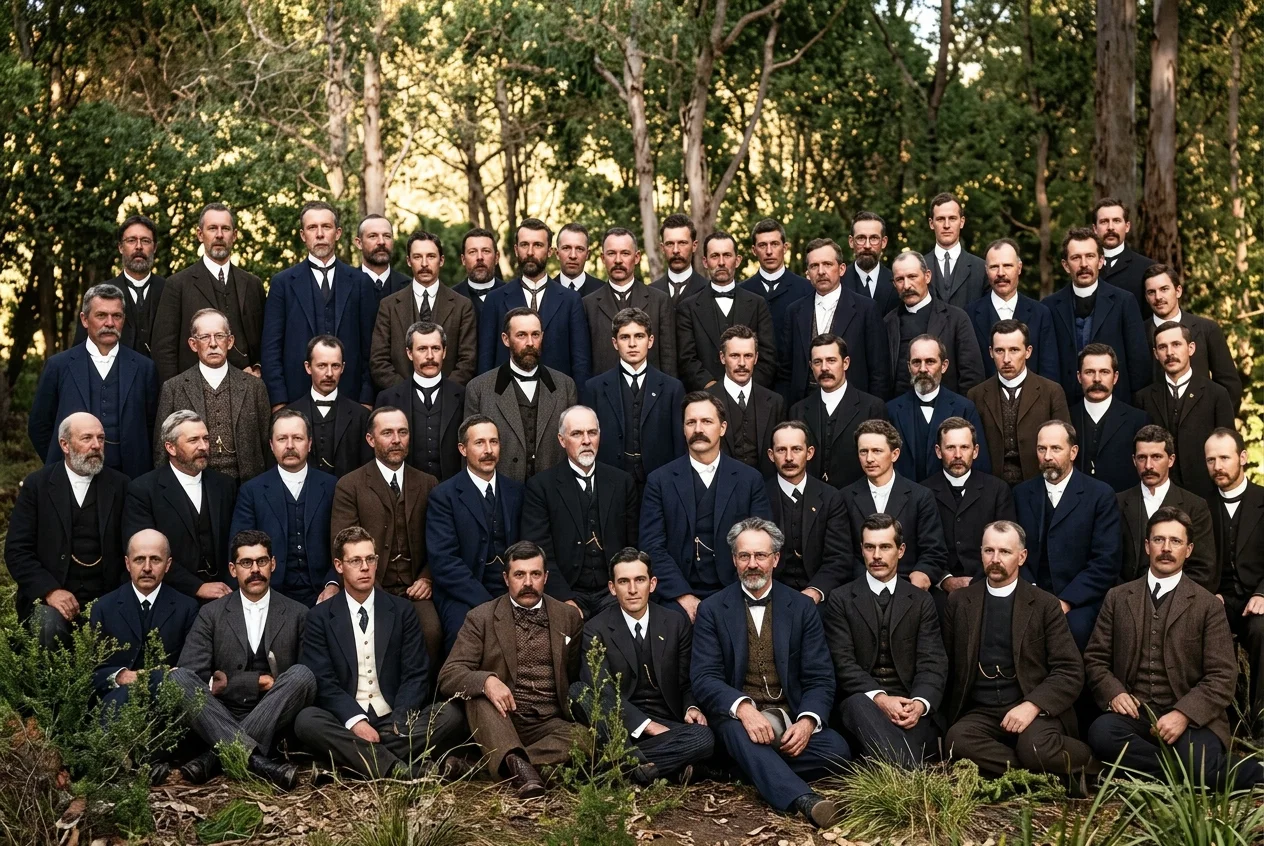
Group of Ministers in the Australasian Field
Another thing that deeply impressed us as we visited the different conferences was the large number of young men and young women connected with our cause. And these young people are giving their lives to the work of this message. There is no difficulty in securing volunteers for either the home or the foreign fields. While this is a most encouraging situation, yet it has its serious side; namely, how we are going to press all these young people into service. While they do not want to connect with the business enterprises of the world, yet they must do something. If we cannot let them enter the organized work, they must devote their energies and activities to private interests.
As I came in contact with these bright, energetic, accomplished young people, it seemed to me that this field might be drawn upon for workers in the British countries throughout the world. May not this be one of the purposes for which the Lord hastened the development of the work in this field?378
It is surely most encouraging to see how these young people come into our ranks and stay by. While some become discouraged and turn away, a far greater number remain faithful.
CONSECRATION TO FINISH THE WORK
As I met our people in different parts of the field, I endeavored to encourage them to hold on, and to consecrate all to the definite effort of quickly finishing the work of God. To this end, I tried to make clear to them what had to be done when our movement started, how much has already been accomplished, what still remains to be done, and what definite line of action must be pursued by God’s people now to finish His work in this our day.
I felt the blessed presence and approval of the Master as I went over this ground. The Holy Spirit stirred and softened the hearts of the people. Many times they were in tears. With great earnestness they united in sacred, solemn covenant to do and to give all for the finishing of this work. Quite a number who, for various reasons, had fallen out, took their stand again for the truth. All together, between fifteen and twenty were persuaded to come back to the Lord. To me this was one of the best and most comforting features of my work.
LARGE AND EAGER AUDIENCES
The presidents of the conferences, who planned my tour, arranged for me to give one or more addresses in large halls in the principal cities. At Auckland two addresses were given on Sunday in the city hall. One of these was on prohibition, and the other on the world-wide foreign missionary movement of the last century. In this latter address, we were able to give the public some idea of our foreign mission operations.
When the war broke out, we took up the Eastern question and Armageddon. The papers were full of references to both of these questions, but did not make it clear just what either one was. Our announcements to deal with them from the standpoint of the Scriptures, brought large audiences eager for light. All together, we gave twelve of these addresses in town halls, theaters, mechanics’ institutes, and temperance halls, besides a number in our churches and in tents at camp meetings.
In all my ministry, I have never had such opportunities for reaching the public as opened to us in New Zealand and Australia. Somehow the people seemed to feel that we could tell them what all these things mean. Many came to our people for an explanation. As soon as the war broke out, we began to sell a pamphlet written by Pastor Teasdale on Armageddon. A large number were disposed of in a short time. This experience shows what quick, earnest efforts we may be called upon to make in the closing days of our work.
WHERE THE WORK STARTED
Our visit to Melbourne was most encouraging. It was in this city that Brethren Haskell, Corliss, and Israel first located when they came to Australia in 1885. It was here that the first sermon was preached by our people south of the equator. It was here we printed the first line of literature in the southern hemisphere. It was here I had the privilege of making the first public appeal to Seventh-day Adventists in this field for gifts to establish our printing house in Melbourne. It was here we organized our first conference in this hemisphere and later organized the first union conference in our denomination. The labor, anxiety, and struggles that go with pioneer work, help to make the place where the work is done, and the people who are associated in the work, very dear to the pioneers.
Now in all these experiences, we had the association and helpful coöperation of many brethren and sisters who embraced the message at the very beginning of our work in Melbourne. We had learned their value and loyalty, and had come to love them very dearly. When we stepped from the train in Melbourne, we found a number of these dear old friends waiting to greet us. And later, when we had gathered in the large hall in the city for our general meeting, we were rejoiced to see the faces of so many of the old pioneers. In our conversation with those we met, we found that some of the old hands had passed away, and that a very few had become discouraged and given up the battle; but the great majority were still firm and pressing on. Our visit to Warburton, where the printing house is located, gave us the privilege of meeting a large number who were but children in those early days, but who are now in charge of the various departments of the printing house. Our public meetings in these places were blessed occasions.
Of the printing work I shall speak in another report.
A. G. D.
THE JUDGMENT ANNOUNCED
By R. C. P.
The Prophets Foretell a World-Wide Proclamation — Has Such a Message Been Sounded in the Past? — Is It Due for To-Day?
In two articles, Mr. Porter will present some interesting thoughts on the messages from God that announce the Judgment. This week, he presents the Bible text of these messages, tells the story of the “sealed book” that was opened, and states a few facts in regard to the world-wide character of the movement.
Next week, he will give more data on the universal extent of this Judgment message; will tell of the disappointment that was foretold, and the work that by divine decree was to follow the disappointment. Editor.
The proclamation of the Judgment message is one of a series of three messages brought to view in Revelation, chapter 14. They are to have their application just prior to the second advent of Christ. This is made clear by the statement of verses 14-16: “And I looked, and behold a white cloud, and upon the cloud One sat like unto the Son of man, having on His head a golden crown, and in His hand a sharp sickle. And another angel came out of the temple, crying with a loud voice to Him that sat on the cloud, Thrust in Thy sickle, and reap; for the time is come for Thee to reap; for the harvest of the earth is ripe. And He that sat on the cloud thrust in His sickle on the earth; and the earth was reaped.”
The Judgment message reads: “And I saw another angel fly in the midst of heaven, having the everlasting gospel to preach unto them that dwell on the earth, and to every nation, and kindred, and tongue, and people, saying with a loud voice, Fear God, and give glory to Him; for the hour of His Judgment is come: and worship Him that made heaven, and earth, and the sea, and the fountains of waters.” Rev. 14: 6, 7.
SERIES OF MESSAGES PROCLAIMS THE END
In Matt. 13: 39, Christ defines the word “harvest” thus: “The harvest is the end of the world.” This series of messages must therefore go to all nations just before the end of the world. This is emphasized by the statement of the revelator, verse 7, “The hour of His Judgment is come.”
A message announcing the Judgment at hand, could not have applied to apostolic times; for Paul “reasoned of righteousness, temperance, and Judgment to come.” Acts 24: 25. He did not declare that the Judgment was then proceeding, but that it was still in the future.
JUDGMENT SET AND BOOKS OPENED
Daniel presents the Judgment as the last act before Christ receives His kingdom, and returns in majesty and glory to gather the saints: “I beheld till the thrones were cast down, and the Ancient of days did sit, whose garment was white as snow, and the hair of His head like the pure wool: His throne was like the fiery flame, and His wheels as burning fire. A fiery stream issued and came forth from before Him: thousand thousands ministered unto Him, and ten thousand times ten thousand stood before Him: the Judgment was set, and the books were opened. . . . I saw in the night visions, and, behold, One like the Son of man came with the clouds of heaven, and came to the Ancient of days, and they brought Him near before Him. And there was given Him dominion, and glory, and a kingdom, that all people, nations, and languages, should serve Him: His dominion is an everlasting dominion, which shall not pass away, and His kingdom that which shall not be destroyed.” Dan. 7: 9, 10, 13, 14.
This statement that the Judgment precedes the second coming of Christ is confirmed by Rev. 22: 11, 12: “He that is379unjust, let him be unjust still: and he which is filthy, let him be filthy still: and he that is righteous, let him be righteous still: and he that is holy, let him be holy still. And, behold, I come quickly; and My reward is with Me, to give every man according as his work shall be.”
THE JUDGMENT PRECEDES HIS COMING
The second coming of Christ is here placed immediately after the close of the Judgment. Much other evidence might be adduced in proof that these messages apply just before the second coming of Christ; but the above is sufficient for this brief study, since the statements are plain and positive.
The parable of Matt. 22: 1-4 and Luke 14: 16-24 refers to the same three messages, and fixes the time at the close of the day in the three calls to supper. The dinner call to the Jews, given at midday by Christ and His apostles, had been refused. The three calls at the close of the gospel day complete the history, and bring the second coming of Christ.
MIGHTY MESSAGES OF WARNING
Having considered the time when these messages are to have their application, let us study the messages themselves: “And I saw another angel fly in the midst of heaven, having the everlasting gospel to preach unto them that dwell on the earth, and to every nation, and kindred, and tongue, and people, saying with a loud voice, Fear God, and give glory to Him; for the hour of His Judgment is come: and worship Him that made heaven, and earth, and the sea, and the fountains of waters. And there followed another angel, saying, Babylon is fallen, is fallen, that great city, because she made all nations drink of the wine of the wrath of her fornication. And the third angel followed them, saying with a loud voice, If any man worship the beast and his image, and receive his mark in his forehead, or in his hand, the same shall drink of the wine of the wrath of God, which is poured out without mixture into the cup of His indignation; and he shall be tormented with fire and brimstone in the presence of the holy angels, and in the presence of the Lamb: and the smoke of their torment ascendeth up forever and ever: and they have no rest day nor night, who worship the beast and his image, and whosoever receiveth the mark of his name. Here is the patience of the saints: here are they that keep the commandments of God, and the faith of Jesus.” Rev. 14: 6-12.
“This series of messages must therefore go to all nations just before the end of the world.”
Since John had previously spoken of an angel with the woe trumpets flying in the midst of heaven (Rev. 8: 13), he calls this “another angel.” We sometimes call it the first angel, because it is the first of a series of three brought to view in Rev. 14: 6-12. No ordinary preaching of the gospel could fulfill this prophecy, for here is a movement that must go speedily “to every nation, and kindred, and tongue, and people, saying with a loud voice, Fear God, and give glory to Him; for the hour of His Judgment is come.”
When this message is fulfilled, the world must hear such an announcement given in good faith.
This message is evidently identical with that of Revelation, chapter 10. Chapter 9 proclaims the first and the second woe. In the study of the Eastern question, we learn that the prophetic period connected with the second woe terminated with the overthrow of the political power of the Ottoman empire, in August 11, 1840. Upon the authority of the prophecy of Revelation, this had been predicted by those who in 1843-44 were proclaiming the hour of God’s Judgment come. When the day came to which all were directed as the day specified in the prophecy for the fall of the Ottoman empire, many learned with amazement that upon that very day the powers of Europe had compelled the Ottoman ruler to sign papers surrendering his government to the control of the great nations of Europe. This gave a great impetus to the advent proclamation of A. D. 1840-44. Chapter 10 gives an account of the great advent movement.
A PROPHETIC TIME MESSAGE
“And I saw another mighty angel come down from heaven, clothed with a cloud: and a rainbow was upon his head, and his face was as it were the sun, and his feet as pillars of fire: and he had in his hand a little book open: and he set his right foot upon the sea, and his left foot on the earth, and cried with a loud voice, as when a lion roareth: and when he had cried, seven thunders uttered their voices.” Rev. 10: 1-3.
Here a mighty angel, with his right foot upon the sea, and his left foot upon the land, makes a proclamation based upon a little book open.
The statement that he has in his hand a little book open, indicates that the little book which he used as the basis of his proclamation, had been once closed, or sealed, but was now open. This is true of the little book of Daniel’s prophecy, to which reference is here evidently made. The statement reads: “But thou, O Daniel, shut up the words, and seal the book, even to the time of the end: many shall run to and fro, and knowledge shall be increased. . . . And he said, Go thy way, Daniel: for the words are closed up and sealed till the time of the end.” Dan. 12: 4, 9.
THE SEALED BOOK IS OPENED
The book open in the hand of the angel deals with time. “And the angel which I saw stand upon the sea and upon the earth lifted up his hand to heaven, and sware by Him that liveth forever and ever, who created heaven, and the things that therein are, and the earth, and the things that therein are, and the sea, and the things which are therein, that there should be time no longer.” Rev. 10: 5, 6. The book of Daniel likewise deals with periods of prophetic time. “And they shall be given into his hand until a time and times and the dividing of time.” Dan. 7: 25, last part. “And he said unto me, Unto two thousand and three hundred days; then shall the sanctuary be cleansed.” Dan. 8: 14.
The proclamation of the angel of Rev. 10: 6, “that there should be time no longer,” refers to the kind of time that he found in the little book of Daniel, which he held in his hand open; namely, prophetic time. The longest prophetic period given in that book is the 2,300-day period, beginning in 457 B. C., and closing in 1844 A. D. When the prophecy of chapter 10 is fulfilled, the world must hear the announcement that there shall “be time no longer.” Nothing less than this will fulfill the prophecy. Based upon this prophetic time period, it must be decidedly announced that “the hour of His Judgment is come,” in fulfillment of Rev. 14: 7.
Both these announcements were definitely made by the proclamation of the great advent movement of 1840-44. This movement was to be world-wide. It was to go to land and sea, as represented in chapter 10, by the angel standing with one foot on the sea, and the other foot on the land. It was to bear a message “to every nation, and kindred, and tongue, and people,” as predicted in Rev. 14: 6, 7.
A WORLD-WIDE MOVEMENT
The fact that both these announcements were made, and that the proclamation was world-wide, in the advent movement of 1840-44, is well known.380
John the Baptist had a special mission, announced in prophecy. He knew that he was the forerunner of Christ at the time of His first advent. He said: “I am the voice of one crying in the wilderness, Make straight the way of the Lord, as said the prophet Esaias.” John 1: 23. If, then, as is here suggested in the prophecy, the great advent movement of 1840-44 fulfilled the prediction, the men who carried the message, like John the Baptist, should have known that they were commissioned by these prophecies to make the proclamation which they gave to the world at that time. Let Sylvester Bliss, an ardent believer in that movement, inform us on this point:
“As an indication of the approach of the end, there was, however, to be seen another angel flying through ‘the midst of heaven, having the everlasting gospel to preach unto them that dwell on the earth, and to every nation, and kindred, and tongue, and people.’ Rev. 14: 6. The burden of this angel was to be the same gospel that had before been proclaimed; but connected with it, was the additional impetus of the proximity of the kingdom—‘saying with a loud voice, Fear God, and give glory to Him; for the hour of His Judgment is come: and worship Him that made heaven, and earth, and the sea, and the fountains of waters.’ Verse 7. No mere preaching of the gospel, without announcing its proximity, could fulfill this message.”—Advent Herald, December 14, 1850.
“We firmly believe that this proclamation has been made, and that the preaching of the immediate advent of our Lord has been in fulfillment of this prophecy. Prior to the fall of the Ottoman empire in 1840, it had been shown by those who were preaching the immediate advent of Christ, that the hour, day, month, and year of the Ottoman supremacy would expire on the eleventh of August, 1840. When the event verified the truth of this calculation, the way was prepared for the great advent message to go with mighty power. The prophecies were not only unsealed, but, in the providence of God, a demonstration of the truthfulness of the mode of calculation respecting the prophetic times was given to the world. Thus, at the very time when the mighty angel of God was to come down with the little book open in his hand, and to cry with a loud voice, the advent message began to be proclaimed with great power. It was the good news of the everlasting kingdom, and of the advent of our glorious King.”
Hence it is evident that the advent proclamation comes in at the right time in this prophecy. R. C. P.
QUESTION CORNER
By Milton C. Wilcox
CONDUCTED BY MILTON C. WILCOX
MOUNTAIN VIEW, CALIFORNIA
NOTE.—This department is for the purpose of helping Bible students. Answers must of necessity be brief, often only suggestive, never exhaustive, never infallible only as they agree with the infallible Word. Such questions only will be answered as seem to the editors to minister to the mission of the paper. Questions of the same import cannot be answered repeatedly in the same volume. Name and address must be given, not for publication, but as evidence of good faith and to insure reply by letter if thought best. It is well always to inclose stamp, not stamped envelope, unless answer is desired by letter alone.
Kindly inform us when the dry bones of Eze. 37:1 were gathered, and by whom, and for what purpose, and also what disposition was made of that great army.
J. C. W.
If our inquirer will read the scripture carefully, he will see that chapter 37 of Ezekiel was not an actual occurrence, but a vision. The prophet was set in a valley; and in that vision, that valley was full of bones, very dry; and he was asked, in that vision, “Can these bones live?” He did not know, but said, “Thou knowest.” Then he was told, in that vision, to prophesy over these bones; and he did as he was commanded; and in that vision, an earthquake occurred; and in that vision, bone came to its bone, flesh came upon the bones; and in the vision, all these bones, with flesh upon them, stood up, a very great army. That was the vision, and the parable of the vision. In verse 11 and onward, we are told what that vision meant. It meant the whole house of Israel then living. Israel was complaining, “Our bones are dried up, and our hope is lost; we are clean cut off.” Then God promises what the parable was designed to teach, and that is, if they would only yield to Him, He would save them out of their difficulty. He would bring their people up out of their graves, and He would bring to them all the blessings and the restoration that are told in the latter part of the prophecies of Ezekiel. But they did not do it, and would not do it. The vision will never be fulfilled as God wished to fulfill it to His people back there. The only fulfillment that we will see of it will be one that is far more glorious, when God will raise all His children from the dead.
“Let your women keep silence in the churches; for it is not permitted unto them to speak; but they are commanded to be under obedience, as also saith the law. And if they will learn anything, let them ask their husbands at home; for it is a shame for women to speak in the church.”
There are many conscientious Christian women who fail to bear testimony to the goodness of God, in public meetings in the church, because of the misunderstanding of this text. Taken in its broadest sense, it would mean that women are absolutely prohibited by the apostle from taking part in public meetings; but certainly the apostle did not mean this, nor is it the general teaching of Scripture. Note the following evidences:
First, the apostle gives instruction as to how women who were prophesying or publicly teaching should dress. 1 Cor. 11:5-13. Surely the apostle would not give instruction in this same epistle regarding women’s manner and dress and her appearance in public, and yet forbid public work.
Secondly, among the noted helpers of the apostle Paul were Aquila and Priscilla. Priscilla was the wife of Aquila. Sometimes her name is mentioned first. She seems to have been a public teacher, and among those who taught the great preacher Apollos. See Acts 18:1-4 and 24-26. Note also the number of women whom the apostle mentions in the last chapter of Romans as among those who helped him.
Thirdly, we are expressly told, in Acts 2, that in the last days God would pour out His Spirit “upon all flesh: and your sons and your daughters shall prophesy: . . . yea and on My servants and on My handmaidens in those days I will pour forth of My Spirit; and they shall prophesy.” No distinction is made between the men and the women.
In the twenty-first chapter of Acts, ninth verse, we read of Philip the evangelist, who had four virgin daughters that prophesied. By the term “prophesying” is meant speaking as impressed by the Spirit for God. It would include public teaching, and it would also include bearing testimony to the Lord’s work. Now this was true in Old Testament times as well. We have Miriam the sister of Moses leading the women of Israel with cymbals and song and praise. We have Deborah the prophetess leading out in the armies of Israel. It was to Huldah the prophetess that Josiah sent to receive instruction in regard to the meaning of the book of the law. When our Saviour was brought into the temple as a little babe, it was Anna the prophetess that spoke, impressed by the Spirit, and prophesied concerning Him.
God does not design that His children, male or female, shall repress the testimony and song and praise that they ought to bear, and instruction, if need be, that they ought to give, because of any human rule or law of church or men.
Why does Paul say what he does, then, to the women of Corinth? These things are worthy of consideration.
First of all, Corinth was one of the wickedest cities in the Roman Empire. It was filled with every class of wickedness that one could imagine; and among those who fostered the wickedness were the heathen priestesses—women who were religiously devoted to lives of licentiousness. These taught in public. They had their manner of teaching. They harangued assemblies and crowds. Some of these doubtless had been converted to the truth of the gospel, but not understanding everything pertaining to it, were carrying into the church the same customs that the heathen priestesses had followed in Corinth. It is these things which the apostle forbids. They needed in Corinth just such instruction as he here gave.
We certainly know that God has, through the ministry of women, wrought mightily for the salvation of precious souls, and He does not design, in these last days of glorious freedom of speech, that women should be suppressed in their work for the good of humanity. He does, however, want everything done decently and in order.
It is but proper to give what is another explanation of this text, and that is that verses 34 and 35 are the language of an objector—the language of some one in the Corinthian church who had been contending that women should say nothing, should not speak in public at all; and that the apostle answered this objection in the thirty-sixth and thirty-seventh verses: “What? came the word of God out from you? or came it unto you only? If any man think himself to be a prophet, or spiritual, let him acknowledge that the things that I write unto you are the commandments of the Lord.” That is, it was not for these objectors who had risen up, to control or seek to control those whom the Spirit of the Lord moved upon to speak. If we could only translate ourselves back to those times, and could only see the customs that were then in vogue, see the converts that were brought out from heathenism, see the nature of the heathenism out of which they came, we would not be surprised at any of these instructions which are given in Scripture.
Looking upon the first view of the text as correct, we could see that there is a real point in what the apostle said to the women of Corinth, “Let your women keep silence in the churches.” But no true follower of Jesus Christ ought to suppress the appeal of the Spirit in testifying to the goodness of God and praising His name for His mercies.
137 — THE CUBIT
Please answer, through the SIGNS OF THE TIMES, how many of our cubits of to-day would be equal to one of the cubits mentioned in Genesis 7, where we are told that the water prevailed fifteen cubits upward.
O. H. S.
There are two ways of reckoning the cubit in the Bible,—the one equal to eighteen inches, and the other to about twenty-two, or nearly that. The cubit of Genesis 7 was probably eighteen inches, or one and one half feet, according to our measurement. We do not reckon in cubits now; but generally speaking, the cubit is eighteen inches. Fifteen cubits, according to that kind of measurement, would be equal to twenty-two and one half of our feet.