Signs of the Times, Vol. 42, No. 24.

A Strange Breath in the World
Earlier text: A Strange Breath in the World

What Becomes of the Sinner

Will All the Impenitent Burn Eternally?—Does the Bible Teach Everlasting Torment?
By Albert M. Dart
Since, as shown in previous articles, man is mortal, perishable, corruptible, and has life only through Christ, it is patent that those without Christ meet the fate of their nature. So we are exhorted to be partakers of the divine nature through Christ, and escape corruption. 2 Peter 1:3, 4.
This puts forever to rout the horrible, God-dishonoring doctrine of eternal, conscious existence in hell fire; for corruptible, perishable things do not exist forever in fire.
The absolute destruction of the wicked is in perfect accord with the plan of salvation, and on no subject does the Bible speak more plainly than on this one.

UNQUENCHABLE FIRE

Of Jesus it is written that He will “gather His wheat into the garner; but He will burn up the chaff with unquenchable fire.” Matt. 3:12.
No argument is needed to convince the reader that the wheat represents the good people, those saved through Christ; and the chaff, the wicked, or unsaved.
Some have thought this a favorable text for eternal life in hell fire; but if it is, what shall be said of the texts not favorable to that doctrine?
The wicked are here likened to chaff, a very inflammable material. How different this from material that could stand the ravages of the hottest of fires to all eternity!
The word “unquenchable” in no wise calls for eternity of existence. God declared of ancient Jerusalem that because of the wickedness of the people, He would “kindle a fire in the gates thereof, and it shall devour the palaces of Jerusalem, and it shall not be quenched.” No one would hold that the fire is still burning, nor that the palaces were able to resist the flames. No; the statement is that the fire would devour the palaces, nor could it be quenched till it had. So in Matt. 3:12. The chaff—the wicked—He would burn up with unquenchable fire. The fate of the wicked is here made plain.

“WHERE THEIR WORM DIETH NOT”

The destiny of the wicked is clearly set forth in the Saviour’s language found in Mark 9:43-48. He states that “It is better for thee to enter into life maimed, than having two hands to go into hell, into the fire that never shall be quenched; where their worm dieth not, and the fire is not quenched.”
A vivid picture of the fate of the wicked, as pointed out by the Saviour, was in constant operation before the eyes of the people outside the walls of Jerusalem.
Greenfield, in his “New Testament Lexicon,” thus defines the word “hell” in the text under consideration: “Gehenna, the valley of Hinnom, south of Jerusalem, once celebrated for the horrid worship of Moloch, and afterward polluted with every species of filth, as well as carcasses of animals and dead bodies of malefactors; to consume which, in order to avoid the pestilence which such a mass of corruption would occasion, constant fires were kept burning.”
Let it be observed that whatever or whoever was cast into this Gehenna fire was consumed by the unquenchable fire. Nothing cast therein resisted the flames nor continued to exist. The worm was associated with the fire, for the reason that worms preyed upon portions remaining around the edge, of whatever was cast into the fire. What was not destroyed by the fire was consumed by the worms. Thus is given a picture of utter destruction for the wicked.
The continuance of the fire was dependent upon a constant supply of new material. Though admitting that the lost will vastly outnumber the saved, we would hardly expect an attempt to prove that from the ranks of the wicked could be obtained a supply lasting through the eternal ages. In all consistency, this is necessary to prove the fire burning forever.

PAST EXAMPLES OF “ETERNAL FIRE”

“Even as Sodom and Gomorrah . . . are set forth for an example, suffering the vengeance of eternal fire.” Jude 7. Whatever “eternal fire” did to Sodom and Gomorrah, that it will do for the wicked.
Let the apostle Peter explain: “And turning the cities of Sodom and Gomorrah into ashes condemned them with an overthrow, making them an ensample unto those that after should live ungodly.” 2 Peter 2:6.
This explanation needs no comment; and the word “eternal,” and other similar words in this connection, are seen to refer to the effects of the fire—ashes eternally.
With this agree the words of the prophet Malachi. In speaking to this same point, he compares the wicked to “stubble” and says: “The day that cometh shall burn them up, . . . that it shall leave them neither root nor branch. . . . And ye shall tread down the wicked; for they shall be ashes under the soles of your feet in the day that I shall do this, saith the Lord of hosts.” Mal. 4:1, 3.
BRITISH SUBMARINE
BRITISH SUBMARINE
How awful the doom that awaits the wicked! How astonishing the love that provided a way of escape!

ESCAPE THE AWFUL DOOM

“But the wicked shall perish, and the enemies of the Lord shall be as the fat of lambs: they shall consume; into smoke shall they consume away.” Ps. 37:20. Listen, dear reader: It is the enemies of the Lord that perish, are consumed by fire. Turn to God. Be His friend. Escape the doom. He has made ample provision. It was “when we were enemies” that “we were reconciled to God by the death of His Son.” Rom. 5:10.
Be sure that all who suffer this doom have chosen to be enemies of God. “Their own way have I recompensed upon their heads.” Eze. 22:31. “For that they hated knowledge, and did not choose the fear of the Lord: they would none of My counsel: they despised all My reproof. Therefore shall they eat of the fruit of their own way, and be filled with their own devices.” Prov. 1:29-31.
“For yet a little while, and the wicked shall not be: yea, thou shalt diligently consider his place, and it shall not be.” Ps. 37:10.

REJOICE THAT NO SUCH PLACE EXISTS

Are you not glad that in the completed plan of salvation, there is no place for the eternal suffering of any who have chosen to be enemies of God, and thus perpetuate sorrow and misery?
How much more of love can be seen in the annihilation of the wicked than in a place provided where they eternally suffer the results of their choice!
Sin is in its very nature destructive. God’s provision to escape it cannot be neglected with impunity. Flee from sin as you would flee from the fires that in the last day will destroy it and the wicked who have chosen it. Take one look at the doom. Then look to Christ, the Saviour from it.
Both righteous and wicked die. When will the results of their choice be apparent? This question will be answered next week.

“We Never Heard of Him”

IN our work among the Hindus, we meet many who have never heard the name of Christ. We tell them how He came as a babe, of His wonderful life on earth, how He died to save all, even the people of India.
They interrupt us, saying: “Who is Christ? We never heard of Him. Does He live here in Karmatar?”
We answer their questions, and continue, “He is soon coming back to take every one home who is ready, and we want you to be ready to meet Him.”
They invariably ask, “How do you know?” From among the many signs, we usually choose those familiar to the people, such as famine, and disobedience of children to parents. They assent: “Yes, it is so. We believe you.” DELLA BURROWAY.

H. E. S. H

What is temperance? Is it merely to sign your name to a pledge—to refrain from indulging in the intoxicating cup? I believe not. One can be intemperate in eating, drinking, dressing, and working. We are living in a fast age. Listen to what Paul says: “Let your moderation be known unto all men. The Lord is at hand.” “Whether therefore ye eat, or drink, or whatsoever ye do, do all to the glory of God.” “And every man that striveth for the mastery is temperate in all things.”

H. E. S. H

Ink and Thought

“INK is the black sea on which thought rides to anchor.”

THE KING'S DREAM INTERPRETED

The Events of History Fulfill the Prophecy—Four World-Wide Kingdoms, Then a Division—No More World Empire Until the Close of Time
By Jean Vuilleumier

THE KING'S QUESTION

“The king answered and said to Daniel, whose name was Belteshazzar, Art thou able to make known unto me the dream which I have seen, and the interpretation thereof?”

DANIEL REPLIES WITHOUT HESITATION

“Daniel answered before the king, and said, The secret which the king hath demanded can neither wise men, enchanters, magicians, nor soothsayers, show unto the king; but there is a God in heaven that revealeth secrets, and He hath made known to the king Nebuchadnezzar what shall be in the latter days.”

TELLS THE KING HIS THOUGHTS

“Thy dream, and the visions of thy head upon thy bed, are these: as for thee, O king, thy thoughts came into thy mind upon thy bed, what should come to pass hereafter; and He that revealeth secrets hath made known to thee what shall come to pass. But as for me, this secret is not revealed to me for any wisdom that I have more than any living, but to the intent that the interpretation may be made known to the king, and that thou mayest know the thoughts of thy heart.”

THE PROPHETIC IMAGE OF THE KING'S DREAM

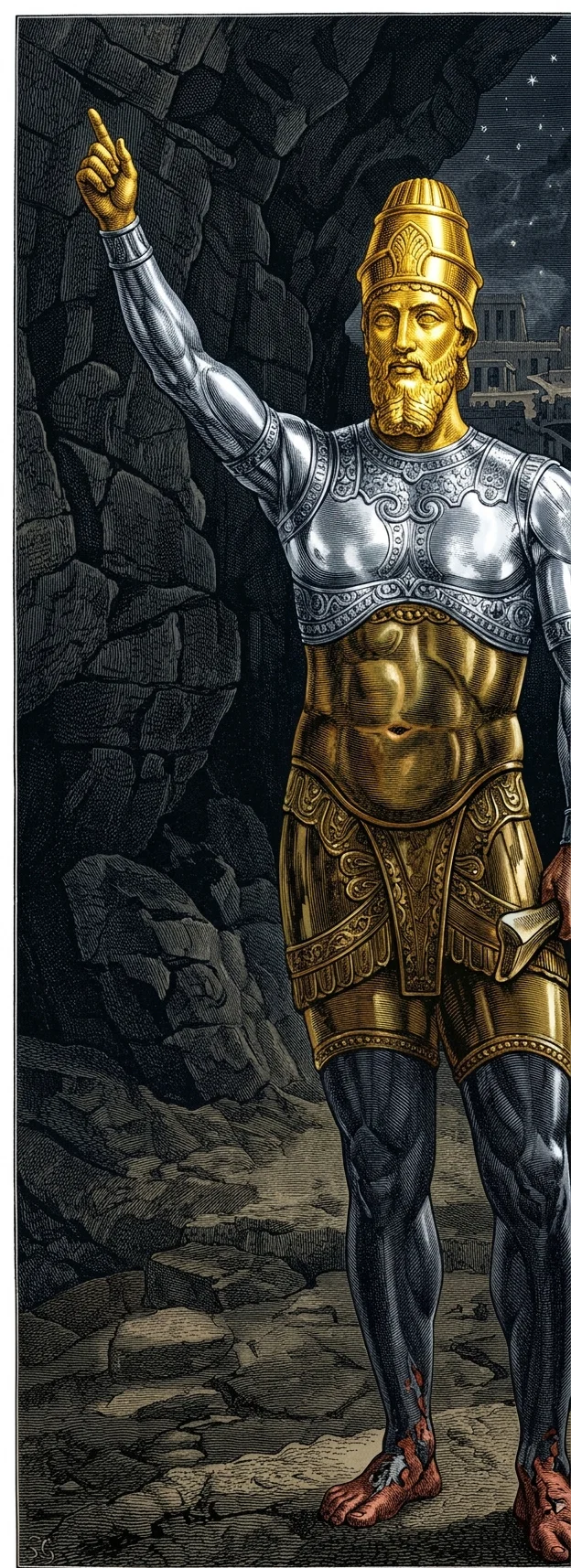
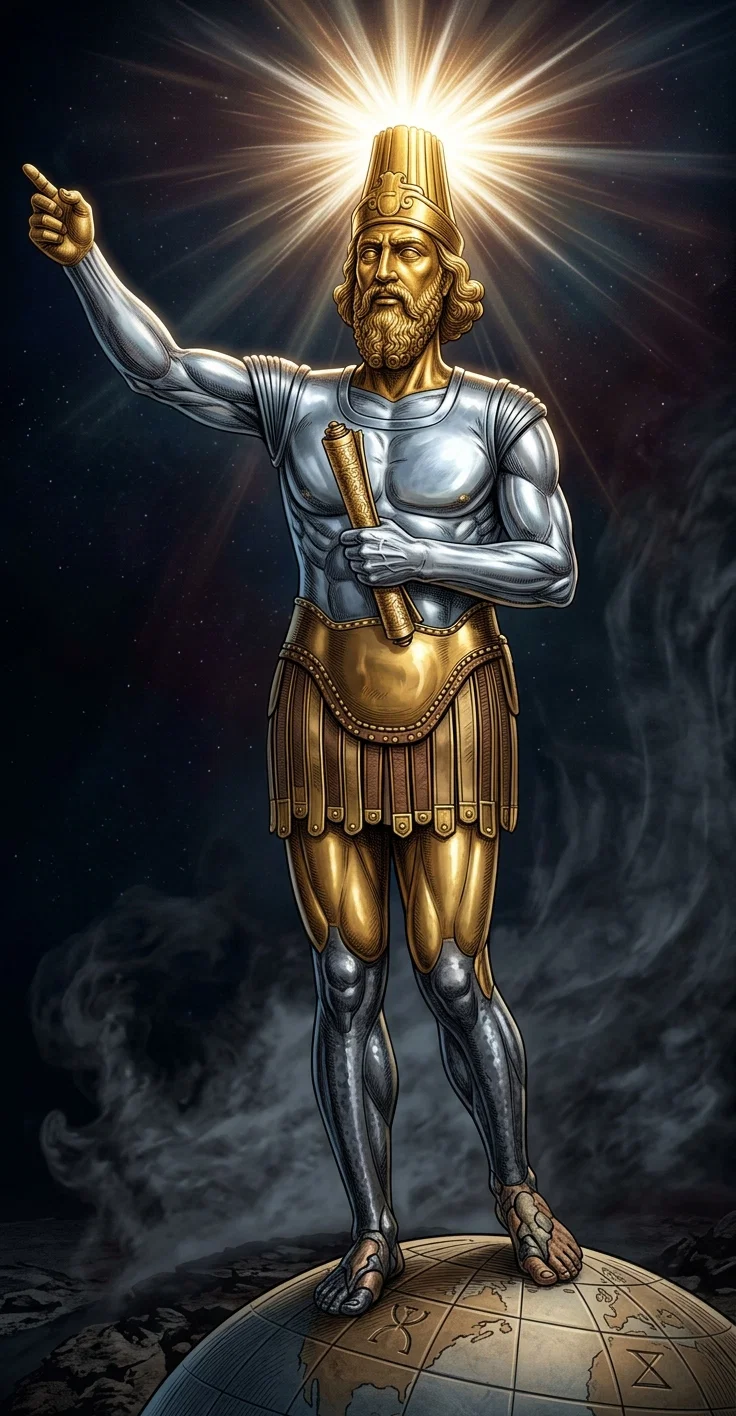
“Thou, O king, sawest, and, behold, a great image. This image, which was mighty, and whose brightness was excellent, stood before thee; and the aspect thereof was terrible. As for this image, its head was of fine gold, its breast and its arms of silver, its belly and its thighs of brass, its legs of iron, its feet part of iron, and part of clay. Thou sawest till that a stone was cut out without hands, which smote the image upon its feet that were of iron and clay, and brake them in pieces. Then was the iron, the clay, the brass, the silver, and the gold, broken in pieces together, and became like the chaff of the summer threshing floors; and the wind carried them away, so that no place was found for them; and the stone that smote the image became a great mountain, and filled the whole earth.”

INTERPRETATION: A SUCCESSION OF KINGDOMS

“This is the dream; and we will tell the interpretation thereof before the king. Thou, O king, art king of kings, unto whom the God of heaven hath given the kingdom, the power, and the strength, and the glory; and wheresoever the children of men dwell, the beasts of the field and the birds of the heavens hath He given into thy hand, and hath made thee to rule over them all: thou art the head of gold. And after thee shall arise another kingdom inferior to thee; and another third kingdom of brass, which shall bear rule over all the earth.”

FOURTH KINGDOM PERMANENTLY BROKEN

“And the fourth kingdom shall be strong as iron, forasmuch as iron breaketh in pieces and subdueth all things; and as iron that crusheth all these, shall it break in pieces and crush. And whereas thou sawest the feet and toes, part of potters' clay, and part of iron, it shall be a divided kingdom; but there shall be in it of the strength of the iron, forasmuch as thou sawest the iron mixed with miry clay. And as the toes of the feet were part of iron, and part of clay, so the kingdom shall be partly strong and partly broken. And whereas thou sawest the iron mixed with miry clay, they shall mingle themselves with the seed of men; but they shall not cleave one to another, even as iron doth not mingle with clay.”

THE ETERNAL KINGDOM SUCCEEDS ALL

“And in the days of those kings shall the God of heaven set up a kingdom which shall never be destroyed, nor shall the sovereignty thereof be left to another people; but it shall break in pieces and consume all these kingdoms, and it shall stand forever. Forasmuch as thou sawest that a stone was cut out of the mountain without hands, and that it brake in pieces the iron, the brass, the clay, the silver, and the gold; the great God hath made known to the king what shall come to pass hereafter; and the dream is certain, and the interpretation thereof sure.” Dan. 2:36-45.
Last week Mr. Vuilleumier gave an introduction to a study of the prophecy of Daniel, chapter two. In order that the reader may have the words of the prophet in mind, the text is reproduced in the center of this page. His article this week shows how kingdom has succeeded kingdom. It speaks also of the divisions of the Roman Empire, and of the unfruitful efforts to reunite the fragments—and all in direct fulfillment of the prophetic Word.
Next week his article will show the superhuman efforts that some great men like Napoleon have made to unite Europe in one vast empire. They have seemed at times on the point of achieving success. But failure following failure has shown the futility of their ambitions, and left the prophecy standing, a monument to divine foreknowledge. Other articles on the prophecies will immediately follow these that are given on the second of Daniel.
EDITOR.
History in hand, we find that the vision has been fulfilled with absolute accuracy from the days of Daniel down to our own.

BABYLONIAN HEAD OF GOLD

The Babylonians, 625-538 B. C., were well symbolized by the head of gold. Their capital—as described by Rollin, Lenormant, and Sayce, following Herodotus, and the cuneiform inscriptions discovered within the last fifty years—was a city of marvelous size and wealth. Its wall, three hundred fifty feet high, eighty-seven feet wide, and sixty miles in circumference, made it impregnable. Its hanging gardens; its palaces, several miles around; its fifty streets, fifteen miles long, crossing one another at right angles; the temple of Bel, containing sacred vessels and statues in gold to the amount of over one hundred million dollars,—all this justified the words of prophecy, “Thou art this head of gold.” The empire of Babylon lasted eighty-seven years.

THE PERSIAN BUST OF SILVER

In 538 B. C., after a long and memorable siege, Babylon was conquered by Cyrus, general-in-chief of the Medo-Persian armies, and the world passed into the hands of the kingdom of silver. The splendor of the Medo-Persian empire, compared with the Babylonian, was to be what silver is to gold. Next to the power of Nebuchadnezzar comes the glory of Darius, Xerxes, and Artaxerxes, the Medo-Persian kings. Next to the glory of the city of Babylon comes that of Shushan and Persepolis, Persian palaces that were marvels of wealth, as may be read in the first chapter of the book of Esther. The royal vestures of Xerxes and his son, according to Plutarch, were worth respectively twelve thousand and ten thousand talents, which represent thirty and twenty-five million dollars. This Persian power lasted two hundred seven years.

THE BRASS OF THE IMAGE AND THE EMPIRE OF GREECE

In 331 B. C. the world again changed masters, and passed under the scepter of a Greek conqueror, Alexander the Great. The brass empire had come. Less ductile and malleable than gold or silver, but with a quick passing brilliancy, this metal fittingly represents the third great monarchy. It was reared in eight years of the swiftest triumphant march ever recorded in history, and at the end of it the founder suddenly disappeared. But it continued 183 years without glory, until 148 B. C., passing through continuous wars between the Seleucidae, or Syrian kings, and the Ptolemies, or Egyptian kings, the two remaining divisions of the empire.

LEGS OF THE IMAGE—THE IRON MONARCHY OF ROME

One century and a half before Christ, still again the world changed masters, and passed under the iron rule of Rome. This symbol indicated that the fourth empire was to outdo the first three in political despotism, brutal force, and devastating instincts. “The fourth kingdom,” says the prophecy, “shall be strong as iron, forasmuch as iron breaketh in pieces and subdueth all things. . . . shall it break in pieces and crush.” Verse 40.
Such was the power established by Marius, Sulla, and Caesar. The terror of the Roman name has become proverbial. Listen to this prayer: “O God, I thank Thee that I was not born a Roman, so as to be still human.” Not only did the Romans conquer and plunder the world, but their heavy, crushing iron yoke rested for six long centuries upon the nations of the world.

THE IRON KINGDOM BROKEN

Then, weakened by corruption bred of wealth and leisure, the empire tottered and fell. Several barbarian nations which had for some time been incorporated into the armies of the empire, conquered it, and have since formed the large and the small powers of Europe.
Here is the list of the ten nations that divided the Western Roman Empire among themselves between the years 400 and 476 A. D.: 1. the Alemanni, who settled in South Germany; 2. the Franks, in northern and central Gaul; 3. the Burgundians, on both sides of the Jura; 4. the Suevi, in Galicia and Portugal; 5. the Vandals, in Andalusia (Vandalicia); 6. the Visigoths, in Spain; 7. the Saxons, in Great Britain; 8. the Ostrogoths, between the Danube, the Po, and the Adriatic; 9. the Lombards, in Lombardy; and 10. the Heruli, in southern and central Italy.
This new phase of universal history is introduced by the prophecy as follows: “And whereas thou sawest the feet and toes, part of potters' clay, and part of iron, it shall be a divided kingdom.” Verse 41. The parts composing this division were to be marked by two characteristics.

“PARTLY STRONG AND PARTLY BROKEN”

First characteristic: “There shall be in it of the strength of the iron, forasmuch as thou sawest the iron mixed with miry clay. And as the toes of the feet were part of iron, and part of clay, so the kingdom shall be partly strong, and partly broken.” Verses 41, 42.
Indeed, the nations that took the place of the Roman Empire have always been divided into two classes, the large and the small powers. Among the large powers must be ranked France under Charlemagne, Francis I, Louis XIV, and Napoleon; Germany under Frederick Barbarossa in the twelfth century, and the Hohenzollern in the nineteenth and the twentieth; Austria under the Hapsburgs; Spain under Charles V; England under the Tudors; Italy since King Victor Emmanuel I. Among the small powers can be mentioned the Swiss cantons, the kingdom of Bavaria, Portugal, Holland, Wurttemberg, Saxony, and Belgium.

THEY SHALL NEVER BE UNITED AGAIN

Second characteristic: “And whereas thou sawest the iron mixed with miry clay, they shall mingle themselves with the seed of men; but they shall not cleave one to another, even as iron doth not mingle with clay.” Verse 43.
“Thou, O king, sawest, and, behold, a great image.”
It is an undeniable fact that all the political history of the Middle Ages and of modern times is overshadowed by one persistent idea on the part of the leading rulers; that is, the reconstitution of the Roman Empire or of some kind of universal empire.
Charlemagne was crowned “emperor of the Romans” at Rome in the year 800. The German emperors still call their power “the Holy Roman Empire of Germany.” The title of “Roman emperor” was taken by Napoleon from the Austrian court, and he called his son “king of Rome.” The custom of intermarriage among the various reigning families is one leading feature in this policy.

INTERMARRIED AND COMMINGLED

It can be safely said that all the courts of Europe have been for centuries intermarried with each other, and thus “mixed with the seed of men”; but notwithstanding that, they have been hopelessly divided by rivalries, jealousies, and bitter enmities, which, in spite of Christianity and civilization, have resulted in the recent period of exhausting armaments and in the present war, the greatest yet witnessed on the face of the globe.

Was Hatred Ever Taught?

IN the Sermon on the Mount, Jesus says, “Ye have heard that it hath been said.” He did not say, “It is written.” He referred to Deuteronomy 23, says the margin, which the teachers had misconstrued.
Jesus told them to love their enemies, but this was not a new doctrine. On the contrary, it is one of the two component parts of God’s law.
In Exodus 23 we are taught that if our enemy’s stock runs astray, we should bring it back to him; and if the beast of burden of him who hates us drops down under its load, we should leave our own, and go to the rescue, and help our enemy first.
Jesus adds that if we love our friends, we only do what the sinners do: for even among murderers and thieves we find a species of brotherly love, sometimes so strong that one will give his life rather than betray his partners. But as followers of Christ, the perfect example, we should do as He did, and love, bless, and pray for those who curse us, hate us, lie about us, or abuse us.
All these verses are plainly an illustration in detail of the real meaning of God’s law. That is why Jesus precedes His remarks by a warning not to think that He is going to teach a new thing or that He is going to do violence to the law; for that law, He says, stands fast till heaven and earth pass away.
J. H. HARTOG.

False Humility

THIS is one of the worst forms of pride. Persons under this deception suppose themselves very humble and lowly in heart. In fact, they really believe that they are far in advance of their brethren in all that renders men acceptable in the sight of God. Under this impression, people become proud of their humility.
If there were one particle of honesty or frankness to sin, we should not so often fall into it. But sin deceives us. That is its very nature. The deceitfulness of sin is that which makes it so dangerous an adversary. Sin is the eldest born of Satan. He is the archdeceiver. Deception is his business. Cheating is an art which he has carried to the highest perfection.
Nothing but fraud and guile can proceed from such a source. Though the prince of darkness, he can transform himself into an angel of light. 2 Cor. 11:14. And such is his skill in beguiling men, that he is able to give to pride the outward form of humility, and to make it, many times, pass for this excellent grace.
That kind of humility is often manifested in acts of austerity or apparent self-denial, for the purpose of securing the attention or approval of others. Sometimes it is shown in the wearing of mean and slovenly apparel, that thereby one's humility may be declared. But all these acts of apparent humility are performed to gratify the pride of a self-righteous heart, or to receive the approval of those whose good opinion is specially desired.
One test generally if not invariably distinguishes false humility from that which is genuine. One can bear reproof, the other cannot. One is grateful for correction, the other is altogether too holy to allow of any such treatment of its exalted piety.
Another almost universal test is found in the fact that spurious humility seeks by word and act to draw men's attention to itself, but that which is genuine would hide from every eye but God's. “Most men will proclaim every one his own goodness: but a faithful man who can find?” Prov. 20:6.—J. N. Andrews.

Nothing Hid

THE disclosure of transgression is sooner or later inevitable. There can be no burial of it so deep that in due time it will not have a resurrection. The voice that tells is somewhere. The stain is somewhere. The sore and shame are somewhere. The avenger is somewhere. The eternal right is over all.
Out of the darkness and silence, out of the misguided zeal of friends, out of the eagerness of the guilty to seem indifferent and unconscious, out of the patience and sufferings of the wronged, out of the very emphasis of denial fortified by favorable public opinion, out of all concealments and subterfuges, will come eventually the revelation, the confession.
There is no special miracle in all this, however singular seems the disclosure, but an eternal miracle through the righteous and perfect methods of God. It is one of the insanities of the sinner to think that for him, at least, there may be an immunity; that in his case the infinitely wise and gracious constitution of things may be modified. But there is no allowance made for him, be he prince or peasant. Just as certainly as sufficient arsenic kills, so does guilt finally appear.—James White.

Finding a Heaven

A RICH church member met his minister on a Monday morning, and said, “Pastor, that was a fine description of heaven you gave us yesterday, but you did not tell us how to find it.”
“Well,” said the minister, “I am glad I met you, so that I can tell you now. I have just been up on the hill to visit a poor widow who is a member of the church. She is out of wood, and almost out of provisions. You go and buy five dollars’ worth of fuel and provisions, take them up to her yourself, and tell her that you give them to her in the name of the Lord Jesus. Then read to her the twenty-third psalm, and pray with her; and if you don’t find a heaven, report to me; and I will foot the bill.”
Later in the day, the man met the minister, and said, “Pastor, I did just exactly as you told me; and if I didn’t find a heaven for fifteen minutes, it’s because I am not here to tell you.” There are more such heavens to be found by those who will “go and do likewise.” J. N. LOUGHBOROUGH.

A GOD IN HEAVEN WORKS ON EARTH

His Gun Refused to Fire—Protected by a Spider’s Web—Food Providentially Provided
TESTIMONIES to the intervening hand of Providence may well be taken from the story of the days when the great Nonconformist body was forming in England, amidst the persecutions and sufferings following the Act of Uniformity, in 1662. Those were “times of trouble” indeed, and the Lord was the refuge of His children.

THOROUGHGOOD'S EXPERIENCE

Nicolas Thoroughgood, a scholar of Cambridge, had been a merchant and a traveler. Becoming a minister, he went out of the state church with the two thousand other nonconforming ministers, and endured privation with them. “In his diary,” says Calamy, “he recorded a variety of remarkable providences in the course of his life, of which he takes notice with great thankfulness.” Here is an account of one of these deliverances:
“At one time, while he was at Monkton, reproving the sin of swearing, one of his hearers, sensible of his guilt, and thinking he was the person particularly intended, resolved to kill him, and in order to do it, hid himself behind a hedge which he knew Mr. Thoroughgood would ride by when he went to preach his weekly lecture.
“When Mr. T. came to the place, he offered [endeavored] to shoot him, but his piece failed, and only flashed in the pan. The next week he lay in the same place and with the same intent. When Mr. T. was come up, the wretch offered to fire again, but the piece would not go off. Upon this, his conscience accusing him for such a wickedness, he went after him, and falling down on his knees, with tears in his eyes, related the whole to him, and begged his pardon. This providence was the means of his conversion; and he became from that time a serious, good man.”—Volume 2, page 76.

KEPT BY A SPIDER'S WEB

An old work, Baxendale’s “Dictionary of Anecdotes,” preserves the following record of the times of 1662. The experience is almost the same as one recorded of a French Huguenot, in the days of the St. Bartholomew massacre.
“A story is related—in connection with the ejectment of the two thousand ministers from the Church of England—of Henry Havers, of Catherine Hall, Cambridge. Being pursued by enemies who sought to apprehend him, he sought refuge in a malt house, and crept into the kiln. Immediately afterward, he observed a spider fixing the first line of a large and beautiful web across the narrow entrance. The web being placed directly between him and the light, he was so much struck with the skill of the insect weaver, that for a while he forgot his own imminent danger; but by the time the network had crossed and recrossed the mouth of the kiln in every direction, the pursuers came to search for him. He listened as they approached, and distinctly overheard one of them say: ‘It is of no use to look in there; the old villain can never be there. Look at that spider’s web. He could never have got in there without breaking it.’”

A GIFT IN TIME OF NEED

Another deliverance of these times is thus narrated in an old volume by an unknown English writer:
“The Rev. Oliver Heywood, B. D., in a time of great persecution, was ejected from Coley Chapel, near Halifax, in Yorkshire. In 1664, a writ came out for apprehending him as an excommunicated person; but he was not taken. He acted with prudence and caution, in order to avoid a long imprisonment, keeping himself private; and it pleased God to protect him from the search of his pursuers. In one of those seasons, being deprived of his income, his family were in great straits. Their little stock of money was quite exhausted, and family provisions were entirely consumed.
“Martha, their faithful servant, who would not desert her master and mistress in their distress, still abode with them, but could lend no more assistance from her little savings. Mr. Heywood still trusted that God would provide; and when he had nothing but the divine promise to live upon, he said,
“When cruise and barrel both are dry, We still will trust in God most high.”
“When the children began to be impatient, Mr. Heywood called his servant, and said to her: ‘Martha, take a basket and go to Halifax. Call upon Mr. N——, the shopkeeper in Northgate, and tell him I desire him to lend me five shillings. If he will be kind enough to do it, buy us some cheese, some bread, and such other little things as you know we want. Be as expeditious as you can in returning, for the poor children begin to be fretful for want of something to eat. The Lord give you good speed. In the meantime, we will offer up our requests to Him who feeds the young ravens when they cry, and who knows what we have need of before we ask Him.’”
“Martha went; but when she came to the house, her heart failed her, and she passed by the door again and again without going in to tell her errand. Mr. N——, standing at the shop door, called her to him, and asked, ‘Are you not Mr. Heywood’s servant?’ When she told him she was, he said to her, ‘I am glad to see you, as some friends have given me five guineas [about $25] for your master, and I was just thinking how I could send it.’ Martha burst into tears, and told him her errand. Mr. N—— was much affected with the story, and bade her come to him if the like necessity should return.
“She made haste to procure the necessary provisions, and, with a heart lightened of its burden, ran home to tell the success of her journey. When she knocked at her master’s door, which now must be kept locked for fear of constables and bailiffs, it was presently opened. Upon her entering the house, the children eagerly examined the basket, the patient mother wiped her eyes, and the father, hearing the servant’s narrative, smiled, and said: ‘The Lord hath not forgotten to be gracious. His word is true from the beginning. “They that seek the Lord shall not want any good.”’ Ps. 34:10.”
Always and everywhere, in prosperity or in trial, the history of God’s providences bears witness that there is access by faith to a Father in the heavens, whose tender mercies are over all.
W. A. S.

A Christian’s Duty

“A CHRISTIAN’S duty is to make stumblingblocks stepping-stones to heaven”
Continue reading: CHEERED BY THE SOLID DEVELOPMENTS