ON this topic the Christian Work has the following truthful utterance:—
“Surely the want of the time is less of mammon, more of righteousness; if not less of Sunday-school, at least more of religious instruction in the home; less denominational competition, more denominational cooperation; not less munificence in endowing great universities, but more proportionable giving according to one's means. Mr. Abram S. Hewitt said in this city not long ago that only one rich man in New York City gave at all proportionably according to his means; and this man, Cornelius Vanderbilt, was laid at rest in his family tomb a few days ago. Think of the enormous wealth, the vast incomes ‘often acquired but never earned,’ and then ponder upon the smallness of the giving in proportion to them.
“Here we rest. Let the reader ponder on these conditions which so vitally affect the religious life to-day; let him ask himself to what extent he is responsible for them. And then he may form some conception of the measure of his own duty—of his own responsibility for much of the Laodicean character of the ornate, self-satisfied Philistine Christianity which to-day we meet with in so many churches.”
Prospects for War and Peace
By T.
WHAT IS THE PROSPECT? IS IT PEACE OR WAR?
ANY one who is in a normal condition would much prefer peace to war. Indeed, war is the one thing that is the most horrible that the human mind can picture. And especially is war with modern weapons a terrible thing to contemplate.
A soldier returning from the Philippine war tells of a church building that was literally packed full of Filipinos. The American soldiers fired a couple of shells into it, and, having taken the range with a range finder, they caused both shells to explode right in the meeting-house. He said that he did not think a single individual survived the wreck of the death-dealing missiles.
Is there a prospect that wars will cease? or is it likely that we will soon have some of the greatest fighting that the world has ever seen? A little survey of the situation may help in reaching a conclusion.
England believes stronger in colonial expansion to-day than ever. Her colonies are helps in the expansion of her trade, and in this commercial age, anything that will help the merchant is eagerly sought out and cultivated. The facts all seem to indicate that England is seeking to dominate the whole of South Africa, and possibly the entire continent. And in pushing her claims in that field she is not averse to war. It is only necessary to mention the great preparations that the Britons are making for the war in the Transvaal, to show that this is so. And it is not alone in South Africa that England is ready to advance her colonial claims, but she has her eye on the far East as well. Notwithstanding all the talk about settling disputes by arbitration in these times, England reads her ultimatum to the Boers in the little South African republic, and pushes preparations for war in case of a failure to accept her terms. In this respect she does not seem to be very much ahead of those more ancient times, when everything had to be settled by arms, and when arbitration was not talked of as it is now.
Russia is an even more aggressive power than England. She is not only building railroads into the far East, and acquiring and fortifying forts there, but she has her eye on Southeastern Europe and many parts of Western and Central Asia. Russia is increasing and strengthening both her army and navy, with a view of not only maintaining her present empire, but of extending it. Certainly where the idea of empire is so strong, we can not look for any permanent peace.
Germany is also seeking to gain a foothold in the far East. She has acquired her seaport in China, and, according to the international fashion, is fortifying it as strongly as the devisings of modern times can suggest. There is no power that seems to be watching things among the nations with a more jealous eye than Germany. The German papers are saying that the "Fatherland" must closely observe the movements of England in South Africa, and if the opportunity is presented, the Germans are exhorted to step in and embarrass England all they can. Taking a general view of the condition of things in Germany, it does not augur for the peace of the world.
The French try to have a colonial policy, and would doubtless do something worthy of special mention in that line if they were not so severely broken up over their domestic affairs that they have but little time for anything else. Every one knows that France is in no condition to aid in a general establishment of peace.
The United States has a war on its hands in the Orient, and it is all because she desires to have a hand in the dividing up of the spoils that will come to the nations of Europe in the dismembering of China. Both the navy and the army in this country have come to the front very prominently during the past year and a half, and there are no indications that she will refuse to fight for any peace that she may wish to dictate.
And so we may turn our eyes to any quarter of the globe and the indications are all for war and not for peace. Even the little republics of South America are in a constant turmoil, and there is scarcely a week in the year that they are not either in civil strife or at war among some of their neighbors.
There is just one quarter from which we may look for peace. The Prince of Peace has promised to return to this earth, and everything indicates that His coming is very near. When He comes He will forever establish the peace that He has already given to every one who has learned to trust Him. The Master has given us His word, and He says, "These things have I spoken unto you, that in Me ye might have peace."
We may have peace in Him now, and enter into the everlasting fruit of it at His coming. But there is peace nowhere else for the inhabitants of this world. Any one who looks at the situation as it is to-day among the nations must be convinced that the universal war foretold by the prophets can not be very long delayed. T.
THE SALE OF JUDICIAL OFFICES.
By T.
In the years 1894 and 1895 the Lexow Committee, appointed by the New York Senate, spent much time in investigating the political corruption of New York City. Their investigations were largely in the line of the oppressions of the poor and unfortunate by those who held positions in the city government. The report showed a most startlingly corrupt condition of things.
At the present time a committee appointed by the New York Legislature, with Mr. Mazet as its chairman, is again investigating the political rule of New York City. They find that the conditions now are even worse than when the Lexow Committee did its work four years ago. But this Mazet Committee is making most of its investigations among the higher officials and leading men of the city, rather than among the poorer ones who have been so sorely oppressed. In speaking upon the subject, the New York World in a recent editorial says:—
"Twelve Supreme Court judges were questioned before the Mazet Committee yesterday. Their testimony revealed the fact that each of them, with one exception, had been compelled to pay from $2,000 to $15,000 for his office. The money was demanded and was paid to a political organization in the guise of an 'assessment for campaign expenses.' In fact it was in every case the price exacted for a judicial office, inasmuch as in each case nomination meant election, and the nomination was contingent upon the contribution.
"These are startling and very depressing facts. But still more startling and depressing is the attitude of the judges themselves toward this system of selling judgeships.
"Judge Patterson, who paid $4,000 or $5,000, thinks that there is no other way of raising the money that must be spent in elections. Judge Gildersleeve, who paid $5,000, thinks a candidate for judge ought to pay something, but that the price to him ought to be reduced somewhat. Judge Giegerich, whose tribute was $5,000, sees 'no way of avoiding' the exaction and payment of such 'contributions.' Judge Scott, whom as a pestilent reformer Tammany taxed to the tune of $9,000, boldly says that in his opinion the judge who has paid for his nomination is freer from obligation than if he had paid nothing. Judge Bischoff, a $10,000 man, agrees with Judge Patterson's views quoted above. Judge McAdam, whose friends gave $10,000 or $15,000 for his place, thinks that the exemption of judicial candidates from such levies 'would be a good thing for the candidate, but a most unfair thing for the party organization.' Judge Dugro, who was taxed $10,000, expressed the opinion that only rich men should be made judges, and that a poor man, if nominated, could 'borrow the money.' Judge Fitzgerald, who got off with $5,000, thinks that if judicial candidates are to be exempt from such levies, all other candidates should be. Judge Beach, who paid $5,000, 'knows' of no reason why a judicial candidate should be relieved of his expenses.' Judge Truax paid $2,000 and approves the system. Judge Beekman alone, who paid $5,000, thinks that 'a law forbidding the collection of campaign expenses from judicial candidates would be a good thing.' Judge MacLean, who paid nothing, declines to express an opinion.
"There are cases in which simple statement is the strongest argument. The attitude of mind thus revealed by the eminent judges whom our bosses have put under tribute is a sufficient demonstration of the need of a law absolutely forbidding political assessments upon candidates for judicial office or contributions by them for election purposes."
The same paper that contained the foregoing editorial also had the portraits of the twelve judges. No one would pick out a single one of them for a man that was a criminal, or even degraded in any way. Their faces are those that would pass for refined gentlemen anywhere. This makes the picture all the darker. The sense of common justice is so far gone that the most intelligent and refined do not have any scruples in doing things that should fill with horror the mind of one who seeks to do the right. The character of a vast number of the men who hold public positions to-day, is such that they will not be long in wrecking the whole world. There is no possible show for anything else. And when the wreck comes, we should make sure that we are in the haven that our heavenly Father has provided. T.
"KNIGHTS OF THE ROYAL ARCH."
By C. M. S.
THE liquor merchants and bartenders have organized a lodge of their own, under the name of "Knights of the Royal Arch." It is somewhat on the order of the Odd Fellows, Masons, and other secret orders. It is supposed to aid its members in case of sickness, and to care for the family of any member removed by death. But it makes no provision for relieving the wants of families whose means of sustenance has been squandered at the bar. It provides no clothing for the wife and child when the drunken father has pawned the remnants of their scanty wardrobe and poured the proceeds of the cruel sale down his burning throat, to make himself less of a husband and less of a father to them than he had been before. It pays no funeral bills for those who are burried into eternity out of a drunken sleep, and have left the entire proceeds of their toil in the till of the saloon-keeper, and have thrown themselves into the hopper of his drunkard-making machine. It pays no benefits to the wife robbed of a husband, the widow robbed of a son, the orphan robbed of a father, by the knife or bullet of a drink-crazed madman. Nay, this is the harvest upon which it feeds. The misery of the multitude is the ponderous mint that is pouring a continuous stream of gold into their hungry coffers—blood money of the innocents. And what are the people being asked to do with this insatiate destroyer? —They are being asked to pray and vote for the closing of the saloons on Sunday!—Another "righteous compromise," and just as unrighteous as was that so-called "righteous compromise" which permits and propagates in India the wickedness of social vice! Every compromise with evil is a victory for evil. The consistent Christian can not afford to "give aid and comfort to the enemy." The saloon is an evil every day in the week. Its work can not be made righteous, honest, or elevating by closing its doors one day in seven.
C. M. S.
Covetousness and Perilous Times
By Editor
Consul Brundage, at Aix-la-Chapelle, in France, makes the statement that, "as trusts are now being discussed in the United States, it may be of interest to know that practically every industry in my consular district is managed in this way." We have had occasion to mention several times that trusts and big combines are reaching out to take the control of commerce and business of all kinds in Great Britain. And now comes the announcement that the same diseased condition of things exists in France. No country seems to be exempt from the evil. What could be the motive power that seems to drive men on to pile up millions upon millions when they can not possibly use it, and when they have no manner of need of it? There is just one thing, and that is covetousness of the basest sort. And God's Word tells us that the covetousness in the last days shall become so great that it will make the times perilous. These times are certainly perilous. Every one acknowledges it. And all can see that covetousness is one of the basic causes of this perilous condition of things. Then where are we in the world's history? Are you prepared to meet the issues that are confronting us in this time?
THE CHICAGO CONFERENCE ON TRUSTS.
By T.
DR. E. BENJAMIN ANDREWS, of Chicago, made some observations on the recent conference on trusts that was held in Chicago. What he says is worthy of consideration by any one who is seeking to understand the significance of the present-day social difficulties. Among other things the doctor says:—
“The fact of this conference, its personnel, its views, and its results are all worthy of remark. The very fact of so large and representative a gathering to discuss a social question is a sign of the times. It means that the public is in earnest thought about the trust problem. Perhaps there was no need of this proof; perhaps all were aware of the fact before; yet no one who attended a session of the conference, saw its comprehensive character, or felt the earnest spirit of its deliberations, could help being impressed as with a special and emphatic kind of evidence that the trust question is now most deeply engaging the public mind. The fact of the conference means, further, that people are no longer depending alone on legislative discussions, political platforms, or the newspapers to make opinion touching questions of high moment. . . .
“The personnel of the conference was noteworthy. . . . All shades of political and of economic belief were represented. The practical politician, the labor leader, the single taxers, the professors of political economy, the reformer, journalists, bankers, clergymen, railroad men, farmers,—all were of the company. Benjamin Tucker, the anarchist, was on the program and said out his whole say, listened to with profound attention from beginning to end and applauded at the end as few of the speakers were. Some bankers and railroad men who listened got off the usual sneer. . . . Yet even this class of hearers paid excellent attention.”
The foregoing sentences are strikingly significant. Professor Andrews has made very extended studies of the social questions of this time, and these studies are from the standpoint of his former position of president of Brown University, and his present position as superintendent of the entire public-school system of Chicago. And it is significant for a man like him to say, “The very fact of so large and representative a gathering to discuss a social question is a sign of the times.” He recognizes also, what every one else must see, that “the trust question is now most deeply engaging the public mind.”
And this trust question is not through engaging the public mind. The Lord knew and caused it to be recorded nearly two thousand years ago that there would be trust questions in the last days, for He tells of the heaping together of treasures in these times. He also says that the rich men will “weep and howl” for the miseries that shall come upon them. The whole story of this matter is told in full in the first part of the fifth chapter of James. That chapter gives the correct solution of the trust problem. Those who are looking for it from any other standpoint will fail to see the true significance of these times, and will be trampled to ruin in the general scramble that will soon break out between the rich and the poor.
It is always well to listen to what God has to say on these social questions. He has spoken in regard to all of the prominent ones that are engaging the minds of men to-day, and He tells what will be the outcome of them all, and what they all signify.
T.
The Powers and Armageddon
By Editor
THE action of the Russian foreign minister in visiting several of the continental capitals is interpreted by the English to possibly mean that something is being talked up against them in the Transvaal difficulties. It is quite clear that Germany is watching a chance to strike England a blow during her South African broil, and now if Russia is watching for the same thing, it will possibly mean more trouble for England than she was anticipating. Or it may be that the Lord is stirring up these two powers to resist England in order that the peace of the world may be maintained a little longer, so that the message of the Gospel can have further opportunity to work unhindered by the distracting influences of war. But be that as it may, we can clearly see that the world's great powers are so tangled in their jealousies that one of them can not make an important move without all the rest desiring to take a hand. The general break must soon come, and when it does, it will lead right up to the great battle of Armageddon. It is a momentous thought that the very soldiers who will fight that great battle, are even now in process of training. And how sad it is that they can not be led to see the evil of it, and be kept out of it! For all who go into that fight will be submerged in the destruction of the great day of God. Going to war in these days has far greater perils in it than the bullets of the enemy. It may mean such a blinding of the eyes by Satan that there will be no possibility of salvation from eternal ruin.
NO SOONER is it ascertained that Great Britain is likely to have a war on her hands in the Transvaal than the bankers of Europe begin to tie up the currency in order to make the money market high. England finds that she has about as great difficulties to contend with in the matter of finances as in the hostile attitude of the Germans, the Russians, or anything else. How intimately are all these questions interlocked! We not only see that the prophecy in regard to the great war spirit that should characterize the last days is being fulfilled most marvelously, but we also see that another prophecy, which speaks of the heaping together of treasure in the last days, is being most literally fulfilled. For if the treasure of this earth was not heaped together, how could a few men control the pile and make the money market flush or stringent just as they please? There can be no question as to where we are in the history of the world. There is too much plain prophecy being fulfilled for us to go amiss in saying that the coming of the Lord is right at hand. Get ready, O, get ready, for that great and glorious day!
A REPORTER in the New York World says, "The magnificent ovation to Dewey reflects the profound pride of the nation in the triumph of the flag through the prowess of our navy," and every one seems to be applauding the sentiment. Then can it be truly said that we have been ushered into an era of peace while one of the foremost nations of the world is still "proud" of the prowess of battle? In the very nature of things, so long as there are nations on this earth they will be continually resorting to arms to sustain their governments. There can be no hope for peace in this world till the coming of the Prince of Peace, and every heart should rejoice at the fact that the glad day of the coming of the Just One is not far off.
UPON the recommendation of Admiral Dewey nine more war ships have been ordered to the Philippines. Such a strong fleet in the Philippine waters would indicate that the government either expects to make short work of the Filipinos or else there is the lingering thought that there may be some foreign interference.
THE girls who are out on a strike from the silk-ribbon weaving establishment of John Hand & Sons, Paterson, N. J., undertook to prevent other girls, whom the firm had employed, from working, and the police arrested a large number of the strikers for disorderly conduct. The disorderly conduct consisted in hooting and jeering at the girls that came in to take their places, and they were also serenaded with tin horns while going to and from their work. It is presumable that girls have as good right to strike as men or boys, but it shows that the tension between capital and labor is getting very acute when such active conditions exist.
ACTING-SECRETARY ALLEN has prepared the naval estimates for the next year, ready to submit to Congress at its next session. His estimates amount to $73,045,183. This estimate for the next year is $24,537,187 more than the naval appropriations for the present year. Every single thing is pointing in the direction of the preparation for war, and war, and war. There is absolutely nothing pointing in the direction of peace for this world. But all who will accept the Prince of Peace may soon have the privilege of seeing Him in person; for His coming is right at the door.
THE mayor of Wyoming, Illinois, knows how to distinguish between things secular and things religious, even when the things secular take place in edifices dedicated to things religious; for he has announced that hereafter all church entertainments will be required to pay the same license fee that is required of the managers of street shows and circuses. Such an announcement should start a train of thought in the minds of church people on the way the world looks upon church worldliness, and the cause of spiritual declension in churches which permit such things.
THE Transvaal committee called a peace meeting in London a few days ago, and over 50,000 persons assembled. The sentiment in favor of the war being pushed in the Transvaal was so strong that the speakers were howled down and the meeting was wholly broken up. And yet people will tell us that we have entered a reign of peace. Why can not men see facts when they are so plain? The trouble is that some notion gets into the mind, and this notion is clung to when the contrary facts are simply overwhelming.
IT is not alone in South Africa that England is having trouble. She is beginning to find that her victories under General Kitchener, in Egypt, were not so pronounced as she had at first thought. It is found to be necessary for the general to organize another body of men to march against the Khalifa.
FORTY thousand gallons of wine were poured upon the flames that are raging in the forests of the Santa Cruz Mountains. Wine is not quite so good as water in extinguishing flames. But if it could all be used in that way, and the water drunk instead of the wine, what untold misery would be saved!
A NEW YORK paper recently said that a coldness had sprung up between President McKinley and Archbishop Ireland. But this can not be true, for at a recent banquet in Chicago the archbishop was with the President at his right as the guest of honor.
A ROYAL proclamation ordering Parliament to convene on October 17 has been issued by the queen of England, and the reserve troops of the empire have been ordered out. This is occasioned by the acute prospects for war in the Transvaal.
MEXICO has commenced an active campaign against the Maya Indians. Five thousand Mexican troops are making forced marches to reach the Indians' camp. The Indians are entrenched, and a strong resistance is expected.
THE sentiment in favor of the Boers is so strong in Germany that anti-English meetings are being held in various places. At a meeting in Berlin it was resolved to send a telegram of sympathy to President Krueger.
SERIOUS rioting still continues in the Canton district, in China. The rioters are mostly robber rebels, who are fighting the government and at the same time looting the people.
A GENERAL strike of workingmen is on in Havana, Cuba.
"TORNADO ALARMS."
By T.
A RECENT editorial in the New York Sun says:—
"Some towns and farming communities in the Passaic River Valley, New Jersey, were visited by a tornado last Sunday. Considerable damage was done to buildings, and a felt mill at Browertown was wrecked. Many imagine that tornadoes are confined almost wholly to our large prairie States, but the Eastern States really have their proportion of them. The tornado statistics which the Weather Bureau has gathered for twenty years show that Kansas, Iowa, and some other Western States have each been the scene of more tornadoes than any Eastern State, but some of the so-called 'tornado States' are each larger than the whole of New England, and, area for area, the East has had its fair share. The last number of the Monthly Weather Bureau says that the chance of injuries from tornadoes is just as great in the East as in the West."
There has been a prevailing opinion that the dread tornado was confined to certain regions. But the stern facts in the case show that these storms are beginning to frequent all parts of the world. And now men are trying to make out that it has always been that way, and that Kansas, Iowa, and some of the other Western States have been advertised too much as storm centers. But men living to-day, and they need not be very old either, can tell from their own memories that storms of an unusual character, and of more than ordinary violence and destructive energy, are bursting forth in many places where such things were never heard of before.
For instance, on October 4 there was a severe cyclone in Lewis County, Washington, the first one that was ever known in that locality. And these storms will continue to break out in unheard-of places until the whole earth will be in one violent turmoil of stormy commotion. We say this confidently because we find it in the Word of God as one of the predictions for these times. The thing for us to do is to believe God, and get ready for all that these things mean. T.
DIFFUSION VERSUS CONCENTRATION
By Francis M. Wilcox
DIFFUSION is the plan upon which God works. We see this principle as a golden thread, permeating all His plans and purposes. Says the apostle James, "Every good gift and every perfect gift is from above, and cometh down from the Father of lights." In the world, and in the kingdom of darkness, we see a diverse principle in operation. While it is the work of the Lord to diffuse, to shed abroad, to give, it is as truly the work of Satan to concentrate and centralize.
God works upon the plan of advancement and progress. Onward, ever onward, is the watchword in every phase of His work in the world. Retrogression and stagnation characterize the work of Satan. Every plan and purpose of God, Satan has tried to thwart. When God has said, Go forward, Satan has sought to block the wheels of progress. But, regardless of all this opposition, the plans and purposes of God will meet a blessed, final fruition.
The history of God's dealing with the human family furnishes illustrations of the operations of these two opposing principles. In placing man upon the earth, one of the first commands was, "Be fruitful, and multiply, and replenish the earth, and subdue it." Failing of this purpose, the earth was destroyed by flood. To Noah, upon his emerging from the ark, the command was repeated, "Be fruitful, and multiply, and replenish the earth." Again Satan sought to circumvent the purpose of God, and a marked illustration of the principle of concentration and self-centered interest, is witnessed in the building of the tower of Babel. "And they said, Go to, let us build us a city and a tower, whose top may reach unto heaven; and let us make us a name, lest we be scattered abroad upon the face of the whole earth." But God was not thus easily to permit His plan for the race to be turned aside. He confounded their language, that they might not understand one another's speech. "So the Lord scattered them abroad from thence upon the face of all the earth."
The self-centered interest of Lot well-nigh proved his ruin, while the principle operating in the life of Abraham, of leaving his home and earthly possessions, dwelling in tents as a pilgrim and stranger, thus diffusing the light and knowledge of the truth of God among the nations, doubtless proved the salvation of himself and household. In after years, in God's great wisdom, He saw that the selection of a particular nation would prove the most efficient means of upholding the knowledge of His name in the earth. But in selecting a country, He chose one upon the great highway of nations, midway between the strong kingdoms of the Northeast and Southwest. Here especially, under the golden reigns of David and Solomon, the name of the God of Israel was exalted among all kingdoms. Failing, however, to meet the royal purpose, Israel was scattered; and thus again did God seek, by the agency of individual effort, the accomplishment of that which His people failed to perform in a national capacity.
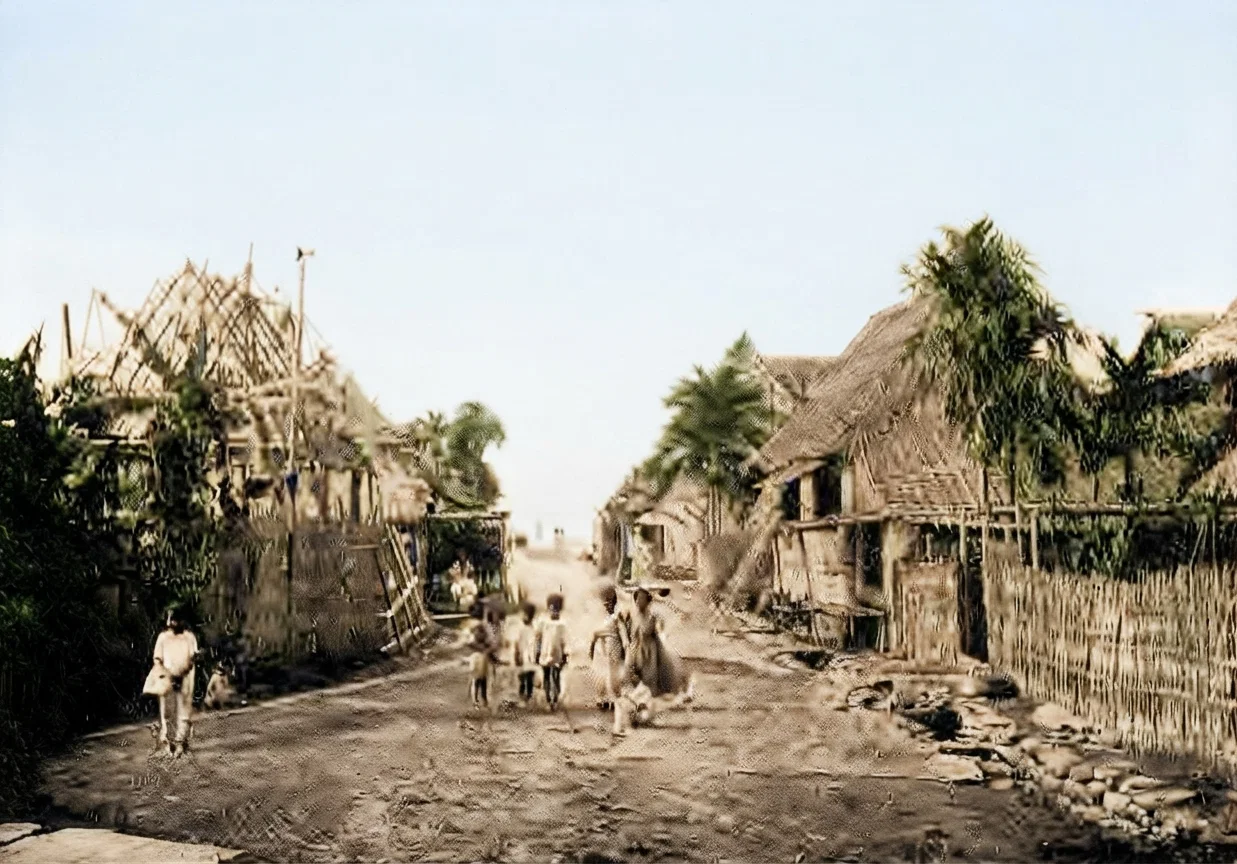
This cut represents a view in Manila, Philippine Islands. Pastor Wilcox' article on this page should suggest to many that in the diffusion and spreading abroad of the Gospel, now is the most opportune time to enter upon the missionary work that needs to be done in those islands.
The amplification of this principle of diffusion is the more clearly emphasized in the Gospel dispensation. It is seen in the sacrifice of Christ. He gave His life a ransom for the fallen race. It is contained in the doctrines He taught His disciples, "Go ye into all the world, and preach the Gospel to every creature." The same truth is taught with respect to the dispensation of means: "Give, and it shall be given unto you." "Sell that ye have and give alms." "God loveth a cheerful giver."
The church at Jerusalem, losing sight of this Gospel truth, or failing to sense the fulness of its significance, became self-centered in their interests. Thus a large church was built up at this center of the work, while other parts of the Roman Empire, and indeed other parts of Judea and Samaria, were left without a witness for the cross. God in mercy permitted the flame of persecution to burst forth, and the disciples in Jerusalem were scattered abroad, and the record is that they "went everywhere preaching the Gospel."
It is needless to cite examples illustrating the operation of these two principles to-day; they are seen in the world everywhere. It is sad to contemplate, however, that the principle of self-interest and concentration operates more strongly and particularly in the affairs of men than does that of diffusion. The hoarding of the millions of the rich, the combination of great monopolies and trusts, the concentration of political power and influence, the formation of society castes, all are indicative of the extent to which the world is governed by selfish ends. But the saddest feature of all is the fact that the principle of concentration has taken such a strong hold in the professed church of Christ.
It is not unnatural to see the world worshiping before the altar of Baal, and spending wealth, and energy, and life for selfish pleasure and gratification. But, in view of all that Christ has done and is doing, there is presented the sad spectacle of the church turning from its solemn duty and blessed privilege, to follow the same course.
Upon the church of God to-day there rests the obligation of the world's evangelization. Especially is this true of the churches of the United States. Ever since our nation was planted, the nations of the world have expected more of it than of any other country. Its professions have been the highest. Its lights and privileges have been the greatest. And so to-day, to America as to no other country, do those in heathen lands reach forth their hands in mute appeal for light and knowledge and truth. True, there is need for Christian work in our own land; but the curse of Christianity in our own country—and this is true of every church, our own not excepted—is the concentration of wealth and membership, such concentration that the churches have become great social organizations where the worshipers meet more for display than for the worship of God. The remedy for these ills would be for the spirit of self-forgetfulness to take possession of the hearts of the believers, and the spirit to reach out and succor those who are in need and distress. The Spirit of Jesus Christ is needed among His people. Nay, if they have not the Spirit of Christ, they are none of His. Rom. 8:9.
At our very border on the south lies Mexico, a country of 12,000,000 people, to whom the true knowledge of Christ is nearly as foreign as it is to the worshipers of wood and stone. A little farther beyond, the States of Central America, of 3,000,000 population, and the great continent of South America, with its 30,000,000 people, present a field for missionary effort in Christian service unequaled in all the world. In fact, so far as Protestant missionary efforts are concerned, the South American field is the most destitute of any mission field on earth.
The following diagram, taken from Regions Beyond, shows the average parish of each missionary working in the countries named:—
In England and U. S., 1 missionary to 800.
“ Madagascar, 1 “ “ 30,700.
“ Burma, 1 “ “ 61,335.
“ Turkey, 1 “ “ 66,122.
“ Oceanica, 1 “ “ 88,334.
“ Japan, 1 “ “ 10,000.
“ Africa, 1 “ “ 140,000.
“ India, 1 “ “ 160,827.
“ Persia, 1 “ “ 187,500.
“ South America, 1 “ “ 227,000.
It will be observed from this that South America is the most needy field in the world so far as missionary effort is concerned.11But, turn where we will, the fields are white. India, with its population of 280,000,000, and China, with its vast population of 400,000,000, furnish unlimited fields for all whose hearts are touched with divine love and the spirit of labor. Some of those fields which in the past have been well-nigh closed to missionary efforts, by the march of time and the turning wheel of Providence, are now open to evangelization. Formerly the States of Central and South America were almost entirely closed to evangelistic efforts. For years Moravian missionaries could gain entrance only to the coast towns of Central America. To-day the entire isthmus is open to the herald of the cross. True, he must contend with a fanatical and bigoted populace, and oftentimes run the risk of losing his life. Africa, which a few years ago was regarded as the dark continent, pathless, unexplored, and unknown, to-day is open from east to west, and from north to south. While its partitioning among the nations of Europe furnished opportunity for the exercise of their avarice, by God’s overruling providence it has opened the way for the Gospel messenger to follow in the path of commerce, and Africa, to-day as never before, is hearing of the Lord Jesus. And now the same influences are at work in the empire of China. We can not approve of the spirit actuating the nations of Europe in the seizure of its ports and the occupancy of different portions of the country, yet God is overruling all of these for a purpose. The Gospel is to go to all the world, and God is overruling these means to provide avenues for its transmission. And, latterly, during the last few months, as the result of the contest between Spain and this country, Cuba, Porto Rico, and the Philippines are open to missionary efforts as never before in their history.
These are some of the magnificent opportunities God is placing before His church to-day. Will His disciples rise in the might and power wherewith God is willing to clothe them, and enter upon the work which He opens before them? Will the principle of diffusion control their lives, or that of concentration? Will their interests be self-centered,—will they seek the life of ease,—or will they enter upon the work to which God calls them, and respond to the appeal His Spirit is now making? God to-day wants men, and He wants money. He wants men and women who are earnest, and willing, and true, and faithful, those who are moved by principle, who are constrained by the love of Christ, who will not falter nor be discouraged tho ten thousand obstacles rise in their pathway, but who, in the strength of Israel’s God, will surmount them by exercising that faith that will conquer the world. And God wants consecrated money to send these consecrated men and women.
The harvest is indeed great, the fields are white. Pray ye therefore the Lord of the harvest to send forth reapers into His harvest, and as you pray, stand in that waiting attitude before Him so that if He calls you to a service of sacrifice you may be enabled to respond with alacrity, Here am I, Lord, for Thee to use as will best meet the glory of Thy cause and serve Thy eternal purpose. Diffusion or concentration, which is the principle operating in our lives and experiences?